
|
A review of the Peugeot 508 in a foreign website:
Quality, purity, efficiency… the Peugeot 508 embodies the Marque’s new expression in the segment of grand touring cars. With the 508, Peugeot continues its international offensive: produced in France for all markets.
With the 508, Peugeot reaffirms its presence and its ambitions in one of its traditional strong suits, the grand touring car segment. Over a period of several decades, every model in the “40X” and “50X” range has left an indelible imprint on its time: due to a unique blend of style, road holding, versatility and robustness.
The 508 is a modern, forward-looking vehicle, perfectly attuned to the aspirations of customers who have moved with the times: demanding, dynamic and responsible. It comprises of two complementary body styles: a Saloon (with a length of 4.79 m) and an SW (4.81 m). Quality, purity and efficiency are the bywords that guided every aspect of the car’s design, offering a multi-faceted appeal to its owners with emotion as its central theme.
Guided by the search for perfectly balanced and streamlined contours, the style of the 508 suggests a vehicle “sculpted from a solid”, reflecting aspirations of elegance, robustness and build quality.
At the front, the 508 illustrates the development of the Marque’s latest stylistic codes first unveiled on the SR1 concept car, with a single grille rendered in a “floating” style and piercing headlamps with a particularly marked visual expression, like its “LED tubes” visible both by day and by night. Similarly, at the rear, three red “claws” mask three rows of LEDs on the Saloon.
The simple and elegant style of the fascia, the materials used, the meticulous finish, the durability and the technologies deployed (colour “head-up display”, four-zone air conditioning, “hands-free” access and start-up…) add to the exclusive ambience of the passenger compartment. Each passenger enjoys a privileged status thanks in particular to the car’s excellent proportions. The boot too, is practical and accommodating, with a generous volume of 545 litres of liquid (515 dm3 according to the VDA standard) for the Saloon. With the seat backs folded (they fold in one easy movement) to form a flat floor, this volume rises to 1581 litres of liquid (1381 dm3 VDA) for the Saloon.
Environmental efficiency was a pivotal concern from the very start of the project with, initially, optimisation of the car’s aerodynamics (a Cx starting from 0.26 and a SCx of 0.60) and a weight reduction compared to the 407 (despite the increase in size and specifications). Under the bonnet, the 508 benefits from engines offering a power output of 156HP.
From the outset, engineering choices underlying the “W2” project (its internal code name) were based on platform 3 of the PSA Group to obtain a particularly refined “architectural efficiency” with:
-a long wheelbase (+ 9.2 cm compared to the 407), and a generous capacity for the rear passengers;
-engineering choices allowing a reduced front overhang (- 4.3 cm compared to the 407) and a longer rear overhang, paving the way for an improved stylistic balance and everyday practicality (with a significantly larger boot volume);
-dimensions, particularly width and height, permitting optimised aerodynamics.
Optimised aerodynamics and weight reduction were key priorities from the very start of the project, in order to ensure the best possible environmental performance. Similarly, a desire to “optimise weight” gave rise to an “upward spiral” benefiting both the car’s fuel consumption and also its passive safety and dynamic performance. Every design element, every technique used, every part of the vehicle was fine-tuned in this sense, a policy which applied to all area of the car’s fabrication: magnesium fascia panel cross member, aluminium bonnet, laser welding of the roof, use of high-strength steel, engine soundproofing at source, etc. Based on like-for-like engines, the 508 weighs 25 kg less than the 407 for the Saloon.
Quality is another key priority of the 508 design brief. It is the result of a continuous search for the best possible quality at all levels, with:
-engineering choices guided by the need for maximum durability, with a determination to provide a vehicle that stays “fresh” for as long as possible;
-a high level finish visible from both outside and inside the car, with an exclusive passenger compartment perceived by occupants as very rewarding;
-completion of a two million kilometre road test under real-life conditions prior to launch;
Finally, the 508 will break new ground in terms of build quality, following on from the most recent product launches where this aspect has been demonstrated and acknowledged. One of the direct consequences targeted by this approach is a reduction in the “total cost of ownership (TCO)”, a decisive factor when buying a vehicle in this segment, particularly for corporate fleets.
The design of the 508 is guided by the continuous search for perfectly balanced and elegant contours. The contours of the Saloon are free-flowing, without break, interruption or embellishment, from the end of the bonnet to the boot. No ostentatious elements or add-ons are permitted (no windscreen wiper jets, no visible aerials, etc): all surfaces are flush-fitting, with clearances between each element precisely determined to obtain optimal build quality. The overall effect suggests a vehicle “sculpted from a solid”, refining the sense of elegance, fluidity and build quality.
At the front, the 508 shows the development of the Marque’s underlying stylistic codes, reinterpreted to reflect ideas brought to fruition on the most recent concept cars (particularly the SR1). This visual identity, strong and always recognisable, is even more suggestive of power, refinement and technological modernity.
At the end of the long aluminium bonnet, the new Lion identity takes its place naturally at the lead of the bonnet contour. Underneath it, the characteristic single grille takes on a new dimension. It sets the tone for a front grille rendered in a ”floating” style, seemingly detached from the body. This effect is created by the chrome edging, which becomes less pronounced under the “nose” of the bonnet to proudly reveal the branding of “Peugeot”. The piercing expression of the headlamps was also a focal point of stylists. Their interior design is a blend of chromium plated and frosted surfaces. On versions with directional bi-Xenon headlamps, “LED lighting tubes” are visible, each with seven electroluminescent diodes. This gives the car an immediate visual signature, visible from afar on the road both by day and by night. Halogen headlamps are also available as, they adopt a new high-performance and compact “Neo” technology, with a series of lenses bearing a resemblance to cat’s eyes.
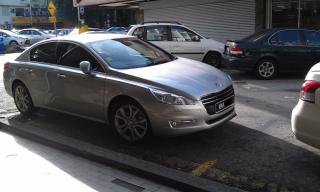
The sides of the car are purposely understated, enhanced by the contours of the chrome-edged windows (availability according to trim versions). Visually, the side windows appear to rest on a sculpted body section, itself no mean feat of industrial engineering: a recessed waistline runs the entire length of the vehicle, giving it an unusual blend of power and elegance.
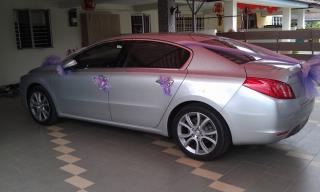
On the Saloon, the entire rear section is designed in one form, the boot perfectly flush with the bumper creating an impression of fluidity, power and control. A horizontal chrome bead on the boot enhances the rear aspect, parallel to the chrome edging at the base of the diffuser which visually “seats” the rear of the car.
A visual characteristic of Peugeot’s heritage is also particularly marked at the rear of both body shapes. On the Saloon, three red clusters mask three rows of 6 LEDs to give the car a unique night-time signature.
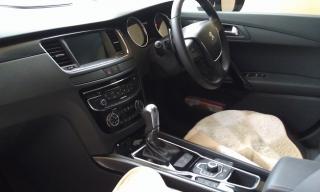
The fascia follows to a large extent the stylistic elements of the car’s exterior design: quality, purity and elegance. The design minimises clearances between the constituent parts of the fascia, helped in particular by a multiplexed centre console featuring technology that overcomes the traditional constraints of “ISO” sized equipment. The materials, meticulous finish and studied durability appeal to all of the senses of the car’s occupants: the texture of the top of the fascia, the different decorations, the black lacquered centre console, and touches of chrome… the overall effect is one of refinement and advanced technology free of ostentation.
This extremely rewarding in-car ambience blends refinement and technology with high-tech equipment that enhances the enjoyment of both driver and passengers. A colour “Head Up Display” (with satellite navigation screen), four-zone air conditioning, “adaptive main beam”, “hands-free” access and start-up, automatic electric parking brake, JBL hi-fi equipment.
This ambience is also the result of much work carried out on acoustics and vibration damping. For example, by tracking down noise to its source (acoustic “encapsulation” of power trains), the level of quietness in the passenger compartment is among the best in any category, while this approach also contributed to the vehicle’s weight reduction.
An acoustic front windscreen as standard (to filter noise from outside) and an active damper on the front axle (to reduce engine vibration) are additional elements contributing to the noise reduction comfort of the occupant compartment worthy of a higher segment vehicle.
In terms of practicality, the choice of a particularly efficient architecture allows for a very generous capacity and boot.
Dedicated space
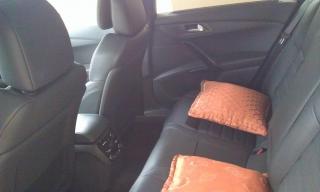
Each passenger enjoys a privileged status, with generous space coupled with dedicated equipment (four-zone air conditioning includes the rear passengers, adjustable seat cushion for the driver and front passenger). Interior dimensions are on a par with those of the 607, i.e. much improved in relation to the 407 (5.3 cm more space between the knees of the rear passenger and the front seat). As a result, two people well over 6 feet tall can be comfortably seated one behind the other.
Generous boot
The boot on the Saloon opens by means of a self-actuating lever (by pressing the plip, a button on the fascia or the “0” of the external badge of the 508. The luggage compartment is practical (solid hooks, luggage net, housing for warning triangle), accommodating (with its strictly parallel-piped shape) and above all extremely spacious. The boot of the 508 has a capacity of 545 litres of liquid (515 dm3 according to the VDA standard) for the saloon.
The 508, according to its equipment level, can offer storage space of up to 22 litres. It has large front door pockets each with a total volume of 4 litres (which can therefore hold a 1.5 litre bottle), rear door panels (able to accommodate a 0.5 litre bottle), a glove box (capacity 9 litres), a storage space under the central armrest (2 litres) and many other “hideaways” according to the level of finish (flap under the steering wheel, closed storage with flap on the centre console, etc).
The 508 benefits from a colour head up display which projects essential driving information from the rear of the instrument panel visor onto a glare-proof translucent smoked polycarbonate panel. The driver thus has access to information concerning speed, cruise control / speed limiter speeds and satellite navigation instructions. In addition to the convenience afforded to the driver on all journeys, long or short, this system offers real benefits in terms of primary safety (no need to take your eyes off the road, immediate focus on the view between the road and the panel). The inclination of the panel and the brightness of the projected information can be adjusted by means of buttons located in the retractable flap to the left of the fascia panel. The panel can also be retracted using these control buttons. The 508 therefore brings to a wider audience a function hitherto unavailable in its segment with a system that locates all information optimally on a dedicated surface.
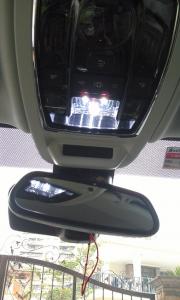
For the convenience and safety of its passengers and also other cars, the 508 is equipped with the Adaptive Main Beam system which, via an intelligent camera positioned at the back of the rear-view mirror, continuously analyses driving conditions (approaching or following vehicles, brightly lit urban areas, etc) and automatically switches quickly from dipped to main beam and vice versa according to traffic. This equipment is connected to the directional bi-Xenon headlamps.
Directional bi-xenon headlamps with LED signature
Xenon headlamps cast a pure white-bluish light with three times the flux of a standard lamp, thereby improving night driving. Their elliptical module includes a shutter frame to ensure dipped and main beam functions. They are equipped with a directional function which improves vision in corners for safer and more convenient night driving. This function is linked to vehicle speed and adapts to different driving conditions between 5 km/h and 160 km/h. On the 508, these headlamps are systematically coupled with “LED tubes” to provide a visual signature both by day and by night.
neo© halogen headlamps
The “classic” headlamps of the 508 benefit from a new technology called NEO© (New Efficiency Optics). With this system, the light flux of the halogen bulb is around 30% more efficient: more uniform, more intense, more far-seeing… for enhanced visibility and safety. In addition, it allows for an original stylistic integration in the headlamp, with a lens visually evocative of a cat’s eye.
Static directional lighting
Static directional lighting, as standard on all 508s with either bi-Xenon or halogen headlamps, optimises lateral visibility at low speeds (less than 40 km/h) in urban areas, at intersections, during parking manoeuvres, on winding roads… The light beam from one of the two fog lights illuminates the inside of the corresponding bend, according to the angle of the steering wheel or use of the direction indicator.
Ambient lighting
According to the level of finish, the interior ambience of the 508 is bathed in a soft glow emanating from the courtesy light, the footwells and front and rear door cappings… and even when getting into the vehicle (LED spotlights on the door mirrors, door sill lighting…).
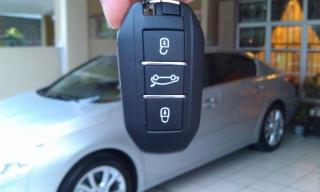
The “hands-free” access and start-up system, available according to the chosen level of finish, replaces the mechanical key with the magic of electronic recognition. By keeping the “electronic key” in their pocket (or handbag), users can enter the car (detection from
1.8 metres), start-up and stop their 508 simply by pressing the Start/Stop button. When getting out of the car, simply brushing a hand over one of the handles is enough to lock the vehicle. If this electronic key is accidentally left inside the vehicle then evidently the car cannot be locked. And if its holder leaves the vehicle with the engine running, the key immediately signals this with an audible warning.
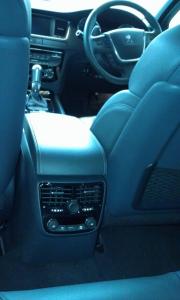
Air conditioning comes as standard on all models and, according to levels and settings, can be: manual single-zone or automatic dual- or four-zone. The latter, a new level of specification in this segment, allows each of the vehicle’s occupants to control the temperature setting, air flow and distribution via their own air conditioning control thereby benefiting from optimal, personalised comfort. Regardless of the level of finish, rear passengers have dedicated air vents. With the four-zone function, an additional blower takes over from the main air conditioning unit to ensure the air flow of the rear blowers and efficiently meet each passenger’s requirements by differentiating the temperature in all 4 zones. Furthermore, with this four-zone system the front passengers can choose between three temperature alignment modes using the “auto”, “soft” (more gentle air flow) or “fast” (more powerful air flow) buttons.
Available as standard, the electric parking brake makes driving even more convenient: when starting-up, the hand brake is released automatically as soon as the driver starts to accelerate. When the engine is switched off, the brake is activated, again automatically. If the vehicles stops without the ignition being switched off, the electric control, located within reach of the driver’s left hand, can be activated manually. Manual release requires one foot to be on the brake.
All 508s, regardless of their power train, are equipped with the Hill Assist system. When positioned on a gradient, this function keeps the vehicle immobile for around two seconds after the brake pedal has been released. This makes manoeuvres safer and facilitates use of the vehicle by the driver in forward gear (hill start) and reverse (accessing a downhill parking space for example). The system operates from a gradient of 3%. The ESP then temporarily maintains braking pressure, giving the driver time to lift his foot from the brake and onto the accelerator.
The WIP Sound MP3 CD dual-tuner audio system is systematically combined with a jack socket and USB connector in the armrest to connect a digital walkman (the USB connector is also iPod, iPhone, USB flash drive compatible). It can have a Bluetooth function allowing the user to make “hands-free” phone calls and listen to streamed audio music. The system comes with 6 speakers on the “Access” level of the range:
- 2 tweeters in the upper part of the front door panels,
- 2 165 mm diameter speakers (25 W) in the front door panels, Woofer with Neodyme magnet,
- 2 165 mm diameter “wide band” speakers (25 W) in the rear door panels. The latter 4 speakers use “Coscone” flat speaker technology patented by Denon and Marantz Premium Sound Solutions, making them lighter and more compact.
On the rest of the range, 8 speakers are associated with WIP Sound and WIP Nav Plus, with in addition 2 rear tweeters in the upper part of the rear door panels.
The 508 features a new generation satellite navigation system called WIP Nav Plus which offers numerous functions:
-large 7’’ 16/9 display (WVGA high resolution 800x480 pixels) with perspective view,
-European cartography (stored in the internal memory),
-MP3 compatible front-mounted CD player,
-three-tuner radio with 2 aerials for optimal reception of radio frequencies
-Bluetooth® connection for the hands-free telephone function and audio streaming (music from a smart phone played through the speakers),
-Jack socket and USB connector, to connect any type of digital audio walkman devices (the USB connector is iPod, iPhone and USB flash drive compatible),
-information concerning speed limits in force on major roads,
-risk areas covered by automatic fixed radar surveillance
The Arkamys software featured on the WIP Sound and WIP Nav Plus systems processes the digital audio signal to recreate a natural acoustic ambience. Sound quality no longer suffers from the constraints of speakers being positioned in doors (often resulting in a concentration of sound low down and to the sides): instruments and voices are more harmoniously positioned in space, head-on to the passengers at windscreen height. This system can also be adapted to favour listening for the driver only or for all passengers.
the jbL™ hi-fi system
For discerning music lovers, the 508 offers a JBL™ system with 10 speakers coupled with a 10-channel 500 W surround-sound amplifier. For these 10 speakers, a central channel in the middle of the fascia panel allows optimal sound distribution in the passenger compartment. The JBL™ system includes:
-4 high-power (50 W) 165 mm diameter reverse motor neodyme speakers, 2 in the front doors and 2 at the rear,
- 2 hi-fi tweeters in the upper part of the front door panels,
- 2 hi-fi tweeters in the upper part of the rear door panels,
- 1 central channel in the upper mid section of the fascia panel,
- 1 150 W triple coil bass woofer in the right side boot trim.
More technology that makes day-to-day driving easier: a system that measures available space and lets the driver know the possibility or difficulty of parking in a free space. This function, coupled with front and rear park assist, can be activated via the “>P<” button located on the centre console. It is coupled with the direction indicator and operates at speeds of less than 20 km/h.
The 508 has many more technological refinements to enhance its exclusive driveability:
-length-adjustable seat cushion for the front seats, offering more comfort to taller drivers,
-lumbar massage on the driver’s seat,
-multi-function steering wheel, both practical and technological, to facilitate access to different functions,
-cruise control / speed limiter with the possibility of storing up to 5 speeds for both functions,
-adjustable colour instrument panel matrix, polyphonic warning signals…
Another important innovation: the impeller of the variable geometry turbocharger is now made of titanium, a very lightweight material which reduces the turbocharger’s inertia for greater availability of engine torque, particularly at mid-range engine speeds, and therefore better responsiveness of the vehicle.
Particular attention has also been paid to the car’s acoustics. As well as the engine’s two counter-rotating balancing shafts, the design of its injection system (and its control) to ensure a more subdued engine noise.
Again to reduce fuel consumption, the “voltcontrol” system removes load from the alternator during acceleration, while it can recharge the battery during deceleration. This allows a saving of nearly 5 g/km of CO2. In another optimization, a reduction of engine idle speed (to 700 rpm instead of 820 rpm) ensures a further saving for the user in terms of day-to-day fuel consumption.
Lastly, the overall weight of the engine has been reduced by nearly 5 kg compared to the DW12B, further contributing to the car’s overall efficiency.
In addition to its engine, the 508 incorporates yet another innovation: a new generation 6-speed automatic gearbox, the «AM6». Still developed with the company AISIN AW according to specifications prepared by the PSA Peugeot Citroën Group, this AM6 has been re-engineered from top to bottom to significantly reduce CO2 emissions while favouring dynamism and driveability due to the enhanced rapidity of gear changes.
The new AM6, capable of withstanding a maximum torque of 450 Nm, features several of the technologies which appeared in 2010 on the new “AT6” 6-speed automatic gearbox coupled with the 1.6 litre THP 156 engine on a number of models (including the 508).
To limit the vehicle’s fuel consumption and CO2 emissions, numerous techniques have been employed, particularly to achieve significant reductions in friction losses: bearings, segments, clutch linings, special oil, and a new converter making it possible to drive at low engine speeds... Similarly, gear change patterns in «drive» mode are calibrated to optimise fuel consumption while ensuring the convenience associated with an automatic gearbox.
In the final reckoning, 13 g/km of CO2 have been saved with this new generation AM6 gearbox. Gear change times have also been optimised to ensure rapid acceleration, for example due to the adoption of a direct controlled hydraulic block and an electronic strategy optimising multiple downchanging. In “Sport” mode, a specific calibration improves the rapidity of gear changes by a further 200 ms compared to the “drive” mode.
In sequential mode, the driver has paddles under the steering wheel (as is the case on all automatic gearboxes and the electronically-controlled gearbox on the 508) for enhanced driving enjoyment. What’s more, these paddles can be used at any time by the driver, even in Drive position. The gear lever’s sequential control also allows manual gear changes by impulse pressure (“-” forward and “+” rearward).
The rack and pinion speed sensative electro-hydraulic steering continuously adjusts the effort required, and facilitates manoeuvres at low speed. It fully reflects the Marque’s expertise; precise and informative, and corresponds to two driving styles according to the expectations of their respective customers.
Braking is designed to match the dynamic qualities of each 508. At the rear, the entire range has 290 x 12 mm discs. All 508s come with latest-generation ESP which includes CDS (stability control), AFU (emergency brake assist) and REF (electronic brake force distribution). The ESP also includes Hill Assist and intelligent traction control, which improves the vehicle’s ability to move off and be driven on slippery road surfaces by authorising more or less wheel slip on each of the front wheels.
The 508 benefits from a high level of primary safety, due to its road holding and equipment specification (Head-Up Display, directional bi-Xenon headlamps, fog lamps with static directional lighting, adaptive main beam, etc).
The car is also designed to offer a level of secondary safety among the best in the segment. Its collapsible structure includes high-performance shock absorbers on the front beam, which also allows a reduction in the length of the overhang. Once again, safety benefits significantly from reductions in the vehicle’s overall weight. The 508 is equipped with efficient means of restraint: 2 front air bags (45 litres for the driver and 80 litres for the passenger), 2 side front air bags (each 18 litres), 2 curtain air bags (each 30 litres), five 3-point seat belts (with pretensioners and force limiters at the front, force limiters for the rear side seats) and 2 Isofix fixtures with 3-point attachments in the rear side seats.
The front seats have new “curved” head restraints with integral multi-position adjustment (no fixed intervals in the stems allowing perfect adaptation to each user) whose shape has been carefully studied to take into account the effects of rear collision (whiplash).
|


 Oct 23 2011, 01:59 AM, updated 14y ago


 Quote
Quote







 Agreed with you..
  But there will be CKD Version of Passat.. maybe TS can wait longer?










 Already registered with WWA xxxx plate







 . Anyway always take car advice with a pinch of salt. You never know the agenda some people might have.




 I love the voice control thing on both mondeo and s-max. Can Understand our voice well.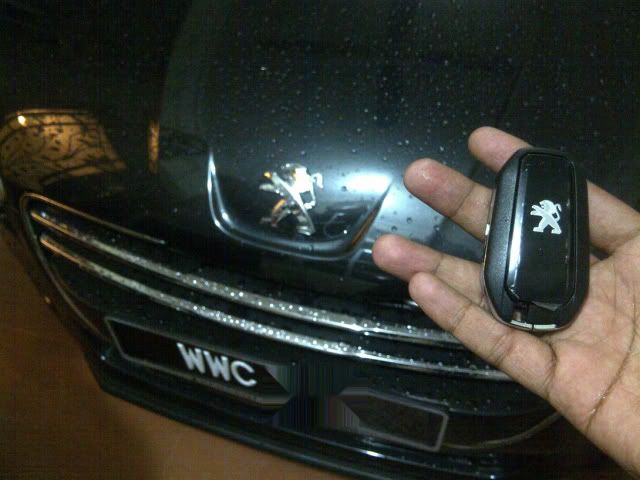





 .
. 







 0.2160sec
 0.31
0.31
 7 queries
 GZIP Disabled