Some reading material I came across. Hope you find it useful.
» Click to show Spoiler - click again to hide... «
Every club has its legends, its myths, its curious traditions. But it’s a very short list that can compare to the legends of Liverpool Football Club. The managerial genius of Bill Shankly and the Boot Room, the most famous football song in the world, the passion of the Kop, the tragedies of Heysel and Hillsborough and the enormous vision of a Liverpool pub owner. Let us begin...
The Origins
Liverpool FC are one of the rare examples of a club built to fit a stadium rather than a stadium built to fit a club. Its origins actually begin with cross-town rival Everton who for a number of years had played at the Anfield Road stadium in the city’s Stanley Park. The stadium was owned by John Houlding, a local brewer, politician and member of Everton. Tensions developed over this scenario within the club over several years as Houlding urged the club to purchase the ground from him outright, believing the sale would be beneficial both to him and the club. A substantial majority of members felt otherwise and in the spring of 1892 ended their tenancy at Anfield Road and purchased land along Goodison Road on the north side of Stanley Park.
Houlding now had himself a stadium but not club to fill it. Backed by a small number of dissident Everton members he decided to form a new club, founded on March 15, 1892 as Liverpool Football Club. Unlike Everton (a district within the city) his ambition was city-wide, even adopting the city’s official red and yellow colors and incorporating the Liverbird within the club’s emblem. After an initial and successful season in the local Lancashire League, Liverpool joined the Football League for the 1893-94 season.
The Kop
The southwest stand of Anfield Road stadium has come to be known as the Kop, the supporters who inhabit it Kopites. This curious nickname dates back to the turn of the century Boer War between the English and the independence-minded Boer Republics. One of the most important battles of that war was the battle of Spion Kop. To commemorate the battle, a number of English football terraces came to be named after the Kop. And the description was rather appropriate considering that the Kop was basically a large hill and many of the early terraces behind the goal were little more than grassy mounds.
Although Liverpool cannot stake claim to the first Kop, theirs is certainly the most famous and this is mostly due to the extraordinary circumstances of Merseyside 1960s. While cheering and the occasional singing at English football matches was nothing new, the spontaneous, collective songs of the masses in the Kop was something never before seen. Beatles songs were a particular and obvious favorite, though so many of the pop hits of the day got their due, most importantly Gerry and the Pacemakers "You’ll Never Walk Alone". While often straightforward renditions the lyrics were just as often given a Liverpool slant, establishing a tradition that has been copied throughout the world.
You’ll Never Walk Alone
Of all the songs that the Kop would sing, and of all the football songs around the world, the most famous is "You’ll Never Walk Alone". The song dates back to the Rogers and Hammerstein musical Carousel but its relevance to Liverpool supporters resides in the 1963 recording by Gerry and the Pacemakers. At that time the band rivaled the Beatles in Liverpudlian support and the song quickly reached #1 in the UK and was just as quickly adopted by the Kop.
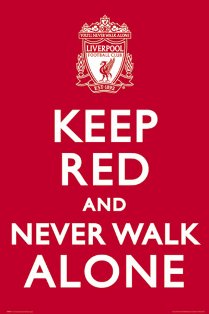
The song has been picked up by a number of other clubs around the world, the most significant being Glasgow Celtic. But its importance to Liverpool and centrality as a club symbol is unequaled elsewhere. It has gained particular poignancy after the tragedy at Hillsborough and has come to mean something more than just success on the field, but a recognition of the highs and lows in life and the collective belief and fraternity of the Liverpool supporters.
Walk On
Walk On
With Hope
In Your Hearts
And You’ll Never Walk
Alone
You’ll Never Walk Alone.
Heysel and Hillsborough
These twin stadium tragedies scarred the collective Liverpool consciousness like few other clubs have ever been scarred. By the mid-1980s deaths at football matches was sadly nothing new. Dilapidated and overcrowded facilities, combined with certain sections of supporters bent on violence had led to an increasingly poisonous atmosphere at football matches in England and in particular when English football clubs played abroad. Football and police authorities on the continent were often woefully unprepared for the chaos English supporters could bring and this combination reached its horribly predictable zenith at the Heysel Stadium in Brussels on May 29, 1985, site of that season’s European Cup final between Liverpool and Juventus. Before the match, a group of Liverpool supporters charged their rivals, a wall collapsed as the Italians tried to escape and 39 people were killed in the ensuing crush.
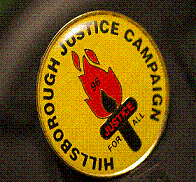
Four years later Liverpool were involved in another tragedy. While considerable blame for Heysel can be placed on the hooligan element within Liverpool’s supporters, the Hillsborough tragedy is largely the responsibility of the incompetent, callous and virtually criminal football authorities and local police. A trail of terrible decisions on that day led to an enormous crush of people an already overcrowded Leppings Lane End. The lengthy amount of time it took before the extent of the crisis was realized and the terribly cramped conditions resulted in 96 deaths. It remains the deadliest incident in English football.
The aftermath of Hillsborough has been a pair of interesting and not exactly harmonious developments – the money-spinning all-seater stadium and the rise of the independent supporters club. The Taylor Report, commissioned to investigate the disaster, recommended the end of the terraced sections and the introduction of all-seater stadiums in British football. The transition was duly made and the costs passed along to the long-suffering supporters, many of whom have gradually been priced out of attending matches. Instead of a very cheap day out for the English working class, attending a football match has become a middle-class staple and the English clubs have become some of the wealthiest in the world.
Simultaneously, a group of football supporters organized themselves to become an advocacy group both within the game and at the political level. Hillsborough became a turning point for many supporters began to push for their rights within grounds and even within the running of their clubs. Combined with the rise of football fanzines and later the internet, the voice of the supporter finally began to make itself heard.
Bill Shankly
Bill Shankly took the reins at Liverpool in 1959, a time in which Liverpool were mired in the old Second Division, the club in shambles. Shankly took control and during his fifteen years in charge brought Liverpool back to the pinnacle of English football and set the stage for the phenomenal success in Europe. He developed what became the trademark Liverpool way of playing in its period of greatest success - keep it simple, on the ground, pass-pass-pass. He was a legendary motivator of players, endlessly talking down the opposition and boosting up his own players confidence. He had a unique bond with Liverpool supporters, his own-working class upbringing helping him to understand the devotion they brought and the effort they demanded. And he was, above all, a quotable machine. Here are a few of his greatest gems.
Shankly famously said about the offside law, "If a player is not interfering with play or seeking to gain an advantage, then he should be."
Football is a simple game based on the giving and taking of passes, of controlling the ball and of making yourself available to receive a pass. It is terribly simple.
I was only in the game for the love of football - and I wanted to bring back happiness to the people of Liverpool.
Someone said "football is more important than life and death to you" and I said "Listen, it's more important than that."
The Boot Room
Somewhere deep in the bowels of Anfield Road there was a room where the players’ boots were stored. A tradition was begun from the beginnings of Bill Shankly’s tenure as manager for the coaching staff to gather there for a cup of tea after matches or training, to discuss the match, the team and football in general. Over time the Boot Room came to symbolize a tradition within Liverpool of building from within. Younger members of the coaching staff were given a footballing education here, in discussions that must have been extraordinary. When the time came for the managerial torch to be passed the new gaffer would have a wealth of knowledge and experience to build on from these Boot Room chats. From Shankly to Bob Paisley to Joe Fagan, and later Ronnie Moran and Roy Evans, the tradition of collective institutional knowledge helped guide Liverpool to success after success. Even Kenny Dalglish and Graeme Souness, though not raised in the Boot Room per se, understood its importance and value. The mythical boot room did not disappear altogether until the 1990s and Gerard Houllier and Rafa Benitez.
Added on March 30, 2011, 1:12 pmA little something on The Kop.
QUOTE
It's as if the spirit of no surrender first shown by those brave Liverpudlians in battle had become synonymous with synonymous with
adjective equivalent to, the same as, identical to, similar to, identified with, equal to, tantamount to, interchangeable with, one and the same as the vociferous spirit of those who have manned it through the decades to make it the most famous football stand in the world .
This is epitomised by the Kop's anthem You'll Never Walk Alone. Sung at the climax of Roger and Hammerstein's classic movie musical Carousel, it's a song about united strength and fighting on together against all the odds.
It became Liverpool's rallying call after the song became Gerry and the Pacemakers' record-breaking third consecutive number one hit in October, 1963.
This marked something of a watershed period in the history of the Kop.
Before then it had always been 100 concrete steps, 394 feet long, 135 feet wide and standing 50 feet high. It was a heaving seething mass of humanity ebbing and flowing like a great wave of flesh and blood against the crash barriers cheering on its home team. But they already shared this feature with a myriad number of other British football club terraces.
In the 1960s, however, with an adopted anthem, a charismatic team of exciting young stars such as Roger Hunt, Tommy Smith and Ian St John and the galvanising influence of one of the most iconic managers of them all, Bill Shankly William "Bill" Shankly, OBE (September 2, 1913 – September 29, 1981) was one of Britain's most successful and respected football managers.
Others in the game recognised this, including that wise old Shankly contemporary the late Joe Mercer.
QUOTE
He once said: "From the moment he arrived, there was only one way - and that was up. This endless success was mirrored in that amazing relationship with the Kop.
"When he was at Anfield he was the city of Liverpool's answer to vandalism and hooliganism, because the kids came to see Liverpool. Shankly was their man, their hero, their football god. He belongs to the Kop, he's one of them.
"If he hadn't managed Liverpool, I'm sure he would have been on the Kop dressed in red singing and chanting 'Liverpool, Liverpool'."
Many know just how true this is. He may have stepped down as manager but he never stopped being a fan. After he had retired, we were playing a home game. A reporter who we present noted that chants of "Shankly! Shankly!" started to erupt from The Kop. Low and behold, the great man had bought a ticket and stood at the Kop as any fanatic would. When asked what he was doing there, he said, "this is where I belong".
QUOTE
This ability to connect with the hopes and dreams of the fans to make them feel important - that they were what Shankly always referred to as The Twelfth Man -was a mantle taken up by subsequent Liverpool managers including the latest, Rafa Benite z.
Kopites know that through the wind and the rain their support is always expected - and respected. They respond in kind.
Many thought with the demise of the old terraced Kop, to be replaced by seating in 1994, that the spirit of old would be wiped out. Its golden age od power has diminished, certainly - but the very nature of the seating structure was always bound to do t h at .
None of the fanaticism or never say die has, though - if anything, it has permeated throughout the whole ground, with Anfield Road and Main Stands now having their own little hot-spots of support.
QUOTE
Anyone who believed that the essence of Kop spirit had been lost only had to be in Istanbul last year at half time when the Reds were three-nil down to AC Milan in the European Champions League Final.
With victory a near impossibility, the low murmur of You'll Never Walk Alone grew to a defiant roar to lift a team whose ultimate victory will go down in footballing legend.
The Twelfth Man had scored its ultimate winning goal.
Still brings a tear to my eye. Those who haven't seen a video of this, need to. The wind was bellowing, the camera picked up on it. Scarves, banners and flag were rippling but there was an eery silence as Liverpool fans had resigned themselves to defeat. 3-0 down against the might of AC Milan. We had been outclassed and outplayed. It is true that we did not play our best football on the day but Shankly was said that if we cannot outplay our opponents, we will outrun them thus his emphasis on fitness. He himself kept well fit, giving up smoking and drinking. From the deathly silence came a low, almost morbid sound. One by one, fans started signing "You'll Never Walk Alone" probably in defiance more than in hope. The signing grew louder and louder. The lads heard it in the dressing room and their spirits grew. Fans had travelled hundreds of miles to watch the team get humiliated in the first half of play and still, they sang. Still, their support never waned. Still, the fans told the players that they would always be with them. What happened next turned out to be one of the biggest comebacks in sports history.
Rivals may mock us for not winning as many titles, or our anthem (e.g. You'll Never Win Again) but they can never take away our faith. It is why I keep reiterating how important is it to live by what we say, especially when we tell someone that they will never walk alone. It isn't words to be uttered losely. The power in those words alone, brought our boys back from the dead in Istanbul.
QUOTE
And away from home too.
With a ground move possibly looming, Kopites should remember this and walk on with hope in their heart
This post has been edited by Duke Red: Mar 30 2011, 01:13 PM 

 Mar 20 2011, 04:16 PM, updated 15y ago




 Quote
Quote
 )
)





















 In-FARKING-credible.
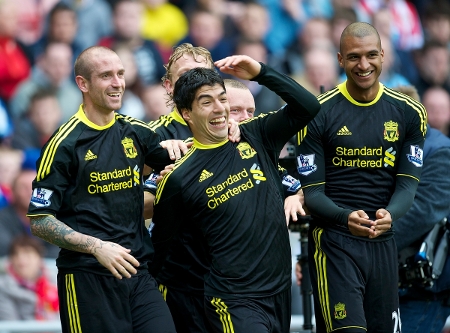
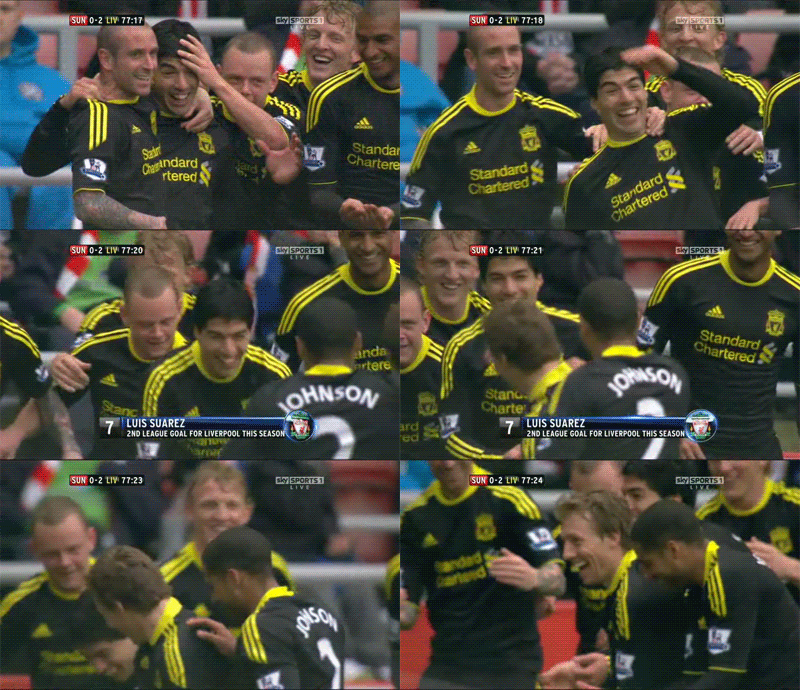









 I believe those two came here knowing that a chance of CL football is slim at the moment. But I'm sure they also know that Liverpool is moving forward and will have a bright chance to win the EPL and claim a CL spot in the following season.











 0.1708sec
 0.74
0.74
 6 queries
 GZIP Disabled