Welcome Guest ( Log In | Register )

389 Pages « < 357 358 359 360 361 > » Bottom

Outline · [ Standard ] · Linear+

 Insurance Talk V7!, Your one stop Insurance Discussion

views
     
Ramjade
post Apr 26 2025, 06:44 PM

20k VIP Club
*********
All Stars
24,380 posts

Joined: Feb 2011


QUOTE(MUM @ Apr 26 2025, 05:26 PM)
I just checked my old received repricing letter.

They did provides some info.
Just not sure what those info can help a new potential customers in determining which insurance companies to choose to buy a new plan or help an existing policy holder's to determine if he should cancel it or change to another company.

I did not bother with the repricing reason, ...I just continue to pay as asked, since I can still afford it, and the feeling of the need of that coverage which I think I needed it.

If I am buying a new plan, I still don't bother with the repricing reasons as I know it is a constant increasing things which does not just happens in Malaysia. Even a strong governance country like Spore are facing this issue too.

I strongly beliefs,
It is either you buy or continue to keep or you can do the opposites..... the insurance companies don't bother.

Average medical inflation is 5.3% pa, yet the premium increase is 25%. Luckily it is not every year premium increase 25%, and luckily BNM said no more than 10% until, ....
But hor, .... I just checked my last month cc bill. ...
Billed RM4,656, that is another 35.58% from last year of RM3434
*
Of course insurance company don't bother. They will still be making money at the end of the day. Join them as shareholdee. Can buy OCBC to get exposure to GE or buy AIA directly. Then you will feel happy everytime they are repricing cause your companies are working for you.
MUM
post Apr 26 2025, 07:13 PM

10k Club
********
All Stars
14,929 posts

Joined: Mar 2015

QUOTE(Ramjade @ Apr 26 2025, 06:44 PM)
Of course insurance company don't bother. They will still be making money at the end of the day. Join them as shareholdee. Can buy OCBC to get exposure to GE or buy AIA directly. Then you will feel happy everytime they are repricing cause your companies are working for you.
*
Also hospitals and retirement homes (reits) ....
And if can, join as shareholders in those funeral process operation business too.

Ha ha ha.

hafizmamak85
post Apr 26 2025, 07:30 PM

Casual
***
Junior Member
463 posts

Joined: Nov 2009

QUOTE(hafizmamak85 @ Apr 26 2025, 06:08 PM)
user posted image

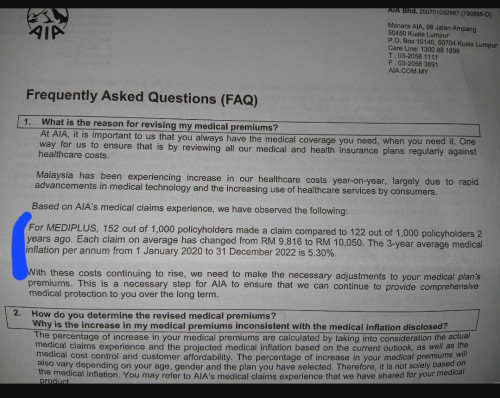
Well, well, well. Would you just look at that. AIA's Mediplus has a MASSIVE claims frequency of 152 per 1000 but only an average claims size of RM 10.1k.

I wonder what in the world could have caused this???? Such a high frequency, but only a miniscule average claims size of RM 10k.

Could it be due to AIA's claims philosophy of allowing huge numbers of small medical claims such as for pneumonia, influenza, bronchitis outpatient treatments - so that more insurance consumers get to "feel" the benefits of holding an insurance policy - while denying or delaying a significant number of large claims at the same time.

High time the four champion horsemen of the apocalypse: IHH, KPJ, Asia Onehealthcare, Sunway, make their move by collaborating with digital insurers and takaful operators. They should outsource all these small claims to their GP and other specialists networks and shift their focus to more complicated or higher end care cases.

Using Dr Gunalan's hospital bill size distribution example below, and assuming only an 8% claims frequency, we can easily deduce that the average claims size in a hospital setting should be around RM 25.6k.
*
Clearly, AIA, GE, Pru and the rest of the kootus are not working with the best interests of Malaysians in mind. They're looking to bleed you dry, so please bleed them out first.

So, what exactly are these “small, less than RM 10k claims”?

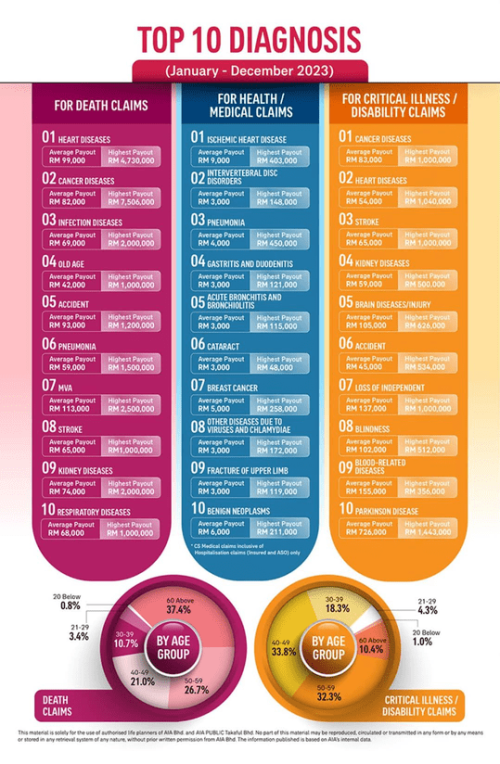
We can examine this AIA chart on the top 10 diagnoses for health / medical claims, between January and December 2023, floating around in Facebook, to get a handle on it.

For ease of analysis, the top 10 will be split into two buckets, the first with what can be considered serious or major health conditions, let's call this bucket A, and in the second bucket, bucket B, with what could be serious, but are generally non-life threatening conditions.

There are only two conditions within the top 10 that could fall comfortably under bucket A, and that would be ischemic heart disease and breast cancer.

What’s really surprising is that the average claim payouts, assuming these payouts are per life insured per diagnosis, for both these diseases are less than RM 10k - RM 9k for ischemic heart disease and RM 5k for breast cancer. Understanding this would solve half the small average claim size puzzle.

In bucket B, we have the usual suspects, respiratory tract infections; gastrointestinal inflammations; non-cancerous growths or lesions; fractures / orthopedic trauma; infectious diseases; cataracts and other eye disorders.

Again, all conditions within bucket B also have average claim payouts less than RM 10k - in fact, it's mostly less than RM 5k. Serious cases for bucket A would likely have an average of over RM 50k and for bucket B, the serious case averages would in general be between RM 10k and 50k.

So, why aren’t the average claim sizes much higher then? How is it possible for 7 out of the top 10 diagnoses to have less than RM 5k payout averages?

user posted image

This post has been edited by hafizmamak85: Apr 26 2025, 11:59 PM
hafizmamak85
post Apr 26 2025, 07:47 PM

Casual
***
Junior Member
463 posts

Joined: Nov 2009

QUOTE(hafizmamak85 @ Apr 26 2025, 03:07 PM)
user posted image

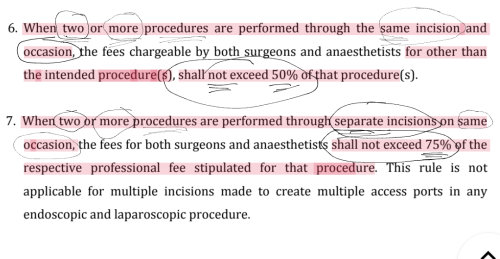
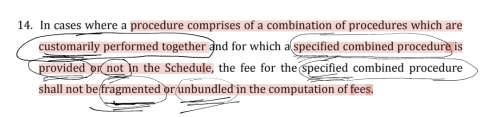
Why is fragmenting/unbundling still a big issue if the law does not allow for it???

user posted image
*
KKM can't even address the issue of schedule 13 non adherence, BNM can't even protect consumer rights and Anwar Ibrahim says, "I welcome continued discussions with agencies such as the Securities Commission, Bank Negara Malaysia and the Ministry of Digital to explore ways to facilitate and promote responsible innovation," while having discussions with convicted Binance CEO, Changpeng Zhao (CZ).🤦🏾‍♂️🤦🏾‍♂️🤦🏾‍♂️

Malaysia Boleh!!!

And now the government wants to develop basic health insurance and takaful products utilizing a DRG payment model without amending schedule 13 or addressing schedule 13 non adherence (unbundling/layering).

QUOTE(hafizmamak85 @ Apr 24 2025, 02:44 AM)
Govt to apply diagnostics-related group payment system to basic insurance only, private healthcare model unaffected — HLIB Research

The government is planning on implementing the proposed DRG (diagnostic related group) payment model only for new basic health insurance and takaful products - according to to HLIB research, the DRG payment model won't be applicable for existing insurance products/policies.

The new products will have an 'extensive provider network' including mid-priced private hospitals, non-profit hospitals, and Rakan KKM facilities. HLIB expects the participation of mid-priced hospitals to be voluntary.
They didn't specify which hospitals were deemed mid-priced.

My question is, will the DRG pricing model for the new basic health insurance and takaful products still be adhering to the schedule 13 surgeon/anesthetist fee caps and procedure classification, and if so, how will the issue of unbundling/layering of fees and charges be addressed????

Given that even a non-profit, like the Tun Hussein Onn Eye Hospital, practices unbundling/layering of fees/charges, is it realistic to expect adherence by mid-priced hospitals????

If we rule out non-profit and mid-priced hospitals, the 'extensive provider network' will only be left with Rakan KKM facilities.

Perhaps even the Rakan KKM facilities don't strictly adhere to the schedule 13 fee caps and procedure classification.

*
This post has been edited by hafizmamak85: Apr 26 2025, 11:54 PM
hafizmamak85
post Apr 26 2025, 11:52 PM

Casual
***
Junior Member
463 posts

Joined: Nov 2009

QUOTE(hafizmamak85 @ Apr 26 2025, 07:30 PM)

user posted image
*
Btw, to those claiming RM 150k - 200k annual limits are sufficient, have a look at the highest payout for each of the diagnoses:

Ischemic Heart Disease: RM 403k
Intervertebral Disc Disorders: RM 148k
Pneumonia: RM 450k
Gastritis & Duodenitis: RM 121k
Acute Bronchitis & Bronchiolitis: RM 115k
Cataract: RM 48k
Breast Cancer: RM 258k
Other Diseases Due to Viruses & Chlamydiae: RM 172k
Fracture of Upper Limb: RM 119k
Benign Neoplasms: RM 211k
adam1190
post Apr 27 2025, 12:04 AM

Lowyat Regular
*******
Senior Member
2,116 posts

Joined: Mar 2009


QUOTE(Ramjade @ Apr 25 2025, 09:18 PM)
I am 35 this year, looking for standalone medical policy with minimum annual coverage limit of 1million, do you have any suggestions?


By the way, for standalone medical coverage, do they usually the CI waiver where do you don’t have to pay the premium ?

Ramjade
post Apr 27 2025, 09:44 AM

20k VIP Club
*********
All Stars
24,380 posts

Joined: Feb 2011


QUOTE(adam1190 @ Apr 27 2025, 12:04 AM)
I am 35 this year, looking for standalone medical policy with minimum annual coverage limit of 1million, do you have any suggestions?
By the way, for standalone medical coverage, do they usually the CI waiver where do you don’t have to pay the premium ?
*
Yes.
AIA Mediflex with booster. You need the booster.
https://www.aia.com.my/en/our-products/heal...e-mediflex.html
GE Great medic shield with extender
https://www.greateasternlife.com/my/en/pers...-extender2.html
Generali SmartCare Optimum Plus
https://www.generali.com.my/medical-health/...re-optimum-plus

No waiver for standalone. Keep in mind the waiver is very specific. If you don't fulfilled the illness despite have the illness, you cannot get the waiver. The waiver only cover your basic CI
hafizmamak85
post Apr 28 2025, 01:35 AM

Casual
***
Junior Member
463 posts

Joined: Nov 2009

QUOTE(hafizmamak85 @ Apr 22 2025, 11:32 PM)
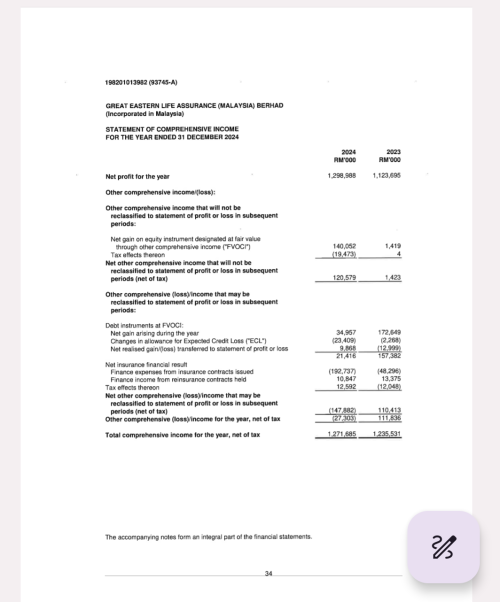
Looks like medical inflation hasn't impacted Great Embarrassment's bottom line at all.

FYE 2024 total comprehensive income of RM 1.27 billion!!!!!!!! - RM 1.24 billion in FYE 2023.

» Click to show Spoiler - click again to hide... «


Fellow Malaysians, this is where a big chunk of your IL premiums have gone to - be glad for the GE Gods drink full from thy cup, blessings abound for thy health.

A round of applause for GE for getting through unscathed, unharmed by the very debilitating medical inflation epidemic. No bloodthirsty hospital may sink their teeth and harm the Great GE balance sheet. All hail The Great Embarrassment Balance Sheet🙌🏾🙌🏾🙌🏾🙌🏾🙌🏾

» Click to show Spoiler - click again to hide... «


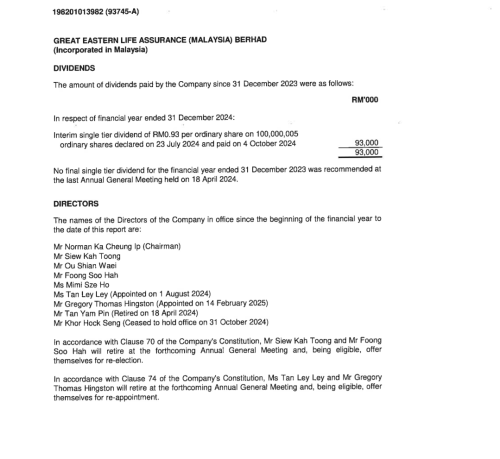
Buggers even dared to pay RM 93 million in dividends. This is even after being exposed for misappropriating RM 2.37 billion from their participating policyholders.
*
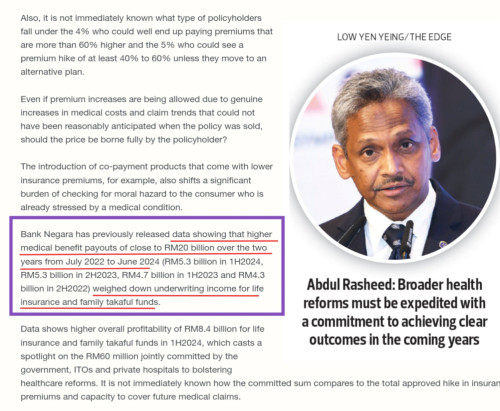
Bank Negara Malaysia (BNM) says the interim measure of spreading medical premium adjustments over three years is expected to negatively impact the net underwriting income of life insurers and family takaful operators.

This increase in medical payouts was due to a rise in overall average cost and utilisation of medical treatments, particularly for chronic and acute cases, according to BNM

BNM: Staggered medical premium hikes to weigh on insurers’ underwriting income

We can guess, by analysing AIA's 2023 average medical claim payouts for its top 10 diagnoses, that it's likely the growth in size and higher utilisation of small claims which are causing an increase in medical payouts.

So, it's really puzzling that BNM is pinning the blame partly on chronic cases. If anything, any growth in claims for chronic cases would have been likely due to prior suppression of such cases through denial and delay tactics.

QUOTE(hafizmamak85 @ Apr 26 2025, 07:30 PM)
There are only two conditions within the top 10 that could fall comfortably under bucket A, and that would be ischemic heart disease and breast cancer.

What’s really surprising is that the average claim payouts, assuming these payouts are per life insured per diagnosis, for both these diseases are less than RM 10k - RM 9k for ischemic heart disease and RM 5k for breast cancer. Understanding this would solve half the small average claim size puzzle.

In bucket B, we have the usual suspects, respiratory tract infections; gastrointestinal inflammations; non-cancerous growths or lesions; fractures / orthopedic trauma; infectious diseases; cataracts and other eye disorders.

Again, all conditions within bucket B also have average claim payouts less than RM 10k - in fact, it's mostly less than RM 5k. Serious cases for bucket A would likely have an average of over RM 50k and for bucket B, the serious case averages would in general be between RM 10k and 50k.

So, why aren’t the average claim sizes much higher then? How is it possible for 7 out of the top 10 diagnoses to have less than RM 5k payout averages?

» Click to show Spoiler - click again to hide... «

*
What about BNM's view that the interim 'cap in premium hikes' measure is expected to negatively impact the net underwriting income of life insurers and family takaful operators (LIFTOs)??? Are medical claims really affecting the profitability of LIFTOs?????

Everyone loves to bash on private hospitals, myself included, but anyone looking at their profit margins (forget profits, even EBITDA margins) will see that they are not the ones making the bulk of the blood money.

It's the LIFTOs/TPAs who have killer profit margins, high expenses and crazy agency force remunerations. All made possible by an agency dominated, kootu medical anchoring other fluff coverage ILP business model.

But how is it that mainstream sources don’t seem to cotton on to this fact? They know that LIFTOs make substantial profits, far exceeding those of private hospitals, but have difficulty in attributing their money making abilities to IL underwriting and expense margins embedded within the product’s cost of insurance/takaful and other charges (amount pooled from each policy to finance expenses and benefit payouts for insured/takaful events).

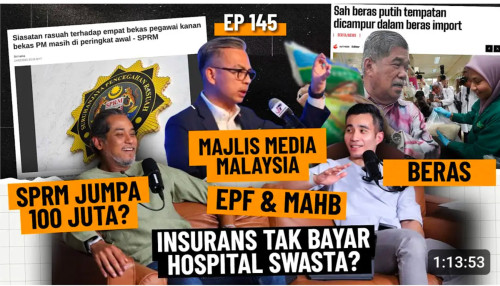
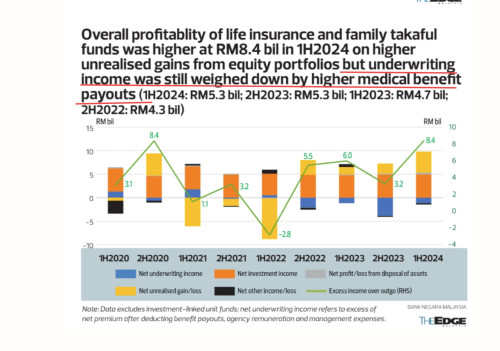
There is one main cause for this, and it's BNM’s to own. Media outlets from The Edge to podcasters like Khairy Jamaluddin & Shahril Hamdan continuously quote the net underwriting income figures (blue colored bars in bar chart below), as derived from an excess of income over outgo analysis - a flawed way to measure a LIFTO’s profitability - in explaining why it may be justifiable for life insurers and family takaful operators to hike premiums.

Someone or a group of people within BNM has to be held accountable for handing these irresponsible talking points to the media.

user posted image
Keluar Sekejap Ep. 145 (Min 33)

user posted image

user posted image
Cover Story: Who pays the price of runaway healthcare inflation?

The major flaw in using an “excess of income over outgo” analysis is that it is an EXCESS OF INCOME OVER OUTGO ANALYSIS.

Unlike a SURPLUS ARISING ANALYSIS (INCLUDING/EXCLUDING PARTICIPATING FUNDS) which would holistically capture all revenue sources and margins, including those from release in reserves, this analysis makes it seem LIFTOs are making a substantial portion of their earnings from investment returns. And that LIFTOs, who have done everything that could have been reasonably expected of them, are being weighed down by too many insurance/takaful (including medical) claims. Nothing could be further from the truth.

Most profitable LIFTOs, especially the big three (AIA, Great Eastern and Prudential), make most of their profits from margins embedded within IL cost of insurance/takaful and other charges and the insurance/takaful benefit component of other policies.

What's missing in an excess income over outgo analysis are two main items, the release in reserves needed to sustain current benefit payouts, for policies whose current payouts are much higher than premiums collected, and the addition to reserves needed to sustain future benefit payouts, for policies whose current benefit payouts are much lower than premiums collected.

The release in reserves include those for participating savings plans which have built up significant cash values, values which far exceed the annual premium amounts collected, and those for single premium mortgage (MRTA, MLTA etc.) and other long term products, whose premiums are initially reserved, only to be released later over time.

Whether it's for maturity, surrenders or payouts related to insurance claims, these reserves will have to be released throughout the policy’s term to make those payments.

The payments can't be sustained by annual premiums alone and that is why the excess income over outgo analysis gives the false impression of LIFTOs having thin underwriting margins.

Also, participating funds are 'owned' by policyholders. There is no point in including them in analysing an insurer's profitability as most of the surplus (90%) will be distributed, in due time, to policyholders.

The release in reserves would flow mostly to the net underwriting income component (blue colored bars in the bar chart above), while the addition to reserves would be deducted mostly from the investment return components (net investment income, net unrealised gain denoted by the orange and yellow colored bars in the bar chart above).

If incorporated into the excess income over outgo analysis, it would result in a 180° flip. The blue bars (net underwriting component) would appear to be more significant than the orange/yellow bars (net investment income, net unrealised gain components).

LIFTOs have been mercenary for a long time towards their policyholders. It's the LIFTOs who are with excessive profits.

So, why is BNM so invested in painting a false narrative when it comes to the LIFTOs profitability????

Why does BNM not want the public to be aware that LIFTOs are profitable, and that it's mostly due to the margins embedded with IL cost of insurance/takaful charges????


This post has been edited by hafizmamak85: Apr 28 2025, 01:29 PM
hafizmamak85
post Apr 30 2025, 03:23 AM

Casual
***
Junior Member
463 posts

Joined: Nov 2009

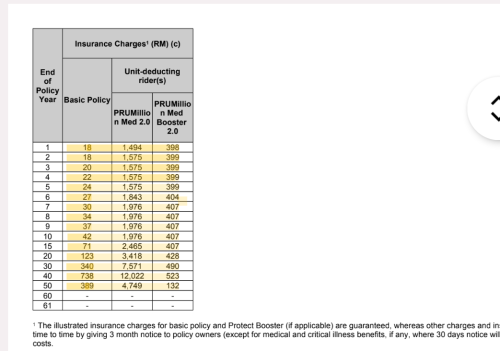
How much do you think Prudential's margin is? A RM 500 deductible policy for a 40 year old has got a cost of insurance charge of RM 1.9k for the medical coverage component (PruMillion Med 2.0 with Booster). Even if the average medical pool claims cost is RM 1.3k, that would still leave a RM 600 margin.

Are insurers and takaful operators truly making a loss from managing medical portfolios????

user posted image

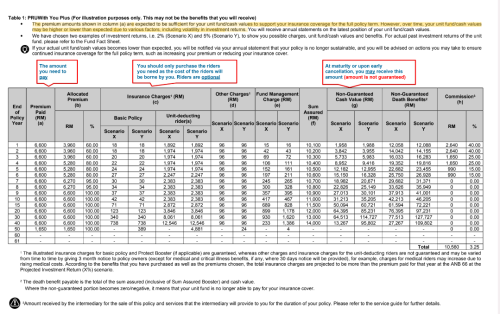
The premium amounts shown in column (a) are expected to be sufficient for your unit fund/cash values to support your insurance coverage for the full policy term

user posted image

Whatever the case may be, just remember that this expectation of premium sustainability has value. Don't let anyone tell you otherwise.

The expectation should rightfully mean a no lapse guarantee as long as premium payments are maintained per the original payment schedule set at the policy's inception.

user posted image

user posted image

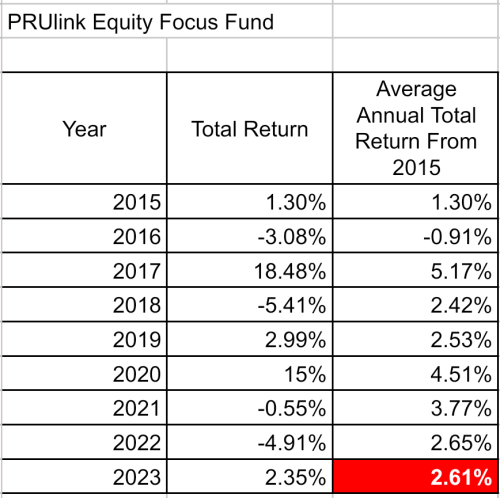
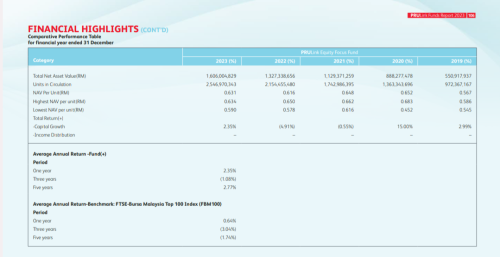
The policy assumes more than 5% in annual total returns to ensure sustainability until end of term, but the PRUlink Equity Focus Fund - one of Prudential's equity funds, with over RM 1.5 billion in NAV - has less than a 3% (2.61%) average annual total return between 2015 and 2023.

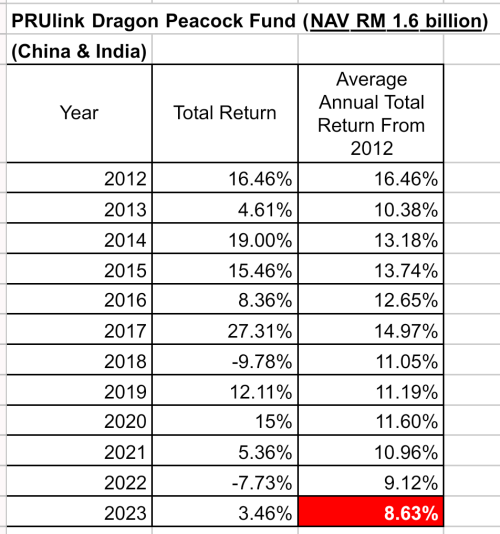
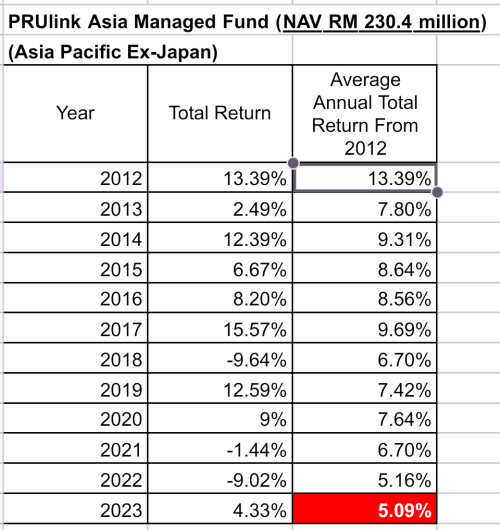
If not locally, where else can we go to source such returns? Asia Ex. Japan???? China??????? India????? How sustainable is this strategy?????? Can we keep expecting these markets to provide above 5% returns per annum for the next 30 - 50 years?????

user posted image

user posted image

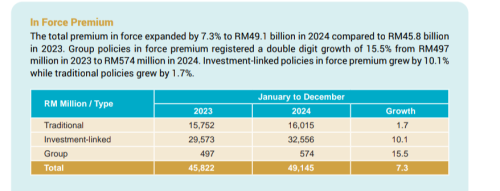
Investment-Linked has got nearly RM 33 billion in annual premiums. If total NAV is around/reaches 6x annual premiums, that would mean nearly RM 200 billion in Malaysian funds may need to be invested abroad to achieve such returns. Sustainable?????

user posted image

This post has been edited by hafizmamak85: Jun 14 2025, 02:02 PM
contestchris
post Apr 30 2025, 09:28 PM

Look at all my stars!!
*******
Senior Member
5,559 posts

Joined: Aug 2011

Hi everyone,

I've been researching for basic term life insurance in Malaysia. Basic term life insurance refers to insurance cover for a pre-determined number of years (e.g. 5, 10, 15, 20, 25, 30 years) with level premiums, and without any savings, maturity and investment elements. These policies only cover death and TPD.

The idea behind getting a basic term life insurance policy is that it is meant to guarantee your income for your dependents, until your age of retirement or until your children have completed their studies.

I've received quotations for a number of policies for roughly age 30, covering RM1mil death and TPD for 25 years. Most plans simply seem to be far too expensive.

Prudential PruTerm Premier: RM2,340 (Agency)
AIA Sejuta Makna: RM2,490 (Agency)
Prudential PruTerm: RM3,746 (Agency)
HLA Level Term: RM4,000 (Agency)
Manulife Manu Term: RM4,186 (Agency)

All the plans above are nearly identical, except for the AIA Sejuta Makna Takaful plan which has some extra fringe benefits.

What seems funny is Prudential has two identical (can't find the difference) plans with wildly different premiums! The "premier" version with TPD add-on is significantly cheaper than the basic PruTerm plan.

I then look at Kaotim Legasi, it is an online product sold by Syarikat Takaful. With the exact same parameters as the other plans, it costs RM1,440 for 20 years and RM2,160 for 30 years cover. This is so much cheaper than the agency plans. But sadly, there is no 25 years option. 20 years might just be too short, 30 years is rather wasteful.

What basic term life insurance (or takaful) plan do you have? Have you researched into this, and if yes, what are your findings?

Thank you!


Paul13579
post May 1 2025, 10:34 AM

New Member
*
Newbie
24 posts

Joined: Oct 2017
I had the exact same reaction when I compared agency vs. online plans, the price difference is wild. I went with an online takaful plan too (not Kaotim but similar) because I couldn’t justify the agency markup for something that doesn’t have savings or investment elements anyway. You’re spot on about what term life is meant for, and it really comes down to finding the lowest cost for the same outcome.

Also agree it’s strange that Prudential’s “Premier” version is cheaper than the regular PruTerm, I suspect it’s more about how they’re packaged and sold than any real difference in benefits. Maybe check if the “Premier” version has mandatory riders or commission structures baked in differently
Paul13579
post May 1 2025, 10:34 AM

New Member
*
Newbie
24 posts

Joined: Oct 2017
EDIT: I posted twice by mistake*

This post has been edited by Paul13579: May 1 2025, 10:35 AM
hafizmamak85
post May 1 2025, 05:49 PM

Casual
***
Junior Member
463 posts

Joined: Nov 2009

QUOTE(contestchris @ Apr 30 2025, 09:28 PM)
I then look at Kaotim Legasi, it is an online product sold by Syarikat Takaful. With the exact same parameters as the other plans, it costs RM1,440 for 20 years and RM2,160 for 30 years cover. This is so much cheaper than the agency plans. But sadly, there is no 25 years option. 20 years might just be too short, 30 years is rather wasteful.

What basic term life insurance (or takaful) plan do you have? Have you researched into this, and if yes, what are your findings?

Thank you!
*
Please be careful when buying 'cheap products', especially when they are long term - e.g. 20, 30 years.

The problem with the big insurers and takaful operators (ITOs) is that they have huge margins and fees. That is how policyholders get screwed.

The problem with mid to small ITOs is that they have another way of shortchanging consumers, and that is through designing or pricing the products as lapse supported. Not to say big ITOs don't do this, but I think the smaller guys will feel the urge to do this more often than not.

I used to think this problem wouldn't plague takaful operators as there was usually this split, where any remainder premium amount (contribution amount) - after deduction of wakalah (management) fees - would flow to something called the savings account first, before monthly drips or deductions from the savings account to the tabarru fund (risk fund) are made.

So, if you die, your beneficiaries will receive any remaining amount retained within the savings account, and the sum assured will be separately paid to your beneficiaries from the risk fund. If you surrender your policy, you will receive the savings account amount.

The savings account amount can also be thought of as the 'Asset Share' of the policy.

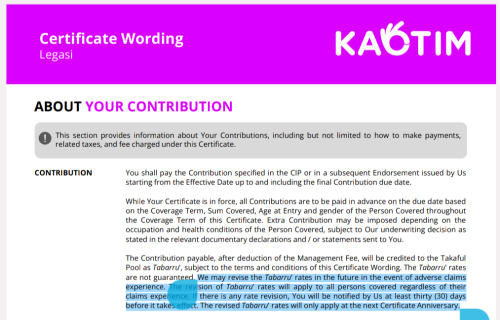
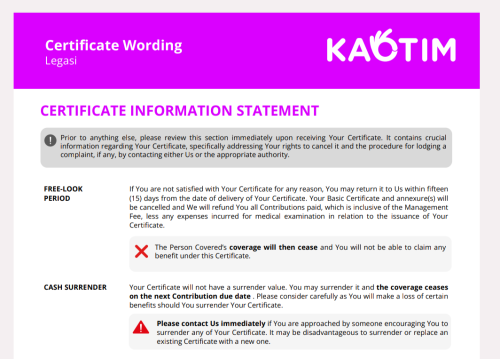
The Kaotim Legasi death benefit 'more than 1 year term' products by STMB (Syarikat Takaful Malaysia Berhad) are suspiciously cheap and not designed and priced fairly, as there is no separation between the savings accounts and risk fund, and there is no surrender value. Kaotim also, very strangely, reserves the right to reprice the tabarru charges at any time during the policy's term. Again, this should only be exercised if the ITO faces going concern risks.

user posted image

user posted image

I suspect that these products may also be benefiting from STMB's Estate. Yes, Great Embarrassment is not the only ITO with an Estate.

This 'no surrender value, lapse supported design' means that the proper management of the Kaotim Legasi product requires either a part, or the entirety, of the Asset Shares of policyholders who leave the fund during the middle of the contract term, to sustain future benefit payouts of remaining policyholders.

Why should you, the leaving policyholder, fork out any amount belonging to you, for the benefit of the other remaining policyholders???? You have no stake in the pool anymore, you're not being afforded any protection. So, why should you and your funds be bothered???

And what happens if all policyholders decide to simultaneously leave the fund??? That money will then languish within the tabarru fund, which would then allow the takaful operator to further underprice the products and claw as much management fees from future policyholders. And when the tabarru fund closes, the government gets the money. What a sham and a scam. Boycott STMB!!!!!.

Again, this is a very unfair contact term and the way the products are designed and managed, without any proper separation between the risk fund and savings account, is also unfair.

Stay Away from it. SAY NO to lapse supported products.

Also, demand that Great Embarrassment calculates the Asset Shares of participating policies within closed funds properly by accounting for the Estate, which is technically not really an Estate, within its computation. Demand that Great Eastern pays out the entirety of the Asset Share and Estate, to participating policyholders within their closed funds, by the time the last policyholder leaves the fund and in line with the 90/10 rule.

I'm truly surprised that STMB is doing this.

This post has been edited by hafizmamak85: May 1 2025, 06:57 PM
contestchris
post May 1 2025, 07:14 PM

Look at all my stars!!
*******
Senior Member
5,559 posts

Joined: Aug 2011

QUOTE(hafizmamak85 @ May 1 2025, 05:49 PM)
Please be careful when buying 'cheap products', especially when they are long term - e.g. 20, 30 years.

The problem with the big insurers and takaful operators (ITOs) is that they have huge margins and fees. That is how policyholders get screwed.

The problem with mid to small ITOs is that they have another way of shortchanging consumers, and that is through designing or pricing the products as lapse supported. Not to say big ITOs don't do this, but I think the smaller guys will feel the urge to do this more often than not.

I used to think this problem wouldn't plague takaful operators as there was usually this split, where any remainder premium amount (contribution amount) - after deduction of wakalah (management) fees - would flow to something called the savings account first, before monthly drips or deductions from the savings account to the tabarru fund (risk fund) are made.

So, if you die, your beneficiaries will receive any remaining amount retained within the savings account, and the sum assured will be separately paid to your beneficiaries from the risk fund. If you surrender your policy, you will receive the savings account amount.

The savings account amount can also be thought of as the 'Asset Share' of the policy.

The Kaotim Legasi death benefit 'more than 1 year term' products by STMB (Syarikat Takaful Malaysia Berhad) are suspiciously cheap and not designed and priced fairly, as there is no separation between the savings accounts and risk fund, and there is no surrender value. Kaotim also, very strangely, reserves the right to reprice the tabarru charges at any time during the policy's term. Again, this should only be exercised if the ITO faces going concern risks.

user posted image

user posted image

I suspect that these products may also be benefiting from STMB's Estate. Yes, Great Embarrassment is not the only ITO with an Estate.

This 'no surrender value, lapse supported design' means that the proper management of the Kaotim Legasi product requires either a part, or the entirety, of the Asset Shares of policyholders who leave the fund during the middle of the contract term, to sustain future benefit payouts of remaining policyholders.

Why should you, the leaving policyholder, fork out any amount belonging to you, for the benefit of the other remaining policyholders???? You have no stake in the pool anymore, you're not being afforded any protection. So, why should you and your funds be bothered???

And what happens if all policyholders decide to simultaneously leave the fund??? That money will then languish within the tabarru fund, which would then allow the takaful operator to further underprice the products and claw as much management fees from future policyholders. And when the tabarru fund closes, the government gets the money. What a sham and a scam. Boycott STMB!!!!!.

Again, this is a very unfair contact term and the way the products are designed and managed, without any proper separation between the risk fund and savings account, is also unfair.

Stay Away from it. SAY NO to lapse supported products.

Also, demand that Great Embarrassment calculates the Asset Shares of participating policies within closed funds properly by accounting for the Estate, which is technically not really an Estate, within its computation. Demand that Great Eastern pays out the entirety of the Asset Share and Estate, to participating policyholders within their closed funds, by the time the last policyholder leaves the fund and in line with the 90/10 rule.

I'm truly surprised that STMB is doing this.
*
I think you are jumping to the wrong conclusions here. Yes, the product is lapse supportable because it contains no surrender value.

But insurers CAN design such products.

If too many policyholders buy long-term cover and the lapse just 2 or 3 years into the policy, the insurers make bank. Why is this wrong though?

Cause on the flip side, by buying such a product, you pay significantly lesser.

In pricing the product, the insurer will make certain lapse assumptions, possibly by drawing from the experience of similar products.

By pricing the product such that there is no surrender value, we customers get to buy "cheaper" term cover. This is proven by the fact that Kaotim Legasi is cheaper than almost every other term insurance covering death and TPD.

There is nothing shady here. It is written clearly in the PDS and policy contract that there is no surrender value.

As a customer looking for the absolute cheapest insurance coverage, I am OKAY with this. I don't need any surrender value from my pure protection policies.

Regarding the company's ability to reprice, I believe it is a standard wording for "non-guaranteed" products. Most term cover products have this clause. Those with guaranteed rates, are generally more expensive. However, given the trend of Malaysians living longer, this should not be a concern. It is fairly unlikely, probably unheard of, for an insurer to reprice pure death+TPD products, and if they do, they will come under significant scrutiny from BNM. If they intentionally underpriced the product, they will not get the approval from BNM to reprice the product. BNM has access to all the assumptions used in pricing the product.

As to the question of the use of estate, I am not sure if STMB has any estate, and if they do, is it even significant? Do takaful operators even have an estate? Is a estate even applicable to non-participating policies such as this? In any case, that's not an issue and BNM has got stringent policies on the management of estates and not a relevant consideration as to whether one should buy this product or not.

Edit: My man, you do know that for pure protection non-participating product from conventional insurance, the customer gets nothing as well right, if ultimately the fund has excess monies due to high lapses, or better-than-expected claims experience.

Edit 2: You may check out the FWD Takaful Protect Direct plan. It is also similarly "cheap", but not as cheap as Kaotim Legasi plan. No surrender value here either. But the drawback is, it does not have TPD protection.

This post has been edited by contestchris: May 1 2025, 09:04 PM
Wedchar2912
post May 1 2025, 08:18 PM

Look at all my stars!!
*******
Senior Member
3,658 posts

Joined: Apr 2019
QUOTE(hafizmamak85 @ Apr 26 2025, 11:52 PM)
Btw, to those claiming RM 150k - 200k annual limits are sufficient, have a look at the highest payout for each of the diagnoses:

Ischemic Heart Disease: RM 403k
Intervertebral Disc Disorders: RM 148k
Pneumonia: RM 450k
Gastritis & Duodenitis: RM 121k
Acute Bronchitis & Bronchiolitis: RM 115k
Cataract: RM 48k
Breast Cancer: RM 258k
Other Diseases Due to Viruses & Chlamydiae: RM  172k
Fracture of Upper Limb: RM 119k
Benign Neoplasms: RM 211k
*
these are the highest per disease rite? cos the average payout remains below 10K rm.

in some sense, 200K annual limit does serve its purpose for most people... definitely most people.

of course, higher limit is better but comes with higher cost rite?


contestchris
post May 1 2025, 09:02 PM

Look at all my stars!!
*******
Senior Member
5,559 posts

Joined: Aug 2011

QUOTE(Paul13579 @ May 1 2025, 10:34 AM)
I had the exact same reaction when I compared agency vs. online plans, the price difference is wild. I went with an online takaful plan too (not Kaotim but similar) because I couldn’t justify the agency markup for something that doesn’t have savings or investment elements anyway. You’re spot on about what term life is meant for, and it really comes down to finding the lowest cost for the same outcome.

Also agree it’s strange that Prudential’s “Premier” version is cheaper than the regular PruTerm, I suspect it’s more about how they’re packaged and sold than any real difference in benefits. Maybe check if the “Premier” version has mandatory riders or commission structures baked in differently
*
What plan did you get then? FWD Takaful Protect Direct?

This post has been edited by contestchris: May 1 2025, 09:02 PM
hafizmamak85
post May 2 2025, 04:27 AM

Casual
***
Junior Member
463 posts

Joined: Nov 2009

QUOTE(contestchris @ May 1 2025, 07:14 PM)
I think you are jumping to the wrong conclusions here. Yes, the product is lapse supportable because it contains no surrender value.

But insurers CAN design such products.

If too many policyholders buy long-term cover and the lapse just 2 or 3 years into the policy, the insurers make bank. Why is this wrong though?

Cause on the flip side, by buying such a product, you pay significantly lesser.

In pricing the product, the insurer will make certain lapse assumptions, possibly by drawing from the experience of similar products.

By pricing the product such that there is no surrender value, we customers get to buy "cheaper" term cover. This is proven by the fact that Kaotim Legasi is cheaper than almost every other term insurance covering death and TPD.

There is nothing shady here. It is written clearly in the PDS and policy contract that there is no surrender value.

As a customer looking for the absolute cheapest insurance coverage, I am OKAY with this. I don't need any surrender value from my pure protection policies.

Regarding the company's ability to reprice, I believe it is a standard wording for "non-guaranteed" products. Most term cover products have this clause. Those with guaranteed rates, are generally more expensive. However, given the trend of Malaysians living longer, this should not be a concern. It is fairly unlikely, probably unheard of, for an insurer to reprice pure death+TPD products, and if they do, they will come under significant scrutiny from BNM. If they intentionally underpriced the product, they will not get the approval from BNM to reprice the product. BNM has access to all the assumptions used in pricing the product.

As to the question of the use of estate, I am not sure if STMB has any estate, and if they do, is it even significant? Do takaful operators even have an estate? Is a estate even applicable to non-participating policies such as this? In any case, that's not an issue and BNM has got stringent policies on the management of estates and not a relevant consideration as to whether one should buy this product or not.

Edit: My man, you do know that for pure protection non-participating product from conventional insurance, the customer gets nothing as well right, if ultimately the fund has excess monies due to high lapses, or better-than-expected claims experience.
*
Seriously, who in the world is feeding you these talking points????? Whatever the case may be, let's go through it.

Can insurers and takaful operators (ITOs) design and price such lapse supported products? Short answer, no. As ITOs are required to treat consumers fairly, which would not be possible in a lapse supported scenario. If ITOs are legally allowed to treat consumers unfairly, then yes, all is good.

The question is, in constructing the terms of the insurance and takaful (IT) contract, what are the implied terms of a fair and just IT contract and why is a lapse supported design inherently unfair, regardless of disclosure?

For one, disclosure is not a carte blanche to treat consumers unfairly. One can't disclose unfair term X to consumers and consider such disclosure sufficient to turn unfair term X to fair term X. Especially in a consumer insurance/takaful contract where consumers have no say in shaping the terms of the contract.

So, what is it about term X (lapse supported design and pricing) that makes it an inherently unfair term in the construction of IT contract terms?

One of the implied terms in any long term IT contract which has a pre-funding element is that there must be a fair surrender value which would pass back to consumers the unused pre-funded amount. Why? Because fairness is linked to equity and equity does not allow for 'Robbing Peter to pay Paul' scenarios.

So, the points about policyholders, as a group, getting cheaper premiums or shareholders getting a bigger share of profits from surrendered policies don't count.

Equity requires a 'proper' balancing of the rights and interests between each individual within a group (between each policyholder within a pooled fund/group of policyholders), and between different groups or parties within the contract (policyholders vs shareholders) over various contemporaneous and non-contemporaneous risk sharing time periods.

Policyholders in a risk pool/fund typically have their cost of insurance/takaful charges calculated based on their individual or group risk exposure levels and duration of exposure.

For a leaving policyholder, their risk exposure is limited to the duration they were in the fund - up until the policy's termination. Therefore, the amounts deducted for insurance/takaful coverage should commensurate with the level of risk exposure for the duration the leaving policyholders were at risk. Not more, not less.

Insurance/takaful is mostly a form of risk sharing within contemporaneous time periods. There is no risk sharing within non-contemporaneous time periods, such as the smoothing of investment returns in a participating fund setting, which would allow for deductions from the policy's asset share. The fact that it is pre-funded means the amount is required for future risk sharing, not present risk sharing.

The excuse that insurance/takaful may involve risk sharing within non-contemporaneous time periods as surpluses may be retained and built up for future generations is misapplied in this scenario. Mortality risk is much less volatile compared to investment returns. And any deductions from the policy's Asset Share for the build-up of surpluses should be done incrementally, applied across the board throughout the term of the policy and shouldn't just target surrendering policies. It is not an excuse to not provide a fair surrender value.

Shareholders also deserve their fair share of profits from a long term contact and the level of profits is tied to the level of service/risk protection provided within the period the leaving policyholder was serviced/at risk. Not more, but can be less. And the amount shareholders may take as profits has nothing to do with the pre-funded amount.

In the case of STMB's Kaotim, there are no profits to be made by STMB from the tabarru fund (risk charges). What they have are only wakalah fees. Very, very high wakalah fees which are charged to the premium (contribution) amount, prior to the remainder being allocated to the tabarru fund.
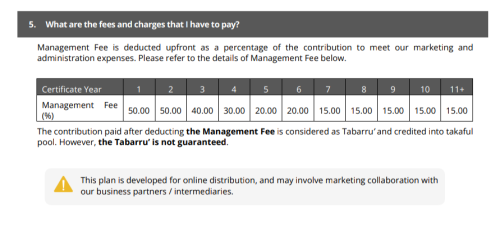
user posted image

Sidenote: The more one looks at the pricing of the premium amounts, the more suspicious it gets. They are either expecting very high lapse rates, perhaps even as high as 5% per annum or above, during the initial 10 - 20 years of the policy, or are relying on the investment returns generated by the Estate within the tabarru fund, or both, or worse, just downright expecting some Estate or other surplus resource within the fund to finance any deficit - I'm pretty confident they may even be praying for mortality to be low. I just don't see how the Kaotim policy can be sustainable with such high wakalah fees and low premium amounts.

Even with a projected 8% return per annum, a 30 year term Kaotim policy for RM 1 million in coverage for a 30 yr old, under a 0% lapse scenario and RM 2040 in annual premiums, still yields a tabarru fund deficit of RM 4.6k at end of the policy's term.


user posted image

Btw, can you imagine, spending RM 50,000 or RM 60,000 on a single premium 30 yr mortgage reducing term assurance product, only to be told that your policy doesn't have any surrender value as the product was designed to be lapse supported, and you are in the midst of settling the loan during the 5th year.

Also, takaful is a participating type policy by its very nature (not non-participating). The tabarru funds (risk funds) are 'owned' by policyholders.

As for BNM, just as what they keep conveying to the media, they do not 'approve' of a product's pricing/re-pricing or design.

Having said that, BNM does have the authority to issue any direction to the lTO, as they deem fit and pursuant to the objectives of the Financial Services Act. These directions may include putting a stop to any re-pricing efforts or the launch of any product, if they deem such efforts may lead to policyholders being treated unfairly or adversely affected. Why didn't BNM issue such directions to put a stop to so many unfair/unlawful practices????

BNM as an institution has failed many a time in protecting the rights and interests of policyholders. We have to stand up to them. They are only human. They have been lulled by the very power they have wielded for so long that they have forgotten their duties or failed to carry them out properly.

Case in point, how did Great Eastern's Estate grow from RM 1.8 billion in 2001 to + RM 10 billion in 2018????? If BNM and Great Embarrassment were so competent and fair to consumers, this wouldn't have happened in the first place.

Why and how did it come to be that BNM ended up conspiring with MOF, Great Eastern in misappropriating RM 2.37 billion from their participating policyholders????

Why haven't any of the other foreign insurers complied with the in-lieu-of-divesting condition: contribution to the mySalam trust fund???

How is it that long term level premium IL policies with medical coverage still face the risk of re-pricing year in, year out??? Why were these policies allowed to be priced without accounting for the long term effects of medical inflation, and with such high expenses and profit margins???? Why have claim delay and denial tactics been allowed to fester?????

Why were are all these unfair/unlawful practices allowed to run rampant????

This post has been edited by hafizmamak85: May 3 2025, 05:00 PM

contestchris
post May 2 2025, 08:40 AM

Look at all my stars!!
*******
Senior Member
5,559 posts

Joined: Aug 2011

Hafiz, you're a smart guy and you're very correct in whatever you're saying.

But I don't understand your issue with building lapse supportable products and pricing them cheaper than they otherwise would be, by designing them such that there is no surrender value.

If this was wrong, BNM and other insurance regulators around the world would outlaw it...but it is perfectly legal and even the "Big 3" design some products like this.

As for single premium products...actually I would for all intents and purposes be happy to buy such a product without a surrender value, if it means the single premium is 20% to 30% cheaper and if it is disclosed upfront.
contestchris
post May 2 2025, 09:31 AM

Look at all my stars!!
*******
Senior Member
5,559 posts

Joined: Aug 2011

An interesting point to note, as I compare PruWeath vs PruWealth Premier.

PreWealth covers only death + TPD.

PruWealth Premier covers only death, with a TPD add on.

Both policies cover the same term, same sum assured. In both cases, premiums are guaranteed. The terms and conditions, benefits and exclusions are all identical.

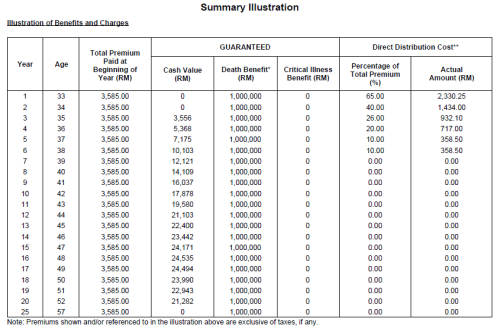
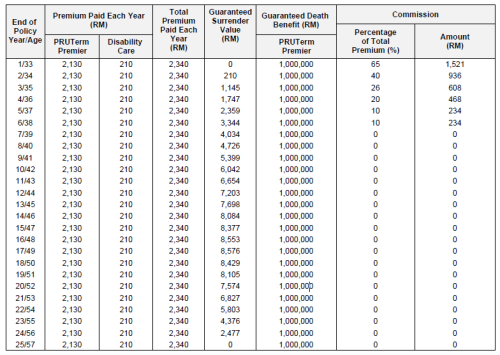
Yet, PruWealth annual premium is RM3,585 and PruWealth Premier (with TPD rider) annual premium is just RM2,340.

The reason why? Because PruWealth probably has a lower lapse assumption built into the pricing, which allows for a higher surrender value mid policy. PruWealth Premier, being newer, possibly has updated pricing assumptions including higher lapse assumptions, which tighten the surrender value considerably.

PruWealth:
user posted image

PruWealth Premier:

user posted image
Ramjade
post May 2 2025, 10:46 AM

20k VIP Club
*********
All Stars
24,380 posts

Joined: Feb 2011


QUOTE(contestchris @ May 2 2025, 09:31 AM)
An interesting point to note, as I compare PruWeath vs PruWealth Premier.

PreWealth covers only death + TPD.

PruWealth Premier covers only death, with a TPD add on.

Both policies cover the same term, same sum assured. In both cases, premiums are guaranteed. The terms and conditions, benefits and exclusions are all identical.

Yet, PruWealth annual premium is RM3,585 and PruWealth Premier (with TPD rider) annual premium is just RM2,340.

The reason why? Because PruWealth probably has a lower lapse assumption built into the pricing, which allows for a higher surrender value mid policy. PruWealth Premier, being newer, possibly has updated pricing assumptions including higher lapse assumptions, which tighten the surrender value considerably.

PruWealth:
user posted image

PruWealth Premier:

user posted image
*
If you are open to buying term life insurance in Singapore, you can get cheaper. Downside is have to travel down there to sign the documents and of course cost will be in SGD.


389 Pages « < 357 358 359 360 361 > » Top
 

Change to:
| Lo-Fi Version
0.0238sec    0.84    6 queries    GZIP Disabled
Time is now: 12th December 2025 - 05:33 PM