Welcome Guest ( Log In | Register )

389 Pages « < 354 355 356 357 358 > » Bottom

Outline · [ Standard ] · Linear+

 Insurance Talk V7!, Your one stop Insurance Discussion

views
     
Ramjade
post Apr 21 2025, 07:13 AM

20k VIP Club
*********
All Stars
24,387 posts

Joined: Feb 2011


QUOTE(Jason @ Apr 21 2025, 01:35 AM)
Through agents? If possible I want to bypass agent and save on comm. Which company you bought for medical?
*
If you want to buy those 200k-1m coverage without agent, not possible. For those 100k coverage can buy fully online.

Generali can be bought online via fi.life
contestchris
post Apr 21 2025, 09:38 AM

Look at all my stars!!
*******
Senior Member
5,562 posts

Joined: Aug 2011

QUOTE(Jason @ Apr 20 2025, 01:42 AM)
I’ve got a basic life with medical on it from GE, and it is  an investment link plan since 2017.

Agent tells me that the premium contribution would be level until I’m 100 years old as that’s what the investment portion does — to keep it level.

There’s been a premium increase of 20% 2 years back due to lack of funds or whatever and cannot sustain, and agent moved me to a new pool because I have not claimed anything. That’s what the agent said lah. To me, I’m like okay. This increase did give a bit extra benefits like higher limit which I don’t really care… I’m happy with the existing limit. 

Now I am curious
1. Is that level premium contribution legit? Like does such a thing exist and really work?
2. I genuinely don’t care about life insurance. My main need is medical coverage esp. when I am old, retired and jobless. 
3. Does GE have deductible medical coverage? Per annum? I don’t mind having deductible of RM1k ~ RM3k. Got company coverage, and I can still afford RM3k/year after retirement.

[attachmentid=11512662]
Edit: don’t really want to talk to my agent. I don’t want to Kena upsell. If anything I want to add on deductible to pull the premium down.

Edit2
hafizmamak85 thanks for sharing
Interesting read. Based on your info, all ITOs are evil. So who is the least evil where I can get guaranteed renewal up to 100 years old. With a premium that would not be raised at the whim and fancy of the ITO? It looks like we do not have a choice and at their mercy?
*
Yes Great Eastern just launched a brand new product with multiple deductible options. If you decide to upgrade to it, make sure you undergo full underwriting (assuming your health is 100%) to be in the healthy pool.
contestchris
post Apr 21 2025, 09:51 AM

Look at all my stars!!
*******
Senior Member
5,562 posts

Joined: Aug 2011

QUOTE(Jason @ Apr 21 2025, 01:35 AM)
Through agents? If possible I want to bypass agent and save on comm. Which company you bought for medical?
It took 61 years for Malaysia to change government, driven by the people. I don't think I will live to see the day ITOs and BNM getting sued. Rule of 78 is outright illegal and banned in many countries including UK, Australia and New Zealand, and even Singapore. BNM talk about abolishing it for years, bila? Not practical lah boss. I don't have 60 years to wait for it to happen.

You can champion that, I will support you, but while that is happening I need to address my current issue first, which is my insurance.

Simple maths to me, you sell me insurance with RM1 mil annual limit, with X premium for Y years. Actually medical cost increase got nothing to do with me and my insurance policy. So what if surgery for knee increase from RM20k to RM60k? It still falls within the RM1 mil annual limit of MY POLICY, you cover lah.

But what you are saying, insurance companies actually give RM1 mil annual limit with no intention of covering actual RM1 mil. So they sell plan on paper but with no actual money to back it. That's called a Ponzi scheme... when not enough $$$ you squeeze your customers to put more money in the pot. That's actually what's happening now lol.
*
You have it wrong. In Malaysia, "health and surgical" insurance is not actually insurance per se as they are all priced on an "annually renewable" basis. Real insurance is life, TPD, CI, cancer etc that are priced for the long-term. "Health and surgical" insurance is actually a cost-plus insurance model. Given the inflationary nature of the underlying claims, this only makes sense. If they were to price the product "properly" as a long-term product, your annual premiums will be 10x to 20x higher.
contestchris
post Apr 21 2025, 10:20 AM

Look at all my stars!!
*******
Senior Member
5,562 posts

Joined: Aug 2011

Medical Insurance Reform Suggestion

Standalone Medical Insurance

For standalone medical insurance policies, there is possibly only one reform required in the presentation to customers. In the Sales Illustration (SI), insurers must be able to show projected long-term future premiums under a low/medium/high scenario to customers. The low scenario can be 7%, the medium scenario can be 12%, and the high scenario can be 20%. This is not legally binding and purely illustrative. Fundamentally however, nothing will change for standalone medical insurance policies as these are already annually renewable, and premiums are only paid for and coverage is only guaranteed for 12 months.

Investment-linked Medical Insurance Rider

For investment-linked insurance policies with medical riders, there is substantial reform required. All of us who purchased investment-linked insurance policies have been told that we are “overpaying” now to build a reserve to pay for future increases in medical costs. The promise has generally been that the premiums will be level (although, the insurers are smart – this was never communicated in writing). This is all pure bollocks.

The picture is muddied further by the fact that unlike standalone plans, there are two components for ILPs – the premiums themselves, and the “cost of insurance”. The premium is dependent on a host of factors, which include the performance of the underlying investment funds and changes made to the policy (i.e. increase coverage term, add/remove riders etc).

Suggested reforms:

1. The base plan (which usually covers death and TPD) and other riders such as CI, accidental death, income replacement and premium waiver are priced on a long-term basis. While repricing is possible, it is rather unheard of and should not occur unless the insurer mispriced the product. Repricing for these will only occur under exceptional circumstances – e.g. a widespread pandemic far more lethal than Covid-19, or a major catastrophe event that either wipes out or severely infects a significant portion of the population in one go.

On the other hand, medical insurance is priced on a cost-plus basis. They are “annually renewable” in nature, which allows the insurers to capture emerging trends such as medical cost inflation and increasing morbidity in the population.

Given the distinct nature, it only makes sense that the medical rider premiums for ILPs be desegregated from the rest of the ILP and be presented separately. This will take away a lot of confusion and “unfairness” given that many were duped into thinking getting medical ILPs will ensure level premiums for life.

2. Another reform would be similar to the one proposed for standalone plans above. In the Sales Illustration (SI), insurers must be able to show projected long-term future premiums under a low/medium/high scenario to customers. The low scenario can be 7%, the medium scenario can be 12%, and the high scenario can be 20%. However, given that there is already other projections being shown in the SI (e.g. the investment returns projection), this might just get too complicated for consumers to comprehend.

This post has been edited by contestchris: Apr 21 2025, 10:22 AM
hafizmamak85
post Apr 21 2025, 12:30 PM

Casual
***
Junior Member
463 posts

Joined: Nov 2009

QUOTE(contestchris @ Apr 21 2025, 09:51 AM)
You have it wrong. In Malaysia, "health and surgical" insurance is not actually insurance per se as they are all priced on an "annually renewable" basis. Real insurance is life, TPD, CI, cancer etc that are priced for the long-term. "Health and surgical" insurance is actually a cost-plus insurance model. Given the inflationary nature of the underlying claims, this only makes sense. If they were to price the product "properly" as a long-term product, your annual premiums will be 10x to 20x higher.

*
Who in the world is feeding you these nonsensical talking points??? You might as well come out as an industry shill. It's not the first time you've said this.

"health and surgical" insurance is a bona fide insurance product written under an insurance contract - it just has its issues due to high claims frequency and our infamous kootu scheme mentality. They are not all priced on an "annually renewable" basis - only medical insurance products covering one year are "annually renewable".

Long-term products with level premiums such as investment-linked policies cannot have rider components priced on an "annually renewable" basis. The main policy and rider components are priced to be sustainable (re: fixed) for the entire term of the contract.

There is no such thing as an insurance contract priced on a cost-plus basis or a "cost-plus insurance model". By definition, an insurance contract involves a transfer of risk. Where is the transfer of risk in this so called "cost-plus insurance model"????

Without the transfer of risk element, it just becomes some form of a service contract, not an insurance or takaful contract. "Cost-plus" pricing is only applicable in a group insurance setting and that too it is clearly delineated as a service contract applicable only for clinic visits. They do this because clinic visits have too high a frequency, are more volatile in nature - which is why clinic visits coverage is marketed as an add on administrative service as part of group medical insurance.

All IL policies have to be priced properly and prudently, accounting for reasonable estimates of medical inflation throughout the entire term of the policy. Whether or not this results in a pricier product or policy is a secondary matter and is not germaine to the proper pricing imperative.

In fact, it could be argued that IL policies should account for long term medical inflation more than it needs to account for long term investment returns. It would be acceptable and prudent for IL policies to assume 0% investment returns in pricing long term IL policies, but it would not be acceptable, prudent or reasonable to assume 0% medical inflation for a significant proportion of the IL policy term.

If the ITO wished to price the IL contract with level premiums assuming 0% medical inflation for a big chunk of the contract term, it should then be comfortable absorbing the risk. Don't complain and burden the policyholders, just bear the burden yourself.

QUOTE(hafizmamak85 @ Apr 20 2025, 09:27 PM)
Fun fact. Malaysian actuaries usually use a slapdash approach when it comes determining 'reasonable estimates' of long term investment returns in pricing IL level premiums. Two key ingredients: past investment return performance and future expectation of investment returns. Past performance is basically a review of the geometric average annual investment return for the 3yr, 5yr, 10yr and 20yr (if available) periods and prior to this, especially for IL pricing, it would be settled based on the 10 yr equity fund or total return equity index geometric average annual return. Since no one in the investment team would have had the chops or gumption to have any long term view or expectation in relation to equity performance, the assessment was basically limited to this review of historical returns. This was how we ended up having IL annual premiums priced assuming 7%, 8%, 9%, 10%, 11% annual returns for policies with terms of over 30 years.

This brings up an interesting question. Why were actuaries comfortable with imputing a certain investment return expectation - why not 0%? - for the entire duration of the contract in pricing IL level premiums, even though they have had an abysmal run at predicting the long term performance of IL equity funds, but were not comfortable with imputing a certain medical inflation expectation for the entire duration of the IL contract, even though the forecasting signal fidelity from the persistent 6% growth in per capita health expenditure could have been argued to be much stronger???

» Click to show Spoiler - click again to hide... «


Could it be because assuming higher investment return performance for the entire policy term meant lower annual premiums while assuming medical inflation for the entire term meant higher annual premiums???

*
This post has been edited by hafizmamak85: May 1 2025, 01:41 PM
contestchris
post Apr 21 2025, 01:02 PM

Look at all my stars!!
*******
Senior Member
5,562 posts

Joined: Aug 2011

Hafiz, you're not wrong. I'm just staying the truth, medical insurance in Malaysia is not true insurance, rather a cost-plus model. Yes they may not be explicitly annually renewable, but they might as well be given how things have been going on in recent years with regards to medical cost inflation. I agree regarding your ILP critique hence see my suggestion
hafizmamak85
post Apr 21 2025, 01:29 PM

Casual
***
Junior Member
463 posts

Joined: Nov 2009

QUOTE(contestchris @ Apr 21 2025, 01:02 PM)
Hafiz, you're not wrong. I'm just staying the truth, medical insurance in Malaysia is not true insurance, rather a cost-plus model. Yes they may not be explicitly annually renewable, but they might as well be given how things have been going on in recent years with regards to medical cost inflation.  I agree regarding your ILP critique hence see my suggestion
*
Your suggestion just makes things worse for policyholders. They are the ones who every year kena with notice on premium hikes. Tak pasal² kena bantai with the ITO. The ITOs are acting like "ibu² kutu" extracting more fees and charges from policyholders. Really unbecoming.

Why are you still insistent on maintaining the ILP business model??? Just get rid of it. Your suggestion still has ILP as the main component in providing medical coverage to the mass upper end of the market. Why not just go full on standalone medical with guaranteed renewability??? You do la what you want then. Up to you how you want to re-price every year. It's the ITOs contractual right. But even then, as I've already pointed out, they still underprice the standalone medical products - they can't even price it to cover for at least the per capita health expenditure on just the hospital/specialist component.

Forget about OKUs and lives with pre-existing conditions, we have completely forsaken this portion of society. Even now, under the ILP model, people buy IL policies so that they can get meaningful coverage during their old age but old people kena kau² di with premium increments.

So why not just close off all of ILP and write it off as a loss making business once and for all??? Why keep expanding this financial health hazard monstrosity???

This post has been edited by hafizmamak85: Apr 21 2025, 01:38 PM
contestchris
post Apr 21 2025, 01:45 PM

Look at all my stars!!
*******
Senior Member
5,562 posts

Joined: Aug 2011

Yes sir that's the best outcome but it won't happen. Let's not kid ourselves, the powers that be have too much at stake here.

ILPs are not unique to Malaysia though, the exist in some form in most countries. What we need to do is carve out the medical riders from there, as clearly they do not gel together.

At the same time, all medical insurance in addition to being guaranteed renewal must also cover and accept pre-existing conditions. Maybe even have a standard rate for age and sex eventually. We will get there, just not yet.
hafizmamak85
post Apr 21 2025, 03:04 PM

Casual
***
Junior Member
463 posts

Joined: Nov 2009

We have to be stronger than this. Don't be afraid of our gomen and the corporates. Especially when we have the contractual rights on our side. They can't just willy nilly bully their way through. Haul BNM and the ITOs to court.

Haul them up for misappropriating RM 2.37 billion from Great Eastern policyholders as well.

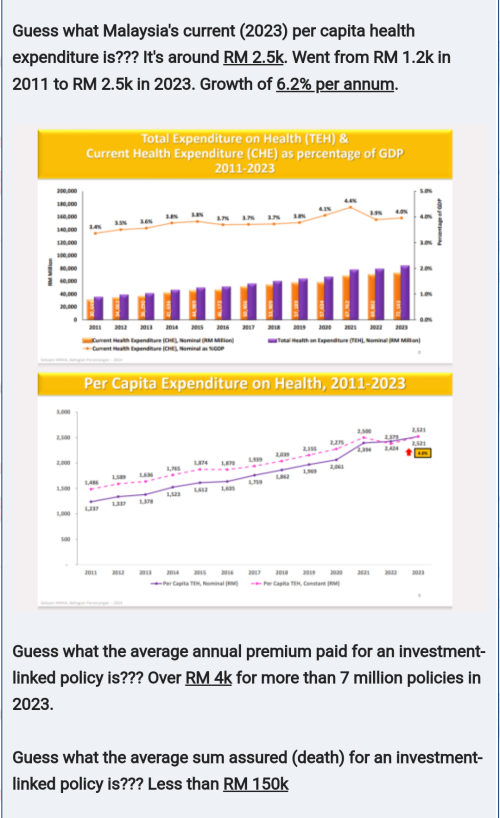
Right now there are more than 7 million IL policyholders and more coming on the way.

The re-pricing will keep occuring, unless we stop them, as they have really kept a tight lid on claims for quite a number of years. They will likely have to loosen their control on the spigot sooner or later so that the medical claims component can at least get to the level of the per capita health expenditure for hospitals/specialists. There may currently at least be an RM 800 ringgit per capita/policyholder gap between the average medical pool claims cost per policyholder and the per capita spend for hospitals/specialists. Bear in mind that the per capita spend for health is also still growing at 6% per annum. It's a moving target that they have to catch up to.

Average IL premiums have already breached RM4k. Don't let them increase the premiums any further and hold them to account for their past underpricing/mispricing errors.

It's best for ITOs to cry uncle now than suffer later.

QUOTE(hafizmamak85 @ Apr 20 2025, 09:27 PM)
Great Eastern's current average medical pool claims cost per policyholder is less than RM 800 - which I think tallies more or less with the LIAM industry average. Prudential's PruHealth is around RM 1.1k. Malaysia's health expenditure per capita in 2023 was around RM 2.5k and is growing at an annual rate of 6%. Let's assume that around RM 1.7 to 1.8k per capita goes to hospitals/specialists for medically necessary treatments/procedures. That's more than a 100% difference when compared to GE's average pool claims cost. For Pru, it's more than a 60% difference.

How many more re-pricing cycles are Malaysian insurance/takaful consumers expected to endure before the average medical pool claims cost can at least catch up to the per capita health expenditure component for hospitals/specialists???

Bear in mind that the current average IL policy annual premium is already above RM 4.4k and there are more than 7 million IL policies paying around RM 29 billion in annual premiums.

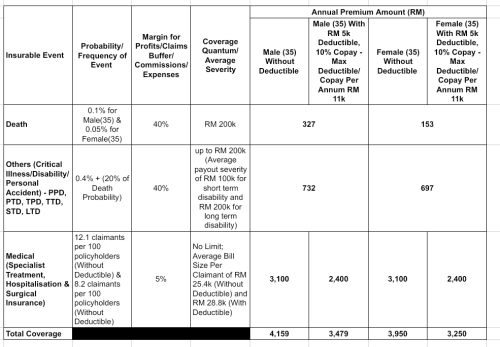
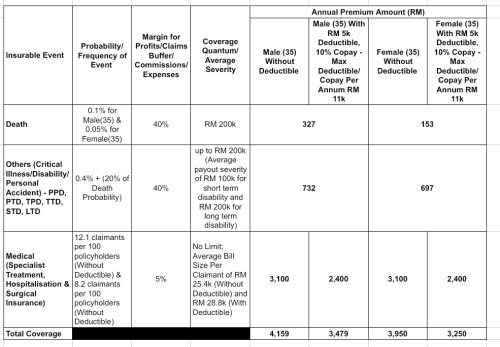
You can easily design and price an insurance/takaful product with RM 200k in death and disability benefits, RM 3.1k in average medical pool claims cost, all for RM 4.2k - has a 40% expense/profit margin for the death and disability components and a 5% expense margin for the medical component. RM 3.1k is almost 4 times as high as GE's average pool claims cost.

» Click to show Spoiler - click again to hide... «


*
This post has been edited by hafizmamak85: May 6 2025, 01:46 AM
1234_4321
post Apr 21 2025, 05:44 PM

Casual
***
Junior Member
328 posts

Joined: Dec 2007


QUOTE(hafizmamak85 @ Mar 23 2025, 06:46 PM)
Unfortunately, for those currently with long-term medical policies, other that suing the ITOs and BNM for unjustifiable and unfair premium hikes, there is nothing much we, as in the public, can do.

But, there is something that can be done by hospitals and specialist centres. They can approach these fledgling digital insurers and takaful operators with a 'friendly' third party administrator, if there is such a thing, and propose to partner in the provision of high coverage medical insurance products for the general public at affordable prices. Get rid of the Big Three's (AIA, PRU and GELM) monopoly and the other mini kootus (Allianz, Hong Leong Assurance etc.).

APHM (private hospitals association) and the specialist centres can tell the DITOs and TPAs, "we'll 'promise' or at least try to keep our costs low but you guys need to do something for us. Get rid of the inner limits and just compete on annual/lifetime limits and R&B, but make them all above 1 mil coverages with or without deductibles/co-pays for all medically necessary treatments/procedures. Cover all medical devices/surgical implants, advanced treatments/procedures, with no exclusions and include coverage for all age groups and pre-existing conditions - no linking of R&B coverage with coverage for treatments/procedures, every type of R&B gets the same level and type of medical care. In exchange, the hospitals and specialists will lower the margins embedded in hospital supplies and services and push some of it back into R&B pricing."

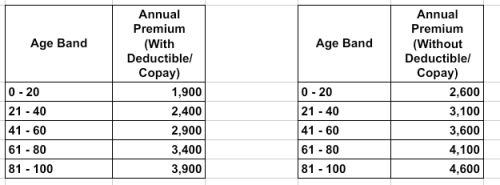
Something tells me that even if all age groups and lives with pre existing conditions were covered, the product would still be affordable. It only costs RM 3100 for a 35 yr old to have a full cover medical card with 12.1 claimants per 100 policyholders and average medical bill size per claimant of RM 25.4k.

user posted image

user posted image
user posted image

Just looks at the ridiculous amounts the BIG three are earning in net profits. Over RM 23 billion within 6 years (2018 - 2023). And they managed to pay out nearly RM 13 billion in dividends/capital reduction during that period. The funny thing is GELM made RM 6.2 billion during the same period and paid out the same amount in dividends. 100% dividend payout - if earnings account for adjustments.
user posted image
*
Since nothing much the public like us can do, what's your advise on reducing the impact for high-cost and forever increasing premium?

I've seen you've mentioned :
1. Don't take ILP Medical Plan.
I've check with a few agents, nowadays most of the available plan is ILP, not much Standalone plan available nowadays.

2. Take something with Co-Pay or "High-Deductible". (Which is not available in most of the lower tier plan)

3. Any ITO to avoid? I've seen you've mentioned GE , despite they are the cheapest in the premium.
What about the other companies, PRU? AIA?

This post has been edited by 1234_4321: Apr 21 2025, 05:44 PM

hafizmamak85
post Apr 21 2025, 06:15 PM

Casual
***
Junior Member
463 posts

Joined: Nov 2009

QUOTE(1234_4321 @ Apr 21 2025, 05:44 PM)

3. Any ITO to avoid? I've seen you've mentioned GE , despite they are the cheapest in the premium.
What about the other companies, PRU? AIA?
*
I think you already know my answer. I'm sorry if my answer may seem bleak.

It's up to you which ITO you would like to go with. But the following are the key indicators you might need to ask your agent for:

QUOTE(hafizmamak85 @ Apr 15 2025, 01:34 AM)
It's just a simple analysis. C for less than RM 1k in average medical pool claims cost per policyholder, B for between RM 1k and RM 2.5k, and A for anything above that. Having said that, this is just one cut of the analysis. Important to query on the average claims size per claimant - be suspicious of those ITOs that have average claims size  below RM 15k.

Unless the other ITOs make their average medical pool claims cost per policyholder and other claims related statistics ( claims ratio, combined ratio (claims + expenses), average claims size per claimant) available online, so that consumers can be informed and make better choices, it's not possible to do an evaluation.

As i'm advocating for high deductible products (the ratings above are based on total claims (policyholder's + ITO's portion)), the coverage for a good one should not only be based on hospital admissions, but for all types of medically necessary treatments/procedures done at hospitals and specialist centres (including dental specialists). All GP and other primary care bills should be counted as part of the deductible.

P.S. I shouldn't have said it's not possible to do an analysis unless info is available online. I just don't have the data. Some of the info (number of claimants and average claims size per claimant) may still be gotten from agents who have clients within re-priced medical pools.
*
Ramjade
post Apr 21 2025, 06:16 PM

20k VIP Club
*********
All Stars
24,387 posts

Joined: Feb 2011


QUOTE(1234_4321 @ Apr 21 2025, 05:44 PM)
Since nothing much the public like us can do, what's your advise on reducing the impact for high-cost and forever increasing premium?

I've seen you've mentioned :
1. Don't take ILP Medical Plan.
I've check with a few agents, nowadays most of the available plan is ILP, not much Standalone plan available nowadays.

2. Take something with Co-Pay or "High-Deductible". (Which is not available in most of the lower tier plan)

3. Any ITO to avoid? I've seen you've mentioned GE , despite they are the cheapest in the premium.
What about the other companies, PRU? AIA?
*
There are standalone available.Only agent not promoting it. You need to ask for it.
AIA, GE, Generali and lonpac have it.
For those 1m coverage above, need to use agent.

For those 100k coverage lots of options available. All can buy online.
hafizmamak85
post Apr 21 2025, 06:29 PM

Casual
***
Junior Member
463 posts

Joined: Nov 2009

QUOTE(Ramjade @ Apr 21 2025, 06:16 PM)
There are standalone available.Only agent not promoting it. You need to ask for it.
AIA, GE, Generali and lonpac have it.
For those 1m coverage above, need to use agent.

For those 100k coverage lots of options available. All can buy online.
*
Please for god's sake, let's stop promoting these 100k products. Just get rid of them. They are not effective at stopping losses. One time kena accident, kena 250k bill, what you gonna do then???
1234_4321
post Apr 21 2025, 06:32 PM

Casual
***
Junior Member
328 posts

Joined: Dec 2007


QUOTE(hafizmamak85 @ Apr 21 2025, 06:15 PM)
I think you already know my answer. I'm sorry if my answer may seem bleak.

It's up to you which ITO you would like to go with. But the following are the key indicators you might need to ask your agent for:
*
Actually for the standard of the agent that I've seen, I really doubt that they can really answer those indicator you've mentioned claims ratio, combined ratio (claims + expenses), average claims size per claimant sweat.gif


Ramjade
post Apr 21 2025, 06:33 PM

20k VIP Club
*********
All Stars
24,387 posts

Joined: Feb 2011


QUOTE(hafizmamak85 @ Apr 21 2025, 06:29 PM)
Please for god's sake, let's stop promoting these 100k products. Just get rid of them. They are not effective at stopping losses. One time kena accident,  kena 250k bill, what you gonna do then???
*
They are effective for people with no money. Not everyone can afford 1m coverage.

Unless you landed up in ICU or have extensive surgery, RM100k coverage more than enough.
kyleen
post Apr 21 2025, 06:47 PM

Getting Started
**
Junior Member
90 posts

Joined: Aug 2011
QUOTE(hafizmamak85 @ Apr 21 2025, 06:29 PM)
Please for god's sake, let's stop promoting these 100k products. Just get rid of them. They are not effective at stopping losses. One time kena accident,  kena 250k bill, what you gonna do then???
*
So dramatic, but what happens is that private hospital will send you to government hospital once 100k runs out. No worries about 250k bill.

hafizmamak85
post Apr 21 2025, 06:59 PM

Casual
***
Junior Member
463 posts

Joined: Nov 2009

QUOTE(kyleen @ Apr 21 2025, 06:47 PM)
So dramatic, but what happens is that private hospital will send you to government hospital once 100k runs out. No worries about 250k bill.
*
There is no continuity of care. That is the point. It's incredibly disruptive. We don't know what level and type of care can be provided at the government facility. This happens in cancer treatment. You run out of insurance coverage then you end up in the government system and there may be issues and other complications due to this. Maybe you might not be able to continue on the same treatment plan as when you were under coverage.

It's ok, for those who can't afford it, by all means please go the government facility. But why should anyone go through this when you have insurance coverage????

This post has been edited by hafizmamak85: Apr 21 2025, 07:05 PM
Ramjade
post Apr 21 2025, 07:36 PM

20k VIP Club
*********
All Stars
24,387 posts

Joined: Feb 2011


QUOTE(hafizmamak85 @ Apr 21 2025, 06:59 PM)
There is no continuity of care. That is the point. It's incredibly disruptive. We don't know what level and type of care can be provided at the government facility. This happens in cancer treatment. You run out of insurance coverage then you end up in the government system and there may be issues and other complications due to this. Maybe you might not be able to continue on the same treatment plan as when you were under coverage.

It's ok, for those who can't afford it, by all means please go the government facility. But why should anyone go through this when you have insurance coverage????
*
Because insurance is based off the coverage and premium you can afford. It's like if you pay for economy ticket, no way you can fly business right? Same thing la. You want business class, need to pay business class price. You want higher coverage, you need to cough up.

Its fair as in the one who pay the higher premium have access to higher coverage. it is like no way a house insurance premium have same coverage for sat a RM1m house and a 5m. Definitely the 5m will be more expensive as the insurance company is taking on more risk/payout so they demand higher premium as compensation.

If you are non profit, it's a different sorry .

Remember insurance is about you paying insurance some money to transfer the risk to them. If you don't claim they make money. If you claim they lose money. But they cannot lose money too much or else shareholder will bising. Many soveign wealth fund or pension fund have insurance in their portfolio to pay for country development or people retirement. But now insurance also wants to make money so package multiple products so that can make more money.

This post has been edited by Ramjade: Apr 21 2025, 07:49 PM
hafizmamak85
post Apr 21 2025, 08:17 PM

Casual
***
Junior Member
463 posts

Joined: Nov 2009

QUOTE(Ramjade @ Apr 21 2025, 07:36 PM)
Because insurance is based off the coverage and premium you can afford.  It's like if you pay for economy ticket, no way you can fly business right? Same thing la. You want business class, need to pay business class price. You want higher coverage, you need to cough up.

Its fair as in the one who pay the higher premium have access to higher coverage. it is like no way a house insurance premium have same coverage for sat a RM1m house and a 5m. Definitely the 5m will be more expensive as the insurance company is taking on more risk/payout so they demand higher premium as compensation.

*
This has been explained before. It's not the big claims that are an issue, it's the more frequent small claims that are causing premium prices to increase. The difference in annual limits at the higher end don't make much of a difference. It all depends on the types of treatments, procedures available. It is not the case, to my mind, that there is a RM 500k treatment option under the 1 million annual limit and another RM 1.5mil treatment option under the 2 million annual limit for the same type of disease/disability burden - and even if that was the case, the frequency of such a disease/disability burden would be minimal enough to not make much of a difference for the purpose of pricing premiums. It would be more impactful from a premium pricing perspective if there were two treatment options, with one being RM 2k and another RM 5k, both covered under the 1 mil and 2 mil annual limit options for the same disease/disability burden, as the smaller claims tend to have a much higher claims frequency and variations in claims severity for the same type of disease/disability burden.

This post has been edited by hafizmamak85: Apr 21 2025, 08:29 PM
Jason
post Apr 21 2025, 09:15 PM

Look at all my stars!!
*******
Senior Member
6,355 posts

Joined: Jan 2003
hafizmamak85 bruh I feel your passion, I really do. and you can champion the good fight.

Laymans like me? I still need insurance lol, whether they are evil or not. Health insurance is required because it can be crippling, both physically and financially.

Ramjade medisavers underwritten by Lonpac macam yes. But they first sell via MLM, then now Metafin, and everything is spun off by Pathlab, I don't know why they make it so damn dodgy when the product is solid.

389 Pages « < 354 355 356 357 358 > » Top
 

Change to:
| Lo-Fi Version
0.0229sec    0.58    6 queries    GZIP Disabled
Time is now: 15th December 2025 - 02:03 AM