QUOTE(Quazacolt @ Jul 4 2025, 06:52 AM)
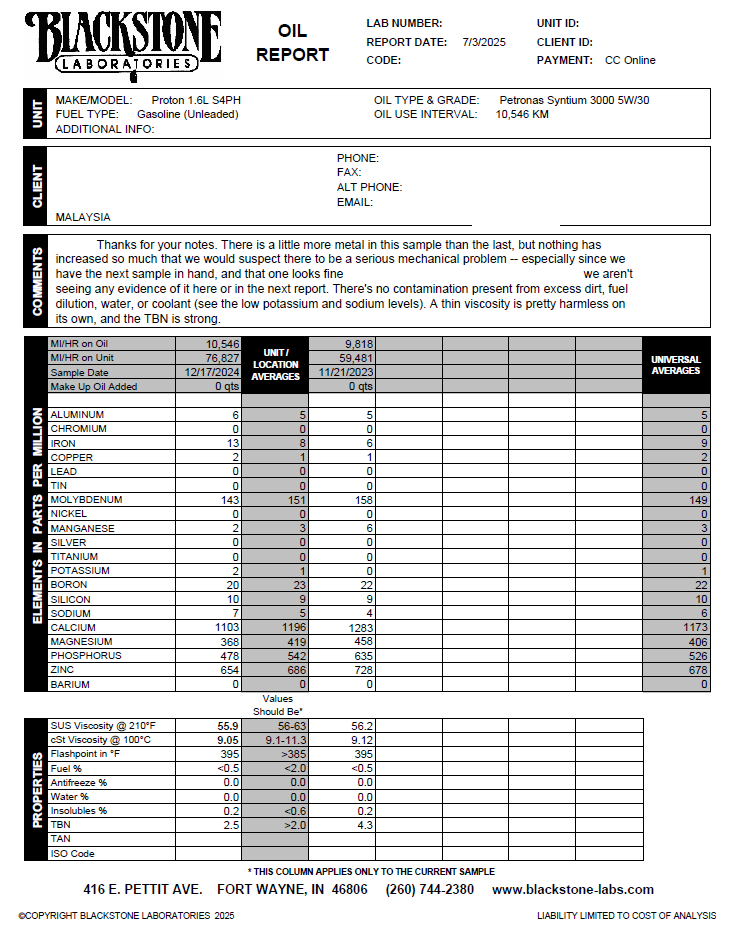
Proton Iriz CamPro engine after numerous Sepang track days and Tougehttps://www.quazacolt.com/uoa/others/202412...etronas3000.png» Click to show Spoiler - click again to hide... «
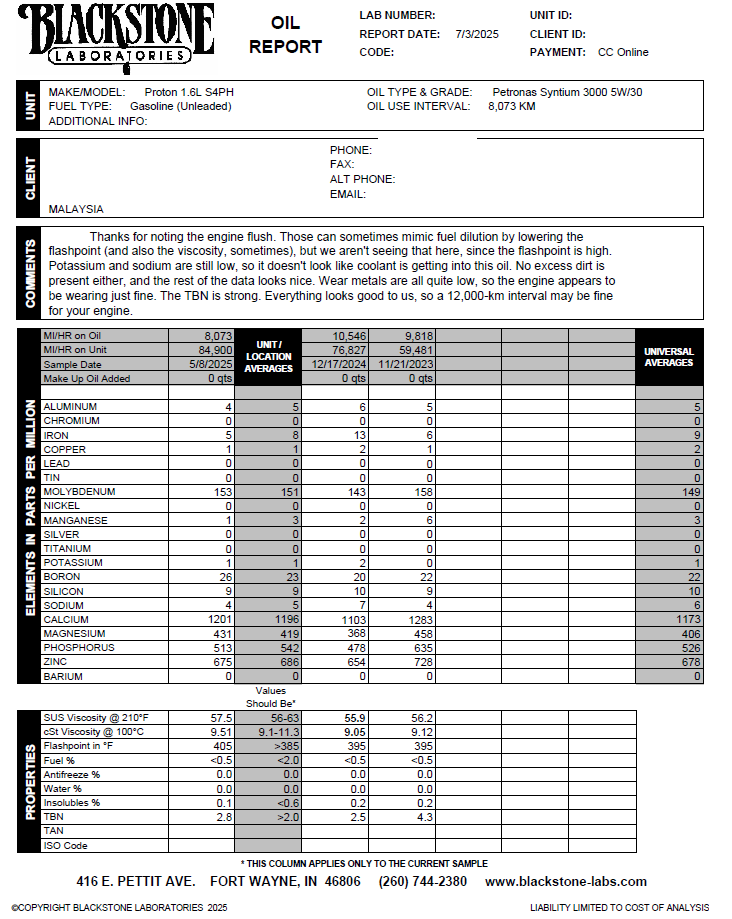
second follow up samplehttps://www.quazacolt.com/uoa/others/202505...etronas3000.png» Click to show Spoiler - click again to hide... «
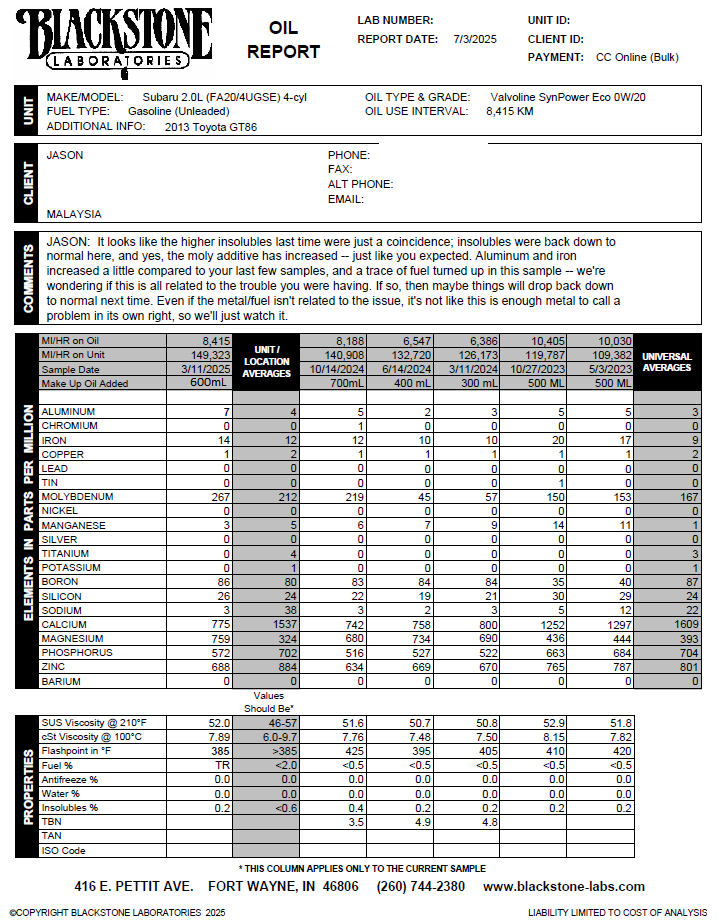
My own GT86 with Valvoline SynPower Eco 0w20 and now with Tan Chong MoS2 additives ,
Moly (MoS2) very slight increase with continual usage
https://www.quazacolt.com/uoa/gt86/20250311...ineEco_MoS2.png» Click to show Spoiler - click again to hide... «
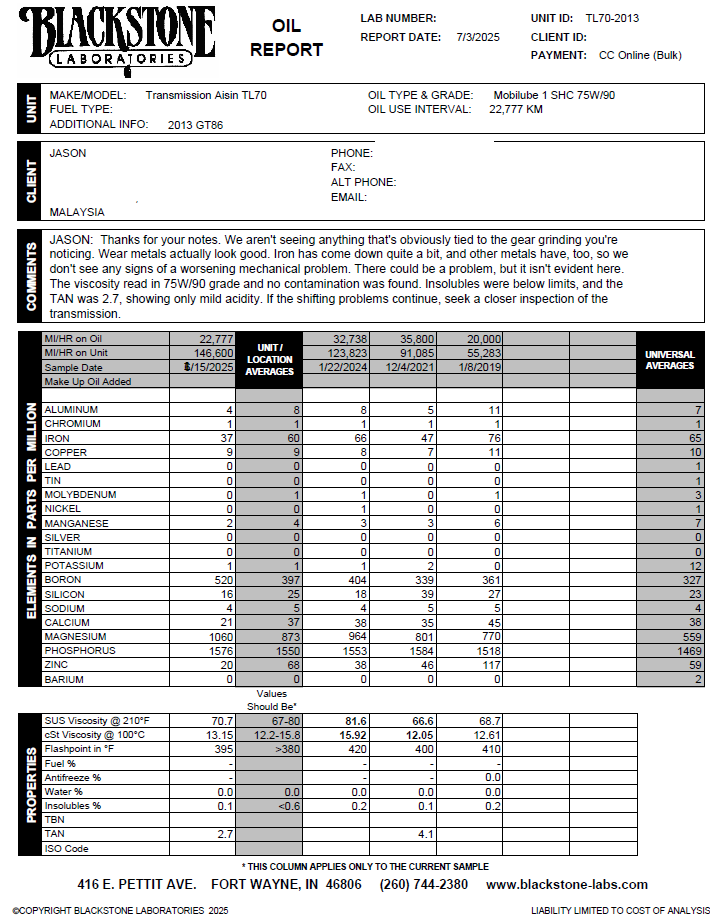
Finally! first Mobil 1 SHC 75w90 gear oil sample!https://www.quazacolt.com/uoa/gt86/20250115...0_Mobil1SHC.png» Click to show Spoiler - click again to hide... «
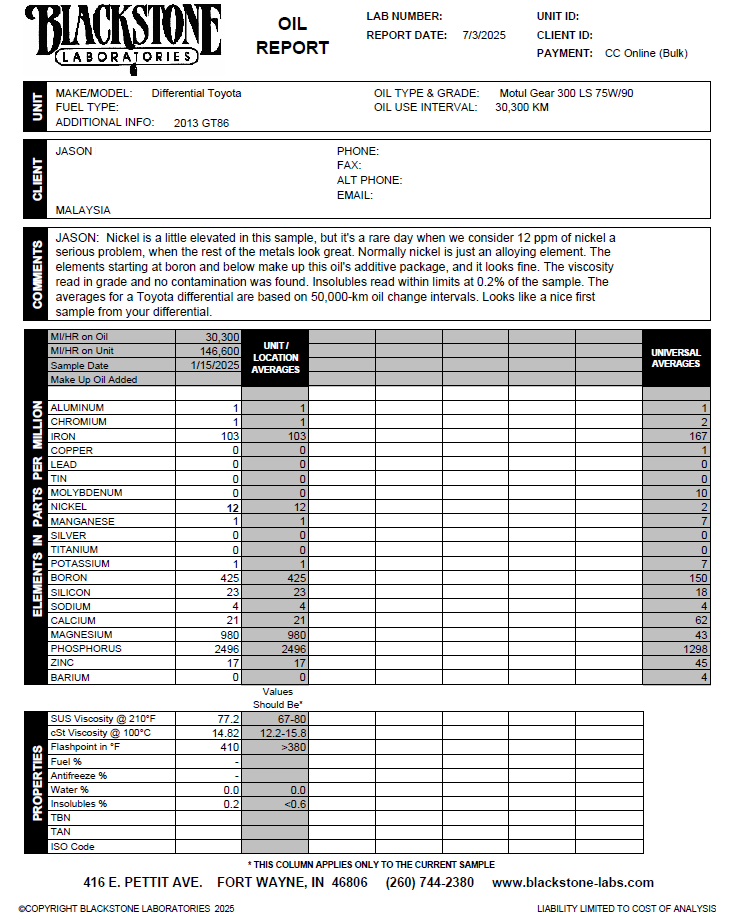
My First LSD sample, using Motul Gear 300 LS 75w90https://www.quazacolt.com/uoa/gt86/20250115...ulGear300LS.png» Click to show Spoiler - click again to hide... «
no Q&A yet as Blackstone labs getting even slower, lol.
not to mention various typos and errors compared to information provided from my oil slips. (all 3 reports also contained typos and errors)
Finally Q&A from my end
Engine1) Can we consider the up trend of aluminium and iron be related to the Moly additives? or just a negligible difference that's probably just from the slight increase of mileage ran?
I think this is more just a negligible difference based on changes in mileage/use.2) What does Trace (TR) mean in the report? Specifically, what % of fuel is present as opposed to a number value of previous samples such as <0.5? Or is it a binary value "yes or no" that is either trace or below 0.5?
It means "trace" — not enough to quantify. So, yes, there's fuel present, but the way we measure fuel, we can't get precise enough to say how much. 3) Would throttle body cleaners contribute to fuel trace?
I'm not entirely sure. Depends on when you used them and how much you used, I would guess... but this isn't something that, to my knowledge, we've isolated as a variable and tested. 4) From what I've mentioned in the notes, would the increased Silicon be a result of the vacuum leak?
It could be, sure. Manual Transmission1) What does Boron and Magnesium do for transmission additives?
I'm not entirely sure. In engine oils they serve as anti-wear/anti-corrosion additives and detergent/dispersant additives, but I don't know that we know for sure what purpose they serve in transmission fluid. Might be the same purpose. 2) Considering the additives are quite identical, the only difference between Mobil and Motul is just the base oil?
I don't know that I'd call them identical, but very, very similar. There could be other things that are different between them — things we don't test. Like, for example, the base stock of the oil. 3) Does Blackstone Labs have any tests that can identify any samples's base oil?
Not at this time. Rear Differential / LSD1) As this is my first rear differential sample, and the car was manufactured in 2013, with a significant amount of mileage, it seems like the differential is still kinda running in from the wear trend? (nickel / silicon amount)
I'm not sure — I guess it depends on how many oil changes have been done. If it's been more than a couple oil changes, I wouldn't expect this metal to still be from wear-in. 2) My friend's previous report highlighted a lot more Nickel as I was slightly worried, and referred to his report [omit]
His unit was considerably newer; probably that was a break-in sample.3) It does beg the question: Why do the universal averages differ quite a bit from both our differential sample reports? It's as if the universal average does not contain nickel at all while ours have a lot more.
Because our differential average files aren't as precise as what the engine average files are. Most people have no idea of the make/model of their differential, so anything that comes with a Toyota name is put together in the average file — Anything from Tundras and other pickup trucks to sportier cars. It would be ideal if we separated the units out a bit more and had precise averages, but we don't see as many differential samples as we do engine oil samples, so the number of samples (and the lack of information about the samples) prevents more specific averages from being created.4) My friend's (assuming) factory fill seemed a lot thinner. How much does viscosity contribute in reducing wear?
I don't know that it does, necessarily. For differentials, this isn't something we've explored a lot. We've explored it a bit more in engine oil samples just because we get so many more engine oil samples than differential samples, so there's enough data to come up with some meaningful reults. Also, the frequency of sampling engine oil vs differential samples lends itself to a bit more comprehensive examination. It's hard with differentials when they're only sampled every 30,000 miles — and sometimes they're only sampled once or twice within a vehicle's life. It's hard to get any hard-and-fast data on how viscosity affects wear patterns. 5) Considering probably the only downside for thicker viscosity oils in a Torsen differential is only fuel consumption or efficiency, if reducing wear is the goal, just go as thick as possible?
I don't know; we don't have enough data to say. (see previous question) 

 Jul 13 2025, 03:32 PM


 Quote
Quote











 0.0211sec
 0.54
0.54
 6 queries
 GZIP Disabled