Welcome Guest ( Log In | Register )

Bump Topic Topic Closed RSS Feed
63 Pages « < 36 37 38 39 40 > » Bottom

Outline · [ Standard ] · Linear+

 LYN Christian Fellowship V14 (Group)

views
     
yeeck
post Feb 14 2019, 12:51 PM

Look at all my stars!!
*******
Senior Member
3,578 posts

Joined: Apr 2006


QUOTE(prophetjul @ Feb 14 2019, 09:57 AM)
There are only TWO passages in the NT which uses this phrase "full of grace".
NONE applied to Mary.
*
Wrong.

"And the Word became flesh and dwelt among us, and we beheld His glory, the glory as of the only begotten of the Father, full of grace and truth" (John 1:14). This one applies to Christ, the Word made Flesh.

"And Stephen, full of grace and fortitude, did great wonders and signs among the people." (Acts 6:8) This one applies to Stephen.

"And the angel being come in, said unto her: Hail, full of grace, the Lord is with thee: blessed art thou among women." (Luke 1:28). This one applies to Mary.

Do check the Greek words used, I think unknown warrior can explain, after which I will add in with the Catholic understanding from his explanation.
prophetjul
post Feb 14 2019, 12:59 PM

10k Club
********
All Stars
12,279 posts

Joined: Oct 2010

QUOTE(yeeck @ Feb 14 2019, 12:34 PM)
As if you know God's will and not the rest? Hehe
*
I do not know God's will but for His scriptures. Your traditions have many conflicts with His scriptures.
prophetjul
post Feb 14 2019, 01:02 PM

10k Club
********
All Stars
12,279 posts

Joined: Oct 2010

QUOTE(yeeck @ Feb 14 2019, 12:51 PM)
Wrong.

"And the Word became flesh and dwelt among us, and we beheld His glory, the glory as of the only begotten of the Father, full of grace and truth" (John 1:14). This one applies to Christ, the Word made Flesh.

"And Stephen, full of grace and fortitude, did great wonders and signs among the people." (Acts 6:8) This one applies to Stephen.

"And the angel being come in, said unto her: Hail, full of grace, the Lord is with thee: blessed art thou among women." (Luke 1:28). This one applies to Mary.

Do check the Greek words used, I think unknown warrior can explain, after which I will add in with the Catholic understanding from his explanation.
*
WRONG.

And the angel came in unto her, and said, Hail, thou that art highly favoured, the Lord is with thee: blessed art thou among women. Lk 1:28

The phrase "full of grace" in Greek is "plaras karitos," and it occurs in only two places in the New Testament; neither one is in reference to Mary.

"And the Word became flesh, and dwelt among us, and we beheld His glory, glory as of the only-begotten from the Father, full of grace and truth," (John 1:14).
"And Stephen, full of grace and power, was performing great wonders and signs among the people," (Acts 6:8).

Your verse is taken from the LATIN Vulgate, a very bad translation by Jerome.
prophetjul
post Feb 14 2019, 01:04 PM

10k Club
********
All Stars
12,279 posts

Joined: Oct 2010

QUOTE(yeeck @ Feb 14 2019, 12:35 PM)
They are when they intend to definitively teach the faithful. And you brought up the clear example of Peter that he was given the authority, but also as human he can fail/fall personally.
*
What's to definitively teach the faithful? He could teach wrong things but for the scriptures as their guide.
ALWAYS check with the scriptures.
pehkay
post Feb 14 2019, 01:21 PM

Getting Started
**
Junior Member
145 posts

Joined: Jan 2008


Wah if like that Stephen will be sinless too smile.gif
prophetjul
post Feb 14 2019, 01:33 PM

10k Club
********
All Stars
12,279 posts

Joined: Oct 2010

QUOTE(pehkay @ Feb 14 2019, 01:21 PM)
Wah if like that Stephen will be sinless too smile.gif
*
icon_question.gif
yeeck
post Feb 14 2019, 03:01 PM

Look at all my stars!!
*******
Senior Member
3,578 posts

Joined: Apr 2006


QUOTE(prophetjul @ Feb 14 2019, 01:02 PM)
WRONG.

And the angel came in unto her, and said, Hail, thou that art highly favoured, the Lord is with thee: blessed art thou among women. Lk 1:28

The phrase "full of grace" in Greek is "plaras karitos," and it occurs in only two places in the New Testament; neither one is in reference to Mary.

"And the Word became flesh, and dwelt among us, and we beheld His glory, glory as of the only-begotten from the Father, full of grace and truth," (John 1:14).
"And Stephen, full of grace and power, was performing great wonders and signs among the people," (Acts 6:8).

Your verse is taken from the LATIN Vulgate, a very bad translation by Jerome.
*
For Luke 1:28, it's κεχαριτωμένη (kecharitomene).

For John 1:14, it's πλήρης χάριτος (pleres charitos), same as for Acts 6:8.

"Full of grace" is literally "pleres charitos," and that wording is used in reference to Jesus (John 1:14) and to St. Stephen (Acts 6:8). Obviously, its used with two different meanings in those two passages, but its meaning is clearly gleamed by its context. Technically, anyone who was recently baptized or received the sacrament of confession is pleres charitos.

In Luke 1:28, the word that the angel uses is kecharitomene. So its not literally "full of grace," but its root word is the Greek verb "to give grace" (charitoo). The word is the past perfect tense, meaning that the action of giving grace has already occurred. It was not something that was about to happen to her but something that has already been accomplished. The word was also used as a title. The angel did not say, "Hail Mary, you are kecharitomene" but rather, "Hail kecharitomene." Therefore the word is not simply an action but an identity.

It is thus difficult to translate because it is a unique use of the word. It has been translated by various scholars as "full of grace", "graced one," "one who has been made graced," "highly graced," and "highly favored." In the last instance the translator is using the concept that to be graced by God is to find favor with God. It would appear that any translation should use the word "grace," because that is the root word.

However, it might sound "clunky" to some—they might think "highly favored" is more title-sounding than "full of grace," and there is nothing inherently incorrect theologically about asserting that Mary was favored by God. The early Christians certainly believed in Mary's sinlessness, and they are more trustworthy witnesses rather than the later comer Protestants who arrived more than 1500 years late to deny this belief.

The constant faith of the Church attests to the belief in the special preparation of the holiness of the person of Mary to bear in her body the most holy person of the Son of God. Implicitly found in the Fathers of the Church in the parallelism between Eve and Mary (Irenaeus, Lyons, 140? - 202?); Found in the more general terms about Mary: "holy", "innocent", "most pure", "intact", "immaculate" (Irenaeus, Lyons, 140?-202?; Ephraem, Syria, 306-373; Ambrose, Milan, 373-397); Explicit language: Mary - free from original sin (Augustine, Hippo, 395-430 to Anselm, Normandy, 1033-1109).
yeeck
post Feb 14 2019, 03:03 PM

Look at all my stars!!
*******
Senior Member
3,578 posts

Joined: Apr 2006


QUOTE(prophetjul @ Feb 14 2019, 01:04 PM)
What's to definitively teach the faithful? He could teach wrong things but for the scriptures as their guide.
ALWAYS check with the scriptures.
*
Even when you check with scriptures, you have different intepretations, which is exactly the cause of the mushrooming multiple churches of different beliefs, especially after Luther. Oh, perhaps you should consider who defined the canon of Scripture that you are accepting.
yeeck
post Feb 14 2019, 03:04 PM

Look at all my stars!!
*******
Senior Member
3,578 posts

Joined: Apr 2006


QUOTE(pehkay @ Feb 14 2019, 01:21 PM)
Wah if like that Stephen will be sinless too smile.gif
*
Which is why I wanted unknown warrior to give the Greek explanation first wink.gif. To say that at that point of time that Stephen was sinless is not wrong, as he was baptised not long before. The Catholic Church teaches that baptism washes away both original and actual sin. wink.gif This is certainly different from Mary's Immaculate Conception, where she was graced by God with this privilege as preparation for the Word to become Flesh.

This post has been edited by yeeck: Feb 14 2019, 03:07 PM
prophetjul
post Feb 14 2019, 03:52 PM

10k Club
********
All Stars
12,279 posts

Joined: Oct 2010

QUOTE(yeeck @ Feb 14 2019, 03:01 PM)
For Luke 1:28, it's κεχαριτωμένη (kecharitomene).

For John 1:14, it's πλήρης χάριτος (pleres charitos), same as for Acts 6:8.

"Full of grace" is literally "pleres charitos," and that wording is used in reference to Jesus (John 1:14) and to St. Stephen (Acts 6:8). Obviously, its used with two different meanings in those two passages, but its meaning is clearly gleamed by its context. Technically, anyone who was recently baptized or received the sacrament of confession is pleres charitos.

In Luke 1:28, the word that the angel uses is kecharitomene. So its not literally "full of grace," but its root word is the Greek verb "to give grace" (charitoo). The word is the past perfect tense, meaning that the action of giving grace has already occurred. It was not something that was about to happen to her but something that has already been accomplished. The word was also used as a title. The angel did not say, "Hail Mary, you are kecharitomene" but rather, "Hail kecharitomene." Therefore the word is not simply an action but an identity.


Means your Latin Vulgate translation of "ave gratia plena" "Hail full of grace." is faulty.

The single Greek word kexaritomena and means highly favored, make accepted, make graceful, etc. It does not mean "full of grace" which is "plaras karitos" (plaras = full and karitos = Grace) in the Greek.


5923 χαριτόω (charitoō): vb.; Str 5487; TDNT 9.372—LN 88.66 show kindness graciously give, freely give (Eph 1:6); as a passive participle, subst., “one highly favored.”1
5487 χαριτόω [charitoo /khar·ee·to·o/] v. From 5485; TDNT 9:372; TDNTA 1298; GK 5923; Two occurrences; AV translates as “be highly favoured” once, and “make accepted” once. 1 to make graceful. 1a charming, lovely, agreeable. 2 to peruse with grace, compass with favour. 3 to honour with blessings.2

So you have rightly pointed out that the phrase "full of grace" is only found in two places in the NT. And both occasions did not apply to Mary. Thank You.


QUOTE

It is thus difficult to translate because it is a unique use of the word. It has been translated by various scholars as "full of grace", "graced one," "one who has been made graced," "highly graced," and "highly favored." In the last instance the translator is using the concept that to be graced by God is to find favor with God. It would appear that any translation should use the word "grace," because that is the root word.


So what do the other translations say about Luke 1:28? Let's find out.

The Nestle-Aland 26th edition, Greek New Testament Interlinear--"having gone into her he said rejoice one having been favored, the master is with you."
The NRSV English-Greek Reverse Interlinear New Testament--And he came to her and said, "Greetings, favored one! The Lord is with you."
American Standard Version--"And he came in unto her, and said, Hail, thou that art highly favored, the Lord is with thee."
English Standard Version--"And he came to her and said, Greetings, O favored one, the Lord is with you!
Today's English Version--'"The angel came to her and said, “Peace be with you! The Lord is with you and has greatly blessed you!”
King James Version--"And the angel came in unto her, and said, Hail, thou that art highly favoured, the Lord is with thee: blessed art thou among women."
New American Standard Bible--"And coming in, he said to her, Hail, favored one! The Lord is with you.
New International Version--"The angel went to her and said, Greetings, you who are highly favored! The Lord is with you.
New King James Version--"And having come in, the angel said to her, Rejoice, highly favored one, the Lord is with you; blessed are you among women!"
Revised Standard Version--"And he came to her and said, 'Hail, O favored one, the Lord is with you!'
New Revised Standard Version--And he came to her and said, “Greetings, favored one! The Lord is with you.”
The New Century Version--The angel came to her and said, “Greetings! The Lord has blessed you and is with you.”
New Living Translation--Gabriel appeared to her and said, “Greetings, favored woman! The Lord is with you!'”
The Cambridge Paragraph Bible--And the angel came in unto her, and said, Hail, 'thou that art 'highly favoured, 'the Lord is with thee: 'blessed art thou among women.'
The Holman Christian Standard Bible--"And the angel came to her and said, “Rejoice, favored woman! The Lord is with you."
International Standard Version--'"The angel'' came to her and said, “'Greetings, you who are highly favored! The Lord is with you!"

QUOTE

However, it might sound "clunky" to some—they might think "highly favored" is more title-sounding than "full of grace," and there is nothing inherently incorrect theologically about asserting that Mary was favored by God. The early Christians certainly believed in Mary's sinlessness, and they are  more trustworthy witnesses rather than the later comer Protestants who arrived more than 1500 years late to deny this belief.


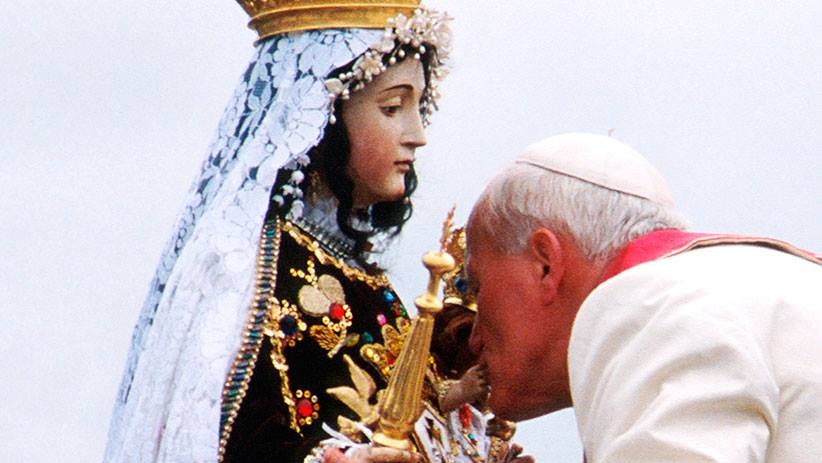
Trying to justify your pagan understanding again? The apostles and prophets would have seriously protested if you did this.

user posted image

Ex 20
4Thou shalt not make unto thee any graven image, or any likeness of any thing that is in heaven above, or that is in the earth beneath, or that is in the water under the earth:

5 Thou shalt not bow down thyself to them, nor serve them: for I the LORD thy God am a jealous God, visiting the iniquity of the fathers upon the children unto the third and fourth generation of them that hate me;

QUOTE
The constant faith of the Church attests to the belief in the special preparation of the holiness of the person of Mary to bear in her body the most holy person of the Son of God. Implicitly found in the Fathers of the Church in the parallelism between Eve and Mary (Irenaeus, Lyons, 140? - 202?); Found in the more general terms about Mary: "holy", "innocent", "most pure", "intact", "immaculate" (Irenaeus, Lyons, 140?-202?; Ephraem, Syria, 306-373; Ambrose, Milan, 373-397); Explicit language: Mary - free from original sin (Augustine, Hippo, 395-430 to Anselm, Normandy, 1033-1109).
*
Luke 11

27 And it came to pass, as he spake these things, a certain woman of the company lifted up her voice, and said unto him, Blessed is the womb that bare thee, and the paps which thou hast sucked.

28 But he said, Yea rather, blessed are they that hear the word of God, and keep it

desmond2020
post Feb 14 2019, 05:08 PM

Enthusiast
*****
Junior Member
911 posts

Joined: Jun 2005


QUOTE(pehkay @ Feb 14 2019, 01:21 PM)
Wah if like that Stephen will be sinless too smile.gif
*
If ransom of sin is death, in bible there is two.person who don't suffer death.


.... then it means they are sinless?
pehkay
post Feb 14 2019, 05:44 PM

Getting Started
**
Junior Member
145 posts

Joined: Jan 2008


QUOTE(desmond2020 @ Feb 14 2019, 05:08 PM)
If ransom of sin is death, in bible there is two.person who don't suffer death.
.... then it means they are sinless?
*
You meant Enoch and Elijah?
desmond2020
post Feb 14 2019, 06:01 PM

Enthusiast
*****
Junior Member
911 posts

Joined: Jun 2005


QUOTE(pehkay @ Feb 14 2019, 05:44 PM)
You meant Enoch and Elijah?
*
Yeah


By no means I think they are sinless.


Just to point out the problem with sinless mary doctrine

pubgblackpink
post Feb 14 2019, 11:42 PM

New Member
*
Newbie
13 posts

Joined: Feb 2019
Where in the Bible did Catholics decided to worship Mary? Even the angels revealed in Revelation to worship God.
unknown warrior
post Feb 15 2019, 09:20 AM

/k/ Legend
*******
Senior Member
6,240 posts

Joined: Jul 2005
QUOTE(yeeck @ Feb 14 2019, 12:33 PM)
Nope, being sinless doesn't mean she is divine. The Church still teaches that she is a created being. No where does the Church teaches that she is equal to Christ or equal to God. I guess most Protestants have issue with the title Mother of God, which is also an issue with Nestorius.
*
but problem is, some of your catholic brethren venerate her as divine which I personally feel very uncomfortable. For me I don't see the reason why, neither the need to venerate Mary as how your catholic venerate other saints and angels. I guess we have different perspective of things when it comes to Christianity, however I hope that doesn't cause you to think any less of us who are not catholics.

For me I don't judge whether catholics are saved, you believe in Christ then you're a bro in Christ to me. However if you think we protestant are never a church or a Christian, then that will not bold well for unity as how Christ prayed in the garden of Gethsemane.


One more thing, you are quite wrong in the matter of washing of sin. Baptism in water does not wash away sins. It's the blood of Christ that washes away sin. Because if you insist Baptism does wash away sin, then the thief on the cross wasn't baptized in water, yet Christ permitted him to paradise, you'll have a hard time to argue against that.

This post has been edited by unknown warrior: Feb 15 2019, 11:06 AM
yeeck
post Feb 15 2019, 11:08 AM

Look at all my stars!!
*******
Senior Member
3,578 posts

Joined: Apr 2006


QUOTE(prophetjul @ Feb 14 2019, 03:52 PM)
Means your Latin Vulgate translation of "ave gratia plena" "Hail full of grace." is faulty. 

The single Greek word kexaritomena and means highly favored, make accepted, make graceful, etc.  It does not mean "full of grace" which is "plaras karitos" (plaras = full and karitos = Grace) in the Greek.
5923 χαριτόω (charitoō): vb.; Str 5487; TDNT 9.372—LN 88.66 show kindness graciously give, freely give (Eph 1:6); as a passive participle, subst., “one highly favored.”1
5487 χαριτόω [charitoo /khar·ee·to·o/] v. From 5485; TDNT 9:372; TDNTA 1298; GK 5923; Two occurrences; AV translates as “be highly favoured” once, and “make accepted” once. 1 to make graceful. 1a charming, lovely, agreeable. 2 to peruse with grace, compass with favour. 3 to honour with blessings.2

So you have rightly pointed out that the phrase "full of grace" is only found in two places in the NT. And both occasions did not apply to Mary. Thank You.
So what do the other translations say about Luke 1:28?  Let's find out.

The Nestle-Aland 26th edition, Greek New Testament Interlinear--"having gone into her he said rejoice one having been favored, the master is with you."
The NRSV English-Greek Reverse Interlinear New Testament--And he came to her and said, "Greetings, favored one! The Lord is with you."
American Standard Version--"And he came in unto her, and said, Hail, thou that art highly favored, the Lord is with thee."
English Standard Version--"And he came to her and said, Greetings, O favored one, the Lord is with you!
Today's English Version--'"The angel came to her and said, “Peace be with you! The Lord is with you and has greatly blessed you!”
King James Version--"And the angel came in unto her, and said, Hail, thou that art highly favoured, the Lord is with thee: blessed art thou among women."
New American Standard Bible--"And coming in, he said to her, Hail, favored one! The Lord is with you.
New International Version--"The angel went to her and said, Greetings, you who are highly favored! The Lord is with you.
New King James Version--"And having come in, the angel said to her, Rejoice, highly favored one, the Lord is with you; blessed are you among women!"
Revised Standard Version--"And he came to her and said, 'Hail, O favored one, the Lord is with you!'
New Revised Standard Version--And he came to her and said, “Greetings, favored one! The Lord is with you.”
The New Century Version--The angel came to her and said, “Greetings! The Lord has blessed you and is with you.”
New Living Translation--Gabriel appeared to her and said, “Greetings, favored woman! The Lord is with you!'”
The Cambridge Paragraph Bible--And the angel came in unto her, and said, Hail, 'thou that art 'highly favoured, 'the Lord is with thee: 'blessed art thou among women.'
The Holman Christian Standard Bible--"And the angel came to her and said, “Rejoice, favored woman! The Lord is with you."
International Standard Version--'"The angel'' came to her and said, “'Greetings, you who are highly favored! The Lord is with you!"

Ex 20
4Thou shalt not make unto thee any graven image, or any likeness of any thing that is in heaven above, or that is in the earth beneath, or that is in the water under the earth:

5 Thou shalt not bow down thyself to them, nor serve them: for I the LORD thy God am a jealous God, visiting the iniquity of the fathers upon the children unto the third and fourth generation of them that hate me;
Luke 11

27 And it came to pass, as he spake these things, a certain woman of the company lifted up her voice, and said unto him, Blessed is the womb that bare thee, and the paps which thou hast sucked.

28 But he said, Yea rather, blessed are they that hear the word of God, and keep it

*
This raises the question as to how to translate the word at issue (kecharitōmenē) in the first place. The word is a form of the verb charitoō. This word should look familiar, even to non-Greek speakers. It’s where we get our word charisma, which refers to someone’s gift as a leader. In ancient Greek, the companion noun was charis, the stock New Testament word for grace. Although it’s sometimes translated as favor, it overwhelmingly is rendered in the King James Bible as grace. (Out of 156 instances, 132 read as grace, while just 7 are favor. Most of the rest appear to be translated as a form of thanks.)

We are right to suspect that charitoō then has something to do with grace as we understand it. And that’s exactly how it’s defined. Vine’s Expository Dictionary of New Testament Words defines the verb this way: “to endow with charis, primarily signified ‘to make graceful or gracious,’ … ‘to cause to find favor.’” Thayer’s Greek Lexicon puts it this way: “to pursue with grace, to compass with favor.” Another dictionary drops “favor” altogether and gives us this definition: “kecharitōmenē … means endowed with grace.”

However, these definitions do leave it open-ended as to whether grace or favor is the way to go. Although favor and grace have related meanings they remain distinct. In a theological context, grace is a free and unmerited gift of God. Grace is something given to someone. Usually we think of a favor as something done for someone else. So which way do we go in Luke 1? Unlike the noun, the verb is used only one other time in the New Testament, so we don’t have too many verses to guide us on how it’s used. (For the record, the other instance is Ephesians 1:6 and the most common translation is grace.)

Fortunately, the text does not leave us hanging. After Mary’s initial apprehension, the angel tells her, “Fear not, Mary, for thou hast found grace with God” (Luke 1:30). Grace here is the noun charis, which we’ve already established usually means grace and only rarely favor (in the New Testament at least). If Luke 1:28 was unclear, Luke 1:30 is our clarification. This should settle it. We’re talking about grace.


Now our question becomes: How much grace did Mary receive and when? The dogma of the Immaculate Conception holds that Mary was fully graced from the moment of conception, that through the grace of God, Mary’s life was one without sin. Is this supported by Luke 1:28?

For the answer, we now turn from the dictionary to the grammar book. As mentioned above kecharitōmenē is a form of the verb charitoō. Our focus will be on the tense. A verb tense at the most basic level refers to the time of action. “I wrote an article” is an example of the past tense. “I am writing” is present and “I will write” is future. Now in ancient Greek there were more than just these three simple tenses. There were other tenses that tell us something about the action done and its enduring impact. And that’s where things get exciting.

Kecharitōmenē is the “perfect” tense of charitoō. According to Herbert Weir Smyth’s A Greek Grammar for Colleges—still the bible for Greek grammar today—defines the perfect tense this way: “The perfect denotes a completed action the effects of which still continue in the present.” So Mary received grace in some complete way and remains completed in that grace. We’re coming awfully close to the Catholic dogma.

Or are we reading too much into this? Here’s the conclusion two scholars draw: “It is permissible, on Greek grammatical and linguistic grounds, to paraphrase kecharitōmenē as completely, perfectly, enduringly endowed with grace” (Blass and DeBrunner, Greek Grammar of the New Testament).

Indeed, to say that Mary was “completely, perfectly, enduringly endowed with grace” is not only a restatement of the dogma of the Immaculate Conception, it also points forward to the traditional teaching that Mary is a “Mediatrix of all graces” (yet to be dogmatically defined). If anything, “full of grace,” seems to understate what the Greek text is saying. But “filled completely, perfectly, and enduringly” is a mouthful, so it’s easy to see why the Vulgate went with the more poetic approximation “full of grace.” Don't forget, St Jerome was translating into Latin which was the lingua franca then.

By turns the dictionary, concordance, and grammar argue for the Catholic reading of Luke 1:28.

Three facts from the narrative seal the case. First, as St. Thomas Aquinas notes in his commentary on the Hail Mary, the angel’s reverent salutation of Mary is a complete reversal of roles from the Old Testament, in which men revered angels. Such reverence was due to angels because angels have a spiritual and incorruptible nature, are more familiar with God, and “partake most fully of the divine light.” In revering Mary, then, then Angel Gabriel is showing that she surpasses the angels in these three aspects. Only someone “full of grace” could merit such extraordinary reverence.

Second, in the Greek text, as Aquinas points out, Mary’s name is missing from Luke 1:28. The text literally reads as “Hail, full of grace.” Mary has become so “full of grace” that it has consumed her completely—it has become more who she is even than even her very name.

This omission makes the most sense if we translate the verb as grace and not as favor. A favor does not involve the interior man (or woman). It chiefly is concerned with their exterior circumstances. I can do a favor for you without changing who you are (for example, buy you a car, or get you a job). God’s grace changes who we are. Grace implies a spiritual state or interior condition (hence the phrase “state of grace”). One can imagine, then, that someone could be in such an intensive state of grace that it defines their whole personality.

Third, Mary’s reaction to the angel’s words is a giant clue as to their significance. Here is the text again (Douay-Rheims translation):

[28] And the angel being come in, said unto her: Hail, full of grace, the Lord is with thee: blessed art thou among women. [29] Who having heard, was troubled at his saying, and thought with herself what manner of salutation this should be. [30] And the angel said to her: Fear not, Mary, for thou hast found grace with God.

[31] Behold thou shalt conceive in thy womb, and shalt bring forth a son; and thou shalt call his name Jesus. [32] He shall be great, and shall be called the Son of the most High; and the Lord God shall give unto him the throne of David his father; and he shall reign in the house of Jacob for ever. [33] And of his kingdom there shall be no end. [34] And Mary said to the angel: How shall this be done, because I know not man? [35] And the angel answering, said to her: The Holy Ghost shall come upon thee, and the power of the most High shall overshadow thee. And therefore also the Holy which shall be born of thee shall be called the Son of God.

This is a lot to take in. Mary is “blessed among women.” Her son will be the “Son of the Most High” and a king after David. And she will do this while remaining a virgin. Instead, she will conceive by the “power of the most High.” Terror-inducing words for any mortal ears, not to mention an unmarried teenage virgin. Readers may recall that Mary was “troubled” by the words of the angel. Your quote of Luke 11 as if trying to make Scripture verses contradict each other is at least ill-advised. But Catholics do not see contradiction in Scripture.

But go back and read at what point she was “troubled.” Mary’s apprehension comes before the angel foretells the birth of Christ and His kingdom. It comes after just this one line: Hail, full of grace, the Lord is with thee: blessed art thou among women. One wonders, were this just an act of divine “favor” what would be so troubling to Mary? Favors are always welcomed, never feared. Divine grace, on the other hand, is powerful, awesome, even fearsome.

The doctrine of the Immaculate Conception can indeed be “troubling.” Our best response, however, is to follow the example of Mary and accept God’s words in faith.

yeeck
post Feb 15 2019, 11:14 AM

Look at all my stars!!
*******
Senior Member
3,578 posts

Joined: Apr 2006


QUOTE(desmond2020 @ Feb 14 2019, 05:08 PM)
If ransom of sin is death, in bible there is two.person who don't suffer death.
.... then it means they are sinless?
*
They are not yet dead, I say not yet, because they will in the future, as in the book of Apocalypse, they will return to preach before the 2nd coming of Christ, and die then.
yeeck
post Feb 15 2019, 11:33 AM

Look at all my stars!!
*******
Senior Member
3,578 posts

Joined: Apr 2006


QUOTE(unknown warrior @ Feb 15 2019, 09:20 AM)
but problem is, some of your catholic brethren venerate her as divine which I personally feel very uncomfortable. For me I don't see the reason why, neither the need to venerate Mary as how your catholic venerate other saints and angels.  I guess we have different perspective of things when it comes to Christianity, however I hope that doesn't cause you to think any less of us who are not catholics.

For me I don't judge whether catholics are saved, you believe in Christ then you're a bro in Christ to me. However if you think we protestant are never a church or a Christian, then that will not bold well for unity as how Christ prayed in the garden of Gethsemane.
One more thing, you are quite wrong in the matter of washing of sin. Baptism in water does not wash away sins. It's the blood of Christ that washes away sin. Because if you insist Baptism does wash away sin, then the thief on the cross wasn't baptized in water, yet Christ permitted him to paradise, you'll have a hard time to argue against that.
*
If there are Catholics who thinks Mary is not a creature but equal to God, then they are wrong as the Church has never taught such a thing. I've mentioned different degrees of worship/veneration in the past, so I won't repeat it here, but we can never venerate Mary on the same level as God. As for thinking that is no need to venerate Mary or the saints and angels, let me give an example. If we believe all the saints and angels are alive in Christ and are like our family members in the mystical Body of Christ (read up on the concept of the Church Triumphant, Militant, Suffering), aka the doctrine of Communion of Saints, do we treat them with disdain and ignore them? Would we do the same to our fellow brethren in the Faith here on earth? Food for thought.

As for baptism, I have quoted scripture to back up that it does wash away sins. The thief on the cross can be easily explained. He was still under the Old Covenant, Christ ascended to Heaven 40 days after His resurrection. So the thief couldn't have been in Heaven before Christ did. Catholic Tradition explains that Christ descended into Hell (as per the Creed, not the Hell of eternal punishment but the place of the Fathers of the Old Covenant traditionally called Limbo of the Fathers of the OT) between the time of his Crucifixion and his Resurrection when he brought salvation to all of the righteous who had died since the beginning of the world. The soul of the good thief would be together with these righteous souls and enter Heaven together with Christ at His Ascension.

user posted image


SUSMr. WongSF
post Feb 15 2019, 01:25 PM

Casual
***
Junior Member
427 posts

Joined: Jan 2016
From: Addis Ababa


God here and now, be lifted high

Right here and now, be glorified

God of Heaven and Earth

God who brought me back to life

I am Yours, forever Yours!!!!!
notworthy.gif notworthy.gif notworthy.gif
desmond2020
post Feb 15 2019, 01:25 PM

Enthusiast
*****
Junior Member
911 posts

Joined: Jun 2005


QUOTE(yeeck @ Feb 15 2019, 11:14 AM)
They are not yet dead, I say not yet, because they will in the future, as in the book of Apocalypse, they will return to preach before the 2nd coming of Christ, and die then.
*
Alright.


Back to infallible of pope, what do Catholic think with the way Peter elect Matthias to replace Judas? Is that a mistake?

As for water baptism. Please consider the below verse


And while staying with them he ordered them not to depart from Jerusalem, but to wait for the promise of the Father, which, he said, "you heard from me; for John baptized with water, but you will be baptized with the Holy Spirit not many days from now."
Acts 1:4‭-‬5 ESV
https://bible.com/bible/59/act.1.4-5.ESV

So when they had come together, they asked him, "Lord, will you at this time restore the kingdom to Israel?" He said to them, "It is not for you to know times or seasons that the Father has fixed by his own authority. But you will receive power when the Holy Spirit has come upon you, and you will be my witnesses in Jerusalem and in all Judea and Samaria, and to the end of the earth."
Acts 1:6‭-‬8 ESV
https://bible.com/bible/59/act.1.6-8.ESV


And let not forget what John the Baptist said in Matthew 3:11.

This post has been edited by desmond2020: Feb 15 2019, 01:36 PM

63 Pages « < 36 37 38 39 40 > » Top
Topic ClosedOptions
 

Change to:
| Lo-Fi Version
0.0298sec    0.63    6 queries    GZIP Disabled
Time is now: 19th December 2025 - 07:15 PM