Welcome Guest ( Log In | Register )

17 Pages « < 7 8 9 10 11 > » Bottom

Outline · [ Standard ] · Linear+

 Private Retirement Scheme Started?

views
     
MGM
post Dec 20 2012, 12:43 PM

10k Club
********
All Stars
18,410 posts

Joined: Oct 2010
For PRS investors who are 55yo n above, can they put in PRS in 2012 and sell off the next year, there won't be any 8% penalty and yet they will have tax saving (from tax relief)? Sure gain?
IF that is the case, it would be more advantages to buy from providers with 0% sales charge.
turbopips
post Dec 20 2012, 01:43 PM

Casual
***
Junior Member
359 posts

Joined: Dec 2012
QUOTE(poolcarpet @ Dec 20 2012, 12:12 PM)

RM3000 contributed today, for 15 yrs (assume age 40 now).

PM:
Yr 1 sales charge - RM90
Annual management/trustee/ppa fee (1.60% of RM2910 cause RM90 reduced under sales charge) - RM46.56
Total management/trustee/ppa fee over 15 yrs - RM698.40

Hwang:
Yr 1 sales charge - RM0
Annual management/trustee/ppa fee (1.88%) - RM56.40
Total management/trustee/ppa fee over 15 yrs - RM846

*
PM:
Yr 1 sales charge - RM90
Annual management/trustee/ppa fee (1.60% of RM2910 cause RM90 reduced under sales charge) - RM46.56
Total management/trustee/ppa fee over 15 yrs - RM698.40
Total sales charge over 15 years = RM90 *15 = RM1350
Hwang:
Yr 1 sales charge - RM0
Annual management/trustee/ppa fee (1.88%) - RM56.40
Total management/trustee/ppa fee over 15 yrs - RM846
Total sales charge over 15 years = RM0 *15 = RM0


U for forgot about sales charge RM90 to be paid every year assuming u invest RM3k every yr.


kochin
post Dec 20 2012, 01:45 PM

I just hope I do!
********
All Stars
10,314 posts

Joined: Dec 2009
From: Malaysia


» Click to show Spoiler - click again to hide... «


» Click to show Spoiler - click again to hide... «


turbopips and poolcarpet boss,
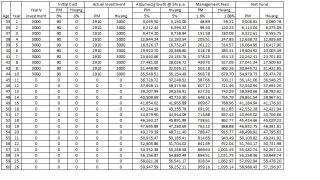
assuming all else being equal, please review my spreadsheet as attached.
This is based on the following assumption:
1. Yearly investment of RM3k for 10 years (align with current tax relief break as announced recently).
2. Assume no change in fees imposed by PM and Hwang (Initial cost for PM at 3%, management fees of PM - 1.6% and Hwang - 1.88%)
3. Assume same growth for both funds at 5% yearly

From my spreadsheet you would be able to see the breakeven for all things being equal, Hwang holds the advantage for the first 15 years wherelse PM holds the advantage for longer term.
Please also note that from Year 9 onwards, Hwang's management fees would be higher than PM's initial cost price of RM90 per annum.
Again the differences is quite marginal and all boils back down to performance of the fund ultimately.

Please feel free to correct if there is any flaws in my analysis.

Thank you. notworthy.gif

This post has been edited by kochin: Dec 20 2012, 01:48 PM


Attached thumbnail(s)
Attached Image
kochin
post Dec 20 2012, 01:51 PM

I just hope I do!
********
All Stars
10,314 posts

Joined: Dec 2009
From: Malaysia


QUOTE(turbopips @ Dec 20 2012, 01:43 PM)
PM:
Yr 1 sales charge - RM90
Annual management/trustee/ppa fee (1.60% of RM2910 cause RM90 reduced under sales charge) - RM46.56
Total management/trustee/ppa fee over 15 yrs - RM698.40
Total sales charge over 15 years = RM90 *15 = RM1350
Hwang:
Yr 1 sales charge - RM0
Annual management/trustee/ppa fee (1.88%) - RM56.40
Total management/trustee/ppa fee over 15 yrs - RM846
Total sales charge over 15 years = RM0 *15 = RM0
U for forgot about sales charge RM90 to be paid every year assuming u invest RM3k every yr.
*
note: i charge the 1.6% at the end of the year AFTER the growth factor. logically the providers should only charge these after 1 year's worth of management, right? and again logically they should charge at year end rather than beginning of the year. hence my figure of RM48.89 rather than your RM46.56.

turbopips
post Dec 20 2012, 01:56 PM

Casual
***
Junior Member
359 posts

Joined: Dec 2012
QUOTE(kochin @ Dec 20 2012, 01:45 PM)
» Click to show Spoiler - click again to hide... «


» Click to show Spoiler - click again to hide... «


turbopips and poolcarpet boss,
assuming all else being equal, please review my spreadsheet as attached.
This is based on the following assumption:
1. Yearly investment of RM3k for 10 years (align with current tax relief break as announced recently).
2. Assume no change in fees imposed by PM and Hwang (Initial cost for PM at 3%, management fees of PM - 1.6% and Hwang - 1.88%)
3. Assume same growth for both funds at 5% yearly

From my spreadsheet you would be able to see the breakeven for all things being equal, Hwang holds the advantage for the first 15 years wherelse PM holds the advantage for longer term.
Please also note that from Year 9 onwards, Hwang's management fees would be higher than PM's initial cost price of RM90 per annum.
Again the differences is quite marginal and all boils back down to performance of the fund ultimately.

Please feel free to correct if there is any flaws in my analysis.

Thank you. notworthy.gif
*
Thanks Ko Chin for the sharing.. Very expert in Excel ah... I agree that it boild down to performance of fund ultimately.
Just curious to know, in the event the government decide to extend the tax relief up to 15 or 20 years (ie the RM3k investment continues) will PM still have a lower cost? Thanks
kochin
post Dec 20 2012, 02:06 PM

I just hope I do!
********
All Stars
10,314 posts

Joined: Dec 2009
From: Malaysia


QUOTE(turbopips @ Dec 20 2012, 01:56 PM)
Thanks Ko Chin for the sharing.. Very expert in Excel ah...  I agree that it boild down to performance of fund ultimately.
Just curious to know, in the event the government decide to extend the tax relief up to 15 or 20 years (ie the RM3k investment continues) will PM still have a lower cost? Thanks
*
i did my spreadsheet immediately after reading your post but i did not saved the file. doh.gif
can redo quite easily. cool2.gif

and i did plunked in the figure for extended years beyond the initial 10 years.
PM still come out tops in the long run. but again marginal.

so it still boils down to the fund as even 0.5%-1% of the fund growth differences would ultimately be the game changer here.

turbopips
post Dec 20 2012, 02:19 PM

Casual
***
Junior Member
359 posts

Joined: Dec 2012
QUOTE(kochin @ Dec 20 2012, 02:06 PM)
i did my spreadsheet immediately after reading your post but i did not saved the file.  doh.gif
can redo quite easily.  cool2.gif

and i did plunked in the figure for extended years beyond the initial 10 years.
PM still come out tops in the long run. but again marginal.

so it still boils down to the fund as even 0.5%-1% of the fund growth differences would ultimately be the game changer here.
*
Yeah.. if investment continues, i think in year 19 PM will overtake Hwang in terms of cost, assuming fund performance is equal.
Probably thats the time to switch fund if one hasn't reach retirement age yet. tongue.gif
kochin
post Dec 20 2012, 02:28 PM

I just hope I do!
********
All Stars
10,314 posts

Joined: Dec 2009
From: Malaysia


sob.... lyn does not have syt smoking hot female PRS agents.....
no one contacted me??? kekeke.
bkwu
post Dec 20 2012, 02:51 PM

Getting Started
**
Junior Member
67 posts

Joined: Jan 2006


QUOTE(kochin @ Dec 20 2012, 01:45 PM)
» Click to show Spoiler - click again to hide... «


» Click to show Spoiler - click again to hide... «


turbopips and poolcarpet boss,
assuming all else being equal, please review my spreadsheet as attached.
This is based on the following assumption:
1. Yearly investment of RM3k for 10 years (align with current tax relief break as announced recently).
2. Assume no change in fees imposed by PM and Hwang (Initial cost for PM at 3%, management fees of PM - 1.6% and Hwang - 1.88%)
3. Assume same growth for both funds at 5% yearly

From my spreadsheet you would be able to see the breakeven for all things being equal, Hwang holds the advantage for the first 15 years wherelse PM holds the advantage for longer term.
Please also note that from Year 9 onwards, Hwang's management fees would be higher than PM's initial cost price of RM90 per annum.
Again the differences is quite marginal and all boils back down to performance of the fund ultimately.

Please feel free to correct if there is any flaws in my analysis.

Thank you. notworthy.gif
*
I just did a comparison based on the sales charge & annual management fees, assuming contribution of RM3000 per annum, annual return = 8% for all providers.

Abang kochin, Im not hot chick but can offer you PRS for hwang, cimb & manulife if you want.

This post has been edited by bkwu: Dec 20 2012, 02:53 PM


Attached thumbnail(s)
Attached Image
xuzen
post Dec 20 2012, 03:00 PM

Look at all my stars!!
*******
Senior Member
4,436 posts

Joined: Oct 2008


Let'c compare:

Public Mutual Growth Fund vs Hwang Growth

Both start at zero present value. Let's assume both the fund will give an average return of 10% per annum for 10 years (N = 10). The annual payment is RM 3,000.00.

With a sales charge of 3%, the PMT for Pub-Mut will be RM 3,000/1.03 = RM 2,912.62, Hwang PMT = RM 3,000.00

So we have, N = 10, Mode = Begin since we put the money at the beginning of the period.

For Pub-Mut, the annual expense ratio is 1.56%; whereas for Hwang is 1.84%

Public Mutual, the real effective rate of return will be, i = (10 - 1.56)/1.0156 = 8.31%

For Hwang, the real effective rate of return will be, i = (10 - 1.84)/1.0184 = 8.01%

For Pub-Mut:

PV = 0; PMT = 2,912.62; N = 10; i = 8.31%; Mode = Begin; Find FV = RM 46,378.45

For Hwang:

PV = 0; PMT = 3,000; N = 10; i = 8.01%; Mode = Begin; Find FV = RM 46,963.11

Conclusion:

Hwang wins Pub-Mut i.e., zero upfront fee wins over upfront fee.

Xuzen

P/S: The above calculation is based on my trustee little friend aka Monsieur Hewlett-Packard 10B-II

This post has been edited by xuzen: Dec 20 2012, 03:03 PM
poolcarpet
post Dec 20 2012, 03:03 PM

On my way
****
Senior Member
548 posts

Joined: Sep 2005
From: Mars
I know about the sales charge. You can't calculate this way, because we are looking at this year by year. If you calculate this way, then similarly your total management fee goes up tremendously i.e. the total management fee for 3k x 10 is NOT only RM698.40 - you can't just take RM46.56 x 15 because in yr 2 you now have RM6k worth.. and yr 3 you have RM9k worth and so on. At the 10th year, with RM30k your management fee under Hwang would be RM564 PER YEAR, while under PM it's RM468 PER YEAR. Difference of RM96 PER YEAR. Assuming you have another 25 yrs to go to retirement, we are talking about RM1440 EXTRA for Hwang compared to PM, even after including the sales charge.


QUOTE(turbopips @ Dec 20 2012, 01:43 PM)
PM:
Yr 1 sales charge - RM90
Annual management/trustee/ppa fee (1.60% of RM2910 cause RM90 reduced under sales charge) - RM46.56
Total management/trustee/ppa fee over 15 yrs - RM698.40
Total sales charge over 15 years = RM90 *15 = RM1350
Hwang:
Yr 1 sales charge - RM0
Annual management/trustee/ppa fee (1.88%) - RM56.40
Total management/trustee/ppa fee over 15 yrs - RM846
Total sales charge over 15 years = RM0 *15 = RM0
U for forgot about sales charge RM90 to be paid every year assuming u invest RM3k every yr.
*

Added on December 20, 2012, 3:19 pmvery nice spreadsheet, this is my understanding as well. up front higher sales charge is a disadvantage over lower management fee IN THE LONG RUN, meaning talking about >20 yrs, because sales charge is based on the initial fund which is RM3k up to RM30k in total, but management fee is based on the value of the fund year after year.

Extreme example, let's say the fund returns 9.6% pa and after 15 yrs it's quadrupled, meaning now it's worth RM120k.

We still have paid a total of RM900 for PM sales charge and RM0 for Hwang.

but calculate the management fee for PM and Hwang on year 15 alone....

PM : RM120k x 1.6% = RM1920
Hwang : RM120k x 1.88% = RM2256

difference of RM336 there... just for ONE year. Assume another 10 yrs to go and it remains at 120k, that would mean extra RM3360 just on management fees alone for Hwang for year 16 to 25...

now go a little more crazy and assume fund is now 10x the initial RM30k upon retirement, so now the annual charges just for the final year...

PM : RM300k x 1.6% = RM4800
Hwang: RM300k x 1.88% = RM5640

difference of RM840.... your FINAL YEAR management fee almost wiped out the RM900 initial sales charge....

hope my understanding is correct, please feel free to correct if wrong.

and still i think we've had fantastic discussion on this, honestly think it really doesn't matter which provider we go for, because we won't know who can perform better. All these discussions are based on the unrealistic fact that both will give you same returns, which i think is not possible icon_rolleyes.gif


QUOTE(kochin @ Dec 20 2012, 01:45 PM)
» Click to show Spoiler - click again to hide... «


» Click to show Spoiler - click again to hide... «


turbopips and poolcarpet boss,
assuming all else being equal, please review my spreadsheet as attached.
This is based on the following assumption:
1. Yearly investment of RM3k for 10 years (align with current tax relief break as announced recently).
2. Assume no change in fees imposed by PM and Hwang (Initial cost for PM at 3%, management fees of PM - 1.6% and Hwang - 1.88%)
3. Assume same growth for both funds at 5% yearly

From my spreadsheet you would be able to see the breakeven for all things being equal, Hwang holds the advantage for the first 15 years wherelse PM holds the advantage for longer term.
Please also note that from Year 9 onwards, Hwang's management fees would be higher than PM's initial cost price of RM90 per annum.
Again the differences is quite marginal and all boils back down to performance of the fund ultimately.

Please feel free to correct if there is any flaws in my analysis.

Thank you. notworthy.gif
*

Added on December 20, 2012, 3:22 pmi think if we are talking about just 10 yrs, then yes it is very possible zero upfront will beat upfront fee. however, i believe most of us discussing this is more than 10 yrs away from retirement, possibly 20 or 25 or even more for some of us. so if you do this little magic below with n=20, what would the results be? smile.gif

QUOTE(xuzen @ Dec 20 2012, 03:00 PM)
Let'c compare:

Public Mutual Growth Fund vs Hwang Growth

Both start at zero present value. Let's assume both the fund will give an average return of 10% per annum for 10 years (N = 10). The annual payment is RM 3,000.00.

With a sales charge of 3%, the PMT for Pub-Mut will be RM 3,000/1.03 = RM 2,912.62, Hwang PMT = RM 3,000.00

So we have, N = 10, Mode = Begin since we put the money at the beginning of the period.

For Pub-Mut, the annual expense ratio is 1.56%; whereas for Hwang is 1.84%

Public Mutual, the real effective rate of return will be, i = (10 - 1.56)/1.0156 = 8.31%

For Hwang, the real effective rate of return will be, i = (10 - 1.84)/1.0184 = 8.01%

For Pub-Mut:

PV = 0; PMT = 2,912.62; N = 10; i = 8.31%; Mode = Begin; Find FV = RM 46,378.45

For Hwang:

PV = 0; PMT = 3,000; N = 10; i = 8.01%; Mode = Begin; Find FV = RM 46,963.11

Conclusion:

Hwang wins Pub-Mut i.e., zero upfront fee wins over upfront fee.

Xuzen

P/S: The above calculation is based on my trustee little friend aka Monsieur Hewlett-Packard 10B-II

*
This post has been edited by poolcarpet: Dec 20 2012, 03:22 PM
kochin
post Dec 20 2012, 03:44 PM

I just hope I do!
********
All Stars
10,314 posts

Joined: Dec 2009
From: Malaysia


let's just all agree on the following, shall we?
1. if all things being equal, hwang beats PM in the short term while PM wins in the long term
2. everything else doesn't matter as spreadsheet have proven that the differences is MARGINAL and ultimately it is the fund performances that matter.

good discussion you all. met some new friends here. cheers!


Added on December 20, 2012, 3:47 pm
QUOTE(bkwu @ Dec 20 2012, 02:51 PM)
I just did a comparison based on the sales charge & annual management fees, assuming contribution of RM3000 per annum, annual return = 8% for all providers.

Abang kochin, Im not hot chick but can offer you PRS for hwang, cimb & manulife if you want.
*
1stly, you are not a syt
2ndly, you do not offer PM which i'm keen to take

so sorry abang bkwu, both product and wow factor also does not fulfill. my $$ cannot go to you. cry.gif

This post has been edited by kochin: Dec 20 2012, 03:47 PM
poolcarpet
post Dec 20 2012, 03:52 PM

On my way
****
Senior Member
548 posts

Joined: Sep 2005
From: Mars
rclxms.gif

QUOTE(kochin @ Dec 20 2012, 03:44 PM)
let's just all agree on the following, shall we?
1. if all things being equal, hwang beats PM in the short term while PM wins in the long term
2. everything else doesn't matter as spreadsheet have proven that the differences is MARGINAL and ultimately it is the fund performances that matter.

good discussion you all. met some new friends here. cheers!
*
bkwu
post Dec 20 2012, 04:10 PM

Getting Started
**
Junior Member
67 posts

Joined: Jan 2006


QUOTE(kochin @ Dec 20 2012, 03:44 PM)
1stly, you are not a syt
2ndly, you do not offer PM which i'm keen to take

so sorry abang bkwu, both product and wow factor also does not fulfill. my $$ cannot go to you.  cry.gif
*
cry.gif
whats syt? haha it's ok just offering.

QUOTE(poolcarpet @ Dec 20 2012, 03:03 PM)

and still i think we've had fantastic discussion on this, honestly think it really doesn't matter which provider we go for, because we won't know who can perform better. All these discussions are based on the unrealistic fact that both will give you same returns, which i think is not possible  icon_rolleyes.gif

Added on December 20, 2012, 3:22 pmi think if we are talking about just 10 yrs, then yes it is very possible zero upfront will beat upfront fee. however, i believe most of us discussing this is more than 10 yrs away from retirement, possibly 20 or 25 or even more for some of us. so if you do this little magic below with n=20, what would the results be? smile.gif
*
I had included the management fees and sales charge in my calculation, fee wise, cimb beats all other competitor. you may refer to the figure in the jpg that i attached earlier.

Anyway, the differences is really not much, (0.5%) even after 30 years. So, just like all taikos said it is actually depend on the performance. Currently I would vote for Hwang as well, since there feeder funds have a proven track record.
kparam77
post Dec 20 2012, 04:12 PM

Enthusiast
*****
Senior Member
952 posts

Joined: Feb 2011


QUOTE(kochin @ Dec 20 2012, 03:44 PM)
let's just all agree on the following, shall we?
1. if all things being equal, hwang beats PM in the short term while PM wins in the long term
2. everything else doesn't matter as spreadsheet have proven that the differences is MARGINAL and ultimately it is the fund performances that matter.

good discussion you all. met some new friends here. cheers!


Added on December 20, 2012, 3:47 pm

1stly, you are not a syt
2ndly, you do not offer PM which i'm keen to take

so sorry abang bkwu, both product and wow factor also does not fulfill. my $$ cannot go to you.  cry.gif
*
if u still love PM, maybe i can help u. but NO empty promise here.... its all DEPEND.......... HOW THE FUND PERFORM.

if u want the tax relief for 2012, sign up now with rm3k. or else, u can do DDI instead of lump sump rm3k. or if u need better entry for 3k lump sum, better wait for GE.

suggestion only.
kochin
post Dec 20 2012, 04:50 PM

I just hope I do!
********
All Stars
10,314 posts

Joined: Dec 2009
From: Malaysia


i just thought of an idea.
why not split our investment?
half to PM, half to Hwang.
that way, there's no mistake on which fund would ultimately performs better. kekeke.
simplesmile
post Dec 20 2012, 08:40 PM

Look at all my stars!!
*******
Senior Member
2,991 posts

Joined: Jun 2007


OK. A few days ago I posted that I was considering between PM and Hwang. And then I decided that in the long term, PM would win over Hwang. So decided to take Hwang then. After that I researched some more on CIMB and found that it has lower fees.

So in the end, yesterday I bought CIMB. The package I bought is the Asia ex-Japan.
Reason why I chose this fund is because It invests in companies with significant businesses in Asia. I wanted to diversify away from Malaysia, hence this fund.

But the masterfund management fee is 1.8%. So, the management fee could be slightly higher, depending on how much cash is held. I also expect this fund to have higher volatility (hence higher capital gain or loss).
xuzen
post Dec 20 2012, 10:39 PM

Look at all my stars!!
*******
Senior Member
4,436 posts

Joined: Oct 2008


I substituted N=20 and the result shows that Pub-Mut wins Hwang by about 0.5% at year 20th.

However, even after the fifth year, other parameters come into play and lower management fee will be secondary to risk adjusted performance wrt benchmark.

In other words, a different set of parameters will be used to evaluate the funds. Namely: Sharpe, Treynor, Sortino, Modigliani ratio et al.

Xuzen
wbk
post Dec 21 2012, 10:53 AM

New Member
*
Junior Member
17 posts

Joined: Aug 2009
QUOTE(simplesmile @ Dec 20 2012, 08:40 PM)
OK. A few days ago I posted that I was considering between PM and Hwang. And then I decided that in the long term, PM would win over Hwang. So decided to take Hwang then. After that I researched some more on CIMB and found that it has lower fees.

So in the end, yesterday I bought CIMB. The package I bought is the Asia ex-Japan.
Reason why I chose this fund is because It invests in companies with significant businesses in Asia. I wanted to diversify away from Malaysia, hence this fund.

But the masterfund management fee is 1.8%. So, the management fee could be slightly higher, depending on how much cash is held. I also expect this fund to have higher volatility (hence higher capital gain or loss).
*
i tot the management fees that need to be paid yearly is for the PRS, should not include the masterfund? anyway, i am interested to investment in CIMB PRS Asia ex Japan as well since the masterfund seems to be doing quite well last year. And the sales charge and management fees is much lower.

question: how we do qualify for Class C investor?
simplesmile
post Dec 21 2012, 11:04 AM

Look at all my stars!!
*******
Senior Member
2,991 posts

Joined: Jun 2007


QUOTE(wbk @ Dec 21 2012, 10:53 AM)
i tot the management fees that need to be paid yearly is for the PRS, should not include the masterfund? anyway, i am interested to investment in CIMB PRS Asia ex Japan as well since the masterfund seems to be doing quite well last year. And the sales charge and management fees is much lower.

question: how we do qualify for Class C investor?
*
You can choose whether to invest in Class A or Class C. It's your choice. I chose Class C of course.
Here's an explanation about the management fee is charged. I think it's a good explanation.
http://forum.lowyat.net/index.php?showtopi...post&p=56909384

This post has been edited by simplesmile: Dec 21 2012, 11:05 AM

17 Pages « < 7 8 9 10 11 > » Top
 

Change to:
| Lo-Fi Version
0.0261sec    0.49    6 queries    GZIP Disabled
Time is now: 5th December 2025 - 09:05 PM