

OK as long as it is a multiband UHF
Digital TV Station Malaysia, How do I tune to digital TV station?
Digital TV Station Malaysia, How do I tune to digital TV station?
|
|
 Jan 29 2019, 02:34 PM Jan 29 2019, 02:34 PM
|
 
Senior Member
1,276 posts Joined: Sep 2018 From: Ampang 
|
OK as long as it is a multiband UHF
|
|
|
|
|
|
Jan 29 2019, 05:49 PM
Show posts by this member only | IPv6 | Post
#5562
|

Senior Member
6,105 posts Joined: Apr 2009 From: Marang, Terengganu  
|
|
|
|
Jan 29 2019, 06:25 PM
Show posts by this member only | IPv6 | Post
#5563
|
|
Junior Member
226 posts Joined: Sep 2007
|
QUOTE(JohnLai @ Jan 28 2019, 09:29 PM) Speaking of which, I don't get any of those MBHD Test channels (second mux) in Sarawak here. There used to be 3 muxes. Donno why they turned it off Rescan all DVB-T2 frequency, only one mux exists.  |
|
|
Jan 29 2019, 06:35 PM
|
|
Senior Member
1,080 posts Joined: Dec 2012
|
QUOTE(izz70 @ Jan 29 2019, 06:25 PM) There used to be 3 muxes. Donno why they turned it off Frequencies had been allocated for MUX 2 and MUX 3 in the past but those multiplexes was never switched on and not used for regular services as the demand for MYTV multiplexes was low when it first started. Only very recently MYTV starts long term test transmissions for MUX 2 in Johor Bahru, Kuantan, Klang Valley (transmitters are slowly being switch on region by region) since MUX 1 is fully utilized.This post has been edited by shaun_kok: Jan 29 2019, 06:39 PM |
|
|
Jan 29 2019, 07:34 PM
|
|
Senior Member
1,276 posts Joined: Sep 2018 From: Ampang
|
QUOTE(izz70 @ Jan 29 2019, 06:25 PM) There used to be 3 muxes. Donno why they turned it off You would be horrified how much the MUX backhaul, maintenance and electricity costs. |
|
|
Jan 29 2019, 10:03 PM
Show posts by this member only | IPv6 | Post
#5566
|
|
Senior Member
6,105 posts Joined: Apr 2009 From: Marang, Terengganu
|
Wonder if the bitrates on the test channels is any better than current one?
|
|
|
|
|
|
Jan 29 2019, 11:19 PM
|
|
Senior Member
1,080 posts Joined: Dec 2012
|
QUOTE(Qash-M @ Jan 29 2019, 10:03 PM) Wonder if the bitrates on the test channels is any better than current one? Bitrates stands at around 1200kbps for HDTV or 550kbps for SDTV based on 5 min record. (This is consider that the transmissions consists only a static test card and information regarding test transmissions, should be similar to bitrates used for MUX 1 when the services are up.) Also interesting to note that the contents transmitted for test transmissions are different.This post has been edited by shaun_kok: Jan 29 2019, 11:20 PM |
|
|
Jan 30 2019, 01:45 AM
Show posts by this member only | IPv6 | Post
#5568
|
|
Senior Member
7,799 posts Joined: Dec 2014 From: Malaysia
|
QUOTE(shaun_kok @ Jan 26 2019, 07:55 AM) Interference could happen if those transmitters using SFN is not planned well. It could significantly shrink the reception range of the transmitter due to co channel interference. Even with a well planned SFN network, some high power/gap filler transmitters may be needed to added into the network to improve overall reception to avoid some areas losing reception completely. Those connecting their analogue TV to Starhub's cable point infrastructure are seeing just blank screens (dead air) transmitted by Starhub themselves (all but 2 channels on the system doesn't switch to blank screen, which was the 743.25Mhz Starhub Testcard and also the sport channel which has ended transmission on 28 December 2018, showing information screen regarding closure.) Starhub also plan to discontinue their digital cable TV services on 30 June 2019 as they move their customers off IPTV platforms and to retire their cable network. Maybe, but back then when Channel U (analogue) was interfered by TV1 Gunung Ledang back on 2010, causing large scale interference to Channel U to many parts in Johor (including areas as far as Pontian and Pekan Nanas), causing viewer complaints to Channel U's Facebook page at that time. Channel U responded as they are a Singapore channel, they will not care about reception issues in Malaysia as it is out of their control. So any reception of Singaporean channels will be an bonus for Johor viewers. However, there were reports at the past describing man installing TV antennas in Muar as Singapore TV channels are quite popular there and some Johor Bahru based businesses (particularly theme parks like Legoland) do advertise on Mediacorp TV channels. Vasantham even organise events on Johor Bahru. They may continue using 16 QAM modulation for an considerable future, unless they are going to start 4K/UHD transmission in the future. Even if UHD reception is available in the future, it will be niche for considerable time as it was hard to even switch over. This is the same for HD5 channel via DVB-T. Many who doesn't subscribe to pay TV remained using analouge TV, as the analogue channels can be received without any ghosting and snows via the cable point and DVB-T only carried 3 simulcast channels (Ch5 and HD5, Ch8, CNA). This resulted very few viewers are receiving the channels in DVB-T as there were no promotion on digital TV at that time. Before the activation of these masts, the DTT transmission were only available from the Gunung Pulai mast only. Although I live in a location when the TV mast could be clearly seen, constant freezing of TV signal was frequently encountered. It wasn't until they activated those 2 masts who partly solve my problems, as those 2 are intended for indoor reception and is strategicly placed so that viewers live in these areas using outdoor antenna (whenever pointed to Gunung Pulai/Bukit Batok SG) could still receive better signal for Malaysia TV. There will be additional interference caused by Indosiar from Batam, as those transmitters has activated Channel 49/698MHz (MYTV MUX 2). Some in JB still can't receive local DTT via antenna (a big issue that must be resolved fast or it would cause negative perception to MYTV when analogue TV switches off), and the problem was caused by co channel issue caused by SCTV, as someone from Batam received stable signals from Malaysia DTT if SCTV happened to have problem on the transmitter. QUOTE They may continue using 16 QAM modulation for an considerable future, Thank you very much for all the explanation you've given in the past few days. I really really appreciate those information very much. I wanna ask, do you know what is the FEC code rate used in Singapore DTT? Are all 4 mux having the same FEC code rate? How about Malaysia's? What's the FEC used for Malaysia DTT? Compare between 16QAM and 256QAM, besides able to transmit more bandwidth, how big is the difference in terms of signal reception? Does it mean, let say now I'm a Singaporean, live in HDB, using indoor antenna to watch Singapore DTT channels and have 90% signal, thanks to 16QAM. If one day, Singapore DTT uses 64QAM or 256QAM, how much does it affect the signal reading? Will I see a big drop of signal % reading? Or the reading did not drop, but the chance of not able to get 0 reading of BER is higher, or what? Could I even, completely lose signal as Singapore DTT transmits in 64 or 256QAM? Another question... Is Indonesia DTT channels possible to receive in Johor or Singapore now? How's the reception? What are the frequencies, QAM and the FEC used? You have the channel list? This post has been edited by joshhd: Jan 30 2019, 01:47 AM |
|
|
Jan 30 2019, 01:55 AM
Show posts by this member only | IPv6 | Post
#5569
|
|
Senior Member
7,799 posts Joined: Dec 2014 From: Malaysia
|
Singapore DTT channels transmits from the frequency range within 538MHz to 586MHz with empty gaps in between. If Singapore's IMDA would have islandwide frequency retune exercise, like after 3 countries has decided which frequencies to be allocated for DTT after ASO and 700MHz refarm for mobile, could they consider this:
i) Increase from 16QAM to 64QAM (or 256QAM?), to squeeze in more HD channels per multiplex to reduce the number of multiplexes to be used, and possibly in the future (many many years from now), they could offer new UHD channels since they have more bandwidth as QAM increases? ii) Instead of using 5xxMHz range frequencies, Singapore to use the lowest range in UHF frequency possible (474MHz, 482MHz, 490MHz, 498MHz) for DTT, to compensate the QAM increase which may affect easy signal reception and improving indoor reception, in contrasts with the current 5xxMHz range, it can somehow have better wall penetration for indoor reception. Therefore, the rest of total 25 x 8MHz channels which is from 506MHz-594MHz and 602MHz-698MHz range to be allocated for Malaysia and Indonesia DTT. What do you think? Do you think this is somewhat practical? Why I think that way is because, Singapore FTA channels: Programming are generally better in quality, so in my opinion, for them to make sure their channels have easy signal reception is a wise thing to do. And that could also mean, easier for Johor people to receive their channels easier too, which is a bonus for Johorians and a bonus for Mediacorp as their channel viewership ratings are "naturally" being contributed from country outside Singapore. Malaysia FTA channels: Just ugh, still has lots of room for improvement. Currently already using 6xxMHz frequency, so hmmm, no comment la. Indonesia FTA channels: Since reception are generally meant for Batam, the population there isn't very very dense and high rise buildings there are not as much as Johor Bahru and Singapore... So, for them to use slightly higher UHF frequencies (>506MHz or >602MHz ones) shall not be a huge problem for them, isn't it? After all, many of their analogue FTA channels are now on 7xxMHz range, so yeaahh.... ---- If Singapore to have frequency retune exercise, how would they manage and reconfigure with the building's MATV system, or indoor signal repeater or something? Do they only repeat their 4 multiplexes of Singapore DTT, or they need not to do anything as its building signal repeater actually repeats all channels from 3 countries together (from 470-698MHz)? |
|
|
Jan 30 2019, 08:36 AM
Show posts by this member only | IPv6 | Post
#5570
|
|
Senior Member
6,105 posts Joined: Apr 2009 From: Marang, Terengganu
|
QUOTE(shaun_kok @ Jan 29 2019, 11:19 PM) Bitrates stands at around 1200kbps for HDTV or 550kbps for SDTV based on 5 min record. (This is consider that the transmissions consists only a static test card and information regarding test transmissions, should be similar to bitrates used for MUX 1 when the services are up.) Also interesting to note that the contents transmitted for test transmissions are different. I see, welp waiting for next month one. |
|
|
Jan 30 2019, 03:28 PM
Show posts by this member only | IPv6 | Post
#5571
|
|
Senior Member
6,105 posts Joined: Apr 2009 From: Marang, Terengganu
|
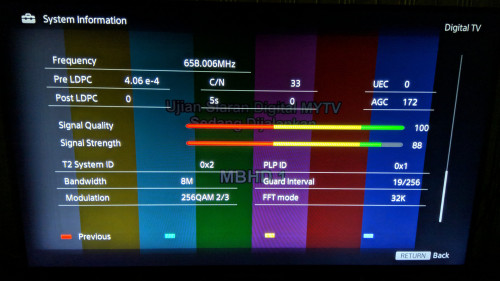
got MUX 2 open test today. 1 SD & 1 HD channels.
 This post has been edited by Qash-M: Jan 30 2019, 08:34 PM |
|
|
Jan 30 2019, 09:08 PM
|

Senior Member
3,669 posts Joined: Apr 2006
|
QUOTE(joshhd @ Jan 30 2019, 01:55 AM) » Click to show Spoiler - click again to hide... « Hilly terrain all over and MYTV uses 600Mhz and above  Current analog frequency is around 200 - 300 Mhz something. |
|
|
Jan 30 2019, 10:51 PM
|
|
Senior Member
1,080 posts Joined: Dec 2012
|
QUOTE(joshhd @ Jan 30 2019, 01:45 AM) Thank you very much for all the explanation you've given in the past few days. I really really appreciate those information very much. I wanna ask, do you know what is the FEC code rate used in Singapore DTT? Are all 4 mux having the same FEC code rate? How about Malaysia's? What's the FEC used for Malaysia DTT? Compare between 16QAM and 256QAM, besides able to transmit more bandwidth, how big is the difference in terms of signal reception? Does it mean, let say now I'm a Singaporean, live in HDB, using indoor antenna to watch Singapore DTT channels and have 90% signal, thanks to 16QAM. If one day, Singapore DTT uses 64QAM or 256QAM, how much does it affect the signal reading? Will I see a big drop of signal % reading? Or the reading did not drop, but the chance of not able to get 0 reading of BER is higher, or what? Could I even, completely lose signal as Singapore DTT transmits in 64 or 256QAM? Another question... Is Indonesia DTT channels possible to receive in Johor or Singapore now? How's the reception? What are the frequencies, QAM and the FEC used? You have the channel list? QUOTE(joshhd @ Jan 30 2019, 01:55 AM) Singapore DTT channels transmits from the frequency range within 538MHz to 586MHz with empty gaps in between. If Singapore's IMDA would have islandwide frequency retune exercise, like after 3 countries has decided which frequencies to be allocated for DTT after ASO and 700MHz refarm for mobile, could they consider this: Not sure about the FEC rate as the TV set at my home cannot see the full details, but if judging for their bitrate usage, it would likely to be 16QAM GI 1/16 COFDM (FFT) 16k-ext FEC 2/3 or 3/5 for all 4 multiplexes. i) Increase from 16QAM to 64QAM (or 256QAM?), to squeeze in more HD channels per multiplex to reduce the number of multiplexes to be used, and possibly in the future (many many years from now), they could offer new UHD channels since they have more bandwidth as QAM increases? ii) Instead of using 5xxMHz range frequencies, Singapore to use the lowest range in UHF frequency possible (474MHz, 482MHz, 490MHz, 498MHz) for DTT, to compensate the QAM increase which may affect easy signal reception and improving indoor reception, in contrasts with the current 5xxMHz range, it can somehow have better wall penetration for indoor reception. Therefore, the rest of total 25 x 8MHz channels which is from 506MHz-594MHz and 602MHz-698MHz range to be allocated for Malaysia and Indonesia DTT. What do you think? Do you think this is somewhat practical? Why I think that way is because, Singapore FTA channels: Programming are generally better in quality, so in my opinion, for them to make sure their channels have easy signal reception is a wise thing to do. And that could also mean, easier for Johor people to receive their channels easier too, which is a bonus for Johorians and a bonus for Mediacorp as their channel viewership ratings are "naturally" being contributed from country outside Singapore. Malaysia FTA channels: Just ugh, still has lots of room for improvement. Currently already using 6xxMHz frequency, so hmmm, no comment la. Indonesia FTA channels: Since reception are generally meant for Batam, the population there isn't very very dense and high rise buildings there are not as much as Johor Bahru and Singapore... So, for them to use slightly higher UHF frequencies (>506MHz or >602MHz ones) shall not be a huge problem for them, isn't it? After all, many of their analogue FTA channels are now on 7xxMHz range, so yeaahh.... ---- If Singapore to have frequency retune exercise, how would they manage and reconfigure with the building's MATV system, or indoor signal repeater or something? Do they only repeat their 4 multiplexes of Singapore DTT, or they need not to do anything as its building signal repeater actually repeats all channels from 3 countries together (from 470-698MHz)? Malaysia's is 256QAM GI 19/256 COFDM (FFT) 32k FEC 2/3. If Mediacorp is going to use 64 QAM or 256 QAM in the future, the received signal can be weaker for 4-5dBm for 64 QAM and up to 9dBm for 256QAM. If they are going to use 256 QAM modulation, they will need to increase power for 2-3x from their currently used power levels to maintain similar reception quality (transmitter power was planned and optimized for 64QAM until they switch to 16QAM for more robust reception on around May 2017) For example, if the transmitter power used for 16QAM (was 64QAM) is 3KW per MUX, to acheive/maintain similar reception quality the transmitter power, when using 256QAM will has to be around 10KW per MUX. Mediacorp can choose to use lesser multiplexes with higher QAM (reduction from 4 multiplexes to 2 multiplexes with more channels per multiplex while maintaining same quality) however the required transmitter power will be much higher. I still can't receive any Indonesian DTT signals in my area, and only 6 multiplexes was receivable in my area. (CH29/538MHz, CH31/554MHz, CH33/570MHz, CH35/586MHz, CH47/682MHz, CH49/698MHz) Data below is listed for example purposes, realisticly the transmitter power used by Mediacorp would be much higher. 16QAM/64QAM X4 - 3KWX4 =12KW 256QAM X2 - 10KWX2=20KW If Singapore needed to do frequency retune exercise in the future, they may not allocate those multiplexes that close (538mhz,546mhz,554mhz .etc) as it may cause adjencent channel interference. Also all wireless frequency plans has to be discussed and done between 3 countries, so that each country will get its own exclusive frequency (like those used for DTT,DAB,FM) and to avoid interference (Mobile phone services, Public services like Police, Fire and DTT,DAB,FM). The frequencies used by digital TV had been agreed the past between 3 countries, so it is unlikely to change for a forseeable future. QUOTE(JohnLai @ Jan 30 2019, 09:08 PM) Sarawak and sabah frequencies are real joke. Yup, as most existing frequencies used in nearly all Sabah and Sarawak analogue main transmitters are on VHF Band III (174-230MHz), with some exceptions : some relay transmitters carrying TV1 and TV2, some TV3 and all NTV7 transmitters being UHF. Even that it is mostly in lower part of UHF band. As DTT is using the upper UHF band (594MHz and above), many gap fillers will be required and because of these reasons, commercial operators was not so interested on Sabah and Sarawak due to low population+big landmass.Hilly terrain all over and MYTV uses 600Mhz and above Current analog frequency is around 200 - 300 Mhz something. |
|
|
|
|
|
Jan 31 2019, 02:38 PM
|
|
Senior Member
1,276 posts Joined: Sep 2018 From: Ampang
|
QUOTE(JohnLai @ Jan 30 2019, 09:08 PM) Sarawak and sabah frequencies are real joke. The 470-500s are unavailable until after ASO, then the digital will be retuned- they have their eye on the 600 MHz band for other uses in the long term.Hilly terrain all over and MYTV uses 600Mhz and above Current analog frequency is around 200 - 300 Mhz something. |
|
|
Jan 31 2019, 03:09 PM
Show posts by this member only | IPv6 | Post
#5575
|

Senior Member
4,583 posts Joined: Oct 2006 From: ... suddenly 1 week
|
I gave up with MYTV as signal reception here in Sibu Sarawak is too weak and unsteady. I use satellite and TVbox(but government is going to ban it 🙄)
|
|
|
Jan 31 2019, 04:26 PM
Show posts by this member only | IPv6 | Post
#5576
|
|
Senior Member
6,822 posts Joined: Oct 2008 From: Kuala Lumpur 
|
QUOTE(work_tgr @ Jan 31 2019, 04:09 PM) I gave up with MYTV as signal reception here in Sibu Sarawak is too weak and unsteady. I use satellite and TVbox(but government is going to ban it 🙄) Satellite has been long existence in Sarawak. Imo nothing to worry, just use whatever boxes while we can. The ASO is not gonna be so smooth I believe, because don't think they can iron out all issues in the shortest time. |
|
|
Jan 31 2019, 10:45 PM
Show posts by this member only | IPv6 | Post
#5577
|
|
Senior Member
7,799 posts Joined: Dec 2014 From: Malaysia
|
» Click to show Spoiler - click again to hide... « Wahh... Your technical explanation really amused me this time (cuz I can't understand much lol). I wonder, are you working in that industry? I mostly know pretty much the surface level of the technical stuff, but not into almost "engineer" level la...  QUOTE Malaysia's is 256QAM GI 19/256 COFDM (FFT) 32k FEC 2/3. I did come across the 19/256, COFDM 32k thing, but I don't understand what does that mean. I only know higher QAM means more bandwidth (e.g. 256QAM) but at the same time, reception may become not as robust as lower QAM. (I wonder is this the same, compare with LTE vs LTE Advanced Pro vs Gigabit LTE? Cuz I know the QAM used are higher?)What do you think about the technical parameters set by MYTV? Is it good, or poor? If compare with Singapore DTT ones, how different is it? Besides the QAM used... QUOTE Mediacorp can choose to use lesser multiplexes with higher QAM (reduction from 4 multiplexes to 2 multiplexes with more channels per multiplex while maintaining same quality) however the required transmitter power will be much higher. Then why MYTV don't just use lower QAM and have 2-3 mux instead of 1, to reduce transmit power, and for them to save cost a bit? Or, MYTV prefers to use the spectral efficient way, rather than making reception robust? QUOTE If Singapore needed to do frequency retune exercise in the future, they may not allocate those multiplexes that close (538mhz,546mhz,554mhz .etc) as it may cause adjencent channel interference. Adjacent channel interference?? HmmmQUOTE 527.25MHz (523.25-531.25MHz) - Channel U Analogue (ceased) How come Singapore DTT and analogue channels are squeezed together, without causing any reception issues to user? It is obvious that the frequency range of each channel "intersect" with the other analogue/digital channel's 8MHz range. Channels are from Singapore, so it shall be the same Bukit Batok transmitting tower. Wouldn't that cause adjacent frequency interference? While compare with analogue channels between Malaysia and Indonesia: 538.00MHz (534.00-542.00MHz) - Channel 5 (HD), Suria (HD) 543.25MHz (539.25-547.25MHz) - okto Analogue (ceased) 546.00MHz (542.00-550.00MHz) - EMPTY for Southern Johor, but it is myFreeview frequency for Northern Johor 554.00MHz (550.00-558.00MHz) - Channel 8 (HD), Vasantham (HD) 559.25MHz (555.25-563.25MHz) - Channel NewsAsia Analogue (ceased) 570.00MHz (566.00-574.00MHz) - Channel NewsAsia (HD), Channel U (SD), okto (HD) 578.00MHz (574.00-582.00MHz) - EMPTY for Digital? 586.00MHz (582.00-590.00MHz) - Channel U (HD) QUOTE 631.25MHz 41 - MNC TV The sequence is Indonesia, Malaysia, Indonesia, Malaysia, Indonesia, Malaysia,.... All frequencies are appears to be fully utilised. No adjacent frequency interference, as perhaps due to further distance away from 2 transmitters from the 2 countries, but what if viewers stay near between Johor and Batam border? Wouldn't they experience adjacent frequency interference that affects signal reception? 639.25MHz 42 - NTV7 647.25MHz 43 - RCTI 655.25MHz 44 - TV9 663.25MHz 45 - Trans TV 671.25MHz 46 - 8TV Anyhow, do you think Singapore will "volunteer to voice out" when discuss with the 3 countries during the discussion of frequency retune exercise being carried out together with 3 countries, saying that they want to use the lowest UHF frequency for their DTT, which will be 474MHz, 490MHz, 506MHz, 522MHz to achieve best signal reception possible? If "skip" each channel like this, then how about 482MHz, 498MHz, 514MHz, 530MHz? Leave it vacant or what? QUOTE Also all wireless frequency plans has to be discussed and done between 3 countries, so that each country will get its own exclusive frequency (like those used for DTT,DAB,FM) and to avoid interference (Mobile phone services, Public services like Police, Fire and DTT,DAB,FM). How irony. Look at the interference of TV1 vs RTV, and also myFreeview (Malaysia DTT) vs SCTV. If properly done and discussed, how come interference like this can happen? Who should held responsible? This post has been edited by joshhd: Jan 31 2019, 10:52 PM |
|
|
Jan 31 2019, 10:55 PM
Show posts by this member only | IPv6 | Post
#5578
|
|
Senior Member
7,799 posts Joined: Dec 2014 From: Malaysia
|
QUOTE(work_tgr @ Jan 31 2019, 03:09 PM) I gave up with MYTV as signal reception here in Sibu Sarawak is too weak and unsteady. I use satellite and TVbox(but government is going to ban it 🙄) You aim at which satellite to watch what channels? And btw, Malaysia FTA channels is sucks. It is considered normal for a Malaysian to not watch those channels. |
|
|
Jan 31 2019, 11:13 PM
Show posts by this member only | IPv6 | Post
#5579
|
|
Senior Member
6,105 posts Joined: Apr 2009 From: Marang, Terengganu
|
QUOTE(joshhd @ Jan 31 2019, 10:55 PM) You aim at which satellite to watch what channels? In the end, most rip out local channel. Case of one, today's King event.And btw, Malaysia FTA channels is sucks. It is considered normal for a Malaysian to not watch those channels. |
|
|
Feb 1 2019, 12:16 AM
Show posts by this member only | IPv6 | Post
#5580
|
|
Senior Member
6,105 posts Joined: Apr 2009 From: Marang, Terengganu
|
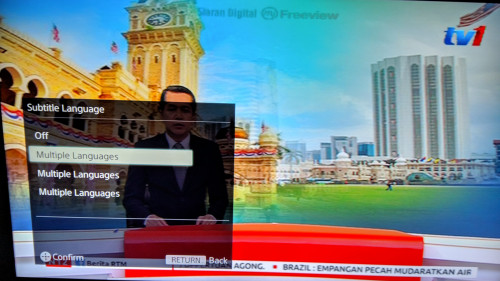 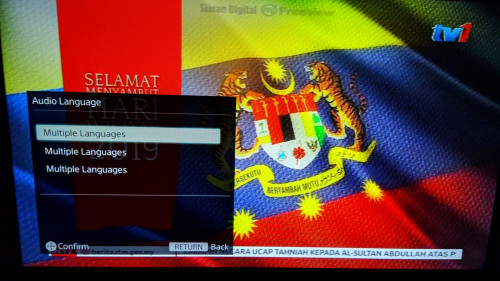 |
|
Topic ClosedOptions
|
| Change to: |  0.0202sec 0.0202sec
 0.43 0.43
 6 queries 6 queries
 GZIP Disabled GZIP Disabled
Time is now: 16th December 2025 - 01:57 PM |
 Quote
Quote