Welcome Guest ( Log In | Register )

19 Pages « < 6 7 8 9 10 > » Bottom

Outline · [ Standard ] · Linear+

 Agarwood/Gaharu, Become a millionaire in 7 years?

views
     
Sham903n
post Jun 7 2008, 06:25 PM

Casual
***
Junior Member
491 posts

Joined: Apr 2006
From: KL - KK


I've been warned about others trying to gain control on your plantation (directly or indirectly).. we must make a correct choice from the start...

QUOTE
In return, I would estimate conservatively a gross income of 50,000 x $200 = US$10,000,000 after 12 months


I assume is it USD $200 (RM640*as per current exchange rate*) per tree? Im taking your estimate for future calculation because it is much realistic and I gather you have much experience on this trade (estimate conservatively).

From the figure above, If I have cultivated 500 trees per acre so 500 x 17acre x RM640 = RM5,440,000. Well I dont mind waiting for that amount of $.

This post has been edited by Sham903n: Jun 7 2008, 07:25 PM
Happy Farmer
post Jun 7 2008, 08:27 PM

New Member
*
Junior Member
14 posts

Joined: Jun 2008


QUOTE(Sham903n @ Jun 7 2008, 05:25 PM)
I assume is it USD $200 (RM640*as per current exchange rate*) per tree? Im taking your estimate for future calculation because it is much realistic and I gather you have much experience on this trade (estimate conservatively).
Hi Sham903n,
Yes I estimate conservatively US$200 per tree. The assumptions on which this figure are based are that an agarwood tree of 10 - 14cm DBH (diameter at breast height - 137 cm from the ground) is treated with a CA Kit and yields one year later a minimum of 200 grams of good quality agarwood chips which are currently selling at not less than US$1,000/kg at wholesale price in the country of production. As you can see from www.scentedmountain.com the retail price in a consuming country can be much higher. Actually yields of up to 500 grams of good quality agarwood chips per tree (of above size) have been harvested. Besides the good quality agarwood chips, there will also be a kilogram of lower quality agarwood powder (produced when cleaning the chips) worth about US$30 - 50/kg that can be used to make incense or for oil extraction. Hence I consider the US$200/tree is a conservative figure.

QUOTE(Sham903n @ Jun 7 2008, 05:25 PM)
I have cultivated 500 trees per acre
I reckon that's nearly 1,250 trees per hectare. I believe around 800 - 850/hectare would be better. Anyhow, you can still produce agarwood at the higher tree density but just remember to give Healthy Business a call when your trees are big enough wink.gif this will probably be at around 5-years-of-age (provided you prune them to just one main stem, otherwise a multi-stem tree will take 1 - 3 years longer for the individual stems to reach the right diameter for treatment).


Added on June 7, 2008, 8:30 pm
QUOTE(kwaytiau @ Jun 7 2008, 01:56 PM)
good information from Happy Farmer.

thank you.
*
Thanks kwaytiau, you're welcome.

This post has been edited by Happy Farmer: Jun 7 2008, 08:30 PM
eehtsitna
post Jun 8 2008, 11:36 AM

Casual
***
Junior Member
356 posts

Joined: Jun 2006


QUOTE(Happy Farmer @ Jun 6 2008, 03:58 PM)
Other good news for a potential investor is that agarwood trees treated with CA Kits can now be harvested at 10 � 12 months after first treatment. In other words the production cycle has been reduced from the original 2 years to just 1 year thanks to improvements in the potency of the CA Kit technology.  (This news was received just this week after a recent visit by Prof. Robert Blanchette of the University of Minnesota - co-inventor of the CA Kit - to assess the latest research results in Vietnam).
Wow that is really something new. Will need to check out on this with my other coleagues.

QUOTE(Happy Farmer @ Jun 6 2008, 03:58 PM)
We can negotiate later the price that we'd charge for CA Kits (one kit per tree) � but for th1e time being you can budget $30/tree (including all materials and application service); this price could be significantly reduced in exchange for a share of the trees at harvest time. You should add say another couple of dollars per tree for security/taking care of the trees (i.e. plantation management). Also, to improve access to the plantation, we advise improving the farm road at a cost of $50,000.

So I estimate a total investment of $1,000,000 (trees) + $1,500,000 (CA Kits) + $100,000 (management) + $50,000 (road) + $500,000 (for processing & marketing costs) = US$3,150,000 (focusing on exploiting the 50,000 mature trees only).

In return, I would estimate conservatively a gross income of 50,000 x $200 = US$10,000,000 after 12 months. (And more money could be made from the 50,000 younger trees in later years).
Based on your experiences working on agarwood plantation in Laos. May i know on average how much agarwood can a tree in Laos produce and what is the grade for the wood?


Added on June 8, 2008, 11:52 am
QUOTE(Happy Farmer @ Jun 7 2008, 02:56 PM)
I am not sure why anybody would pay RM1,000 per 5-year-old-tree without any treatment when they could buy 7-year-old trees from me for less than one tenth of that price!

In the Lao PDR, farmers sell trees at any age from one year upwards but the older they are the higher the price. 
Dont mind the Rm1000 example. That was just a convenient figure that pops up in my mind when i try to explain the option of selling their own tree.

QUOTE(Happy Farmer @ Jun 7 2008, 02:56 PM)
Regarding inducement treatment, the only proven and patented treatment worth applying is the CA Kit. All other techniques (and there are many that can produce resin in agarwood trees) are by far inferior. It simply does not make sense to spend money to grow a tree and then treat it with an inferior technique (especially if it costs more than a CA Kit!).

Furthermore, if you want to export the agarwood legally (with CITES certification) then you will need to declare where the wood came from. Since the patent for CA Kits covers all other inducement techniques it will be easy to catch the person trading the agarwood that has been produced using another technique that infringes the CA Kit patent.

So if you want to maximize your profits from your agarwood trees and stay legal, the CA Kit is your only option.
I think I have to sit out of this issue because there is already alot of discussion regarding CA Kit.

QUOTE(Happy Farmer @ Jun 7 2008, 02:56 PM)
Not sure why you want to do testing when others have already done the testing for you! If I was a Malaysian tax payer I would be complaining about my government wasting my taxes doing unnecessary research!  biggrin.gif  Also all the other techniques (i.e. other than CA Kits) are illegal.
We researchers are a bunch of curious people. Did you ever consider that technique that might work for agarwood tree in Laos might not work in Malaysia? We have our own species of agarwood, different microclimate, soil properties, rainfall and alot of other different factors. Not to mention that we need proof/result to backup our claim. Until some research is done on this in Malaysia, we cannot draw any conclusion or make any claim.


Added on June 8, 2008, 12:10 pmOoo by the way, a planting spacing of 3x3m or a planting density of 1100 tree per hectare is still viable if you are planning to conduct thinning on the trees in 1-2 years time. If you want to save cost and time, you might as well plant it using 4x4m.

This post has been edited by eehtsitna: Jun 8 2008, 12:10 PM
TSamirbashah
post Jun 8 2008, 12:32 PM

Getting Started
**
Junior Member
274 posts

Joined: Sep 2007
QUOTE(Happy Farmer @ Jun 7 2008, 01:56 PM)

Added on June 7, 2008, 2:05 pm

Yes - too close planting and also lack of correct pruning (to maintain only one leader/main stem) when the trees are young.

*
I'm already planting my trees 3 metres (10 feet) apart from each other. But what do you mean by pruning? I've called the company which you've mentioned (happy .......?) but unfortunately the worker/officer/manager was on MC that day. I'll call back on Monday. I'm quite interested in the CA kit but USD30 is quite high don't you think? It's near to RM100 per kit. If I have 1000 trees, I would need around RM100,000 to buy the CA kit. That's the current price for the kit, don't forget the price will increase in the future (hopefully not).


Added on June 8, 2008, 12:34 pm
QUOTE(eehtsitna @ Jun 8 2008, 11:36 AM)

Added on June 8, 2008, 12:10 pmOoo by the way, a planting spacing of 3x3m or a planting density of 1100 tree per hectare is still viable if you are planning to conduct thinning on the trees in 1-2 years time. If you want to save cost and time, you might as well plant it using 4x4m.
*
Eehsitna, you still haven't explained the thinning process to me sad.gif

I'm glad there's a few experts like Happy Farmer, Eehsitna, Growproject etc in this thread. Hopefully they could share more on their knowledge/expertise to us. I really appreciate your contribution to this thread. Thanks smile.gif

Hei, when are we going to conduct a meeting? I'm still waiting for you Eehsitna. Hahaha biggrin.gif

This post has been edited by amirbashah: Jun 8 2008, 12:46 PM
Happy Farmer
post Jun 8 2008, 02:24 PM

New Member
*
Junior Member
14 posts

Joined: Jun 2008


QUOTE(amirbashah @ Jun 8 2008, 11:32 AM)
But what do you mean by pruning?
I mean that when the young agarwood tree is growing (even when it is still in the nursery) it often has a tendency to form two or more main stems, i.e. one or more of the branches tends to become more dominant than is desirable and so it starts to compete with the original main stem. If this side branch is not removed it will form a main stem leading to a mature tree with more than one main stem or trunk. Not all side branches do this, so I don't mean you should cut off all the side branches - but where one side branch starts to become equal in size to the main stem then you can either cut it off or just cut it back a little to reduce its apical dominance. Later on it is good to cut off the lower side branches so that you have a nice clear stretch of main stem in which to apply the CA Kit (because it's difficult to work on a tree when there are many side branches in the way).


QUOTE(amirbashah @ Jun 8 2008, 11:32 AM)
I've called the company which you've mentioned (happy .......?) but unfortunately the worker/officer/manager was on MC that day. I'll call back on Monday. I'm quite interested in the CA kit but USD30 is quite high don't you think? It's near to RM100 per kit. If I have 1000 trees, I would need around RM100,000 to buy the CA kit. That's the current price for the kit, don't forget the price will increase in the future (hopefully not).
You need to call the Healthy company not the Happy one! biggrin.gif Actually I don't know what is the price of CA Kits in Malaysia, that depends on Healthy Business. US$30 is our price in Lao PDR for a number one size CA Kit (including the booster treatment and application service).

I agree that if you have a lot of trees the financial investment to treat them with CA Kits can be very high, but then so can the payback. One strategy would be to treat as many of the trees as you can afford one year, then 12 months later after you have harvested and sold the agarwood you can reinvest your income in treating the remaining trees, i.e. you don't have to treat all 1,000 trees at the same time.
Happy Farmer
post Jun 8 2008, 02:43 PM

New Member
*
Junior Member
14 posts

Joined: Jun 2008


QUOTE(eehtsitna @ Jun 8 2008, 10:36 AM)
May i know on average how much agarwood can a tree in Laos produce and what is the grade for the wood?
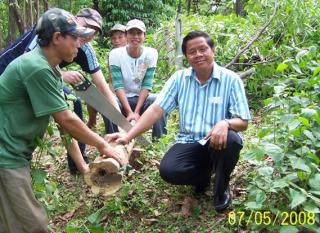
We will be harvesting our first batches of trees in Laos later this year, but we expect to get the same results as achieved in Vietnam and Thailand where CA Kits have already been tested. We have already cut some trees earlier than recommended to monitor the development of resin in the tree and everything looks good. I attach a recent photo taken of one such tree. The proud owner is on the right - he owns one of the largest plantations in Laos - several hundred hectares. He is now a Happy Farmer, hence our company's name. biggrin.gif I'm holding the saw!

QUOTE(eehtsitna @ Jun 8 2008, 10:36 AM)
Did you ever consider that technique that might work for agarwood tree in Laos might not work in Malaysia? We have our own species of agarwood, different microclimate, soil properties, rainfall and alot of other different factors. Not to mention that we need proof/result to backup our claim. Until some research is done on this in Malaysia, we cannot draw any conclusion or make any claim.
Well there is always scope for improvement and that is exactly what Bob and Henry are doing (i.e. aiming to further increase the performance of the CA Kit technology). However, the CA Kit as it currently stands will work equally well for all species of agarwood and in all countries where agarwood trees grow.

Attached Image

This post has been edited by Happy Farmer: Jun 8 2008, 02:47 PM
kwaytiau
post Jun 8 2008, 02:44 PM

Getting Started
**
Junior Member
50 posts

Joined: Aug 2006
From: Kuala Lumpur MAL


QUOTE(Happy Farmer @ Jun 8 2008, 02:24 PM)
I mean that when the young agarwood tree is growing (even when it is still in the nursery) it often has a tendency to form two or more main stems, i.e. one or more of the branches tends to become more dominant than is desirable and so it starts to compete with the original main stem. If this side branch is not removed it will form a main stem leading to a mature tree with more than one main stem or trunk. Not all side branches do this, so I don't mean you should cut off all the side branches - but where one side branch starts to become equal in size to the main stem then you can either cut it off or just cut it back a little to reduce its apical dominance. Later on it is good to cut off the lower side branches so that you have a nice clear stretch of main stem in which to apply the CA Kit (because it's difficult to work on a tree when there are many side branches in the way).
You need to call the Healthy company not the Happy one!  biggrin.gif Actually I don't know what is the price of CA Kits in Malaysia, that depends on Healthy Business. US$30 is our price in Lao PDR for a number one size CA Kit (including the booster treatment and application service).

I agree that if you have a lot of trees the financial investment to treat them with CA Kits can be very high, but then so can the payback. One strategy would be to treat as many of the trees as you can afford one year, then 12 months later after you have harvested and sold the agarwood you can reinvest your income in treating the remaining trees, i.e. you don't have to treat all 1,000 trees at the same time.
*
So in Malaysia only Healthy company provide/sell the CA Kit?

And after implement the method to the trees..after harvested do this company will buy the agarwood?

Thanks to HF,AB,ES and GP for sharing the information about agarwood investment/project.

Cheers,
Happy Farmer
post Jun 8 2008, 02:59 PM

New Member
*
Junior Member
14 posts

Joined: Jun 2008


QUOTE(kwaytiau @ Jun 8 2008, 01:44 PM)
So in Malaysia only Healthy company provide/sell the CA Kit?
Hi Kwaytiau,

Yes that is correct.

QUOTE(kwaytiau @ Jun 8 2008, 01:44 PM)
And after implement the method to the trees..after harvested do this company will buy the agarwood?
I'm sorry I don't know what is the deal in Malaysia with Healthy Business Co, but I am sure they will tell you. In Laos, we will buy the agarwood from the tree owner if we can negotiate a price that is satisfactory for seller and buyer. You might like to consider that the potential to make profit from the agarwood tree is much higher than from the CA Kit (because the value of the treated tree is many times higher than the price of a CA Kit).

You might like to drop an email to Healthy Business and ask them to participate in this thread so that everyone here can learn more about them, their prices, etc.

Thanks again for your appreciation.

HF

TSamirbashah
post Jun 8 2008, 04:15 PM

Getting Started
**
Junior Member
274 posts

Joined: Sep 2007
QUOTE(Happy Farmer @ Jun 8 2008, 02:24 PM)
I mean that when the young agarwood tree is growing (even when it is still in the nursery) it often has a tendency to form two or more main stems, i.e. one or more of the branches tends to become more dominant than is desirable and so it starts to compete with the original main stem. If this side branch is not removed it will form a main stem leading to a mature tree with more than one main stem or trunk. Not all side branches do this, so I don't mean you should cut off all the side branches - but where one side branch starts to become equal in size to the main stem then you can either cut it off or just cut it back a little to reduce its apical dominance. Later on it is good to cut off the lower side branches so that you have a nice clear stretch of main stem in which to apply the CA Kit (because it's difficult to work on a tree when there are many side branches in the way).
You need to call the Healthy company not the Happy one!  biggrin.gif Actually I don't know what is the price of CA Kits in Malaysia, that depends on Healthy Business. US$30 is our price in Lao PDR for a number one size CA Kit (including the booster treatment and application service).

I agree that if you have a lot of trees the financial investment to treat them with CA Kits can be very high, but then so can the payback. One strategy would be to treat as many of the trees as you can afford one year, then 12 months later after you have harvested and sold the agarwood you can reinvest your income in treating the remaining trees, i.e. you don't have to treat all 1,000 trees at the same time.
*
This pruning technique is a bit complicated. I don't know which branches to cut and my trees are still young. I don't fully understand this concept but will definitely do some research on it. Could you please give me a link on this particular subject? So what will happen if we don't prune the trees? In a nutshell, to make the trees/trunks bigger we must plant the trees at least 3 meters from each other and have to do pruning. Am I right?

This post has been edited by amirbashah: Jun 8 2008, 04:23 PM
eehtsitna
post Jun 8 2008, 08:48 PM

Casual
***
Junior Member
356 posts

Joined: Jun 2006


QUOTE(amirbashah @ Jun 8 2008, 01:32 PM)
Eehsitna, you still haven't explained the thinning process to me sad.gif
Okok. tongue.gif I will try my best to explain it in detail.

In timber plantation establishment, the first thing that you have to consider is what sort of spacing that you want to use for your plot. You can either choose a close spacing such as 3x3m which has a planting density of around 1100 tree per hectare. OR you can choose a wide spacing such as 5x5m, 5x6m which has a planting density that is lower than that of the 3x3m spacing mentioned earlier.

There are pros and cons on either approach. The close spacing such as the 3x3m will need more planting material in the initial planting stage and not to mention other resources such as labour, time and modal. This spacing will encourage the tree to compete against each other especially for light (canopy establishment) so the trees will grow vertically. And as for the wide spacing mentioned earlier, there are less tree per hectare so the tree will not have to compete too much against each other compare to the tree planted in a close spacing. The tree will grow horizontally (diameter) instead of growing vertically (height).

For timber production, our priority is to grow trees that is tall and straight with less or no forking at all. It is safe to assume that it is true in agarwood production too like what Happy Farmer has mentioned earlier. BUT there is a catch in using a close spacing for plantation establishment. Sooner or later, you will run out of space for the trees to grow (when canopy establishment is achieve). The growth potential of the tree is capped by this factor and the tree will not be able to grow to its full potential.

This is where THINNING treatment comes into play. Usually 1-2 years after planting, you will have to carry out thinning or else it will not be effective. The thinning process is quite straight forward. It is as if you are playing the role of nature where you select and pick out trees that is not growing well (survival of the fittest). By doing so you will free up space for the remaining tree. If our initial planting density is 1100 tree per hectare, after thinning, we will have a density of around 500-600 tree per hectare. Of course this will add up to your management cost but you can still sell those felled tree to generate some return for the time being.

That is really a mouthful! tongue.gif I will try to post something more detail when i get back to the office tomorrow. biggrin.gif Will try my best to answer you guys if you have any question. tongue.gif

QUOTE(amirbashah @ Jun 8 2008, 01:32 PM)
Hei, when are we going to conduct a meeting? I'm still waiting for you Eehsitna. Hahaha  biggrin.gif
Sorry for the hold up. tongue.gif Will keep you guys informed if I am going to KL anytime soon. tongue.gif


Added on June 8, 2008, 8:52 pm
QUOTE(amirbashah @ Jun 8 2008, 05:15 PM)
This pruning technique is a bit complicated. I don't know which branches to cut and my trees are still young. I don't fully understand this concept but will definitely do some research on it. Could you please give me a link on this particular subject? So what will happen if we don't prune the trees? In a nutshell, to make the trees/trunks bigger we must plant the trees at least 3 meters from each other and have to do pruning. Am I right?
*
You dont need to prune your tree this early! tongue.gif Wait till it has establish itself on the site and wait till it is starting to fork/branch out. Only then you should start to prune it. Doing it now might as well kill your seedling. sweat.gif I will post something regarding to pruning too later. tongue.gif Yes LATER... (cross my fingers)

This post has been edited by eehtsitna: Jun 8 2008, 08:52 PM
TSamirbashah
post Jun 9 2008, 07:58 AM

Getting Started
**
Junior Member
274 posts

Joined: Sep 2007
QUOTE(eehtsitna @ Jun 8 2008, 08:48 PM)
Okok. tongue.gif I will try my best to explain it in detail.

In timber plantation establishment, the first thing that you have to consider is what sort of spacing that you want to use for your plot. You can either choose a close spacing such as 3x3m which has a planting density of around 1100 tree per hectare. OR you can choose a wide spacing such as 5x5m, 5x6m which has a planting density that is lower than that of the 3x3m spacing mentioned earlier.

There are pros and cons on either approach. The close spacing such as the 3x3m will need more planting material in the initial planting stage and not to mention other resources such as labour, time and modal. This spacing will encourage the tree to compete against each other especially for light (canopy establishment) so the trees will grow vertically. And as for the wide spacing mentioned earlier, there are less tree per hectare so the tree will not have to compete too much against each other compare to the tree planted in a close spacing. The tree will grow horizontally (diameter) instead of growing vertically (height).

For timber production, our priority is to grow trees that is tall and straight with less or no forking at all. It is safe to assume that it is true in agarwood production too like what Happy Farmer has mentioned earlier. BUT there is a catch in using a close spacing for plantation establishment. Sooner or later, you will run out of space for the trees to grow (when canopy establishment is achieve). The growth potential of the tree is capped by this factor and the tree will not be able to grow to its full potential.

This is where THINNING treatment comes into play. Usually 1-2 years after planting, you will have to carry out thinning or else it will not be effective. The thinning process is quite straight forward. It is as if you are playing the role of nature where you select and pick out trees that is not growing well (survival of the fittest). By doing so you will free up space for the remaining tree. If our initial planting density is 1100 tree per hectare, after thinning, we will have a density of around 500-600 tree per hectare. Of course this will add up to your management cost but you can still sell those felled tree to generate some return for the time being.

That is really a mouthful! tongue.gif I will try to post something more detail when i get back to the office tomorrow. biggrin.gif Will try my best to answer you guys if you have any question. tongue.gif
Sorry for the hold up. tongue.gif Will keep you guys informed if I am going to KL anytime soon. tongue.gif


Added on June 8, 2008, 8:52 pm

You dont need to prune your tree this early! tongue.gif Wait till it has establish itself on the site and wait till it is starting to fork/branch out. Only then you should start to prune it. Doing it now might as well kill your seedling.  sweat.gif  I will post something regarding to pruning too later. tongue.gif Yes LATER... (cross my fingers)
*
Thanks for sharing the information. It's very helpful and really appreciate your help smile.gif

Happy Farmer
post Jun 9 2008, 10:45 AM

New Member
*
Junior Member
14 posts

Joined: Jun 2008


QUOTE(amirbashah @ Jun 8 2008, 03:15 PM)
This pruning technique is a bit complicated. I don't know which branches to cut and my trees are still young. I don't fully understand this concept but will definitely do some research on it. Could you please give me a link on this particular subject? So what will happen if we don't prune the trees? In a nutshell, to make the trees/trunks bigger we must plant the trees at least 3 meters from each other and have to do pruning. Am I right?
*
Yes you are right.

Having sufficient space between the trees is important so that you get short fat trunks rather than tall thin trunks.

Pruning is important so that you get single trunks not multiple trunks.

So the objective is to get trees with single short fat trunks, not multiple tall thin trunks.

I will try to get some photos to show you what I mean about the pruning.


eehtsitna
post Jun 9 2008, 11:54 AM

Casual
***
Junior Member
356 posts

Joined: Jun 2006


PRUNING

Pruning is another standard silvicultural input in tree plantation which is aimed at producing trees without low heavy branches so that long clear boles are formed. The need for pruning depends entirely on the branch development on the lower bole. Well stocked, dense stands discourage early side branch formation and generally require no pruning (Evans 1982). There are two main considerations for pruning, i.e., silvicultural and technical considerations.


Silvicultural considerations

In some species, dead branches soon fall off (natural pruning); in others they persist for many years. For example, Acacia auriculiformis has persistent branches, and pruning must be done if knot-free timber is desired, while such species as Terminalia superba and Neolamarckia cadamba, and most eucalypts have good natural self-pruning ability and rarely need artificial pruning. Eucalyptus grandis and Pinus caribaea are intermediate and have branches persisting for 2-3 years after dying.

Self-pruning is, to some extent, influenced by stand density. Dense, unthinned stands, with trees close together, encourage earlier suppression and death of side branches while they are small. However, the effect on accelerating natural pruning is not much. Of greater importance is the increase in persistence of branches low down the stem in open stands. Where wide spacing and heavy thinning are practised, artificial pruning is essential for all but the most freely naturally self-pruning species if high quality timber is desired.

Technical considerations

The important technical consideration is whether clear, knot-free, and consequently high grade timber is required. For example, wood of such quality is of little importance in plantations grown for:

· Firewood or fuelwood;
· Pulpwood and particle board;
· Low grade sawntimber for uses such as shuttering, and packing cases; and
· Protection purposes such as shelterbelts, erosion control, and stabilisation – in fact, persistent lower branches are often an advantage.

In contrast, clear, knot-free timber is highly desirable or essential for:

1. Veneer production for decorative use, match making, and plywood; knot free timber is needed to ease peeling, improve appearance, and reduce blemishes;
2. High grade constructional timber where uniform strength, and good machining, finishing, and seasoning qualities are important;
3. Various types of poles, e.g. transmission, which need to be smooth for handling, and free of surface snags or holes to prevent entry of fungi or termite into the heartwood which is often not penetrated by preservatives.

THINNING

For most thinning regimes the total volume of timber removed in thinning during rotation amounts to about 40-60 per cent of total production (Evans, 1982). The effects of thinning are:

1. To stimulate diameter growth of the remaining trees;
2. To interrupt stand development by volume reduction, followed by recovery;
3. To redistribute future growth on fewer trees resulting in a stand with a few large trees as opposed to many small ones; and
4. To reduce natural mortality.

Ahmad Zuhaidi and Weinland (2002) suggested that in general, 200 to 300 potential crop trees (PCTs) should be selected for final stand. The desired characteristics of potential crop trees are:

1. Dominant or co-dominant position in the stand;
2. 8 to 9 m bole height;
3. No big side branches;
4. No visible stem damage, disease or epicormic shoots;
5. A straight and vertical trunk;
6. A distinct dominant leader; and
7. No spiral grain or heavy forking.

An even distribution of PCTs is desirable. The selection of small groups of up to 3 trees is permissible. It is not a good practice to sacrifice PCTs for reasons of even distribution when the PCTs reserve does not contain sufficient number of trees. After this stand intervention, the average distance between trees should be 6 to 7 m.

The thinning practice recommended by Ahmad Zuhaidi and Weinland (2002) comprises three main thinning interventions as follows:

First thinning

First thinning is carried out when the average top height of the main crop is about 15 m (preferably diameter at this stage should be around 10 cm). This thinning involves the following steps:

1. Selection and marking of a defined number of potential final crop trees;
2. Removal of trees hampering crown development of the PCTs which could be secondary trees;
3. Removal of wolf trees;
4. Climber control; and
5. Liberation of commercial species in the intervening areas.

Second thinning

Second thinning is carried out when the top height of the main crop averages 20 to 25 m. Three main steps are taken for this operation:

1. Reduction of main crop trees down to PCTs;
2. Climber control on PCTs; and
3. Removal of trees hampering crown development of the selected trees as well as secondary trees.

Third thinning

Third thinning takes place when the average height of the main crop is 30 to 35 m (a 20-year or more rotation is planned). This thinning has two purposes:

1. Reduction of PCTs to the final crop trees ; and
2. Regeneration and final harvest phase (for longer than 20-year rotation), e.g. in the Dryobalanops aromatica stand in FRIM if the next rotation is to be regenerated naturally. Once the regeneration has established itself in sufficient number, felling is carried out to harvest about 50% of the standing stock. The remaining standing stock can be removed when the young regeneration reaches a height of 1.5 m.

Detailed information regarding pruning and thinning.
Source: A Guide to Plantation Forestry In Sabah

Feel free to add this information to the first post.

Cheers! biggrin.gif
Happy Farmer
post Jun 9 2008, 02:43 PM

New Member
*
Junior Member
14 posts

Joined: Jun 2008


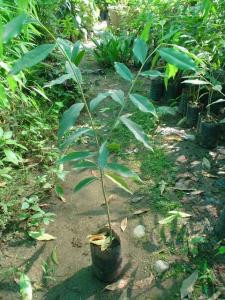
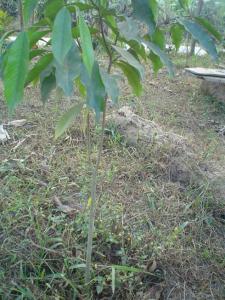
Below are 2 photos of agarwood seedlings - one in the nursery and one already planted. In both cases you can see that one of the side branches has started to form a second main stem. Therefore some pruning should start even in the nursery to prevent this from happening.

Attached Image

Attached Image
TSamirbashah
post Jun 9 2008, 02:50 PM

Getting Started
**
Junior Member
274 posts

Joined: Sep 2007
QUOTE(Happy Farmer @ Jun 9 2008, 02:43 PM)
Below are 2 photos of agarwood seedlings - one in the nursery and one already planted. In both cases you can see that one of the side branches has started to form a second main stem. Therefore some pruning should start even in the nursery to prevent this from happening.

Attached Image

Attached Image
*
So what I should do is remove one of the branch right? Just cut the entire branch? Would it have any affect on the growth of the tree or would it kill the tree?

This post has been edited by amirbashah: Jun 9 2008, 02:51 PM
jollygreengiant
post Jun 16 2008, 12:26 PM

New Member
*
Junior Member
7 posts

Joined: Jun 2008
QUOTE(amirbashah @ Jun 9 2008, 02:50 PM)
So what I should do is remove one of the branch right? Just cut the entire branch? Would it have any affect on the growth of the tree or would it kill the tree?
*
I think anyone thinking about growing these tress should think about what the market will be like by the time you can harvest. There are 10s of millions of trees that were planted just to get the 10% that will make oil when they are very mature. Now with this kit the market will in a few years be over flowing with oil. Do some research before you jump in the deep end.


Added on June 17, 2008, 10:48 am
QUOTE(Happy Farmer @ Jun 7 2008, 08:27 PM)
Hi Sham903n,
Yes I estimate conservatively US$200 per tree. The assumptions on which this figure are based are that an agarwood tree of 10 - 14cm DBH (diameter at breast height - 137 cm from the ground) is treated with a CA Kit and yields one year later a minimum of 200 grams of good quality agarwood chips which are currently selling at  not less than US$1,000/kg at wholesale price in the country of production. As you can see from www.scentedmountain.com the retail price in a consuming country can be much higher. Actually yields of up to 500 grams of good quality agarwood chips per tree (of above size) have been harvested. Besides the good quality agarwood chips, there will also be a kilogram of lower quality agarwood powder (produced when cleaning the chips) worth about US$30 - 50/kg that can be used to make incense or for oil extraction. Hence I consider the US$200/tree is a conservative figure.
I reckon that's nearly 1,250 trees per hectare. I believe around 800 - 850/hectare would be better. Anyhow, you can still produce agarwood at the higher tree density but just remember to give Healthy Business a call when your trees are big enough   wink.gif this will probably be at around 5-years-of-age (provided you prune them to just one main stem, otherwise a multi-stem tree will take 1 - 3 years longer for the individual stems to reach the right diameter for treatment).


Added on June 7, 2008, 8:30 pm

Thanks kwaytiau, you're welcome.
*
Isn,t scentedmountain owned by the same company that sells the kits? The kits produce B grade chips tha,t and I have found several refferences on the web sell for $230 KG. So its no where near $1 gram! Who is buying volume at that price? I want to see company info. So in todays market a tree yields $45 to $100 of chips after 6 years . This kit cost $30 and saplings, care, etc. What is the selling price years from now, when the millions of trees out there are done with the kit? Big old trees that were planted 20 years ago. How much will B grade chips be worth then? Don,t base an investment on facts from the company that makes money selling you the tools. Do your own homework.


Added on June 17, 2008, 12:06 pm
QUOTE(jollygreengiant @ Jun 16 2008, 12:26 PM)
I think anyone thinking about growing these tress should think about what the market will be like by the time you can harvest. There are 10s of millions of trees that were planted just to get the 10% that will make oil when they are very mature. Now with this kit the market will in a few years be over flowing with oil. Do some research before you jump in the deep end.


Added on June 17, 2008, 10:48 am

Isn,t scentedmountain owned by the same company that sells the kits? The kits produce B grade chips tha,t and I have found several refferences on the web sell for $230 KG. So its no where near $1 gram! Who is buying volume at that price? I want to see company info. So in todays market a tree yields $45 to $100 of chips after 6 years .  This kit cost $30 and saplings, care, etc. What is the selling price years from now, when the millions of trees out there are done with the kit? Big old trees that were planted 20 years ago. How much will B grade chips be worth then? Don,t base an investment on facts from the company that makes money selling you the tools. Do your own homework.
*
"Good quality agarwood produced from plantation trees treated with CA Kits is currently selling ex-factory at US$1,000/kg in Vietnam and US$5,000/kg in USA (actually retailing via the internet at US$25/5 grams). I could give you the web site address but I don�t want to be accused of blatantly promoting products (even though I have no commercial interest in the web site).
From trees treated at 5 years and harvested at 7 years between 200 � 500 grams of agarwood chips worth US$1 per gram are being harvested by my business associate in Vietnam, hence the value of US$200 � 500 per tree that I mentioned previously (in addition they get about 1 kg of agarwood powder per tree worth about US$30 � 50 that can be used to make oil/incense). "

Another quote from the saleman. No comercial interest directly but indirectly yes. Anyone can set up a web site but do they have sales?The associates in Vietnam runs the web site. What does that tell you? I found this on the web....

"As noted in Barden et al, grading gaharu is a complicated process. This includes evaluating thesize, colour, odour, weight (on scales and in water) and flammability of the wood – butapplication of grade codes (Super A, A, B, C, D, E) varies between buyers in PNG. Asian buyersare mostly based in Vanimo, though several have been reported to buy in Wewak when there isdemand. Most Asian buyers have PNG nationals working for them who are sent as ‘agents’ outto the village communities to assay and purchase gaharu. Prices paid to collectors in East Sepikand Sandaun Provinces are made in PNG Kina (PGK) per gram or kilogram. According toinformation collected from individuals involved in the trade, prices in May 2001 averaged asfollows:A grade = PGK1139.5 (USD341); B grade = PGK791.2 (USD237); C grade = PGK172(USD172); D grade = PGK371.66 (USD111"


B grade = $237 in 2001. Do you think the price is going up with greater market availabilty? Another find "we have ready stock agarwood and sandal wood Price per one Kg Agarwood Grade A USD 950 Grade B USD 650 Grade C USD 280 sandal wood USD 35 Per one kg too" Selling wholesale for $ 650. Ah this ling has the price at $280 kg
http://209.85.175.104/search?q=cache:GTBbt...lnk&cd=63&gl=th Do your homwwork investors.


This post has been edited by jollygreengiant: Jun 17 2008, 12:06 PM
Happy Farmer
post Jun 18 2008, 01:05 PM

New Member
*
Junior Member
14 posts

Joined: Jun 2008


QUOTE(amirbashah @ Jun 9 2008, 01:50 PM)
So what I should do is remove one of the branch right? Just cut the entire branch? Would it have any affect on the growth of the tree or would it kill the tree?
*
Actually there is only one branch in each of those two pictures - the other is not a branch but is the main stem! biggrin.gif So yes you can remove the branch but don't remove the main stem. So now you will ask me which is the branch. Well the branch is the one that emerges from a leaf axil (see http://en.wikipedia.org/wiki/Leaf if you don't know what is a leaf axil or just look at some of your own plants and you will soon see what I mean). You could remove the entire branch or just cut off its tip to keep it in check (i.e. not let it become dominant). With the latter approach you retain most of the leaves of the branch so that it can continue to photosynthesize and contribute to the growth of the seedlings. Eventually though it will either fall off or be removed by pruning to create the desirable clear bole that we talked about earlier.

But please don't make the mistake of removing all branches - only remove or trim back those which are becoming too dominant.


Added on June 18, 2008, 1:53 pm
QUOTE(jollygreengiant @ Jun 16 2008, 11:26 AM)
I think anyone thinking about growing these tress should think about what the market will be like by the time you can harvest. There are 10s of millions of trees that were planted just to get the 10% that will make oil when they are very mature. Now with this kit the market will in a few years be over flowing with oil. Do some research before you jump in the deep end.


Added on June 17, 2008, 10:48 am

Isn,t scentedmountain owned by the same company that sells the kits? The kits produce B grade chips tha,t and I have found several refferences on the web sell for $230 KG. So its no where near $1 gram! Who is buying volume at that price? I want to see company info. So in todays market a tree yields $45 to $100 of chips after 6 years .  This kit cost $30 and saplings, care, etc. What is the selling price years from now, when the millions of trees out there are done with the kit? Big old trees that were planted 20 years ago. How much will B grade chips be worth then? Don,t base an investment on facts from the company that makes money selling you the tools. Do your own homework.


Added on June 17, 2008, 12:06 pm

Another quote from the saleman. No comercial interest directly but indirectly yes. Anyone can set up a web site but do they have sales?The associates in Vietnam runs the web site. What does that tell you? I found this on the web....

"As noted in Barden et al, grading gaharu is a complicated process. This includes evaluating thesize, colour, odour, weight (on scales and in water) and flammability of the wood – butapplication of grade codes (Super A, A, B, C, D, E) varies between buyers in PNG. Asian buyersare mostly based in Vanimo, though several have been reported to buy in Wewak when there isdemand. Most Asian buyers have PNG nationals working for them who are sent as ‘agents’ outto the village communities to assay and purchase gaharu. Prices paid to collectors in East Sepikand Sandaun Provinces are made in PNG Kina (PGK) per gram or kilogram. According toinformation collected from individuals involved in the trade, prices in May 2001 averaged asfollows:A grade = PGK1139.5 (USD341); B grade = PGK791.2 (USD237); C grade = PGK172(USD172); D grade = PGK371.66 (USD111"
B grade = $237 in 2001. Do you think the price is going up with greater market availabilty? Another find  "we have ready stock agarwood and sandal wood Price per one Kg Agarwood Grade A USD 950 Grade B USD 650 Grade C USD 280 sandal wood USD 35 Per one kg too" Selling wholesale for $ 650. Ah this ling has the price at $280 kg
http://209.85.175.104/search?q=cache:GTBbt...lnk&cd=63&gl=th  Do your homwwork investors.
*
Hi Jolly Green Giant,

You don't seem so jolly today? sad.gif I hope that chip on your shoulder is an agarwood chip! (Preferably Grade A) biggrin.gif

Your advice to investors to do their homework is excellent advice and I agree with Barden that grading (and valuation) of agarwood is complicated. I'll be learning my first lessons in this process very soon following the harvest last week of some CA Kit-treated agarwood trees here in Laos.

Regarding your comments on prices:

(a) Who said the CA Kits produce Grade B chips? In fact they produce a range of grades.
(b) I don't think you can safely assume that what is referred to as Grade A or B in one country is the same quality as Grade A or B in another country;
© I think prices should still be going up and will continue to do so for a while because the production of cultivated agarwood from CA Kits is still a tiny fraction of world production;
(d) Yes of course prices do vary according to the quantity being sold and also the level of the transaction in the marketing chain (e.g. prices go up as you proceed from village collector, district trader, provincial trader, exporter, importer, retailer, etc, according to the value added by each intermediary). I understand that mark-ups in the agarwood trade are very large, perhaps because most of the trade is illegal.

As you have suggested, in the future, prices probably will come down due to increased production from plantations using CA Kits. At the same time, as agarwood becomes more affordable for "the masses" demand will increase and new uses will be found for agarwood (e.g. agarwood soap, shampoo, toothpaste, air freshener, herbal medicines, etc) and new markets will be targeted; so this will tend to counter the decline in prices. Since CA Kits are still new in the market it will be a while before supplies of cultivated agarwood increase significantly so in the meantime it is a simple case of "the early bird catches the worm". I know for a fact that while some people like yourself are skeptical and pessimistic there are many others who have already done their homework, recognized the business opportunities and are now hard at work.

By the way, here in Laos I am not in the business of encouraging people to plant agarwood, but rather I am trying to convince the many farmers that have already planted agarwood trees that the best way to turn their "empty" trees into real money is to use CA Kits. Now that I have recently harvested some trees treated with CA Kits my job is going to become much easier!

Best regards,
HF.


This post has been edited by Happy Farmer: Jun 18 2008, 01:53 PM
Happy Farmer
post Jun 18 2008, 01:58 PM

New Member
*
Junior Member
14 posts

Joined: Jun 2008


Here are some pictures taken last week here in Laos following the harvest of 9 trees treated with CA Kits:

Attached Image

Attached Image

Attached Image

Attached Image


jollygreengiant
post Jun 18 2008, 03:46 PM

New Member
*
Junior Member
7 posts

Joined: Jun 2008
QUOTE(Happy Farmer @ Jun 18 2008, 01:05 PM)
Actually there is only one branch in each of those two pictures - the other is not a branch but is the main stem!  biggrin.gif  So yes you can remove the branch but don't remove the main stem. So now you will ask me which is the branch. Well the branch is the one that emerges from a leaf axil (see http://en.wikipedia.org/wiki/Leaf if you don't know what is a leaf axil or just look at some of your own plants and you will soon see what I mean).  You could remove the entire branch or just cut off its tip to keep it in check (i.e. not let it become dominant). With the latter approach you retain most of the leaves of the branch so that it can continue to photosynthesize and contribute to the growth of the seedlings. Eventually though it will either fall off or be removed by pruning to create the desirable clear bole that we talked about earlier.

But please don't make the mistake of removing all branches - only remove or trim back those which are becoming too dominant.


Added on June 18, 2008, 1:53 pm

Hi Jolly Green Giant,

You don't seem so jolly today?  sad.gif   I hope that chip on your shoulder is an agarwood chip! (Preferably Grade A)  biggrin.gif

Your advice to investors to do their homework is excellent advice and I agree with Barden that grading (and valuation) of agarwood is complicated. I'll be learning my first lessons in this process very soon following the harvest last week of some CA Kit-treated agarwood trees here in Laos.

Regarding your comments on prices:

(a) Who said the CA Kits produce Grade B chips? In fact they produce a range of grades.
(b) I don't think you can safely assume that what is referred to as Grade A or B in one country is the same quality as Grade A or B in another country;
© I think prices should still be going up and will continue to do so for a while because the production of cultivated agarwood from CA Kits is still a tiny fraction of world production;
(d) Yes of course prices do vary according to the quantity being sold and also the level of the transaction in the marketing chain (e.g. prices go up as you proceed from village collector, district trader, provincial trader, exporter, importer, retailer, etc, according to the value added by each intermediary). I understand that mark-ups in the agarwood trade are very large, perhaps because most of the trade is illegal.

As you have suggested, in the future, prices probably will come down due to increased production from plantations using CA Kits. At the same time, as agarwood becomes more affordable for "the masses" demand will increase and new uses will be found for agarwood (e.g. agarwood soap, shampoo, toothpaste, air freshener, herbal medicines, etc) and new markets will be targeted; so this will tend to counter the decline in prices. Since CA Kits are still new in the market it will be a while before supplies of cultivated agarwood increase significantly so in the meantime it is a simple case of "the early bird catches the worm". I know for a fact that while some people like yourself are skeptical and pessimistic there are many others who have already done their homework, recognized the business opportunities and are now hard at work.

By the way, here in Laos I am not in the business of encouraging people to plant agarwood, but rather I am trying to convince the many farmers that have already planted agarwood trees that the best way to turn their "empty" trees into real money is to use CA Kits. Now that I have recently harvested some trees treated with CA Kits my job is going to become much easier!

Best regards,
HF.
*
You have a lot of opinion but very little facts. A The CA kit site saids " med-high" with an avr of 225 gms not the 200-500 you claim. The grading system is internation al and why are claiming it is not? Why does the ca site claim for 10-50 gms of grade A and not grade the the rest?I have a quote from someone who claims to be a researcher who saids most of the chips are grade C ""Hmmm... you can say that I am actually quite familiar with this topic because I am involved in a research related to gaharu. Just for your information, the price of the gaharu itself depends solely in the grade of the resin and cultivated gaharu is known to have a grade of around "C" which does not really fetch a good price in the market. There are still alot of grey area in this trade so you can say that there are risk involved" B there are only a couple of main countrys that buy and buying hubs why are you trying to say the grading system varuies? Why don,t you say exactly what grade and how much on average the kits produce. These claims by the way from your site say the ttrees are 6-9 year old and not as who like to keep saying age healty 3-4-5 year old trees. C http://www.biotrop.org/prd.php?act=proddet&id=8 this is the current market plus maybe double for smuggling. http://www.enfleurage.com/ac-agarwood-2.html Massive amounts of trees have been planted only to get the harvest that occurs by way of nature.Doesnt Lao have 10 million trees alone? In fact the truth is even with out the kits there are too many trees planted and the price has been falling. Also what you said about the Kits being a tiny fraction is not true. Tens of thousands of kit have been used and sales are increasing. The kit is already doing about 1/8 of world producion.D prices, value chain. You say the kits make chips worth $1 gram to the grower. Then you must know what grade to make that statement, what is it. I provided some links to wholesale prices for different grades what can you show us? A link to your partners web site. What is your dirty little secret.... I know, the price is falling and fast. You hope there will be a market for shampoo etc. It will have to be very cheap before that happens. I find it strange that someone who is in the business selling kits can not offer or will not offer links to buyers prices or accounting to what the real price is.Learning your first lesson? Hard to believe you are in this business and don,t even really know the price of the product. In fact the average tree in THIS market will only get $100 and production is increasing. Of course as long as you sell kits you are making money, $30 each is that right? Tell us have you offered any buy back scemes like you said you do? if so for how much? Ya right vNot in the business of incouraging people tp plant agarwood hahaha I have read many of your post here and on other forums where you do just that, in fact on your own web site you offer seeds, your a real joker arn,t you. You talk alot but only ever offer opinion, business men want facts, something you would rather we did not know.So put up or shut up. No more of your smooth salesman jive. Show us FACTS FACTS


Added on June 18, 2008, 4:08 pm
QUOTE(Happy Farmer @ Jun 7 2008, 08:27 PM)
Hi Sham903n,
Yes I estimate conservatively US$200 per tree. The assumptions on which this figure are based are that an agarwood tree of 10 - 14cm DBH (diameter at breast height - 137 cm from the ground) is treated with a CA Kit and yields one year later a minimum of 200 grams of good quality agarwood chips which are currently selling at  not less than US$1,000/kg at wholesale price in the country of production. As you can see from www.scentedmountain.com the retail price in a consuming country can be much higher. Actually yields of up to 500 grams of good quality agarwood chips per tree (of above size) have been harvested. Besides the good quality agarwood chips, there will also be a kilogram of lower quality agarwood powder (produced when cleaning the chips) worth about US$30 - 50/kg that can be used to make incense or for oil extraction. Hence I consider the US$200/tree is a conservative figure.
I reckon that's nearly 1,250 trees per hectare. I believe around 800 - 850/hectare would be better. Anyhow, you can still produce agarwood at the higher tree density but just remember to give Healthy Business a call when your trees are big enough  wink.gif this will probably be at around 5-years-of-age (provided you prune them to just one main stem, otherwise a multi-stem tree will take 1 - 3 years longer for the individual stems to reach the right diameter for treatment).

Added on June 7, 2008, 8:30 pm

Thanks kwaytiau, you're welcome.
*
us$1,000 WOW thats amazing! amazing bs that is. The real price is $250 kg or $56, C grade for oil and incence takes 15 kg to produce $25 oil and is expensive to distill. $30 for the kit. 5 year old tree that is care for watered, pruned, fertilized, guarded, fenced, labor intensive harvest and WOW maybe $50 bucks. Oh ya I heard 1 in 10 trees dies from the treatment and in plantation its not unusual to have to replace 50%.What will the price be next year?

HOHOHO

This post has been edited by jollygreengiant: Jun 18 2008, 04:08 PM
Happy Farmer
post Jun 19 2008, 11:44 AM

New Member
*
Junior Member
14 posts

Joined: Jun 2008


QUOTE(jollygreengiant @ Jun 18 2008, 02:46 PM)
You have a lot of opinion but very little facts. What is your dirty little secret....  your a real joker arn,t you. You talk alot but only ever offer opinion, So put up or shut up. No more of your smooth salesman jive. Show us FACTS FACTS      HOHOHO
Hi Jolly Green Giant,

I would be grateful if you could be a little more civil, thank you. smile.gif

Regarding agarwood grades, according to the report "HEART OF THE MATTER: AGARWOOD USE AND TRADE AND CITES IMPLEMENTATION FOR AQUILARIA MALACCENSIS" by Barden et al, 2000 (I assume this is the same Barden report that you quoted earlier; it can be downloaded here: http://www.trafficj.org/publication/00_hea...er_agarwood.pdf ):

Agarwood "is classified according to various grading systems that differ according to the product in trade and country in which trade is taking place. The grade (and hence value) of agarwood and agarwood derivatives such as oil is determined by a complex set of factors including: country of origin; fragrance strength and longevity; wood density; product purity; resin content; colour; and size of the form traded."

Of course, it is possible that since the report was written that international grades have been developed, in which case perhaps you could kindly provide us with further information or a link to the international grades for agarwood?

Also please can you provide evidence to support your claims (opinions?) that CA Kits account for 1/8 of world agarwood production and that agarwood prices are already falling?

Could you also tell us what is your interest in agarwood? Perhaps if we know this, then we may understand why you are trying so hard to discredit CA Kits?

Have a nice day! smile.gif

Best regards,
HF.

19 Pages « < 6 7 8 9 10 > » Top
 

Change to:
| Lo-Fi Version
0.0268sec    0.16    6 queries    GZIP Disabled
Time is now: 2nd December 2025 - 08:41 PM