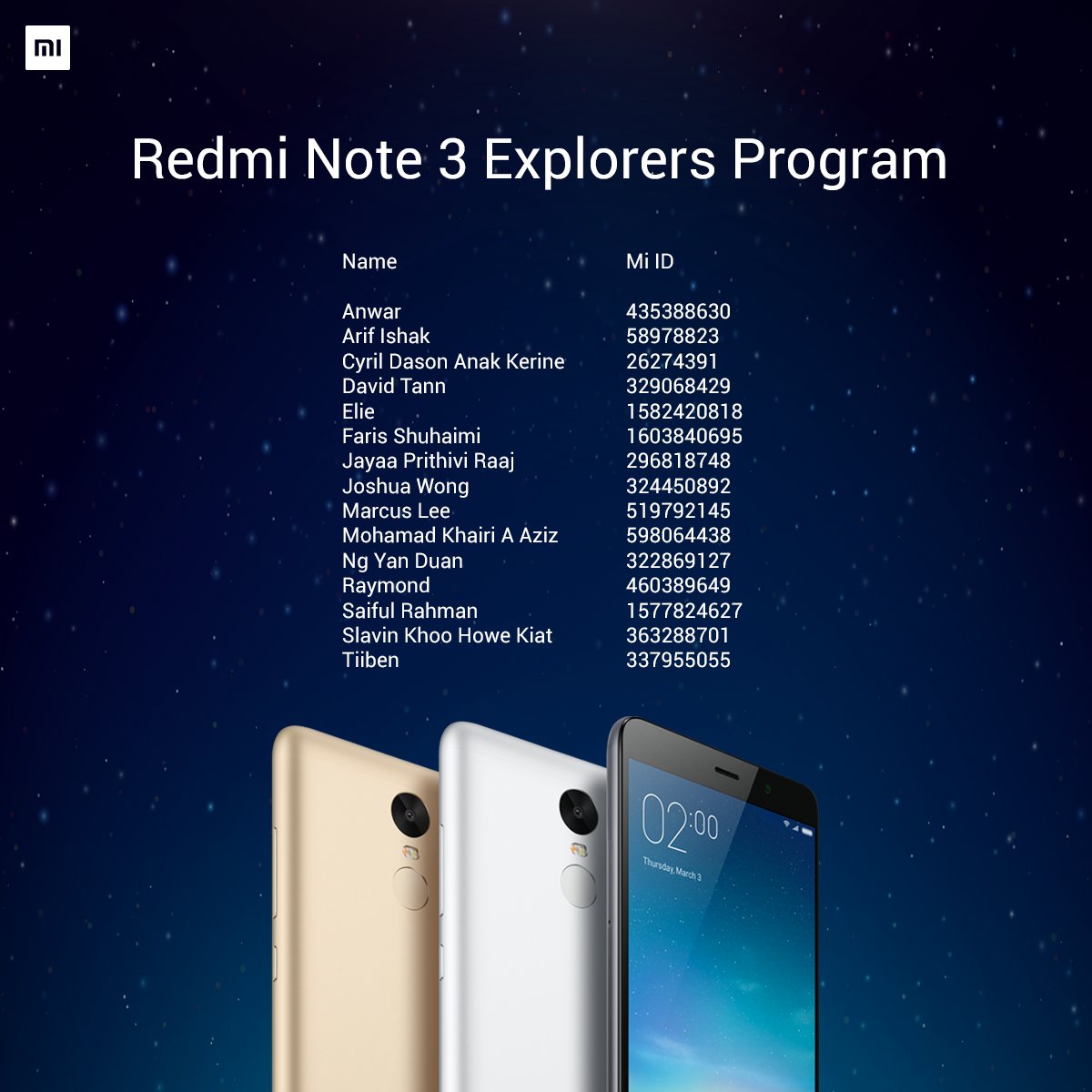
Firstly, I would like to thank my friend; Larrie Chua, for introducing me the Xiaomi Explorer programme and the Big Man above who gave me this sweet opportunity!
Hundreds or maybe thousands of Mi Malaysia fans were trying their luck to get their hands-on the latest, powerful and yet still affordable phone; the Xiaomi Redmi Note 3. The package arrived the day after my name was announced as one of the explorers and I was amazed with the prompt delivery, kudos to the team Xiaomi Malaysia!
» Click to show Spoiler - click again to hide... «
Before I continue, I will be reviewing the Snapdragon Version of Xiaomi Redmi Note 3. Below are the specification.
Aluminium body
5.5-inch, 1920x1080 IPS LCD
Qualcomm Snapdragon 650; 2x 1.8GHz Cortex-A72 + 4x 1.2GHz Cortex-A53; Adreno 510
3GB RAM with 32GB storage; microSD support
Dual SIM, LTE, Wi-Fi 802.11ac, Bluetooth 4.1, IR, microUSB
16 megapixel rear camera with PDAF, f2.0 aperture, dual LED flash
5 megapixel front camera, f2.0 aperture
Fingerprint sensor
4050mAh battery
Android 5.1.1 with MIUI 7
The beautiful full HD 5.5inch screen makes the phone premium especially with it being solidly built without feeling heavy at a mere 164grams. It fits just perfectly in my hand! The matte finish also makes the phone feel fantastic and is so much more comfortable to hold. Another great thing is that it doesn’t attract fingerprints, which is a big pet peeve for many phone users. Although Redmi Note 3 is classified as a budget phone but this is an absolute beast!
Redmi Note 3 is the first Xiaomi phone with a full aluminium body and a fingerprint sensor. The fingerprint is located at the rear that makes unlocking the phone much more convenient and easy; it is perfectly positioned at comfortable reach of the index finger. Xiaomi claims that the sensor could recognise and unlock in 0.3 seconds. I had the phone for over 2 weeks and I can assure you that the claim is true and it has not failed me! It is simply accurate and faster than a PIN. The sensor can also recognise up to 5 fingerprints.
» Click to show Spoiler - click again to hide... «
Other than that, Redmi Note 3 also supports IR Blaster, Bluetooth 4.2 and GPS with Assisted-GPS. The GPS system locks in pretty quick with an accuracy about 1 metre to 5 metres. For the time being, I have not noticed any strange behaviour with the system. The speaker is located at bottom rear and it is fairly loud which is useful for alerts and media playback.
» Click to show Spoiler - click again to hide... «
There are 2 different variants available on the market; Mediatek 6795 X10 Helio that was announced in China on November 2015 and Qualcomm Snapdragon 650 on January 2016.
We all love the extra storage on our phones. Both versions come with 16gB or 32gB built-in storage but the major selling point difference between the Snapdragon and the Helio is that the Snapdragon variant has a hybrid dual sim card tray; a main micro-sim slot and an exchangeable nano-sim or microSD slot with an expansion up to 128gB. It’s pretty darn awesome if you were to ask me!
In this current age phone apps, games and videos have grown immensely in size. Music is now easily available offline, with the rise of e-books being downloaded and more choices available online, we can also see that the number of e-book readers has increased. “Photographers” and “Instagrammers” love to take photos with their smartphone and deleting photos can be something that people hate and dread doing. With an increase of more resources being widely available and more accessible, we can easily conclude that storage is what we need.
Both Snapdragon 650 and Helio X10 are 64bit architecture with 28nm process technology; energy efficient and high performance. Snapdragon 650 is powered by Dual Core ARM cortex A72 and Quad Core A53 cortex. It is also driven by powerful Adreno 510 GPU; a latest 5th generation GPU from Qualcomm.
CODE
http://i.imgur.com/BqWgthb.jpg
Though Helio X10 has 2 more cores compared to Snapdragon 650, but the benchmark performance shows otherwise. Of course, higher benchmark does not reflect real life performance, usage and user experience. What should you take into consideration are your needs, what are you going to do with your device; usage of social media, games, web browsing, music, video and photography, messaging, calls and more. These are in my opinion comparative to benchmark and real life usage.
On the camera wise, the Snapdragon variant is also rocked out with 16MP PDAF with f/2.0 compared to a 13MP f/2.2 on Helio. Both comes with a dual tone LED flash. We as the user must understand that having higher megapixels does not always mean that it will take better photos but other elements such as lighting and angle will make a difference in the photo being captured.
The stock camera is very simple and easy to use with a number of different filters and modes. One of the features I liked the most is the “Slow Motion” on the video mode. Unfortunately it is only available for recording at 720p, that being said, it is still one of the sweet and awesome features! Oh, did I forget to mention that it records at 120fps too! Now it makes the phone even slicker! On top of that, the “Time Lapse” function has been pre-installed together with the stock camera. Thanks to the Snapdragon chipset, you now can record 4K video with Google Camera.
Camera Mode
» Click to show Spoiler - click again to hide... «
Slow Motion
CODE
https://youtu.be/ir2_49GD2-A
Time Lapse
CODE
https://youtu.be/N6zZcsagaRM
In the photo mode, the camera colour production and the image quality are relatively good especially in the daylight setting. The PDAF (Phase-Detect Auto Focus) system; a DSLR level image processing, works really well in a well-lit environment. The results were quite pleasing. The only struggle here is on the lowlight setting as it takes longer for the camera to focus and the result may be a little blurry, this could be due to an unstable hand. That being said even with the flash, the image quality in the lowlight environment is still reasonably decent.
» Click to show Spoiler - click again to hide... «
Notably I must mention, the burst mode on the camera works pretty well too! It is smooth and always ready. It can be simply activated by holding on to the shutter button and it can take up to 20 photos under 4 seconds. Repeat the same process if you would like to take more.
Provided there is good lighting, the front 5MP camera is really good for selfies but decent enough when it’s under lowlight. Nevertheless, the camera is still pretty good for the phone at this price range.
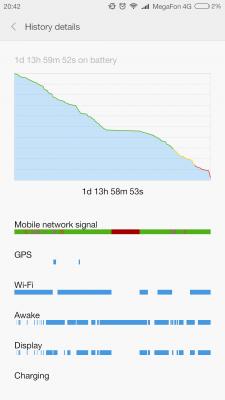
Now, let’s unleash the beast! Introducing the enormous 4,050mAh battery. I have the phone for almost 2 weeks and I can certainly say that the battery life exceptionally good! The battery can easily last me the whole day on a single charge without any battery saver mode. The battery is non-removable but I doubt it’s going to be any issues to anyone. If it does, the Redmi Note 3 also comes with Qualcomm first generation Quick Charge that can charge from 0% to 100% in 2 hours and 30 minutes.
» Click to show Spoiler - click again to hide... «
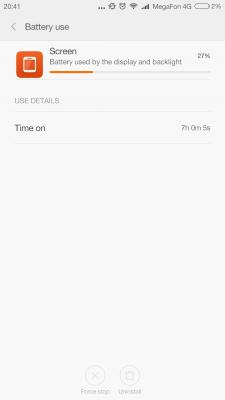
Even after hours on Spotify, Youtube, web surfing, WhatsApp, Viber, taking photos and updating social media, the battery could last 1 day and 5 hours or more with 5 hours to 6 hours screen-on time. The battery life may varies with gamers though I do play some games from time to time. On top of that, I’d prefer the phone brightness set at either medium or full. The beautiful, bright and clear LCD screen is meant for our eye pleasure! Battery juice isn’t something that users should be concerned about.
» Click to show Spoiler - click again to hide... «
On the software wise, the phone is running on MIUI 7 which based on Android 5.1.1 Lolipop. MIUI 7 is pretty much simple and straight forward. For users that have never experienced MIUI, just imagine a mixture of both iOS and Android. Which ends up with a good, smooth, quick and clean user friendly interface. There are also a few cool features that you should be aware of. Please note these “cool features” can be subjective and I probably miss a few other features. If you know, please share with us!
Below are the lists.
• Vibrates when call is answered
• Child mode
• Theme store; makes MIUI highly-customisable
• Built in Security Feature
• Hidden files
• One-handed mode
• Audio Profile for different types of earphones.
One of the trick I found on how to access the volume levels (alarms, notifications etc.) You need to press on the volume button, then a volume icon will appear on the screen. Once it appears you will need to continue holding for all the major volume options to come up.
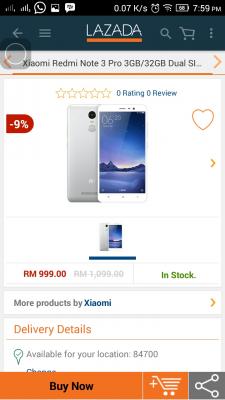
As the conclusion, Redmi Note 3 is selling at a third of the flagship phone prices out there. The low priced the Redmi Note 3 is being sold for is a major drawing card for potential buyers. Although it is mid-range phone it has a lot of potential to compete with other phones in a higher price segment.
Redmi Note 3 has high resolution full HD screen, fast processor, exceptional battery life, fingerprint sensor, aluminium body, neat user interface and excellent design.
Redmi Note 3 simply is a great, affordable and powerful phone.
This post has been edited by Lucius <3: Mar 25 2016, 02:54 AM 

 Mar 8 2016, 06:37 PM, updated 10y ago


 Quote
Quote













 sell off as 2nd hand + top up to upgrade.... gg those amount of $$. I better calm myself and stick with RN3


 .
.

 my question





 )
)










 I thought my phone malfunction or something *keep touching the screen and feeling it with my face* LOL no heat la! rike it!


























 0.2177sec
 0.52
0.52
 6 queries
 GZIP Disabled