to me, MinDef better lubok for songlaping since any procurement can be kept secret due to 'national security'. Of coz, some procurement must be kept top secret due to its security nature, but many data can be easily obtain regarding on what type of equipment being installed. For example, the subs procurement, which many songlapers backers argue must not be disclosed to the public, walhal can actually be easily tarced back on what equipment being installed by researching the vendors involved. Only the sensitive parts like data encryption maybe not on the companies' datasheet. So, argument that we publicly say we bought 2 scorpene but also another one in secret is pure crap.. Samudera class have big potential for converting into patrol vessels, Dun think it would require that much of re-designing.. Once fully armed, Kedah-class would be quite awesome.. why not go for air-breathing supersonic anti-ship missiles?
Well you have yet to see moe and moh level yet. As for procurement i always support full disclose of contract. If certain parts in the contract deem sensitive they can censor it.
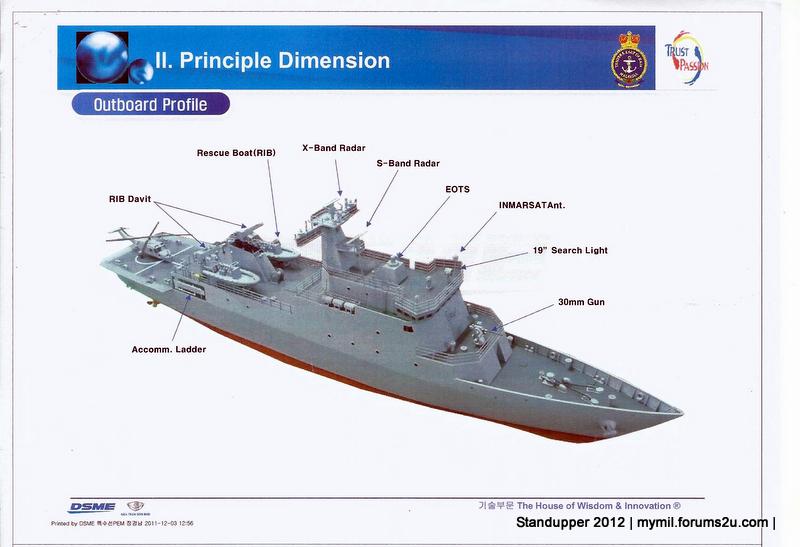
For samudera they still need to redesign certain parts to suits it role. Increase the space for its weapons deck is needed. Rib davit and rib could be remove to make space for heli hangar. Though i would prefer it retain such future and replace the rib with fic instead.
Jon Grevatt, Bangkok - IHS Jane's Defence Weekly 13 October 2013
A diesel-electric submarine and another batch of six Saab JAS 39C/D Gripen combat aircraft are expected to be high on a shopping list of items that the Royal Thai Armed Forces (RTAF) wants to purchase by 2024.
An RTAF source confirmed to IHS Jane's recently that the list is being put together by RTAF Supreme Commander General Thanasak Patimaprakorn following a request from Prime Minister Yingluck Shinawatra, who is also Defence Minister.
The list is being drawn up in response to a requirement to replace a range of ageing RTAF materiel and to maintain the military balance with Thailand's peers in Southeast Asia, all of whom are pressing ahead with plans to modernise their respective military capabilities. Shopping list
As well as the submarine, other military equipment expected to be on the Royal Thai Navy's (RTN's) shopping list include a multipurpose frigate from South Korea's Daewoo Shipbuilding & Marine Engineering (DSME) - a follow-on order to the frigate ordered from DSME in August 2013; offshore patrol vessels (OPVs), likely to be based on BAE Systems' River-class Offshore Patrol Vessel (OPV), one of which recently entered service with the RTN; and helicopters fitted with anti-submarine warfare capabilities.
The Royal Thai Air Force (RTAF) outlined a requirement in September for at least six additional Gripen aircraft within the next decade to supplement the 12 in service. The RTAF is also looking to acquire search-and-rescue-capable utility helicopters, which is likely to centre on the purchase of Eurocopter EC725 platforms.
The Royal Thai Army is expected to request more Oplot main battle tanks from Ukraine; more armoured personnel carriers, also likely to be sourced from Ukraine; as well as a range of helicopters - including Sikorsky S-70 Black Hawks, Mil Mi-17V-5s and Eurocopter UH-72A Lakotas - to replace ageing Bell and Sikorsky platforms in service.
Submarine procurement
While most of the equipment to be requested by the RTAF is, to varying degrees, already anticipated by the government, it is the procurement of the submarine that will prove most contentious, given the RTN's previous efforts to acquire such a capability and the government's uncommitted stance on the programme.
However, the RTAF source told IHS Jane's that the purchase of the diesel-electric submarine is now being seriously considered. The main driver behind the purchase is the expected long-term impact of Thailand's significant involvement in the development of the deep-sea Dawei port off the Andaman Sea in Myanmar.
This port is forecast to commence operations in about 10 years and will enable Thailand, through its high investment and involvement in the project, to bypass the Gulf of Thailand in importing and exporting goods to Europe, India and the Middle East. The port is the brainchild of former Prime Minister Thaksin Shinawatra, (Yingluck's brother) who was ousted in a military coup in 2006.
The RTAF source said that while the RTN's attention is currently drawn to the procurement of the first of two frigates from DSME, under a USD468 million contract signed in August, a team from the RTN has been undergoing a submarine technology training programme, held by ThyssenKrupp Marine Systems in Germany, with a view to a potential future purchase. The RTN, he said, has also invested in a range of submarine simulation and training systems, which are now installed at the RTN's Sattahip Naval Base.
He said: "The Navy's number one priority at the moment is the procurement of the frigate, but on 8 November a team that has been undergoing submarine training in Germany will return to Thailand. Another team is expected to go to South Korea shortly and with the knowledge from these two teams we will find the best solution for the RTN." He added: "This submarine programme will only be for a brand new submarine, we will not buy second-hand."
Bartering plans
With the growth of Thailand's Gross Domestic Product (GDP) slowing due to the country's dependency on exports to weakened economies and a cutback in domestic spending, the trajectory of Thailand's defence budget is forecast to remain relatively flat. According to IHS Jane's Defence Budgets , total defence spending climbed 7% in 2013 to about USD5.8 billion and will remain at around this level for the next few years.
This economic challenge coupled with a perceived requirement in Bangkok to bolster the country's agricultural industry have prompted the Thai government to consider purchasing the RTAF's list of required materiel through barter-trade. Underscoring this effort, Yingluck is reported to have sought support from RTAF leaders to purchase the military acquisition requirements through exchanges of "rubber, rice and chicken". Such barter trade deals will help Thai farmers, she said.
RTAF spokesman Group Captain Prapas Sonjaidee also confirmed to IHS Jane's in September that the service was looking at the possibility of acquiring additional Gripen aircraft through the exchange of chickens or other agricultural produce. "This is a possibility depending on the government's policy," he said. "We don't have a plan at the moment but a barter trade arrangement could be organised in the future."
There is a mistake in the article. According to the article it is the AH-1Z and should be the Viper not the Super Cobra. The AH-1Z is designated as the Viper or Zulu. The Zulu has 4 blades.
QUOTE
The US is also offering the AH-1Z Super Cobra to meet Malaysia's requirement for an attack helicopter. While Boeing has been marketing the AH-64 Apache, the prospect of a purchase by Kuala Lumpur is unlikely due to Malaysia's disinclination to buy key military equipment in service with its neighbours: the Apache is in service with Singapore and on order by Indonesia.
This post has been edited by azriel: Oct 17 2013, 09:48 AM
Don't believe in hiding mistake, we're all fallible and prone to make mistakes though for defence journos, making model types mistakes can occur since most of us around reporting when the earlier models were in service
A notional combat suit for a future U.S. Armuy soldier. U.S. Special Operations Command (SOCOM) believes that innovation between industry can accelerate the introduction of leap-forward capabilities embodied in a tactical combat outfit for a future soldier. U.S. Army photo by Conrad Johnson, RDECOM Public Affairs
U.S. Army Sgt. 1st Class Matthew Oliver showcases an example of what a soldier may look like in the year 2032 at the Chicago Auto Show, Feb. 14, 2012. U.S. Special Operations Command (SOCOM) issued an RFI for a Tactical Assault Light Operator Suit (TALOS) that has the potential to make 2032 happen in 2013. U.S. Army photo by Anthony Taylor, 85th Support Command Public Affairs Office
huhu... just found out. viper can fire sidewinder and Apache can't.
doesn't really make sense to arm with sidewinders, given that: 1. apache is mainly a tank buster/CAS role 2. you only deploy apaches when you have air supremacy, else your helis will be picked off easily by enemy jets
come to think of it, i can't recall any heli-to-heli air combat.
except this:
This post has been edited by cks2k2: Oct 17 2013, 04:29 PM
Ac-130 better than attack heli.... but too bad Amerika not exporting it.
ask deftech/stride modify RMAF hercules ourselves..hehe using our own tech n specs..i think it can be done though..using old bofors cannon n small howitzer on it..just my imagination..haha


 Military Thread V10, Merry X'Mas and Happy New Year
  Oct 17 2013, 07:12 AM


 Quote
Quote


 , and apologies for the Super Cobra mistake got a little mixed up on it, should be the 1Z Viper




.jpg)


 0.0300sec
 0.44
0.44
 5 queries
 GZIP Disabled