Welcome Guest ( Log In | Register )

91 Pages « < 23 24 25 26 27 > » Bottom

Outline · [ Standard ] · Linear+

 Ask a Mathematical Physicist

views
     
delsoo
post Dec 28 2013, 12:32 AM

Look at all my stars!!
*******
Senior Member
3,187 posts

Joined: Nov 2013
QUOTE(Critical_Fallacy @ Dec 27 2013, 09:10 PM)
The more you read the question carefully, the better you understand what it requires. Intermission is right! To obtain the total potential energy of the system, you need to calculate U for every pair of charges and summing the terms algebraically. For example, the total potential energy of the system of four charges is

user posted image
*
thanks! rclxms.gif
delsoo
post Dec 28 2013, 12:46 AM

Look at all my stars!!
*******
Senior Member
3,187 posts

Joined: Nov 2013
sometimes i find it difficult to do back the maths and physics question that i've left in incompleted... (hard to think and recall the concept)
TSCritical_Fallacy
post Dec 28 2013, 01:41 AM

∫nnộvisεr
Group Icon
VIP
3,713 posts

Joined: Nov 2011
From: Torino
QUOTE(delsoo @ Dec 28 2013, 12:46 AM)
sometimes i find it difficult to do back the maths and physics question that i've left in uncompleted... (hard to think and recall  the concept)
Beware! That's a typical LAZY student syndrome. dry.gif All fundamental principles are stated in your textbooks. What were the reasons you took Math and Physics in STPM? Do you really want to become a Mathematician or a Physicist? sweat.gif

This post has been edited by Critical_Fallacy: Dec 28 2013, 01:42 AM
studyboy
post Dec 28 2013, 01:55 AM

On my way
****
Senior Member
522 posts

Joined: Mar 2013
QUOTE(danny88888 @ Dec 27 2013, 09:51 AM)
Thanks for the insight.

Anyway this is too advanced, 1st year uni calculus, cannot use calculator for exam.

To find the determinant for 4X4, the formula is cofactor-cofactor+cofactor-cofactor? Do you get what i meant?
*
Refer to post #470 by Critical_Fallacy. The method to compute a 4X4 matrix is depicted very clearly.

Nevertheless, the formula you stated here is correct. smile.gif

Yes, these are all rather advanced for a 1st year university student but given time, you will get used to it.
TSCritical_Fallacy
post Dec 28 2013, 12:09 PM

∫nnộvisεr
Group Icon
VIP
3,713 posts

Joined: Nov 2011
From: Torino
Hi Flame Haze, RED-HAIR-SHANKS, maximR, crazywing26 and delsoo,

Most chemical equations in STPM/A-level are sufficiently simple that they could have been balanced by trial and error, but for more complicated chemical equations we will need a systematic method. There are various methods that can be used, but I will give one that uses Matrix theory. icon_idea.gif

To balance a chemical equation, we let x1, x2, x3, and x4 be positive integers that balance the equation

user posted image

Equating the number of atoms of each type on the two sides yields

Hydrogen (H) :: 1 x1 = 3 x3
Chloride (Cl) :: 1 x1 = 1 x4
Sodium (Na) :: 3 x2 = 1 x4
Phosphorus (P) :: 1 x2 = 1 x3
Oxygen (O) :: 4 x2 = 4 x3

from which we obtain the homogeneous linear system
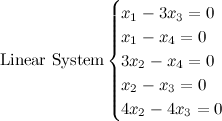
user posted image

The augmented matrix for this system is
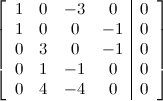
user posted image

I leave it for you to show that the reduced row echelon form of the augmented matrix for this system is
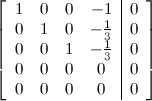
user posted image

from which we conclude that the general solution of the system is

x1 = t, x2 = t/3, x3 = t/3, x4 = t

where t is arbitrary. To obtain the smallest positive integers that balance the equation, we let t = 3, in which case we obtain x1 = 3, x2 = 1, x3 = 1, and x4 = 3. Substituting these values in the original problem produces the balanced equation


user posted image
RED-HAIR-SHANKS
post Dec 28 2013, 12:35 PM

On my way
****
Senior Member
654 posts

Joined: Apr 2013
From: Planet Earth


QUOTE(Critical_Fallacy @ Dec 28 2013, 12:09 PM)
Hi Flame Haze, RED-HAIR-SHANKS, maximR, crazywing26 and delsoo,

Most chemical equations in STPM/A-level are sufficiently simple that they could have been balanced by trial and error, but for more complicated chemical equations we will need a systematic method. There are various methods that can be used, but I will give one that uses Matrix theory. icon_idea.gif

To balance a chemical equation, we let x1, x2, x3, and x4 be positive integers that balance the equation

user posted image

Equating the number of atoms of each type on the two sides yields

Hydrogen (H) :: 1 x1 = 3 x3
Chloride (Cl) :: 1 x1 = 1 x4
Sodium (Na) :: 3 x2 = 1 x4
Phosphorus (P) :: 1 x2 = 1 x3
Oxygen (O) :: 4 x2 = 4 x3

from which we obtain the homogeneous linear system

user posted image

The augmented matrix for this system is

user posted image

I leave it for you to show that the reduced row echelon form of the augmented matrix for this system is

user posted image

from which we conclude that the general solution of the system is

x1 = t, x2 = t/3, x3 = t/3, x4 = t

where t is arbitrary. To obtain the smallest positive integers that balance the equation, we let t = 3, in which case we obtain x1 = 3, x2 = 1, x3 = 1, and x4 = 3. Substituting these values in the original problem produces the balanced equation

user posted image
*
I'm simply amazed by the application of matrices in solving Chemistry-related question like this one, thanks for it. I'm going to note this down for sure, in case I'm going to need to use this method in the near future. But, knowing that the time given for answering a question in STPM would be really scarce, do you reckon that we're able to balance the said equation under the short amount of time using Gauss-Jordan Elimination? But, I guess with given appropriate space and time to practice, we can really master it.
delsoo
post Dec 28 2013, 01:55 PM

Look at all my stars!!
*******
Senior Member
3,187 posts

Joined: Nov 2013
Why the total charge of two spheres of.two.isolated conducting spheres with different radii AnD charges but connected by a wire is.the same?
RED-HAIR-SHANKS
post Dec 28 2013, 02:03 PM

On my way
****
Senior Member
654 posts

Joined: Apr 2013
From: Planet Earth


QUOTE(Critical_Fallacy @ Dec 28 2013, 12:09 PM)
The augmented matrix for this system is

user posted image

I leave it for you to show that the reduced row echelon form of the augmented matrix for this system is

user posted image

*
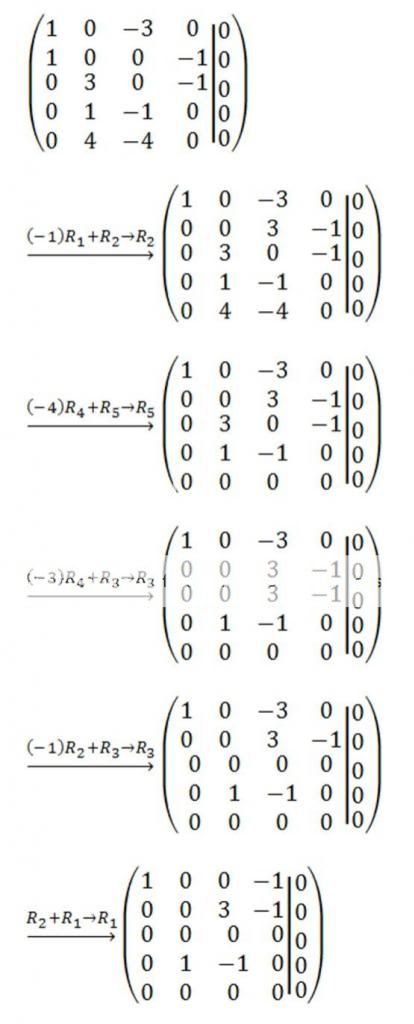
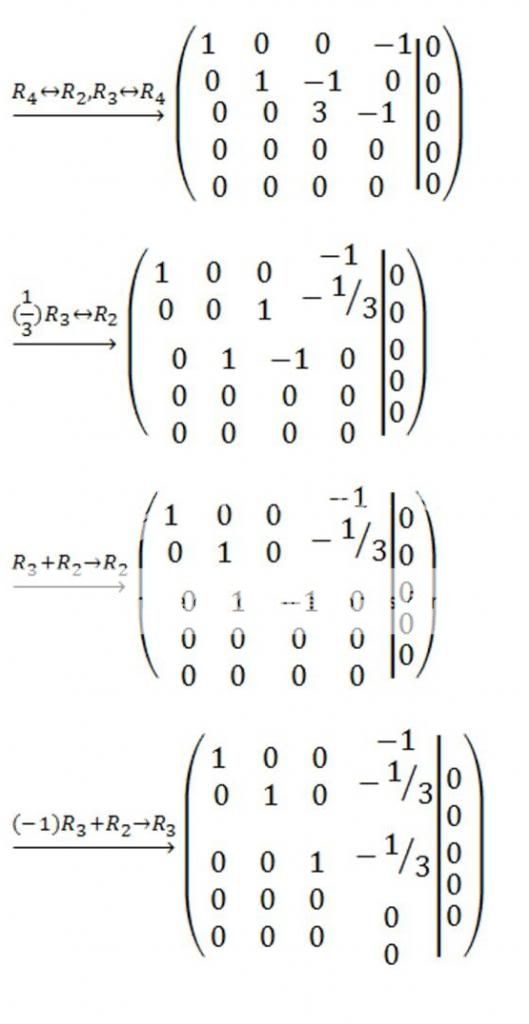
I've applied the Gauss-Jordan Elimination to convert it into reduced row-echelon form. Sorry for my messy workings. sweat.gif Am I correct? If there is any other simpler workings, please post it up, thanks.

user posted image
user posted image
maximR
post Dec 28 2013, 02:45 PM

Remember who you are
*******
Senior Member
3,864 posts

Joined: Dec 2009


QUOTE(Critical_Fallacy @ Dec 27 2013, 11:57 PM)
It would be pretty tedious for me to type out all the sophisticated equations here. sweat.gif But I can guide you to find out more about the discovery of Superfluidity. Superfluidity is an ability of a fluid to flow without friction through narrow tubes, and it is closely related to Bose-Einstein condensation.

@ Macroscopic structure of Superfluid helium: Landau’s two-fluid theory of superfluidity, which is related to the free energy of Ising model.

@ Microscopic structure of Superfluid helium: Quantum vortex ring model. Quantized vortices were first predicted by Onsager (1949), and later independently by Feynman (1955). Feynman further developed Onsager’s ideas and simplified the the problem of rotations in superfluids by applying Stokes’ theorem (the Calculus mentioned by Susskind).

user posted image

Stokes’ theorem :: Let S be an oriented surface with unit normal vector n, bounded by a piecewise smooth simple closed curve C with a positive orientation. If v is a vector field whose component functions have continuous first partial derivatives on an open region containing S and C, then

user posted image
*
Finally . Thank you ! rclxms.gif When Susskind mentioned 'bright' high school student , he did really mean 'bright' because this is still beyond me .
TSCritical_Fallacy
post Dec 28 2013, 10:37 PM

∫nnộvisεr
Group Icon
VIP
3,713 posts

Joined: Nov 2011
From: Torino
Hi Flame Haze, RED-HAIR-SHANKS, maximR, crazywing26 and ystiang,

Another important application of Linear Algebra & Matrix Theory is to find a polynomial whose graph passes through a specified set of points in the plane. And this process is called polynomial interpolation. icon_idea.gif Now let us consider the more general problem of finding a polynomial whose graph passes through n points with distinct x-coordinates

user posted image

THEOREM :: Given any n points in the xy-plane that have distinct x-coordinates, there is a unique polynomial of degree n − 1 or less whose graph passes through those points.

Let us now consider how we might go about finding the interpolating polynomial whose graph passes through the n points. According to the THEOREM, the graph of this polynomial is the graph of the equation

user posted image

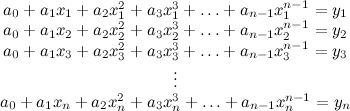
It follows that the coordinates of the points must satisfy

user posted image

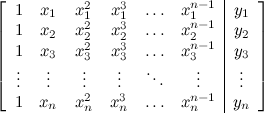
In these equations the values of x’s and y’s are assumed to be known, so we can view this as a linear system in the unknowns user posted image. From this point of view the augmented matrix for the system is
user posted image

and hence the interpolating polynomial can be found either by reducing this matrix to reduced row echelon form (Gauss–Jordan elimination), or by solving the linear system using Cramer’s Rule or user posted image.

P.S. MATRIX is not designed to be solved by hand, but very efficient in a numerical computing environment, which allows matrix manipulations, plotting of functions, and implementation of algorithms. Learn how to solve Linear Equations with MINVERSE and MMULT functions in Microsoft Excel.
TSCritical_Fallacy
post Dec 28 2013, 10:38 PM

∫nnộvisεr
Group Icon
VIP
3,713 posts

Joined: Nov 2011
From: Torino
Hi Flame Haze, RED-HAIR-SHANKS, maximR, crazywing26 and ystiang,

EXAMPLE :: Find a cubic polynomial whose graph passes through the points

user posted image

Solution :: Since there are four points, we will use an interpolating polynomial of degree n = 3. Denote this polynomial by

user posted image

and denote the x- and y-coordinates of the given points by

x1 = 1, x2 = 2, x3 = 3, x4 = 4 ... and ... y1 = 3, y2 = −2, y3 = −5, y4 = 0

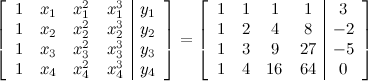
Thus, the augmented matrix for the linear system in the unknowns a0, a1, a2, and a3 is

user posted image

I leave it for you to solve by hand (if you are interested), and here is the computation using MS Excel:

user posted image

from which it follows that a0 = 4, a1 = 3, a2 = −5, a3 = 1. Thus, the interpolating polynomial is

user posted image

The graph of this interpolating polynomial is shown below:

user posted image
Flame Haze
post Dec 28 2013, 10:40 PM

Enthusiast
*****
Senior Member
814 posts

Joined: Oct 2009


Sorry but I've forgotten every single thing about matrixes sweat.gif , A-level maths doesn't seem to deal with them, and I hope I won't be encountering them in Further Maths. Will take some time to catch up, busy spring cleaning the house for CNY icon_rolleyes.gif , and new semester is around the corner. cry.gif
TSCritical_Fallacy
post Dec 28 2013, 11:00 PM

∫nnộvisεr
Group Icon
VIP
3,713 posts

Joined: Nov 2011
From: Torino
QUOTE(Flame Haze @ Dec 28 2013, 10:40 PM)
Sorry but I've forgotten every single thing about matrixes sweat.gif  , A-level maths doesn't seem to deal with them, and I hope I won't be encountering them in Further Maths. Will take some time to catch up, busy spring cleaning the house for CNY  icon_rolleyes.gif , and new semester is around the corner.  cry.gif
House cleaning is important and you are an amazing character!

I suppose that you will encounter Matrices and Transformations in AS MODULE – Further Pure 1, and Matrix Algebra and Solution of Linear Equations in A2 MODULE - Further Pure 4. sweat.gif
danny88888
post Dec 28 2013, 11:24 PM

Casual
***
Junior Member
321 posts

Joined: Sep 2008


Attached Image Attached Image come someone explain this? What is the use for this?
TSCritical_Fallacy
post Dec 29 2013, 08:39 AM

∫nnộvisεr
Group Icon
VIP
3,713 posts

Joined: Nov 2011
From: Torino
Hi danny88888,

Some textbooks fail to explain the essential applications of Matrix Algebra. To find out the important application of the rank of a matrix, please read the confession of a Control & Instrument Engineer: smile.gif

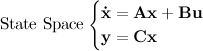
To a Systems Designer/Engineer, whether they are Mechanical Systems & Electrical Systems, or Fluid Systems & Thermal Systems, the concepts of controllability and observability play an important role in the design of control systems in state space (Matrix form):

user posted image

where

x = n-state vector
u = r-control input vector
y = m-output vector
A = n × n state matrix
B = n × r control input matrix
C = m × n output matrix

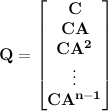
A system is said to be controllable, if an input u to a system can be found that takes every state variable from a desired initial state user posted image to a desired final state user posted image; otherwise the system is said to be uncontrollable. In other words, an nth-order plant is completely controllable if the matrix

user posted image

is of rank n, where P is called the controllability matrix.

A system is said to be observable, if it is possible to determine the initial-state vector user posted image from the observation of the output y over a finite interval of time from t0; otherwise the system is said to be unobservable. Thus, an nth-order plant is completely observable if the matrix

user posted image

is of rank n, where Q is called the observability matrix.

Remark: The conditions of controllability and observability may govern the existence of a complete solution to the control system design problem. The solution to this problem may not exist if the system considered is not controllable. Although most physical systems are controllable and observable, corresponding mathematical models may not possess the property of controllability and observability.Then it is necessary to know the conditions under which a system is controllable and observable.
dividebyzero
post Dec 29 2013, 12:54 PM

New Member
*
Validating
37 posts

Joined: Oct 2010
Quick question once again:

user posted image

First part was cleared. The solution of the second part was blunt and depressing.

user posted image

What logic is this? Please, enlighten me.

In the meantime I'm off to study Abelian groups etc etc.
TSCritical_Fallacy
post Dec 29 2013, 05:40 PM

∫nnộvisεr
Group Icon
VIP
3,713 posts

Joined: Nov 2011
From: Torino
QUOTE(dividebyzero @ Dec 29 2013, 12:54 PM)
user posted image
ZERO,

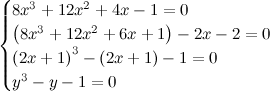
This is purely algebraic manipulations. laugh.gif It is pretty obvious that

user posted image

Next, we divide both sides by y²:

user posted image

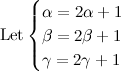
Then, we denote roots of the cubic function as

user posted image

Now we compare Eq.(1) with the properties of Sum and Product of Cubic Roots:

user posted image

From Eq.(3), we can detrmine

user posted image

With the results from (4) and (5), we can solve

user posted image

This post has been edited by Critical_Fallacy: Dec 29 2013, 05:46 PM
dividebyzero
post Dec 29 2013, 06:18 PM

New Member
*
Validating
37 posts

Joined: Oct 2010
QUOTE(Critical_Fallacy @ Dec 29 2013, 05:40 PM)
ZERO,

This is purely algebraic manipulations. laugh.gif It is pretty obvious that

user posted image

*
I understood every part of your explanation except this. Why would Sn be equivalent to the original roots? To my understanding, when the sum of two numbers is raised to any power, they give rise to intermediate terms like those in binomial theorem. Correct me if I'm wrong.
TSCritical_Fallacy
post Dec 29 2013, 06:42 PM

∫nnộvisεr
Group Icon
VIP
3,713 posts

Joined: Nov 2011
From: Torino
QUOTE(dividebyzero @ Dec 29 2013, 06:18 PM)
I understood every part of your explanation except this. Why would Sn be equivalent to the original roots? To my understanding, when the sum of two numbers is raised to any power, they give rise to intermediate terms like those in binomial theorem. Correct me if I'm wrong.
ZERO,

It was originated from here:

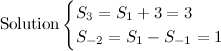
user posted image

Therefore, when we add up the three equations below:

user posted image

This post has been edited by Critical_Fallacy: Dec 29 2013, 06:51 PM
crazywing26
post Dec 29 2013, 07:00 PM

Getting Started
**
Junior Member
283 posts

Joined: Apr 2013


Critical_Fallacy, I do wonder how can you think in such brilliant ways of solving mathematical problems? In ways that usually people would not thought of yet effective. Is it with sufficient practise or critical thinking? Just asking only biggrin.gif

91 Pages « < 23 24 25 26 27 > » Top
 

Change to:
| Lo-Fi Version
0.0211sec    0.72    6 queries    GZIP Disabled
Time is now: 18th December 2025 - 01:43 PM