

This is amazing . This is something big .
I hope people will start to utilise this thread as much as possible . I'll share it to everyone I know .
Thank you so much .
Ask a Mathematical Physicist
Ask a Mathematical Physicist
|
|
 Aug 6 2013, 09:30 PM Aug 6 2013, 09:30 PM
Return to original view | Post
#1
|
 
Senior Member
3,864 posts Joined: Dec 2009   
|
This is amazing . This is something big .
I hope people will start to utilise this thread as much as possible . I'll share it to everyone I know . Thank you so much . |
|
|
|
|
|
Aug 6 2013, 10:31 PM
Return to original view | Post
#2
|
|
Senior Member
3,864 posts Joined: Dec 2009
|
Critical_Fallacy
I consulted the Bronze Medallist , and he told me that this solution is incorrect , and it'll be worth one point only . He attached a link to an accurate solution : http://www.artofproblemsolving.com/Forum/v...ce9c11#p3152687 He added : The solution gives a construction of 2^k-1 terms but the problem statement requires exactly k terms I never knew the questions in IMO would be this challenging ! This post has been edited by maximR: Aug 6 2013, 10:33 PM |
|
|
Aug 6 2013, 10:48 PM
Return to original view | Post
#3
|
|
Senior Member
3,864 posts Joined: Dec 2009
|
QUOTE(ystiang @ Aug 6 2013, 10:39 PM) Try to participate OMK if you intend to study form 6. I don't think I'll make the cut for IMO camps ( IPhO , probably . In the near future . OMK considered as very hard, IMO I can't imagine my brain blank 4 hours... For Malaysia, Top OMK performers are selected to attend the training camps, and the final IMO representatives are selected based on the students' performance in the camps and race. (I think only 6 in the final stage, and 3~4 of them are "bumiputera".   ) though . You know the Bronze Medallist I mentioned ? He's as old as me , but he has far more experience and he started very young , at about 7 . ) though . You know the Bronze Medallist I mentioned ? He's as old as me , but he has far more experience and he started very young , at about 7 . How do you find STPM ? Enjoying it ? |
|
|
Aug 7 2013, 05:46 PM
Return to original view | Post
#4
|
|
Senior Member
3,864 posts Joined: Dec 2009
|
» Click to show Spoiler - click again to hide... « I see ! I've heard about turbulence in fluid motion and how hard it is to model that accurately ( I think it's still on Wikipedia's List of unsolved problems in Physics ) . If you don't mind me asking , what led you to to become a Mathematical Physicist ? Was is a smooth pathway ? |
|
|
Aug 10 2013, 04:41 PM
Return to original view | Post
#5
|
|
Senior Member
3,864 posts Joined: Dec 2009
|
» Click to show Spoiler - click again to hide... « I see . I've thought about that for a long time . Thanks for clarifying ! Now I've a question , it's regarding the constants that appear in Physics equations . Example : 1 . E = mc^2 2 . F = kx 3 . F(grav) = G (Mm)/r^2 My question is , will a constant always appear if a physical quantity varies directly as the other ? If it will , why do some constants behave in different ways . Why is the speed of light squared in Einstein's equation ? Since there were no experimental data at first to support his theory , how did he derive c ? Why can the constant in F = kma be defined so that F = ma , but not with other equations ? |
|
|
Aug 10 2013, 06:26 PM
Return to original view | Post
#6
|
|
Senior Member
3,864 posts Joined: Dec 2009
|
QUOTE(VengenZ @ Aug 10 2013, 06:13 PM) I don't know about others but E=mc^2 isnt the full formula. By using some complex special relativity theories, he came up with the momentum in 4D equation.. And if I remembered correctly by using binomial expansion, he got the equation E = mc^2 + 1/2(mv^2) + ... From this he found the rest mass energy equation E = mc^2. There's a second way that he did to derive it which involved E^2 = (pc)^2 + (mc^2)^2 .. after a few algebraic operation, we can obtain E =mc^2. But of course this is the end product of a long complex mathematical calculation and awesome thought experiments. I am aware of the actual equations . I think Critical_Fallacy can explain more to you about Time Dilation, Length contraction and so on, until the part where he got the rest mass energy equation. For F = ma, that is not actually the real formula. From Newton's 2nd law, force can be expressed as:  ---> ---> 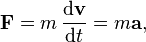 Force is said to be exerted when the mass of an object changes, or the velocity of the object changes. I am more interested in the general relativity of Einstein. Anyone here knows how he got the christoeffel symbol in terms of the metric tensor? Probably Critical_Fallacy knows? But I've always wondered about the constants . Why must constants appear in every Physics equation ? And why can the constant in Newton's 2nd Law be simplified to 1 ? Thank you for your reply . What are you doing , currently ? Are you a Physics major ? |
|
|
|
|
|
Aug 12 2013, 03:02 PM
Return to original view | Post
#7
|
|
Senior Member
3,864 posts Joined: Dec 2009
|
» Click to show Spoiler - click again to hide... « Thank you for your detailed explanation ! I really appreciate it . » Click to show Spoiler - click again to hide... « Thanks ! QUOTE(Critical_Fallacy @ Aug 12 2013, 04:29 AM) Physicists know some things never change and they call them the fundamental physical constants. Such frequently used constants as the speed of light in vacuum, c, magnetic constant, μ0, electric constant, ε0, Newtonian constant of gravitation, G, Planck constant, h, elementary charge, e, and the Proton-to-electron mass ratio, μ, are assumed to be the same at all places and times in the universe. They form the scaffolding around which the theories of physics are built on, and they define the fabric of the cosmos. This is what I need ! I've been thinking about this since Form Four . You've cleared everything up . Thank you ! Despite that, one of the most fundamental properties of Newton’s Mechanics, Maxwell’s Macroscopic Electrodynamics, and the Laws of Thermodynamics, is the absence of any physical constants in their basic equations. In fact, all necessary fundamental physical constants appear only at the stage of applications of these theories to specific phenomena. Nevertheless, these constants play an important role in physics and metrology because scientists need reference values for measurements in experimental physics and making theoretical prediction on papers. Other than Newton’s and Maxwell’s equations, centripetal acceleration (a = v²/r), density (Q = m/V), pressure (P = F/A), and electric power (P = V*I) seem to be self-evident counterexamples to your above question. You can also see other frequently used physics equations for yourself in this link.   Although physical constants can appear to be dimensional or dimensionless, the imaginary constant factor k in your F = kma does not exist. That’s because the equation F = ma is self-contained and Newton did NOT require adding a dimensionless constant factor k = 1 to his mechanics to reproduce that “observation of force”. In fact, as guided by VengenZ in Post #20, Newton’s 2nd Law originally states that the net force on an object is equal to the rate of change of its linear momentum p in an inertial reference frame, which can be manipulated algebraically to be stated in terms of an object's acceleration, i.e. F = ma. ---> Since the dimensionless constant factor k does not exist in F = dp/dt in the first place, then it follows that k is not needed in F = ma either. If your friends or physics teacher insist on the existence of k = 1, be sure to ask them what they think of a = dv/dt, p = mv, v = dx/dt, and other counterexamples as shown, so that other similar fundamental physics equations cannot be ignored, and they will thus be psychologically compelled to consider their merit.  ~ HAVE A NICE DAY! ~ As for why I proposed that there is a constant in F = ma , here's what's written in our textbooks , and reference books . One of the errors in our Physics syllabus . My aim is to major in Physics , then one day hopefully , revamp the Physics syllabus in Malaysia . Here's the explanation provided by textbooks : From Experiment 1 , a α F From Experiment 2 , a α 1/m The two results are combined . a α F/m OR F α ma Therefore : F = kma Unit of force is newton , N . In order to make the formula as simple as possible , we make k = 1 by defining a force of 1 N as 1 N is the force which gives a mass of 1 kg an acceleration of 1 m s^-2 , 1 N = (k) (1 kg) (1 m s^-2) k = 1 Therefore , F = ma This post has been edited by maximR: Aug 12 2013, 04:22 PM |
|
|
Aug 13 2013, 01:14 PM
Return to original view | Post
#8
|
|
Senior Member
3,864 posts Joined: Dec 2009
|
» Click to show Spoiler - click again to hide... « Another great post !  This is the first time I've read that Newton originally stated that Impulse is directly proportional to the Change in momentum . So he actually considered the time in which a force acts on a body . Interesting . So if I get this right , the reason why G appears in Newton's Law of Universal Gravitation is because the unit of force is defined as amount needed to accelerate 1 kg of mass at the rate of 1 m/s² , therefore G should be added to ensure that the units on both sides of the equation are the same ? And that after careful experiments , experimental physicists discovered that the force on gravity between two bodies does not vary simply as F = Mm/r^2 , so there must be a constant to account for the interaction between the two bodies ? And that means Newton never really had accurate calculations since he couldn't determine G , and did not include them in his equations ? ( or did he ? if yes , then how did he come to the conclusion that there is a constant just by empirical observation ? or did he derive it mathematically , or did he think that since the force of gravity is usually very small between two bodies , there must be something that accounts for this , therefore , a constant must exist ? ) This post has been edited by maximR: Aug 13 2013, 01:19 PM |
|
|
Aug 13 2013, 10:47 PM
Return to original view | Post
#9
|
|
Senior Member
3,864 posts Joined: Dec 2009
|
QUOTE(Intermission @ Aug 13 2013, 05:30 PM) Are you planning to go for it again next year? It will be the last time we are allowed to participate in OMK. I was well aware that Newton did not explicitly state that F = ma ( It's derived from his 2nd law ) , and I've read that force is defined as the rate of change of momentum early on when I first started learning dynamics . Did you really not read anything other than your SPM Physics reference book in form four and form five ? This surprised me when I re-learn physics at AS level too. Actually it is not the formula F=ma that leads to F=(mv-mu)/t but rather the other round when newton first formulated his 3 laws of motion.  But I didn't know that he said Ft α mv - mu This post has been edited by maximR: Aug 13 2013, 10:49 PM |
|
|
Aug 14 2013, 03:28 PM
Return to original view | Post
#10
|
|
Senior Member
3,864 posts Joined: Dec 2009
|
QUOTE(Critical_Fallacy @ Aug 14 2013, 02:13 PM) In Newtonian Kinetic Energy, as long as the object is not at microscopic level and the speed involved is very much lower than the speed of light, the mass is considered an absolute, or in a state of constant in an inertial frame of reference. For beginners like me , how do I develop the intuition to manipulate the equation so p exists in that KE equation ? Also , if KE becomes 2KE , p becomes 2p as well ? How to prove this ? » Click to show Spoiler - click again to hide... « All right , noted . Thank you . Here's a question from an SPM Olympiad Fizik book :  This post has been edited by maximR: Aug 14 2013, 06:24 PM |
|
|
Aug 14 2013, 06:02 PM
Return to original view | Post
#11
|
|
Senior Member
3,864 posts Joined: Dec 2009
|
QUOTE(kingkingyyk @ Aug 14 2013, 05:59 PM) The answer is B? According to the guy who provided the question , yes . |
|
|
Aug 14 2013, 06:09 PM
Return to original view | Post
#12
|
|
Senior Member
3,864 posts Joined: Dec 2009
|
QUOTE(kingkingyyk @ Aug 14 2013, 06:05 PM) If so, you may experience it when the car/bus where you sit brakes. Solution provided is about pressure , artificial gravity , inertia ... |
|
|
Aug 15 2013, 01:20 PM
Return to original view | Post
#13
|
|
Senior Member
3,864 posts Joined: Dec 2009
|
QUOTE(Critical_Fallacy @ Aug 15 2013, 12:59 AM) Perhaps watching the YouTube video below would give you new insights into the physics of helium balloon. QUOTE(Krevaki @ Aug 15 2013, 10:47 AM) You're right! As the box moves to the right, the air gets compressed to the left, making the left side of the box denser than the right side. The helium balloon actually gets pushed to the right! I get it now .  But looking for explanations on the internet , there are some who use General Relativity to explain this . So is the explanation using air compression / buoyant force correct , or General Relativity , or both ? |
|
|
|
|
|
Aug 15 2013, 01:24 PM
Return to original view | Post
#14
|
|
Senior Member
3,864 posts Joined: Dec 2009
|
» Click to show Spoiler - click again to hide... « All right . Thank you ! I got only some of them covered through watching Walter Lewin's lectures , like proving the Work-Energy Theorem , P= h(rho)g , etc . I learned the general proof for derivatives too , but not the SPM way where you just add delta x and delta y to x and y respectively . I prefer the usual method , those that are available online . |
|
|
Nov 23 2013, 12:25 PM
Return to original view | Post
#15
|
|
Senior Member
3,864 posts Joined: Dec 2009
|
» Click to show Spoiler - click again to hide... « Sorry I went offline yesterday , it was quite late and I had to go to bed . Anyway , I'm done with Remainder Theorem and Factor Theorem . As for your last question , is my reasoning correct ? Since the remainder theorem states that if f(x) is divided by (x-a) , then the remainder = f(a) and factor theorem states that if f(x) is divided by (x-a) and it equals zero , then (x-a) is a linear factor , thus , if x = a , then : a^3 - 6a - 7a + 60 = 0 Factoring using my calculator , since I haven't learned Cubic and Quartic Eqn  ( can you please re-post the tutorial ? it's too small for my eyes ) yields : ( can you please re-post the tutorial ? it's too small for my eyes ) yields : (a+3)(a-5)(a-4) = 0 Therefore : (x+3)(x-5)(x-4) = 0 Thus , I've found the linear factors of the function without using the first linear factor . I hope it's correct .  |
|
|
Nov 25 2013, 07:54 PM
Return to original view | Post
#16
|
|
Senior Member
3,864 posts Joined: Dec 2009
|
» Click to show Spoiler - click again to hide... «  Actually , I wanted to tell you that the day after you posted that Cubic/Quartic tutorial , I'd read it and it's safe to say I'm done with it . Maybe more practices so I can be faster with algebraic long division .  I'll look through these tutorials probably after my Biology paper . Thank you so much , someone who spends his time creating tutorials for a complete stranger deserves an award . Don't really know how to re-pay you . |
|
|
Dec 4 2013, 07:01 PM
Return to original view | Post
#17
|
|
Senior Member
3,864 posts Joined: Dec 2009
|
I'm back , after a couple of days of rest .
Critical_Fallacy there has been quite a lot of things going on here , and I'll take some time to slowly wade through . I think I'll start with where I left off . RED-HAIR-SHANKS may I know where you get these questions ? |
|
|
Dec 9 2013, 10:44 PM
Return to original view | Post
#18
|
|
Senior Member
3,864 posts Joined: Dec 2009
|
A quick question as I have been reading a book on core concepts in Maths , the chapter is Introduction to Logic .
" Can a statement such as 'Some men are silly' be disproved by finding an example of a man who is not silly ? Discuss what type of statement we should have to have in order to be able to disprove it by finding a counterexample .' I was thinking along the lines of 'All men are not silly' , then coming with 'This man is silly' which is a counterexample of the negation , but that would he proving that initial statement . By the way , I see a lot of new tutorials ! Will update about my progress tomorrow . |
|
|
Dec 10 2013, 01:21 PM
Return to original view | Post
#19
|
|
Senior Member
3,864 posts Joined: Dec 2009
|
» Click to show Spoiler - click again to hide... « Thank you . I've been placing my hand in different cookie jars , not knowing which to delve deeper into . For now , I have the luxury to do so so I'll jump around different topics , and get some serious work done in January . The problem which I posed is from the book titled ' Basic Concepts of Mathematics and Logic ' by Michael C . Gemignani , which covers logic , set theory , counting , numbers , functions , ordering , probabilities and Euclidean geometry . It's quite a compact book , not the best designed book but I find it quite entertaining ( although the content comprises mostly of paragraphs of words ) . That problem comes after this : In order to disprove the following statement , which statements would we actually prove ? ' Some triangles are isosceles . ' The answer is : All triangles are not isosceles . (the answer doesn't delve deeper into how to prove this statement) After the topic on Mathematical Disproofs , I ventured into Conjunctions and Disjunctions , which I've seen when learning Mathematical Reasoning in SPM Mathematics , and Boolean Algebra in SPM Physics . A question : If A , then B is equivalent to ~( A ∧ ~B ) , with the reasoning : If A , then B , thus if A occurs B must occur as well , or it cannot happen that A occurs but B does not occur , it cannot happen that A occurs and ~B occurs . So this statement ~( ~A ∧ B ) is false , right ? Because if A does not occur , B can occur . At the Big Bad Wolf sale , I bought Calculus ( Pearson International Edition ) textbook for RM 10 , which is a huge college level textbook which covers a lot of concepts in Calculus . I'm still in the preliminaries section , I'm familiar with most of the topics in the preliminaries ( they are covered in SPM Maths / Add Maths ) so I'm learning Logic and Proofs . I've also printed out your tutorials , but not sure where to start with all the resources around me . In the Calculus textbook , there are a few problems which I need help with ( college level textbooks only provide solutions for Odd-Number questions ) 1 . We can show that a number divided by zero is meaningless . Suppose a ≠ 0 . If a/0 = b , then a = 0 , which is a contradiction . Now find a reason why 0/0 is also meaningless . 2 . Show that any rational number p/q , for which the prime factorisation of q consists entirely of 2s and 5s , has a terminating decimal expansion . 3 . Show that between two real numbers there is a rational number . 4 . (a) Use the Fundamental Theorem of Arithmetic to show that the square of any natural number greater than 1 can be written as the product of primes in a unique way , except for the order of the factors , with each prime occurring an even number of times . (b) Show that √2 is irrational . ( Hint : Try a proof by contradiction . Suppose that √2 = p/q , where p and q are natural ( necessarily different from 1 ) . Then 2 = p^2/q^2 , and 2q^2 = p^2 . Now use (a) to get the contradiction . Your help is greatly appreciated . By the way , is this topic under Number Theory ? It's under preliminaries , the author didn't label this sub-topic . |
|
|
Dec 13 2013, 09:46 PM
Return to original view | Post
#20
|
|
Senior Member
3,864 posts Joined: Dec 2009
|
QUOTE(Critical_Fallacy @ Dec 13 2013, 07:39 PM) Hi maximR & RED-HAIR-SHANKS, A very good exercise as I'm studying ways of proofs and logic , I haven't abandoned all Maths stuff yet . Don’t let your brain rust! This is fun and predictably IRRATIONAL.  Anyway , if this were a simple irrational X irrational problem , it would be easier to come up with a proof . The exponent makes it a little bit more complicated for me . I tried hard , but gave up in the end . So I Googled for it , and I can say that I'm 'mind-blown' !  I need help for the proof for ' rational between two reals problem ' . The book I have gives hints about the Law of Completeness and something about set theory which I can't comprehend . |
| Change to: |  0.0664sec 0.0664sec
 0.36 0.36
 7 queries 7 queries
 GZIP Disabled GZIP Disabled
Time is now: 17th December 2025 - 12:58 AM |
 Quote
Quote


