Welcome Guest ( Log In | Register )

Outline · [ Standard ] · Linear+

 Ask a Mathematical Physicist

views
     
studyboy
post Aug 11 2013, 09:35 PM

On my way
****
Senior Member
522 posts

Joined: Mar 2013
QUOTE(Critical_Fallacy @ Aug 11 2013, 08:32 PM)
The derivation of Einstein's most famous equation E = mc² is purely theoretical, which arises as a direct consequence of his Special Theory of Relativity that involves some algebraic manipulations using the Pythagorean theorem (SPM level). To understand how he derived the equation, you must understand a portion of his Special Relativity; Time Dilation (see the embedded Spaceship figure). The following derivation is highly simplified for the mathematically untrained. To further enhance your understanding, you should watch the YouTube video by minutephysics. icon_rolleyes.gif

user posted image

user posted image


*
Hey Critical_Fallacy! I am so curious of your education background! Are you currently a researcher in a university? You took up a daunting task of explaining time dilation to the masses.
studyboy
post Dec 22 2013, 07:49 PM

On my way
****
Senior Member
522 posts

Joined: Mar 2013
QUOTE(delsoo @ Dec 22 2013, 07:09 PM)
Hi can anyone here explain what the point v=0 is not situated at the left side of charge 5q or right side of charge -2q?? V=electric potential
*
Hmm, let me give this a go. I suppose the point v=0 is situated between the two charges because they are both subjected to an attractive force.

Hence, the negative charge will move to the left towards until there is an equilibrium in force where both the left and right charge and exert an equal amount of force on one another.

At this, the negative charge will stop it moving hence v=0.

It will be good if anyone can verify or validate the above! My answers are based on a vague and possibly incorrect recollection of Electromagnetism. blush.gif blush.gif
studyboy
post Dec 23 2013, 09:11 PM

On my way
****
Senior Member
522 posts

Joined: Mar 2013
So V is the potential not speed or velocity? sweat.gif Lol, my explanation is totally out then!

studyboy
post Dec 25 2013, 02:57 AM

On my way
****
Senior Member
522 posts

Joined: Mar 2013
QUOTE(Flame Haze @ Dec 25 2013, 01:54 AM)
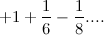
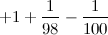
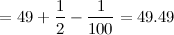
49.49?  sweat.gif

      user posted image
      user posted image
      user posted image
      user posted image
      user posted image
user posted image

P.S I think my notations are a little bit misleading, by sum from 3 to 99, I mean the sum of odd numbers only, 3, 5, 7, 9....99
*
You are correct! biggrin.gif

Well done for spotting the pattern!

This post has been edited by studyboy: Dec 25 2013, 03:04 AM
studyboy
post Dec 25 2013, 02:41 PM

On my way
****
Senior Member
522 posts

Joined: Mar 2013
QUOTE(Critical_Fallacy @ Dec 25 2013, 08:26 AM)
So, my hypothesis on passing the Pure Math exam with flying colors has a good degree of trueness. sweat.gif
*
tongue.gif I am sure the statement is true for Flame Haze! As for me, I wish I could spend more time on it whilst still at university. blush.gif

Ah well, this is why I am here! To polish the math/thinking skills! biggrin.gif
studyboy
post Dec 25 2013, 02:50 PM

On my way
****
Senior Member
522 posts

Joined: Mar 2013
QUOTE(Flame Haze @ Dec 25 2013, 01:13 PM)
5?
*
I think it is correct but we shall see what the others have to say about this! rclxms.gif Well done!
studyboy
post Dec 25 2013, 05:53 PM

On my way
****
Senior Member
522 posts

Joined: Mar 2013
QUOTE(Critical_Fallacy @ Dec 25 2013, 04:52 PM)
The question can be solved algebraically using knowledge learned from SPM Progressions, Indices and Logarithms.

user posted image

which can be rearranged to give

user posted image.

By letting

user posted image,

we need find integer n which satisfies

user posted image

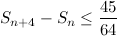
Using a graphing software, one can evaluate

user posted image
*
Fantastic solution! Normally one wouldn't think of using graphs for this sort of stuff!

This might be unknown to some of you here but such a method is commonplace in academia. A graph provides much insight on a particular equation in terms of behaviour, possible roots and etc. Very powerful stuff!

This post has been edited by studyboy: Dec 25 2013, 05:58 PM
studyboy
post Dec 26 2013, 12:54 AM

On my way
****
Senior Member
522 posts

Joined: Mar 2013
QUOTE(Flame Haze @ Dec 25 2013, 07:04 PM)
1/5050, 5049?
*
I think you are correct!

However, how would one prove this by induction? Did you do it by induction Flame Haze?

Critical_Fallacy or anyone else do comment!
studyboy
post Dec 26 2013, 01:29 AM

On my way
****
Senior Member
522 posts

Joined: Mar 2013
QUOTE(Flame Haze @ Dec 26 2013, 01:00 AM)
I did it using similar method as the last question.
*
Thanks for the information!

studyboy
post Dec 26 2013, 07:06 PM

On my way
****
Senior Member
522 posts

Joined: Mar 2013
QUOTE(RED-HAIR-SHANKS @ Dec 26 2013, 06:41 PM)
Hi Critical_Fallacy and crazywing26, I would like to ask you something concerning matrices.

Suppose that we have a 3 x 3 matrix A, and that we have to find it's determinant.
user posted image

From the above matrix A, it's determinant can be evaluated by adding the products of any elements with any one row(with it's column) with their respective cofactors. It should be like this:
user posted image

But, I too found out that there is another alternative way to solve the determinant of a 3 x 3 matrix, that is by using Sarrus' Rule. It's the sum of the multiplication of entries in every arrow to the right(blue colour) minus the sum of multiplication of entries in every arrow to the left(red colour).
user posted image

Now my question is, as far as I know from my book, Sarrus' Rule is not mentioned in it. If by any chances were I to stumble across a question concerning the determinant of a 3 x 3 matrix, can I use Sarrus' Rule? My reason is that it's way more flexible and less tedious compared to the other method in which we need to first find the minor and cofactor first. But, knowing that sometimes the marking scheme for STPM is extremely stringent and rigid, I feel that it's not a safe bet. Any Form 6-ers have experience this before? unsure.gif

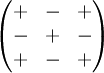
Another thing I would like to know is why the signs of the 3 x 3 matrix (cofactors) should be like this ? sweat.gif :
user posted image
*
http://en.wikipedia.org/wiki/Leibniz_formu...or_determinants

http://en.wikipedia.org/wiki/Laplace_expansion

http://en.wikipedia.org/wiki/Cofactor_%28linear_algebra%29

Have a look at these links! smile.gif

As for the Rule of Sarrus, use it by all means to check your answers. To be on the safe side, it is better if you use the standard way of computing a 3X3 matrix and by standard, I mean whatever that you are taught in Form 6.

This post has been edited by studyboy: Dec 26 2013, 07:10 PM
studyboy
post Dec 27 2013, 12:03 AM

On my way
****
Senior Member
522 posts

Joined: Mar 2013
QUOTE(RED-HAIR-SHANKS @ Dec 26 2013, 09:21 PM)
I'm quite flabbergasted regarding the above bold statement. I never knew that the way the markers mark is this stringent and complicated. blink.gif Anyway, thanks for that heads-up. Now I know a little bit on what I should and should not do in the near future.
*
My sentiments exactly! I was quite perplexed by crazywing26's revelation!


studyboy
post Dec 27 2013, 12:06 AM

On my way
****
Senior Member
522 posts

Joined: Mar 2013
QUOTE(danny88888 @ Dec 27 2013, 12:01 AM)
To find determinant of 4x4 matrices would it be very tedious then?
*
Not unless you use computing programmes like Matlab or Mathematica!

Otherwise yes. Essentially, the method shown by Critical_Fallacy is known as the Laplacian Expansion.

http://en.wikipedia.org/wiki/Laplace_expansion

I remember I had to do this for 5 times 5 matrix once in my undergraduate exams. cry.gif
studyboy
post Dec 28 2013, 01:55 AM

On my way
****
Senior Member
522 posts

Joined: Mar 2013
QUOTE(danny88888 @ Dec 27 2013, 09:51 AM)
Thanks for the insight.

Anyway this is too advanced, 1st year uni calculus, cannot use calculator for exam.

To find the determinant for 4X4, the formula is cofactor-cofactor+cofactor-cofactor? Do you get what i meant?
*
Refer to post #470 by Critical_Fallacy. The method to compute a 4X4 matrix is depicted very clearly.

Nevertheless, the formula you stated here is correct. smile.gif

Yes, these are all rather advanced for a 1st year university student but given time, you will get used to it.
studyboy
post Jan 1 2014, 06:02 PM

On my way
****
Senior Member
522 posts

Joined: Mar 2013
QUOTE(maximR @ Jan 1 2014, 04:06 PM)
Critical_Fallacy and v1n0d

Look at what I found !

http://eprints.usm.my/view/subjects/
*
tongue.gif Why are you so excited? Have a look at the link below:

http://eprints.maths.ox.ac.uk/view/subjects/

See if the above appeals to you. They are mostly applied maths thesis though, not physics unfortunately.
studyboy
post Jan 1 2014, 08:26 PM

On my way
****
Senior Member
522 posts

Joined: Mar 2013
QUOTE(danny88888 @ Jan 1 2014, 08:02 PM)
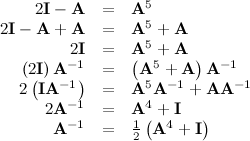
Let A be an (n x n) matrix satisfying 2I - A = A^5. Find an expression for the inverse of A.

2(AA*-1) = A*5+A
A*-1 = (A*5+A/2A)
A*-1= 1/2A*4 + 1/2

This is my answer, but the answer sheet says
A*-1 = 1/2A*4 +1/2I ( why is there an I?) anyone can explain it to me ? @Critical_Fallacy
*
Hmm, something is very wrong with this. You are working with a matrix. How is it possible for 1 to appear in the equation?
studyboy
post Jan 1 2014, 08:45 PM

On my way
****
Senior Member
522 posts

Joined: Mar 2013
QUOTE(maximR @ Jan 1 2014, 06:07 PM)
They say I'm weird but delicious things like this make me go "  shocking.gif  " . I actually prefer this ( although I understand 0.1% of it ) to parties and countdowns .

I still haven't found a friend who has the same wavelength as me .  sad.gif

Hopefully at uni , I'll finally be able to talk to someone whose eyes glimmer when reading about stuff like the curving of space-time , even in layman's terms . Nobody is interested in what I'm interested in . Everyone's so career oriented that I want to get out of this shell , this small fishing village to somewhere which hopefully would provide me with academic stimulation which I'd really appreciate .

I've been living for 18 years ( almost ) as a lonely kid , thank Goodness there's this thing called the internet .  notworthy.gif
*
Oh you will find people who share your interests so fret not! University is full of people studying purely for seeking knowledge. You needn't worry about being lonely anymore! laugh.gif


studyboy
post Jan 1 2014, 09:15 PM

On my way
****
Senior Member
522 posts

Joined: Mar 2013
QUOTE(Flame Haze @ Jan 1 2014, 08:47 PM)
sorry i seek money and waifu only  sad.gif
*
Lol! Then you are on the right path too! tongue.gif What do you want to study and where if you do not mind me asking?
studyboy
post Jan 1 2014, 09:57 PM

On my way
****
Senior Member
522 posts

Joined: Mar 2013
QUOTE(Flame Haze @ Jan 1 2014, 09:42 PM)
Accounting & Finance, at LSE  sweat.gif
*
Good stuff! LSE is the place to be for that but competition for jobs or internships is so stiff there! My fellow LSE mate once told me that at LSE the primary goal for a student is to look for a job! The next priority will be studies! biggrin.gif

Ah! Why don't you try Business Maths and Stats? You are good in the subject!
studyboy
post Jan 1 2014, 10:39 PM

On my way
****
Senior Member
522 posts

Joined: Mar 2013
QUOTE(Flame Haze @ Jan 1 2014, 10:33 PM)
Parents are both accountants. Pathway laid out edi.  sweat.gif
*
Ah!! All the best then! biggrin.gif
studyboy
post Jan 2 2014, 11:56 AM

On my way
****
Senior Member
522 posts

Joined: Mar 2013
QUOTE(Critical_Fallacy @ Jan 1 2014, 10:45 PM)
As you probably already know, we don't actually divide matrices. Try this: sweat.gif

user posted image
*
I knew it! I made the same mistake once and my lecturer was utterly appalled by it. blush.gif

2 Pages  1 2 >Top
 

Change to:
| Lo-Fi Version
0.0570sec    0.29    7 queries    GZIP Disabled
Time is now: 17th December 2025 - 07:18 AM