Welcome Guest ( Log In | Register )

91 Pages « < 21 22 23 24 25 > » Bottom

Outline · [ Standard ] · Linear+

 Ask a Mathematical Physicist

views
     
Flame Haze
post Dec 25 2013, 01:13 PM

Enthusiast
*****
Senior Member
814 posts

Joined: Oct 2009


QUOTE(v1n0d @ Dec 25 2013, 10:50 AM)
Alternating series are generally more fun to work with, because the terms sometimes cancel out, resulting in a very simple solution.

Since we're on the subject of series, do try this one:

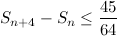
For the geometric series user posted image, obtain the smallest value of user posted image if the difference between the sum of the first user posted image terms and the sum of the first user posted image terms is less than user posted image.

This is an STPM Mathematics T Paper 1 question from 2009.
*
5?
studyboy
post Dec 25 2013, 02:41 PM

On my way
****
Senior Member
522 posts

Joined: Mar 2013
QUOTE(Critical_Fallacy @ Dec 25 2013, 08:26 AM)
So, my hypothesis on passing the Pure Math exam with flying colors has a good degree of trueness. sweat.gif
*
tongue.gif I am sure the statement is true for Flame Haze! As for me, I wish I could spend more time on it whilst still at university. blush.gif

Ah well, this is why I am here! To polish the math/thinking skills! biggrin.gif
studyboy
post Dec 25 2013, 02:50 PM

On my way
****
Senior Member
522 posts

Joined: Mar 2013
QUOTE(Flame Haze @ Dec 25 2013, 01:13 PM)
5?
*
I think it is correct but we shall see what the others have to say about this! rclxms.gif Well done!
TSCritical_Fallacy
post Dec 25 2013, 04:52 PM

∫nnộvisεr
Group Icon
VIP
3,713 posts

Joined: Nov 2011
From: Torino
QUOTE(v1n0d @ Dec 25 2013, 10:50 AM)
For the geometric series user posted image, obtain the smallest value of user posted image if the difference between the sum of the first user posted image terms and the sum of the first user posted image terms is less than user posted image.
The question can be solved algebraically using knowledge learned from SPM Progressions, Indices and Logarithms.

user posted image

which can be rearranged to give

user posted image.

By letting

user posted image,

we need find integer n which satisfies

user posted image

Using a graphing software, one can evaluate

user posted image
TSCritical_Fallacy
post Dec 25 2013, 05:23 PM

∫nnộvisεr
Group Icon
VIP
3,713 posts

Joined: Nov 2011
From: Torino
Hi Flame Haze, RED-HAIR-SHANKS, maximR, crazywing26 and studyboy,

The purpose of these exercises is to train your problem-solving skill to be adaptive to searching viable mathematical methods from 360°, primarily Arithmetic, Algebra, Polynomials, Graphs, and Linear equations. It does not limit to the formulas you learned in Sequences & Series.

After simplification, the value of

user posted image

is a proper fraction in its lowest form, which is related to Gauss' famous number. Find the difference of its denominator and numerator. sweat.gif
ystiang
post Dec 25 2013, 05:37 PM

Getting Started
**
Junior Member
171 posts

Joined: May 2012
QUOTE(v1n0d @ Dec 25 2013, 10:50 AM)
Alternating series are generally more fun to work with, because the terms sometimes cancel out, resulting in a very simple solution.

Since we're on the subject of series, do try this one:

For the geometric series user posted image, obtain the smallest value of user posted image if the difference between the sum of the first user posted image terms and the sum of the first user posted image terms is less than user posted image.

This is an STPM Mathematics T Paper 1 question from 2009.
*
A standard way to solve this type of problem in STPM, taking the logarithm at both sides:

» Click to show Spoiler - click again to hide... «


Hence, the least value of n is 5.

This post has been edited by ystiang: Dec 25 2013, 05:39 PM
delsoo
post Dec 25 2013, 05:40 PM

Look at all my stars!!
*******
Senior Member
3,187 posts

Joined: Nov 2013
Hi it's a chemistry question here?? Which bond.is.stronger?? Ionic bond.or.ionic bond.with covalent characterics??
studyboy
post Dec 25 2013, 05:53 PM

On my way
****
Senior Member
522 posts

Joined: Mar 2013
QUOTE(Critical_Fallacy @ Dec 25 2013, 04:52 PM)
The question can be solved algebraically using knowledge learned from SPM Progressions, Indices and Logarithms.

user posted image

which can be rearranged to give

user posted image.

By letting

user posted image,

we need find integer n which satisfies

user posted image

Using a graphing software, one can evaluate

user posted image
*
Fantastic solution! Normally one wouldn't think of using graphs for this sort of stuff!

This might be unknown to some of you here but such a method is commonplace in academia. A graph provides much insight on a particular equation in terms of behaviour, possible roots and etc. Very powerful stuff!

This post has been edited by studyboy: Dec 25 2013, 05:58 PM
Flame Haze
post Dec 25 2013, 07:04 PM

Enthusiast
*****
Senior Member
814 posts

Joined: Oct 2009


QUOTE(Critical_Fallacy @ Dec 25 2013, 05:23 PM)
Hi Flame Haze, RED-HAIR-SHANKS, maximR, crazywing26 and studyboy,

The purpose of these exercises is to train your problem-solving skill to be adaptive to searching viable mathematical methods from 360°, primarily Arithmetic, Algebra, Polynomials, Graphs, and Linear equations. It does not limit to the formulas you learned in Sequences & Series.

After simplification, the value of

user posted image

is a proper fraction in its lowest form, which is related to Gauss' famous number. Find the difference of its denominator and numerator. sweat.gif
*
1/5050, 5049?

This post has been edited by Flame Haze: Dec 25 2013, 07:07 PM
studyboy
post Dec 26 2013, 12:54 AM

On my way
****
Senior Member
522 posts

Joined: Mar 2013
QUOTE(Flame Haze @ Dec 25 2013, 07:04 PM)
1/5050, 5049?
*
I think you are correct!

However, how would one prove this by induction? Did you do it by induction Flame Haze?

Critical_Fallacy or anyone else do comment!
Flame Haze
post Dec 26 2013, 01:00 AM

Enthusiast
*****
Senior Member
814 posts

Joined: Oct 2009


QUOTE(studyboy @ Dec 26 2013, 12:54 AM)
I think you are correct!

However,  how would one prove this by induction? Did you do it by induction Flame Haze?

Critical_Fallacy or anyone else do comment!
*
I did it using similar method as the last question.
studyboy
post Dec 26 2013, 01:29 AM

On my way
****
Senior Member
522 posts

Joined: Mar 2013
QUOTE(Flame Haze @ Dec 26 2013, 01:00 AM)
I did it using similar method as the last question.
*
Thanks for the information!

v1n0d
post Dec 26 2013, 08:15 AM

Another roof, another proof.
*******
Senior Member
3,197 posts

Joined: Mar 2007
From: Kuala Lumpur, Malaysia


QUOTE(Flame Haze @ Dec 25 2013, 01:13 PM)
5?
*
QUOTE(ystiang @ Dec 25 2013, 05:37 PM)
A standard way to solve this type of problem in STPM, taking the logarithm at both sides:

» Click to show Spoiler - click again to hide... «


Hence, the least value of n is 5.
*
The answer is 5, yes.
ystiang provides the standard answer as according to the answer scheme, but it's worth noting that there is more than one method that can be applied, as shown by Critical_Fallacy. Depending on the seniority of the teacher marking your paper, the alternative method may/may not be accepted (younger teachers tend to be very rigid when it comes to marking papers according to the answer scheme given). The only time that an answer is to strictly follow a specific method is when you see the word "hence" in the question, which implies that you MUST use the results from the previous section (either an equality or a graph) to deduce your answer. smile.gif
TSCritical_Fallacy
post Dec 26 2013, 10:34 AM

∫nnộvisεr
Group Icon
VIP
3,713 posts

Joined: Nov 2011
From: Torino
QUOTE(studyboy @ Dec 26 2013, 12:54 AM)
However,  how would one prove this by induction? Did you do it by induction Flame Haze?
Flame Haze-san was able to grasp the nature of series and rational functions. With enough training, one should be able to see this pattern:

user posted image

Since it is a rational function, you can do a partial fraction decomposition! icon_rolleyes.gif
TSCritical_Fallacy
post Dec 26 2013, 11:03 AM

∫nnộvisεr
Group Icon
VIP
3,713 posts

Joined: Nov 2011
From: Torino
QUOTE(ystiang @ Dec 25 2013, 05:37 PM)
A standard way to solve this type of problem in STPM, taking the logarithm at both sides:
I remember I did this kind of question in my SPM. And v1n0d is right. Under normal exam circumstances, one may not be able to plot a smooth curve for evaluation because graphing calculators are usually not allowed. Technically, it is possible to sketch by computing n = 1, 2, 3, 4, ... and then link up the dots. But it is impractical because one does not know the root, Depending on the convergence of the series, the root can occur at n = 25 or at n = 50. Usually the questions are single-variable problems and most of them have closed-form solutions.

My purpose of showing the graphical solution (without spilling out the algebraic solution sweat.gif), as mentioned by studyboy, is to create the awareness in students that we can model a function and analyze it better by understanding the behaviors of the function f(x) at -∞ < x < ∞ domain. In analyzing dynamic systems in Biology, Chemistry, Physics, the graphs tell us many useful information for design purposes, such as the system response (shape), resiliency (boundedness), stability (convergence), optimality (max performance / min resources), etc.
TSCritical_Fallacy
post Dec 26 2013, 11:29 AM

∫nnộvisεr
Group Icon
VIP
3,713 posts

Joined: Nov 2011
From: Torino
QUOTE(delsoo @ Dec 25 2013, 05:40 PM)
Hi it's a chemistry question here?? Which bond.is.stronger?? Ionic bond.or.ionic bond.with covalent characteristics?
What happen to the "dots"? unsure.gif I don't have a textbook with me. What kind of formations are written in your Chemistry textbook about the Ionic Bonding and Covalent Bonding? Perhaps you can tell me! wink.gif
TSCritical_Fallacy
post Dec 26 2013, 04:29 PM

∫nnộvisεr
Group Icon
VIP
3,713 posts

Joined: Nov 2011
From: Torino
Hi Flame Haze, RED-HAIR-SHANKS, maximR, crazywing26 and studyboy,

I've updated Post #1 with Calculators. icon_rolleyes.gif

Scientific Calculator
user posted image

Graphing Calculator
user posted image

Programmable Calculator
user posted image

Equations and Systems Solver
user posted image

Symbolic Differentiation and Integration
user posted image
RED-HAIR-SHANKS
post Dec 26 2013, 06:41 PM

On my way
****
Senior Member
654 posts

Joined: Apr 2013
From: Planet Earth


Hi Critical_Fallacy and crazywing26, I would like to ask you something concerning matrices.

Suppose that we have a 3 x 3 matrix A, and that we have to find it's determinant.
user posted image

From the above matrix A, it's determinant can be evaluated by adding the products of any elements with any one row(with it's column) with their respective cofactors. It should be like this:
user posted image

But, I too found out that there is another alternative way to solve the determinant of a 3 x 3 matrix, that is by using Sarrus' Rule. It's the sum of the multiplication of entries in every arrow to the right(blue colour) minus the sum of multiplication of entries in every arrow to the left(red colour).
user posted image

Now my question is, as far as I know from my book, Sarrus' Rule is not mentioned in it. If by any chances were I to stumble across a question concerning the determinant of a 3 x 3 matrix, can I use Sarrus' Rule? My reason is that it's way more flexible and less tedious compared to the other method in which we need to first find the minor and cofactor first. But, knowing that sometimes the marking scheme for STPM is extremely stringent and rigid, I feel that it's not a safe bet. Any Form 6-ers have experience this before? unsure.gif

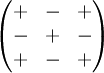
Another thing I would like to know is why the signs of the 3 x 3 matrix (cofactors) should be like this ? sweat.gif :
user posted image

This post has been edited by RED-HAIR-SHANKS: Dec 26 2013, 06:46 PM
VengenZ
post Dec 26 2013, 06:58 PM

La la la~
****
Senior Member
608 posts

Joined: Nov 2009
From: 127.0.0.1


QUOTE(RED-HAIR-SHANKS @ Dec 26 2013, 06:41 PM)
Hi Critical_Fallacy and crazywing26, I would like to ask you something concerning matrices.

Suppose that we have a 3 x 3 matrix A, and that we have to find it's determinant.
user posted image

From the above matrix A, it's determinant can be evaluated by adding the products of any elements with any one row(with it's column) with their respective cofactors. It should be like this:
user posted image

But, I too found out that there is another alternative way to solve the determinant of a 3 x 3 matrix, that is by using Sarrus' Rule. It's the sum of the multiplication of entries in every arrow to the right(blue colour) minus the sum of multiplication of entries in every arrow to the left(red colour).
user posted image

Now my question is, as far as I know from my book, Sarrus' Rule is not mentioned in it. If by any chances were I to stumble across a question concerning the determinant of a 3 x 3 matrix, can I use Sarrus' Rule? My reason is that it's way more flexible and less tedious compared to the other method in which we need to first find the minor and cofactor first. But, knowing that sometimes the marking scheme for STPM is extremely stringent and rigid, I feel that it's not a safe bet. Any Form 6-ers have experience this before? unsure.gif

Another thing I would like to know is why the signs of the 3 x 3 matrix (cofactors) should be like this ? sweat.gif :
user posted image
*
the sign is like that because the formula states that (-1)^i+j (M)

try finding books on linear algebra, its really fun to read
studyboy
post Dec 26 2013, 07:06 PM

On my way
****
Senior Member
522 posts

Joined: Mar 2013
QUOTE(RED-HAIR-SHANKS @ Dec 26 2013, 06:41 PM)
Hi Critical_Fallacy and crazywing26, I would like to ask you something concerning matrices.

Suppose that we have a 3 x 3 matrix A, and that we have to find it's determinant.
user posted image

From the above matrix A, it's determinant can be evaluated by adding the products of any elements with any one row(with it's column) with their respective cofactors. It should be like this:
user posted image

But, I too found out that there is another alternative way to solve the determinant of a 3 x 3 matrix, that is by using Sarrus' Rule. It's the sum of the multiplication of entries in every arrow to the right(blue colour) minus the sum of multiplication of entries in every arrow to the left(red colour).
user posted image

Now my question is, as far as I know from my book, Sarrus' Rule is not mentioned in it. If by any chances were I to stumble across a question concerning the determinant of a 3 x 3 matrix, can I use Sarrus' Rule? My reason is that it's way more flexible and less tedious compared to the other method in which we need to first find the minor and cofactor first. But, knowing that sometimes the marking scheme for STPM is extremely stringent and rigid, I feel that it's not a safe bet. Any Form 6-ers have experience this before? unsure.gif

Another thing I would like to know is why the signs of the 3 x 3 matrix (cofactors) should be like this ? sweat.gif :
user posted image
*
http://en.wikipedia.org/wiki/Leibniz_formu...or_determinants

http://en.wikipedia.org/wiki/Laplace_expansion

http://en.wikipedia.org/wiki/Cofactor_%28linear_algebra%29

Have a look at these links! smile.gif

As for the Rule of Sarrus, use it by all means to check your answers. To be on the safe side, it is better if you use the standard way of computing a 3X3 matrix and by standard, I mean whatever that you are taught in Form 6.

This post has been edited by studyboy: Dec 26 2013, 07:10 PM

91 Pages « < 21 22 23 24 25 > » Top
 

Change to:
| Lo-Fi Version
0.0382sec    0.73    6 queries    GZIP Disabled
Time is now: 19th December 2025 - 05:18 AM