QUOTE(malutapimau @ Aug 24 2010, 05:00 PM)
you should get their irish linen
I cannot afford their linen. I have far cheaper sources for it. Right now I'm sitting on 4 pieces of linen to be made up.
------------------------------------------------------------------
Let’s move on to the tubular piece of cloth to which the cuffs are attached: the sleeves. Unlike the cuffs, which should be narrow, optimal sleeves must strike a balance between being too narrow and too wide, and between being too long and too short.
Sleeves are too narrow when you feel the cloth straining when you bend your elbows. Overly narrow sleeves cause not only physical discomfort; the strain on the sleeves at the elbow area causes the cloth there to develop severe and ugly wrinkling. Sleeves, however, should not be too wide and it is here that RTW shirts fail most miserably: they have sleeves that billow about the wind, and share no relation whatsoever to the arms they envelope. A wide sleeve necessarily results in a low armhole. A low armhole is a heinous thing to have on a shirt. You would pull out your shirttails shoving your bag into the overhead compartment of an airplane, it pulls the torso of your shirt here and there with your arm movements, and it bunches around your armpits when you put on a properly cut suit jacket. Optimal sleeves are those which are just wide enough to offer no resistance to your bending your elbows – and no wider.
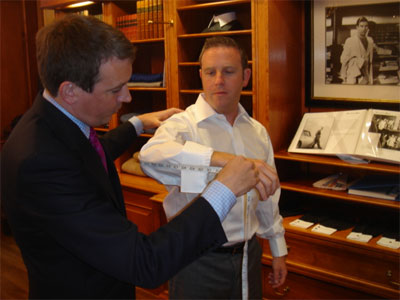
There is nothing less elegant than the bunching of overly long sleeves. But how short can one get away with making sleeves? The following picture of a shirt measuring session with the famed shirtmaker Turnbull & Asser gives you a clue.
The sleeves should be just long enough that the cuff does not retract from your wrist when you adopt the following pose:
In the next installment, we deal with the torso of the shirt.


 Aug 23 2010, 02:21 PM


 Quote
Quote





 0.0198sec
 0.56
0.56
 6 queries
 GZIP Disabled