QUOTE(surrodox2001 @ Sep 29 2020, 02:34 PM)
If you can receive both Malaysia and Indonesia digital muxes, wouldn't the Indonesian digital muxes will cause adjacent channel interference?
Also, what's the ERP/power figure for Malaysia/Singapore/Indonesia digital muxes?
I don't have the information on the EIRP power values of the transmitters.
I know someone online, he stays in Batam, and he is able to receive all 3 country's TV signals, Indonesia, Singapore and Malaysia. So I would get updated on any new changes and happenings on the TV reception there.
UHF TV frequency plan are the same for Malaysia, Singapore and Indonesia, so adjacent channel interference isn't the case here.
The only ones that has interferences today, is between both Malaysia's digital TV MYTV muxes with Indonesia's analogue TV stations, which is SCTV and RCTI.
Look at the ones highlighted as red, where
co-channel interference still happening today.
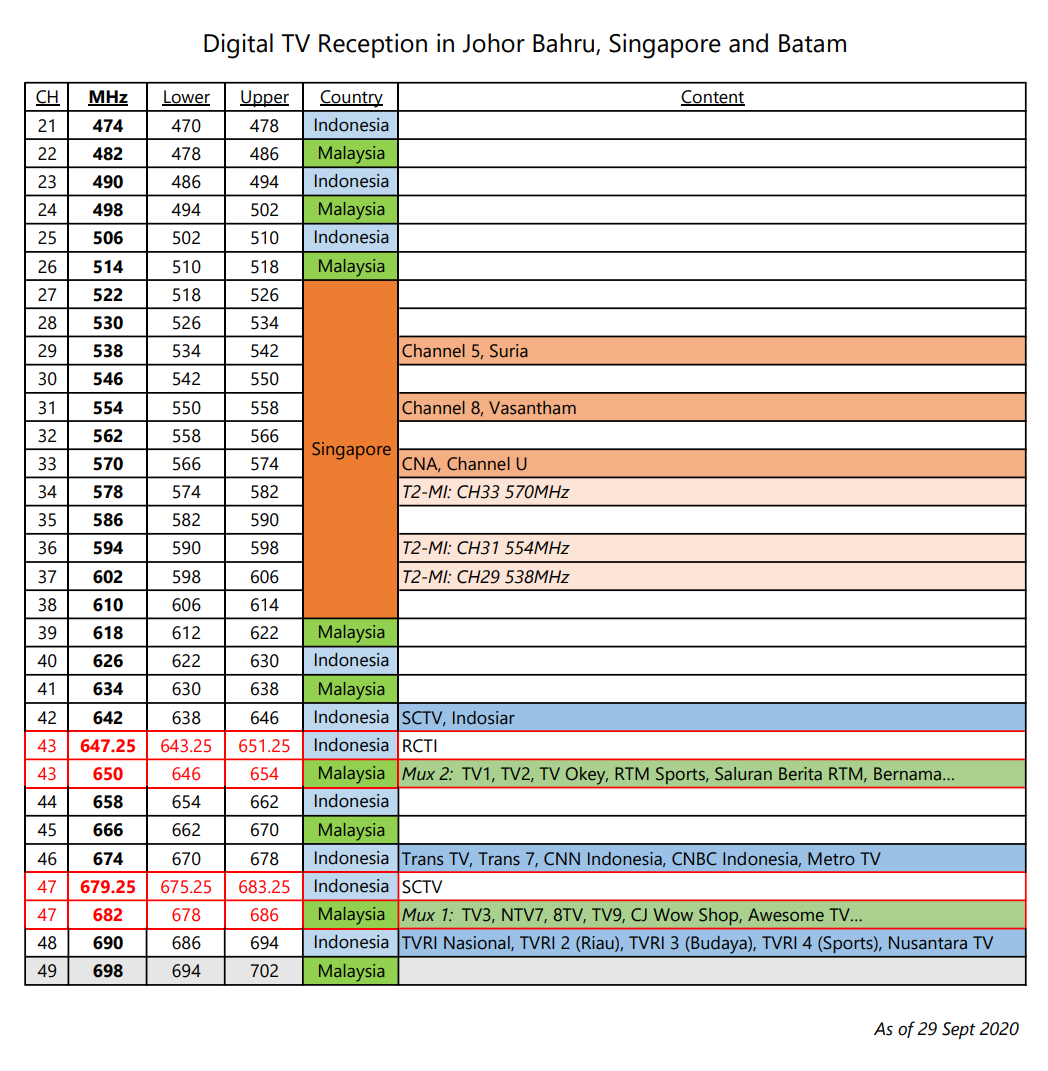
What I know, the situation for certain viewers in
Johor Bahru is:
- Singapore DTT channels can be received
much easier, and signals are
much more robust compared to Malaysia DTT channels
- Cannot receive Malaysia DTT channels at all, but can only receive Singapore DTT channels
- Have to either
align antenna properly or
use better outdoor antenna to watch Malaysia DTT channels
- In some cases, use 2 outdoor antennas that aims different direction (one is towards Gunung Pulai, Malaysia, another is towards Bukit Batok, Singapore) to receive DTT channels from both countries.
- Indonesian DTT channels are generally
not receivable, unless if use better antenna or with booster when needed. But not many Malaysians are in favour of Indonesian TV channels anyway.
What I know, the situation for many viewers in and around
Batam area is:
- Analogue TV
static noise are severely present for both SCTV and RCTI channels; and it simply just won't go away regardless of day or night (because interfered by Malaysia's MYTV). It is known that RCTI has the worst reception quality, while SCTV is somehow still watchable.
- Able to receive all Malaysia and Singapore DTT channels at a
very strong signal strength by using outdoor antenna (no booster whatsoever), and Singapore Mediacorp one is the highest among all.
- Many Batam viewers would choose to watch Malaysian and Singapore TV channels because they find that their own local channels are boring or aren't that interesting, or they simply just want to have more choice of TV channels to watch.
- For those Batam viewers who is unable to get a clear TV reception for SCTV and RCTI channels, the alternatives are,
watch the channels via local cable TV (DVB-C) or
satellite TV (either C band or Ku band), or watch SCTV channel over digital TV (DVB-T2). RCTI channel isn't available in digital TV platform for Batam region yet.
Batam viewers are very lucky, as they can receive TV channels from 3 countries pretty easily.
The remaining Indonesian analogue TV stations that is still on-air around Batam region:
| RF Channel No. | Analogue TV Frequency | Channel Name |
| UHF 39 | 615.25MHz | NET |
| UHF 41 | 631.25MHz | MNC TV |
| UHF 43 | 647.25MHz | RCTI |
| UHF 45 | 663.25MHz | Trans TV |
| UHF 47 | 679.25MHz | SCTV |
| UHF 49 | 695.25MHz | Indosiar |
| UHF 51 | 711.25MHz | Batam TV |
| UHF 55 | 743.25MHz | RTV |
| UHF 61 | 791.25MHz | iNews |
*Other Indonesian TV channels that is not listed above, means it is already off-air.
This post has been edited by joshhd: Sep 29 2020, 04:41 PM 

 Sep 26 2020, 10:52 PM


 Quote
Quote





 0.0313sec
 0.71
0.71
 6 queries
 GZIP Disabled