QUOTE(surrodox2001 @ Oct 13 2020, 02:59 PM)
Agreed. Even with change of codec to AAC, the artifacts when dropping down is still noticeable, but less so than MP3. (MP3 will sound like in water, while AAC will lose its high end)
And IMO the lowest you can go without notable artifacts with AAC is 64-128k and without SBR nor PS, as these will mangle the audio significantly.
So yeah, I think MP3 wins here as it's a compression and not much processing.
For hires listening though, I'd recommend FLAC. BTW,
what's the best audio quality that you can theoretically put into DTT?QUOTE(shaun_kok @ Oct 13 2020, 06:56 PM)
Most radio stations and even popular music streaming apps, unfortunately
never provide a hi-res FLAC stream. It will cost a lot of money, in terms of operator side, to distribute a FLAC stream. So often that it is money that usually avoided the distribution of high quality audio. Imagine the cost of sending 1000 FLAC streams online. It will require an 1Gbps link. The more you send the more internet capacity is needed.
Most radio stations I see in Malaysia only provide a 32-48kbps HE-AAC V2 stream and nothing higher than that. Meanwhile in overseas, whilst that 128kbps MP3/AAC streams are common, most stations defaults to 48kbps HE-AAC V2 stream. Media Prima stations do have higher res audio on their Live streaming feeds placed on YouTube and Dailymotion. Astro uses HE-AAC and AC3 (5.1) soundtracks for HD channels and MP2 for SD and audio channels. Ironically, for Malaysian channels, it is often the online catch up feed on YouTube that sounds better.
Obviously, I preferred 128kbps AAC/96kbps HE-AAC is to be used as an standard on DTT (and other platforms).
The typical bitrate for DTT audio (in stereo) across the world are 128-256kbps (MP2), 192kbps (AC3), 32-48kbps for HE-AAC V2, 64-96kbps for HE-AAC and 96-128kbps for AAC.
The highest you may theoretically put into DTT can be as high as 448kbps for AAC and 384kbps for MP2 (both of course in stereo). But obviously broadcasters won't do so as the additional bandwidth can be used to improve picture quality.
Technically and theoretically
surrodox2001, whatever the video/audio codec that accommodate into the Transport Stream (.ts), can actually be able to supported on DVB-T2.
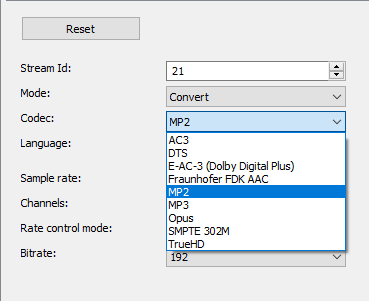
And nope, no one would use FLAC audio codec for general broadcasts... There is high quality audio for general broadcast use, but not "lossless" quality due to bandwidth constraints on both broadcaster and viewers.
Nowadays, commonly used audio codecs for broadcasts could be:
- AAC (either AAC-LC or HE-AAC)
- AC3 (Dolby Digital)
- E-AC3 (Dolby Digital Plus)
- MP1/MP2 (usually used due to loyalty and/or device compatibility reasons)
Like what
shaun_kok said, typical bitrates are around that range... They're not so "big hearted" to use very high audio bitrates for your audio immersive enjoyment.
But for a broadcaster like MYTV Broadcasting, which prioritises
quantity to the very maximum rather than
quality, all they care about is how to pump in more TV channels/radio and content in one mux to save cost; no need to spend more money on using more muxes.


 Oct 8 2020, 01:12 AM


 Quote
Quote


 0.0225sec
 0.52
0.52
 6 queries
 GZIP Disabled