QUOTE(Leo.Lee @ Jan 17 2018, 11:27 AM)
I have 2 young kids and my wife are pregnant with another one. My wife have been frequently advise to eat more fish especially those with high Omega 3 content as Omega 3 are good for brain development. It also have the same benefits for young child and also benefit adult in one way or another.
However, I realize that there is also the concern of mercury content in fish especially popular high Omega 3 content fish such as Tuna, Salmon and etc. To deal with that, I am thinking of eating plant based Omega 3 & local freshwater fish with lower Omega 3 content fish (not sure how low) but recently I heard that freshwater fish actually have higher mercury content that can affect brain development. I am confuse


. Do you guys have any info about this?
Other than that, I also wanted to show my kids the photo of those fish before it is cooked & served on a plate as I noticed many youngster today don't even know what kind of fish that they're eating. (Including myself, I only know few but not really sure how to differentiate it). I don't want my kids to be like those kids in developed country like USA & etc that don't even realize the foods that they eat especially meat are living being that have head, feet, name and etc before being served as food.
And being a Chinese and living in Malaysia, I also want to know and tell my kids the name of those fish in Chinese, Malay and etc. Hope you guys have some info about this.
Also known as : Unicorn Filefish
Mandarin name : 鹿仔鱼 (Lù zǐ yú), 鸡鱼 (Jī yú), 肉竹 (Ròu zhú)
Cantonese name: 剝皮魚 (Mok Pei Yu), 牛鯭 (Ngau Mang), 大沙鯭 (Dai Sa Mang)
Hokkien name : Keh Hu, Bak Teik
Malay name : Ikan Barat-barat, Kerosok Padi, Ayam Laut
Details:
• This fish is sold/marketed as
"Chicken Fish" in Malaysia.
• This fish grow slowly and take more than 14 years to become sexually mature, making them vulnerable to fishing pressure.
• Usually caught as a bycatch.
https://www.tripadvisor.co.za/LocationPhoto...ersekutuan.htmlThe links above show the photo of the fish sold at Jalan Alor.
When I try to search about the fish, I found that the fish is called Unicorn Leatherjacket in English, Ikan Barat-barat in Malay and Keh Hu in Hokkien. And the image results based on using the information above are definitely showing the same fish. However, when I search using the terms "Chicken Fish", I found some fish image that definitely not Ikan Barat-barat/Unicorn Leatherjacket, instead it is another type of fish called Starry triggerfish and Ikan Jebong/Ayam Laut in Malay. Most of the search results are from Malay blog and as such, saying that Starry triggerfish is the "Chicken Fish".
http://sharingthotsandluv.blogspot.my/2013...asam-manis.htmlOne of the blog that write about Starry triggerfish/Ikan Jebong.
My question is which is the real identity of "Chicken Fish" in Malaysia. Note that when i say in Malaysia because there is another Chicken fish from Vanuatu near Solomon Islands called poulet fish.
Or is it both consider as the Chicken fish? Just like how the Chinese identify both freshwater catfish and marine/saltwater catfish as Tong Sat (Cantonese)?
It is said to be taste like chicken. Hence, it is sold under the name of “Chicken Fish” in Malaysia.
Redbelly Yellowtail FusilierMandarin name : 豆腐鱼 (Dòu fu yú), 黄尾鱼 (Huáng wěi yú)
Cantonese name: Tau Fu Yu
Hokkien name : Tau Hoo
Malay name : Ikan Delah, Delah Pinang, Bagan, Sulit
Details:
• Well known for its use in making fish balls, because it gives the fish balls a nice bouncy texture.
• The meat of the Yellowtail Fusilier is very sweet, so apart from using it to make fishballs, you can also pan-fry the whole fish.
• On the other hand, the skin is very tough, so people don’t usually eat it.
• You can easily identify Yellowtail Fusilier by its unique combination of yellow (tail), blue (middle section) and an obviously pink (belly) hues.
 Chinese Silver Pomfret
Also known as : Butterfish
Mandarin name : 斗鲳 (Dòu chāng), 斗底白鯧 (Dòu dǐ bái chāng), 斗底 (Dòu dǐ)
Cantonese name: 斗底 (Dau Dai)
Hokkien name : Dao Chior
Malay name : Ikan Bawal Tambak, Duai Tambak
Details:
• This fish is the most expensive fish within the “鲳” (Chāng) fish category.
• The fish is identified by its diamond shape with dull silver, pewter coloured body.
 Silver Pomfret
Also known as : White Pomfret
Mandarin name : 白鲳 (Bái chāng), 银鲳 (Yín chāng)
Cantonese name: 白䱽 (Baak Cong / Pak Cong)
Hokkien name : Pek Chior
Malay name : Ikan Bawal Putih, Duai Putih
Details:
• The fish is identified by its silverish white, not pewter coloured body.
 Black Pomfret
 Mandarin name : 黑鲳 (Hēi chāng)
Cantonese name: 黑鯧 (Haak Cong / Hak Chong)
Hokkien name : Orh Chior
Malay name : Ikan Bawal Hitam
 Snubnose Pompano
Also known as : Snubnose Dart
Mandarin name : 金鲳 (Jīn chāng)
Cantonese name: 金鯧 (Gam Cong / Kam Cong)
Hokkien name : Kim Chior
Malay name : Bawal Mas, Nyior-nyior
Details:
• The fish is identified by its golden fins and tail.
 Yellowstripe Scad
Also known as : Yellowstripe Trevally / Yellow-Banded Trevally / Smooth-Tailed Trevally
Mandarin name : 金带细鲹 (Jīn dài xì shēn), 君令 (Jūn lìng)
Hokkien name : Kun Ning
Malay name : Ikan Kuning, Selar Kuning, Pelata Kuning
Details:
• This is the fish that Malaysian (mostly at coastal region, elsewhere they usually eat nasi lemak with fried chicken) and Singaporean eat with Nasi Lemak.
• It is good for frying especially if it is coated with tumeric powder or paprika and a little salt.
• It is also known as “the poor man’s fish” because of its affordability.
• It is currently on World Wide Fund for Nature’s (WWF) red list of threatened ocean species.
• Do not confuse this fish with another similar looking fish, Yellow
tail Scad which is larger. This fish is around half the size
smaller or more than Yellow
tail Scad.
• It can be easily identified by its distinctive and prominent lateral yellow strip running along the back from the head to its tail. It has small eyes, very thin scales and greyish tail.


Nasi lemak with ikan kuning
Yellowtail ScadAlso known as : Northern Yellowtail Scad / One-finlet Scad / Omaka
Mandarin name : 色腊 (Sè là)
Cantonese name: Sik La
Hokkien name : Sek La
Malay name : Ikan Selar, Temenong
Details:
• It has yellow tail and an easily identifiable long dark strip of hard scales extending from the tail to 1/3 of body.
• Do not confuse this fish with another similar looking fish, Yellow
stripe Scad which is smaller.
• This fish is often served at the peranakan restaurants grilled with sambal belacan chilli stuffed inside the fish.


Ikan Selar-Yellow
tail (top) vs. Ikan Kuning-Yellow
stripe (bottom)
Torpedo scadAlso known as : Hardtail Scad / Finny Scad
Mandarin name : 硬尾 (Yìng wěi)
Cantonese name: 硬尾 (Ngang Mei)
Hokkien name : Ngeh Bueh
Malay name : Ikan Cencaru
Details:
• This fish has body color range from bluish-grey to greenish, changing to a silvery white on its sides and belly, with a large black spot on the upper rear edge of the gill cover, a series of prominent deep scutes along the side,
long scythe-like pectoral fins, and a narrow caudal peduncle.

 Milkfish
Also known as : Bangus
Mandarin name : 虱目鱼 (Shī mù yú), 牛奶鱼 (Niú nǎi yú)
Cantonese name: 虱目魚 (Sat Muk Yu)
Hokkien name : Gu Ni Heur
Malay name : Ikan Susu, Ikan Bandeng, Ikan Baulu
Details:
• It has streamlined body, huge eyes which is covered with a thick layer of transparent gelatinous tissue, a pointed snout with a small toothless terminal mouth and a large deeply-forked caudal fin.
• The colour of its body is silvery blue-green above, silvery on sides and white below.
• The young fry live at sea for two to three weeks and then migrate during the juvenile stage to mangrove swamps, estuaries, and sometimes lakes, and return to sea to mature sexually and reproduce.
• This fish is considered as a bony fish hence the lower market value.
• This fish is popular in Taiwan and Philippines where the local expertly debone the fish.

 Pale-edged Stingray
Also known as : Sharpnose Stingray
Mandarin name : 魟鱼 (Hōng yú), 魔鬼鱼 (Mó guǐ yú)
Cantonese name: 鯆魚 (Pou Yu), 魔鬼魚 (Mo Gwai Yu)
Hokkien name : Hung Heur
Teochew name : Hung Hu
Malay name : Ikan Pari Ketuka, Tuka
Details:
• This species is the most common stingray to be served in Malaysia as it is often a bycatch (caught unintentionally) in fisherman net which cause this species to be branded as Near Threatened.
• It is used to be sold cheaply because there is no market value for it. It is considered as “fishy fish” as it has ammonia smell.
• It is only began to be served as food in Malaysia after the Portuguese traders brought their cuisine in the form of Sambal Stingray (Ikan Bakar in Malay) using local ingredients to Malacca during Malacca Sultanate era and make popular by the Kristang (also known as the "Portuguese-Eurasians" or "Malacca Portuguese" or “Orang Serani” in Malay).
•
Trivia: Portuguese are the one who spread chilli to the rest of the world includes India (imagine curry without chilli) and Malaysia after Christopher Columbus who is an Italian under the Spanish found chilli at South America (Mexico).
 Indian Threadfin
Mandarin name : 顺风午 (Shùn fēng wǔ), 午鱼 (Wǔ yú), 马友鱼 (Mǎ yǒu yú)
Cantonese name: Mah Yau Yu
Hokkien name : Ngor Her, Orh Ngor
Malay name : Ikan Kurau, Senohong
Details:
• The fish is identified by it threadlike rays which are found under the pectoral fins (the front fins). The Indian threadfin has
5 threadfin. It has black and white pattern on its skin.
• There is a premium grade Indian threadfin called the
Balai Ngor. It is named so because they’re fished off Tanjung Balai in Indonesia (near to Singapore). It has a golden yellow hue on its skin in addition to the usual black and white.


5 threadfin under the pectoral fins
Fourfinger ThreadfinAlso known as : Indian Salmon / Blue Threadfin / Rawas Fish
Mandarin name : 午鱼 (Wǔ yú), 马友鱼 (Mǎ yǒu yú)
Cantonese name: Mah Yau Yu
Hokkien name : Peh Ngor, Ngor Her
Malay name : Ikan Senangin, Senangin Rambu Empat
Details:
• This fish has
4 threadlike rays under the pectoral fins (the front fins).
• The diameter of its eye is also greater than the distance between the eye and the snout. So compared to the Indian threadfin, the eyes are proportionally larger.
• It also have lighter skin colour compared to Indian threadfin. Hence its name in Hokkien peh ngor (white ngor) as opposed to orh ngor (black ngor) referring to the Indian threadfin.
 Trivia:
 • Grouper are listed as fish which
high in mercury.• This fish sometime named as Garouper which is a wrong spelling of its Portuguese name, Garoupa. Some said the word Garoupa was derived from Malay word, Kerapu. Some say it is the other way around. Nobody know for sure. I mean even the word "Mandarin" come from Portuguese mispronunciation of Malay word, "Menteri" when Portuguese traders are asking the Malay what to call those officer from China during Malacca Sultanate era.
Spotted Coral GrouperAlso known as : Bar Cheek Coral Trout
Mandarin name : 石斑魚 (Shí bān yú), 七星斑 (Qī xīng bān), 太星斑 (Tai xīng bān)
Cantonese name : 七星斑 (Cat Sing Baan / Chat Seng Paan)
Hokkien name : Ang Gau, Chut Bee Gau
Malay name : Kerapu Sunoh Pisang, Kerapu Bara
Details:
• A red, pale greyish or olive to dark brown grouper with small blue spots on the head, body and fins. Some spots on the head and anterior body are horizontally elongate forming dashes (oval shape).
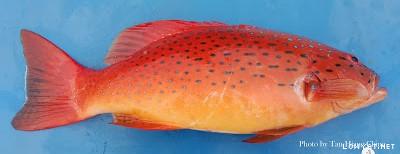


Blue spot (oval shape) that form dashes
Leopard Coral GrouperAlso known as : Leopard Coral Trout / Common Coral Trout
Mandarin name : 石斑魚 (Shí bān yú), 东星斑 (Dōng xīng bān ), 西星斑 (Xi xīng bān)
Cantonese name : 東星斑 (Dung Sing Baan), 西星斑 (Sai Sing Baan)
Hokkien name : Ang Gau
Malay name : Kerapu Sunoh Bara, Kerapu Bintang
Details:
• Most likely to refers as 東星斑 (Dung Sing Baan) as 西星斑 (Sai Sing Baan) refers to few other groupers.
• A large olive green to reddish brown or orange-red grouper covered in regularly-spaced bright blue spots (except below), and a blue ring around the eye (may be broken up).
• This fish can rapidly change their colour, and often assume a mottled pattern when hunting. This species is often mistaken for the Spotted Coral Grouper, which has some elongate spots or dashes on the head region.


Blue spot (round shape) on an orange-red Leopard Coral Grouper
Orange-spotted GrouperAlso known as : Goldspotted Rockcod / Estuary Cod
Mandarin name : 石斑魚 (Shí bān yú), 红点石斑 (Hóng diǎn shí bān)
Cantonese name : 青斑 (Ceng Baan)
Hokkien name : Chia Gau
Malay name : Ikan Kerapu Bintik Jingga, Kerapu Pinang, Kerapu Balong, Kerapu Rintek
Details:
• A pale brownish to greyish-brown grouper.
• Best identified by their orange-brown to reddish-brown spots on their body and 4 to 5 “H-shaped” darker bars on its sides.


H-shaped pattern
Areolate GrouperAlso known as : Areolate Rockcod / Greenspotted Rockcod
Mandarin name : 石斑魚 (Shí bān yú), 西星斑 (Xi xīng bān)
Cantonese name : 西星斑 (Sai Sing Baan / Sai Seng Paan)
Hokkien name : Koay Gau
Malay name : Kerapu Ekor Putih, Kerapu Bintik Bulat
Details:
• A pale grouper covered in close-set orange to brown spots (refers as areolate pattern - mean pattern like nipple) that become more numerous and relatively smaller as the fish grows, and a narrow white margin on the tail.


Narrow white margin on the edge of the tail
Duskytail GrouperMandarin name : 石斑魚 (Shí bān yú), 红点油班 (Hóng diǎn yóu bān)
Cantonese name : 芝麻斑 (Zi Maa Baan), 雙色尾紅斑 (Sheung Sik Mei Hung Paan)
Hokkien name : Koay Gau
Malay name : Kerapu Ekor Gelap
Details:
• This grouper often mistaken for the orange-spotted grouper because of the similar orange dots on the body of the fish.
• The easiest way to identify this grouper is to look at its tail which only has the orange spots on the upper third while the lower two thirds is a dusky brown colour, hence its name.


Lower two thirds of its tail in dusky brown colour
Humpback GrouperAlso known as : Mouse Grouper / Panther Grouper / Barramundi Cod / Polka Dot Cod or Grouper
Mandarin name : 老鼠斑 (Lǎoshǔ bān), 驼背鲈 (Tuóbèi lú)
Cantonese name : 老鼠斑 (Lou Syu Baan / Lou Shu Paan)
Hokkien name : Ngiau Chee Gau, Zut Bi Gau
Malay name : Kerapu Tikus, Kerapu Belida, Sunoh
Details:
• Its small head and humpback appearance resembles the Barramundi or Asian Sea Bass, earning it the name Barramundi Cod in Australia.
• Its colour ranges from greenish white to pale greenish brown with large widely spaced round black spots all over the body, earning it the reputation of being occasionally called Polka Dot Cod/Grouper.
• It is called Lou Shu Paan or Mouse Grouper because of its resemblance to the rodent.
 Giant Grouper
Also known as : Brindlebass / Bumblebee Grouper / Brown Spotted Cod / Queensland grouper
Mandarin name : 石斑魚 (Shí bān yú), 鞍帶石斑魚(Ān dài shí bān yú), 龙旦 (Lóng dàn)
Cantonese name : 龍躉 (Lung Dan)
Hokkien name : Gau Tun
Malay name : Ikan Kertang, Kerapu Kertang, Kerapu Pertang
Details:
• Largest bony fish found in coral reefs and largest among the 石斑魚 (Shí bān yú) category.
•
DO NOT confuse with
Goliath Grouper. They're not the same fish.
• Adults are greyish-brown with a mottled pattern and darker fins, while small secretive juveniles are yellow with dark broad irregular bars and irregular dark spots on the fins.
• The defining characteristic of the fish are the numerous small black dots which cover the fins, most predominantly on the pectoral fins, but also the dorsal and tail fins.


Numerous small black dots which cover its fin
Brown Marbled GrouperAlso known as : Tiger Grouper / Black Rockcod / Carpet Cod / Flowery Rockcod
Mandarin name : 石斑魚 (Shí bān yú), 老虎斑 (lǎo hǔ bān)
Cantonese name : 老虎斑 (Lou Fu Baan / Lou Fu Paan)
Malay name : Kerapu Harimau
Details:
• A large pale yellowish-brown grouper covered in small close-set brown spots, five vertical series of irregular dark brown blotches, and a distinctive small black saddle at the base of the tail. All the fins have small brown spots.
 Dragon Tiger Grouper
Also known as : Hybrid Grouper / Sabah Grouper / Pearl Grouper
Scientific name : Epinephelus Fuscoguttatus x Epinephelus Lanceolatus
Mandarin name : 石斑魚 (Shí bān yú), 龙虎班 (Lóng hǔ bān)
Cantonese name : 龍虎斑 (Lung Fu Baan / Long Fu Paan), 沙巴龍躉 (Sa Ba Lung Dan)
Malay name : Kerapu Hibrid, Kerapu Kacukan
Details:
• A new type of grouper results from cross-breeding.
• There are a lot of hybrid grouper in the current market but the first hybrid grouper is cross-bred via researches from Universiti Malaysia Sabah (UMS), Malaysia, in collaboration among researchers of the Borneo Marine Research Institute of UMS, the Fisheries Development Authority of Malaysia (LKIM) and Kinki University of Japan, represented by Prof. Dr Shigeharu Senoo of UMS.
• This grouper was produced by fertilising the eggs of the tiger grouper (Brown Marbled Grouper or Lao Hu Ban in Mandarin) with the sperm of the giant grouper (Long Dan in Mandarin – literally mean Dragon Grouper) through the in-vitro fertilisation (IVF) technique; hence earning its name of Dragon Tiger Grouper derives from its Chinese name.
 Narrow-barred Spanish Mackerel
Mandarin name : 马鲛鱼 (Mǎ jiāo yú), 康氏马鲛 (Kāng shì mǎ jiāo)
Cantonese name : 鮫魚 (Gaau Yu / Kau Yue), 竹鮫 (Zuk Gaau / Chuk Gaau)
Hokkien name : Tek Ka
Malay name : Ikan Tenggiri Batang
Details:
• It has long body, lack of scales and thick rubbery skin.
• It has dark bluish-grey to bluish-green top body, silvery grey sides and whitish belly with multiple dark grey vertical bars pattern on its body.
• When selecting a Narrow-barred Spanish Mackerel, make sure that its flesh is slightly pinkish and not in whitish colour. The blood clots around the bone should be fresh red in colour. (refer the fish cross-section as below)

The cross-section of the fish
 Spotted Spanish Mackerel
Also known as : Indo-Pacific King Mackerel / Spotted Seerfish
Mandarin name : 马鲛鱼 (Mǎ jiāo yú), 斑点马鲛 (Bān diǎn mǎ jiāo)
Cantonese name : 線鮫 (Sin Gaau),泥鮫 (Nai Gaau)
Hokkien name : Beh Ka
Malay name : Ikan Tenggiri Papan, Ikan Tenggiri Bunga
Details:
• It has silvery white sides with several rows of round dark brownish spots scattered in about three irregular rows along the lateral line.
 Korean Seerfish
Also known as : Korean Mackerel
Mandarin name : 马鲛鱼 (Mǎ jiāo yú), 朝鲜马鲛 (Cháoxiǎn mǎ jiāo)
Cantonese name : 扁鮫 (Bin Gaau)
Hokkien name : Tua Pan
Malay name : Ikan Tenggiri Korea
Details:
• Compare with the Narrow-Barred Spanish Mackerel & Spotted Spanish Mackerel, this fish have a more distinct hump above the eyes which make it look a bit “fiercer”.

P.S.
Tongkol, Aya and Tuna are referring to the same thing. It is just a matter of name from different region of Malaysia. Tongkol (also known as ikan kayu) mainly used by people of west Peninsular Malaysia while Aya used by people from east of Peninsular Malaysia. While Tuna are loanword from English.
Mackerel TunaAlso known as : Eastern Little Tuna / Kawakawa
Mandarin name : 巴鲣 (Bā jiān), 柴鱼 (Chái yú), 金鎗魚 (Jīnqiāngyú), 鲔鱼 (Wěi yú)
Cantonese name : 杜仲 (Dou Zung, Tow Chung), 杜仲魚 (Dou Zung Yu)
Hokkien name : Cha Hu
Malay name : Ikan Tongkol Kurik, Aya Kurik, Kayu, Bakulan
Details:
• Dark blue-greenish dorsally, belly silvery-white.
• Dark spots in area between pelvic and pectoral fins.
• Many dark, broken, oblique stripes above lateral line, from below first dorsal fin to caudal peduncle.

Dark spots in area between pelvic and pectoral fins.
 Frigate Tuna
Also known as : Frigate Mackerel
Mandarin name : 扁舵鲣 (Biǎn duò jiān), 平花鲣 (Píng huājiān)
Cantonese name : 小杜仲 (Siu Dou Zung, Siu Tow Chung)
Hokkien name : Cha Hu
Malay name : Ikan Tongkol Selasih, Aya Selasih, Kayu, Bakulan
Details:
• A small dark blue tuna with silvery sides and belly, and 15 or more narrow, oblique to nearly horizontal dark wavy lines in a scaleless area above the lateral line.
• Look quite similar to mackerel tuna but frigate tuna are only half the size of mackerel tuna and do not have dark spots in area between pelvic and pectoral fins.
 Longtail Tuna
Mandarin name : 青甘金枪鱼 (Qīng gān jīnqiāngyú), 小黄鳍鲔 (Xiǎo huángqíwěi)
Hokkien name : Cha Hu
Malay name : Ikan Tongkol Hitam, Aya Hitam, Kayu, Bakulan
Details:
• Longtail tuna is a relatively small slender species with a very long slender tail.
• This fish have metallic dark blue to black on the upper third of the body, and silver-white below, with colourless elongate oval spots in rows along the underside and belly.
• Second dorsal and anal fins each followed by 7-10 finlets (pointy diamond shaped fin around tail area).
• It has moderately long pectoral fins.
 Indian Mackerel
Also known as : Mouth Mackerel / Long-jawed Mackerel
Mandarin name : 甘望鱼 (Gān wàng yú), 羽鳃鲐 (Yǔ sāi tái)
Cantonese name : 大口鮫 (Dai Hau Gau), 花鮫𩼰 (Fa Gau Ci),花鮫 (Fa Gau)
Hokkien name : Kam Bong Hu
Malay name : Ikan Kembung Borek, Ikan Temenung, Rumahan
Details:
• This fish have blue-green upper body with silvery sides and belly.
• It has several dark stripes on upper body, uppermost stripes breaking up into spots on towards the rear of the body, and a prominent black spot on the body near the lower margin of the pectoral fin.
• It has large mouth with it upper jawbone reaching beyond rear margin of eye and a visible long gill rakers when the fish open its mouth, hence the name Mouth Mackerel & Long-jawed Mackerel.
• Its dorsal fin, pectoral fin and caudal (tail) fin are yellow in colour with black tips.
 Whitefin Wolf Herring
Mandarin name : 西刀鱼 (Xī dāo yú)
Cantonese name : Sai Tou Yue / Sai Dou Yue
Hokkien name : Sai Toh
Malay name : Ikan Parang
Details:
• This fish have a lot of bones with sweet flesh making it usually made into fish ball or home-made fish cake.
• Its dorsal fin is entirely white or colourless, hence the name Whitefin.

Whitefin Wolf Herring with white dorsal fin

Whitefin Wolf Herring with colourless/transparent dorsal fin
Blackfin Wolf HerringAlso known as : Dorab Wolf Herring / Knife-fish / Leaping Silver-bar
Mandarin name : 西刀鱼 (Xī dāo yú)
Cantonese name : 西刀魚 (Sai Dou Yu)
Hokkien name : Sai Toh
Malay name : Ikan Parang
Details:
• This fish have a lot of bones with sweet flesh making it usually made into fish ball or home-made fish cake.
• There are black markings on the upper part of its dorsal fin that set this fish apart from its closest relative,
Whitefin Wolf Herring which lead to its name of Blackfin.

Black marking on the upper part of the colourless/transparent dorsal fin
CobiaAlso known as : Black Bonito / Black Kingfish
Mandarin name : 海鲡 (Hǎi lí), 军曹鱼 (Jūn cáo yú)
Cantonese name : 懵仔 (Mung Zai), 懵仔魚 (Mung Zai Yu)
Hokkien name : Hai Lay
Malay name : Ikan Haruan Tasik
Details:
• This fish is distributed in most tropical and subtropical waters worldwide, but absent in the eastern Pacific ocean.
• It is dark brown in color with creamy-white or yellowish belly and two silvery-white or bronze stripes from the head to base of tail.

 This post has been edited by xxhenry89xx: Jun 17 2019, 09:53 PM

 Name of MY edible fish & Fish eating concern, Fish name in Malaysia & mercury in fish
 Jan 17 2018, 11:27 AM, updated 8y ago


 Quote
Quote










 such a detailed information. where did you get it from?


 patiently .... hahaha
 Thank you so much.. This is what i wanted.

 while I am not sure about sea bass, black bass in USA but I am sure that Barramundi are only refers by the Australian Ang Moh while Asian Sea Bass by Asian.








 ) for you.













 0.1882sec
 0.72
0.72
 6 queries
 GZIP Disabled