They will regret it. Not like they never learn the down time of apache in the last few operation having relying on viper and a10. Lol I did not said a10 going to do sead. Those sead operation it done by a combination of f18g and cruise missile. F35 aint effective tank hunter and it will be expensive as well. It can't stay on the battlefield too long as well. As for sam it was supposed to be taken care before deploying most of their air units into the areas. Heck they would not even sent f35 any where near within 100km range of an SAM.
possible, but i read article said F35 have EOTS so much better tracking ground target, means more easy hunting tanks, SAM vehicles, Amour vehicles. radar vehicles, and advantage F35 on stealth & electronic/jammer make more safer. unless they re-fresh A10 entire system/electronic to get new life. but cost maybe too high for F35 doing A10 job.
This post has been edited by waja2000: May 3 2016, 09:55 AM
» Click to show Spoiler - click again to hide... «
(CNN)The man who was the architect of the raid that killed Osama bin Laden in the suburbs of a Pakistani city was getting anxious.
He had thought it was possible to keep an element of surprise and evade any response from Pakistan's military if the U.S. Navy SEALs could complete the mission in 30 minutes, Adm. William "Bill" McRaven told CNN last week in his first in-depth interview about the operation. But after killing bin Laden and his bodyguards, some SEALs went down to the second floor of bin Laden's house and found a treasure trove of hard drives and documents. Now they were trying to pick up all this, which was stretching the time on target.
After about 40 minutes, McRaven was "getting a little bit anxious," he recalled. Speaking to the ground commander, he said, "Hey, get everything you can. But it's time to wrap this up and get out of Abbottabad." As they lifted off from the Abbottabad compound, the SEALs had spent 48 minutes on the ground. By now the Pakistanis, who he said had no advance knowledge of the operation, had some of their F-16 fighters in the air. McRaven wasn't overly concerned they would be able to engage because they had quite limited ability to fly at night, but he couldn't dismiss the fact that the fighters were now looking for the SEALs' helicopters. The helicopters had to stop off about midway back from Abbottabad to refuel. They spent 19 minutes on the ground in Pakistan refueling. McRaven said, "That was probably the longest 19 minutes of my life."
A legend in 'Spec Ops' McRaven is a legend in the special operations community. In 1995 he published "Spec Ops," the standard text on the subject, which grew out of his graduate thesis at the Naval Postgraduate School in Monterey, California. McRaven then worked in the Bush White House -- the first U.S. Navy SEAL to do so -- where he focused on counterterrorism policy. McRaven later rose to become the head of U.S. Special Operations Command, which oversees more than 60,000 people working in special operations and special forces.
McRaven, who retired from running Special Operations Command in 2014 and is now Chancellor of the University of Texas, sat down with CNN to talk about the bin Laden operation. He first heard the news that the CIA had generated some interesting intelligence about al Qaeda's leader in late 2010 from Adm. Michael Mullen, then the chairman of the Joint Chiefs. McRaven was somewhat skeptical about the new intelligence. After all, there had been a lot of bin Laden "sightings" over the years. McRaven had first deployed to Afghanistan more than half a decade earlier and recalls that there was a bin Laden sighting around every two months, all of which, of course, had to be chased down. One such sighting had al Qaeda's leader living on top of an Afghan mountain at about 14,000 feet. This sighting, just like so many others, never panned out. That said, Mullen had seen this new bin Laden intelligence and thought it was interesting, so McRaven thought it was certainly worth taking seriously.
Was a raid feasible? In January 2011, McRaven travelled to CIA headquarters in Langley, Virginia, just outside Washington and was briefed by CIA Deputy Director Michael Morell, who told him about the intelligence that bin Laden possibly might be living in a large compound in the northern Pakistani city of Abbottabad. McRaven was shown a detailed model of the compound that intelligence officials had created and that was based on overhead imagery of the complex. CIA officials, along with Mullen and Secretary of Defense Robert Gates, wanted to hear McRaven's opinion about the feasibility of a raid on the compound. McRaven recalled that he told the CIA officials, "These are the sorts of things that we in the special operations community have been doing since 9/11. The compounds in Iraq and certainly the compounds in Afghanistan are very similar: high walls, fortified." McRaven wasn't too concerned about the potential mission from a tactical point of view. What was a real concern was that the compound was in Abbottabad, a city deep inside northern Pakistan. Over the next several months McRaven went frequently to the CIA for briefings about the mysterious man at the Abbottabad compound who was referred to as "the Pacer" because he would take frequent, quick walks around the compound. These were captured by American satellites, but those satellites could never get a clear view of the man's face.
At this point McRaven could not seek advice about raid options from other SEALs or Delta operators because the "intel" on the possibility that bin Laden was living in Abbottabad was very tightly held. It was so secret that even Gen. David Petraeus, the overall U.S. commander in Afghanistan, was not informed until just before the raid. McRaven developed something of a cover story for his frequent trips back to Washington. The civil war in Libya was beginning to intensify in the first months of 2011 and options were being considered in Washington that might include the insertion of Special Operations Forces.
Options for the mission As they contemplated what to do about the possible bin Laden hideout, senior Obama officials considered some courses of action other than a raid. One was to level the compound and any possible subterranean passageways beneath it by dropping some two-dozen 2,000-pound bombs on it. But the compound was in a suburban area and there likely would be significant civilian casualties. Such a large-scale bombing raid also meant that it might never be possible to prove that bin Laden was dead. McRaven had done considerable research for his book, "Spec Ops: Case Studies in Special Operations Warfare: Theory and Practice," which examined in detail eight successful commando raids since World War II. For the book, McRaven interviewed many of the participants in those raids and also traveled to the locations of the operations. From this, McRaven had developed a theory for special operations, a key component of which was making sure forces arrived at the target before they became vulnerable to detection.
Informed by this theory, McRaven considered a number of options for the raid. One was to parachute in a SEAL team to a point outside Abbottabad and then have them walk to the target covering some 10 miles on foot. Another was to drive to Abbottabad, which is some 150 miles from Afghanistan. But both these options had clear points of vulnerability. Whether they traveled on foot or in vehicles, Abbottabad is a city of some 500,000 people and there was too great a risk that the SEAL team would be detected. Pretty quickly it became apparent to McRaven the only real option was to fly choppers directly to the target from an airbase in Jalalabad, in eastern Afghanistan not far from the Pakistani border. The helicopter assault had vulnerabilities, too, but they were far less than the parachute drop or long drive options. The main vulnerability was the noise from the choppers' engines and rotors, but McRaven calculated that that noise would not be audible until the helicopters came out from behind a screen of mountains that surrounds Abbottabad. That noise would likely be heard about two minutes flight time from the target. A two-minute window seemed reasonable to McRaven in terms of maintaining the all-important element of surprise. McRaven's initial plan was not to put the SEAL team in a position where they had to fight their way out of Pakistan. After all, the Pakistanis were a key to the war in Afghanistan because the vast majority of supplies for the some 100,000 American troops then stationed in Afghanistan transited Pakistan by land or across Pakistani airspace.
Getting into a firefight with Pakistani soldiers or policemen was something McRaven understood would create serious political problems. The suspected bin Laden compound was only a mile or so from Pakistan's equivalent of West Point and there were also police stations not far from the compound. There was a real risk that Pakistani army and police units might get into a firefight with a strange force that appeared to be invading Abbottabad. As McRaven kept briefing President Obama and his team, the President made it clear that if it came to a firefight with the Pakistanis he could live with it, telling McRaven, "Look, I want to make sure your troops are safe. If we get bin Laden, that's obviously the mission, but I also want to make sure the troops get back safely." With that clear directive McRaven assembled a "package" of sufficient helicopters and a QRF (quick reaction force) on the other side of the border in Afghanistan so that if it came to a firefight, the SEALs could fight their way out of Pakistan. In early April, McRaven presented to the President and his senior advisers in the Situation Room a helicopter raid into the compound designed to capture or kill bin Laden. Obama said, "Can you do this?" McRaven replied, "Mr. President, I won't know if we can do this until I have an opportunity to bring in the SEALs and the helicopter pilots from the 160th (Special Operations Air Regiment) and to rehearse it." The President asked, "How much time do you need?" McRaven replied, "Mr. President, I need about three weeks." Obama said, "OK, you have three weeks."
The dress rehearsal The SEAL team proceeded to hold rehearsals in North Carolina and Nevada involving flying the full 162 miles to the target, refueling the helicopters and practicing on a full scale mock-up of the compound. Mullen and a number of other senior Pentagon and CIA officials went to watch the full dress rehearsal. After three weeks McRaven reported back to Obama and his national security team that the rehearsals had been completed and he was confident the SEALs could do the mission. Four days before the raid was supposed to launch, McRaven flew to Afghanistan. There he received a call from the President, who asked, "What do you think?" McRaven replied, "Well, Mr. President, if he's there we'll get him. And if he's not, we'll come home."
McRaven said, "Regardless of what your politics are you would have been incredibly proud of how the President and his national security team handled this very, very difficult and ambiguous situation. There was never any discussion about politics and whether or not the decision the President may or may not make, how that would affect his political career. ... Being the junior man in the room and watching this unfold, having been in the military at that point in time, 34 years, I was very proud of the way the President and his team really walked through the details of this mission, asked the hard questions, looked at the options. And then obviously the President, who bore the sole responsibility for the decision, decided to go forward with this even when the intelligence was at best 50/50." McRaven initially planned to launch the mission on Saturday, April 30, 2011, but there was low-lying fog in some of the valleys that the choppers would be flying through that night. McRaven said, "I didn't wanna rush to failure." He moved the mission to the next night.
A blackout On the night of Sunday, May 1, there was no moon. Around 10 p.m. in Jalalabad, the SEALs took off in two stealth choppers as well as two backup Chinook helicopters for the 90-minute flight to the Abbottabad area. That night there was no electricity on in Abbottabad. McRaven said, "There are some out there that believe that we were clever enough to turn the electricity off. I can tell you that was not the case. I think there was just a blackout." Blackouts are common in Pakistan. All was going well with the mission until the lead stealth Black Hawk was approaching the Abbottabad compound. The Black Hawk descended into the compound but abruptly lost "lift" and started to descend very quickly. McRaven saw on a video feed that the chopper was going into a controlled crash. He wasn't overly concerned with what he was seeing. McRaven had lost several helicopters in the course of his time leading Joint Special Operations Command and he knew what a real crash looked like.
McRaven had also spoken to the helicopter pilot ahead of time because he was concerned that when the chopper descended into the compound that a guard might come out of the third floor of the building in which bin Laden was believed to be hiding and fire a rocket propelled grenade, an RPG, or shoot small arms at the helicopter. McRaven had snipers in the helicopter ready to deal with that eventuality, but the helicopter pilot had also told him, "Look, if I take an RPG or I take small arms, unless I'm killed in the action, I can get that helicopter into what we refer to as the animal pen." The animal pen was the area in the suspected bin Laden compound where cows and chickens were kept. On the video feed, McRaven could see that the men who were in the downed helicopter had clambered out and were moving on with the mission, which was first to secure one of the smaller buildings on the compound and then proceed into the ground level of the suspected bin Laden living quarters. Along the way they shot and killed both bin Laden's bodyguards, his son Khalid and the wife of one of the bodyguards. The stairway in the three-story living quarters was barricaded with a steel gate that the SEALs had to blow open. The SEALs then rushed up the stairs of the living quarters toward the third floor. The first SEAL operator coming up the stairs saw a man peeking out through a door on the third floor. The operator later told McRaven, "I knew immediately it was bin Laden." The operator fired at him. Two other SEALs also shot bin Laden inside his bedroom on the third floor. McRaven heard the ground commander saying, "For God and country, Geronimo, Geronimo, Geronimo." The code word "Geronimo" was ambiguous as to whether bin Laden had been captured or killed. McRaven said it quickly occurred to him, "Well, did we capture him? Or was he killed? Was Geronimo EKIA (enemy killed in action)?" McRaven spoke to the ground commander, who clarified, "Yes. Geronimo EKIA."
McRaven said that while many have speculated this was a straight-kill mission, it wasn't. There was a real fear that bin Laden would, like other leaders of al Qaeda, be wearing a suicide vest, maybe even sleep in a suicide vest, but the rules of engagement for the operators were that if they categorically found that bin Laden was not a threat, his hands were up in the air, and he wasn't wearing a suicide vest, then they had to capture him. If bin Laden had been detained he would have been taken to the massive U.S. base at Bagram not far from Kabul. McRaven believed that the optimal time to be "on target" was no more than half an hour. By the time the Geronimo code word came through, the operation was 17 to 18 minutes in. McRaven recalled, "I'm watching the clock. And I am watching what is going on around the compound. Of course by this time, we have a helicopter that's down in the compound. The Pakistanis we know are beginning to realize something is happening in Abbottabad. And you can begin to see them trying to figure out what best to do."
'Can you confirm it's bin Laden?' Around the time the helicopters were landing back in Jalalabad, President Obama asked McRaven, "Bill, can you confirm that it's bin Laden?" McRaven left the video teleconference with the President and walked over to the hangar where the SEALs had offloaded the body. McRaven unzipped the body bag. It was bin Laden. "He didn't look terrific. He had two rounds in his head," McRaven said. The SEALs had several photos of bin Laden. As soon as they put the photos close to the face, it was immediately obvious that it was al Qaeda's leader.
McRaven knew that bin Laden was about 6-foot-4. After removing his remains from the body bag, McRaven saw a young SEAL standing nearby. McRaven asked, "Son, how tall are you?" The SEAL replied, "Well, sir, I'm about 6-foot-2." McRaven said, "Good, come here. I want you to lie down next to the remains here." The young SEAL said "I'm sorry, sir. You want me to do what?" McRaven replied, "I want you to lie down next to the remains." "OK, sir," said the SEAL. The remains were a couple of inches longer than the young SEAL. McRaven returned to the videoconference and told Obama, "Mr. President, I can't be certain without DNA that it's bin Laden, but frankly, it's probably about 99% chance that it is bin Laden. In fact, I had a young SEAL lie down next to him, and the remains were a little taller."
There was a pause on the other end of the videoconference. The President came up on the video saying, "Bill, let me get this straight. We have $60 million for a helicopter, and you didn't have $10 for a tape measure?" McRaven said, "It was one of those light moments in the middle of a very anxious time in our nation's history. And it was kinda perfectly timed. It lightened a very tough moment." A couple of days later, the President presented McRaven with a tape measure mounted on a stand. Bin Laden was buried at sea. DNA obtained from bin Laden relatives gave a 100% match that it was al Qaeda's leader. On May 6, four days after the raid, Obama traveled to Fort Campbell, Kentucky, home to the 160th Special Operations Air Regiment. There he met with the SEAL team and the helicopter pilots who had carried out the mission. The President didn't ask who had taken the kill shot and no one volunteered who had done so. Fighting back tears as he reflected on the many years of sacrifice that had preceded the bin Laden raid, McRaven said, "The President understood everybody was part of this and it wasn't just the SEAL team and the Night Stalkers (helicopter pilots), it was everybody that has fought in the Iraq and the Afghanistan wars after 9/11. ... There may have been one person that pulled the trigger, but there were hundreds of thousands of troops behind us."
» Click to show Spoiler - click again to hide... «
(CNN)The man who was the architect of the raid that killed Osama bin Laden in the suburbs of a Pakistani city was getting anxious.
He had thought it was possible to keep an element of surprise and evade any response from Pakistan's military if the U.S. Navy SEALs could complete the mission in 30 minutes, Adm. William "Bill" McRaven told CNN last week in his first in-depth interview about the operation. But after killing bin Laden and his bodyguards, some SEALs went down to the second floor of bin Laden's house and found a treasure trove of hard drives and documents. Now they were trying to pick up all this, which was stretching the time on target.
After about 40 minutes, McRaven was "getting a little bit anxious," he recalled. Speaking to the ground commander, he said, "Hey, get everything you can. But it's time to wrap this up and get out of Abbottabad." As they lifted off from the Abbottabad compound, the SEALs had spent 48 minutes on the ground. By now the Pakistanis, who he said had no advance knowledge of the operation, had some of their F-16 fighters in the air. McRaven wasn't overly concerned they would be able to engage because they had quite limited ability to fly at night, but he couldn't dismiss the fact that the fighters were now looking for the SEALs' helicopters. The helicopters had to stop off about midway back from Abbottabad to refuel. They spent 19 minutes on the ground in Pakistan refueling. McRaven said, "That was probably the longest 19 minutes of my life."
A legend in 'Spec Ops' McRaven is a legend in the special operations community. In 1995 he published "Spec Ops," the standard text on the subject, which grew out of his graduate thesis at the Naval Postgraduate School in Monterey, California. McRaven then worked in the Bush White House -- the first U.S. Navy SEAL to do so -- where he focused on counterterrorism policy. McRaven later rose to become the head of U.S. Special Operations Command, which oversees more than 60,000 people working in special operations and special forces.
McRaven, who retired from running Special Operations Command in 2014 and is now Chancellor of the University of Texas, sat down with CNN to talk about the bin Laden operation. He first heard the news that the CIA had generated some interesting intelligence about al Qaeda's leader in late 2010 from Adm. Michael Mullen, then the chairman of the Joint Chiefs. McRaven was somewhat skeptical about the new intelligence. After all, there had been a lot of bin Laden "sightings" over the years. McRaven had first deployed to Afghanistan more than half a decade earlier and recalls that there was a bin Laden sighting around every two months, all of which, of course, had to be chased down. One such sighting had al Qaeda's leader living on top of an Afghan mountain at about 14,000 feet. This sighting, just like so many others, never panned out. That said, Mullen had seen this new bin Laden intelligence and thought it was interesting, so McRaven thought it was certainly worth taking seriously.
Was a raid feasible? In January 2011, McRaven travelled to CIA headquarters in Langley, Virginia, just outside Washington and was briefed by CIA Deputy Director Michael Morell, who told him about the intelligence that bin Laden possibly might be living in a large compound in the northern Pakistani city of Abbottabad. McRaven was shown a detailed model of the compound that intelligence officials had created and that was based on overhead imagery of the complex. CIA officials, along with Mullen and Secretary of Defense Robert Gates, wanted to hear McRaven's opinion about the feasibility of a raid on the compound. McRaven recalled that he told the CIA officials, "These are the sorts of things that we in the special operations community have been doing since 9/11. The compounds in Iraq and certainly the compounds in Afghanistan are very similar: high walls, fortified." McRaven wasn't too concerned about the potential mission from a tactical point of view. What was a real concern was that the compound was in Abbottabad, a city deep inside northern Pakistan. Over the next several months McRaven went frequently to the CIA for briefings about the mysterious man at the Abbottabad compound who was referred to as "the Pacer" because he would take frequent, quick walks around the compound. These were captured by American satellites, but those satellites could never get a clear view of the man's face.
At this point McRaven could not seek advice about raid options from other SEALs or Delta operators because the "intel" on the possibility that bin Laden was living in Abbottabad was very tightly held. It was so secret that even Gen. David Petraeus, the overall U.S. commander in Afghanistan, was not informed until just before the raid. McRaven developed something of a cover story for his frequent trips back to Washington. The civil war in Libya was beginning to intensify in the first months of 2011 and options were being considered in Washington that might include the insertion of Special Operations Forces.
Options for the mission As they contemplated what to do about the possible bin Laden hideout, senior Obama officials considered some courses of action other than a raid. One was to level the compound and any possible subterranean passageways beneath it by dropping some two-dozen 2,000-pound bombs on it. But the compound was in a suburban area and there likely would be significant civilian casualties. Such a large-scale bombing raid also meant that it might never be possible to prove that bin Laden was dead. McRaven had done considerable research for his book, "Spec Ops: Case Studies in Special Operations Warfare: Theory and Practice," which examined in detail eight successful commando raids since World War II. For the book, McRaven interviewed many of the participants in those raids and also traveled to the locations of the operations. From this, McRaven had developed a theory for special operations, a key component of which was making sure forces arrived at the target before they became vulnerable to detection.
Informed by this theory, McRaven considered a number of options for the raid. One was to parachute in a SEAL team to a point outside Abbottabad and then have them walk to the target covering some 10 miles on foot. Another was to drive to Abbottabad, which is some 150 miles from Afghanistan. But both these options had clear points of vulnerability. Whether they traveled on foot or in vehicles, Abbottabad is a city of some 500,000 people and there was too great a risk that the SEAL team would be detected. Pretty quickly it became apparent to McRaven the only real option was to fly choppers directly to the target from an airbase in Jalalabad, in eastern Afghanistan not far from the Pakistani border. The helicopter assault had vulnerabilities, too, but they were far less than the parachute drop or long drive options. The main vulnerability was the noise from the choppers' engines and rotors, but McRaven calculated that that noise would not be audible until the helicopters came out from behind a screen of mountains that surrounds Abbottabad. That noise would likely be heard about two minutes flight time from the target. A two-minute window seemed reasonable to McRaven in terms of maintaining the all-important element of surprise. McRaven's initial plan was not to put the SEAL team in a position where they had to fight their way out of Pakistan. After all, the Pakistanis were a key to the war in Afghanistan because the vast majority of supplies for the some 100,000 American troops then stationed in Afghanistan transited Pakistan by land or across Pakistani airspace.
Getting into a firefight with Pakistani soldiers or policemen was something McRaven understood would create serious political problems. The suspected bin Laden compound was only a mile or so from Pakistan's equivalent of West Point and there were also police stations not far from the compound. There was a real risk that Pakistani army and police units might get into a firefight with a strange force that appeared to be invading Abbottabad. As McRaven kept briefing President Obama and his team, the President made it clear that if it came to a firefight with the Pakistanis he could live with it, telling McRaven, "Look, I want to make sure your troops are safe. If we get bin Laden, that's obviously the mission, but I also want to make sure the troops get back safely." With that clear directive McRaven assembled a "package" of sufficient helicopters and a QRF (quick reaction force) on the other side of the border in Afghanistan so that if it came to a firefight, the SEALs could fight their way out of Pakistan. In early April, McRaven presented to the President and his senior advisers in the Situation Room a helicopter raid into the compound designed to capture or kill bin Laden. Obama said, "Can you do this?" McRaven replied, "Mr. President, I won't know if we can do this until I have an opportunity to bring in the SEALs and the helicopter pilots from the 160th (Special Operations Air Regiment) and to rehearse it." The President asked, "How much time do you need?" McRaven replied, "Mr. President, I need about three weeks." Obama said, "OK, you have three weeks."
The dress rehearsal The SEAL team proceeded to hold rehearsals in North Carolina and Nevada involving flying the full 162 miles to the target, refueling the helicopters and practicing on a full scale mock-up of the compound. Mullen and a number of other senior Pentagon and CIA officials went to watch the full dress rehearsal. After three weeks McRaven reported back to Obama and his national security team that the rehearsals had been completed and he was confident the SEALs could do the mission. Four days before the raid was supposed to launch, McRaven flew to Afghanistan. There he received a call from the President, who asked, "What do you think?" McRaven replied, "Well, Mr. President, if he's there we'll get him. And if he's not, we'll come home."
McRaven said, "Regardless of what your politics are you would have been incredibly proud of how the President and his national security team handled this very, very difficult and ambiguous situation. There was never any discussion about politics and whether or not the decision the President may or may not make, how that would affect his political career. ... Being the junior man in the room and watching this unfold, having been in the military at that point in time, 34 years, I was very proud of the way the President and his team really walked through the details of this mission, asked the hard questions, looked at the options. And then obviously the President, who bore the sole responsibility for the decision, decided to go forward with this even when the intelligence was at best 50/50." McRaven initially planned to launch the mission on Saturday, April 30, 2011, but there was low-lying fog in some of the valleys that the choppers would be flying through that night. McRaven said, "I didn't wanna rush to failure." He moved the mission to the next night.
A blackout On the night of Sunday, May 1, there was no moon. Around 10 p.m. in Jalalabad, the SEALs took off in two stealth choppers as well as two backup Chinook helicopters for the 90-minute flight to the Abbottabad area. That night there was no electricity on in Abbottabad. McRaven said, "There are some out there that believe that we were clever enough to turn the electricity off. I can tell you that was not the case. I think there was just a blackout." Blackouts are common in Pakistan. All was going well with the mission until the lead stealth Black Hawk was approaching the Abbottabad compound. The Black Hawk descended into the compound but abruptly lost "lift" and started to descend very quickly. McRaven saw on a video feed that the chopper was going into a controlled crash. He wasn't overly concerned with what he was seeing. McRaven had lost several helicopters in the course of his time leading Joint Special Operations Command and he knew what a real crash looked like.
McRaven had also spoken to the helicopter pilot ahead of time because he was concerned that when the chopper descended into the compound that a guard might come out of the third floor of the building in which bin Laden was believed to be hiding and fire a rocket propelled grenade, an RPG, or shoot small arms at the helicopter. McRaven had snipers in the helicopter ready to deal with that eventuality, but the helicopter pilot had also told him, "Look, if I take an RPG or I take small arms, unless I'm killed in the action, I can get that helicopter into what we refer to as the animal pen." The animal pen was the area in the suspected bin Laden compound where cows and chickens were kept. On the video feed, McRaven could see that the men who were in the downed helicopter had clambered out and were moving on with the mission, which was first to secure one of the smaller buildings on the compound and then proceed into the ground level of the suspected bin Laden living quarters. Along the way they shot and killed both bin Laden's bodyguards, his son Khalid and the wife of one of the bodyguards. The stairway in the three-story living quarters was barricaded with a steel gate that the SEALs had to blow open. The SEALs then rushed up the stairs of the living quarters toward the third floor. The first SEAL operator coming up the stairs saw a man peeking out through a door on the third floor. The operator later told McRaven, "I knew immediately it was bin Laden." The operator fired at him. Two other SEALs also shot bin Laden inside his bedroom on the third floor. McRaven heard the ground commander saying, "For God and country, Geronimo, Geronimo, Geronimo." The code word "Geronimo" was ambiguous as to whether bin Laden had been captured or killed. McRaven said it quickly occurred to him, "Well, did we capture him? Or was he killed? Was Geronimo EKIA (enemy killed in action)?" McRaven spoke to the ground commander, who clarified, "Yes. Geronimo EKIA."
McRaven said that while many have speculated this was a straight-kill mission, it wasn't. There was a real fear that bin Laden would, like other leaders of al Qaeda, be wearing a suicide vest, maybe even sleep in a suicide vest, but the rules of engagement for the operators were that if they categorically found that bin Laden was not a threat, his hands were up in the air, and he wasn't wearing a suicide vest, then they had to capture him. If bin Laden had been detained he would have been taken to the massive U.S. base at Bagram not far from Kabul. McRaven believed that the optimal time to be "on target" was no more than half an hour. By the time the Geronimo code word came through, the operation was 17 to 18 minutes in. McRaven recalled, "I'm watching the clock. And I am watching what is going on around the compound. Of course by this time, we have a helicopter that's down in the compound. The Pakistanis we know are beginning to realize something is happening in Abbottabad. And you can begin to see them trying to figure out what best to do."
'Can you confirm it's bin Laden?' Around the time the helicopters were landing back in Jalalabad, President Obama asked McRaven, "Bill, can you confirm that it's bin Laden?" McRaven left the video teleconference with the President and walked over to the hangar where the SEALs had offloaded the body. McRaven unzipped the body bag. It was bin Laden. "He didn't look terrific. He had two rounds in his head," McRaven said. The SEALs had several photos of bin Laden. As soon as they put the photos close to the face, it was immediately obvious that it was al Qaeda's leader.
McRaven knew that bin Laden was about 6-foot-4. After removing his remains from the body bag, McRaven saw a young SEAL standing nearby. McRaven asked, "Son, how tall are you?" The SEAL replied, "Well, sir, I'm about 6-foot-2." McRaven said, "Good, come here. I want you to lie down next to the remains here." The young SEAL said "I'm sorry, sir. You want me to do what?" McRaven replied, "I want you to lie down next to the remains." "OK, sir," said the SEAL. The remains were a couple of inches longer than the young SEAL. McRaven returned to the videoconference and told Obama, "Mr. President, I can't be certain without DNA that it's bin Laden, but frankly, it's probably about 99% chance that it is bin Laden. In fact, I had a young SEAL lie down next to him, and the remains were a little taller."
There was a pause on the other end of the videoconference. The President came up on the video saying, "Bill, let me get this straight. We have $60 million for a helicopter, and you didn't have $10 for a tape measure?" McRaven said, "It was one of those light moments in the middle of a very anxious time in our nation's history. And it was kinda perfectly timed. It lightened a very tough moment." A couple of days later, the President presented McRaven with a tape measure mounted on a stand. Bin Laden was buried at sea. DNA obtained from bin Laden relatives gave a 100% match that it was al Qaeda's leader. On May 6, four days after the raid, Obama traveled to Fort Campbell, Kentucky, home to the 160th Special Operations Air Regiment. There he met with the SEAL team and the helicopter pilots who had carried out the mission. The President didn't ask who had taken the kill shot and no one volunteered who had done so. Fighting back tears as he reflected on the many years of sacrifice that had preceded the bin Laden raid, McRaven said, "The President understood everybody was part of this and it wasn't just the SEAL team and the Night Stalkers (helicopter pilots), it was everybody that has fought in the Iraq and the Afghanistan wars after 9/11. ... There may have been one person that pulled the trigger, but there were hundreds of thousands of troops behind us."
The U.S. Marine Corps has got an air force problem. Its current fleet of fighter jets, purchased from the 1980s to the mid-1990s, are in poor repair
QUOTE
The slow-motion collapse of the combat squadrons could, in some future conflict, expose Marine infantry on the ground to enemy air attack
QUOTE
It consists of 276 F/A-18 Hornet fighters
QUOTE
87 of those Hornets were flightworthy—a mere 32 percent
QUOTE
they need 58 percent of their F/A-18s to be ready for flight in order to have enough planes to fight America’s wars while also training new pilots
QUOTE
The Marines keep around 40 Hornets deployed to the Middle East and the Western Pacific for airstrikes on ISIS and for patrols near China and North Korea
QUOTE
Another 30 F/A-18s belong to basic-training squadrons
QUOTE
That leaves just 17 Hornets for the potentially hundreds of pilots who aren’t currently bombing ISIS or keeping an eye on the Pacific,
QUOTE
The Marines’ wish list for 2017 includes a staggering $800 million for warplane spare parts plus four F-35 stealth fighters. “Our measure[s] of mission readiness are not where they need to be… and I will find the resources to turn that around,”
QUOTE
They’ve blamed the U.S. aerospace industry for not producing spare parts fast enough
QUOTE
they’ve indirectly blamed American policymakers for getting involved in long conflicts that increase the wear and tear on aircraft
QUOTE
We left our airplanes overseas—particularly our rotary-wing [helicopters]—probably longer than we should have
QUOTE
“The American military’s shrinking capabilities have very little to do with money,”
QUOTE
“Rather, they are the result of internal mismanagement.”
QUOTE
The Marines want to buy more than 400 F-35s to replace all of its old F/A-18s and other current fighters
QUOTE
it will take until the mid-2030s to buy enough F-35s to fully replace existing jets
QUOTE
Today the Marine Corps is short fighters not because America is at war or because Congress insisted on a little budgetary restraint, but because the service wants the latest high-tech jets
Syrian Army turns the tables on ISIS in Deir Ezzor – Map update
Yesterday, government troops retook the Industrial District from ISIS fighters who had attempted to advance towards Deir Ezzor Airbase from the northern flank.
Meanwhile, another major battle took place at the neighbouring al-Sina’ah district which was captured by Islamic State forces 2 weeks ago but since almost entirely retaken.
With government forces in control of 80% of the district at daybreak, ISIS launched a morning offensive and managed to captured a dozen building blocks.
However, during yesterday afternoon the Syrian Arab Army’s (SAA) Republican Guard launched a counter-offensive which had them seize the entire al-Sina’ah district and simultaneously the neighbouring Industrial Zone.
ISIS was unable to keep control of al-Sina’ah due to Major General Issam Zahreddine commanding the battle from the strategic al-Tharda Mountain which overlooks the district.
The initial ISIS thrust into al-Sina’ah did nevertheless cause the death of 10 government troops while an SAA source said they had killed approximately 20 ISIS fighters in return.
With the SAA in control of both al-Sina’ah district and the Industrial District, they are now set to strike towards the Old Airport neighbourhood where government troops did a special demolishing operation 3 days ago.
If the SAA can capture the entire western bank of the Euphrates in Deir Ezzor city, this would have their forces entrenched until Tiger Forces advancing from Palmyra can relieve the besieged troops held up in the provincial capital of Deir Ezzor.
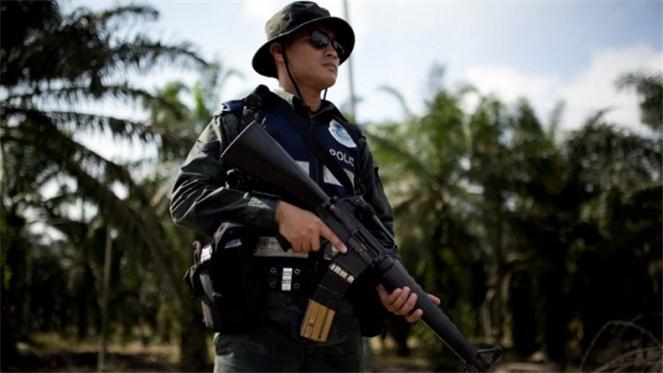
Deputy Prime Minister, Datuk Seri Dr. Ahmad Zahid Hamidi said the government has plans to upgrade the General Operations Force (GOF) to a departmental position to improve the team's excellence in maintaining the safety and sovereignty of the country.
Ahmad Zahid, who is also Home Minister, said the move was seen to expand the employment aspects of the team.
"God willing, one day PGA will become a department with a director-general appointed and promoted more members," he said at a gathering with members of the PGA in Batu Kawa, Kuching today.
Also present were Chief of Police Tan Sri Khalid Abu Bakar and Sarawak Police Commissioner Datuk Muhammad Sabtu Osman.
Now there are 10 departments under the Royal Malaysian Police (RMP).
The Islamic State group broke through Kurdish defences in northern Iraq on Tuesday and killed a US Navy SEAL deployed as part of the US-led coalition against the jihadists.
QUOTE
The sailor from the special operations force was at least the third coalition member killed by enemy fire in Iraq since IS overran swathes of the country in 2014.
QUOTE
A US defence official said the US SEAL's death was the result of "an orchestrated attack".
QUOTE
The SEAL was a member of a "small team" that was present at a peshmerga encampment behind the original front line during the IS attack, which involved explosives-rigged vehicles, bulldozers and infantry, the official said.
QUOTE
"They fought, but they're a small number and they're not supposed to be in direct contact," and they departed by American helicopter after the SEAL was shot, according to the official.
Let me know if you guys don't want training videos and want to keep it strictly mil news in this thread. I thinking that since we're kinda like minded, you'll enjoy these kinds of videos.
Learn something new everyday, some doors can stop a through and through
“Brigade 65 is a part of our army’s ground force and we are dispatching soldiers from Brigade 65, as well as other units, as advisers to Syria. This dispatch is not limited to commandos of Brigade 65, as advisers of Brigade 65 are already there.”
QUOTE
Its original core was formed in the 1950s, when the army sent 10 senior officers to France for parachuting training. The “Green Berets” 65th Airborne Special Forces Brigade was established in 1959 and was part of 23rd Commando Division. It glory the brigade gained during Iraq-Iran war
QUOTE
TheBrigade specialized in hostage rescue missions, irregular warfare, psychological warfare and support and may perform tactical missions abroad
QUOTE
One of its training camps is located in jungles of Kelardasht, in which jungle warfare is trained during spring. The winter training camp is in Emamzadeh Hashem, in which there is a ski resort dedicated to the brigade, used for training snow warfare. The summer camp is located at Karaj Dam. Another camp is located in the desert of Qom, in which desert warfare is trained
QUOTE
Syrian-government sources reported that the brigade deployed alongside Lebanese and Iraqi Hezbollah during fighting against Jabhat al-Nusra in Al-Eis. Iranian classifications put the size of brigades at about 6,000 to 7,000 troops. Thus, it is probable that about 100 to 200 Brigade 65 commandos have been deployed to Syria. During the fighting in south Aleppo the brigade lost number of its soldiers
QUOTE
Evidence of involvement of additional Iranian units Stems from casualties from other units like, the 45th and 258th Special Forces, 33th Airborne Special Forces Brigade “Al-Mahdi”-fighters from this unit were killed mostly in Al-Zabadani area near Qalamoun Mountains during summer 2015, Fatemiyoun Brigade (Afghan Hezbollah), Liwa Zainebiyoun Brigade (Pakistan Hezbollah) and 338th Mechanized Infantry Division. There are also noticeable losses among IRGC high officer ranks
QUOTE
Colonel Mashalloah Shamesh, Brig. General Hasanali Shamsabadi and Colonel Ali Taheri killed, Killed in South Aleppo, Syria.
-Interestingly to note two groups of IRGC “Foreign fighters” which are fighting in Syria,
684.jpg-Liwa Zainebiyoun (People of Zainab Brigade) is a contingent of Pakistani Shi’a fighters in Syria, officially fighting to defend the Sayyida Zainab shrine in Damascus claiming that it draws on Afghan Shi’a based in Pakistan. Due to the relatively small size there is not much information about the unit. The unit casualties in syria is the only record of their existence as a military force.
QUOTE
Fatemiyoun Brigade also known as the Fatemiyoun Division, and is an Afghanistani Shia militia formed in 2014 to fight for in Syria. The Division primarily recruits from the approximately 3 million Afghan refugees in Iran many are illiterate. This unit also fought in the liberation Palmyra and has the heaviest amount of losses
A EUROPEAN PERSPECTIVE ON ANTI-ACCESS/AREA DENIAL AND THE THIRD OFFSET STRATEGY
QUOTE
Over the past two decades, China, Russia, Iran, and others have developed anti-access and area denial (A2/AD) capabilities such as ballistic and cruise missiles, offensive cyber weapons, electronic warfare, and more
QUOTE
A2/AD capabilities undermine the key foundation of the global liberal order and threaten the U.S. military’s global freedom of access presence across all operating domains: air, land, sea, space, and cyberspace
QUOTE
In order to overcome or at least mitigate the impending global A2/AD challenge, the U.S. Department of Defense began to roll out its third offset strategy in late 2014. The aim of this offset strategy is to leverage U.S. advantages in technologies such as big data, stealth, advanced manufacturing (3D printing), robotics, and directed energy, with a view toward sustaining and advancing U.S. military-technological superiority for the 21st century
QUOTE
Geography is key to any discussion on A2/AD. In order to deny access to its long and open littoral, China needs sophisticated A2/AD capabilities constituting a long-range maritime reconnaissance and strike complex covering huge swaths of the Pacific Ocean. In turn, a country like Iran can focus its maritime denial capabilities on the far smaller Persian Gulf and the key chokepoint at the Strait of Hormuz. Relative to the western Pacific, the Persian Gulf region is rather compact, and population centers and military bases in the southern Persian Gulf are well within range of Iran’s short- and medium-range strike assets, while the narrow waters of the Strait of Hormuz make it relatively easy for Tehran to block access into the Persian Gulf
QUOTE
Russia is perhaps closer to Iran than China on the scale of difficulty of imposing A2/AD ecosystems in eastern Europe. This is because the Black and Baltic Sea recesses are sufficiently compact to allow relatively small numbers of anti-air and anti-sea platforms to dominate neighboring regions. To be sure, Russia’s long continental border could offset these advantages, as it could potentially force Moscow to spread its military resources across a 1,000-mile frontier. However, this problem is mitigated by two factors: a) the fact that Belarus is strategically close to Russia and Ukraine is not a member of NATO; and b) the absence of NATO offensive capabilities in or close to the frontline, with the partial exception of Poland
QUOTE
Since both eastern Europe and the broader Middle East are geographically close to Europe, Europeans should perhaps prioritize short- and medium-range strike capabilities, in contrast with Washington’s emphasis on long-range strike capabilities in an Asia-Pacific context. It is also important to distinguish between Europe’s eastern “flank” and its “extended southern neighborhood” because different levels of A2/AD maturity require different balances and sets of capabilities for defeating and hedging
QUOTE
In eastern Europe, Russia’s advances in precision-guided systems have resulted in significant improvements in A2/AD capabilities, such as overlapping air and missile defenses, dense concentrations of surface-to-surface ballistic missiles and land-, air-, and sea-launched cruise missiles, and layered anti-submarine warfare capabilities. Moscow’s ability to deny the use of the airspace of border countries and even constrain the movement of ships and land forces in a crisis or conflict appears to have improved significantly in recent years
QUOTE
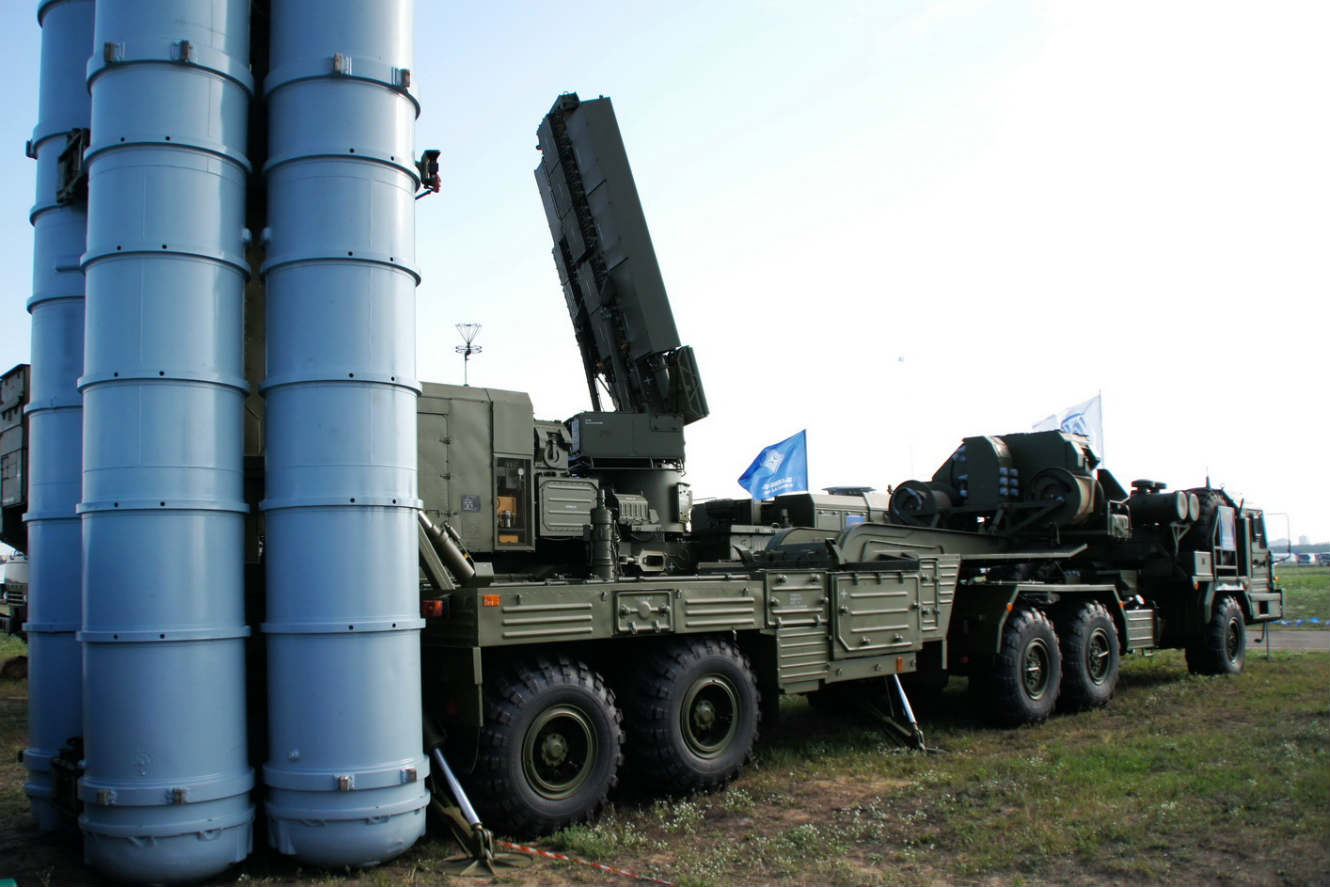
NATO member states bordering Russia are increasingly vulnerable to A2/AD systems. Moscow’s integrated air defense system and short-range land-attack missiles already cover the Baltic States in their entirety, as well as large swathes of Polish territory. This problem is further compounded by the alleged presence of Russian S-400 missiles in Kaliningrad
QUOTE
Russia’s militarization of Sevastopol is leading to the emergence of an A2/AD “bubble” in the Black Sea area, one that extends as far as the eastern Mediterranean and the Levant. Last but not least, the rapid build-up of Russia’s military arsenal in Murmansk has translated into an A2/AD bubble covering parts of Norway and of the Barents and Norwegian seas
QUOTE
“Hedging” strategies are mainly about turning the tables on Russia. In this regard, some experts have alluded to the need for NATO frontline allies to invest in air, sea, and land denial capabilities to negate and reduce the risks posed by the Russian conventional force aggression or else resort to “protracted warfare” through small and highly distributed irregular resistance forces, prepositioned and concealed weapons, and clandestine support networks or auxiliaries that focus on lethal maneuvers, ambushes and sabotage
QUOTE
By building up their irregular forces, the Baltic States would advertise their indigestibility to a potential predator, thus raising the costs of a potential Russian aggression and contributing to deterrence by denial
QUOTE
One way to defeat Russian A2/AD capabilities is to invest in advanced missile defense systems by drawing on some of the technologies being discussed in the context of the third offset strategy, such directed-energy weapons or electromagnetic rail guns. Another option is to invest in offensive capabilities that can defeat Russian A2/AD systems and restore deterrence by investing in strike capabilities that can cut through Russia’s A2/AD layer, such as stealthy air-to-air and air-to-ground systems, submarines (which are becoming increasingly important in the context of land-strike missions), offensive cyber and electronic weapons, and short- and medium-range missiles that can target Russian launchers and command and control infrastructure
The typical examples of battle footage from the Syrian Arab Army (SAA) and embedded journalists feature urban environments. This is largely due to the fact that government forces continue to be the primary influence in larger city centers, such as Damascus and Homs
QUOTE
However, on the vast expanses of the Syrian Desert, rebel strongholds built atop isolated settlements continue to pose a grave challenge. There are two issues working against the SAA forces. The first issue pertains to the degradation of force strength, while the second is a lack of cover
QUOTE
Five years of war have taken their toll on the SAA. By 2013, Syrian government forces had already lost a quarter of their military equipment. Nearly 1800 tanks and armored fighting vehicles (AFVs) along with trucks and artillery were lost due to destruction or capture
QUOTE
As a result, the availability of tanks and AFVs is an ever growing hurdle for SAA commanders to overcome. It is not uncommon to see SAA infantry assaulting rebel-held settlements
QUOTE
SAA divisions have overcome the shortage of support vehicles by heavily improvising. Technicals, or civilian vehicles with mounted weapons, are being constructed on a regular basis by all factions. In the more recent months of combat, SAA units have been showing an increasing capability to execute assaults with guerilla style tactics
QUOTE
The shortfall of armor and artillery is heavily subsidized with the addition of technicals armed with machine guns and anti-aircraft guns, such as the twin-barrel 23mm ZU-23-2. The government has partnered with local militias to help retake the land they’ve been displaced from when troop size had to be supplemented
QUOTE
The Syrian Desert offers little in terms of geographic features beyond hills and scattered rocks. Isolated settlements built in desert regions can offer excellent visibility on the surrounding countryside, while offering very little cover for any attacking force
QUOTE
A staging area for an assault in the Syrian Desert, near Damascus, seen from a LIFE TV drone in the picture above. Approximately 2000 meters from the T-72 tank’s facing, a small settlement stands infested with ISIS
QUOTE
SAA has supplemented natural cover with prepared positions; mounds of dirt hastily created at the hands of a brave operator within an armored bulldozer. These positions represent more than a staging area for the assault, but the first position in a string of successive leaps where two or more SAA assault elements make successive advances on an isolated settlement
QUOTE
Where cover can’t be found, speed must be maintained. In this example, a T-72 and pair of technicals sprint across open ground towards a craggy spur. Not far beyond, the settlement and final objective. To the immediate front of the spur, a small roadside barrier hosts a few SAA scouts coordinating with the assaulting forces. The two technicals on the road are filled with troops ready to secure a position atop the spur
QUOTE
The roadside barrier and scouts can be seen in the upper portion of the image above. The two technicals are disembarking troops for the spur’s ridge. The T-72 provides overwatch for the assaulting troops
QUOTE
The troops take the ridge atop the spur and gain a commanding view of the settlement. Once the position is secure, a single 2S1 Gvozdika self-propelled howitzer joins the T-72 to lay down a barrage of high explosive (HE) on the settlement. It is important to note that the settlement is devoid of all life forms save for jihadists. ISIS executed all 280 civilians inhabiting the settlement, creating one of many ‘ghost towns’ dotting the Syrian Desert
QUOTE
The T-72 and 2S1 deliver accurate fire against ISIS positions outside the settlement. In short order, all jihadist forces withdraw to the relative safety of the settlement buildings. With this action, the second phase of the settlement assault begins with infantry following the preceding artillery barrage
QUOTE
Unfortunately, there is no further footage of the final assault on the settlement itself from the previous example. However, there is SAA footage of a final assault on a similar settlement outside of Deir ez-Zor that has already been staged by the government forces. In the following case, we see SAA forces make their final assault on ISIS positions inside another ‘ghost’ settlement. In the image above, just over the commander’s silhouetted shoulder, Objective A houses jihadists armed with assault rifles and grenades. Objective B is further off to the right, and appears to have prepared positions dug on either side of the building
QUOTE
Where artillery isn’t available, the SAA is forced to improvise. Instead of suppressing the ISIS criminals with artillery fire, the SAA rake their positions with a ZSU-23-4 Shilka. The quadruple 23mm anti-aircraft guns fire snarling bursts of explosive shells, shredding the Objective B building where ISIS fighters hide
QUOTE
SAA troops get in position to assault Objective A, which is visible just beyond the fence on the hill. A cloud of dust from a 125mm HE round can be seen in the left portion of the screen grab
QUOTE
With Objective A in the background, a T-72 in the foreground belches fire as it delivers HE rounds to Objective B. After completing its rounds, the T-72 withdraws and the infantry begin their assault against a wounded and dazed enemy
QUOTE
Objective B is seen pulverized by 125 mm HE and 23 mm Shilka rounds. SAA soldiers hug the walls of the building as they hurl grenades into the ISIS trenches. When a break in enemy fire is heard, the soldiers take turns firing over the threshold of the trench
QUOTE
Syrian troops at Objective A provide flanking fire against ISIS positions, supporting their comrades at Objective B. Soon after, troops are seen standing triumphant on the hill waving the Syrian flag in a howling wind
QUOTE
While equipment can be repaired and replaced, loyalty in the frontline fighters of the SAA cannot. Russian assistance in terms of T-72B and T-90S tanks, as well as air strikes have helped bolster SAA efforts in the conflict zone. However, in terms of manpower, the Syrian government continues to rely on a much smaller force of battle-hardened and loyal fighters. The SAA infantry man that remains in 2016 is an entirely different breed than his counterpart in 2011, at the outbreak of war
QUOTE
The tactics described above depict a fighting force that is no stranger to close contact, and capable of employing mobile, guerrilla-style tactics against criminal gangs
Pakistan to Abandon F-16 Purchase Plans Unless US Subsidizes Deal
QUOTE
"They take our money, take our arms and laugh in our face," Kentucky Senator Rand Paul said, according to Defense News. "Pakistan is at best a frenemy – part friend and a lot enemy."


 Military Thread V20
  May 3 2016, 09:51 AM


 Quote
Quote









 fail betul
 0.0930sec
 0.46
0.46
 6 queries
 GZIP Disabled