Welcome Guest ( Log In | Register )

4 Pages  1 2 3 > » Bottom

Outline · [ Standard ] · Linear+

 Ask a Mathematical Physicist

views
     
TSCritical_Fallacy
post Aug 6 2013, 07:47 PM, updated 3y ago

∫nnộvisεr
Group Icon
VIP
3,713 posts

Joined: Nov 2011
From: Torino
https://www.symbolab.com/
http://onsolver.com/

Original First Post
» Click to show Spoiler - click again to hide... «

College Algebra
» Click to show Spoiler - click again to hide... «

Calculus :: Early Transcendentals
» Click to show Spoiler - click again to hide... «

Advanced Engineering Mathematics
» Click to show Spoiler - click again to hide... «

Numerical Methods (a.k.a. Computational Methods for Applied Sciences)
» Click to show Spoiler - click again to hide... «

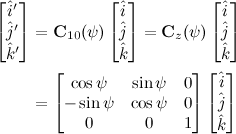
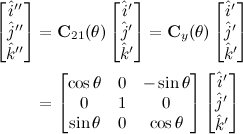
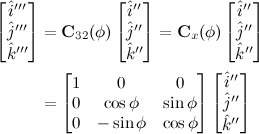
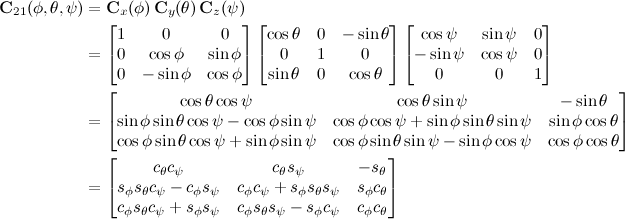
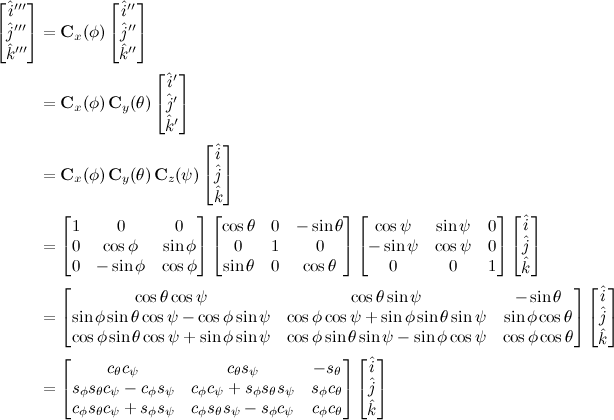
Euler Angles
» Click to show Spoiler - click again to hide... «
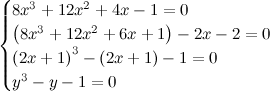
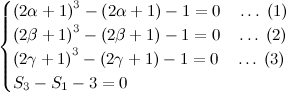
Operators & Symbols ::
(–x, y) ± + − × ÷ √ ² ³ ^ ∫ Σ Δ ∇ ∂ ∠ ° Ω “” → ← ↑ ↓ ∵ ∴ ½ ∞ ≈ ≠ ≪ ≤ ≥ ≫ • · ∝ † ⊗ ✔ ✘ 2⁄2 x≈-1.25992 ∧ ‖a‖ y≈-1.5874 …

Common Greek alphabets in Rotational dynamics:
ϕ, θ, ψ, ω

PID Controller ::
u = − (Ki*∫ x + Kp*x + Kd*ẋ)

15° π/12
30° π/6
45° π/4
60° π/3
75° 5π/12
90° π/2

① ② ③ ④ ⑤ ⑥ ⑦ ⑧ ⑨ ⑩

b² – 4ac

Superscripts and subscripts ::
x⁰ x¹ x² x³ x⁴ x⁵ x⁶ x⁷ x⁸ x⁹ x⁺ x⁻ x⁼ x⁽ ⁾ xⁿ x* x˙ xˣ

x₀ x₁ x₂ x₃ x₄ x₅ x₆ x₇ x₈ x₉ x₊ x₋ x₌ x₍ ₎ xᵢ xᵣ xₑ xₙ

Greek alphabets (lowercase) ::
α, β, γ, δ, ε, ζ, η, θ, κ, λ, μ, ξ, π, ρ, σ, τ, υ, ϕ, φ, χ, ψ, ω

Greek alphabets (uppercase & lowercase) ::
Αα Alpha Νν Nu
Ββ Beta Ξξ Xi
Γγ Gamma Οο Omicron
Δδ Delta Ππ Pi
Εε Epsilon Ρρ Rho
Ζζ Zeta Σσς Sigma
Ηη Eta Ττ Tau
Θθ Theta Υυ Upsilon
Ιι Iota Φϕφ Phi
Κκ Kappa Χχ Chi
Λλ Lambda Ψψ Psi
Μμ Mu Ωω Omega

» Click to show Spoiler - click again to hide... «

[attachmentid=4328645]

This post has been edited by Critical_Fallacy: Apr 29 2023, 03:50 PM
ystiang
post Aug 6 2013, 09:23 PM

Getting Started
**
Junior Member
171 posts

Joined: May 2012
Mostly are out of syllabus, like Cauchy-Schwarz Inequality, AM-GM Inequality, but Number Theory(Modular Arithmetic, Diophantine Equation) and Euclidean Plane Geometry do cover on syllabus of STPM further maths...

9th Dec 2013: Updated questions and answers...

OMK 2013 Sulong

Section A

1. A large cube is divided into 99 cubes with integer lengths, 98 of them with side 1. Find the volume of the large cube.

2. Let M be the set of all nine-digit positive integers that contain each digit from 1 to 9 once. Find the highest common factor of all elements of M.

3. What is the remainder when 5^5555 is divided by 10000?

4. Given a trapezium with perpendicular diagonals and height 12. The length of one of its diagonals is 15. Find the area of the trapezium.

5. The digits of 2013 can be rearranged to form an arithmetic progression. Determine the number of four-digit positive integers with this property.
(Note: An arithmetic progression might have common difference 0.)

6. Determine the smallest prime factor of 8051.


Section B

1. Given a triangle ABC. The midpoints of AB, BC, CA are C1, A1, B1 respectively.
Construct another triangle DEF with side lengths equal to the lengths of AA1, BB1, CC1.
(a) Prove that the ratio of the area of triangle DEF to the area of triangle ABC is a constant, regardless of the choice of triangle ABC.
(b) Find the area of triangle DEF if AB = 13, BC = 14, CA = 15.


2. Prove that there exist integers a1, a2, a3, …, a2013, b, all greater than 1, such that
(a1!)(a2!)(a3!)…(a2013!) = b!


3. A sequence x1, x2, x3, … is defined as follows: x1 = 1, x2 = 143, and
xn+1 = 5(x1 + x2 + … + xn)/n for all n ≥ 2.
Prove that all terms of the sequence are integers.


Hints & Answers:
» Click to show Spoiler - click again to hide... «

This post has been edited by ystiang: Dec 9 2013, 05:53 PM
maximR
post Aug 6 2013, 09:30 PM

Remember who you are
*******
Senior Member
3,864 posts

Joined: Dec 2009


This is amazing . This is something big .
I hope people will start to utilise this thread as much as possible . I'll share it to everyone I know .

Thank you so much .
5p3ak
post Aug 6 2013, 09:44 PM

CPE, FIG Certified Gymnastics Coach
*******
Senior Member
5,648 posts

Joined: Mar 2011
From: Jalan Tijani
Thanks to maximR for showing me this thread.

I got question.

» Click to show Spoiler - click again to hide... «


Show means to prove right? hmm.gif

This this correct? P(Z<500-510/s.d.)= 0.01
ystiang
post Aug 6 2013, 10:11 PM

Getting Started
**
Junior Member
171 posts

Joined: May 2012
QUOTE(5p3ak @ Aug 6 2013, 09:44 PM)
Thanks to maximR for showing me this thread.

I got question.

» Click to show Spoiler - click again to hide... «

Show means to prove right?  hmm.gif

This this correct? P(Z<500-510/s.d.)= 0.01
*
P(X < 500) = 0.01

Show basically means prove. Don't forget [shown].

Edited for: wrong info... sorry T_T

This post has been edited by ystiang: Nov 29 2013, 07:56 AM
maximR
post Aug 6 2013, 10:31 PM

Remember who you are
*******
Senior Member
3,864 posts

Joined: Dec 2009


Critical_Fallacy

I consulted the Bronze Medallist , and he told me that this solution is incorrect , and it'll be worth one point only . He attached a link to an accurate solution :

http://www.artofproblemsolving.com/Forum/v...ce9c11#p3152687

He added : The solution gives a construction of 2^k-1 terms but the problem statement requires exactly k terms

I never knew the questions in IMO would be this challenging !

This post has been edited by maximR: Aug 6 2013, 10:33 PM
ystiang
post Aug 6 2013, 10:39 PM

Getting Started
**
Junior Member
171 posts

Joined: May 2012
QUOTE(maximR @ Aug 6 2013, 10:31 PM)
Critical_Fallacy

I consulted the Bronze Medallist , and he told me that this solution is incorrect , and it'll be worth one point only . He attached a link to an accurate solution :

http://www.artofproblemsolving.com/Forum/v...ce9c11#p3152687

He added : The solution gives a construction of 2^k-1 terms but the problem statement requires exactly k terms

I never knew the questions in IMO would be this challenging !
*
Try to participate OMK if you intend to study form 6.
OMK considered as very hard, IMO I can't imagine my brain blank 4 hours...

For Malaysia, Top OMK performers are selected to attend the training camps, and the final IMO representatives are selected based on the students' performance in the camps and race. (I think only 6 in the final stage, and 3~4 of them are "bumiputera".

This post has been edited by ystiang: Aug 6 2013, 10:39 PM
maximR
post Aug 6 2013, 10:48 PM

Remember who you are
*******
Senior Member
3,864 posts

Joined: Dec 2009


QUOTE(ystiang @ Aug 6 2013, 10:39 PM)
Try to participate OMK if you intend to study form 6.
OMK considered as very hard, IMO I can't imagine my brain blank 4 hours...

For Malaysia, Top OMK performers are selected to attend the training camps, and the final IMO representatives are selected based on the students' performance in the camps and race. (I think only 6 in the final stage, and 3~4 of them are "bumiputera".
*
I don't think I'll make the cut for IMO camps ( IPhO , probably . In the near future . tongue.gif ) though . You know the Bronze Medallist I mentioned ? He's as old as me , but he has far more experience and he started very young , at about 7 .

How do you find STPM ? Enjoying it ?
ystiang
post Aug 6 2013, 11:56 PM

Getting Started
**
Junior Member
171 posts

Joined: May 2012
QUOTE(maximR @ Aug 6 2013, 10:48 PM)
I don't think I'll make the cut for IMO camps ( IPhO , probably . In the near future .  tongue.gif ) though . You know the Bronze Medallist I mentioned ? He's as old as me , but he has far more experience and he started very young , at about 7 .

How do you find STPM ? Enjoying it ?
*
You ask the same question to me several months ago... But I think my answer is different now.

Quiet enjoying... especially maths =)

My target: 3.5 or above.

Quit working this sem, and rapidly done all the PBS, focusing on study now.

The only 'tak syok' thing in this sem so far is my monthly test math paper, originally can get perfect score, but so much careless T_T


CallMeBin
post Aug 7 2013, 01:10 AM

Regular
******
Senior Member
1,222 posts

Joined: Jan 2011
edited for doh.gif

This post has been edited by CallMeBin: Aug 7 2013, 02:31 AM
VengenZ
post Aug 7 2013, 02:27 AM

La la la~
****
Senior Member
608 posts

Joined: Nov 2009
From: 127.0.0.1


Malaysia got 37/97 on this year's IMO, singapore on the other hand got 6th. China's 14-year-old got gold ffuuu so pro these guys
5p3ak
post Aug 7 2013, 07:52 AM

CPE, FIG Certified Gymnastics Coach
*******
Senior Member
5,648 posts

Joined: Mar 2011
From: Jalan Tijani
QUOTE(ystiang @ Aug 6 2013, 10:11 PM)
Usually I will suggest continuity correction...

P(X < 500) = 0.01

P(Z < (499.5-510)/S.D.) = 0.01

Show basically means prove. Don't forget [shown].
*
But when does the 4.3g come into play? rclxub.gif
ystiang
post Aug 7 2013, 11:13 AM

Getting Started
**
Junior Member
171 posts

Joined: May 2012
QUOTE(5p3ak @ Aug 7 2013, 07:52 AM)
But when does the 4.3g come into play?  rclxub.gif
*
Since P(Z < z) = 0.01

Since the probability is less than 0.5, z must be negative.

P(Z < -z) = 1 - 0.01 = 0.99

From the normal distribution table, P(Z < 2.326) = 0.99

Thus, P(Z < -2.326) = 0.01

(500-510)/SD = -2.326
-10/SD = -2.326

SD = -10/-2.326 = 4.3g [shown]


This post has been edited by ystiang: Nov 29 2013, 07:55 AM
TSCritical_Fallacy
post Aug 7 2013, 03:00 PM

∫nnộvisεr
Group Icon
VIP
3,713 posts

Joined: Nov 2011
From: Torino
QUOTE(maximR @ Aug 6 2013, 10:31 PM)
I consulted the Bronze Medallist , and he told me that this solution is incorrect , and it'll be worth one point only . He attached a link to an accurate solution :

http://www.artofproblemsolving.com/Forum/v...ce9c11#p3152687

He added : The solution gives a construction of 2^k-1 terms but the problem statement requires exactly k terms

I never knew the questions in IMO would be this challenging !
Impressive! Thanks for sharing the link. Tell your Bronze Medallist friend that he obviously has a good understanding of mathematics that is far superior to mine. Through the composed power of his highly intelligent mind, he could probably solve some of the unsolved problems in mathematics in near future. Perhaps you don’t know; I’m particularly fascinated by the Navier–Stokes existence and smoothness problem. laugh.gif

If you want to claim $1 million Millennium Prize from the Clay Mathematics Institute, you’ll need to either prove or disprove this statement: “In three space dimensions and time, given an initial velocity field, there exists a vector velocity and a scalar pressure field, which are both smooth and globally defined, that solve the Navier–Stokes equations.icon_idea.gif

In physics, the Navier–Stokes equations are a system of nonlinear partial differential equations for describing the motion of fluid substances in almost every real situation. In fact, these equations are derived from applying Newton's 2nd law to fluid motion. The animation below shows how a Kármán vortex street develops behind a cylinder moving through a fluid.

user posted image
(courtesy of Cesareo de la Rosa Siqueira at the University of Sao Paulo, Brazil)
maximR
post Aug 7 2013, 05:46 PM

Remember who you are
*******
Senior Member
3,864 posts

Joined: Dec 2009


» Click to show Spoiler - click again to hide... «

I see !

I've heard about turbulence in fluid motion and how hard it is to model that accurately ( I think it's still on Wikipedia's List of unsolved problems in Physics ) .

If you don't mind me asking , what led you to to become a Mathematical Physicist ? Was is a smooth pathway ?

katijah
post Aug 7 2013, 06:19 PM

Getting Started
**
Junior Member
77 posts

Joined: Aug 2013
QUOTE(ystiang @ Aug 6 2013, 10:39 PM)

For Malaysia, Top OMK performers are selected to attend the training camps, and the final IMO representatives are selected based on the students' performance in the camps and race. (I think only 6 in the final stage, and 3~4 of them are "bumiputera".
*
Are you sure of your last statement? wink.gif
5p3ak
post Aug 7 2013, 07:27 PM

CPE, FIG Certified Gymnastics Coach
*******
Senior Member
5,648 posts

Joined: Mar 2011
From: Jalan Tijani
QUOTE(ystiang @ Aug 7 2013, 11:13 AM)
Since P(Z < z) = 0.01

Since the probability is less than 0.5, z must be negative.

P(Z < -z) = 1 - 0.01 = 0.99

From the normal distribution table, P(Z < 2.326) = 0.99

Thus, P(Z < -2.326) = 0.01

(500-510)/SD = -2.326
-10/SD = -2.326

SD = -10/-2.326 = 4.3g [shown]

I use back 500 because I think continuity correction isn't in SPM level.
*
I see. Thanks for the heads up thumbup.gif
TSCritical_Fallacy
post Aug 10 2013, 04:01 PM

∫nnộvisεr
Group Icon
VIP
3,713 posts

Joined: Nov 2011
From: Torino
GreatFish posted a physics question about Newton’s Law of Universal Gravitation on this thread. Because there is slight inaccuracy about the direction of the gravitational force vector on the Wikipedia, so I decided to provide a salient answer on this matter. The negative-sign equation arises partly due to our interest in researching the kinodynamics behavior of the object being accelerated. icon_idea.gif

user posted image

This post has been edited by Critical_Fallacy: Oct 2 2014, 04:02 PM
maximR
post Aug 10 2013, 04:41 PM

Remember who you are
*******
Senior Member
3,864 posts

Joined: Dec 2009


» Click to show Spoiler - click again to hide... «


I see . I've thought about that for a long time . Thanks for clarifying !

Now I've a question , it's regarding the constants that appear in Physics equations .

Example :

1 . E = mc^2
2 . F = kx
3 . F(grav) = G (Mm)/r^2

My question is , will a constant always appear if a physical quantity varies directly as the other ? If it will , why do some constants behave in different ways . Why is the speed of light squared in Einstein's equation ? Since there were no experimental data at first to support his theory , how did he derive c ?

Why can the constant in F = kma be defined so that F = ma , but not with other equations ?
VengenZ
post Aug 10 2013, 06:13 PM

La la la~
****
Senior Member
608 posts

Joined: Nov 2009
From: 127.0.0.1


QUOTE(maximR @ Aug 10 2013, 04:41 PM)
» Click to show Spoiler - click again to hide... «


I see . I've thought about that for a long time . Thanks for clarifying !

Now I've a question , it's regarding the constants that appear in Physics equations .

Example :

1 . E = mc^2
2 . F = kx
3 . F(grav) = G (Mm)/r^2

My question is , will a constant always appear if a physical quantity varies directly as the other ? If it will , why do some constants behave in different ways . Why is the speed of light squared in Einstein's equation ? Since there were no experimental data at first to support his theory , how did he derive c ?

Why can the constant in F = kma be defined so that F = ma , but not with other equations ?
*
I don't know about others but E=mc^2 isnt the full formula. By using some complex special relativity theories, he came up with the momentum in 4D equation.. And if I remembered correctly by using binomial expansion, he got the equation E = mc^2 + 1/2(mv^2) + ... From this he found the rest mass energy equation E = mc^2. There's a second way that he did to derive it which involved E^2 = (pc)^2 + (mc^2)^2 .. after a few algebraic operation, we can obtain E =mc^2. But of course this is the end product of a long complex mathematical calculation and awesome thought experiments.
I think Critical_Fallacy can explain more to you about Time Dilation, Length contraction and so on, until the part where he got the rest mass energy equation.

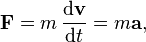
For F = ma, that is not actually the real formula. From Newton's 2nd law, force can be expressed as:
user posted image ---> user posted image

Force is said to be exerted when the mass of an object changes, or the velocity of the object changes.

I am more interested in the general relativity of Einstein. Anyone here knows how he got the christoeffel symbol in terms of the metric tensor? Probably Critical_Fallacy knows?
maximR
post Aug 10 2013, 06:26 PM

Remember who you are
*******
Senior Member
3,864 posts

Joined: Dec 2009


QUOTE(VengenZ @ Aug 10 2013, 06:13 PM)
I don't know about others but E=mc^2 isnt the full formula. By using some complex special relativity theories, he came up with the momentum in 4D equation.. And if I remembered correctly by using binomial expansion, he got the equation E = mc^2 + 1/2(mv^2) + ... From this he found the rest mass energy equation E = mc^2. There's a second way that he did to derive it which involved E^2 = (pc)^2 + (mc^2)^2 .. after a few algebraic operation, we can obtain E =mc^2. But of course this is the end product of a long complex mathematical calculation and awesome thought experiments.
I think Critical_Fallacy can explain more to you about Time Dilation, Length contraction and so on, until the part where he got the rest mass energy equation.

For F = ma, that is not actually the real formula. From Newton's 2nd law, force can be expressed as:
user posted image ---> user posted image

Force is said to be exerted when the mass of an object changes, or the velocity of the object changes.

I am more interested in the general relativity of Einstein. Anyone here knows how he got the christoeffel symbol in terms of the metric tensor? Probably Critical_Fallacy knows?
*
I am aware of the actual equations .
But I've always wondered about the constants . Why must constants appear in every Physics equation ? And why can the constant in Newton's 2nd Law be simplified to 1 ?

Thank you for your reply .

What are you doing , currently ? Are you a Physics major ?
VengenZ
post Aug 10 2013, 07:15 PM

La la la~
****
Senior Member
608 posts

Joined: Nov 2009
From: 127.0.0.1


QUOTE(maximR @ Aug 10 2013, 06:26 PM)
I am aware of the actual equations .
But I've always wondered about the constants . Why must constants appear in every Physics equation ? And why can the constant in Newton's 2nd Law be simplified to 1 ?

Thank you for your reply .

What are you doing , currently ? Are you a Physics major ?
*
Why must constants appear in every Physics equation ?
Idk, probably that's how the world works.
Let say you conduct an experiment to find the relationship between force and the extension of a spring.
After you have get the data, you plot a graph, you'll get something like this:
(Dependant variable on y axis, independent variable on x axis)
user posted image
So you'll get the equation, F = kx (y = mx) where k is the gradient. The c-intercept is 0, so thats why we do not get F = kx + c.

Some teachers tend to teach proportionality like this:
F α x
To remove α we must add a constant:
F = kx

And why can the constant in Newton's 2nd Law be simplified to 1 ?
The equation F=ma is not derived from F=kma where k = 1.
If you want to write it in proportionality form you'll write the equation F=ma as:
F α a (By assing that mass is constant)
And you get F = ma.
This means that "m" is actually the constant for the equation since m do not change. (For secondary physics level).

Another way to view proportionality is by intuition.
Lets take the Newton's gravitational equation F = -GMm/r^2

From this we can see that the attraction force will of course increase when the masses of the two body increases, therefore we can conclude that F α Mm. And intuitively, we know that when the distance, r increases, the force will decrease. so F α 1/r^2 (Using inverse-square law that newton found, since the body is sphere we cant use 1/r).
By combining these two equations, we get:
F α Mm/r^2
To remove the α, we must add a constant.
F = GMm/r^2.

Now you might be wondering how the heck they figured out G. Try to look up on a brilliant experiment called Cavendish experiment.

user posted image

And no, I'm not a physics major biggrin.gif

I hope you get a light on how classical physics equations are derived.

As fallacy said to err is human, so please fix if there is anything wrong with my explanation.

GreatFish
post Aug 11 2013, 11:30 AM

New Member
*
Junior Member
6 posts

Joined: Jun 2013


QUOTE(Critical_Fallacy @ Aug 10 2013, 04:01 PM)
GreatFish posted a physics question about Newton’s Law of Universal Gravitation on this thread. Because there is slight inaccuracy about the direction of the gravitational force vector on the Wikipedia, so I decided to provide a salient answer on this matter. The negative-sign equation arises partly due to our interest in researching the kinodynamics behavior of the object being accelerated. icon_idea.gif

user posted image
*
can you write the deriavation of gravitational potential energy at here notworthy.gif
Intermission
post Aug 11 2013, 02:06 PM

Enthusiast
*****
Senior Member
825 posts

Joined: Aug 2012
QUOTE(ystiang @ Aug 6 2013, 09:23 PM)
» Click to show Spoiler - click again to hide... «

*
As a unsuccessful wannabe math olympian who never had any formal training in mathematical olympiads, I participated in this year's OMK Sulong 2013. Here are a few of my crude attempts at solving those questions. tongue.gif
The answers that I gave during the actual competition are:

1) 125. Looks quite obvious. So didn't give much thought to it.

3) 8125. Through last 4 digit analysis. the last 4 digits 0625 , 3125, 5625 and 8125 recur for every increment of 4 powers of 5. Since 5555= 4(1388) + 3, 8125 is the answer.

4) Is it 108? Wait, I think I made a mistake here. Not sure what I was thinking back then.user posted image[/URL][/IMG]

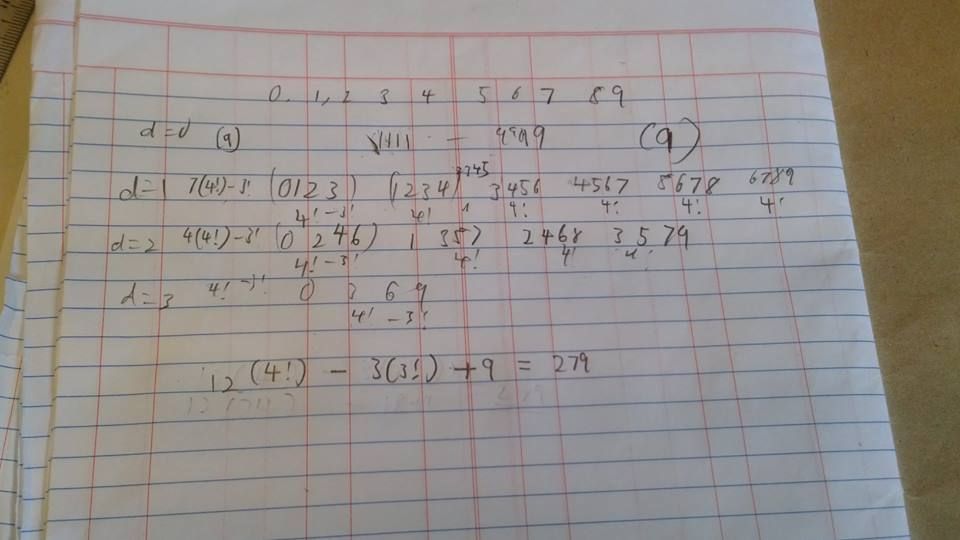
5) 279? Forgive me for my crude workings. 4! implies the number of permutation of the 4 digits. Minus 3! at combinations including the digit zero because one does not simply start a number with digit 0.
user posted image[/URL][/IMG]

6) 83. It took me forever to do it by trial and error but I got there. tongue.gif

As for section B,

1) b) Heron's Formula!

3) I tried doing it by induction but I am not sure if I have done it correctly. The working is so long that I feel it is almost certainly wrong.

This post has been edited by Intermission: Aug 11 2013, 02:18 PM
TSCritical_Fallacy
post Aug 11 2013, 08:04 PM

∫nnộvisεr
Group Icon
VIP
3,713 posts

Joined: Nov 2011
From: Torino
QUOTE(GreatFish @ Aug 11 2013, 11:30 AM)
can you write the deriavation of gravitational potential energy at here notworthy.gif
You should be able to find a lots of detailed explanations from many physics textbooks and websites. smile.gif
user posted image

user posted image
TSCritical_Fallacy
post Aug 11 2013, 08:32 PM

∫nnộvisεr
Group Icon
VIP
3,713 posts

Joined: Nov 2011
From: Torino
QUOTE(maximR @ Aug 10 2013, 04:41 PM)
Why is the speed of light squared in Einstein's equation? Since there were no experimental data at first to support his theory, how did he derive c?
The derivation of Einstein's most famous equation E = mc² is purely theoretical, which arises as a direct consequence of his Special Theory of Relativity that involves some algebraic manipulations using the Pythagorean theorem (SPM level). To understand how he derived the equation, you must understand a portion of his Special Relativity; Time Dilation (see the embedded Spaceship figure). The following derivation is highly simplified for the mathematically untrained. To further enhance your understanding, you should watch the YouTube video by minutephysics. icon_rolleyes.gif

user posted image

user posted image


studyboy
post Aug 11 2013, 09:35 PM

On my way
****
Senior Member
522 posts

Joined: Mar 2013
QUOTE(Critical_Fallacy @ Aug 11 2013, 08:32 PM)
The derivation of Einstein's most famous equation E = mc² is purely theoretical, which arises as a direct consequence of his Special Theory of Relativity that involves some algebraic manipulations using the Pythagorean theorem (SPM level). To understand how he derived the equation, you must understand a portion of his Special Relativity; Time Dilation (see the embedded Spaceship figure). The following derivation is highly simplified for the mathematically untrained. To further enhance your understanding, you should watch the YouTube video by minutephysics. icon_rolleyes.gif

user posted image

user posted image


*
Hey Critical_Fallacy! I am so curious of your education background! Are you currently a researcher in a university? You took up a daunting task of explaining time dilation to the masses.
ystiang
post Aug 11 2013, 11:01 PM

Getting Started
**
Junior Member
171 posts

Joined: May 2012
QUOTE(Intermission @ Aug 11 2013, 02:06 PM)
As a unsuccessful wannabe math olympian who never had any formal training in mathematical olympiads, I participated in this year's OMK Sulong 2013. Here are a few of my crude attempts at solving those questions.  tongue.gif
The answers that I gave during the actual competition are:

1) 125. Looks quite obvious. So didn't give much thought to it.

3) 8125. Through last 4 digit analysis. the last 4 digits 0625 , 3125, 5625 and 8125 recur for every increment of 4 powers of 5. Since 5555= 4(1388) + 3, 8125 is the answer.

4) Is it 108? Wait, I think I made a mistake here. Not sure what I was thinking back then.user posted image[/URL][/IMG]

5) 279? Forgive me for my crude workings. 4! implies the number of permutation of the 4 digits. Minus 3! at combinations including the digit zero because one does not simply start a number with digit 0.
user posted image[/URL][/IMG]

6) 83. It took me forever to do it by trial and error but I got there.  tongue.gif

As for section B,

1) b) Heron's Formula!

3) I tried doing it by induction but I am not sure if I have done it correctly. The working is so long that I feel it is almost certainly wrong.
*
Bravo. Me too haven't had any formal training but surely you're more success than me.

For Section A, I think I only have one question correct, yup that prime factor.
Actually, 8051 = 8100 - 49 = (90^2) - (7^2) = (90-7)(90+7) = 83*97

Q3 should be easy though but I wrote 625 and the answer is 8125 TvT
Q1, Q4, Q5... just randomly put some answers...

Section B, I hate those prove, prove and prove...

TSCritical_Fallacy
post Aug 12 2013, 04:29 AM

∫nnộvisεr
Group Icon
VIP
3,713 posts

Joined: Nov 2011
From: Torino
QUOTE(VengenZ @ Aug 10 2013, 07:15 PM)
As fallacy said to err is human, so please fix if there is anything wrong with my explanation.
QUOTE(maximR @ Aug 10 2013, 04:41 PM)
Will a constant always appear if a physical quantity varies directly as the other? If it will, why do some constants behave in different ways?
QUOTE(maximR @ Aug 10 2013, 06:26 PM)
Why must constants appear in every Physics equation?
Physicists know some things never change and they call them the fundamental physical constants. Such frequently used constants as the speed of light in vacuum, c, magnetic constant, μ0, electric constant, ε0, Newtonian constant of gravitation, G, Planck constant, h, elementary charge, e, and the Proton-to-electron mass ratio, μ, are assumed to be the same at all places and times in the universe. They form the scaffolding around which the theories of physics are built on, and they define the fabric of the cosmos.

Despite that, one of the most fundamental properties of Newton’s Mechanics, Maxwell’s Macroscopic Electrodynamics, and the Laws of Thermodynamics, is the absence of any physical constants in their basic equations. In fact, all necessary fundamental physical constants appear only at the stage of applications of these theories to specific phenomena. Nevertheless, these constants play an important role in physics and metrology because scientists need reference values for measurements in experimental physics and making theoretical prediction on papers.

Other than Newton’s and Maxwell’s equations, centripetal acceleration (a = v²/r), density (Q = m/V), pressure (P = F/A), and electric power (P = V*I) seem to be self-evident counterexamples to your above question. You can also see other frequently used physics equations for yourself in this link. icon_rolleyes.gif
user posted image

QUOTE(maximR @ Aug 10 2013, 04:41 PM)
Why can the constant in F = kma be defined so that F = ma, but not with other equations?
QUOTE(maximR @ Aug 10 2013, 06:26 PM)
And why can the constant in Newton's 2nd Law be simplified to 1?
Although physical constants can appear to be dimensional or dimensionless, the imaginary constant factor k in your F = kma does not exist. That’s because the equation F = ma is self-contained and Newton did NOT require adding a dimensionless constant factor k = 1 to his mechanics to reproduce that “observation of force”. In fact, as guided by VengenZ in Post #20, Newton’s 2nd Law originally states that the net force on an object is equal to the rate of change of its linear momentum p in an inertial reference frame, which can be manipulated algebraically to be stated in terms of an object's acceleration, i.e. F = ma.

user posted image ---> user posted image

Since the dimensionless constant factor k does not exist in F = dp/dt in the first place, then it follows that k is not needed in F = ma either. If your friends or physics teacher insist on the existence of k = 1, be sure to ask them what they think of a = dv/dt, p = mv, v = dx/dt, and other counterexamples as shown, so that other similar fundamental physics equations cannot be ignored, and they will thus be psychologically compelled to consider their merit. icon_idea.gif

~ HAVE A NICE DAY! ~
TSCritical_Fallacy
post Aug 12 2013, 02:35 PM

∫nnộvisεr
Group Icon
VIP
3,713 posts

Joined: Nov 2011
From: Torino
QUOTE(maximR @ Aug 10 2013, 04:41 PM)
it's regarding the constants that appear in Physics equations .
This set of frequently used Fundamental Physical Constants is recommended for international use by CODATA (The Committee on Data for Science and Technology). The full 2010 CODATA set of constants may be found at its website (click the image) at the time of this writing.

user posted image

For your convenience, a PDF document (Extensive Listing) is available which can be read online or printed. icon_rolleyes.gif
Attached File  Fundamental_Physical_Constants_____Extensive_Listing__2010_.pdf ( 124.83k ) Number of downloads: 1

maximR
post Aug 12 2013, 03:02 PM

Remember who you are
*******
Senior Member
3,864 posts

Joined: Dec 2009


» Click to show Spoiler - click again to hide... «


Thank you for your detailed explanation ! I really appreciate it .


» Click to show Spoiler - click again to hide... «


Thanks !


QUOTE(Critical_Fallacy @ Aug 12 2013, 04:29 AM)
Physicists know some things never change and they call them the fundamental physical constants. Such frequently used constants as the speed of light in vacuum, c, magnetic constant, μ0, electric constant, ε0, Newtonian constant of gravitation, G, Planck constant, h, elementary charge, e, and the Proton-to-electron mass ratio, μ, are assumed to be the same at all places and times in the universe. They form the scaffolding around which the theories of physics are built on, and they define the fabric of the cosmos.

Despite that, one of the most fundamental properties of Newton’s Mechanics, Maxwell’s Macroscopic Electrodynamics, and the Laws of Thermodynamics, is the absence of any physical constants in their basic equations. In fact, all necessary fundamental physical constants appear only at the stage of applications of these theories to specific phenomena. Nevertheless, these constants play an important role in physics and metrology because scientists need reference values for measurements in experimental physics and making theoretical prediction on papers.

Other than Newton’s and Maxwell’s equations, centripetal acceleration (a = v²/r), density (Q = m/V), pressure (P = F/A), and electric power (P = V*I) seem to be self-evident counterexamples to your above question. You can also see other frequently used physics equations for yourself in this link. icon_rolleyes.gif
user posted image
Although physical constants can appear to be dimensional or dimensionless, the imaginary constant factor k in your F = kma does not exist. That’s because the equation F = ma is self-contained and Newton did NOT require adding a dimensionless constant factor k = 1 to his mechanics to reproduce that “observation of force”. In fact, as guided by VengenZ in Post #20, Newton’s 2nd Law originally states that the net force on an object is equal to the rate of change of its linear momentum p in an inertial reference frame, which can be manipulated algebraically to be stated in terms of an object's acceleration, i.e. F = ma.

user posted image ---> user posted image

Since the dimensionless constant factor k does not exist in F = dp/dt in the first place, then it follows that k is not needed in F = ma either. If your friends or physics teacher insist on the existence of k = 1, be sure to ask them what they think of a = dv/dt, p = mv, v = dx/dt, and other counterexamples as shown, so that other similar fundamental physics equations cannot be ignored, and they will thus  be psychologically compelled to consider their merit. icon_idea.gif

~ HAVE A NICE DAY! ~
*
This is what I need ! I've been thinking about this since Form Four . You've cleared everything up . Thank you !

As for why I proposed that there is a constant in F = ma , here's what's written in our textbooks , and reference books . One of the errors in our Physics syllabus . My aim is to major in Physics , then one day hopefully , revamp the Physics syllabus in Malaysia .

Here's the explanation provided by textbooks :

From Experiment 1 , a α F
From Experiment 2 , a α 1/m

The two results are combined .

a α F/m

OR

F α ma

Therefore : F = kma

Unit of force is newton , N .

In order to make the formula as simple as possible , we make k = 1 by defining a force of 1 N as

1 N is the force which gives a mass of 1 kg an acceleration of 1 m s^-2 ,

1 N = (k) (1 kg) (1 m s^-2)
k = 1

Therefore , F = ma


This post has been edited by maximR: Aug 12 2013, 04:22 PM
TSCritical_Fallacy
post Aug 13 2013, 03:41 AM

∫nnộvisεr
Group Icon
VIP
3,713 posts

Joined: Nov 2011
From: Torino
QUOTE(maximR @ Aug 12 2013, 03:02 PM)
Here's the explanation provided by textbooks :
From Experiment 1 , a α F
From Experiment 2 , a α 1/m
The two results are combined.
a α F/m
OR
F α ma
Therefore : F = kma
What you see in the following figure is an excerpt from The Principia: Mathematical Principles of Natural Philosophy (2010), the reprinted text which based on Motte’s 1729 translation of the 1726, 3rd edition of Philosophiæ Naturalis Principia Mathematica, that was the final version corrected by Sir Isaac Newton.

user posted image

QUOTE
Law II: The alteration of motion is ever proportional to the motive force impressed; and is made in the direction of the right line in which that force is impressed.

As you can see, Newton never explicitly stated the formula F = ma in his Principia. The “motion” and “impressed” in which Newton used his terminology, and how he understood the second law and intended it to be understood, have been extensively discussed by historians of science. It was until James Clerk Maxwell published a treatise in Matter and Motion in 1876 (see excerpt below) that the modern ideas of how Newton was using his terminology is understood.

user posted image

According to Maxwell, Newton meant by motion “the quantity of matter moved as well as the rate at which it travels” and by impressed force he meant “the time during which the force acts as well as the intensity of the force”. And so in modern terms, motion is Newton’s name for momentum, which allows Newton’s 2nd Law to be formulated as follows:

user posted imageuser posted image

Now, allow me to make a few additional points after my Post #29. Based on what the mathematicians and physicists understood from the experimental observations of Newton’s 2nd Law: the change of momentum of a body is proportional to the impulse impressed on the body, a proportionality constant k, shall be assigned to the formula F = kma. In order to standardize the unit force and to eliminate the proportionality constant k, Conférence Générale des Poids et Mesures (CGPM) in 1948, adopted the name "newton" with symbol N for the SI unit force to define the amount needed to accelerate 1 kg of mass at the rate of 1 m/s² by choosing a proportionality constant of 1.

In a sense, the proportionality constant k can be seen as a conversion factor if we apply F = kma in other system of measurement, such as the Imperial units. For example, 1 pound-force (lbf) is defined as the amount needed to accelerate 1 pound (lb) of mass at the standard gravity of 32.174 ft/s². Consequently, we can deduced from this observation that k = 1/32.174. Thus, to eliminate the proportionality constant k, the preferred unit of mass is the slug because a slug is defined to have a mass of 32.174 lb, so that 1 lbf = 1 slug × 1 ft/s².

To summarize this post and Post #29, naturally, the proportionality constant k = 1 doesn’t appear in momentum (p = m*v), centripetal acceleration (a = v²/r), density (Q = m/V), pressure (P = F/A), electric power (P = V*I), and a bundle of other primary equations of physics, because the physicists relate the basic physical quantities by defining the formulation of physical laws in a way to achieve universality and generality. All in all, to determine whether a significant proportionality constant is needed or not, at the first place, we should at least understand how strong the correlation of physical quantities is by performing the dimensional analysis, and ensure that the experimental data are consistent. icon_rolleyes.gif
TSCritical_Fallacy
post Aug 13 2013, 03:52 AM

∫nnộvisεr
Group Icon
VIP
3,713 posts

Joined: Nov 2011
From: Torino
QUOTE(studyboy @ Aug 11 2013, 09:35 PM)
You took up a daunting task of explaining time dilation to the masses.
Oh! It is not as daunting as the quantum mechanics. Coincidentally, 12 August marks the birthday of Erwin Schrödinger, the Nobel prize-winning quantum physicist whose eponymous equation lies at the heart of quantum mechanics. laugh.gif

user posted image
manutd96
post Aug 13 2013, 04:13 AM

Getting Started
**
Junior Member
184 posts

Joined: Mar 2013


In a shooting competition, the probability that ali hits the target is 0.4. Find the minimum number of trials that ali needs to make such that the probability that he hits the target at least once is 0.8. << add maths question. How do I do it? Which method should I use? Is it part of binomial distribution?
maximR
post Aug 13 2013, 01:14 PM

Remember who you are
*******
Senior Member
3,864 posts

Joined: Dec 2009


» Click to show Spoiler - click again to hide... «


Another great post ! biggrin.gif
This is the first time I've read that Newton originally stated that Impulse is directly proportional to the Change in momentum . So he actually considered the time in which a force acts on a body . Interesting .

So if I get this right , the reason why G appears in Newton's Law of Universal Gravitation is because the unit of force is defined as amount needed to accelerate 1 kg of mass at the rate of 1 m/s² , therefore G should be added to ensure that the units on both sides of the equation are the same ? And that after careful experiments , experimental physicists discovered that the force on gravity between two bodies does not vary simply as F = Mm/r^2 , so there must be a constant to account for the interaction between the two bodies ?

And that means Newton never really had accurate calculations since he couldn't determine G , and did not include them in his equations ? ( or did he ? if yes , then how did he come to the conclusion that there is a constant just by empirical observation ? or did he derive it mathematically , or did he think that since the force of gravity is usually very small between two bodies , there must be something that accounts for this , therefore , a constant must exist ? )


This post has been edited by maximR: Aug 13 2013, 01:19 PM
Intermission
post Aug 13 2013, 05:30 PM

Enthusiast
*****
Senior Member
825 posts

Joined: Aug 2012
QUOTE(ystiang @ Aug 11 2013, 11:01 PM)
Bravo. Me too haven't had any formal training but surely you're more success than me.

For Section A, I think I only have one question correct, yup that prime factor.
Actually, 8051 = 8100 - 49 = (90^2) - (7^2) = (90-7)(90+7) = 83*97

Q3 should be easy though but I wrote 625 and the answer is 8125 TvT
Q1, Q4, Q5... just randomly put some answers...

Section B, I hate those prove, prove and prove...
*
Are you planning to go for it again next year? It will be the last time we are allowed to participate in OMK.

QUOTE(maximR @ Aug 13 2013, 01:14 PM)
» Click to show Spoiler - click again to hide... «


Another great post !  biggrin.gif
This is the first time I've read that Newton originally stated that Impulse is directly proportional to the Change in momentum . So he actually considered the time in which a force acts on a body . Interesting .

So if I get this right , the reason why G appears in Newton's Law of Universal Gravitation is because the unit of force is defined as amount needed to accelerate 1 kg of mass at the rate of 1 m/s² , therefore G should be added to ensure that the units on both sides of the equation are the same ? And that after careful experiments , experimental physicists discovered that the force on gravity between two bodies does not vary simply as F = Mm/r^2 , so there must be a constant to account for the interaction between the two bodies ?

And that means Newton never really had accurate calculations since he couldn't determine G , and did not include them in his equations ? ( or did he ? if yes , then how did he come to the conclusion that there is a constant just by empirical observation ? or did he derive it mathematically , or did he think that since the force of gravity is usually very small between two bodies , there must be something that accounts for this , therefore , a constant must exist ? )
*
This surprised me when I re-learn physics at AS level too. Actually it is not the formula F=ma that leads to F=(mv-mu)/t but rather the other round when newton first formulated his 3 laws of motion.
maximR
post Aug 13 2013, 10:47 PM

Remember who you are
*******
Senior Member
3,864 posts

Joined: Dec 2009


QUOTE(Intermission @ Aug 13 2013, 05:30 PM)
Are you planning to go for it again next year? It will be the last time we are allowed to participate in OMK.
This surprised me when I re-learn physics at AS level too. Actually it is not the formula F=ma that leads to F=(mv-mu)/t but rather the other round when newton first formulated his 3 laws of motion.
*
I was well aware that Newton did not explicitly state that F = ma ( It's derived from his 2nd law ) , and I've read that force is defined as the rate of change of momentum early on when I first started learning dynamics . Did you really not read anything other than your SPM Physics reference book in form four and form five ? blink.gif

But I didn't know that he said Ft α mv - mu

This post has been edited by maximR: Aug 13 2013, 10:49 PM
ystiang
post Aug 14 2013, 01:12 AM

Getting Started
**
Junior Member
171 posts

Joined: May 2012
QUOTE(Intermission @ Aug 13 2013, 05:30 PM)
Are you planning to go for it again next year? It will be the last time we are allowed to participate in OMK.

*
I hope I can. I'm upper six this year, should be last year for me to participate =(
TSCritical_Fallacy
post Aug 14 2013, 02:13 PM

∫nnộvisεr
Group Icon
VIP
3,713 posts

Joined: Nov 2011
From: Torino
QUOTE(mr unknown @ Aug 14 2013, 10:33 AM)
The kinetic energy of a an object is E and its linear momentum is p. if the kinetic energy is 2E, then it's linear momentum will be? ans: (square root of 2p)... can anyone pls explain how to get the ans?
In Newtonian Kinetic Energy, as long as the object is not at microscopic level and the speed involved is very much lower than the speed of light, the mass is considered an absolute, or in a state of constant in an inertial frame of reference.

user posted image

P.S. Thanks sharp-eyed Krevaki for pointing out the typo in Line 4 of the previous image. Correction has been made. notworthy.gif

This post has been edited by Critical_Fallacy: Aug 14 2013, 07:28 PM
TSCritical_Fallacy
post Aug 14 2013, 03:15 PM

∫nnộvisεr
Group Icon
VIP
3,713 posts

Joined: Nov 2011
From: Torino
QUOTE(maximR @ Aug 13 2013, 01:14 PM)
So if I get this right, the reason why G appears in Newton's Law of Universal Gravitation is because the unit of force is defined as amount needed to accelerate 1 kg of mass at the rate of 1 m/s², therefore G should be added to ensure that the units on both sides of the equation are the same? And that after careful experiments, experimental physicists discovered that the force on gravity between two bodies does not vary simply as F = Mm/r², so there must be a constant to account for the interaction between the two bodies?

And that means Newton never really had accurate calculations since he couldn't determine G, and did not include them in his equations? (or did he? if yes, then how did he come to the conclusion that there is a constant just by empirical observation? or did he derive it mathematically, or did he think that since the force of gravity is usually very small between two bodies, there must be something that accounts for this, therefore, a constant must exist?)
Though Newton’s Principia (1687) theorized the presence of the gravitational constant G, it was not until 1798 that the constant was determined through observing the density of the Earth in the Cavendish experiment. Because Newton’s calculations could not use the mathematical value of G, he could only calculate a force relative to another force as a ratio using Kepler’s Third Law. The following propositions for Newton’s Law of Universal Gravitation are the excerpts from The Book III of Principia. If you are interested, you probably find this link useful (Read Proposition VIII. Theorem VIII. Corollary 2).

user posted image
user posted image
user posted image

As you probably already know, most modern physics textbooks states Newton’s law of universal gravitation according Maxwell’s Matter and Motion (1876); “Every portion of matter attracts every other portion of matter, and the stress between them is proportional to the product of their masses divided by the square of their distance.” Maxwell also acknowledged that although the idea of inverse square law had been the prior work of others, but in the hands of Newton, the doctrine of gravitation assumed its final form.

user posted image

This post has been edited by Critical_Fallacy: Oct 24 2014, 12:05 AM
maximR
post Aug 14 2013, 03:28 PM

Remember who you are
*******
Senior Member
3,864 posts

Joined: Dec 2009


QUOTE(Critical_Fallacy @ Aug 14 2013, 02:13 PM)
In Newtonian Kinetic Energy, as long as the object is not at microscopic level and the speed involved is very much lower than the speed of light, the mass is considered an absolute, or in a state of constant in an inertial frame of reference.

user posted image
*
For beginners like me , how do I develop the intuition to manipulate the equation so p exists in that KE equation ?
Also , if KE becomes 2KE , p becomes 2p as well ? How to prove this ?

» Click to show Spoiler - click again to hide... «


All right , noted . Thank you .

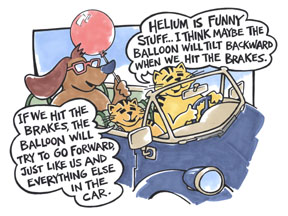
Here's a question from an SPM Olympiad Fizik book :

user posted image

This post has been edited by maximR: Aug 14 2013, 06:24 PM
kingkingyyk
post Aug 14 2013, 05:59 PM

10k Club
Group Icon
Elite
15,694 posts

Joined: Mar 2008
QUOTE(maximR @ Aug 14 2013, 03:28 PM)
Here's a question from an SPM Olympiad Fizik book :

user posted image
*
The answer is B? drool.gif
maximR
post Aug 14 2013, 06:02 PM

Remember who you are
*******
Senior Member
3,864 posts

Joined: Dec 2009


QUOTE(kingkingyyk @ Aug 14 2013, 05:59 PM)
The answer is B?  drool.gif
*
According to the guy who provided the question , yes .
kingkingyyk
post Aug 14 2013, 06:05 PM

10k Club
Group Icon
Elite
15,694 posts

Joined: Mar 2008
QUOTE(maximR @ Aug 14 2013, 06:02 PM)
According to the guy who provided the question , yes .
*
If so, you may experience it when the car/bus where you sit brakes.
maximR
post Aug 14 2013, 06:09 PM

Remember who you are
*******
Senior Member
3,864 posts

Joined: Dec 2009


QUOTE(kingkingyyk @ Aug 14 2013, 06:05 PM)
If so, you may experience it when the car/bus where you sit brakes.
*
Solution provided is about pressure , artificial gravity , inertia ... blink.gif
kingkingyyk
post Aug 14 2013, 06:17 PM

10k Club
Group Icon
Elite
15,694 posts

Joined: Mar 2008
QUOTE(maximR @ Aug 14 2013, 06:09 PM)
Solution provided is about pressure , artificial gravity , inertia ...  blink.gif
*
That's complicated.
My reason :
When you are sitting in a moving bus, you are moving as well. When the bus stops, your inertia causes you to continue to move.
Same to the question.
The initial state of the objects is static. When you push the box, the inertia will cause the object to try to stay in the initial state, that is not moving.

You might use Newton's Third Law to think about it.

This post has been edited by kingkingyyk: Aug 14 2013, 06:18 PM
TSCritical_Fallacy
post Aug 14 2013, 07:45 PM

∫nnộvisεr
Group Icon
VIP
3,713 posts

Joined: Nov 2011
From: Torino
QUOTE(maximR @ Aug 14 2013, 03:28 PM)
For beginners like me, how do I develop the intuition to manipulate the equation so p exists in that KE equation?
Also, if KE becomes 2KE, p becomes 2p as well? How to prove this?
Erratum: Please take note that there was a typo in the last line of the previous image. Last line “√(2p)” should be “√2*p”. Thanks Krevaki for pointing it out. It has been corrected.

Basically, it is very similar to proving Trigonometric Identities in SPM Add Maths. When you have the knowledge of momentum p = m*v, you will think of ways to express KE in terms of momentum and at the same time, conserving the dimensions of the original KE equation. icon_rolleyes.gif
TSCritical_Fallacy
post Aug 14 2013, 07:50 PM

∫nnộvisεr
Group Icon
VIP
3,713 posts

Joined: Nov 2011
From: Torino
QUOTE(Intermission @ Aug 11 2013, 02:06 PM)
As a unsuccessful wannabe math olympian who never had any formal training in mathematical olympiads, I participated in this year's OMK Sulong 2013.
By the way, care to tell me about the reception of your Science Fair project? laugh.gif
Krevaki
post Aug 14 2013, 07:54 PM

Regular
******
Senior Member
1,282 posts

Joined: Apr 2012
QUOTE(maximR @ Aug 14 2013, 03:28 PM)
For beginners like me , how do I develop the intuition to manipulate the equation so p exists in that KE equation ?
Also , if KE becomes 2KE , p becomes 2p as well ? How to prove this ? 

» Click to show Spoiler - click again to hide... «


All right , noted . Thank you .

Here's a question from an SPM Olympiad Fizik book :

user posted image
*
The steel (?) ball and the helium balloon are attached to the box by strings. The connections are not rigid and when you move the box, you would expect their inertia to hold them in their original position.
Krevaki
post Aug 14 2013, 07:55 PM

Regular
******
Senior Member
1,282 posts

Joined: Apr 2012
QUOTE(Critical_Fallacy @ Aug 14 2013, 07:45 PM)
Erratum: Please take note that there was a typo in the last line of the previous image. Last line “√(2p)” should be “√2*p”. Thanks Krevaki for pointing it out. It has been corrected.

Basically, it is very similar to proving Trigonometric Identities in SPM Add Maths. When you have the knowledge of momentum p = m*v, you will think of ways to express KE in terms of momentum and at the same time, conserving the dimensions of the original KE equation. icon_rolleyes.gif
*
Alamak, why mention my name? sweat.gif Anyway, you're welcome.
TSCritical_Fallacy
post Aug 14 2013, 08:33 PM

∫nnộvisεr
Group Icon
VIP
3,713 posts

Joined: Nov 2011
From: Torino
QUOTE(maximR @ Aug 14 2013, 03:28 PM)
Here's a question from an SPM Olympiad Fizik book :
user posted image
QUOTE(kingkingyyk @ Aug 14 2013, 05:59 PM)
The answer is Bdrool.gif
QUOTE(maximR @ Aug 14 2013, 06:02 PM)
According to the guy who provided the question, yes.
Under normal circumstances, your daily experience, common sense plus Newton’s 1st Law generally would tell you the “rational” answer seems to be B. However, if B were the intended answer, why would the person who set the question bother to add the floating helium-filled balloon in the boxcar? Is it a tricky question? sweat.gif

There are 2 clues provided:
(1) If the helium-filled balloon wasn't tied to the floor of the boxcar, it would float all the way up to the ceiling.
(2) In physics, Impulse of Force is used to refer to a fast-acting force that is applied briefly: I = F*δt = m*δv.

QUOTE(kingkingyyk @ Aug 14 2013, 06:17 PM)
My reason:
When you are sitting in a moving bus, you are moving as well. When the bus stops, your inertia causes you to continue to move. Same to the question. The initial state of the objects is static. When you push the box, the inertia will cause the object to try to stay in the initial state, that is not moving. You might use Newton's Third Law to think about it.
QUOTE(kingkingyyk @ Aug 14 2013, 06:44 PM)
Physical Chemistry : Keywords, Calculations, Logical Thinking.
Lastly, logical thinking is not just using our “common sense.” After all, “common sense” tells us the earth is flat. But even when “common sense” is correct, it may tell us, for example, that gravity cannot be pulling a thing down and pushing up the other at the same time. Therefore, critical thinking goes well beyond just using such basic principles. icon_idea.gif

Perhaps Krevaki and work_tgr can offer some clues as well. laugh.gif

user posted image
kingkingyyk
post Aug 14 2013, 08:39 PM

10k Club
Group Icon
Elite
15,694 posts

Joined: Mar 2008
QUOTE(Critical_Fallacy @ Aug 14 2013, 08:33 PM)
Under normal circumstances, your daily experience, common sense plus Newton’s 1st Law generally would tell you the “rational” answer seems to be B. However, if B were the intended answer, why would the person who set the question bother to add the floating helium-filled balloon in the boxcar? Is it a tricky question? sweat.gif

There are 2 clues provided:
(1) If the helium-filled balloon wasn't tied to the floor of the boxcar, it would float all the way up to the ceiling.
(2) In physics, Impulse of Force is used to refer to a fast-acting force that is applied briefly: I = F*δt = m*δv.

Lastly, logical thinking is not just using our “common sense.” After all, “common sense” tells us the earth is flat. But even when “common sense” is correct, it may tell us, for example, that gravity cannot be pulling a thing down and pushing up the other at the same time. Therefore, critical thinking goes well beyond just using such basic principles. icon_idea.gif

Perhaps Krevaki and work_tgr can offer some clues as well. laugh.gif

user posted image
*
The answer would be A then. unsure.gif
What I meant by "logical thinking" here is think based on law's logic. icon_idea.gif
Intermission
post Aug 14 2013, 10:23 PM

Enthusiast
*****
Senior Member
825 posts

Joined: Aug 2012
QUOTE(maximR @ Aug 13 2013, 10:47 PM)
I was well aware that Newton did not explicitly state that F = ma ( It's derived from his 2nd law ) , and I've read that force is defined as the rate of change of momentum early on when I first started learning dynamics . Did you really not read anything other than your SPM Physics reference book in form four and form five ?  blink.gif

But I didn't know that he said Ft α mv - mu
*
Admittedly, no. Not quite. I was paying more attention to the application rather than the origin of the ideas which was fine at SPM level. But now at A level I realize it would be imprecise to define or explain force using F=ma instead of F=(mv-mu)/t. That could pose some problems when answering structure questions at A level.

QUOTE(Critical_Fallacy @ Aug 14 2013, 07:50 PM)
By the way, care to tell me about the reception of your Science Fair project? laugh.gif
*
Of all posts, why quote this one? tongue.gif

Didn't manage to finish before the deadline due to many reasons but mostly because of my incompetence. Might participate again next year if possible.

QUOTE(maximR @ Aug 14 2013, 06:20 PM)
So that means after SPM I can straight away buy STPM books and start doing ?  drool.gif Good idea to fill those 3 months .
*
Hmm....I think A levels would serve a better purpose for this because for AS physics mechanics/Mathematics Mechanics 1 the knowledge from SPM can be extrapolated quite easily to fit the needs of the question. If you do exercises from STPM however, watch out for pre requisite knowledge.

QUOTE(maximR @ Aug 14 2013, 03:28 PM)
For beginners like me , how do I develop the intuition to manipulate the equation so p exists in that KE equation ?
Also , if KE becomes 2KE , p becomes 2p as well ? How to prove this ? 

*
Learn to relate different quantities together by the use of formula you already know. A good exercise would be proving formulas that you know, such as differentiation by 1st principle, proving E=mgh and E=0.5mv^2 from W=FS, proving P=h(rho)g from P=F/A and other formulas and so on. Proving trigonometric identities as mentioned by Critical_Fallacy is good too.

I couldn't stress how important this skill is if you are planning to study Physics/Mathematics/Further mathematics at A level/STPM.
TSCritical_Fallacy
post Aug 15 2013, 12:59 AM

∫nnộvisεr
Group Icon
VIP
3,713 posts

Joined: Nov 2011
From: Torino
QUOTE(maximR @ Aug 14 2013, 06:09 PM)
Solution provided is about pressure , artificial gravity , inertia ...  blink.gif
QUOTE(Krevaki @ Aug 14 2013, 07:54 PM)
The steel (?) ball and the helium balloon are attached to the box by strings. The connections are not rigid and when you move the box, you would expect their inertia to hold them in their original position.
QUOTE(kingkingyyk @ Aug 14 2013, 08:39 PM)
The answer would be A then.  unsure.gif
What I meant by "logical thinking" here is think based on law's logic.  icon_idea.gif
Perhaps watching the YouTube video below would give you new insights into the physics of helium balloon. icon_rolleyes.gif


ystiang
post Aug 15 2013, 02:04 AM

Getting Started
**
Junior Member
171 posts

Joined: May 2012
QUOTE(manutd96 @ Aug 13 2013, 04:13 AM)
In a shooting competition, the probability that ali hits the target is 0.4. Find the minimum number of trials that ali needs to make such that the probability that he hits the target at least once is 0.8. << add maths question. How do I do it? Which method should I use? Is it part of binomial distribution?
*
P(X >= 1) = 1 - P(X < 1) = 1 - P(X = 0) = 0.8

Yup, binomial distribution.

» Click to show Spoiler - click again to hide... «


TSCritical_Fallacy
post Aug 15 2013, 04:20 AM

∫nnộvisεr
Group Icon
VIP
3,713 posts

Joined: Nov 2011
From: Torino
QUOTE(manutd96 @ Aug 13 2013, 04:13 AM)
In a shooting competition, the probability that ali hits the target is 0.4. Find the minimum number of trials that ali needs to make such that the probability that he hits the target at least once is 0.8. << add maths question. How do I do it? Which method should I use? Is it part of binomial distribution?
Technically speaking, the method employed by ystiang is called Complementary Cumulative Distribution Function. The solution is exactly the same as the one beautifully brought by ystiang, with a little extra information of how the principle of Cumulative Distribution Function works. wink.gif

user posted image
manutd96
post Aug 15 2013, 06:19 AM

Getting Started
**
Junior Member
184 posts

Joined: Mar 2013


Alright thanks people!
kingkingyyk
post Aug 15 2013, 09:25 AM

10k Club
Group Icon
Elite
15,694 posts

Joined: Mar 2008
QUOTE(Critical_Fallacy @ Aug 15 2013, 12:59 AM)
Perhaps watching the YouTube video below would give you new insights into the physics of helium balloon. icon_rolleyes.gif


*
Helium gas balloon will move forward, pendulum will move behind? shocking.gif
Weird guy.
Krevaki
post Aug 15 2013, 10:47 AM

Regular
******
Senior Member
1,282 posts

Joined: Apr 2012
QUOTE(Critical_Fallacy @ Aug 15 2013, 12:59 AM)
Perhaps watching the YouTube video below would give you new insights into the physics of helium balloon. icon_rolleyes.gif


*
You're right! As the box moves to the right, the air gets compressed to the left, making the left side of the box denser than the right side. The helium balloon actually gets pushed to the right!
maximR
post Aug 15 2013, 01:20 PM

Remember who you are
*******
Senior Member
3,864 posts

Joined: Dec 2009


QUOTE(Critical_Fallacy @ Aug 15 2013, 12:59 AM)
Perhaps watching the YouTube video below would give you new insights into the physics of helium balloon. icon_rolleyes.gif


*
QUOTE(Krevaki @ Aug 15 2013, 10:47 AM)
You're right! As the box moves to the right, the air gets compressed to the left, making the left side of the box denser than the right side. The helium balloon actually gets pushed to the right!
*
I get it now . nod.gif

But looking for explanations on the internet , there are some who use General Relativity to explain this . So is the explanation using air compression / buoyant force correct , or General Relativity , or both ?


maximR
post Aug 15 2013, 01:24 PM

Remember who you are
*******
Senior Member
3,864 posts

Joined: Dec 2009


» Click to show Spoiler - click again to hide... «


All right . Thank you ! I got only some of them covered through watching Walter Lewin's lectures , like proving the Work-Energy Theorem , P= h(rho)g , etc . I learned the general proof for derivatives too , but not the SPM way where you just add delta x and delta y to x and y respectively . I prefer the usual method , those that are available online .

TSCritical_Fallacy
post Aug 15 2013, 05:20 PM

∫nnộvisεr
Group Icon
VIP
3,713 posts

Joined: Nov 2011
From: Torino
QUOTE(kingkingyyk @ Aug 15 2013, 09:25 AM)
Helium gas balloon will move forward, pendulum will move behind? shocking.gif
QUOTE(Krevaki @ Aug 15 2013, 10:47 AM)
You're right! As the box moves to the right, the air gets compressed to the left, making the left side of the box denser than the right side. The helium balloon actually gets pushed to the right!
QUOTE(maximR @ Aug 15 2013, 01:20 PM)
But looking for explanations on the internet, there are some who use General Relativity to explain this. So is the explanation using air compression / buoyant force correct, or General Relativity, or both?
It takes the knowledge of Density of Steel, Density of Helium, Newton’s Law, Archimedes’ principle (Buoyancy), Impulse of Force, and a few assumptions to understand the tricky physics problem.

Statics ::

(1) The boxcar is at rest on a frictionless surface. Between the two objects inside the boxcar, a solid steel ball is much more dense than a helium-filled balloon. The steel pendulum and helium balloon are rigid bodies.

(2) Newton’s Law tells us the downward force of gravity pulls the steel pendulum and helium balloon, which results in their respective weights, W↓ = mg.

(3) Archimedes’ principle tells us the upward buoyant forces exerted on the steel pendulum and helium balloon “immersed fully” in the air, are equal to the respective weights of the air that the objects displace, F↑ = ρVg.

(4) For the heavier-than-air steel ball, because W↓ > F↑, the steel ball is pulled downward by the Net force.

(5) For the lighter-than-air helium balloon, because F↑ > W↓, the helium balloon is pushed upward by the Net force.

(6) Because the freedom of movements of the steel pendulum and helium balloon are constrained in the direction of the respective Net forces (vertical) axes, Newton’s Law tells us their respective normal Reaction forces are generated, so that they appear to be held in their places.

user posted imageuser posted image

Dynamics ::

(7) For the impulse of force, in which we assume the force exerted on boxcar acts for a very short time δt but is much greater than any other force present. Imagine flicking your finger to apply the impulse of force on the outer left side of the boxcar! The duration of the collision is very short and bring the boxcar to an abrupt STOP.

user posted image

(8) Now, because the steel pendulum and helium balloon are not constrained horizontally, any applied horizontal force will cause the objects to swing left and right.

(9) Since the boxcar comes to an abrupt STOP, when we reapply the Newton’s Laws and Archimedes’ principle from (1)−(5), the most probable positions of the steel pendulum and helium balloon caused by the impulse is depicted in Image C. What do you think? sweat.gif

user posted image
work_tgr
post Aug 15 2013, 10:53 PM

501 - Not Implemented
*******
Senior Member
4,583 posts

Joined: Oct 2006
From: ... suddenly 1 week


My first respond to this question is thinking about inertia and my answer goes to C.

Reedit : second thought, answer is B. tongue.gif

---

My explanation:

1. An opposite force, f occurs at the string to resist F. The direction of f is to the left.

2. Resultant force of L is pointing south west.

3. Resultant force of B is pointing north west.

This post has been edited by work_tgr: Aug 15 2013, 11:38 PM
VengenZ
post Aug 16 2013, 02:23 AM

La la la~
****
Senior Member
608 posts

Joined: Nov 2009
From: 127.0.0.1


Probably could use general relativity for that question. Einstein's famous thought experiment (physicist in a box):
user posted image
http://www.pitt.edu/~jdnorton/teaching/HPS...hway/index.html
(Principle in equivalence section)

Lets imagine the force exerted causes the box to accelerate with acceleration = g. Assuming that this experiment is not conducted in vacuum, we can say that the condition of the inside of the box will be exactly the same as if we were to rotate the box 90 degree anticlockwise.

Using this principle of equivalence, we know that in normal gravity condition (with air), the steel ball will move downward and the helium balloon will move upward. Now lets rotate this image back again 90 degree clockwise and we will get the answer.

The steel ball should move to the left and the helium to the right. So actually there is no answer? blink.gif

This post has been edited by VengenZ: Aug 16 2013, 02:32 AM
Krevaki
post Aug 16 2013, 11:52 AM

Regular
******
Senior Member
1,282 posts

Joined: Apr 2012
QUOTE(maximR @ Aug 15 2013, 01:20 PM)
I get it now .  nod.gif

But looking for explanations on the internet , there are some who use General Relativity to explain this . So is the explanation using air compression / buoyant force correct , or General Relativity , or both ?
*
Would you be so kind as to provide the reference link?

QUOTE(Critical_Fallacy @ Aug 15 2013, 05:20 PM)
It takes the knowledge of Density of Steel, Density of Helium, Newton’s Law, Archimedes’ principle (Buoyancy), Impulse of Force, and a few assumptions to understand the tricky physics problem.

Statics ::

(1) The boxcar is at rest on a frictionless surface. Between the two objects inside the boxcar, a solid steel ball is much more dense than a helium-filled balloon. The steel pendulum and helium balloon are rigid bodies.

(2) Newton’s Law tells us the downward force of gravity pulls the steel pendulum and helium balloon, which results in their respective weights, W↓ = mg.

(3) Archimedes’ principle tells us the upward buoyant forces exerted on the steel pendulum and helium balloon “immersed fully” in the air, are equal to the respective weights of the air that the objects displace, F↑ = ρVg.

(4) For the heavier-than-air steel ball, because W↓ > F↑, the steel ball is pulled downward by the Net force.

(5) For the lighter-than-air helium balloon, because F↑ > W↓, the helium balloon is pushed upward by the Net force.

(6) Because the freedom of movements of the steel pendulum and helium balloon are constrained in the direction of the respective Net forces (vertical) axes, Newton’s Law tells us their respective normal Reaction forces are generated, so that they appear to be held in their places.

user posted imageuser posted image

Dynamics ::

(7) For the impulse of force, in which we assume the force exerted on boxcar acts for a very short time δt but is much greater than any other force present. Imagine flicking your finger to apply the impulse of force on the outer left side of the boxcar! The duration of the collision is very short and bring the boxcar to an abrupt STOP.

user posted image

(8) Now, because the steel pendulum and helium balloon are not constrained horizontally, any applied horizontal force will cause the objects to swing left and right.

(9) Since the boxcar comes to an abrupt STOP, when we reapply the Newton’s Laws and Archimedes’ principle from (1)−(5), the most probable positions of the steel pendulum and helium balloon caused by the impulse is depicted in Image C. What do you think? sweat.gif

user posted image
*
But are we not looking for the moment when the box is "pushed"?
TSCritical_Fallacy
post Aug 21 2013, 04:05 AM

∫nnộvisεr
Group Icon
VIP
3,713 posts

Joined: Nov 2011
From: Torino
QUOTE(maximR @ Aug 15 2013, 01:20 PM)
But looking for explanations on the internet, there are some who use General Relativity to explain this. So is the explanation using air compression / buoyant force correct, or General Relativity, or both?
Have you discovered this link? icon_idea.gif

QUOTE(work_tgr @ Aug 15 2013, 10:53 PM)
Reedit : second thought, answer is B.  tongue.gif

1. An opposite force, f occurs at the string to resist F. The direction of f is to the left.
2. Resultant force of L is pointing south west.
3. Resultant force of B is pointing north west.
Possible, if it is an “open” boxcar. wink.gif

QUOTE(VengenZ @ Aug 16 2013, 02:23 AM)
Probably could use general relativity for that question. Einstein's famous thought experiment (physicist in a box):
In the physics of general relativity (non SPM), we can certainly describe the motion of the steel pendulum and helium balloon by the equivalence principle. icon_rolleyes.gif

QUOTE(Krevaki @ Aug 16 2013, 11:52 AM)
But are we not looking for the moment when the box is "pushed"?
True, but since the impulse acts for a very short time δt ~ 0 sec, the closest image that describes the positions (during δt) of the steel pendulum and helium balloon caused by the impulse that brings the boxcar to an abrupt STOP would probably be Image C. Just my 2 cents. sweat.gif

user posted image
TSCritical_Fallacy
post Aug 21 2013, 05:26 AM

∫nnộvisεr
Group Icon
VIP
3,713 posts

Joined: Nov 2011
From: Torino
QUOTE(young_97 @ Aug 20 2013, 09:32 PM)
this two question shocking.gif  unsure.gif
user posted image

Refer to Tensile testing and Stress–strain curve. icon_idea.gif

The formula to calculate the “apparentengineering stress, σ, is given by σ = F / Ao, assuming that the original cross-sectional area Ao is UNCHANGED (not reducing) through which the force is applied. In fact, as deformation continues, cross-sectional area decreases.

Similarly, the formula to calculate the engineering strain, ε, is given by ε = ΔL / Lo. Some questions give the elongation measurement L instead, and if that is the case, use ΔL = L − Lo.

user posted image

Refer to Properties of Water, Continuity equation, Bernoulli's principle and Venturi effect. icon_rolleyes.gif

Water is treated as an incompressible fluid because the changes in relative volume ΔV / V is negligible as the pressure increases.

In fluid mechanics, the continuity equation states that, in any steady state process, the rate of change of mass within the control volume is equal to the rate at which mass leaves the surface S of volume V.

user posted image

In other words, mass inflow = mass outflow. However, mass is also given by the product of ρV (density × volume). Because water is essentially incompressible, therefore the density ρ of water is treated as constant throughout the streamline from the hose to the head. For that reason, we can rewrite the continuity equation as follows:

Volumetric inflow rate, Q1 = Volumetric outflow rate, Q2[/B][/COLOR]

user posted image

Because Volumetric flow rate, Q is defined as Q = dV / dt,

and the volume of a mass, V is given by V = A*l (cross-sectional area × traversed length), therefore

A1 × (dl1 / dt) = A2 × (dl2 / dt)

Since dl / dt is defined as the velocity, υ, we can simplify the equation to

A1 × υ1 = A2 × υ2
young_97
post Aug 21 2013, 06:37 AM

Enthusiast
*****
Senior Member
828 posts

Joined: Dec 2010
QUOTE(Critical_Fallacy @ Aug 21 2013, 05:26 AM)
» Click to show Spoiler - click again to hide... «
I wonder where does we learn this hmm.gif
So deep rclxub.gif
TSCritical_Fallacy
post Aug 21 2013, 03:44 PM

∫nnộvisεr
Group Icon
VIP
3,713 posts

Joined: Nov 2011
From: Torino
QUOTE(manutd96 @ Aug 21 2013, 09:25 AM)
What is the ans for 3c and explanation please?
user posted image

If the gas is continuously supplied at a constant pressure, the new level of “A would probably look like this: icon_idea.gif

user posted image
manutd96
post Aug 21 2013, 04:02 PM

Getting Started
**
Junior Member
184 posts

Joined: Mar 2013


Ok thanks! Im impressed how well you edited the pic. I also want to know that,when an object fully immersed in water and its weight is then lets say, 5N , it will still be 5N when it is immersed further right as the vol of water displaced is still the same. Am I correct?
TSCritical_Fallacy
post Nov 13 2013, 09:11 PM

∫nnộvisεr
Group Icon
VIP
3,713 posts

Joined: Nov 2011
From: Torino
QUOTE(E Crew @ Nov 13 2013, 02:12 PM)
This is a question from my homework that I need help with.The question asked me to find the general solution for the given second differential equation.How am I suppose to solve this ? Anyone pros can help me out please ? icon_question.gif
user posted image
At first glance, you maybe tempted to solve ODE using Laplace Transforms. But it is not easy to find the Laplace Transform of 1/(1+t²). Since the ODE is a nonhomogeneous equation y'' + p(t)*y' + q(t)*y = g(t), your Lecturer probably has taught you about the Variation of Parameters formula.

user posted image

This post has been edited by Critical_Fallacy: Nov 15 2013, 01:58 PM
TSCritical_Fallacy
post Nov 13 2013, 09:44 PM

∫nnộvisεr
Group Icon
VIP
3,713 posts

Joined: Nov 2011
From: Torino
QUOTE(ailing tan @ Nov 13 2013, 09:18 PM)
can anyone explain why this is -500j not  positive 500J ???
user posted image
Because the gas undergoes expansion from L to J

W(L,J) = (0.005 − 0.003)m³ × (100)kPa = 200 J

and then the gas undergoes compression from J to L

W(J,L) = ½ × {(0.005 − 0.003)m³ × (600 + 100)kPa} = 700 J

Therefore, the net work of the system is:

W(L,J) − W(J,L) = 200 − 700 = -500 J

Ans (A)... icon_rolleyes.gif

This post has been edited by Critical_Fallacy: Nov 14 2013, 12:39 AM
TSCritical_Fallacy
post Nov 13 2013, 09:57 PM

∫nnộvisεr
Group Icon
VIP
3,713 posts

Joined: Nov 2011
From: Torino
QUOTE(ailing tan @ Nov 13 2013, 09:34 PM)
gaussian elimination is to make d g h = 0?
user posted image
Technically NO because you missed out the Matrix B. sweat.gif

Given a system of linear equations in the form of Ax = B:

user posted image

Transform the linear system into augmented matrix:

user posted image

Then, perform Gaussian Elimination to put the augmented matrix into the upper triangular form:

user posted image
ailing tan
post Nov 14 2013, 05:28 PM

Getting Started
**
Junior Member
233 posts

Joined: Jul 2013
QUOTE(Critical_Fallacy @ Nov 13 2013, 09:44 PM)
Because the gas undergoes expansion from L to J

W(L,J) = (0.005 − 0.003)m³ × (100)kPa = 200 J

and then the gas undergoes compression from J to L

W(J,L) = ½ × {(0.005 − 0.003)m³ × (600 + 100)kPa} = 700 J

Therefore, the net work of the system is:

W(L,J) − W(J,L) = 200 − 700 = -500 J

Ans (A)... icon_rolleyes.gif
*

hi tanks for ur reply! i can understand finally!!
ailing tan
post Nov 14 2013, 06:10 PM

Getting Started
**
Junior Member
233 posts

Joined: Jul 2013
how to do this???? i need ur help!!!!!


Attached thumbnail(s)
Attached Image
ystiang
post Nov 14 2013, 06:16 PM

Getting Started
**
Junior Member
171 posts

Joined: May 2012
QUOTE(ailing tan @ Nov 14 2013, 06:10 PM)
how to do this???? i need ur help!!!!!
*
|-2/(x+1)| < 1

-1 < -2/(x+1) < 1

0 < -2/(x+1) + 1 or -2/(x+1) - 1 < 0

(x-1)/(x+1) > 0 or -(x+3)/(x+1) < 0

By number line or sign table, you'll get

{x| x<-3 or x>1}


This post has been edited by ystiang: Nov 14 2013, 06:35 PM
TSCritical_Fallacy
post Nov 14 2013, 08:02 PM

∫nnộvisεr
Group Icon
VIP
3,713 posts

Joined: Nov 2011
From: Torino
QUOTE(ailing tan @ Nov 14 2013, 06:10 PM)
how to do this???? i need ur help!!!!!
This belongs to the topic called Absolute-Value Inequalities.

To solve this problem, let's understand what is absolute value.

The absolute value of a real number R (denoted “|R|”) may be defined as the distance of R from zero.

For example, both –1 and 1 are one unit from zero, and therefore we have |–1| = |1| = 1.

The absolute value of R can be written as a function of the positive square root: |R| = √(R²).

Come back to the problem: |–2 / (x + 1)| < 1.

Let's define f(x) = –2 / (x + 1), and it follows that |f(x)| < 1.

By the above definition, we can intuitively imagine that f(x) = –1 and f(x) = 1.

To satisfy the condition of the inequality |f(x)| < 1, let's do four possible logic tests:

Test 1: f(x) < –1 :: Let f(x) = –1.1, and |f(x)| = |–1.1| = 1.1 < 1 ~ FALSE

Test 2: f(x) > –1 :: Let f(x) = –0.9, and |f(x)| = |–0.9| = 0.9 < 1 ~ TRUE

Test 3: f(x) < 1 :: Let f(x) = 0.9, and |f(x)| = |0.9| = 0.9 < 1 ~ TRUE

Test 4: f(x) > 1 :: Let f(x) = 1.1, and |f(x)| = |1.1| = 1.1 < 1 ~ FALSE

From the results, because Test 2 and 3 are TRUE, we can conclude that given the inequality |x| < a, the solution is always of the form –a < x < a.

Therefore, we have two inequalities: –1 < |f(x)| < 1.

Solve inequality #1: –1 < –2 / (x + 1) ... → ... we have x > 1.

Solve inequality #2: –2 / (x + 1) < 1 ... → ... we have x < –3.

Once you understand the concept, you can use the same simple approach as ystiang did.

Question: What if you were given the inequality |x| > a? sweat.gif
TSCritical_Fallacy
post Nov 15 2013, 12:59 PM

∫nnộvisεr
Group Icon
VIP
3,713 posts

Joined: Nov 2011
From: Torino
QUOTE(maximR @ Nov 15 2013, 11:45 AM)
If possible, post your questions in Critical_Fallacy's Ask a Mathematical Physicist Thread.  smile.gif
user posted image

Even though it is a complex number, you can solve this problem using basic algebraic manipulation skill that you have already learned in Form 2 Factorization & Form 3 Simultaneous equations. Let me show you:

Find √(16 − 30i).

Since (16 − 30i) is a complex number, your developed mathematical intuition should tell you that the expected answer must be also a complex number (a + bi). Therefore it can be written as

√(16 − 30i) = √[(a + bi)²]

Your task now is to find a and b. As simple as that, regardless of the square root sign.

16 − 30i = (a + bi)² = a² + 2abi + b²i².

Since i² = −1, you can rearrange the equation to

16 − 30i = (a² − b²) + (2ab)i.

Eq.(1): a² − b² = 16

Eq.(2): 2ab = −30 ... → ... b = −15/a

You can solve the simultaneous equations by expressing b in term of a and substitute it into Eq.(1):

a² − (−15/a)² = 16

Multiply both sides with a² and turn it into a standard quadratic equation:

(a²)² − 16a² − 225 = 0

(a² − 25) (a² + 9) = 0

By the definition of a complex number (a + bi) where a and b must be Real Numbers, it renders a² = −9 invalid and therefore

a² − 25 = 0 ... → ... a = 5

Back-substituting a = 5 into Eq.(2) to find b:

b = −15/5 = −3

With the values found for a & b, and for all complex z with Re(z) > 0, √(z²) = z, the answer for

√(16 − 30i) = 5 − 3i icon_rolleyes.gif

This post has been edited by Critical_Fallacy: Nov 15 2013, 01:59 PM
TSCritical_Fallacy
post Nov 17 2013, 01:05 AM

∫nnộvisεr
Group Icon
VIP
3,713 posts

Joined: Nov 2011
From: Torino
QUOTE(ailing tan @ Nov 16 2013, 05:20 PM)
I was given this question... can someone show how to get k=3??? my ans is not 3
user posted image

Given a system of linear equations with a set of variables x, y, z. Find k.

R1: 1x − 2y + 2z = 6
R2: 2x + 1y + 3z = 5
R3: 4x + 7y + 5z = k

Let's do some elementary row operations: You're lucky because element a11 is 1. See R1.

To eliminate coefficient of x (2) in R2, therefore 2 × R1: 2x − 4y + 4z = 12
R2 − 2R1:
R2': 5y − 1z = −7 ... eliminated x

To eliminate coefficient of x (4) in R3, therefore 4 × R1: 4x − 8y + 8z = 24
R3 − 4R1:
R3': 15y − 3z = k − 24 ... eliminated x

If you compare carefully R2' with R3', you'll notice that R2' & R3' are the same equation when scaled by a factor of 3, therefore 3 × R2': 15y − 3z = −21

Because it is stated that the equations are consistent, only then you can perform the next operation:
R3' − 3R2': 0 = k − 3

Solve for k and you have k = 3.

P.S. If you analyze the coefficient matrix, its determinant is 0, and thus the matrix is said to be singular, or it doesn't have a matrix inverse. If you plot the three equations in 3D, you'll discover that the linear system has infinitely many solutions because the equations are linearly dependent (see above R2' and R3'). If the system has a single unique solution, the three planes will intersect at a single point. icon_idea.gif

user posted image
ailing tan
post Nov 17 2013, 03:39 PM

Getting Started
**
Junior Member
233 posts

Joined: Jul 2013
why this is B why not A???


Attached thumbnail(s)
Attached Image
VengenZ
post Nov 17 2013, 06:31 PM

La la la~
****
Senior Member
608 posts

Joined: Nov 2009
From: 127.0.0.1


QUOTE(ailing tan @ Nov 17 2013, 03:39 PM)
why this is B why not A???
*
Adiabatic compression curve should be steeper than isothermal's. Since the gas is adiabatically compressed, so the temperature must've increased, therefore the adiabatic curve must be located above the isothermal curve.
ailing tan
post Nov 17 2013, 06:55 PM

Getting Started
**
Junior Member
233 posts

Joined: Jul 2013
ok ... thanks .... can you show how to get the ans for this question ??? help!!


Attached thumbnail(s)
Attached Image
TSCritical_Fallacy
post Nov 18 2013, 02:23 AM

∫nnộvisεr
Group Icon
VIP
3,713 posts

Joined: Nov 2011
From: Torino
QUOTE(ailing tan @ Nov 17 2013, 05:31 PM)
if i am given a question like this [ the parametric equations of curve is x = t*(t+2) y = 2*(t+1) ] How to know that this curve is ellipse, parabola, or hyperbola at first glance??
Like crazywing26 said, you hardly know which conic section is unless you have done many practices. However, it's not the end of maths. With a little quick-witted algebraic manipulation skills plus some knowledge in trigonometric identities, you can derive the General Parametric Equations for parabola, ellipse, and hyperbola. The parametric equations of a circle with radius r can be derived from the parametric equations of an ellipse by setting a = b = r.

user posted image
TSCritical_Fallacy
post Nov 18 2013, 03:41 AM

∫nnộvisεr
Group Icon
VIP
3,713 posts

Joined: Nov 2011
From: Torino
QUOTE(Flame Haze @ Nov 17 2013, 03:52 PM)
This is complicated  biggrin.gif

Let s = 1+2+4+8+....
So 2s = 2+4+8+16....
And s-1 = 2+4+8+16+...

Seems to stand true that 2s = s-1
How come s = -1?  sweat.gif
QUOTE(reconnaissance @ Nov 18 2013, 02:24 AM)
However, can it be explained this way?;

2s = s-1
2s-s = (s-1)-s
s = -1
There might be a more sinister motive behind the smiley. Well, straight to the point, it's a mathematical fallacy, where it presents an invalid proof for 3 reasons as explained in the following:

Reason #1: s has no sum.
s = 1 + 2 + 4 + 8 + … + 2^n is the infinite series whose terms are the successive powers of two. It is logically obvious that the sum of ever-growing positive-definite terms does not converge at a negative value or s = −1. In other words, it diverges to infinity, and so in the usual sense it has no sum.

Reason #2: Division-by-zero fallacy.
Let's start from here: 2s = s − 1. We know s is said to tend to infinity (∞). Using the notion of infinite limits, we can generalize that s − 1 becomes extremely close to s as s approaches indefinitely to infinity (∞).

And so, it follows that
2s = s
Divide by the non-zero s
2 = 1
The fallacious result is the implicit assumption that dividing by 0 is a legitimate operation
2 × 0 = 1 × 0
Dividing by zero gives:
2 × (0/0) = 1 × (0/0)

Reason #3: Invalid argument of power series.
Using Maclaurin series expansion, one can show that 1/(1 − x) = 1 + x + x² + x³ + …
If we plug in x = 2, the series becomes s and it sums the terms on the RHS to the finite value of −1.
Unfortunately, the expansion is only VALID for arguments |x| < 1. In plain English, invalid argument yields invalid result.

This post has been edited by Critical_Fallacy: Nov 18 2013, 03:43 AM
ailing tan
post Nov 18 2013, 03:05 PM

Getting Started
**
Junior Member
233 posts

Joined: Jul 2013
i gt a physics question here...
A surface area A is bombarded normally by n molecules per unit second.. If the collision are elastic each molecule has a mass of m and moves with speed u , hence the pressure actiong on surface is 2nmu... how to get the ans??? icon_question.gif icon_question.gif
TSCritical_Fallacy
post Nov 18 2013, 06:27 PM

∫nnộvisεr
Group Icon
VIP
3,713 posts

Joined: Nov 2011
From: Torino
QUOTE(ailing tan @ Nov 18 2013, 03:05 PM)
i gt a physics question here...
A surface area A is bombarded normally by n molecules per unit second.. If the collision are elastic each molecule has a mass of m and moves with speed u , hence the pressure actiong on surface is 2nmu...  how to get the ans???  icon_question.gif  icon_question.gif
The information given on your physics question are incomplete. No assumptions are made. However, this is my probable explanation of the elastic collision. Do you get the concept? sweat.gif

user posted image
ailing tan
post Nov 18 2013, 06:31 PM

Getting Started
**
Junior Member
233 posts

Joined: Jul 2013
sry i cant understand this....haha.. this is too difficult for me...
TSCritical_Fallacy
post Nov 18 2013, 06:44 PM

∫nnộvisεr
Group Icon
VIP
3,713 posts

Joined: Nov 2011
From: Torino
QUOTE(ailing tan @ Nov 18 2013, 06:31 PM)
sry i cant understand this....haha.. this is too difficult for me...
Perhaps you can ask your classmates, Just Visiting By or crazywing26 to explain to you. By the way, are you familiar with the fundamentals of Linear Momentum and Elastic Collision in One Dimension? icon_question.gif

user posted image
crazywing26
post Nov 18 2013, 08:38 PM

Getting Started
**
Junior Member
283 posts

Joined: Apr 2013


QUOTE(ailing tan @ Nov 18 2013, 03:05 PM)
i gt a physics question here...
A surface area A is bombarded normally by n molecules per unit second.. If the collision are elastic each molecule has a mass of m and moves with speed u , hence the pressure actiong on surface is 2nmu...   how to get the ans???  icon_question.gif  icon_question.gif
*
The question given has incomplete information. To sum up, @Critical_Fallacy made an assumption (not exactly that way but I think it can be assumed as this way) of the molecules bounce on a wall (remains at rest after the collision, the particles won't push the wall to move right? flex.gif). So I suppose that is the crucial information you have missed out.

This post has been edited by crazywing26: Nov 18 2013, 10:11 PM
TSCritical_Fallacy
post Nov 21 2013, 03:01 PM

∫nnộvisεr
Group Icon
VIP
3,713 posts

Joined: Nov 2011
From: Torino
2013 STPM Maths T paper: Part 1 & Part 2

Hi ailing tan, crazywing26, iChronicles, yellowpika, ystiang

Here is my solution for Question 1 ~ [8 marks]:

user posted image
TSCritical_Fallacy
post Nov 21 2013, 03:02 PM

∫nnộvisεr
Group Icon
VIP
3,713 posts

Joined: Nov 2011
From: Torino
2013 STPM Maths T paper: Part 1 & Part 2

Hi ailing tan, crazywing26, iChronicles, yellowpika, ystiang

Here is my solution for Question 2 ~ [7 marks]:

user posted image
TSCritical_Fallacy
post Nov 21 2013, 03:02 PM

∫nnộvisεr
Group Icon
VIP
3,713 posts

Joined: Nov 2011
From: Torino
2013 STPM Maths T paper: Part 1 & Part 2

Hi ailing tan, crazywing26, iChronicles, yellowpika, ystiang

Here is my solution for Question 3 ~ [5 marks]:

user posted image
TSCritical_Fallacy
post Nov 21 2013, 03:03 PM

∫nnộvisεr
Group Icon
VIP
3,713 posts

Joined: Nov 2011
From: Torino
2013 STPM Maths T paper: Part 1 & Part 2

Hi ailing tan, crazywing26, iChronicles, yellowpika, ystiang

Here is my solution for Question 4 ~ [9 marks]:

user posted image
ailing tan
post Nov 21 2013, 03:31 PM

Getting Started
**
Junior Member
233 posts

Joined: Jul 2013
can you show the ans for no6??
TSCritical_Fallacy
post Nov 21 2013, 06:36 PM

∫nnộvisεr
Group Icon
VIP
3,713 posts

Joined: Nov 2011
From: Torino
2013 STPM Maths T paper: Part 1 & Part 2

Hi ailing tan, crazywing26, iChronicles, WoanPing, yellowpika

Here is my solution for Question 5 ~ [9 marks]:

user posted image
TSCritical_Fallacy
post Nov 21 2013, 06:37 PM

∫nnộvisεr
Group Icon
VIP
3,713 posts

Joined: Nov 2011
From: Torino
2013 STPM Maths T paper: Part 1 & Part 2

Hi ailing tan, crazywing26, iChronicles, WoanPing, yellowpika

Here is my solution for Question 6 ~ [7 marks]:

user posted image
crazywing26
post Nov 21 2013, 06:37 PM

Getting Started
**
Junior Member
283 posts

Joined: Apr 2013


QUOTE(Critical_Fallacy @ Nov 21 2013, 03:01 PM)
2013 STPM Maths T paper: Part 1 & Part 2

Hi ailing tan, crazywing26, iChronicles, yellowpika, ystiang

Here is my solution for Question 1 ~ [8 marks]:

user posted image
*
Although your solutions for the inequality is true, but the question stated "Hence". So I think we need to solve this question by finding the intersection point. And then refer to the graph, straight away write the answer for range of x (-<infinity> 1-<surd>3] or [0, <infinity>) and the answer is supposed to be in set notation.

And very thank you for providing us solutions with working. XD

This post has been edited by crazywing26: Nov 21 2013, 06:42 PM
TSCritical_Fallacy
post Nov 21 2013, 06:37 PM

∫nnộvisεr
Group Icon
VIP
3,713 posts

Joined: Nov 2011
From: Torino
2013 STPM Maths T paper: Part 1 & Part 2

Hi ailing tan, crazywing26, iChronicles, WoanPing, yellowpika

Repost of solution for Question 7 ~ [15 marks]:

user posted image
TSCritical_Fallacy
post Nov 21 2013, 06:38 PM

∫nnộvisεr
Group Icon
VIP
3,713 posts

Joined: Nov 2011
From: Torino
2013 STPM Maths T paper: Part 1 & Part 2

Hi ailing tan, crazywing26, iChronicles, WoanPing, yellowpika

Repost of solution for Question 8 ~ [15 marks]:

user posted image
TSCritical_Fallacy
post Nov 22 2013, 11:41 PM

∫nnộvisεr
Group Icon
VIP
3,713 posts

Joined: Nov 2011
From: Torino
Hi maximR, this is Remainder Theorem. Most likely you will master this in less than 3 minutes. laugh.gif

user posted image
TSCritical_Fallacy
post Nov 23 2013, 02:14 AM

∫nnộvisεr
Group Icon
VIP
3,713 posts

Joined: Nov 2011
From: Torino
Hi maximR, this is the Solution of Cubic equations & Quartic equations. Most likely you will master this in about 10~15 minutes. wink.gif

user posted image

You have already learned the basic factorization skill in Form 2 and quadratic solution by completing the square & formula in Form 4 Add Math. So, tell me now, are your Math skills sufficient to solve cubic equations and quartic equations with the systematic procedure? sweat.gif

This post has been edited by Critical_Fallacy: Nov 23 2013, 02:20 AM
maximR
post Nov 23 2013, 12:25 PM

Remember who you are
*******
Senior Member
3,864 posts

Joined: Dec 2009


» Click to show Spoiler - click again to hide... «


Sorry I went offline yesterday , it was quite late and I had to go to bed . Anyway , I'm done with Remainder Theorem and Factor Theorem .

As for your last question , is my reasoning correct ?

Since the remainder theorem states that if f(x) is divided by (x-a) , then the remainder = f(a) and factor theorem states that if f(x) is divided by (x-a) and it equals zero , then (x-a) is a linear factor , thus , if x = a , then :

a^3 - 6a - 7a + 60 = 0

Factoring using my calculator , since I haven't learned Cubic and Quartic Eqn sweat.gif ( can you please re-post the tutorial ? it's too small for my eyes ) yields :

(a+3)(a-5)(a-4) = 0

Therefore :

(x+3)(x-5)(x-4) = 0

Thus , I've found the linear factors of the function without using the first linear factor . I hope it's correct . smile.gif

TSCritical_Fallacy
post Nov 23 2013, 07:56 PM

∫nnộvisεr
Group Icon
VIP
3,713 posts

Joined: Nov 2011
From: Torino
QUOTE(maximR @ Nov 23 2013, 12:25 PM)
Since the remainder theorem states that if f(x) is divided by (x − a), then the remainder = f(a) and factor theorem states that if f(x) is divided by (x − a) and it equals zero, then (x − a) is a linear factor, thus , if x = a, then:

a^3 - 6a - 7a + 60 = 0
Good! Let me reiterate the point. The idea behind the Remainder Theorem is that if you just want to know the remainder R when a polynomial f(x) is divided by (x − a), then you don't need to do any long division; you can directly substitute x = a so that f(a) = R.

Factor Theorem states if R happens to be zero: R = 0, then (x − a) is a linear factor of f(x).

QUOTE(maximR @ Nov 23 2013, 12:25 PM)
Factoring using my calculator , since I haven't learned Cubic and Quartic Eqn sweat.gif yields :
(a+3)(a-5)(a-4) = 0
Therefore :
(x+3)(x-5)(x-4) = 0
Thus , I've found the linear factors of the function without using the first linear factor . I hope it's correct .  smile.gif
In practice, you really don't need to find the first linear factor. Because CASIO fx-570/911 has a built-in function EQN to find the roots of a polynomial (up to 3rd degree), you'll find either 3 unequal real roots, or 3 real roots & at least 2 are equal, or 1 real root & 2 complex conjugates.

In fact, the factorization of cubic polynomials is a math skill, pretty much the same as you learned the factorization of quadratic polynomials in Form 2. In exam, you'll probably encounter a question like the following: icon_idea.gif

Given a cubic function, f(x) = x³ − 6x² − 7x + 60

(a) Find the remainders if f(x) is divided by i. (x − 1), ii. (x − 2), iii. (x − 3), and iv. (x − 4). ... [2 marks]
Long division is NOT required. Just find f(1), f(2), f(3), f(4).

(b) Using the results from (a), solve the equation x³ − 6x² − 7x + 60 = 0 ... [4 marks]
Do a long division for 2 marks and solve the quadratic part for another 2 marks.

QUOTE(maximR @ Nov 23 2013, 12:25 PM)
can you please re-post the tutorial ? it's too small for my eyes
The image size and resolution should be good enough for reading. Are you using a Desktop? Anyhow, please download the pdf version. Attached File  Tutorial_1_Remainder_Theorem.pdf ( 194.27k ) Number of downloads: 18


This post has been edited by Critical_Fallacy: Nov 23 2013, 08:02 PM
VengenZ
post Nov 23 2013, 08:00 PM

La la la~
****
Senior Member
608 posts

Joined: Nov 2009
From: 127.0.0.1


QUOTE(Critical_Fallacy @ Nov 23 2013, 07:56 PM)
Good! Let me reiterate the point. The idea behind the Remainder Theorem is that if you just want to know the remainder R when a polynomial f(x) is divided by (x − a), then you don't need to do any long division; you can directly substitute x = a so that f(a) = R.

Factor Theorem states if R happens to be zero: R = 0, then (x − a) is a linear factor of f(x).
In practice, you really don't need to find the first linear factor. Because CASIO fx-570/911 has a built-in function EQN to find the roots of a polynomial (up to 3rd degree), you'll find either 3 unequal real roots, or 3 real roots & at least 2 are equal, or 1 real root & 2 complex conjugates.

In fact, the factorization of cubic polynomials is a math skill, pretty much the same as you learned the factorization of quadratic polynomials in Form 2. In exam, you'll probably encounter a question like the following: icon_idea.gif

Given a cubic function, f(x) = x³ − 6x² − 7x + 60

(a) Find the remainders of f(1), f(2), f(3), f(4). ... [2 marks]

(b) Using the results from (a), solve the equation x³ − 6x² − 7x + 60 = 0 ... [4 marks]
Do a long division for 2 marks and solve the quadratic part for another 2 marks.
The image size and resolution should be good enough for reading. Are you using a Desktop? Anyhow, please download the pdf version. Attached File  Tutorial_1_Remainder_Theorem.pdf ( 194.27k ) Number of downloads: 18

*
An easier method would be by inspection, which should be faster than long division. But long divison is safer.

This post has been edited by VengenZ: Nov 23 2013, 08:00 PM
TSCritical_Fallacy
post Nov 23 2013, 08:07 PM

∫nnộvisεr
Group Icon
VIP
3,713 posts

Joined: Nov 2011
From: Torino
QUOTE(VengenZ @ Nov 23 2013, 08:00 PM)
An easier method would be by inspection, which should be faster than long division. But long divison is safer.
Could you show me the inspection method, please? sweat.gif
VengenZ
post Nov 23 2013, 08:22 PM

La la la~
****
Senior Member
608 posts

Joined: Nov 2009
From: 127.0.0.1


QUOTE(Critical_Fallacy @ Nov 23 2013, 08:07 PM)
Could you show me the inspection method, please? sweat.gif
*
Its somewhat same with long division,
for example we know that (x-4) is one of the factor for the eqn x³ − 6x² − 7x + 60

so x times x² will get you x³. we will get
(x-4)(x² + bx +c)

we know that -15 times -4 is equal to 60
we get
(x-4)(x² +bx -15)

heres the kinda tricky part,
-15 * x = -15x
to get -7x, we know that -15x must be added with 8x, and we also know that -4 * -2x = 8
so we get (x-4)(x² -2x -15), when factorised completely, we'll get (x-4)(x+3)(x-5).

This method saves time as we can just look at the equation and factorise it straight away with some mental calculations.

This post has been edited by VengenZ: Nov 23 2013, 08:23 PM
TSCritical_Fallacy
post Nov 25 2013, 11:34 AM

∫nnộvisεr
Group Icon
VIP
3,713 posts

Joined: Nov 2011
From: Torino
QUOTE(VengenZ @ Nov 23 2013, 08:22 PM)
This method saves time as we can just look at the equation and factorise it  straight away with some mental calculations.
Wow! Pretty fast calculations. Thanks for showing me the Mental Inspection method. Although Long Division is the official method, in practice, we use Synthetic Division because it is more systematic and has fewer steps. Perhaps, you wanna have a look in Part 2 of the Partial Fraction Tutorial.

This post has been edited by Critical_Fallacy: Nov 25 2013, 11:39 AM
TSCritical_Fallacy
post Nov 25 2013, 11:34 AM

∫nnộvisεr
Group Icon
VIP
3,713 posts

Joined: Nov 2011
From: Torino
Hi maximR, this is the tutorial for Partial Fractions, which split into 4 parts. You will become a Master of Partial Fractions in 60 minutes. laugh.gif

Part 1: Introduction to Partial Fractions
» Click to show Spoiler - click again to hide... «

Part 2: Rules of Partial Fractions & Synthetic Division
» Click to show Spoiler - click again to hide... «

Part 3: Denominators with Irreducible Quadratic and Repeated Factors
» Click to show Spoiler - click again to hide... «

Part 4: Other interesting methods :: Differentiation, Residue, and “Cover-up”
» Click to show Spoiler - click again to hide... «

Pre-print version (pdf): Attached File  Tutorial_2_Partial_Fractions.pdf ( 205.06k ) Number of downloads: 17

TSCritical_Fallacy
post Nov 25 2013, 07:33 PM

∫nnộvisεr
Group Icon
VIP
3,713 posts

Joined: Nov 2011
From: Torino
QUOTE(Screen @ Nov 25 2013, 05:05 PM)
Btw, Critical, do Vacuum Cleaners work based on Bernoulli's Principle?

If there are 2 selections, Bunsen Burner and Vacuum cleaner, which answer will you choose if asked on which equipment that works based on the Bernoulli's principle?
Vacuum Cleaner
-------------------
As the fan blades of the Vacuum Cleaner turn, air particles are driven forward. This causes the air pressure decreases behind the fan. This pressure drop behind the fan creates suction, a partial vacuum, inside the vacuum cleaner. The ambient air pushes itself into the vacuum cleaner through the intake port because the air pressure inside the vacuum cleaner is lower than the pressure outside. Although we can associate Bernoulli effect at the intake port, the suction mechanism is just like the pressure drop in the straw when you sip from your drink.

Bunsen Burner
-------------------
When the Bunsen Burner is connected to a gas supply, the gas flows at high velocity through a narrow passage in the burner, creating a region of low pressure. According to Bernoulli's Principle, the outside air, which is at atmospheric pressure, is drawn in and mixes with the gas. The mixture of gas and air enables the gas to burn completely to produce a clean, hot, and smokeless flame.

If you ask me, the Bernoulli's Principle has a more significant effect on the operation of the Bunsen Burner. sweat.gif

user posted image
maximR
post Nov 25 2013, 07:54 PM

Remember who you are
*******
Senior Member
3,864 posts

Joined: Dec 2009


» Click to show Spoiler - click again to hide... «


notworthy.gif

Actually , I wanted to tell you that the day after you posted that Cubic/Quartic tutorial , I'd read it and it's safe to say I'm done with it . Maybe more practices so I can be faster with algebraic long division . laugh.gif

I'll look through these tutorials probably after my Biology paper . Thank you so much , someone who spends his time creating tutorials for a complete stranger deserves an award . Don't really know how to re-pay you .

delsoo
post Nov 27 2013, 11:10 AM

Look at all my stars!!
*******
Senior Member
3,187 posts

Joined: Nov 2013
hi i got a question here. kindly refer to the photo attached. why the total flux flow thru both ends are zero??? is it beacuse of sin0??? why not cosine 0 ??? when to use cos0? and sin0??? rclxub.gif


Attached thumbnail(s)
Attached Image
TSCritical_Fallacy
post Nov 27 2013, 01:54 PM

∫nnộvisεr
Group Icon
VIP
3,713 posts

Joined: Nov 2011
From: Torino
QUOTE(delsoo @ Nov 27 2013, 11:10 AM)
hi i got a question here. kindly refer to the photo attached. why the total flux flow thru both ends are zero? is it because of sin 0? why not cosine 0? when to use cos 0? and sin 0? rclxub.gif
Before jumping to the Explanation part, let's review the basics. The following is a short lecture on Electric flux. sweat.gif

By definition, Electric flux (Φ) is proportional to the number of electric field lines penetrating some surface. The total number of lines penetrating the surface is proportional to the product of the magnitude of the electric field (E) and surface area (A) perpendicular to the field:

Φ = EA

If the same surface under consideration is not perpendicular to the field, where the normal to the surface of area A is at an angle θ to the uniform electric field E, the flux through it must be less than that given by the above equation, and a modified equation is derived:

Φ = EA cos θ

From this result, we see that the flux through a surface of fixed area A has a maximum value EA when the surface is perpendicular to the field (when the normal to the surface is parallel to the field, that is, when θ = 0° in Fig. 24.2); the flux is zero when the surface is parallel to the field (when the normal to the surface is perpendicular to the field, that is, when θ = 90°).

user posted image

In more general situations, the electric field may vary over a large surface. Therefore, the definition of flux given by the Modified Equation has meaning only for a small element of area over which the field is approximately constant. Consider a general surface divided into a large number of small elements, each of area ΔA.

user posted image

It is convenient to define a vector ΔAi whose magnitude represents the area of the ith element of the large surface and whose direction is defined to be perpendicular to the surface element as shown in Figure 24.3. The electric field Ei at the location of this element makes an angle θi with the vector ΔAi. The electric flux ΔΦi through this element is

ΔΦ = Ei ΔAi cos θi = Ei•ΔAi

where we have used the definition of the scalar “Dot” product of two vectors. Summing the contributions of all elements gives an approximation to the total flux through the surface:

Φ ≈ Σ(Ei•ΔAi)

Using Calculus, if the area of each element approaches zero (ΔA → 0), and the number of elements approaches infinity (i → ∞), then the sum (Σ) can be replaced by an integral (∫). Therefore, the general definition of electric flux is

Φ = ∫ Ei•dAi

The above general equation is a surface integral, which means it must be evaluated over the surface in question. In general, the value of Φ depends both on the field pattern and on the surface. We are often interested in evaluating the flux through a closed surface, defined as a surface that divides space into an inside and an outside region so that one cannot move from one region to the other without crossing the surface.

user posted image

For a closed surface in an electric field, the area vectors are normal to the surface and by convention, always point outward. Therefore the electric flux Φ where the electrical field lines:
(1) crossing a surface area element from the inside to the outside and 0° ≤ θ < 90° is positive,
(2) grazing a surface area element (perpendicular to the vector ΔAi or parallel to the surface) and θ = 90° is zero,
(3) crossing a surface area element from the outside to the inside and 90° < θ ≤ 180° is negative.

The net flux through the surface is proportional to the net number of lines leaving the surface, where the net number means the number of lines leaving the surface minus the number of lines entering the surface. If more lines are leaving than entering, the net flux is positive. If more lines are entering than leaving, the net flux is negative.

Explanation: Total flux that passes through the cylindrical Gaussian surface:
» Click to show Spoiler - click again to hide... «


This post has been edited by Critical_Fallacy: Nov 27 2013, 01:56 PM
v1n0d
post Nov 27 2013, 02:02 PM

Another roof, another proof.
*******
Senior Member
3,197 posts

Joined: Mar 2007
From: Kuala Lumpur, Malaysia


Excellent thread, keep 'em coming!
delsoo
post Nov 27 2013, 04:46 PM

Look at all my stars!!
*******
Senior Member
3,187 posts

Joined: Nov 2013
hi i don't understand why the flux is zero when the surface is parallel to the field ?
TSCritical_Fallacy
post Nov 27 2013, 04:56 PM

∫nnộvisεr
Group Icon
VIP
3,713 posts

Joined: Nov 2011
From: Torino
QUOTE(delsoo @ Nov 27 2013, 04:46 PM)
hi i don't understand why the flux is zero when the surface is parallel to the field ?
Maybe you missed the 2nd and 3rd paragraph. Referring to Fig. 24.2, when the surface A is parallel to the E field, what do you think the angle θ would be?

θ = 90°

Isn't it? Now, by applying the modified formula, we have

Φ = EA cos 90°

Since cos 90° = 0 (in trigonometry), whatever number multiplied by 0 is 0, then

Φ = EA × 0 = 0

Therefore, the flux is zero when the surface is parallel to the field. Got it now? sweat.gif

Putting it another way, imagine when the surface is parallel to the field, the E lines do NOT hit the surface area A, do you see that? Since no hitting, then the flux is zero, by definition stated on the 1st paragraph. wink.gif

This post has been edited by Critical_Fallacy: Nov 27 2013, 05:01 PM
delsoo
post Nov 27 2013, 05:19 PM

Look at all my stars!!
*******
Senior Member
3,187 posts

Joined: Nov 2013
QUOTE(Critical_Fallacy @ Nov 27 2013, 04:56 PM)
Maybe you missed the 2nd and 3rd paragraph. Referring to Fig. 24.2, when the surface A is parallel to the E field, what do you think the angle θ would be?

θ = 90°

Isn't it? Now, by applying the modified formula, we have

Φ = EA cos 90°

Since cos 90° = 0 (in trigonometry), whatever number multiplied by 0 is 0, then

Φ = EA × 0 = 0

Therefore, the flux is zero when the surface is parallel to the field. Got it now? sweat.gif

Putting it another way, imagine when the surface is parallel to the field, the E lines do NOT hit the surface area A, do you see that? Since no hitting, then the flux is zero, by definition stated on the 1st paragraph. wink.gif
*
yeah i got it now! thanks for your explanation again! your explaination is better than the book ! notworthy.gif rclxm9.gif rclxms.gif
yijun513
post Nov 27 2013, 06:18 PM

New Member
*
Junior Member
34 posts

Joined: Mar 2009


Hi everyone,
I would first introduce myself. My name is YiJun, 19 and I'm studying STPM in MBSSKL.
I participated the IPhO training in UKM a few months ago, not sure whether did I met any of you.
After the exams and university applications I would started reading some Olympiad math and physics materials, perhaps we can share knowledge with each others. Nice to meet you smile.gif
TSCritical_Fallacy
post Nov 28 2013, 10:55 PM

∫nnộvisεr
Group Icon
VIP
3,713 posts

Joined: Nov 2011
From: Torino
QUOTE(dividebyzero @ Nov 28 2013, 08:23 PM)
user posted image

The answer to this is to substitute x = y/(2y - 1). What sorcery is this? Even if I follow my instincts, shouldn't that be x = y/(y - 2)?
Let's apply Polya’s four-step problem-solving process in this case.

STEP 1: Understand the problem

Suppose that the cubic equation f(x) = ax³ + bx² + cx+ d = 0 has roots α, β, γ.

f(x) = ax³ + bx² + cx+ d = 0

x = α, β, γ

Find a new cubic equation g(x) with the roots h(α); h(β); h(γ).

Given: x = h(α); h(β); h(γ)

Find: g(x) = 0

STEP 2: Develop a plan to solve the problem

Remainder and Factor Theorems tell us that: f(α) = f(β) = f(γ) = 0

Since g(x) = 0, we can apply the law of conservation of energy and we pick: g(x) = f(γ) = 0

Both sides must contain x. And the link between x and γ is x = h(γ). Manipulate it: γ = h^-1(x)

STEP 3: Carry out plan

g(x) = f(γ) = 0

g(x) = f[h^-1(x)] = 0

g(x) = px³ + qx² + rx+ s = 0

STEP 4: Look back and check the answer.

The roots of the cubic equation px³ + qx² + rx+ s = 0 should be exactly the same as h(α); h(β); h(γ).

By the way, this sorcery is called “by means of a substitution”, and the substitution is γ = h^-1(x) = 2x / (x − 1). Although this problem is inherently A-level / STPM level, it can be solved using SPM Form 4 Add Math Functions knowledge + Standard Algebraic Manipulations (SAM). Thanks ystiang for he has done a good job! thumbup.gif

This post has been edited by Critical_Fallacy: Nov 28 2013, 11:10 PM
dividebyzero
post Nov 29 2013, 10:47 AM

New Member
*
Validating
37 posts

Joined: Oct 2010
QUOTE(Critical_Fallacy @ Nov 28 2013, 10:55 PM)
» Click to show Spoiler - click again to hide... «
Thumbs up for both of you. I kept trying x = y/(y-2) and even (x-a)(x-b)(x-c)=0 to solve and failed superbly.

Now, another math question appears.
user posted image

So far I have reached here. How can I execute these highlighted areas?
user posted image

This post has been edited by dividebyzero: Nov 29 2013, 10:06 PM
TSCritical_Fallacy
post Nov 30 2013, 02:53 AM

∫nnộvisεr
Group Icon
VIP
3,713 posts

Joined: Nov 2011
From: Torino
QUOTE(v1n0d @ Nov 27 2013, 02:02 PM)
Excellent thread, keep 'em coming!
Thanks Dr v1n0d! Please be a “Mathematician by day” in this thread so that you can provide some guidance to students if they need help, when I'm not around. notworthy.gif

QUOTE(yijun513 @ Nov 27 2013, 06:18 PM)
Hi everyone,
I would first introduce myself. My name is YiJun, 19 and I'm studying STPM in MBSSKL.
I participated the IPhO training in UKM a few months ago, not sure whether did I met any of you.
After the exams and university applications I would started reading some Olympiad math and physics materials, perhaps we can share knowledge with each others. Nice to meet you smile.gif
You're welcome, and you are gifted, YiJun. laugh.gif Please help some students to understand the physics principles and concepts when I'm not around. icon_rolleyes.gif
TSCritical_Fallacy
post Nov 30 2013, 02:56 AM

∫nnộvisεr
Group Icon
VIP
3,713 posts

Joined: Nov 2011
From: Torino
My Critical Story: When I was younger, I asked my SPM Modern Math teacher “What is the value for log(−1)?” but he told me that the logarithm of a negative number does not exist! Well, I was skeptical and at 16yo, it was possible for me to think log(−x) = log(x), so log(−1) = log(1) = 0. My mathematical proof was the following:

Since (−x)*(−x) = x², therefore log[(−x)*(−x)] = log(x²) = 2*log(x).
But log[(−x)*(−x)] = log(−x) + log(−x) = 2*log(−x), so I got log(−x) = log(x).

I still remember the look on his face, and he dismissed my thought without further explanation, although I was algebraically correct. sad.gif

Hi ailing tan, dividebyzero & maximR, this is my blood, sweat and tears for Complex Numbers, which is a breathtaking 14-part tutorial notes. Once you learn the fundamental examples, you will be able to do almost every Complex Numbers problems in A-level/STPM tests, because such nominal tests can't be recycled as much, or derivable from over 30 fundamental examples. icon_rolleyes.gif

You are probably aware that Complex Numbers have something to do with √(−1). In fact, Complex Numbers enable engineers, mathematicians, & scientists to solve many Insoluble Problems beyond the Real Numbers domain. When you have completed this tutorial, you will be able to find the value of log(−1). And you will become a very “Complex Person” in 7 hours. cool2.gif

Prerequisites: SPM Arithmetic, Algebra, Geometry, Indices, Logarithms, Trigonometry, Binomial expansions

Part 1: Introduction to the symbol i, Powers of i, & Complex numbers (z)
» Click to show Spoiler - click again to hide... «

Part 2: Addition & Subtraction, Multiplication, Complex conjugates, Division
» Click to show Spoiler - click again to hide... «

Part 3: Equal Complex numbers, Graphical representation, Polar form
» Click to show Spoiler - click again to hide... «

Part 4: Exponential form of a Complex number
» Click to show Spoiler - click again to hide... «

Part 5: Exponential form of a Complex number (cont'd)
» Click to show Spoiler - click again to hide... «

Part 6: Tricks, Powers of Complex Numbers, Roots of Complex Numbers
» Click to show Spoiler - click again to hide... «

Part 7: Exploiting the 6th Rule of Law of Indices
» Click to show Spoiler - click again to hide... «

continue to Post #122...

This post has been edited by Critical_Fallacy: Nov 30 2013, 09:00 PM
TSCritical_Fallacy
post Nov 30 2013, 02:56 AM

∫nnộvisεr
Group Icon
VIP
3,713 posts

Joined: Nov 2011
From: Torino
continue from Post #121...

Part 8: Multiple examples of Powers & Roots of Complex Numbers
» Click to show Spoiler - click again to hide... «

Part 9: Trigonometry and Complex Numbers
» Click to show Spoiler - click again to hide... «

Part 10: Trigonometry and Complex Numbers (cont'd)
» Click to show Spoiler - click again to hide... «

Part 11: Multiple examples of Trigonometry problems
» Click to show Spoiler - click again to hide... «

Part 12: Loci Problems
» Click to show Spoiler - click again to hide... «

Part 13: Loci Problems (cont'd)
» Click to show Spoiler - click again to hide... «

Part 14: Exponential and Trigonometric Functions of z, Logarithm and General Power of z
» Click to show Spoiler - click again to hide... «

Pre-print version: Attached File  Tutorial_3_Complex_Numbers.pdf ( 537.3k ) Number of downloads: 32


This post has been edited by Critical_Fallacy: Nov 30 2013, 04:31 AM
TSCritical_Fallacy
post Nov 30 2013, 02:58 AM

∫nnộvisεr
Group Icon
VIP
3,713 posts

Joined: Nov 2011
From: Torino
QUOTE(dividebyzero @ Nov 29 2013, 10:47 AM)
Now, another math question appears.
user posted image

So far I have reached here. How can I execute these highlighted areas?
user posted image
Your approach is basically correct. The mistake probably occurred at the Numerator of the Sum: 1 − z^(N − 1). When you add up the terms up to the last term n in a converging geometric series, the Sum formula should compute the sum of n+1 terms (compare the LHS and the RHS of the equation below).

user posted image

Another mistake occurred at the denominator part when you multiplied two complex conjugates to produce a real number. Mathematicians expand to proper polar forms when doing the complex multiplication. The best practice is to avoid writing shorthands of polar form r∠θ when doing arithmetic operations, even though the work is tedious.

To find out how to solve the rest of the problem, please check out the Examples 23 & 24 (found in Parts 11 & 12 of my Complex Number tutorial note). I believe they would be helpful, because your problem is exactly derivable from the fundamental examples. icon_rolleyes.gif

As a smart student, choose the selective question fastidiously, because complex trigonometric proof often requires one to go the extra mile and then return. For example, in proving the cos part (Real), the student inevitably has to expand the sine part (imaginary) as well, even though it is not required to be proven. For solving a 10-mark question, you need the 20-mark worth time. One thing good is that most A-level/STPM complex problems cannot run away far from the fundamental examples. sweat.gif

This post has been edited by Critical_Fallacy: Nov 30 2013, 04:10 AM
v1n0d
post Nov 30 2013, 12:42 PM

Another roof, another proof.
*******
Senior Member
3,197 posts

Joined: Mar 2007
From: Kuala Lumpur, Malaysia


QUOTE(Critical_Fallacy @ Nov 30 2013, 02:53 AM)
Thanks Dr v1n0d! Please be a “Mathematician by day” in this thread so that you can provide some guidance to students if they need help, when I'm not around. notworthy.gif
*
Will try my best. blush.gif

Thesis submission in a week, so it's busy busy busy at the moment! sweat.gif
delsoo
post Nov 30 2013, 04:38 PM

Look at all my stars!!
*******
Senior Member
3,187 posts

Joined: Nov 2013
i have a question here... refer to part b, why can't we consider the moving of charge form infinity to C is driven by external force? accoring to the question the work done is either done or by the electric field...


Attached thumbnail(s)
Attached Image
dividebyzero
post Dec 1 2013, 12:01 AM

New Member
*
Validating
37 posts

Joined: Oct 2010
QUOTE(Critical_Fallacy @ Nov 30 2013, 02:58 AM)
» Click to show Spoiler - click again to hide... «
ohmy.gif How can I repay my gratitude for such detailed explanation? You sir, deserve unlimited medals of honour.

I'm still on my way to solve cos 4θ. Wish me luck.
dividebyzero
post Dec 1 2013, 12:14 AM

New Member
*
Validating
37 posts

Joined: Oct 2010
QUOTE(delsoo @ Nov 30 2013, 04:38 PM)
» Click to show Spoiler - click again to hide... «
Perhaps you may consider this: Work done to increase kinetic energy is not considered since no change of speed is observed (keyphrase: constant speed). If an external force other than electrostatic force, the equation W = q(V - V\inf) is not applicable since V is the electric potential / driving force at a certain location.
Is there any other type of forces which brings charged particles around? IMO there should be none other than electrostatic force.

This post has been edited by dividebyzero: Dec 1 2013, 12:17 AM
TSCritical_Fallacy
post Dec 1 2013, 12:45 AM

∫nnộvisεr
Group Icon
VIP
3,713 posts

Joined: Nov 2011
From: Torino
QUOTE(dividebyzero @ Dec 1 2013, 12:01 AM)
I'm still on my way to solve cos 4θ. Wish me luck.
"Knock-Knock" anybody's home? Luck is at doorstep... sweat.gif

user posted image

Tip: Complex conjugates are a pair of complex numbers, both having the same real part, but with imaginary parts of equal magnitude and opposite signs. For example, The conjugate of (−3 + 4i) is identical to it, except for the opposite sign of the imaginary part: (−3 − 4i).

This post has been edited by Critical_Fallacy: Dec 1 2013, 01:23 AM
delsoo
post Dec 1 2013, 08:39 AM

Look at all my stars!!
*******
Senior Member
3,187 posts

Joined: Nov 2013
QUOTE(dividebyzero @ Dec 1 2013, 12:14 AM)
Perhaps you may consider this: Work done to increase kinetic energy is not considered since no change of speed is observed (keyphrase: constant speed). If an external force other than electrostatic force, the equation W = q(V - V\inf) is not applicable since V is the electric potential / driving force at a certain location.
Is there any other type of forces which brings charged particles around? IMO there should be none other than electrostatic force.
*

hi. how can you know that there's no other force than electrostatic force to drive the charge particle around? do u mean if the charged particle is moving at constant speed then the charged paricle is driven by the electrostsic force alone? rclxub.gif icon_question.gif
do u mean if the external force is not stated in the question, then the charged paticle should be driven by the elcstrostatic force alone? shakehead.gif

This post has been edited by delsoo: Dec 1 2013, 08:46 AM
dividebyzero
post Dec 1 2013, 09:17 PM

New Member
*
Validating
37 posts

Joined: Oct 2010
QUOTE(delsoo @ Dec 1 2013, 08:39 AM)
do u mean if the external force is not stated in the question, then the charged paticle should be driven by the elcstrostatic force alone? shakehead.gif
*
nod.gif
RED-HAIR-SHANKS
post Dec 2 2013, 07:13 AM

On my way
****
Senior Member
654 posts

Joined: Apr 2013
From: Planet Earth


Can somebody help me in this question on how do I find the unknowns a and b? It involves radicals, and the main problem is that I can't seemed to find out what is the value of a and b, though I could only simplify the outer part of the LHS of the equation. It might look simple, but I am having a hard time in cracking out both of the unknowns.

user posted image

This post has been edited by RED-HAIR-SHANKS: Dec 2 2013, 05:15 PM
crazywing26
post Dec 2 2013, 07:43 AM

Getting Started
**
Junior Member
283 posts

Joined: Apr 2013


QUOTE(RED-HAIR-SHANKS @ Dec 2 2013, 07:13 AM)
Can somebody help me in this question on how do I find the unknowns a and b? It involves radicals, and the main problem is that I can't seemed to find out what is the value of a and b, though I could only simplify the outer part of the LHS of the equation. It might look simple, but I am having a hard time in cracking out both of the unknowns.
user posted image
*
Hint: (a-b)^2n = (b-a)^2n, n = 1,2,3,…
I think you should be able to solve it from there smile.gif

This post has been edited by crazywing26: Dec 2 2013, 07:52 AM
TSCritical_Fallacy
post Dec 2 2013, 08:23 AM

∫nnộvisεr
Group Icon
VIP
3,713 posts

Joined: Nov 2011
From: Torino
QUOTE(RED-HAIR-SHANKS @ Dec 2 2013, 07:13 AM)
Can somebody help me in this question on how do I find the unknowns a and b? It involves radicals, and the main problem is that I can't seemed to find out what is the value of a and b, though I could only simplify the outer part of the LHS of the equation. It might look simple, but I am having a hard time in cracking out both of the unknowns.
user posted image
SPM question? Simple but you need three evanescent qualities as shown below: icon_idea.gif

(1) Intelligence.
You see √ on the LHS. But you cannot get over to RHS to assess a and b directly. You are walking into a trap. So, how do you put both sides on equal ground using algebra? +, −, ×, ÷, ^, √? Which is the one? hmm.gif

(2) Originality.
If you think you have found a and b, you just fell into the trap! When students deal with quadratic stuffs, they tend to ignore the original unwritten sign “+” in front of the “beg-to-be-found” √. Who’s fault? Not me. It’s the mathematicians’. shakehead.gif

(3) Excellence.
The more elegant your answer is, the more excellent you are. In fact, There are two aspects to mathematics:“discovery and proof” ... and they are of equal importance. We must discover something before we can attempt to prove it, and we cannot be certain of its truth until it has been proved. icon_rolleyes.gif

This post has been edited by Critical_Fallacy: Dec 2 2013, 08:48 AM
crazywing26
post Dec 2 2013, 10:39 AM

Getting Started
**
Junior Member
283 posts

Joined: Apr 2013


QUOTE(Critical_Fallacy @ Dec 2 2013, 08:23 AM)
SPM question? Simple but you need three evanescent qualities as shown below: icon_idea.gif

(1) Intelligence.
You see √ on the LHS. But you cannot get over to RHS to assess a and b directly. You are walking into a trap. So, how do you put both sides on equal ground using algebra? +, −, ×, ÷, ^, √? Which is the one? hmm.gif

(2) Originality.
If you think you have found a and b, you just fell into the trap! When students deal with quadratic stuffs, they tend to ignore the original unwritten sign “+” in front of the “beg-to-be-found” √. Who’s fault? Not me. It’s the mathematicians’. shakehead.gif

(3) Excellence.
The more elegant your answer is, the more excellent you are. In fact, There are two aspects to mathematics:“discovery and proof” ... and they are of equal importance. We must discover something before we can attempt to prove it, and we cannot be certain of its truth until it has been proved. icon_rolleyes.gif
*
May I ask, are (a-b)^2 and (b-a)^2 consider as ambiguous case? Or is there any terminology describe this scenario?

This post has been edited by crazywing26: Dec 2 2013, 11:22 AM
delsoo
post Dec 2 2013, 02:28 PM

Look at all my stars!!
*******
Senior Member
3,187 posts

Joined: Nov 2013
can someone explain why there's no need to change cos (3x-4) to -sin x? since we know that del(cos X)/dx =-sin x....


Attached thumbnail(s)
Attached Image
delsoo
post Dec 2 2013, 02:34 PM

Look at all my stars!!
*******
Senior Member
3,187 posts

Joined: Nov 2013
can you explain why delta v will change to delta y /delta x suddenly? (circle part)


Attached thumbnail(s)
Attached Image
TSCritical_Fallacy
post Dec 2 2013, 02:49 PM

∫nnộvisεr
Group Icon
VIP
3,713 posts

Joined: Nov 2011
From: Torino
QUOTE(crazywing26 @ Dec 2 2013, 10:39 AM)
May I ask, are (a-b)^2 and (b-a)^2 consider as ambiguous case? Or is there any terminology describe this scenario?
In fact, the power of 2 is rather ambiguous, because it has a double meaning. icon_idea.gif

(−3)² = 9

(+3)² = 9

The question from Shanks is designed to trick those “I-think-I'm-smart” people. Most instantly find a = 81 and b = 88. sweat.gif

If we examine the equation carefully, the outer √ on the LHS suggests that (√a − √b) > 0 on the RHS. icon_rolleyes.gif

This post has been edited by Critical_Fallacy: Dec 2 2013, 03:03 PM
TSCritical_Fallacy
post Dec 2 2013, 02:53 PM

∫nnộvisεr
Group Icon
VIP
3,713 posts

Joined: Nov 2011
From: Torino
QUOTE(delsoo @ Dec 2 2013, 02:28 PM)
can someone explain why there's no need to change cos (3x-4) to -sin x? since we know that del(cos X)/dx =-sin x....
Sorry, I cannot explain that. But I can tell you are intuitively correct. icon_rolleyes.gif

y = 2*cos(3x-4)

Using chain rule, you'll get

dy/dx = 6*sin(4-3x) sweat.gif
TSCritical_Fallacy
post Dec 2 2013, 02:56 PM

∫nnộvisεr
Group Icon
VIP
3,713 posts

Joined: Nov 2011
From: Torino
QUOTE(delsoo @ Dec 2 2013, 02:34 PM)
can you explain why delta v will change to delta y /delta x suddenly? (circle part)
∂soo,

That's an obvious typo. Again, you are intuitively correct.

Are you learning Al-level / STPM Differentiation right now? sweat.gif
RED-HAIR-SHANKS
post Dec 2 2013, 05:06 PM

On my way
****
Senior Member
654 posts

Joined: Apr 2013
From: Planet Earth


QUOTE(crazywing26 @ Dec 2 2013, 07:43 AM)
Hint: (a-b)^2n = (b-a)^2n, n = 1,2,3,…
I think you should be able to solve it from there smile.gif
*
QUOTE(Critical_Fallacy @ Dec 2 2013, 02:49 PM)
If we examine the equation carefully, the outer √ on the LHS suggests that (√a − √b) > 0 on the RHS. icon_rolleyes.gif
*
Frankly, I am coerced to repeat the same type of questions repetitively for hours, and only by then I had able to find out the pattern of solving this question involves radical. Actually, I too realised that my main weakness in delving further into this question was that I lack the intuition of incorporating both the LHS and the RHS as a whole, just like what Critical Fallacy has mentioned before in the earlier post. Anyway, this is my workings, and they're as same as the answers, but I am unsure whether my workings are acceptable or not, or are there any errs in it. Critical_Fallacy,crazywing26, am I correct? unsure.gif

user posted image

This post has been edited by RED-HAIR-SHANKS: Dec 2 2013, 05:09 PM
delsoo
post Dec 2 2013, 05:22 PM

Look at all my stars!!
*******
Senior Member
3,187 posts

Joined: Nov 2013
QUOTE(Critical_Fallacy @ Dec 2 2013, 02:56 PM)
∂soo,

That's an obvious typo. Again, you are intuitively correct.

Are you learning Al-level / STPM Differentiation right now? sweat.gif
*
yea it's stpm differentation..
delsoo
post Dec 2 2013, 05:24 PM

Look at all my stars!!
*******
Senior Member
3,187 posts

Joined: Nov 2013
QUOTE(Critical_Fallacy @ Dec 2 2013, 02:56 PM)
∂soo,

That's an obvious typo. Again, you are intuitively correct.

Are you learning Al-level / STPM Differentiation right now? sweat.gif
*
so it should be del v /del x ? am i correct? rolleyes.gif

This post has been edited by delsoo: Dec 2 2013, 05:28 PM
crazywing26
post Dec 2 2013, 05:39 PM

Getting Started
**
Junior Member
283 posts

Joined: Apr 2013


QUOTE(RED-HAIR-SHANKS @ Dec 2 2013, 05:06 PM)
Frankly, I am coerced to repeat the same type of questions repetitively for hours, and only by then I had able to find out the pattern of solving this question involves radical. Actually, I too realised that my main weakness in delving further into this question was that I lack the intuition of incorporating both the LHS and the RHS as a whole, just like what Critical Fallacy has mentioned before in the earlier post. Anyway, this is my workings, and they're as same as the answers, but I am unsure whether my workings are acceptable or not, or are there any errs in it. Critical_Fallacy,crazywing26, am I correct? unsure.gif

user posted image
*
Your working isn't correct actually. In fact, I don't know what is the proper working to the answer sweat.gif I think you may need to explain in words instead of showing steps. Maybe? hmm.gif better wait for Critical Fallacy to answer your question whistling.gif

Even if you were to expand, the square root of the three terms cannot separate into square root of each term singly. Just like Pythagoras' theorem: c = [root](a^2 + b^2) =/= [root]a^2 + [root]b^2. This mistake is done by many students actually so don't be so depressed. Just be extra alert next time icon_idea.gif

This post has been edited by crazywing26: Dec 2 2013, 05:51 PM
RED-HAIR-SHANKS
post Dec 2 2013, 05:43 PM

On my way
****
Senior Member
654 posts

Joined: Apr 2013
From: Planet Earth


QUOTE(crazywing26 @ Dec 2 2013, 05:39 PM)
Your working isn't that correct actually. In fact, I don't know what is the proper working to the answer sweat.gif I think you may need to explain in words instead of showing steps. Maybe? hmm.gif better wait for Critical Fallacy to answer your question whistling.gif
*
Yes, it may be true as I too, uncertain about my workings, but I have already applied the same workings into another three or four types of the exact same questions(but with variety of patterns), and all of the answers that I got was correct. This is quite disturbing for me unsure.gif
crazywing26
post Dec 2 2013, 05:50 PM

Getting Started
**
Junior Member
283 posts

Joined: Apr 2013


QUOTE(RED-HAIR-SHANKS @ Dec 2 2013, 05:43 PM)
Yes, it may be true as I too, uncertain about my workings, but I have already applied the same workings into another three or four types of the exact same questions(but with variety of patterns), and all of the answers that I got was correct. This is quite disturbing for me unsure.gif
*
You should read my edited post oops.gif And as refer to #133 as well.
TSCritical_Fallacy
post Dec 2 2013, 05:53 PM

∫nnộvisεr
Group Icon
VIP
3,713 posts

Joined: Nov 2011
From: Torino
QUOTE(RED-HAIR-SHANKS @ Dec 2 2013, 05:43 PM)
Yes, it may be true as I too, uncertain about my workings, but I have already applied the same workings into another three or four types of the exact same questions(but with variety of patterns), and all of the answers that I got was correct. This is quite disturbing for me unsure.gif
The orange box is critical. The blue boxes are non-critical comment but they are worth pointing out. You could prove by mathematical induction. Remember the last quality: Excellence? sweat.gif

user posted image
crazywing26
post Dec 2 2013, 06:06 PM

Getting Started
**
Junior Member
283 posts

Joined: Apr 2013


Attached Image
This is what I thought of as part of the working. And please excuse my ugly handwriting tongue.gif
RED-HAIR-SHANKS
post Dec 2 2013, 06:07 PM

On my way
****
Senior Member
654 posts

Joined: Apr 2013
From: Planet Earth


QUOTE(crazywing26 @ Dec 2 2013, 05:39 PM)
Even if you were to expand, the square root of the three terms cannot separate into square root of each term singly. Just like Pythagoras' theorem: c = [root](a^2 + b^2) =/= [root]a^2 + [root]b^2. This mistake is done by many students actually so don't be so depressed. Just be extra alert next time icon_idea.gif
*
QUOTE(Critical_Fallacy @ Dec 2 2013, 05:53 PM)
The orange box is critical. The blue boxes are non-critical comment but they are worth pointing out. You could prove by mathematical induction. Remember the last quality: Excellence? sweat.gif

user posted image
*
Thank you both for managing to pinpoint my erroneous solutions, and I already fathom at the parts where I was wrong. But if that's the case, then why all the answers that I got are correct by applying the same approach to every other questions of the same type with the ones that I previously posted here? Does it implies that the answers given are wrong too? unsure.gif
TSCritical_Fallacy
post Dec 2 2013, 07:02 PM

∫nnộvisεr
Group Icon
VIP
3,713 posts

Joined: Nov 2011
From: Torino
QUOTE(RED-HAIR-SHANKS @ Dec 2 2013, 06:07 PM)
But if that's the case, then why all the answers that I got are correct by applying the same approach to every other questions of the same type with the ones that I previously posted here? Does it implies that the answers given are wrong too? unsure.gif
To a strict math marker, you are plucking the figures (happen to be the same as answers) out of thin air, because those workings are illegitimate. ohmy.gif

user posted image
RED-HAIR-SHANKS
post Dec 2 2013, 07:20 PM

On my way
****
Senior Member
654 posts

Joined: Apr 2013
From: Planet Earth


QUOTE(Critical_Fallacy @ Dec 2 2013, 07:02 PM)
To a strict math marker, you are plucking the figures (happen to be the same as answers) out of thin air, because those workings are illegitimate. ohmy.gif

user posted image
*
Without a doubt, I concur with your concise explanations, thanks. Now I fully understand on how to solve this question. Looks like that explains it:
-my first problem arised when I had failed to juxtapose both the LHS and RHS of the equation and make them alike to each other
-the second erroneous steps that I had committed was that I segregated the whole radicals on the LHS into a root for each single term respectively
Looks like I had left out lots of essential info just by comparing the final answers given by the questions with mine. This'll be the most important lesson I've learned today and it'll be an eye-opener for me, thank you for your help.
boo-boomer
post Dec 2 2013, 09:01 PM

New Member
*
Junior Member
44 posts

Joined: Dec 2013
Can anyone solve this? I found this question from a certain textbook.

Calculate the number of passengers of a typical hot air balloon, given that the balloon has an envelope volume of 3000m^3 , and the maximum temperature of heated air in the envelope is 100°C.

I have posted this as main topic before this but someone suggested to post it here instead
TSCritical_Fallacy
post Dec 2 2013, 11:39 PM

∫nnộvisεr
Group Icon
VIP
3,713 posts

Joined: Nov 2011
From: Torino
QUOTE(boo-boomer @ Dec 2 2013, 09:01 PM)
Can anyone solve this? I found this question from a certain textbook.

Calculate the number of passengers of a typical hot air balloon, given that the balloon has an envelope volume of 3000m^3 , and the maximum temperature of heated air in the envelope is 100°C.
I'm wondering, from which chapter of the textbook did you find that Hot Air Balloon Physics question? That's because the principles behind hot air balloon physics are usually related to the chapter. At first glance, it probably has something to do with the Archimedes’s Principle (Buoyant Force).

Since, the temperature of the air (100 °C), volume of the envelope (3000 m³), and the unwritten atmospheric pressure (1 atm) are known, it seems to relate to the equation of state for an ideal gas: PV = nRT.

Perhaps, based on the above principles, you can work out something and post up here for further discussion. icon_idea.gif

user posted image
TSCritical_Fallacy
post Dec 3 2013, 12:21 AM

∫nnộvisεr
Group Icon
VIP
3,713 posts

Joined: Nov 2011
From: Torino
QUOTE(crazywing26 @ Dec 2 2013, 06:06 PM)
This is what I thought of as part of the working. And please excuse my ugly handwriting tongue.gif
Thank you for guiding SHANKS. I can read them and they are not unlovely. blush.gif

By the way, do you know what is the reasonable average weight of a hot air balloon occupant? icon_question.gif
TSCritical_Fallacy
post Dec 3 2013, 09:23 AM

∫nnộvisεr
Group Icon
VIP
3,713 posts

Joined: Nov 2011
From: Torino
QUOTE(delsoo @ Dec 2 2013, 05:22 PM)
yea it's stpm differentation..
so it should be del v /del x ? am i correct? rolleyes.gif
Here are the dy/dx rules that enable us to calculate with relative ease the derivatives of polynomials, rational functions, algebraic functions, exponential and logarithmic functions, and trigonometric and inverse trigonometric functions. You can then use these rules to solve STPM problems involving rates of change and the approximation of functions. icon_idea.gif

user posted image
crazywing26
post Dec 3 2013, 09:46 AM

Getting Started
**
Junior Member
283 posts

Joined: Apr 2013


QUOTE(Critical_Fallacy @ Dec 3 2013, 12:21 AM)
Thank you for guiding SHANKS. I can read them and they are not unlovely. blush.gif

By the way, do you know what is the reasonable average weight of a hot air balloon occupant? icon_question.gif
*
Sorry, I don't know either. What I know is based on Newton's Second Law of Motion, to enable the hot air balloon to float, mass of the occupants < mass of air in the balloon - mass of the hot air balloon (without air and occupants)
boo-boomer
post Dec 3 2013, 09:56 AM

New Member
*
Junior Member
44 posts

Joined: Dec 2013
QUOTE(Critical_Fallacy @ Dec 2 2013, 11:39 PM)
I'm wondering, from which chapter of the textbook did you find that Hot Air Balloon Physics question? That's because the principles behind hot air balloon physics are usually related to the chapter. At first glance, it probably has something to do with the Archimedes’s Principle (Buoyant Force).

Since, the temperature of the air (100 °C), volume of the envelope (3000 m³), and the unwritten atmospheric pressure (1 atm) are known, it seems to relate to the equation of state for an ideal gas: PV = nRT.

Perhaps, based on the above principles, you can work out something and post up here for further discussion. icon_idea.gif

user posted image
*
The only thing I find it confusing is that how does that information ( volume and temperature ) would be able to calculate the number of passengers onboard. Do I need assume or create assumptions? Sounds like a physics riddle than a exam question to me.
TSCritical_Fallacy
post Dec 3 2013, 02:29 PM

∫nnộvisεr
Group Icon
VIP
3,713 posts

Joined: Nov 2011
From: Torino
QUOTE(boo-boomer @ Dec 3 2013, 09:56 AM)
The only thing I find it confusing is that how does that information (volume and temperature) would be able to calculate the number of passengers onboard. Do I need assume or create assumptions?
Do as crazywing26 advises. Your task is to find the lifting capacity and divide by the reasonable average weight of a hot air balloon occupant (assume 100 kg/pax) to determine the number of passengers it can lift. Now calculate it and show to me if you really understand! icon_rolleyes.gif

Using ideal gas law, PV = mRT ... where

P is the standard atmosphere pressure, 101 325 Pa
V is the volume of heated dry air (SI unit m³), 3,000 m³ (same as the volume of the envelope)
m is the dry air mass (SI unit kg) contained inside the envelope,
R is the specific gas constant of dry air, 287.058 J /kg /K
T is the thermodynamic temperature of the heated dry air (SI unit K), 100 °C.

Because m/V = ρ is the density of the heated dry air, the gas equation can be rewritten as

P = ρRT ... where you need to solving for ρ ... ρ = P/(RT)

According to Archimedes' principle, the buoyancy is an upward force exerted by a fluid (ambient air) that opposes the weight of an immersed object (dry air). Therefore, the buoyant force, B↑ = weight of displaced ambient air.

B↑ = Wa = Mg = ϱVg

F↓ = Wd = mg = ρVg

According to ISA (International Standard Atmosphere), ambient air has a density of approximately ϱ = 1.225 kg/m³. According to the Bureau International de Poids et Mesures, International Systems of Units (SI), the Earth's standard acceleration due to gravity is, g = 9.80665 m/s².

Here Newton's 2nd Law comes in: If ϱ > ρ, then the buoyant force (B↑) is greater than weight of the heated dry air (F↓), and the Net buoyant force (N↑) will cause the hot air balloon to be lifted off the ground.

user posted image

Net buoyant force, N↑ = B↑ − F↓ = ϱVg − ρVg = (ϱ− ρ)Vg

Lifting Capacity, L = N↑ / g

The number of passengers (n) the hot air balloon can lift is given by

n = INT(L / 100) − 1

where INT(x) means to retain only the integer portion of x, without rounding, i.e., INT(9.876) = 9.

This post has been edited by Critical_Fallacy: Dec 3 2013, 03:35 PM
boo-boomer
post Dec 3 2013, 05:56 PM

New Member
*
Junior Member
44 posts

Joined: Dec 2013
[quote=Critical_Fallacy,Dec 3 2013, 02:29 PM]

Thanks very much for your help, Critical_Fallacy. Based on your data, the answer is 7 occupants. smile.gif

Oh wait, why the formula INT(x)-1..you have to minus one from the INT(x) ?

This post has been edited by boo-boomer: Dec 3 2013, 07:31 PM
TSCritical_Fallacy
post Dec 3 2013, 09:49 PM

∫nnộvisεr
Group Icon
VIP
3,713 posts

Joined: Nov 2011
From: Torino
QUOTE(boo-boomer @ Dec 3 2013, 05:56 PM)
Thanks very much for your help, Critical_Fallacy. Based on your data, the answer is 7 occupants. smile.gif

Oh wait, why the formula INT(x)-1..you have to minus one from the INT(x) ?
Caught you! tongue.gif You must be forgetful of a passenger is defined as a traveler on a public or private conveyance other than the driver, pilot, crew. Because only one pilot is required to operate the balloon, therefore you need to minus one from the INT(x). In real exam, you have to clarity this. The number of occupants = no. of passengers + 1 pilot. icon_idea.gif

user posted image
TSCritical_Fallacy
post Dec 3 2013, 10:40 PM

∫nnộvisεr
Group Icon
VIP
3,713 posts

Joined: Nov 2011
From: Torino
QUOTE(RED-HAIR-SHANKS @ Dec 2 2013, 07:20 PM)
This will be the most important lesson I've learned today and it'll be an eye-opener for me, thank you for your help.
The following is another good lesson for you, because the problem has the same structure but the method is exactly the opposite of what you learned the other day!! icon_idea.gif

Can you notice what is wrong with the following ”proof” of the inequality “½(a + b) ≥ √(ab)”? sweat.gif

(a + b) / 2 ≥ √(ab)

Square both sides:

(a + b)² / 4 ≥ ab

Expand LHS numerator and multiply both sides by 4:

a² + 2ab + b² ≥ 4ab

Rearranging the inequality

a² − 2ab + b² ≥ 0

Factor LHS:

(a − b)² ≥ 0

Because the last inequality is true, therefore

(a + b) / 2 ≥ √(ab) ... is proven.

This post has been edited by Critical_Fallacy: Dec 3 2013, 10:42 PM
crazywing26
post Dec 3 2013, 11:03 PM

Getting Started
**
Junior Member
283 posts

Joined: Apr 2013


QUOTE(Critical_Fallacy @ Dec 3 2013, 10:40 PM)
The following is another good lesson for you, because the problem has the same structure but the method is exactly the opposite of what you learned the other day!! icon_idea.gif

Can you notice what is wrong with the following ”proof” of the inequality “½(a + b) ≥ √(ab)”? sweat.gif

(a + b) / 2 ≥ √(ab)

Square both sides:

(a + b)² / 4 ≥ ab

Expand LHS numerator and multiply both sides by 4:

a² + 2ab + b² ≥ 4ab

Rearranging the inequality

a² − 2ab + b² ≥ 0

Factor LHS:

(a − b)² ≥ 0

Because the last inequality is true, therefore

(a + b) / 2 ≥ √(ab) ... is proven.
*
Noticed something. But I'm working on my presentation, or more like persuading tongue.gif the power of 2n, n = 1, 2, 3,… has interesting outcomes brows.gif

Finally finished with my working. Waiting for RED-HAIR-SHANKS to post first before I post my working smile.gif

This post has been edited by crazywing26: Dec 3 2013, 11:27 PM
RED-HAIR-SHANKS
post Dec 4 2013, 12:14 AM

On my way
****
Senior Member
654 posts

Joined: Apr 2013
From: Planet Earth


QUOTE(Critical_Fallacy @ Dec 3 2013, 10:40 PM)
The following is another good lesson for you, because the problem has the same structure but the method is exactly the opposite of what you learned the other day!! icon_idea.gif

Can you notice what is wrong with the following ”proof” of the inequality “½(a + b) ≥ √(ab)”? sweat.gif

(a + b) / 2 ≥ √(ab)

Square both sides:

(a + b)² / 4 ≥ ab

Expand LHS numerator and multiply both sides by 4:

a² + 2ab + b² ≥ 4ab

Rearranging the inequality

a² − 2ab + b² ≥ 0

Factor LHS:

(a − b)² ≥ 0

Because the last inequality is true, therefore

(a + b) / 2 ≥ √(ab) ... is proven.
*
I've already tried this question and I don't seemed to find or notice anything that is wrong with it. Forgive me for my ignorance, but did I missed anything? Oh, this might be trivial, but my question is , shouldn't (-ab) be taken into consideration in the RHS too? I mean,√(4)=2, but (-2)²=4, or am I wrong?
crazywing26
post Dec 4 2013, 12:22 AM

Getting Started
**
Junior Member
283 posts

Joined: Apr 2013


QUOTE(RED-HAIR-SHANKS @ Dec 4 2013, 12:14 AM)
I've already tried this question and I don't seemed to find or notice anything that is wrong with it. Forgive me for my ignorance, but did I missed anything? Oh, this might be trivial, but my question is , shouldn't (-ab) be taken into consideration in the RHS too? I mean,√(4)=2, but (-2)²=4, or am I wrong?
*
Its not a crime to not know how to solve a question innocent.gif Chillax. There is something similar to what you have thought of but one think you have to note, (-2)^2 = 2^2 = 4, but [root](-4) =/= 2 and [root](4) =/= -2. In fact, square root of a negative number does not produce any real number. And square root of a positive number does not produce negative number either.

This post has been edited by crazywing26: Dec 4 2013, 12:33 AM
RED-HAIR-SHANKS
post Dec 4 2013, 12:33 AM

On my way
****
Senior Member
654 posts

Joined: Apr 2013
From: Planet Earth


QUOTE(crazywing26 @ Dec 4 2013, 12:22 AM)
Its not a crime to not know how to solve a question innocent.gif Chillax. There is something similar to what you have thought of but one think you have to note, (-2)^2 = 4, but [root](-4) =/= 2. In fact, square root of a negative number does not produce any real number.
*
Yeah, I already clarify that, thanks for that heads-up. But no matter how hard I tried, be it expanding starting from the LHS or RHS, I could prove the equation back and forth correctly. Seriously, what did I left out? rclxub.gif While it's not a crime to not know on how to solve this riddle, it's unforgivable for me to just let it go just like that. The more harder it gets, the more intriguing it is for me. But now, I'm in a stalemate.
crazywing26
post Dec 4 2013, 12:44 AM

Getting Started
**
Junior Member
283 posts

Joined: Apr 2013


QUOTE(RED-HAIR-SHANKS @ Dec 4 2013, 12:33 AM)
Yeah, I already clarify that, thanks for that heads-up. But no matter how hard I tried, be it expanding starting from the LHS or RHS, I could prove the equation back and forth correctly. Seriously, what did I left out? rclxub.gif While it's not a crime to not know on how to solve this riddle, it's unforgivable for me to just let it go just like that. The more harder it gets, the more intriguing it is for me. But now, I'm in a stalemate.
*
Attached Image
This applies to all individuals (I think its effective for everyone, I think) while doing mathematics practice or exam icon_rolleyes.gif Keep calm and think critically, you may eventually solve a problem, sometimes easily.

This is a gift from my form 6 maths teacher before term 1 STPM smile.gif
(Oops! Rotated doh.gif)

This post has been edited by crazywing26: Dec 4 2013, 12:45 AM
RED-HAIR-SHANKS
post Dec 4 2013, 04:48 AM

On my way
****
Senior Member
654 posts

Joined: Apr 2013
From: Planet Earth


QUOTE(crazywing26 @ Dec 4 2013, 12:44 AM)
Attached Image
This applies to all individuals (I think its effective for everyone, I think) while doing mathematics practice or exam icon_rolleyes.gif Keep calm and think critically, you may eventually solve a problem, sometimes easily.

This is a gift from my form 6 maths teacher before term 1 STPM smile.gif
(Oops! Rotated doh.gif)
*
Thanks, by the way, can I humbly ask you to spend few minutes just to solve this question and might as well take a glance at my workings too? I spend around 2 hours to find the way to decipher it, quite some time, but I've finally managed to peel off my ''blind-eyes'' and find the values of a,b and c. Please do correct any of my steps in my workings if there's anything erroneous, and please do post any other workings that you know of. Thanks.

user posted image

» Click to show Spoiler - click again to hide... «


This post has been edited by RED-HAIR-SHANKS: Dec 4 2013, 04:59 AM
ystiang
post Dec 4 2013, 06:43 AM

Getting Started
**
Junior Member
171 posts

Joined: May 2012
QUOTE(RED-HAIR-SHANKS @ Dec 4 2013, 04:48 AM)
Thanks, by the way, can I humbly ask you to spend few minutes just to solve this question and might as well take a glance at my workings too? I spend around 2 hours to find the way to decipher it, quite some time, but I've finally managed to peel off my ''blind-eyes'' and find the values of a,b and c. Please do correct any of my steps in my workings if there's anything erroneous, and please do post any other workings that you know of. Thanks.

user posted image

» Click to show Spoiler - click again to hide... «

*
Your working don't have any error. Essentially you can verify your answer with calculator.
TSCritical_Fallacy
post Dec 4 2013, 08:00 AM

∫nnộvisεr
Group Icon
VIP
3,713 posts

Joined: Nov 2011
From: Torino
QUOTE(RED-HAIR-SHANKS @ Dec 4 2013, 04:48 AM)
Please do correct any of my steps in my workings if there's anything erroneous, and please do post any other workings that you know of. Thanks.
QUOTE(ystiang @ Dec 4 2013, 06:43 AM)
Your working don't have any error. Essentially you can verify your answer with calculator.
Your method is exactly the same as the solution in Example 6 (Part 2 of Complex Numbers tutorial). In fact, this is an useful algebraic manipulation skill called factorization, which you probably had forgotten since Form 2 or 3. Well, if the question is worth 5 marks, I'd probably give 4.5 due to the following comment. Only half-mark was deducted because the second line suggests you knew what you were doing. sweat.gif

user posted image

This post has been edited by Critical_Fallacy: Dec 4 2013, 09:41 AM
delsoo
post Dec 4 2013, 09:28 AM

Look at all my stars!!
*******
Senior Member
3,187 posts

Joined: Nov 2013
QUOTE(Critical_Fallacy @ Dec 3 2013, 09:23 AM)
Here are the dy/dx rules that enable us to calculate with relative ease the derivatives of polynomials, rational functions, algebraic functions, exponential and logarithmic functions, and trigonometric and inverse trigonometric functions. You can then use these rules to solve STPM problems involving rates of change and the approximation of functions. icon_idea.gif

user posted image
*
hi thanks critical _fallacy... your notes are better and more complete than textbook!! rclxms.gif rclxms.gif can i ask you some chemistry question here?? sweat.gif

This post has been edited by delsoo: Dec 4 2013, 09:37 AM
TSCritical_Fallacy
post Dec 4 2013, 12:44 PM

∫nnộvisεr
Group Icon
VIP
3,713 posts

Joined: Nov 2011
From: Torino
QUOTE(crazywing26 @ Dec 3 2013, 11:03 PM)
Noticed something. But I'm working on my presentation, or more like persuading tongue.gif the power of 2n, n = 1, 2, 3,… has interesting outcomes brows.gif
QUOTE(RED-HAIR-SHANKS @ Dec 4 2013, 12:33 AM)
The more harder it gets, the more intriguing it is for me. But now, I'm in a stalemate.
The question was flawed from the beginning, because the inequality to be proved is false for, say, negative a and b, and it is not defined when one of the numbers a, b is positive and one negative. All of the implications in our chain are true, but the fact that we deduced a true inequality “(a − b)² ≥ 0” from the one to be proved “½(a + b) ≥ √(ab)” has nothing to do with proving that inequality. Well, almost nothing. This chain can serve as analysis, which can help find a proof, but the proof must be a chain of implications, which starts with the inequality known to be true and ends with the required inequality.

user posted image

To polish your Form 2 Algebraic Manipulation Skills, perhaps you should learn how to tackle the next problem. Let me know if you need a hint on the special product... sweat.gif

user posted image

This post has been edited by Critical_Fallacy: Dec 4 2013, 12:44 PM
RED-HAIR-SHANKS
post Dec 4 2013, 05:23 PM

On my way
****
Senior Member
654 posts

Joined: Apr 2013
From: Planet Earth


QUOTE(ystiang @ Dec 4 2013, 06:43 AM)
Your working don't have any error. Essentially you can verify your answer with calculator.
*
QUOTE(Critical_Fallacy @ Dec 4 2013, 08:00 AM)
Your method is exactly the same as the solution in Example 6 (Part 2 of Complex Numbers tutorial). In fact, this is an useful algebraic manipulation skill called factorization, which you probably had forgotten since Form 2 or 3. Well, if the question is worth 5 marks, I'd probably give 4.5 due to the following comment. Only half-mark was deducted because the second line suggests you knew what you were doing. sweat.gif

user posted image
*
²
Thank you both for willingly spend some time to check my solutions. Oh, actually, I was meant to write it that way for the denominators:(a+b)(a-b)=(a)²-(b)². Thanks for that, I owe you one, Critical_Fallacy smile.gif Initially, I was discombobulated by the question as on how should I make the LHS look alike to the RHS, and I must say that I nearly gave up too, only to ''accidentally'' found out that all I need to do was to primarily rationalize the denominators, and it wasn't that hard at all after the first step to my solutions. I must admit that this question is only easy if I hadn't forgot to incorporate it with the fundamentals of algebra that I learned in my lower secondary.
maximR
post Dec 4 2013, 07:01 PM

Remember who you are
*******
Senior Member
3,864 posts

Joined: Dec 2009


I'm back , after a couple of days of rest .
Critical_Fallacy there has been quite a lot of things going on here , and I'll take some time to slowly wade through . smile.gif I think I'll start with where I left off .

RED-HAIR-SHANKS may I know where you get these questions ?
RED-HAIR-SHANKS
post Dec 4 2013, 07:05 PM

On my way
****
Senior Member
654 posts

Joined: Apr 2013
From: Planet Earth


QUOTE(Critical_Fallacy @ Dec 4 2013, 12:44 PM)
The question was flawed from the beginning, because the inequality to be proved is false for, say, negative a and b, and it is not defined when one of the numbers a, b is positive and one negative. All of the implications in our chain are true, but the fact that we deduced a true inequality “(a − b)² ≥ 0” from the one to be proved “½(a + b) ≥ √(ab)” has nothing to do with proving that inequality. Well, almost nothing. This chain can serve as analysis, which can help find a proof, but the proof must be a chain of implications, which starts with the inequality known to be true and ends with the required inequality.

user posted image

To polish your Form 2 Algebraic Manipulation Skills, perhaps you should learn how to tackle the next problem. Let me know if you need a hint on the special product... sweat.gif

user posted image
*
Thanks for letting me know about it. Through your workings as well as mine, I was able to prove that ½(a + b) ≥ √(ab) is true, but I didn't conceive that there's something wrong with it in the first place.

Here it is,am I correct?
user posted image
RED-HAIR-SHANKS
post Dec 4 2013, 07:11 PM

On my way
****
Senior Member
654 posts

Joined: Apr 2013
From: Planet Earth


QUOTE(maximR @ Dec 4 2013, 07:01 PM)
I'm back , after a couple of days of rest .
Critical_Fallacy there has been quite a lot of things going on here , and I'll take some time to slowly wade through . smile.gif I think I'll start with where I left off .

RED-HAIR-SHANKS may I know where you get these questions ?
*
Brilliant.org, there are tons of math and physics questions which are in olympiad style. I reckon you've heard of this website before.
TSCritical_Fallacy
post Dec 5 2013, 12:02 AM

∫nnộvisεr
Group Icon
VIP
3,713 posts

Joined: Nov 2011
From: Torino
QUOTE(maximR @ Dec 4 2013, 07:01 PM)
I think I'll start with where I left off.
Great! thumbup.gif Welcome back!

QUOTE(RED-HAIR-SHANKS @ Dec 4 2013, 07:05 PM)
Here it is, am I correct?
Correct! I'm sure your algebraic manipulation skills improve a lot after some rigorous training in these few days. Whether you are preparing for A-level Pure Math or STPM Math T or Foundation Mathematics, this is probably the best time to learn complementary materials to SPM Add Math to strengthen your foundations. Since both of you have already had some basic knowledge in Sequences and Series from SPM Add Math, then you should be able to:

1. find the nth-term of the sequence defined by either an explicit formula and a recursive formula
2. use the formula “a + (n−1)d” for the nth term, and for the sum of the first n terms of an arithmetic series
3. use the formula “ar^(n−1)” for the nth term, and for the sum of the first n terms of a geometric series
4. use the method of differences “S(n) − S(m−1)” to find the nth partial sum of a series from mth term
5. use the formula for the sum of an infinite geometric series S(∞) = a / (1−r)

Perhaps, you should pick up where you left off.

6. manipulate series of powers of the natural numbers
7. determine the limiting values of arithmetic, geometric series, and indeterminate forms
8. apply various convergence tests to infinite series
9. distinguish between absolute and conditional convergence of a geometric series
10. use binomial expansions in approximations

I think it's time to introduce the Sigma Notation (Σ). Given a sequence “a1, a2, a3,..., an,...” we can write the sum of the first n terms using summation notation, or sigma (Σ) notation.

user posted image

That was easy enough. laugh.gif Now let's look at this one. A formula for the sum of squares can be determined, but the proof is rather a little complicated and, in fact, the method is different from what you have learned to derive the formulas for the sum of the first n terms of the arithmetic and geometric series. To establish the result for the sum of the first n terms of the series 1² + 2² + 3² + 4² + ... + n², you'll need to manipulate the Algebraic identity of (n + 1)³. Can you show how to get it? sweat.gif

user posted image

This post has been edited by Critical_Fallacy: Dec 5 2013, 12:21 AM
RED-HAIR-SHANKS
post Dec 5 2013, 04:32 PM

On my way
****
Senior Member
654 posts

Joined: Apr 2013
From: Planet Earth


QUOTE(Critical_Fallacy @ Dec 5 2013, 12:02 AM)
Great! thumbup.gif Welcome back!
Correct! I'm sure your algebraic manipulation skills improve a lot after some rigorous training in these few days. Whether you are preparing for A-level Pure Math or STPM Math T or Foundation Mathematics, this is probably the best time to learn complementary materials to SPM Add Math to strengthen your foundations. Since both of you have already had some basic knowledge in Sequences and Series from SPM Add Math, then you should be able to:

1. find the nth-term of the sequence defined by either an explicit formula and a recursive formula
2. use the formula “a + (n−1)d” for the nth term, and for the sum of the first n terms of an arithmetic series
3. use the formula “ar^(n−1)” for the nth term, and for the sum of the first n terms of a geometric series
4. use the method of differences “S(n) − S(m−1)” to find the nth partial sum of a series from mth term
5. use the formula for the sum of an infinite geometric series S(∞) = a / (1−r)

Perhaps, you should pick up where you left off.

6. manipulate series of powers of the natural numbers
7. determine the limiting values of arithmetic, geometric series, and indeterminate forms
8. apply various convergence tests to infinite series
9. distinguish between absolute and conditional convergence of a geometric series
10. use binomial expansions in approximations

I think it's time to introduce the Sigma Notation (Σ). Given a sequence “a1, a2, a3,..., an,...” we can write the sum of the first n terms using summation notation, or sigma (Σ) notation.

user posted image

That was easy enough. laugh.gif Now let's look at this one. A formula for the sum of squares can be determined, but the proof is rather a little complicated and, in fact, the method is different from what you have learned to derive the formulas for the sum of the first n terms of the arithmetic and geometric series. To establish the result for the sum of the first n terms of the series 1² + 2² + 3² + 4² + ... + n², you'll need to manipulate the Algebraic identity of (n + 1)³. Can you show how to get it? sweat.gif

user posted image
*
I'm not quite sure about this, but here it is:
user posted image
Oh, and sorry for my messy workings sweat.gif
TSCritical_Fallacy
post Dec 5 2013, 06:51 PM

∫nnộvisεr
Group Icon
VIP
3,713 posts

Joined: Nov 2011
From: Torino
QUOTE(RED-HAIR-SHANKS @ Dec 5 2013, 04:32 PM)
I'm not quite sure about this, but here it is:
» Click to show Spoiler - click again to hide... «
Brilliant! thumbup.gif Your algebraic manipulation skills are getting good. Just remember that the sum of cubes of the natural numbers Σ(r³) can also be found in much the same way, but using (n + 1)^4. So far, we have been concerned with a finite number of terms of a given series. When you are dealing with the sum of infinite number of terms of a series, you must be careful about the steps you take. Before we proceed further, let's fill the knowledge gap about Sequence.

user posted image

A series in which the sum (Sn) of n terms of the series tends to a definite value as n → ∞, is called a convergent series. If Sn does not tend to a definite value as n → ∞, the series is said to be divergent. Now, it's time to put your manipulation skills you learned from SPM to test, before I introduce new things. icon_idea.gif

user posted image
TSCritical_Fallacy
post Dec 6 2013, 02:02 AM

∫nnộvisεr
Group Icon
VIP
3,713 posts

Joined: Nov 2011
From: Torino
QUOTE(dividebyzero @ Dec 1 2013, 12:01 AM)
I'm still on my way to solve cos 4θ. Wish me luck.
Since the problem is related to Sequence & Series, and in fact, a hybrid of Series + Complex Numbers, so I decided to put up the solution here for reference. icon_rolleyes.gif Please note that the problem can also be solved in Polar form r∠θ. I prefer exponential form because I'm more familiar with the Laws of Indices than the Trigonometric identities. sweat.gif

user posted image
crazywing26
post Dec 6 2013, 11:07 AM

Getting Started
**
Junior Member
283 posts

Joined: Apr 2013


QUOTE(Critical_Fallacy @ Dec 5 2013, 06:51 PM)
Brilliant! thumbup.gif Your algebraic manipulation skills are getting good. Just remember that the sum of cubes of the natural numbers Σ(r³) can also be found in much the same way, but using (n + 1)^4. So far, we have been concerned with a finite number of terms of a given series. When you are dealing with the sum of infinite number of terms of a series, you must be careful about the steps you take. Before we proceed further, let's fill the knowledge gap about Sequence.

user posted image

A series in which the sum (Sn) of n terms of the series tends to a definite value as n → ∞, is called a convergent series. If Sn does not tend to a definite value as n → ∞, the series is said to be divergent. Now, it's time to put your manipulation skills you learned from SPM to test, before I introduce new things. icon_idea.gif

user posted image
*
For question 4, the method of proving this is it by using area under the curve (integration method)? hmm.gif I don't know is there any better method to show it is divergent series rclxub.gif

This post has been edited by crazywing26: Dec 6 2013, 12:52 PM
delsoo
post Dec 6 2013, 03:36 PM

Look at all my stars!!
*******
Senior Member
3,187 posts

Joined: Nov 2013
can you take your time explain how to get the equation... (circle part)


Attached thumbnail(s)
Attached Image
RED-HAIR-SHANKS
post Dec 6 2013, 03:52 PM

On my way
****
Senior Member
654 posts

Joined: Apr 2013
From: Planet Earth


QUOTE(Critical_Fallacy @ Dec 5 2013, 06:51 PM)
A series in which the sum (Sn) of n terms of the series tends to a definite value as n → ∞, is called a convergent series. If Sn does not tend to a definite value as n → ∞, the series is said to be divergent. Now, it's time to put your manipulation skills you learned from SPM to test, before I introduce new things. icon_idea.gif

user posted image
*
Here they are, but this time I might make lots of errs, so please don't go too hard on me smile.gif . And while we're on it, can you please guide me and explain to me on how should I prove that it is convergent for the series in Q3, and divergent for the series in Q4? unsure.gif Thanks in advance smile.gif

Q1
user posted image

Q2
user posted image

Q3
user posted image

Q4
user posted image
crazywing26
post Dec 6 2013, 04:09 PM

Getting Started
**
Junior Member
283 posts

Joined: Apr 2013


QUOTE(RED-HAIR-SHANKS @ Dec 6 2013, 03:52 PM)
Here they are, but this time I might make lots of errs, so please don't go too hard on me smile.gif . And while we're on it, can you please guide me and explain to me on how should I prove that it is convergent for the series in Q3, and divergent for the series in Q4? unsure.gif Thanks in advance smile.gif

Q1
user posted image

Q2
user posted image

Q3
user posted image

Q4
user posted image
*
Oh, that's how to prove the diverging harmonic series ohmy.gif I thought of finding the area under the curve 1/n from n=1 and onwards. Your method looks better than mine rclxms.gif
delsoo
post Dec 6 2013, 07:15 PM

Look at all my stars!!
*******
Senior Member
3,187 posts

Joined: Nov 2013
hi, can you pls explain that current entering a junction in a circuit is equal to zero ....the lower statement (circle part states that current entering a junction is positive..... both statement are contrary to each other...


Attached thumbnail(s)
Attached Image
delsoo
post Dec 6 2013, 07:18 PM

Look at all my stars!!
*******
Senior Member
3,187 posts

Joined: Nov 2013
in this case how do we know that the potential difference across R3 =40V ....?


Attached thumbnail(s)
Attached Image
RED-HAIR-SHANKS
post Dec 6 2013, 10:12 PM

On my way
****
Senior Member
654 posts

Joined: Apr 2013
From: Planet Earth


QUOTE(crazywing26 @ Dec 6 2013, 04:09 PM)
Oh, that's how to prove the diverging harmonic series ohmy.gif I thought of finding the area under the curve 1/n from n=1 and onwards. Your method looks better than mine rclxms.gif
*
Actually, thanks to you, I've already learned a new and perhaps a little more complicating series which involves integration. Just not too long ago, I've searched about it and it was termed Integral Test. I find it to be very intriguing, albeit the fact that I can't seemed to find a way on how to show that the series is divergent, perhaps you can guide me ? unsure.gif

user posted image
user posted image
crazywing26
post Dec 6 2013, 10:47 PM

Getting Started
**
Junior Member
283 posts

Joined: Apr 2013


QUOTE(RED-HAIR-SHANKS @ Dec 6 2013, 10:12 PM)
Actually, thanks to you, I've already learned a new and perhaps a little more complicating series which involves integration. Just not too long ago, I've searched about it and it was termed Integral Test. I find it to be very intriguing, albeit the fact that I can't seemed to find a way on how to show that the series is divergent, perhaps you can guide me ? unsure.gif

user posted image
user posted image
*
As you can see, the terms in the series can be represented as 1/x. And Sn =(approx)= [integral](1/x) dx [1,n].
Integral of 1/x dx = ln x (natural logarithm) [1,n]
= ln n - ln 1 = ln n
As you can see, n is approaching infinity. Therefore Sn=(approx)= ln (infinity) = infinity

You may not have learn the integral of 1/x (differentiate of ln x). When you know this then you should be able to prove it. Oh, and graph of ln x (actually applies for all logarithms) may looks like converging but it is actually diverging. Just like [root](n). In case you don't know, ln is actually log to the base e (2.7182818…)
RED-HAIR-SHANKS
post Dec 6 2013, 11:16 PM

On my way
****
Senior Member
654 posts

Joined: Apr 2013
From: Planet Earth


QUOTE(crazywing26 @ Dec 6 2013, 10:47 PM)
As you can see, the terms in the series can be represented as 1/x. And Sn =(approx)= [integral](1/x) dx [1,n].
Integral of 1/x dx = ln x (natural logarithm) [1,n]
= ln n - ln 1 = ln n
As you can see, n is approaching infinity. Therefore Sn=(approx)= ln (infinity) = infinity

You may not have learn the integral of 1/x (differentiate of ln x). When you know this then you should be able to prove it. Oh, and graph of ln x (actually applies for all logarithms) may looks like converging but it is actually diverging. Just like [root](n). In case you don't know, ln is actually log to the base e (2.7182818…)
*
Thanks for your reply, really appreciate it. smile.gif I haven't really delve myself into it yet, so I might need to take some time perusing all of the available notes and info that I can get.
TSCritical_Fallacy
post Dec 6 2013, 11:52 PM

∫nnộvisεr
Group Icon
VIP
3,713 posts

Joined: Nov 2011
From: Torino
QUOTE(RED-HAIR-SHANKS @ Dec 6 2013, 03:52 PM)
Here they are, but this time I might make lots of errs, so please don't go too hard on me smile.gif . And while we're on it, can you please guide me and explain to me on how should I prove that it is convergent for the series in Q3, and divergent for the series in Q4? unsure.gif Thanks in advance smile.gif
» Click to show Spoiler - click again to hide... «
Fabulous! Your answers are acceptable. Result of Q2 can be simplified. Here are my workings or hints. icon_rolleyes.gif Put your belt on. The Convergence Test tutorial is coming! sweat.gif

user posted image
crazywing26
post Dec 7 2013, 12:20 AM

Getting Started
**
Junior Member
283 posts

Joined: Apr 2013


QUOTE(RED-HAIR-SHANKS @ Dec 6 2013, 11:16 PM)
Thanks for your reply, really appreciate it. smile.gif I haven't really delve myself into it yet, so I might need to take some time perusing all of the available notes and info that I can get.
*
Slowly, I would say calculus is another skill. So try to focus on sequences and series for now as Critical_Fallacy prepares biggrin.gif

I also need to thank you and Critical_Fallacy for showing the alternative of the diverging harmonic series notworthy.gif

This post has been edited by crazywing26: Dec 7 2013, 12:23 AM
TSCritical_Fallacy
post Dec 7 2013, 12:28 AM

∫nnộvisεr
Group Icon
VIP
3,713 posts

Joined: Nov 2011
From: Torino
Hi ailing tan, RED-HAIR-SHANKS & maximR, this is my fourth Critical Tutorial on Sequences & Series :: Convergence Tests. It does not only provide the perfect complement to SPM Sequences & Series, but also prepares you to the next level of “all-purpose” and beautiful series called, Binomial Series, Taylor Series, and Maclaurin Series. icon_idea.gif

In SPM Add Math, you have already learned how to manipulate arithmetic and geometric series with a finite number of terms. When we are dealing with the sum of an infinite number of terms, we know they are infinite series. We can make use of infinite series only when they are convergent. Therefore, it is necessary to have some means of testing whether or not a give series is, in fact, convergent.

There are various kinds of convergence tests available. The tests in this tutorial are some of the most useful tests that are suitable to evaluate A-level/STPM problems. However, the Integral Test and Raabe's Test are not covered in this tutorial. In fact, Raabe’s test may often give conclusive result when the d’Alembert’s Ratio Test fails. Further treatment on these test maybe found on Wikipedia or Wolfram MathWorld. icon_idea.gif

Prerequisites: SPM Sequences & Series

Part 1 :: Term Test and Series Comparison Test
» Click to show Spoiler - click again to hide... «

Part 2 :: Limit Comparison Test and d’Alembert’s Test
» Click to show Spoiler - click again to hide... «

Part 3 :: Alternating Series and Absolute Convergence
» Click to show Spoiler - click again to hide... «

Part 4 :: Ratio Test and Root Test
» Click to show Spoiler - click again to hide... «

Pre-print version: Attached File  Tutorial_4_Convergence_Tests.pdf ( 253.37k ) Number of downloads: 14

TSCritical_Fallacy
post Dec 7 2013, 01:05 AM

∫nnộvisεr
Group Icon
VIP
3,713 posts

Joined: Nov 2011
From: Torino
QUOTE(delsoo @ Dec 6 2013, 07:15 PM)
hi, can you pls explain that current entering a junction in a circuit is equal to zero ....the lower statement (circle part states that current entering a junction is positive..... both statement are contrary to each other...
Ohm’s law by itself is not sufficient to analyze circuits. However, when it is coupled with Kirchhoff’s two laws, we have a sufficient, powerful set of tools for analyzing a large variety of electric circuits. These laws are formally known as Kirchhoff’s current law (KCL) and Kirchhoff’s voltage law (KVL).

Kirchhoff’s first law, the current law (KCL), is based on the law of conservation of charge (something like Newton's 3rd law), which states that the algebraic sum of currents entering a node (or a closed boundary) is zero. Mathematically, KCL implies that

[n=1, N] Σ(i_n) = 0

where N is the number of branches connected to the node and i_n is the nth current entering (or leaving) the node. By this law, currents entering a node may be regarded as positive, while currents leaving the node may be taken as negative. Referring to Fig 20.27, there 3 branches connected to the node B, and so there are 3 currents.

user posted image

currents entering node B are i1 and i2, and so we assign them as “positive” currents with respect to B.

current leaving node B is i3 only, and thus we assign it as “negative” current with respect to B.

Applying Kirchhoff’s current law, we have the “algebraic sum [+]” of “assigned” currents

[n=1, 3] Σ(i_n) = 0

(+i1) [+] (+i2) [+] (−i3) = 0 ... If you have mastered KCL, you can simply write i1 + i2 − i3 = 0.

Rearranging the equation, we have

i1 + i2 = i3

This post has been edited by Critical_Fallacy: Dec 7 2013, 01:07 AM
TSCritical_Fallacy
post Dec 7 2013, 02:04 AM

∫nnộvisεr
Group Icon
VIP
3,713 posts

Joined: Nov 2011
From: Torino
QUOTE(delsoo @ Dec 6 2013, 07:18 PM)
in this case how do we know that the potential difference across R3 =40V ....?
Maybe if you study about the electric circuit graphically, you will understand the method of analysis better. icon_idea.gif

user posted image
delsoo
post Dec 7 2013, 07:28 AM

Look at all my stars!!
*******
Senior Member
3,187 posts

Joined: Nov 2013
QUOTE(Critical_Fallacy @ Dec 7 2013, 01:05 AM)
Ohm’s law by itself is not sufficient to analyze circuits. However, when it is coupled with Kirchhoff’s two laws, we have a sufficient, powerful set of tools for analyzing a large variety of electric circuits. These laws are formally known as Kirchhoff’s current law (KCL) and Kirchhoff’s voltage law (KVL).

Kirchhoff’s first law, the current law (KCL), is based on the law of conservation of charge (something like Newton's 3rd law), which states that the algebraic sum of currents entering a node (or a closed boundary) is zero. Mathematically, KCL implies that

[n=1, N] Σ(i_n) = 0

where N is the number of branches connected to the node and i_n is the nth current entering (or leaving) the node. By this law, currents entering a node may be regarded as positive, while currents leaving the node may be taken as negative. Referring to Fig 20.27, there 3 branches connected to the node B, and so there are 3 currents.

user posted image

currents entering node B are i1 and i2, and so we assign them as “positive” currents with respect to B.

current leaving node B is i3 only, and thus we assign it as “negative” current with respect to B.

Applying Kirchhoff’s current law, we have the “algebraic sum [+]” of “assigned” currents

[n=1, 3] Σ(i_n) = 0

(+i1) [+] (+i2) [+] (−i3) = 0 ... If you have mastered KCL, you can simply write i1 + i2 − i3 = 0.

Rearranging the equation, we have

i1 + i2 = i3
*
hi , thanks for your explaintaion.... i can understand it better now.. thumbup.gif
delsoo
post Dec 7 2013, 07:31 AM

Look at all my stars!!
*******
Senior Member
3,187 posts

Joined: Nov 2013
sometimes i feel that the reference books for stpm now aren't good enough... i think the old stpm reference books are much better because the explaination in the old stpm book are more detail....unlike the new book are more concise... they actually left out quite a lot of explaintaion part
RED-HAIR-SHANKS
post Dec 7 2013, 11:30 PM

On my way
****
Senior Member
654 posts

Joined: Apr 2013
From: Planet Earth


QUOTE(Critical_Fallacy @ Dec 7 2013, 12:28 AM)
Hi ailing tan, RED-HAIR-SHANKS & maximR, this is my fourth Critical Tutorial on Sequences & Series :: Convergence Tests. It does not only provide the perfect complement to SPM Sequences & Series, but also prepares you to the next level of “all-purpose” and beautiful series called, Binomial Series, Taylor Series, and Maclaurin Series. icon_idea.gif

In SPM Add Math, you have already learned how to manipulate arithmetic and geometric series with a finite number of terms. When we are dealing with the sum of an infinite number of terms, we know they are infinite series. We can make use of infinite series only when they are convergent. Therefore, it is necessary to have some means of testing whether or not a give series is, in fact, convergent.

There are various kinds of convergence tests available. The tests in this tutorial are some of the most useful tests that are suitable to evaluate A-level/STPM problems. However, the Integral Test and Raabe's Test are not covered in this tutorial. In fact, Raabe’s test may often give conclusive result when the d’Alembert’s Ratio Test fails. Further treatment on these test maybe found on Wikipedia or Wolfram MathWorld. icon_idea.gif

Prerequisites: SPM Sequences & Series

Part 1 :: Term Test and Series Comparison Test
» Click to show Spoiler - click again to hide... «

Part 2 :: Limit Comparison Test and d’Alembert’s Test
» Click to show Spoiler - click again to hide... «

Part 3 :: Alternating Series and Absolute Convergence
» Click to show Spoiler - click again to hide... «

Part 4 :: Ratio Test and Root Test
» Click to show Spoiler - click again to hide... «

Pre-print version: Attached File  Tutorial_4_Convergence_Tests.pdf ( 253.37k ) Number of downloads: 14

*
Thanks for posting me your working and solutions for the Q3 and Q4 in your previous post. Anyway, for this time, the convergence test took the best of me. I thought it would be a bit harder, but I've never thought it would be this complicated blink.gif , especially for the question 3 rclxub.gif So, I will really appreciate it if you can aid me in Q3 smile.gif And, I must say that I haven't completely grasp on the Limit Comparison Test and the Series Comparison Test, so I still need some time for these 2. Root Test and Ratio Test are fine for me though, but I still need more practice. There's no doubt that I'll certainly commit ample of mistakes this time, but I need some time to ameliorate, so I hope you'll tolerate with me. Here they are:

Q1
user posted image

Q2
user posted image

Q3(My apologies, I'm unable to solve this question as I'm lack of insight and intuitive regarding this riddle)

Q4
user posted image

Q5
user posted image

Q6
user posted image
TSCritical_Fallacy
post Dec 8 2013, 07:46 PM

∫nnộvisεr
Group Icon
VIP
3,713 posts

Joined: Nov 2011
From: Torino
QUOTE(RED-HAIR-SHANKS @ Dec 7 2013, 11:30 PM)
So, I will really appreciate it if you can aid me in Q3 smile.gif And, I must say that I haven't completely grasp on the Limit Comparison Test and the Series Comparison Test, so I still need some time for these 2.
Sorry, there is a typo in Q4. We now have several ways of testing a series for convergence or divergence; the problem is to decide which test to use on which series. There are no hard and fast rules about which test to apply to a given series, but it is not wise to apply a list of the tests in a specific order until one finally works. That would be a waste of time and effort. In testing many series, we usually find a suitable comparison series by keeping only the highest powers in the numerator and denominator. Here you may find the following general advice of some use:

Strategy for Testing Series ::
---------------------------------------
1. If the series is of the form Σ{1/(n^p)}, it is a p-series, which we know to be convergent if p > 1 and divergent if p ≤ 1. See Example 1 of the Tutorial #4.

2. If the series has the form Σ{ar^(n−1)} or Σ{ar^n}, it is a geometric series, which converges if |r| < 1 and diverges if |r| ≥ 1. Some preliminary algebraic manipulation may be required to bring the series into this form.

3. If you can intuitively see that lim {an} > 0, as n → ∞, then the Term Test should be used for checking the Divergence.

4. If the series is of the form Σ{(−1)^(n−1)*bn} or Σ{(−1)^n*bn}, then the Alternating Series Test is an obvious possibility.

5. Series that involve factorials or other products (including a constant raised to the nth power) are often conveniently tested using the Ratio Test.

6. If {an} is of the form {(bn)^n}, then the Root Test may be useful.

7. If {an} = f(n) where [1,∞] ∫ f(x) dx can be easily evaluated, then the Integral Test is effective (assuming the hypotheses of this test are satisfied).

user posted image

user posted image

user posted image

user posted image
TSCritical_Fallacy
post Dec 8 2013, 07:47 PM

∫nnộvisεr
Group Icon
VIP
3,713 posts

Joined: Nov 2011
From: Torino
Hi ailing tan, RED-HAIR-SHANKS & maximR, here is the Solutions for the Test Exercise in Tutorial #4 Sequences & Series :: Convergence Tests. Again, there are no hard and fast rules about which test to apply to a given series, as long as you can prove the test conditions are reasonably satisfied. Remember to check out the Solution for Q4. icon_rolleyes.gif

Part 1 :: Solutions for Q1, Q2, Q3
» Click to show Spoiler - click again to hide... «

Part 2 :: Solutions for Q4, Q5, Q6
» Click to show Spoiler - click again to hide... «

Pre-print version: Attached File  Solutions_for_TE_4.pdf ( 186.02k ) Number of downloads: 7

TSCritical_Fallacy
post Dec 8 2013, 07:47 PM

∫nnộvisεr
Group Icon
VIP
3,713 posts

Joined: Nov 2011
From: Torino
Hi ailing tan, RED-HAIR-SHANKS & maximR, this is my 5th Critical Tutorial on Binomial Series. An important exponential function e(x) will be introduced. Before we move on to Maclaurin Series and Taylor Series, you'll need to do some revision on the Differentiation Rules. icon_idea.gif

Prerequisites: SPM Sequences & Series, and Permutations & Combinations

Part 1 :: Revision on Factorials and Combinations, Binomial expansions
» Click to show Spoiler - click again to hide... «

Part 2 :: The general term of the binomial expansion, The exponential function, e^x
» Click to show Spoiler - click again to hide... «

Pre-print version: Attached File  Tutorial_5_Binomial_Series.pdf ( 202.5k ) Number of downloads: 8

delsoo
post Dec 9 2013, 10:24 AM

Look at all my stars!!
*******
Senior Member
3,187 posts

Joined: Nov 2013
Hi if tetha is very small then sine tetha = tan tetha??
delsoo
post Dec 9 2013, 11:40 AM

Look at all my stars!!
*******
Senior Member
3,187 posts

Joined: Nov 2013
Hi can you pls explain why l equals to N(2A plus 2B)...THANKS IN ADVANCE!


Attached thumbnail(s)
Attached Image Attached Image
TSCritical_Fallacy
post Dec 9 2013, 11:43 AM

∫nnộvisεr
Group Icon
VIP
3,713 posts

Joined: Nov 2011
From: Torino
QUOTE(delsoo @ Dec 9 2013, 10:24 AM)
Hi if tetha is very small then sine tetha = tan tetha??
This is the subject of Small-angle approximation.

And we don't really use the equal sign. sweat.gif

tan θ ≈ sin θ ≈ θ as θ → 0

The easiest way to prove it is to apply L'Hôpital's rule, which will be covered in my Critical Tutorial #7. nod.gif

user posted image
TSCritical_Fallacy
post Dec 9 2013, 12:51 PM

∫nnộvisεr
Group Icon
VIP
3,713 posts

Joined: Nov 2011
From: Torino
QUOTE(delsoo @ Dec 9 2013, 11:40 AM)
Hi can you pls explain why l equals to N(2A plus 2B)...THANKS IN ADVANCE!
This is a geometry problem. If you study Electrical Engineering, you will learn the construction and mechanics of a typical galvanometer. the galvanometer is the main component in analog meters for measuring current and voltage. Many analog meters are still in use, although digital meters, which operate on a different principle, are currently more common.

One type, called the D’Arsonval galvanometer, consists of a coil of wire mounted so that it is free to rotate on a pivot in a magnetic field provided by a permanent magnet. The deflection of a needle attached to the coil is proportional to the current in the galvanometer. Once the instrument is properly calibrated, it can be used in conjunction with other circuit elements to measure either currents or potential differences.

In this diagram, you can clearly see a long, thin loop of wire is wrapped around a metallic core in a rectangular manner with four right angles (90°). We can express the resistance of a uniform block of material (in this case, a block of coil of wire) along the length L as

R = ρL / A

where the length L is the entire length or Perimeter of the rectangular coil of wire with dimension 2 cm × 2 cm × 50 turns. A rectangle has four sides with opposite sides being congruent. The formula for finding the perimeter is Side A + Side B + Side A + Side B. This could also be stated as

2*Side A + 2*Side B ... or ... 2*(Side A + Side B)

user posted image
delsoo
post Dec 9 2013, 01:01 PM

Look at all my stars!!
*******
Senior Member
3,187 posts

Joined: Nov 2013
what do u mean by Critical Tutorial #7....? i'm trying to understand your notes on post#202...
TSCritical_Fallacy
post Dec 9 2013, 01:12 PM

∫nnộvisεr
Group Icon
VIP
3,713 posts

Joined: Nov 2011
From: Torino
QUOTE(delsoo @ Dec 9 2013, 01:01 PM)
what do u mean by  Critical Tutorial #7....? i'm trying to understand your notes on post#202...
Disregard the first two paragraphs in Post #202. In your problem, you need to find the length L and Area A to determine the resistance of the coil. To make things straightforward, you have to understand and visualize the construction of the coil, so that you can determine the formula needed to calculate the length L.

Because the coil of wire is wrapped into a rectangular shape, therefore you apply the perimeter formula of a rectangle. If there are 50 turns, that means there are 50 rectangular coils, and so you multiply the uniform perimeter of the rectangular coil by 50. Got it? icon_idea.gif
delsoo
post Dec 9 2013, 01:32 PM

Look at all my stars!!
*******
Senior Member
3,187 posts

Joined: Nov 2013
yea i understand it.. whistling.gif thumbup.gif rclxm9.gif
delsoo
post Dec 9 2013, 01:53 PM

Look at all my stars!!
*******
Senior Member
3,187 posts

Joined: Nov 2013
Continue to the previous post, what's the difference between a1 and a2??


Attached thumbnail(s)
Attached Image
boo-boomer
post Dec 9 2013, 05:06 PM

New Member
*
Junior Member
44 posts

Joined: Dec 2013
Just asking can u tackle theoretical physics topics? hmm.gif
VengenZ
post Dec 9 2013, 07:02 PM

La la la~
****
Senior Member
608 posts

Joined: Nov 2009
From: 127.0.0.1


QUOTE(boo-boomer @ Dec 9 2013, 05:06 PM)
Just asking can u tackle theoretical physics topics?  hmm.gif
*
this! im interested to learn about string theories.(including the rigorous maths involved) critical can shed a light on this perhaps?
delsoo
post Dec 9 2013, 08:55 PM

Look at all my stars!!
*******
Senior Member
3,187 posts

Joined: Nov 2013
Pls refer to the photo....how to know that electric force is acted upwards and magnetic force is acted downwards?


Attached thumbnail(s)
Attached Image
maximR
post Dec 9 2013, 10:44 PM

Remember who you are
*******
Senior Member
3,864 posts

Joined: Dec 2009


A quick question as I have been reading a book on core concepts in Maths , the chapter is Introduction to Logic .

" Can a statement such as 'Some men are silly' be disproved by finding an example of a man who is not silly ? Discuss what type of statement we should have to have in order to be able to disprove it by finding a counterexample .'

I was thinking along the lines of 'All men are not silly' , then coming with 'This man is silly' which is a counterexample of the negation , but that would he proving that initial statement .

By the way , I see a lot of new tutorials ! Will update about my progress tomorrow .
TSCritical_Fallacy
post Dec 10 2013, 02:59 AM

∫nnộvisεr
Group Icon
VIP
3,713 posts

Joined: Nov 2011
From: Torino
QUOTE(maximR @ Dec 9 2013, 10:44 PM)
Can a statement such as 'Some men are silly' be disproved by finding an example of a man who is not silly?
Extremely difficult to disprove “some” because you have to eliminate all competing claims. And the only way we can do that is to find and show every man on Earth is not silly. rclxub.gif

Categorical statements that begin with “some” must be treated differently from categorical statements that begin with “all or no”. Some is often ambiguous in ordinary usage. Does it mean “a few,” “at least a few,” “at least one but not all,” “at least one and maybe all,” “at least a few but not all,” “lots,” “many”? To avoid such confusions, logicians always use some with the same consistent meaning. In logic, “some” always means “at least one.

For example, “Some dogs are animals,” means “At least one dog is an animal” (which is true), not “At least one dog is an animal, but not all” (which is false).

QUOTE(maximR @ Dec 9 2013, 10:44 PM)
Discuss what type of statement we should have to have in order to be able to disprove it by finding a counterexample.
(1) Rebuild the structure of the argument: icon_idea.gif

If men are humans, ... (premise)
and some human tends to be silly, ... (premise)
Then, some men are silly. ... (conclusion)

(2) The first main way to attack an argument is to challenge one of its premises. Another way is to show that the claim to be refuted implies something that is ridiculous or absurd in ways that are independent of any particular counterexample. This mode of refutation is called a reductio ad absurdum, which means a reduction to absurdity. mega_shok.gif

If dogs are humans, then some dogs are silly,
and dogs are not humans,
Therefore, dogs are not silly.
RED-HAIR-SHANKS
post Dec 10 2013, 04:38 AM

On my way
****
Senior Member
654 posts

Joined: Apr 2013
From: Planet Earth


Hi Critical_Fallacy, I would like to thank you for posting your solutions previously. They have cleared lots of my doubts concerning on which tests do I need to pick to find out whether it's convergent/divergent or inconclusive. I haven't totally comprehend on all of those tests yet,but in time I will. While we're on it, can I ask you a question regarding ratio test? These below are two cases in which I use ratio test to test them out.

Case 1
user posted image

Case 2
user posted image

From both of the cases above, it looks like I'll only get neither divergent nor convergent by using ratio test,(except for the fact when we determine the p-series of the n in the Case 2). So now my question is, does this imply that the harmonic series in Case 1 is inconclusive, due to the fact that we don't know where this leads to? I too did found out that the harmonic series is divergent concurrently, so, does it mean that I need to further perform other tests or that I shouldn't choose the ratio test in this case?

My next question is based on your previous tests exercises in tutorial #4,Q6. I did that question on my first try by using the ratio test, and I found out that the utilization of term test/divergent test in your solutions would prove much easier and efficient. This time, I'm choosing root test for it. Are my solutions acceptable? I've decided to change the n! into e^n since I'm choosing the root test this time, and that was why I changed the denominator. I'm not too sure about this, so please correct me if I'm wrong.
user posted image
RED-HAIR-SHANKS
post Dec 10 2013, 04:51 AM

On my way
****
Senior Member
654 posts

Joined: Apr 2013
From: Planet Earth


Not too long ago I've came across this intriguing proof that sparked my mind. There are two proofs that show 0=1. This is how it goes:
First proof:
Let x = 1
So x²= (1)²=1
By subtracting x from x², we get:
x²-x=0
x(x-1)=0
x=0,x=1
Ergo, 0=x=1

Second proof:
Let x=y
Multiply x on both sides:
x²=xy
Next, subtract y² from both sides:
x²-y²=xy-y²
By factoring out (x-y) on both sides and dividing them out:
(x+y)(x-y)=y(x-y)
x+y=y
Since x=y:
y+y=y
2y=y
Hence,
2=1
Subtracting 1 from both sides:
1=0

My question is, are both of the 2 proofs above plausible, even if there is something wrong with it, can somebody show me the correct way of dealing with it? icon_question.gif

This post has been edited by RED-HAIR-SHANKS: Dec 10 2013, 05:28 AM
TSCritical_Fallacy
post Dec 10 2013, 10:29 AM

∫nnộvisεr
Group Icon
VIP
3,713 posts

Joined: Nov 2011
From: Torino
QUOTE(delsoo @ Dec 9 2013, 01:53 PM)
Continue to the previous post, what's the difference between a1 and a2??
A1 is the uniform cross-sectional area along the entire the coil of wire, which is a circle (πr²).
The area A1 is used to calculate the resistivity.

A2 is the area of the plane of the coil, which is the rectangular shape (2 cm × 2 cm).
The area A2 is used to calculate the torque acting on the coil of wire.
TSCritical_Fallacy
post Dec 10 2013, 11:06 AM

∫nnộvisεr
Group Icon
VIP
3,713 posts

Joined: Nov 2011
From: Torino
QUOTE(delsoo @ Dec 9 2013, 08:55 PM)
Pls refer to the photo....how to know that electric force is acted upwards and magnetic force is acted downwards?
I'm sure you have already known that charged particles whose charges have the same sign repel one another, and particles whose charges have different signs attract. Therefore, the same thing can be used to explain the electric force F1.

For the magnetic force F2, there must be some kind of law governs the behavior or motion of charged particle. Well, this law is called Lorentz force. If fact, Lorentz force applies to both applications involving charged particles moving in a electric field and magnetic field. The total force F (called the Lorentz force) acting on the charge is given by

F = FE + FB = qE + (qv × B)

where the bolded are vectors. E is electric field. B is magnetic field. v is the velocity of the charged particle.

Electric force :: FE = qE

Magnetic force :: FB = qv × B

In math, you have learned that cross product on two vectors in 3-D space results in a vector which is perpendicular to both and therefore normal to the plane containing them. In the Lorentz force, the magnetic force is perpendicular to both v and B. In the following diagram, it is clearly shown oppositely directed magnetic forces are exerted on two oppositely charged particles moving at the same velocity in a magnetic field:

user posted image

A general rule of thumb, you can use a MODIFIED Fleming's right-hand rule for positively (+) charged particles, and Fleming's left-hand rule for negatively (−) charged particles. For details, see Post #228.

user posted image

Since the electron in your problem is a negatively charged particle, you may apply modified Fleming's left-hand rule, and you will discover the magnetic force F2 is directed downward. icon_rolleyes.gif

This post has been edited by Critical_Fallacy: Dec 10 2013, 10:28 PM
TSCritical_Fallacy
post Dec 10 2013, 11:17 AM

∫nnộvisεr
Group Icon
VIP
3,713 posts

Joined: Nov 2011
From: Torino
QUOTE(RED-HAIR-SHANKS @ Dec 10 2013, 04:38 AM)
Case 1
user posted image

Case 2
user posted image

From both of the cases above, it looks like I'll only get neither divergent nor convergent by using ratio test,(except for the fact when we determine the p-series of the n in the Case 2). So now my question is, does this imply that the harmonic series in Case 1 is inconclusive, due to the fact that we don't know where this leads to? I too did found out that the harmonic series is divergent concurrently, so, does it mean that I need to further perform other tests or that I shouldn't choose the ratio test in this case?
Notice that in both cases, L = 1, therefore, the both ratio tests failed. They are pretty much worthless and we would need to resort to a different test to determine the convergence of the series. Like I mentioned previously, there are no hard and fast rules about which test to apply to a given series, but it is not wise to apply a list of the tests in a specific order until one finally works. But there are some strategies we can apply to decide which test is appropriate.

In Case 1 and 2, both can be tested and compared using the p-series Σ{1/(n^p)} because the denominator is a polynomial function. In a nutshell, p-series says, if p ≤ 1, it is divergent, and if p > 1, it is convergent.
v1n0d
post Dec 10 2013, 11:18 AM

Another roof, another proof.
*******
Senior Member
3,197 posts

Joined: Mar 2007
From: Kuala Lumpur, Malaysia


QUOTE(RED-HAIR-SHANKS @ Dec 10 2013, 04:51 AM)
Not too long ago I've came across this intriguing proof that sparked my mind. There are two proofs that show 0=1. This is how it goes:
First proof:
Let x = 1
So x²= (1)²=1
By subtracting x from x², we get:
x²-x=0
x(x-1)=0
x=0,x=1
Ergo, 0=x=1

Second proof:
Let x=y
Multiply x on both sides:
x²=xy
Next, subtract y² from both sides:
x²-y²=xy-y²
By factoring out (x-y) on both sides and dividing them out:
(x+y)(x-y)=y(x-y)
x+y=y
Since x=y:
y+y=y
2y=y
Hence,
2=1
Subtracting 1 from both sides:
1=0

My question is, are both of the 2 proofs above plausible, even if there is something wrong with it, can somebody show me the correct way of dealing with it? icon_question.gif
*
The mistakes in both your examples boil down to one word - "or".
For the first one, x(x-1)=0 implies that x=0 OR x=1. Only one of these will hold. Since the derivation of the quadratic equation x^2-x=0 began with the assumption that x=, the result x=0 must be discarded.

As for the second example, (x+y)(x-y)=y(x-y) implies that the products on each side are equal. Hence x+y can take two possible values, namely x+y=y OR x+y=x-y. This leaves you with either x=0 or y=0 since 0 is the only value that fulfills the requirement that y=-y (this also satisfies the initial condition that x=y). Now look at your final equation, which yields 2y=y. You can only discard y if it has non-zero value, which it doesn't (as shown above).
TSCritical_Fallacy
post Dec 10 2013, 11:24 AM

∫nnộvisεr
Group Icon
VIP
3,713 posts

Joined: Nov 2011
From: Torino
QUOTE(RED-HAIR-SHANKS @ Dec 10 2013, 04:38 AM)
My next question is based on your previous tests exercises in tutorial #4,Q6. I did that question on my first try by using the ratio test, and I found out that the utilization of term test/divergent test in your solutions would prove much easier and efficient. This time, I'm choosing root test for it. Are my solutions acceptable? I've decided to change the n! into e^n since I'm choosing the root test this time, and that was why I changed the denominator. I'm not too sure about this, so please correct me if I'm wrong.
user posted image
It does not stop there. In fact, you have only proved Σ{(n^n)/(e^n)} is divergent, which is true, using the Root Test.

You did not prove anything about the convergence of Σ{(n^n)/n!}.

To continue, since you know Σ{(n^n)/(e^n)} is divergent, all you need to do now is to prove

(n^n)/n! > (n^n)/(e^n)

because Series Comparison Test says if the term of a given series Σ{(n^n)/n!} is larger than the corresponding term of another series Σ{(n^n)/(e^n)}, which is known to be divergent, then the given series must be divergent too. icon_idea.gif
TSCritical_Fallacy
post Dec 10 2013, 11:28 AM

∫nnộvisεr
Group Icon
VIP
3,713 posts

Joined: Nov 2011
From: Torino
QUOTE(RED-HAIR-SHANKS @ Dec 10 2013, 04:38 AM)
Hi Critical_Fallacy, I would like to thank you for posting your solutions previously. They have cleared lots of my doubts concerning on which tests do I need to pick to find out whether it's convergent/divergent or inconclusive. I haven't totally comprehend on all of those tests yet, but in time I will.
Please remind maximR to copy down this to his note book ::

Strategy for Testing Series ::
---------------------------------------
1. If the series is of the form Σ{1/(n^p)}, it is a p-series, which we know to be convergent if p > 1 and divergent if p ≤ 1. See Example 1 of the Tutorial #4.

2. If the series has the form Σ{ar^(n−1)} or Σ{ar^n}, it is a geometric series, which converges if |r| < 1 and diverges if |r| ≥ 1. Some preliminary algebraic manipulation may be required to bring the series into this form.

3. If you can intuitively see that lim {an} > 0, as n → ∞, then the Term Test should be used for checking the Divergence.

4. If the series is of the form Σ{(−1)^(n−1)*bn} or Σ{(−1)^n*bn}, then the Alternating Series Test is an obvious possibility.

5. Series that involve factorials or other products (including a constant raised to the nth power) are often conveniently tested using the Ratio Test.

6. If {an} is of the form {(bn)^n}, then the Root Test may be useful.

7. If {an} = f(n) where [1,∞] ∫ f(x) dx can be easily evaluated, then the Integral Test is effective (assuming the hypotheses of this test are satisfied).

This post has been edited by Critical_Fallacy: Dec 10 2013, 11:29 AM
TSCritical_Fallacy
post Dec 10 2013, 11:31 AM

∫nnộvisεr
Group Icon
VIP
3,713 posts

Joined: Nov 2011
From: Torino
QUOTE(RED-HAIR-SHANKS @ Dec 10 2013, 04:51 AM)
Not too long ago I've came across this intriguing proof that sparked my mind. There are two proofs that show 0=1. This is how it goes:
First proof:
Let x = 1
So x²= (1)²=1
By subtracting x from x², we get:
x²-x=0
x(x-1)=0
x=0,x=1
Ergo, 0=x=1
Up to this point, x² − x = 0 is a quadratic equation. And you don't need me to tell you how to solve it, right? icon_rolleyes.gif
TSCritical_Fallacy
post Dec 10 2013, 11:42 AM

∫nnộvisεr
Group Icon
VIP
3,713 posts

Joined: Nov 2011
From: Torino
QUOTE(RED-HAIR-SHANKS @ Dec 10 2013, 04:51 AM)
Second proof:
Let x=y
Multiply x on both sides:
x²=xy
Next, subtract y² from both sides:
x²-y²=xy-y²
By factoring out (x-y) on both sides and dividing them out:
(x+y)(x-y)=y(x-y)
x+y=y
Since x=y:
y+y=y
2y=y
Hence,
2=1
Subtracting 1 from both sides:
1=0
Thanks v1n0d for the explanation! notworthy.gif

Again, up to this point, x + y = y, it is very obvious that x = 0 in order to satisfy the equation.

From this point onward, "Since x = y: ∴ y + y = y" writing down the equation is blatant ignorance.

Let me give you an example. We know a = b, and we also know a = 0.

Mathematically, it is true that

0 + 0 + 0 + 0 = 0

Knowing that a = 0, Can I write

a + a + a + a = a

and therefore, 4a = a?

Yes I can. But can cancel the a on both sides? To find what is a, we do a little algebraic manipulation

4a − a = 0

3a = 0

In the end, we still find a = 0.

Remember that we DO NOT simply cancel or divide out the unknown a! icon_idea.gif

This post has been edited by Critical_Fallacy: Dec 10 2013, 11:44 AM
RED-HAIR-SHANKS
post Dec 10 2013, 12:36 PM

On my way
****
Senior Member
654 posts

Joined: Apr 2013
From: Planet Earth


QUOTE(Critical_Fallacy @ Dec 10 2013, 11:17 AM)
Notice that in both cases, L = 1, therefore, the both ratio tests failed. They are pretty much worthless and we would need to resort to a different test to determine the convergence of the series. In Case 1 and 2, both can be tested and compared using the p-series Σ{1/(n^p)} because the denominator is a polynomial function. In a nutshell, p-series says, if p ≤ 1, it is divergent, and if p > 1, it is convergent.
*
Oh, alright I got it nod.gif . Thanks once more! smile.gif

QUOTE(Critical_Fallacy @ Dec 10 2013, 11:24 AM)
It does not stop there. In fact, you have only proved Σ{(n^n)/(e^n)} is divergent, which is true, using the Root Test.

You did not prove anything about the convergence of Σ{(n^n)/n!}.

To continue, since you know Σ{(n^n)/(e^n)} is divergent, all you need to do now is to prove

(n^n)/n! > (n^n)/(e^n)

because Series Comparison Test says if the term of a given series Σ{(n^n)/n!} is larger than the corresponding term of another series Σ{(n^n)/(e^n)}, which is known to be divergent, then the given series must be divergent too. icon_idea.gif
*
I seemed to left out few steps for proving the convergence test for Σ{(n^n)/(e^n)}, and now that you've mentioned it, I recall that it was somewhere in your tutorials #4. Thank you for pinpointing my lack of steps in my solutions.
RED-HAIR-SHANKS
post Dec 10 2013, 12:49 PM

On my way
****
Senior Member
654 posts

Joined: Apr 2013
From: Planet Earth


QUOTE(v1n0d @ Dec 10 2013, 11:18 AM)
The mistakes in both your examples boil down to one word - "or".
You can only discard y if it has non-zero value, which it doesn't (as shown above).
*
QUOTE(Critical_Fallacy @ Dec 10 2013, 11:42 AM)
Thanks v1n0d for the explanation! notworthy.gif

Again, up to this point, x + y = y, it is very obvious that x = 0 in order to satisfy the equation.

From this point onward, "Since x = y: ∴ y + y = y" writing down the equation is blatant ignorance.

Let me give you an example. We know a = b, and we also know a = 0.

Mathematically, it is true that

0 + 0 + 0 + 0 = 0

Knowing that a = 0, Can I write

a + a + a + a = a

and therefore, 4a = a?

Yes I can. But can cancel the a on both sides? To find what is a, we do a little algebraic manipulation

4a − a = 0

3a = 0

In the end, we still find a = 0.

Remember that we DO NOT simply cancel or divide out the unknown a! icon_idea.gif
*
Thanks to both v1n0d and Critical_Fallacy, I finally got a clearer picture concerning this riddle. Initially, I assumed that it was all algebraically correct and logic, but, little did I realised that there were something erroneous going on in those 2 proofs. One of my fatal mistakes was that I falsely regarded the bold part in the above posts as true.
maximR
post Dec 10 2013, 01:21 PM

Remember who you are
*******
Senior Member
3,864 posts

Joined: Dec 2009


» Click to show Spoiler - click again to hide... «


Thank you . I've been placing my hand in different cookie jars , not knowing which to delve deeper into . For now , I have the luxury to do so so I'll jump around different topics , and get some serious work done in January .

The problem which I posed is from the book titled ' Basic Concepts of Mathematics and Logic ' by Michael C . Gemignani , which covers logic , set theory , counting , numbers , functions , ordering , probabilities and Euclidean geometry . It's quite a compact book , not the best designed book but I find it quite entertaining ( although the content comprises mostly of paragraphs of words ) .

That problem comes after this :

In order to disprove the following statement , which statements would we actually prove ?

' Some triangles are isosceles . '

The answer is : All triangles are not isosceles . (the answer doesn't delve deeper into how to prove this statement)

After the topic on Mathematical Disproofs , I ventured into Conjunctions and Disjunctions , which I've seen when learning Mathematical Reasoning in SPM Mathematics , and Boolean Algebra in SPM Physics .

A question : If A , then B is equivalent to ~( A ∧ ~B ) , with the reasoning :

If A , then B , thus if A occurs B must occur as well , or it cannot happen that A occurs but B does not occur , it cannot happen that A occurs and ~B occurs .

So this statement ~( ~A ∧ B ) is false , right ? Because if A does not occur , B can occur .

At the Big Bad Wolf sale , I bought Calculus ( Pearson International Edition ) textbook for RM 10 , which is a huge college level textbook which covers a lot of concepts in Calculus . I'm still in the preliminaries section , I'm familiar with most of the topics in the preliminaries ( they are covered in SPM Maths / Add Maths ) so I'm learning Logic and Proofs . I've also printed out your tutorials , but not sure where to start with all the resources around me . biggrin.gif

In the Calculus textbook , there are a few problems which I need help with ( college level textbooks only provide solutions for Odd-Number questions sweat.gif )

1 . We can show that a number divided by zero is meaningless . Suppose a ≠ 0 . If a/0 = b , then a = 0 , which is a contradiction . Now find a reason why 0/0 is also meaningless .

2 . Show that any rational number p/q , for which the prime factorisation of q consists entirely of 2s and 5s , has a terminating decimal expansion .

3 . Show that between two real numbers there is a rational number .

4 . (a) Use the Fundamental Theorem of Arithmetic to show that the square of any natural number greater than 1 can be written as the product of primes in a unique way , except for the order of the factors , with each prime occurring an even number of times .

(b) Show that √2 is irrational . ( Hint : Try a proof by contradiction . Suppose that √2 = p/q , where p and q are natural ( necessarily different from 1 ) . Then 2 = p^2/q^2 , and 2q^2 = p^2 . Now use (a) to get the contradiction .

Your help is greatly appreciated . notworthy.gif By the way , is this topic under Number Theory ? It's under preliminaries , the author didn't label this sub-topic .


v1n0d
post Dec 10 2013, 02:02 PM

Another roof, another proof.
*******
Senior Member
3,197 posts

Joined: Mar 2007
From: Kuala Lumpur, Malaysia


QUOTE(maximR @ Dec 10 2013, 01:21 PM)
» Click to show Spoiler - click again to hide... «


Thank you . I've been placing my hand in different cookie jars , not knowing which to delve deeper into . For now , I have the luxury to do so so I'll jump around different topics , and get some serious work done in January .

The problem which I posed is from the book titled ' Basic Concepts of Mathematics and Logic ' by Michael C . Gemignani , which covers logic , set theory , counting , numbers , functions , ordering , probabilities and Euclidean geometry . It's quite a compact book , not the best designed book but I find it quite entertaining ( although the content comprises mostly of paragraphs of words ) .

That problem comes after this :

In order to disprove the following statement , which statements would we actually prove ?

' Some triangles are isosceles . '

The answer is : All triangles are not isosceles . (the answer doesn't delve deeper into how to prove this statement)

After the topic on Mathematical Disproofs , I ventured into Conjunctions and Disjunctions , which I've seen when learning Mathematical Reasoning in SPM Mathematics , and Boolean Algebra in SPM Physics .

A question : If A , then B is equivalent to ~( A ∧ ~B ) , with the reasoning :

If A , then B , thus if A occurs B must occur as well , or it cannot happen that A occurs but B does not occur , it cannot happen that A  occurs and ~B occurs .

So this statement ~( ~A ∧ B ) is false , right ? Because if A does not occur , B can occur .
*
Proof need not be unique. This is something most students are unable to grasp. We're so used to duplicating results here in Malaysia, that we often ignore the beauty of alternative proof.
For the triangle question, the word "some" indicates that you need to show that not all triangles are isosceles. This of course is a monumental task, as you would need to test all triangles in existence to see if they are isosceles. To simplify the task, we prove the contrapositive (if A implies B, then not A implies not B). The solution given in your book is based on this approach. Try come up with the contrapositive statement for your question and we'll have a look at it. smile.gif
As for your second question, simple boolean computation will give you the desired result. However, if you wish to see the details, take the set-theoretic approach, which is to show that if you pick any element x in set A, then x must also be in set B.


QUOTE(maximR @ Dec 10 2013, 01:21 PM)
» Click to show Spoiler - click again to hide... «

At the Big Bad Wolf sale , I bought Calculus ( Pearson International Edition ) textbook for RM 10 , which is a huge college level textbook which covers a lot of concepts in Calculus . I'm still in the preliminaries section , I'm familiar with most of the topics in the preliminaries ( they are covered in SPM Maths / Add Maths ) so I'm learning Logic and Proofs . I've also printed out your tutorials , but not sure where to start with all the resources around me .  biggrin.gif

In the Calculus textbook , there are a few problems which I need help with ( college level textbooks only provide solutions for Odd-Number questions  sweat.gif  )

1 . We can show that a number divided by zero is meaningless . Suppose a ≠ 0 . If a/0 = b , then a = 0 , which is a contradiction . Now find a reason why 0/0 is also meaningless .

2 . Show that any rational number p/q , for which the prime factorisation of q consists entirely of 2s and 5s , has a terminating decimal expansion .

3 . Show that between two real numbers there is a rational number .

4 . (a) Use the Fundamental Theorem of  Arithmetic to show that the square of any natural number greater than 1 can be written as the product of primes in a unique way , except for the order of the factors , with each prime occurring an even number of times .

(b) Show that √2 is irrational . ( Hint : Try a proof by contradiction . Suppose that √2 = p/q , where p and q are natural ( necessarily different from 1 ) . Then 2 = p^2/q^2 , and 2q^2 = p^2 . Now use (a) to get the contradiction .

Your help is greatly appreciated .  notworthy.gif By the way , is this topic under Number Theory ? It's under preliminaries , the author didn't label this sub-topic .
*
Yes, these questions are under the field of number theory. The author may not have labelled it because number theory tends to overlap with many other fields.
As for the questions you posed, I have the complete solutions for all of them, but I'm afraid that they're in storage on campus. I do however recall that the proof for question 4 (a) is available online, and it merely involves quadratic expansion of the original equation for the FTA.
TSCritical_Fallacy
post Dec 10 2013, 08:58 PM

∫nnộvisεr
Group Icon
VIP
3,713 posts

Joined: Nov 2011
From: Torino
QUOTE(maximR @ Dec 10 2013, 01:21 PM)
(b) Show that √2 is irrational . ( Hint : Try a proof by contradiction . Suppose that √2 = p/q , where p and q are natural ( necessarily different from 1 ) . Then 2 = p^2/q^2 , and 2q^2 = p^2 . Now use (a) to get the contradiction .
Modus tollens is one of a mathematician's finest weapons, because it is a logically reliable pattern of deductive reasoning, and it is is absolutely guaranteed to have a true conclusion if the premises are also true. We can symbolize this reasoning pattern in the following way:

If p, then q. {p → q}

Since not q, {∵ ¬q}

Therefore, not p. {∴ ¬p}

**********************
Show that √2 is irrational.
**********************
If √2 were rational, then √2 could be expressed as a fraction m/n in irreducible terms, where m and n are integers having no common factors. {p → q}

So, 2 = m²/n², which implies m² = 2n². Clearly, m² is even. Because the squares of even numbers are even (2a)² = 2(2a²), that in turn implies that m must be even.

Let m = 2k. So m² = 4k² = 2n². It follows that n² = 2k² is even. By the same token, we see that n is even.

This shows m/n, a ratio of two even integers must be a reducible fraction because they have a common divisor 2.

Since m/n is not is reduced form {¬q}, therefore √2 is not rational {¬p}.
delsoo
post Dec 10 2013, 09:22 PM

Look at all my stars!!
*******
Senior Member
3,187 posts

Joined: Nov 2013
QUOTE(Critical_Fallacy @ Dec 10 2013, 11:06 AM)
I'm sure you have already known that charged particles whose charges have the same sign repel one another, and particles whose charges have different signs attract. Therefore, the same thing can be used to explain the electric force F1.

For the magnetic force F2, there must be some kind of law governs the behavior or motion of charged particle. Well, this law is called Lorentz force. If fact, Lorentz force applies to both applications involving charged particles moving in a electric field and magnetic field. The total force F (called the Lorentz force) acting on the charge is given by

F = FE + FB = qE + (qv × B)

where the bolded are vectors. E is electric field. B is magnetic field. v is the velocity of the charged particle.

Electric force :: FE = qE

Magnetic force :: FB = qv × B

In math, you have learned that cross product on two vectors in 3-D space results in a vector which is perpendicular to both and therefore normal to the plane containing them. In the Lorentz force, the magnetic force is perpendicular to both v and B. In the following diagram, it is clearly shown oppositely directed magnetic forces are exerted on two oppositely charged particles moving at the same velocity in a magnetic field:

user posted image

A general rule of thumb, you can use a MODIFIED Fleming's left-hand rule for positively (+) charged particles, and Fleming's right-hand rule for negatively (−) charged particles.

user posted image

Since the electron in your problem is a negatively charged particle, you may apply modified Fleming's right-hand rule, and you will discover the magnetic force F2 is directed downward. icon_rolleyes.gif
*
magnetic force is on right thumb right? rclxub.gif
TSCritical_Fallacy
post Dec 10 2013, 09:57 PM

∫nnộvisεr
Group Icon
VIP
3,713 posts

Joined: Nov 2011
From: Torino
QUOTE(delsoo @ Dec 10 2013, 09:22 PM)
magnetic force is on right thumb right? rclxub.gif
I seriously do not know STPM physics is that hard. If you have troubles with imagining the Fleming's hands rule, maybe this will help you. I just figured out that it is very convenient to assign the middle fingers ┌∩┐(happy.gif)┌∩┐ as magnetic field B.

For a negatively (−) charged particle: use Fleming's LEFT hand rule

Left Thumb = Magnetic Force, F
Left Index Finger = Direction of motion, v
Left Middle Finger = Magnetic Field, B

For a positively (+) charged particle: use Fleming's RIGHT hand rule

Right Thumb = Magnetic Force, F
Right Index Finger = Direction of motion, v
Right Middle Finger = Magnetic Field, B

Procedure:
1. Begin with pointing your middle finger according to the field B, either point in or point out.
2. Once the field B is fixed, start to rotate your hand until your index finger is pointing to the Direction of motion, v.
3. Voila! You can determine the Force direction by looking at your thumb direction. icon_rolleyes.gif

This post has been edited by Critical_Fallacy: Dec 10 2013, 10:07 PM
delsoo
post Dec 10 2013, 10:06 PM

Look at all my stars!!
*******
Senior Member
3,187 posts

Joined: Nov 2013
sorry maybe it's due to my understanding problem not because stpm is that hard
TSCritical_Fallacy
post Dec 10 2013, 10:10 PM

∫nnộvisεr
Group Icon
VIP
3,713 posts

Joined: Nov 2011
From: Torino
QUOTE(delsoo @ Dec 10 2013, 10:06 PM)
sorry maybe it's due to my understanding problem not because stpm is that hard
It's OK. I also have a hard time learning other subjects as well. We just cover for each other and the world will be a better place to live. Please check out the updated post in #228. It should be very EASY now. laugh.gif

This post has been edited by Critical_Fallacy: Dec 10 2013, 10:12 PM
delsoo
post Dec 10 2013, 10:19 PM

Look at all my stars!!
*******
Senior Member
3,187 posts

Joined: Nov 2013
QUOTE(Critical_Fallacy @ Dec 10 2013, 10:10 PM)
It's OK. I also have a hard time learning other subjects as well. We just cover for each other and the world will be a better place to live. Please check out the updated post in #228. It should be very EASY now. laugh.gif
*
how about your explaination on notes #215??? notes on #228 and #215 are contrary to each other? sweat.gif
TSCritical_Fallacy
post Dec 10 2013, 10:25 PM

∫nnộvisεr
Group Icon
VIP
3,713 posts

Joined: Nov 2011
From: Torino
QUOTE(delsoo @ Dec 10 2013, 10:19 PM)
how about your explaination on notes #215??? notes on #228 and #215 are contrary to each other? sweat.gif
The Fleming's hands rule is just a suggestion. That's why I stated "modified". In fact, why don't we call them Critical's LEFT hand & RIGHT hand rules? Just stick to #228. laugh.gif
delsoo
post Dec 10 2013, 10:27 PM

Look at all my stars!!
*******
Senior Member
3,187 posts

Joined: Nov 2013
QUOTE(Critical_Fallacy @ Dec 10 2013, 10:25 PM)
The Fleming's hands rule is just a suggestion. That's why I stated "modified". In fact, why don't we call them Critical's LEFT hand & RIGHT hand rules? Just stick to #228. laugh.gif
*
yea ! critical rule would be more suitable biggrin.gif rclxms.gif
TSCritical_Fallacy
post Dec 10 2013, 10:30 PM

∫nnộvisεr
Group Icon
VIP
3,713 posts

Joined: Nov 2011
From: Torino
QUOTE(delsoo @ Dec 10 2013, 10:27 PM)
yea ! critical rule would be more suitable biggrin.gif  rclxms.gif
It was meant for comic relief. As long as you find the modified rules convenient and useful, just name it whatever we want. Do you understand how to find the Lorentz Force now?
delsoo
post Dec 11 2013, 11:07 PM

Look at all my stars!!
*******
Senior Member
3,187 posts

Joined: Nov 2013
Can you pls show that how can sin theta/(1-cos theta) equals to cot0.5theta
delsoo
post Dec 11 2013, 11:08 PM

Look at all my stars!!
*******
Senior Member
3,187 posts

Joined: Nov 2013
Can you pls show that how can sin theta/(1-cos theta) equals to cot0.5theta
TSCritical_Fallacy
post Dec 11 2013, 11:11 PM

∫nnộvisεr
Group Icon
VIP
3,713 posts

Joined: Nov 2011
From: Torino
QUOTE(delsoo @ Dec 11 2013, 11:07 PM)
Can you pls show that how can sin theta/(1-cos theta) equals to cot0.5theta
What trigonometric identities are you using? I don't get it. Perhaps you could show some of your workings here, and then let me have a look. blink.gif
TSCritical_Fallacy
post Dec 12 2013, 12:50 PM

∫nnộvisεr
Group Icon
VIP
3,713 posts

Joined: Nov 2011
From: Torino
QUOTE(delsoo @ Dec 11 2013, 11:08 PM)
Can  you pls  show that how can sin theta/(1-cos theta) equals to cot0.5theta
Using Double-Angle Formulas for sin and cos, this gives: icon_rolleyes.gif

user posted image
delsoo
post Dec 12 2013, 06:25 PM

Look at all my stars!!
*******
Senior Member
3,187 posts

Joined: Nov 2013
QUOTE(Critical_Fallacy @ Dec 12 2013, 12:50 PM)
Using Double-Angle Formulas for sin and cos, this gives: icon_rolleyes.gif

user posted image
*

thanks.I saw the solution now.

This post has been edited by delsoo: Dec 12 2013, 06:42 PM
delsoo
post Dec 12 2013, 07:47 PM

Look at all my stars!!
*******
Senior Member
3,187 posts

Joined: Nov 2013
Can you explain how to get step 2 from step1 ? Circle part


Attached thumbnail(s)
Attached Image
TSCritical_Fallacy
post Dec 12 2013, 08:21 PM

∫nnộvisεr
Group Icon
VIP
3,713 posts

Joined: Nov 2011
From: Torino
QUOTE(delsoo @ Dec 12 2013, 07:47 PM)
Can you explain how to get step 2 from step1 ? Circle part
Oh! ohmy.gif I just discovered that STPM Syllabus suffers for a lack of Trigonometry. Foundation topics in Math are very important for students who are starting courses in Applied Math and Engineering Math from diverse backgrounds. Refer to Fundamental Identities, csc θ = 1 / sin θ. Remember to print out this Trigonometry Reference Sheet and keep by your side.

user posted image
delsoo
post Dec 12 2013, 11:26 PM

Look at all my stars!!
*******
Senior Member
3,187 posts

Joined: Nov 2013
QUOTE(Critical_Fallacy @ Dec 12 2013, 08:21 PM)
Oh! ohmy.gif I just discovered that STPM Syllabus suffers for a lack of Trigonometry. Foundation topics in Math are very important for students who are starting courses in Applied Math and Engineering Math from diverse backgrounds. Refer to Fundamental Identities, csc θ = 1 / sin θ. Remember to print out this Trigonometry Reference Sheet and keep by your side.

user posted image
*
The new stpm system which also known as stpm modular system lacks a lot of detail explanation.... Whereas the old stpm syllabus book contains a lot of detailed explanation....
TSCritical_Fallacy
post Dec 13 2013, 12:55 AM

∫nnộvisεr
Group Icon
VIP
3,713 posts

Joined: Nov 2011
From: Torino
QUOTE(delsoo @ Dec 12 2013, 11:26 PM)
The new stpm system which also known as stpm modular system lacks a lot of detail explanation.... Whereas the old stpm syllabus book contains a lot of detailed explanation....
The following topics are lacking in STPM syllabus. To prepare for Calculus, you have to master them before going to college.

1. Functions (Trigonometric identities, Hyperbolic functions)
2. Complex numbers in exponential form
3. Differentiation of Hyperbolic functions
4. Taylor Series (General form of Maclaurin Series)
5. Partial differentiation
6. Integration by Reduction formula (useful for functions that can't be integrated directly)
7. Advanced integration applications (mechanics)
8. Polar coordinate systems
9. 2nd-order Differential equations
ystiang
post Dec 13 2013, 03:31 AM

Getting Started
**
Junior Member
171 posts

Joined: May 2012
QUOTE(Critical_Fallacy @ Dec 13 2013, 12:55 AM)
The following topics are lacking in STPM syllabus. To prepare for Calculus, you have to master them before going to college.

1. Functions (Trigonometric identities, Hyperbolic functions)
2. Complex numbers in exponential form
3. Differentiation of Hyperbolic functions
4. Taylor Series (General form of Maclaurin Series)
5. Partial differentiation
6. Integration by Reduction formula (useful for functions that can't be integrated directly)
7. Advanced integration applications (mechanics)
8. Polar coordinate systems
9. 2nd-order Differential equations
*
Trigonometric identities and Complex numbers in exponential form do cover in STPM Mathematics T syllabus.

Others are also in the STPM Further Mathematics syllabus which only a few canditates take for each year.

What they cut in the new syllabus for Maths T are law of sines, law of cosines, deductive geometry... Which are moved to Further Maths.


This post has been edited by ystiang: Dec 13 2013, 03:34 AM
v1n0d
post Dec 13 2013, 08:23 AM

Another roof, another proof.
*******
Senior Member
3,197 posts

Joined: Mar 2007
From: Kuala Lumpur, Malaysia


QUOTE(delsoo @ Dec 12 2013, 11:26 PM)
The new stpm system which also known as stpm modular system lacks a lot of detail explanation.... Whereas the old stpm syllabus book contains a lot of detailed explanation....
*
The new STPM syllabus is very badly organized. I taught STPM for close to 3 years, and in my opinion, you should always start with the section on number systems before progressing to the later chapters.
TSCritical_Fallacy
post Dec 13 2013, 11:24 AM

∫nnộvisεr
Group Icon
VIP
3,713 posts

Joined: Nov 2011
From: Torino
QUOTE(ystiang @ Dec 13 2013, 03:31 AM)
Trigonometric identities and Complex numbers in exponential form do cover in STPM Mathematics T syllabus.

Others are also in the STPM Further Mathematics syllabus which only a few canditates take for each year.

What they cut in the new syllabus for Maths T are law of sines, law of cosines, deductive geometry... Which are moved to Further Maths.
Thanks for clarifying that! In fact, I learned the Law of Sines, and Law of Cosines in my classic SPM. laugh.gif

How are you doing on the mechanics? happy.gif
TSCritical_Fallacy
post Dec 13 2013, 12:04 PM

∫nnộvisεr
Group Icon
VIP
3,713 posts

Joined: Nov 2011
From: Torino
QUOTE(maximR @ Dec 10 2013, 01:21 PM)
1. We can show that a number divided by zero is meaningless. Suppose a ≠ 0. If a/0 = b, then a = 0, which is a contradiction. Now find a reason why 0/0 is also meaningless.
Conventionally, mathematicians will tell you that there is no number that you can multiply by 0 to get a non-zero number. Hence, there is NO solution, and so any non-zero number divided by 0 is undefined or rather meaningless.

However, to physicists, it remains an unsolved problem in Black Hole Astrophysics. At the center of a black hole, the singularity point has zero volume (V = 0 m³) and infinite density (ρ = m/V = ∞). If you are a fan of Albert Einstein, you probably know that he once quoted, “Black holes are where God divided by zero.

There are controversies about the existence of black holes, but astrophysicists generally agree that black holes exist. Moreover, there is good observational evidence from X-ray observations and from the Hubble Space Telescope that there are massive black holes (with masses more than a million times that of the Sun) exist in the centers of some galaxies.

user posted image
v1n0d
post Dec 13 2013, 02:14 PM

Another roof, another proof.
*******
Senior Member
3,197 posts

Joined: Mar 2007
From: Kuala Lumpur, Malaysia


QUOTE(Critical_Fallacy @ Dec 13 2013, 12:04 PM)
Conventionally, mathematicians will tell you that there is no number that you can multiply by 0 to get a non-zero number. Hence, there is NO solution, and so any non-zero number divided by 0 is undefined or rather meaningless.
*
I think the full work should look something like this?

Let a,b,c∈R.
Suppose that a≠0 and pick any multiple b of a.
Then ∃ c ∋ a/c=b.
Thus a=bc.
Assume that c=0.
Then a=b(0) i.e. a=0 (contradiction since we assumed that a≠0)
Hence a number cannot be divided by zero as it fails to comply with the laws of divisibility.

P.S. Did this in a rush, do correct any mistakes if you spot them. tongue.gif

This post has been edited by v1n0d: Dec 13 2013, 02:15 PM
TSCritical_Fallacy
post Dec 13 2013, 03:12 PM

∫nnộvisεr
Group Icon
VIP
3,713 posts

Joined: Nov 2011
From: Torino
QUOTE(v1n0d @ Dec 13 2013, 02:14 PM)
I think the full work should look something like this?

Let a,b,c∈R.
Suppose that a≠0 and pick any multiple b of a.
Then ∃ c ∋ a / c = b.
Thus a = b × c.
Assume that c = 0.
Then a = b (0) i.e. a = 0 (contradiction since we assumed that a≠0)
Hence a number cannot be divided by zero as it fails to comply with the laws of divisibility.

P.S. Did this in a rush, do correct any mistakes if you spot them. tongue.gif
Technically you are correct because you have proven that any attempt at a definition for "Division by 0" leads to a contradiction. thumbup.gif

In order to show maximR why 0/0 is meaningless, now we let a = 0, and from a = b × c, this gives

0 / 0 = b

The equation tells us that we have to find a number b such that

0 = b × 0

The problem occurs when we could argue that b is 1, or 2, or any other number.

Therefore, it means "meaningless", because the result of 0/0 could be anything, you name it! doh.gif
K-o-E
post Dec 13 2013, 04:05 PM

Getting Started
**
Junior Member
279 posts

Joined: Mar 2006
holy smokes...the stuffs you guys wrote are like alien to me. Good work extending the knowledge. Perhaps if my kids need tutorial, i can point to this thread. Anybody tutoring secondary students?
TSCritical_Fallacy
post Dec 13 2013, 04:21 PM

∫nnộvisεr
Group Icon
VIP
3,713 posts

Joined: Nov 2011
From: Torino
QUOTE(K-o-E @ Dec 13 2013, 04:05 PM)
holy smokes...the stuffs you guys wrote are like alien to me. Good work extending the knowledge. Perhaps if my kids need tutorial, i can point to this thread. Anybody tutoring secondary students?
How about if I start a new thread on Numerical Methods for Buying-LOW-&-selling-HIGH stock? Maybe it won't be so alien to you then. sweat.gif
v1n0d
post Dec 13 2013, 04:54 PM

Another roof, another proof.
*******
Senior Member
3,197 posts

Joined: Mar 2007
From: Kuala Lumpur, Malaysia


QUOTE(K-o-E @ Dec 13 2013, 04:05 PM)
holy smokes...the stuffs you guys wrote are like alien to me. Good work extending the knowledge. Perhaps if my kids need tutorial, i can point to this thread. Anybody tutoring secondary students?
*
Everybody has their own forte, as do you sir. biggrin.gif
K-o-E
post Dec 13 2013, 07:04 PM

Getting Started
**
Junior Member
279 posts

Joined: Mar 2006
QUOTE(v1n0d @ Dec 13 2013, 04:54 PM)
Everybody has their own forte, as do you sir. biggrin.gif
*
emm...i thought i had till i visited some of the threads here. Got to notworthy.gif notworthy.gif notworthy.gif ya fellas. I've for so long (i'm old/jaded compared to most of you ppl and flunked miserably at anything that has to do with numbers) never get tired admiring how certain group of ppl can discuss/argue intellectually with symbols and numbers and finally make sense out of those.
TSCritical_Fallacy
post Dec 13 2013, 07:39 PM

∫nnộvisεr
Group Icon
VIP
3,713 posts

Joined: Nov 2011
From: Torino
Hi maximR & RED-HAIR-SHANKS,

Don’t let your brain rust! This is fun and predictably IRRATIONAL. laugh.gif

user posted image
v1n0d
post Dec 13 2013, 09:20 PM

Another roof, another proof.
*******
Senior Member
3,197 posts

Joined: Mar 2007
From: Kuala Lumpur, Malaysia


Does anyone know if LYN accepts TeX commands? It would be a lot easier to put forward stuff with the proper formatting.
maximR
post Dec 13 2013, 09:46 PM

Remember who you are
*******
Senior Member
3,864 posts

Joined: Dec 2009


QUOTE(Critical_Fallacy @ Dec 13 2013, 07:39 PM)
Hi maximR & RED-HAIR-SHANKS,

Don’t let your brain rust! This is fun and predictably IRRATIONAL. laugh.gif

user posted image
*
A very good exercise as I'm studying ways of proofs and logic , I haven't abandoned all Maths stuff yet . biggrin.gif

Anyway , if this were a simple irrational X irrational problem , it would be easier to come up with a proof . The exponent makes it a little bit more complicated for me . I tried hard , but gave up in the end . So I Googled for it , and I can say that I'm 'mind-blown' ! rclxms.gif

I need help for the proof for ' rational between two reals problem ' . The book I have gives hints about the Law of Completeness and something about set theory which I can't comprehend .


TSCritical_Fallacy
post Dec 13 2013, 09:46 PM

∫nnộvisεr
Group Icon
VIP
3,713 posts

Joined: Nov 2011
From: Torino
QUOTE(v1n0d @ Dec 13 2013, 09:20 PM)
Does anyone know if LYN accepts TeX commands? It would be a lot easier to put forward stuff with the proper formatting.
A very good suggestion. Preparing the tutorial notes in MSWord, convert to picture, resize, touch-up and upload are very inconvenient. Therefore, I second that! thumbup.gif

As you can see, I typed the following equation using LaTeX commands.

e^{i\pi} + 1 = 0

Can anyone identify the most compact equation in all of mathematics? sweat.gif

Find out the answer in http://www.codecogs.com/latex/eqneditor.php wink.gif
maximR
post Dec 13 2013, 09:54 PM

Remember who you are
*******
Senior Member
3,864 posts

Joined: Dec 2009


QUOTE(Critical_Fallacy @ Dec 13 2013, 09:46 PM)
A very good suggestion. Preparing the tutorial notes in MSWord, convert to picture, resize, touch-up and upload are very inconvenient. Therefore, I second that! thumbup.gif

As you can see, I typed the following equation using LaTeX commands.

e^{i\pi} + 1 = 0

Can anyone identify the most compact equation in all of mathematics? sweat.gif

Find out the answer in http://www.codecogs.com/latex/eqneditor.php  wink.gif
*
Yes , an equation which combines i , pi , e , 1 and 0 ! smile.gif Very beautiful equation .

I would appreciate it if you could provide tutorials on Logic .

https://fbcdn-sphotos-h-a.akamaihd.net/hpho...650586348_n.jpg

The link will bring you to a page of 2013 Further Mathematics STPM Repeat Paper . In Q1 , it asks for the validity of propositions , but in my book , it says that a proposition and an argument are two different things . A proposition can be true or false , valid and invalid are incorrect terms to refer to propositions .

I know how to do (a) and (b) , but what about the conclusion ?
RED-HAIR-SHANKS
post Dec 13 2013, 09:55 PM

On my way
****
Senior Member
654 posts

Joined: Apr 2013
From: Planet Earth


QUOTE(Critical_Fallacy @ Dec 13 2013, 07:39 PM)
Hi maximR & RED-HAIR-SHANKS,

Don’t let your brain rust! This is fun and predictably IRRATIONAL. laugh.gif

user posted image
*
Hmmm hmm.gif I kinda fathom the question, but I have no idea on how to show that it's rational or not. A very tricky one I'd say.... unsure.gif

This post has been edited by RED-HAIR-SHANKS: Dec 13 2013, 09:58 PM
maximR
post Dec 13 2013, 09:57 PM

Remember who you are
*******
Senior Member
3,864 posts

Joined: Dec 2009


QUOTE(RED-HAIR-SHANKS @ Dec 13 2013, 09:55 PM)
Hmmm hmm.gif I kinda fathom the question, but I have no idea on how to show that it's rational or not. A ver tricky one I'd say.... unsure.gif
*
Try a simpler one then : Proof , or disproof that the product of two irrational numbers results in a rational number .
TSCritical_Fallacy
post Dec 13 2013, 10:01 PM

∫nnộvisεr
Group Icon
VIP
3,713 posts

Joined: Nov 2011
From: Torino
QUOTE(maximR @ Dec 13 2013, 09:54 PM)
Yes , an equation which combines i , pi , e , 1 and 0 !  smile.gif Very beautiful equation .
Can you name that beautiful equation? laugh.gif

QUOTE(RED-HAIR-SHANKS @ Dec 13 2013, 09:55 PM)
Hmmm hmm.gif I kinda fathom the question, but I have no idea on how to show that it's rational or not. A very tricky one I'd say.... unsure.gif
Hint: See Post #226 on Page 12. icon_idea.gif
maximR
post Dec 13 2013, 10:04 PM

Remember who you are
*******
Senior Member
3,864 posts

Joined: Dec 2009


QUOTE(Critical_Fallacy @ Dec 13 2013, 10:01 PM)
Can you name that beautiful equation? laugh.gif
Hint: See Post #226 on Page 12. icon_idea.gif
*
Euler's Identity , as Sal Khan of KhanAcademy put it , ' If this doesn't blow your mind , you have no emotion . ' , in his long derivation of this identity . I think it involves some series but I can't recall . blush.gif
RED-HAIR-SHANKS
post Dec 13 2013, 10:08 PM

On my way
****
Senior Member
654 posts

Joined: Apr 2013
From: Planet Earth


QUOTE(maximR @ Dec 13 2013, 09:57 PM)
Try a simpler one then : Proof , or disproof that the product of two irrational numbers results in a rational number .
*
I'm not so sure about this, but I might give it a try. We know that √2 is irrational. But if we multiply √2 with √2:
√2 x √2 = 2/1
Hence, 2 in this case, is rational.
v1n0d
post Dec 13 2013, 10:13 PM

Another roof, another proof.
*******
Senior Member
3,197 posts

Joined: Mar 2007
From: Kuala Lumpur, Malaysia


QUOTE(maximR @ Dec 13 2013, 09:54 PM)
Yes , an equation which combines i , pi , e , 1 and 0 !  smile.gif Very beautiful equation .

I would appreciate it if you could provide tutorials on Logic .

https://fbcdn-sphotos-h-a.akamaihd.net/hpho...650586348_n.jpg

The link will bring you to a page of 2013 Further Mathematics STPM Repeat Paper . In Q1 , it asks for the validity of propositions , but in my book , it says that a proposition and an argument are two different things . A proposition can be true or false , valid and invalid are incorrect terms to refer to propositions .

I know how to do (a) and (b) , but what about the conclusion ?
*
The conclusion is that for every x∈R, ∃ an inverse y∈R ∋x+y=0.

Edit: Corrected! Thanks maximR

This post has been edited by v1n0d: Dec 13 2013, 10:36 PM
maximR
post Dec 13 2013, 10:15 PM

Remember who you are
*******
Senior Member
3,864 posts

Joined: Dec 2009


QUOTE(Critical_Fallacy @ Dec 13 2013, 10:01 PM)
Can you name that beautiful equation? laugh.gif
Hint: See Post #226 on Page 12. icon_idea.gif
*
Wait , I think I see something .

Suppose that (√2)^(√2) is irrational .

Let (√2)^(√2) = a , where a is an irrational number .

Raising the powers of both sides by √2 , we have (√2)^2 = a^(√2) ;

a^(√2) = 2 ( a is irrational , √2 is also irrational but 2 is rational ) .

shocking.gif

Call me a nerd , but this is much more exciting than a lot of things I've seen !
v1n0d
post Dec 13 2013, 10:15 PM

Another roof, another proof.
*******
Senior Member
3,197 posts

Joined: Mar 2007
From: Kuala Lumpur, Malaysia


QUOTE(RED-HAIR-SHANKS @ Dec 13 2013, 09:55 PM)
Hmmm hmm.gif I kinda fathom the question, but I have no idea on how to show that it's rational or not. A very tricky one I'd say.... unsure.gif
*
The solution makes use of the Gelfond-Schneider theorem. smile.gif

QUOTE(maximR @ Dec 13 2013, 10:15 PM)
Wait , I think I see something .

Suppose that (√2)^(√2) is irrational .

Let (√2)^(√2) = a , where a is an irrational number .

Raising the powers of both sides by √2 , we have (√2)^2 = a^(√2) ;

a^(√2) = 2  ( a is irrational , √2 is also irrational but 2 is rational ) .

shocking.gif

Call me a nerd , but this is much more exciting than a lot of things I've seen !
*
Correct, but what happens when a≠b?

This post has been edited by v1n0d: Dec 13 2013, 10:16 PM
maximR
post Dec 13 2013, 10:17 PM

Remember who you are
*******
Senior Member
3,864 posts

Joined: Dec 2009


QUOTE(v1n0d @ Dec 13 2013, 10:15 PM)
The solution makes use of the Gelfond-Schneider theorem. smile.gif
Correct, but what happens when a≠b?
*
Can the working that I've shown be accepted ? It seems a bit simple and doesn't touch on anything about transcendental numbers .
maximR
post Dec 13 2013, 10:18 PM

Remember who you are
*******
Senior Member
3,864 posts

Joined: Dec 2009


QUOTE(v1n0d @ Dec 13 2013, 10:15 PM)
The solution makes use of the Gelfond-Schneider theorem. smile.gif
Correct, but what happens when a≠b?
*
Didn't think of that . sweat.gif

Is there a general proof ?
maximR
post Dec 13 2013, 10:20 PM

Remember who you are
*******
Senior Member
3,864 posts

Joined: Dec 2009


QUOTE(RED-HAIR-SHANKS @ Dec 13 2013, 10:08 PM)
I'm not so sure about this, but I might give it a try. We know that √2 is irrational. But if we multiply √2 with √2:
√2 x √2 = 2/1
Hence, 2 in this case, is rational.
*
What about a general proof ?
maximR
post Dec 13 2013, 10:23 PM

Remember who you are
*******
Senior Member
3,864 posts

Joined: Dec 2009


QUOTE(v1n0d @ Dec 13 2013, 10:13 PM)
The conclusion is that for every x∈R, ∃ an inverse y∈R ∋x+y∈R.
*
∋ means 'such that' ?

Any reasoning behind this , maybe a more detailed explanation ? I'm sorry , I've a lot to go .
v1n0d
post Dec 13 2013, 10:24 PM

Another roof, another proof.
*******
Senior Member
3,197 posts

Joined: Mar 2007
From: Kuala Lumpur, Malaysia


QUOTE(maximR @ Dec 13 2013, 10:18 PM)
Didn't think of that .  sweat.gif

Is there a general proof ?
*
It's not necessary to provide general proof. Existence is shown if you can provide just one example where the property holds.

QUOTE(maximR @ Dec 13 2013, 10:23 PM)
∋ means 'such that' ?

Any reasoning behind this , maybe a more detailed explanation ? I'm sorry , I've a lot to go .
*
Sorry, creature of habit. ∋ means such that. For any real number, an additive inverse exists within the set so that that number added to it's inverse will yield the additive identity, 0. This is a basic property of the vector space R of real numbers. You can find more info on this in books on linear algebra.

This post has been edited by v1n0d: Dec 13 2013, 10:26 PM
RED-HAIR-SHANKS
post Dec 13 2013, 10:28 PM

On my way
****
Senior Member
654 posts

Joined: Apr 2013
From: Planet Earth


QUOTE(v1n0d @ Dec 13 2013, 10:15 PM)
The solution makes use of the Gelfond-Schneider theorem. smile.gif
*
Ohh, thanks! Now I get it! smile.gif
maximR
post Dec 13 2013, 10:32 PM

Remember who you are
*******
Senior Member
3,864 posts

Joined: Dec 2009


QUOTE(v1n0d @ Dec 13 2013, 10:24 PM)
It's not necessary to provide general proof. Existence is shown if you can provide just one example where the property holds.
Sorry, creature of habit. ∋ means such that. For any real number, an additive inverse exists within the set so that that number added to it's inverse will yield the additive identity, 0. This is a basic property of the vector space R of real numbers. You can find more info on this in books on linear algebra.
*
Can I say :

For every x∈R, ∃ an inverse y∈R such that x+y = 0 instead of x+y∈R ?
RED-HAIR-SHANKS
post Dec 13 2013, 10:33 PM

On my way
****
Senior Member
654 posts

Joined: Apr 2013
From: Planet Earth


QUOTE(maximR @ Dec 13 2013, 10:20 PM)
What about a general proof ?
*
Wait, did I miss something? shocking.gif If I were to multiply an irrational number(√2) with itself, then I'll get a rational number, which is 2. So, the product of two irrational numbers is rational. Did I left out anything vital? unsure.gif
v1n0d
post Dec 13 2013, 10:35 PM

Another roof, another proof.
*******
Senior Member
3,197 posts

Joined: Mar 2007
From: Kuala Lumpur, Malaysia


QUOTE(maximR @ Dec 13 2013, 10:32 PM)
Can I say :

For every x∈R, ∃ an inverse y∈R such that x+y = 0 instead of x+y∈R ?
*
Yes. In fact, you've just pointed out a mistake I made in my original post. I'll go correct it now. doh.gif

QUOTE(RED-HAIR-SHANKS @ Dec 13 2013, 10:33 PM)
Wait, did I miss something? shocking.gif  If I were to multiply an irrational number(√2) with itself, then I'll get a rational number, which is 2. So, the product of two irrational numbers is rational. Did I left out anything vital? unsure.gif
*
Your concern for the question is this - is the irrational power of an irrational still irrational?
maximR
post Dec 13 2013, 10:40 PM

Remember who you are
*******
Senior Member
3,864 posts

Joined: Dec 2009


QUOTE(RED-HAIR-SHANKS @ Dec 13 2013, 10:33 PM)
Wait, did I miss something? shocking.gif  If I were to multiply an irrational number(√2) with itself, then I'll get a rational number, which is 2. So, the product of two irrational numbers is rational. Did I left out anything vital? unsure.gif
*
Try this out :

√2*√3 , do you still get a rational number ?


RED-HAIR-SHANKS
post Dec 13 2013, 10:52 PM

On my way
****
Senior Member
654 posts

Joined: Apr 2013
From: Planet Earth


QUOTE(v1n0d @ Dec 13 2013, 10:35 PM)
Your concern for the question is this - is the irrational power of an irrational still irrational?
*
QUOTE(maximR @ Dec 13 2013, 10:40 PM)
Try this out :

√2*√3 , do you still get a rational number ?
*
An irrational to an irrational power may be rational, as what has been shown previously by maximR,(which also involves multiplying the Gelfond–Schneider constant with √2)

But, if in the case of √2*√3, I don't think the result is rational. Correct me if I'm wrong though.

v1n0d
post Dec 13 2013, 10:56 PM

Another roof, another proof.
*******
Senior Member
3,197 posts

Joined: Mar 2007
From: Kuala Lumpur, Malaysia


QUOTE(RED-HAIR-SHANKS @ Dec 13 2013, 10:52 PM)
An irrational to an irrational power may be rational, as what has been shown previously by maximR,(which also involves multiplying the Gelfond–Schneider constant with √2)

But, if in the case of √2*√3, I don't think the result is rational. Correct me if I'm wrong though.
*
The product of irrationals aren't always rational. As with the original question, one only need show an example to prove this statement true.
maximR
post Dec 13 2013, 10:59 PM

Remember who you are
*******
Senior Member
3,864 posts

Joined: Dec 2009


QUOTE(v1n0d @ Dec 13 2013, 10:56 PM)
The product of irrationals aren't always rational. As with the original question, one only need show an example to prove this statement true.
*
For every x and y such that both are irrational , their product is a rational number .

If the statement is revised as above , can one example prove the statement ?
v1n0d
post Dec 13 2013, 11:01 PM

Another roof, another proof.
*******
Senior Member
3,197 posts

Joined: Mar 2007
From: Kuala Lumpur, Malaysia


QUOTE(maximR @ Dec 13 2013, 10:59 PM)
For every x and y such that both are irrational , their product is a rational number .

If the statement is revised as above , can one example prove the statement ?
*
You mean disprove. Yes, by providing a counterexample.
maximR
post Dec 13 2013, 11:02 PM

Remember who you are
*******
Senior Member
3,864 posts

Joined: Dec 2009


QUOTE(v1n0d @ Dec 13 2013, 11:01 PM)
You mean disprove. Yes, by providing a counterexample.
*
Okay . Thank you ! icon_rolleyes.gif
RED-HAIR-SHANKS
post Dec 13 2013, 11:04 PM

On my way
****
Senior Member
654 posts

Joined: Apr 2013
From: Planet Earth


QUOTE(v1n0d @ Dec 13 2013, 10:56 PM)
The product of irrationals aren't always rational. As with the original question, one only need show an example to prove this statement true.
*
Oh, thanks for your clarification.
But, again, does this proof is constructive since √2^√3, and that the results is irrational?
v1n0d
post Dec 13 2013, 11:07 PM

Another roof, another proof.
*******
Senior Member
3,197 posts

Joined: Mar 2007
From: Kuala Lumpur, Malaysia


QUOTE(RED-HAIR-SHANKS @ Dec 13 2013, 11:04 PM)
Oh, thanks for your clarification.
But, again, does this proof is constructive since √2^√3, and that the results is irrational?
*
I don't quite understand this bit. Mind rephrasing the question?
RED-HAIR-SHANKS
post Dec 13 2013, 11:18 PM

On my way
****
Senior Member
654 posts

Joined: Apr 2013
From: Planet Earth


QUOTE(v1n0d @ Dec 13 2013, 11:07 PM)
I don't quite understand this bit. Mind rephrasing the question?
*
I'm sorry, my bad. What I want to point out was that, do we only need to show just one example/proof to imply that the statement is true or false?
Like in the case of a^b, and that both a and b is irrational(suppose that both a and b is √2). And that if we multiply (a^b)^√2, we will get 2, which is rational.
But on the other hand, if a=√2, and that b=√3, the results will surely be irrational. Now, doesn't both examples contradict each other? So, how does one tell or pick one of these examples that will proof that the statement is true? unsure.gif

This post has been edited by RED-HAIR-SHANKS: Dec 13 2013, 11:22 PM
TSCritical_Fallacy
post Dec 13 2013, 11:39 PM

∫nnộvisεr
Group Icon
VIP
3,713 posts

Joined: Nov 2011
From: Torino
QUOTE(RED-HAIR-SHANKS @ Dec 13 2013, 11:18 PM)
I'm sorry, my bad. What I want to point out was that, do we only need to show just one example/proof to imply that the statement is true or false?

Like in the case of a^b, and that both a and b is irrational(suppose that both a and b is √2). And that if we multiply (a^b)^√2, we will get 2, which is rational.

But on the other hand, if a=√2, and that b=√3, the results will surely be irrational. Now, doesn't both examples contradict each other? So, how does one tell or pick one of these examples that will proof that the statement is true?
I'm back! Wow, what a fruitful discussion... laugh.gif

In logic, accordingly, the statement “There exist irrational numbers a and b such that a^b is rational” means “At least one, but not all cases, where two irrational numbers a and b will produce a rational value of a^b.icon_idea.gif

This post has been edited by Critical_Fallacy: Dec 13 2013, 11:39 PM
RED-HAIR-SHANKS
post Dec 14 2013, 12:51 AM

On my way
****
Senior Member
654 posts

Joined: Apr 2013
From: Planet Earth


QUOTE(Critical_Fallacy @ Dec 13 2013, 11:39 PM)
I'm back! Wow, what a fruitful discussion... laugh.gif

In logic, accordingly, the statement “There exist irrational numbers a and b such that a^b is rational” means “At least one, but not all cases, where two irrational numbers a and b will produce a rational value of a^b.icon_idea.gif
*
Ok, now I got it, forgive me for my total ignorance. I would like to thank v1n0d too for helping me to delve into the question.
TSCritical_Fallacy
post Dec 14 2013, 01:00 AM

∫nnộvisεr
Group Icon
VIP
3,713 posts

Joined: Nov 2011
From: Torino
QUOTE(maximR @ Dec 13 2013, 10:15 PM)
Call me a nerd, but this is much more exciting than a lot of things I've seen !
QUOTE(v1n0d @ Dec 13 2013, 10:15 PM)
The solution makes use of the Gelfond-Schneider theorem. smile.gif
Correct, but what happens when a≠b?
QUOTE(RED-HAIR-SHANKS @ Dec 13 2013, 10:52 PM)
But, if in the case of √2*√3, I don't think the result is rational. Correct me if I'm wrong though.
Appreciate v1n0d's efforts in guiding both of you. notworthy.gif

The whole idea is to develop your HOTS, even without the knowledge of Gelfond-Schneider Theorem.

The simplest irrational number we know is √2. So, in the simplest form, we have user posted image.

However, we do not know whether user posted image is rational or irrational. Thus, we have two cases here.

CASE 1: If user posted image is rational, then it is self-evident that the theorem is correct because both a and b are irrational from the beginning.

CASE 2: If user posted image is irrational, then we can reassign user posted image and raise it to the power of user posted image, so that user posted image, that is obviously rational, which in turn proves the theorem is correct.

CONCLUSION: Therefore, whichever the case is, we can deduce that the theorem is readily in a position to be validated, even when a ≠ b, or having two distinct irrational numbers, e.g. user posted image.

P.S.: Gelfond-Schneider Theorem only tells you that user posted image is irrational.

This post has been edited by Critical_Fallacy: Dec 14 2013, 01:16 AM
TSCritical_Fallacy
post Dec 14 2013, 01:39 AM

∫nnộvisεr
Group Icon
VIP
3,713 posts

Joined: Nov 2011
From: Torino
QUOTE(maximR @ Dec 13 2013, 10:04 PM)
Euler’s Identity, as Sal Khan of KhanAcademy put it, 'If this doesn't blow your mind , you have no emotion.', in his long derivation of this identity. I think it involves some series but I can't recall. blush.gif
The most compact equation in all of mathematics is surely Euler’s Identity, or user posted image.

In this equation, the five fundamental constants coming from four major branches of classical mathematics – arithmetic (0, 1), algebra (i), geometry (π) , and analysis (e) , – are connected by the three most important mathematics operations – addition, multiplication, and exponentiation – into two non-vanishing terms.

Some of my Tutorial followers (in Complex numbers) are probably aware that Euler’s Identity is but one of the consequences of the miraculous Euler formula user posted image, because when user posted image, user posted image, user posted image, it follows that user posted image.

This post has been edited by Critical_Fallacy: Dec 14 2013, 01:39 AM
v1n0d
post Dec 14 2013, 08:49 AM

Another roof, another proof.
*******
Senior Member
3,197 posts

Joined: Mar 2007
From: Kuala Lumpur, Malaysia


QUOTE(RED-HAIR-SHANKS @ Dec 13 2013, 11:18 PM)
I'm sorry, my bad. What I want to point out was that, do we only need to show just one example/proof to imply that the statement is true or false?
Like in the case of a^b, and that both a and b is irrational(suppose that both a and b is √2). And that if we multiply (a^b)^√2, we will get 2, which is rational.
But on the other hand, if a=√2, and that b=√3, the results will surely be irrational. Now, doesn't both examples contradict each other? So, how does one tell or pick one of these examples that will proof that the statement is true? unsure.gif
*
Sorry, I slept off last night. sweat.gif
I see that Critical_Fallacy has already answered your question. laugh.gif
Michael_Light
post Dec 14 2013, 06:48 PM

Casual
***
Junior Member
473 posts

Joined: Dec 2010
From: Kuala Lumpur


Hi! I have a question under partial derivatives, hope you can provide some clue. smile.gif

user posted image

I have no problem with part (a), but I face great difficulty with part (b) despite the hint provided by the suggested answer. I have no idea how to find user posted image.

Can you shed some light on part (b)? Thank you. rclxms.gif
VengenZ
post Dec 14 2013, 08:35 PM

La la la~
****
Senior Member
608 posts

Joined: Nov 2009
From: 127.0.0.1


QUOTE(Michael_Light @ Dec 14 2013, 06:48 PM)
Hi! I have a question under partial derivatives, hope you can provide some clue.  smile.gif

user posted image

I have no problem with part (a), but I face great difficulty with part (b) despite the hint provided by the suggested answer. I have no idea how to find user posted image.

Can you shed some light on part (b)? Thank you.   rclxms.gif
*
I'm too lazy to solve it till the end but here's a kickstart for you:
user posted image

Use product rule to solve for ∂/∂x(∂z/∂r) ..

Product rule:

user posted image

P.s: Just realised I made a silly mistake there.. notice that ∂/∂x(∂z/∂y) = ∂^2z/∂x∂y
Sorreh. icon_rolleyes.gif

This post has been edited by VengenZ: Dec 15 2013, 09:51 PM
Krevaki
post Dec 15 2013, 08:13 PM

Regular
******
Senior Member
1,282 posts

Joined: Apr 2012
QUOTE(Michael_Light @ Dec 14 2013, 06:48 PM)
Hi! I have a question under partial derivatives, hope you can provide some clue.  smile.gif

user posted image

I have no problem with part (a), but I face great difficulty with part (b) despite the hint provided by the suggested answer. I have no idea how to find user posted image.

Can you shed some light on part (b)? Thank you.  rclxms.gif
*
Posting after a long hiatus:
user posted image

p/s: How's everyone doing?
maximR
post Dec 15 2013, 09:27 PM

Remember who you are
*******
Senior Member
3,864 posts

Joined: Dec 2009


» Click to show Spoiler - click again to hide... «


Done with SPM . Starting on more 'advanced' concepts for now to get used to them before PreU . How are the lecturers at USM by the way ? How 'rigorous' is the curriculum for Mech Eng ?

v1n0d
post Dec 15 2013, 09:32 PM

Another roof, another proof.
*******
Senior Member
3,197 posts

Joined: Mar 2007
From: Kuala Lumpur, Malaysia


QUOTE(maximR @ Dec 15 2013, 09:27 PM)
» Click to show Spoiler - click again to hide... «


Done with SPM . Starting on more 'advanced' concepts for now to get used to them before PreU . How are the lecturers at  USM by the way ? How 'rigorous' is the curriculum for Mech Eng ?
*
USM has brought in plenty of good lecturers due to their apex status. If you're gunning for Mech Eng, I'll suggest UTM as that's their premier course. Most of the other public unis in Malaysia have adopted their syllabus and local reference material was written by lecturers there. They also have strong ties with the industry. If I remember correctly, they signed an MoU so that their Pure Mech degree is recognized by MIT.

This post has been edited by v1n0d: Dec 15 2013, 09:33 PM
maximR
post Dec 15 2013, 09:35 PM

Remember who you are
*******
Senior Member
3,864 posts

Joined: Dec 2009


QUOTE(v1n0d @ Dec 15 2013, 09:32 PM)
USM has brought in plenty of good lecturers due to their apex status. If you're gunning for Mech Eng, I'll suggest UTM as that's their premier course. Most of the other public unis in Malaysia have adopted their syllabus and local reference material was written by lecturers there. They also have strong ties with the industry. If I remember correctly, they signed an MoU so that their Pure Mech degree is recognized by MIT.
*
I'm not into Mechanical Engineering , I'm more geared towards Physics at the moment . This might change , that's why I'm keeping my options open , planning to do A Levels first ( which means IPTA would be out of the picture for me ) , and I've to really dig deep for scholarships after A Levels .
v1n0d
post Dec 15 2013, 09:39 PM

Another roof, another proof.
*******
Senior Member
3,197 posts

Joined: Mar 2007
From: Kuala Lumpur, Malaysia


QUOTE(maximR @ Dec 15 2013, 09:35 PM)
I'm not into Mechanical Engineering , I'm more geared towards Physics at the moment . This might change , that's why I'm keeping my options open , planning to do A Levels first ( which means IPTA would be out of the picture for me ) , and I've to really dig deep for scholarships after A Levels .
*
When it comes to Physics, my heart is with UM. I spent a couple of days there in the IPO selection camp, it still ranks as one of my top 3 academic experiences.
Krevaki
post Dec 15 2013, 10:02 PM

Regular
******
Senior Member
1,282 posts

Joined: Apr 2012
QUOTE(maximR @ Dec 15 2013, 09:27 PM)
Done with SPM . Starting on more 'advanced' concepts for now to get used to them before PreU . How are the lecturers at  USM by the way ? How 'rigorous' is the curriculum for Mech Eng ?
*
shocking.gif I have a secret admirer.

» Click to show Spoiler - click again to hide... «


Jokes aside, that is good to know. How were the papers this year? Any "special" things?

The lecturers are okay, I guess. But then I have never walked into lectures by lecturers at other universities, unless you count MIT OCW in. The curriculum, by my estimate, would be slightly above the average IPTA standards. There are some courses that are more intense than others, and then there are those that nobody cares about. And let me tell you one fact about engineering: we are very software intensive. So far I've been exposed to 7 different softwares, and there are more to come.

By the way, USM accepts A-levels, AUSMAT, SAM and such, other than the usual ones, so IPTA is not entirely out of your reach. (This bit of info may be outdated, so don't quote me on this.)
maximR
post Dec 15 2013, 10:03 PM

Remember who you are
*******
Senior Member
3,864 posts

Joined: Dec 2009


QUOTE(v1n0d @ Dec 15 2013, 09:39 PM)
When it comes to Physics, my heart is with UM. I spent a couple of days there in the IPO selection camp, it still ranks as one of my top 3 academic experiences.
*
Do you know how I can be involved with the camp ? I've heard of the IMO one but information about IPO is scarce . sad.gif

How do you think I should prepare for it ? IPO involves a lot of college level Physics , not sure if I can manage to self-study everything .
maximR
post Dec 15 2013, 10:09 PM

Remember who you are
*******
Senior Member
3,864 posts

Joined: Dec 2009


QUOTE(Krevaki @ Dec 15 2013, 10:02 PM)
shocking.gif I have a secret admirer.

» Click to show Spoiler - click again to hide... «


Jokes aside, that is good to know. How were the papers this year? Any "special" things?

The lecturers are okay, I guess. But then I have never walked into lectures by lecturers at other universities, unless you count MIT OCW in. The curriculum, by my estimate, would be slightly above the average IPTA standards. There are some courses that are more intense than others, and then there are those that nobody cares about. And let me tell you one fact about engineering: we are very software intensive. So far I've been exposed to 7 different softwares, and there are more to come.

By the way, USM accepts A-levels, AUSMAT, SAM and such, other than the usual ones, so IPTA is not entirely out of your reach. (This bit of info may be outdated, so don't quote me on this.)
*
I remember you asking about USM , so yeah , that's how I got to know which course and where you're studying .

Yes . A lot . If you've followed the SPM Thread , you will see a lot of rants . The biggest one is Moral , where LPM had to come up with an official reply for many angry parents/students . The sudden change in format , where 'nilai' is no longer needed in essay questions , and 80% comprises of KBKK questions . Sejarah was like this too .

I see . I'm still a little bit undecided . I mean I still have a passion for Physics , but interests change , so I'm trying to be exposed to as many things as possible . I'm reading up on Logic , does engineering involve stuff like Mathematical proofs , number theory , etc or does it require only calculus ?
v1n0d
post Dec 15 2013, 10:10 PM

Another roof, another proof.
*******
Senior Member
3,197 posts

Joined: Mar 2007
From: Kuala Lumpur, Malaysia


QUOTE(maximR @ Dec 15 2013, 10:03 PM)
Do you know how I can be involved with the camp ? I've heard of the IMO one but information about IPO is scarce . sad.gif

How do you think I should prepare for it ? IPO involves a lot of college level Physics , not sure if I can manage to self-study everything .
*
Honestly, I have no idea. My F6 physics teacher picked my buddy and I to take the statewide exam and we scored. Next thing you know, we were part of 40-student pool for national team selections.

Most of the material covered in the selection camp was college level, so we were pretty lost. I do remember an experiment were asked to approximate the value of g without using a stopwatch.
maximR
post Dec 15 2013, 10:15 PM

Remember who you are
*******
Senior Member
3,864 posts

Joined: Dec 2009


QUOTE(v1n0d @ Dec 15 2013, 10:10 PM)
Honestly, I have no idea. My F6 physics teacher picked my buddy and I to take the statewide exam and we scored. Next thing you know, we were part of 40-student pool for national team selections.

Most of the material covered in the selection camp was college level, so we were pretty lost. I do remember an experiment were asked to approximate the value of g without using a stopwatch.
*
I see . Where are you studying right now , if you don't mind me asking .
ystiang
post Dec 15 2013, 10:16 PM

Getting Started
**
Junior Member
171 posts

Joined: May 2012
QUOTE(Critical_Fallacy @ Dec 13 2013, 11:24 AM)
Thanks for clarifying that! In fact, I learned the Law of Sines, and Law of Cosines in my classic SPM. laugh.gif

How are you doing on the mechanics? happy.gif
*
Oh ya, and Heron's formula too~

But the Plane Geometry in further maths is more likely logical reasoning, a lot of 'prove'.
And there are a few new theorems, Apollonius’, Ptolemy’s, Menelaus’ and Ceva’s theorem.

I'm terrible with this chapter... :/

Slowly in progress, so lazy to study in the holiday. sweat.gif
I'm done with kinematics in both one and two dimensions, now studying kinetics and dynamics.

This post has been edited by ystiang: Dec 15 2013, 10:23 PM
v1n0d
post Dec 15 2013, 10:17 PM

Another roof, another proof.
*******
Senior Member
3,197 posts

Joined: Mar 2007
From: Kuala Lumpur, Malaysia


QUOTE(maximR @ Dec 15 2013, 10:15 PM)
I see . Where are you studying right now , if you don't mind me asking .
*
UTM. biggrin.gif
maximR
post Dec 15 2013, 10:21 PM

Remember who you are
*******
Senior Member
3,864 posts

Joined: Dec 2009


QUOTE(v1n0d @ Dec 15 2013, 10:17 PM)
UTM. biggrin.gif
*
UTM offers Mathematics ? I didn't know that . Thanks .
v1n0d
post Dec 15 2013, 10:25 PM

Another roof, another proof.
*******
Senior Member
3,197 posts

Joined: Mar 2007
From: Kuala Lumpur, Malaysia


QUOTE(maximR @ Dec 15 2013, 10:21 PM)
UTM offers Mathematics ? I didn't know that . Thanks .
*
Pure and Industrial. Pure has more focus on analytical subjects such as topology and set theory, industrial focuses on statistics and mathematical physics.
TSCritical_Fallacy
post Dec 16 2013, 06:01 PM

∫nnộvisεr
Group Icon
VIP
3,713 posts

Joined: Nov 2011
From: Torino
Hi ailing tan, RED-HAIR-SHANKS & maximR, this is my 6th Critical Tutorial on Differentiation. Learning differentiation is a prerequisite for Maclaurin Series and Taylor Series. In addition, if you master differentiation, learning integration will be a lot easier because you will be dealing with the antiderivatives of the functions. However, please take note that hyperbolic functions and parametric equations are not covered in this tutorial.

Prerequisites: SPM Differentiation, Geometry Coordinates, Trigonometry

Part 1 :: Derivative of a Function, Constant rule, Power rule user posted image, Sum Rule
» Click to show Spoiler - click again to hide... «

Part 2 :: Difference Rule, Derivative of user posted image, Product Rule
» Click to show Spoiler - click again to hide... «

Part 3 :: Quotient Rule, Chain Rule, Derivative of user posted image
» Click to show Spoiler - click again to hide... «

Part 4 :: Derivatives for user posted image and user posted image
» Click to show Spoiler - click again to hide... «

Part 5 :: Implicit Differentiation
» Click to show Spoiler - click again to hide... «

Continue to Post #307
TSCritical_Fallacy
post Dec 16 2013, 06:01 PM

∫nnộvisεr
Group Icon
VIP
3,713 posts

Joined: Nov 2011
From: Torino
ailing tan, RED-HAIR-SHANKS & maximR,

Part 6 :: Applications of Implicit Differentiation
» Click to show Spoiler - click again to hide... «

Part 7 :: Derivative of an Inverse Function, Derivatives of Inverse Trigonometric Functions
» Click to show Spoiler - click again to hide... «

Part 8 :: Derivative of user posted image and user posted image, Logarithmic Differentiation
» Click to show Spoiler - click again to hide... «

Part 9 :: More examples on differentiation, Newton-Raphson method
» Click to show Spoiler - click again to hide... «

Part 10 :: Applications of Newton-Raphson method
» Click to show Spoiler - click again to hide... «

Pre-print version: Attached File  Tutorial_6_Differentiation.pdf ( 284.54k ) Number of downloads: 11

Krevaki
post Dec 16 2013, 06:36 PM

Regular
******
Senior Member
1,282 posts

Joined: Apr 2012
QUOTE(maximR @ Dec 15 2013, 10:09 PM)
I remember you asking about USM , so yeah , that's how I got to know which course and where you're studying .

Yes . A lot . If you've followed the SPM Thread , you will see a lot of rants . The biggest one is Moral , where LPM had to come up with an official reply for many angry parents/students . The sudden change in format , where 'nilai' is no longer needed in essay questions , and 80% comprises of KBKK questions . Sejarah was like this too .

I see . I'm still a little bit undecided . I mean I still have a passion for Physics , but interests change , so I'm trying to be exposed to as many things as possible . I'm reading up on Logic , does engineering involve stuff like Mathematical proofs , number theory , etc or does it require only calculus ?
*
I have this strange vision of the future that the results are going to be surprising as well. sweat.gif

Engineers are more concerned with how to use a formula. As to how it comes about, that is usually left to the scientific and mathematical community.

Number theory and discrete mathematics are taught to students of computer science and software engineering. For the more traditional fields of engineering, we have calculus, vectors, matrices, some simple geometry, complex numbers, statistics, hmm, can't think of anything else at the moment. It boils down to which field of engineering you are asking about. Although at the end of the day, we end up plugging numbers into computers to arrive at a bunch of numerical solutions. sweat.gif
Intermission
post Dec 16 2013, 11:04 PM

Enthusiast
*****
Senior Member
825 posts

Joined: Aug 2012
Hi everyone, I have some confusion about sampling.

Suppose 30 bottles of bottled water were randomly chosen from a batch, and the measurement of the actual volume of water in the bottle was done by 2 scientists who took 10 bottles and 20 bottles respectively, who later decided to share their data. Assume that they have measured the volume the same way with the same degree of precision. They end up having the same Variance, but slightly different means.

How many "samples" are there? 1? or 2? What happens if we apply weighted average to calculate the mean of 30 bottles? Is this something related to pooled variance? If they end up with the same mean in the first place, would this be considered as one sample?

This post has been edited by Intermission: Dec 16 2013, 11:11 PM
TSCritical_Fallacy
post Dec 18 2013, 12:19 AM

∫nnộvisεr
Group Icon
VIP
3,713 posts

Joined: Nov 2011
From: Torino
QUOTE(Intermission @ Dec 16 2013, 11:04 PM)
Suppose 30 bottles of bottled water were randomly chosen from a batch, and the measurement of the actual volume of water in the bottle was done by 2 scientists who took 10 bottles and 20 bottles respectively, who later decided to share their data. Assume that they have measured the volume the same way with the same degree of precision. They end up having the same Variance, but slightly different means.
30 bottles are randomly selected from a single batch.

The data from 10 and 20 measurements are obtained from the same batch (parent population).

Batch production occurs when many similar items are produced together in which small batches of product are made one at a time. Say there are 5 batches in daily production. Suppose that 30 bottles of bottled water are randomly selected in each of the five batches. We usually perform a single test called analysis of variance, for the hypothesis “all five population means are equal” for QA/QC purposes. icon_idea.gif

QUOTE(Intermission @ Dec 16 2013, 11:04 PM)
How many "samples" are there? 1? or 2? What happens if we apply weighted average to calculate the mean of 30 bottles? Is this something related to pooled variance? If they end up with the same mean in the first place, would this be considered as one sample?
Have you asked mumeichan? sweat.gif
TSCritical_Fallacy
post Dec 18 2013, 10:41 AM

∫nnộvisεr
Group Icon
VIP
3,713 posts

Joined: Nov 2011
From: Torino
QUOTE(maximR @ Dec 15 2013, 09:35 PM)
I'm more geared towards Physics at the moment. This might change, that's why I'm keeping my options open.
Here is the Applied Physics based ACME network: icon_idea.gif
user posted image

Aerospace Engineering :: Aerodynamics, Aeroelasticity, Aerothermodynamics, Aerospace Structures, Flight Mechanics, Aircraft Stability & Control, Aircraft Design, Aircraft Fuel Systems, Air-breathing Propulsion, Avionics, Orbital Mechanics, Finite Element Analysis using Abaqus, Computational Fluid Dynamics using ANSYS, 3D CAD Design using CATIA

Civil Engineering :: Engineering Mechanics (Statics), Solid Mechanics, Materials Science, Structural Analysis & Design, Soil Mechanics, Fluid Mechanics, Hydraulics, Reinforced Concrete Design, Geotechnical Engineering, Environmental Engineering, Transportation Engineering, Water Resources Engineering, Construction Machinery, Computer-Aided Engineering Design using AutoCAD

Mechanical Engineering :: Engineering Mechanics (Statics & Dynamics), Mechanics of Materials, Materials Science, Thermodynamics, Tribology, Design of Machine Elements, Manufacturing Technology, Piston Machines, Pressure Vessels, Heat Exchangers, Turbomachinery, Computer-Aided Engineering Design using AutoCAD & Solidworks

Electrical Engineering :: RLC Circuits, AC Circuits, Filter Circuits, Three-Phase Circuits, Logic Circuits, Diodes, Transistors, Operational Amplifiers, Magnetic Circuits & Transformers, Applied Electromagnetics, DC Motors, AC Motors, Signal Processing, Communication Systems, Power Systems, Microelectronics, Intelligent Control Systems, Modeling, Simulation, Analysis, Design & Optimization of Systems using MATLAB & Simulink
RED-HAIR-SHANKS
post Dec 18 2013, 01:14 PM

On my way
****
Senior Member
654 posts

Joined: Apr 2013
From: Planet Earth


Can anybody help me to find the inverse matrices of user posted image by using the elementary row operation (ERO)? hmm.gif

I too found out that I had a hard time changing the above matrices (A|I) to (I|B), and especially when it comes to changing all of the entries in it into 0, except for the part in the leading diagonal.

Thanks in advance.

This post has been edited by RED-HAIR-SHANKS: Dec 18 2013, 01:16 PM
TSCritical_Fallacy
post Dec 18 2013, 01:30 PM

∫nnộvisεr
Group Icon
VIP
3,713 posts

Joined: Nov 2011
From: Torino
QUOTE(RED-HAIR-SHANKS @ Dec 18 2013, 01:14 PM)
Can anybody help me to find the inverse matrices of user posted image by using the elementary row operation (ERO)? hmm.gif

I too found out that I had a hard time changing the above matrices (A|I) to (I|B), and especially when it comes to changing all of the entries in it into 0, except for the part in the leading diagonal.

Thanks in advance.
Because two elements of the matrix come with desired values, user posted image, only a maximum of seven (ERO) operations are required to get user posted image. In fact, ERO is nothing simpler than the basic arithmetic operations + − × ÷. By the way, ERO is NOT a formula, but an algorithm, meaning a process or set of rules to be followed in calculations. icon_idea.gif

Could you post your workings here? sweat.gif

This post has been edited by Critical_Fallacy: Dec 18 2013, 01:36 PM
maximR
post Dec 18 2013, 02:49 PM

Remember who you are
*******
Senior Member
3,864 posts

Joined: Dec 2009


» Click to show Spoiler - click again to hide... «


Thank you . However , I cannot decide based on the topics given . I need to get to the heart and meat of the topic , the contents .

As of yet I'm still leaning towards theoretical aspect of Physics . I just bought a First Term Physics STPM book , and I have two volumes of the older version books . Instead of lying to myself that I like a course without even knowing about it ( which many of my friends do ) , I will tell you how I 'feel' about topics in a certain syllabus , I will use STPM Physics' syllabus because I have the books . I believe that this is a sure-fire way of demonstrating my passion towards a subject because I've seen and read the actual contents of the topics , instead of bluffing you that I love Petroleum Engineering ( I am not interested in pipes , not interested in economical ways to transport gases and fluids , not interested in developing new methods or compounds that can sustain the Oil and Gas industry , etc ) . Here you go :

I like the 'sureness' of mechanics , I like the idea that the universe behaves in those elegant set of rules ( but I have come to terms with the fact that Newtonian mechanics are just approximations ) . I like Gravitation . I like the study of states of matter ( like force between molecules , etc ) . In the Kinetic Theory of Gases , I like the derivation of the density and pressure of a gas using simple concepts in Newtonian mechanics , the speed of molecules of different gases , and the degrees of freedom of molecules . In Thermodynamics , the molecular explanation of the process of conduction caught my eye .

In Second Term , for unknown reasons this part : https://keterehsky.wordpress.com/2011/06/24...etic-induction/ makes me excited on a metaphysical level . tongue.gif The fact that trigonometric functions are used in the study of a.c is also interesting .

But what really turns me on is Third Term Physics STPM , Waves and Modern Physics . Geometrical Optics is kind of bland for me , but I like Wave Optics . I really , really like the Atomic Structure sub-topic , everything about Bohr's Postulates are highly intriguing , simply because some assumptions are radical and some parts still use Newtonian mechanics , when I first learned it , I was blown away how I could follow the derivations for the energy levels of a hydrogen atom ( I watched Donald Sadoway's Solid State Chemistry videos for this , Donald Sadoway is an amazing teacher ) . The representation of electromagnetic spectra using different series in Maths is still beyond me but they excite me ( instead of things like our Constitution which really bores me ) . I like everything about X-Ray and Elementary Particles in STPM Physics ( although I feel they are quite short and less emphasised ) .


So there you go .

This post has been edited by maximR: Dec 18 2013, 02:56 PM
Intermission
post Dec 18 2013, 04:48 PM

Enthusiast
*****
Senior Member
825 posts

Joined: Aug 2012
QUOTE(Critical_Fallacy @ Dec 18 2013, 12:19 AM)
30 bottles are randomly selected from a single batch.

The data from 10 and 20 measurements are obtained from the same batch (parent population).

Batch production occurs when many similar items are produced together in which small batches of product are made one at a time. Say there are 5 batches in daily production. Suppose that 30 bottles of bottled water are randomly selected in each of the five batches. We usually perform a single test called analysis of variance, for the hypothesis “all five population means are equal” for QA/QC purposes. icon_idea.gif
Have you asked mumeichan ? sweat.gif
*
The batch thing is to imply that the parameters of the population(mean, variance) is unknown, but lol what I was thinking tongue.gif . I apologize for confusing you with my brain fart. tongue.gif

So if the mean and variance of the population is not known.....How should the sample(s) as mentioned in the post be treated? mumeichan


QUOTE(maximR @ Dec 18 2013, 02:49 PM)
» Click to show Spoiler - click again to hide... «


Thank you . However , I cannot decide based on the topics given . I need to get to the heart and meat of the topic , the contents .

As of yet I'm still leaning towards theoretical aspect of Physics . I just bought a First Term Physics STPM book , and I have two volumes of the older version books . Instead of lying to myself that I like a course without even knowing about it ( which many of my friends do )  , I will tell you how I 'feel' about topics in a certain syllabus , I will use STPM Physics' syllabus because I have the books . I believe that this is a sure-fire way of demonstrating my passion towards a subject because I've seen and read the actual contents of the topics , instead of bluffing you that I love Petroleum Engineering ( I am not interested in pipes , not interested in economical ways to transport gases and fluids , not interested in developing new methods or compounds that can sustain the Oil and Gas industry , etc ) . Here you go :

I like the 'sureness' of mechanics , I like the idea that the universe behaves in those elegant set of rules ( but I have come to terms with the fact that Newtonian mechanics are just approximations ) . I like Gravitation . I like the study of states of matter ( like force between molecules , etc ) . In the Kinetic Theory of Gases , I like the derivation of the density and pressure of a gas using simple concepts in Newtonian mechanics , the speed of molecules of different gases , and the degrees of freedom of molecules . In Thermodynamics , the molecular explanation of the process of conduction caught my eye . 

In Second Term , for unknown reasons this part : https://keterehsky.wordpress.com/2011/06/24...etic-induction/ makes me excited on a metaphysical level . tongue.gif The fact that trigonometric functions are used in the study of a.c is also interesting .

But what really turns me on is Third Term Physics STPM , Waves and Modern Physics . Geometrical Optics is kind of bland for me , but I like Wave Optics . I really , really like the Atomic Structure sub-topic , everything about Bohr's Postulates are highly intriguing , simply because some assumptions are radical and some parts still use Newtonian mechanics , when I first learned it , I was blown away how I could follow the derivations for the energy levels of a hydrogen atom ( I watched Donald Sadoway's Solid State Chemistry videos for this , Donald Sadoway is an amazing teacher ) . The representation of electromagnetic spectra using different series in Maths is still beyond me but they excite me ( instead of things like our Constitution which really bores me ) . I like everything about X-Ray and Elementary Particles in STPM Physics ( although I feel they are quite short and less emphasised ) .


So there you go .
*
What if I tell you.....

Trigonometric functions are also used in the study of oscillations? tongue.gif (related in the same way like a.c, graphs!)
Exponential relationships exist in damping, capacitance and nuclear physics?

So you like the mathematical aspects of physics? unsure.gif
RED-HAIR-SHANKS
post Dec 18 2013, 07:15 PM

On my way
****
Senior Member
654 posts

Joined: Apr 2013
From: Planet Earth


QUOTE(Critical_Fallacy @ Dec 18 2013, 01:30 PM)
Because two elements of the matrix come with desired values, user posted image, only a maximum of seven (ERO) operations are required to get user posted image. In fact, ERO is nothing simpler than the basic arithmetic operations + − × ÷. By the way, ERO is NOT a formula, but an algorithm, meaning a process or set of rules to be followed in calculations. icon_idea.gif

Could you post your workings here? sweat.gif
*
Here, these are my workings, but I think they're incomplete:
user posted image

My problem arouse when I am unable to obtain zero in all three of the entries that is above the leading diagonal(above all the 1's). I'm in deadlock.
crazywing26
post Dec 18 2013, 07:21 PM

Getting Started
**
Junior Member
283 posts

Joined: Apr 2013


QUOTE(RED-HAIR-SHANKS @ Dec 18 2013, 07:15 PM)
Here, these are my workings, but I think they're incomplete:
user posted image

My problem arouse when I am unable to obtain zero in all three of the entries that is above the leading diagonal(above all the 1's). I'm in deadlock.
*
Its incomplete. You have to do until Identity matrix is obtained (major diagonal of 1 n other entries are zero). You can multiply a number as long as its not zero along with addition of another row. smile.gif

That one on the left of the augmented matrix is matrix in row echelon form.

This post has been edited by crazywing26: Dec 18 2013, 07:22 PM
RED-HAIR-SHANKS
post Dec 18 2013, 07:31 PM

On my way
****
Senior Member
654 posts

Joined: Apr 2013
From: Planet Earth


QUOTE(crazywing26 @ Dec 18 2013, 07:21 PM)
Its incomplete. You have to do until Identity matrix is obtained (major diagonal of 1 n other entries are zero). You can multiply a number as long as its not zero along with addition of another row. smile.gif

That one on the left of the augmented matrix is matrix in row echelon form.
*
Yes, I know, but unfortunately, no matter what scalar I applied to multiply the rows with, or multiply a certain row and sum them up into another row, the whole row/entries are gonna jumble up and down and that would further impede my progress of obtaining the B form the (A|I). Looks like I'm in a quagmire...
iAdor3 Naz
post Dec 18 2013, 07:32 PM

Enthusiast
*****
Senior Member
769 posts

Joined: Nov 2010


Oh wait.. so in this thread we can ask anything involving maths huh?.. particularly for me calculus.. excited smile.gif^^

does anyone have any link to study for chapter 16. Vector Calculus ? .. i can't understand the book explanation rclxub.gif

This post has been edited by iAdor3 Naz: Dec 18 2013, 07:35 PM
maximR
post Dec 18 2013, 07:39 PM

Remember who you are
*******
Senior Member
3,864 posts

Joined: Dec 2009


QUOTE(iAdor3 Naz @ Dec 18 2013, 07:32 PM)
Oh wait.. so in this thread we can ask anything involving maths huh?.. particularly for me calculus.. excited smile.gif^^

does anyone have any link to study for chapter 16. Vector Calculus ? .. i can't understand the book explanation  rclxub.gif
*
Are you books in Korean ?
RED-HAIR-SHANKS
post Dec 18 2013, 07:39 PM

On my way
****
Senior Member
654 posts

Joined: Apr 2013
From: Planet Earth


QUOTE(iAdor3 Naz @ Dec 18 2013, 07:32 PM)
Oh wait.. so in this thread we can ask anything involving maths huh?.. particularly for me calculus.. excited smile.gif^^
*
Yep, anything that's concerning maths, modern/classical physics, and perhaps even questions that regarding Physics Olympiad or Maths Olympiad. From the looks of it, calculus seems like to be your forte. Never seen you for some time in here before you continued studying at one of the SKY institutes. Welcome back. smile.gif
crazywing26
post Dec 18 2013, 07:39 PM

Getting Started
**
Junior Member
283 posts

Joined: Apr 2013


QUOTE(RED-HAIR-SHANKS @ Dec 18 2013, 07:31 PM)
Yes, I know, but unfortunately, no matter what scalar I applied to multiply the rows with, or multiply a certain row and sum them up into another row, the whole row/entries are gonna jumble up and down and that would further impede my progress of obtaining the B form the (A|I). Looks like I'm in a quagmire...
*
You may perform R2 - (6/5)R3 -> R2 so your R3 is unaffected and you still can get your desired entry icon_rolleyes.gif
iAdor3 Naz
post Dec 18 2013, 07:46 PM

Enthusiast
*****
Senior Member
769 posts

Joined: Nov 2010


QUOTE(maximR @ Dec 18 2013, 07:39 PM)
Are you books in Korean ?
*
for maths it's in english . but last sem for my major sub , the book waas in korean cry.gif cry.gif cry.gif
idk how i can survive next sem lol
RED-HAIR-SHANKS
post Dec 18 2013, 07:53 PM

On my way
****
Senior Member
654 posts

Joined: Apr 2013
From: Planet Earth


QUOTE(crazywing26 @ Dec 18 2013, 07:39 PM)
You may perform R2 - (6/5)R3 -> R2 so your R3 is unaffected and you still can get your desired entry  icon_rolleyes.gif
*
Oh, now, nobody tell me that we can apply that method to modify the entries. I'm starting to fathom it bit by bit, I owe you big time,crazywing26. smile.gif Thanks for solving that one portion for me.

By the way, I concurrently found out that in order to reduce an augmented matrix form into row-echelon form, we need to initiate the Gaussian Elimination method. But, in order to do that, we have to use the ERO. But, my concern is, which method do we need to use when it comes to determine the type of solution(be it infinitely many solutions or none at all)?

This post has been edited by RED-HAIR-SHANKS: Dec 18 2013, 09:17 PM
v1n0d
post Dec 18 2013, 07:53 PM

Another roof, another proof.
*******
Senior Member
3,197 posts

Joined: Mar 2007
From: Kuala Lumpur, Malaysia


QUOTE(RED-HAIR-SHANKS @ Dec 18 2013, 07:15 PM)
Here, these are my workings, but I think they're incomplete:
user posted image

My problem arouse when I am unable to obtain zero in all three of the entries that is above the leading diagonal(above all the 1's). I'm in deadlock.
*
Your work is incomplete, you have generated what's called a row echelon matrix (REM). To obtain the inverse, you need to keep reducing the matrix on the left to reduced row echelon form (RREM).
Use the third row to eliminate the third column in rows 1 and 2. Then use the 2nd row to eliminate the second column in row 1.
crazywing26
post Dec 18 2013, 08:31 PM

Getting Started
**
Junior Member
283 posts

Joined: Apr 2013


QUOTE(RED-HAIR-SHANKS @ Dec 18 2013, 07:53 PM)
Oh, now, nobody tell me that we can apply that method to modify the entries. I'm starting to fathom it bit by bit, I owe you big time,crazywing26. smile.gif Thanks for solving that one portion for me.

By the way, I concurrently found out that in order to reduce an augmented matrix form into roe-echelon form, we need to initiate the Gaussian Elimination method. But, in order to do that, we have to use the ERO. But, my concern is, which method do we need to use when it comes to determine the type of solution(be it infinitely many solutions or none at all)?
*
In determining the types of solutions available, it is called Gaussian Elimination method, which is still a series of Elementary Row Operations. And this time you reduce them into row echelon form like you have done just now.

In row echelon form, if every row also has distinct entries (as in not exactly the same rows with the same entries) and all rows have at least one non-zero entries, then the matrix has unique solution. If there is a row of zero entries or two rows with the exact same entries, then there will be either many solutions or no solution depending on the system of linear equations given.

And the one you should do for the question you have done is called Gauss-Jordan Elimination method. Its halfway the same as Gaussian Elimination method but you reduce the matrix into reduced row echelon form. Although my coursework was on Matrices but I don't seem to recall much from it so you might want to google the terms such as reduced row echelon form. smile.gif

Correct me if I am wrong.

This post has been edited by crazywing26: Dec 18 2013, 09:17 PM
maximR
post Dec 18 2013, 08:49 PM

Remember who you are
*******
Senior Member
3,864 posts

Joined: Dec 2009


In choosing a correct physics equation , one thing to check is its homogeneity . But if two equations are homogenous , the books tell us that we should conduct experiments and plot the graph for both equations . However , after getting our results , which graph is the correct one ? One book tells me that the one with a straight line from origin is correct , another one chooses a straight line not from zero over another graph which is a curve .

Which is which ?
crazywing26
post Dec 18 2013, 08:59 PM

Getting Started
**
Junior Member
283 posts

Joined: Apr 2013


QUOTE(maximR @ Dec 18 2013, 08:49 PM)
In choosing a correct physics equation , one thing to check is its homogeneity . But if two equations are homogenous , the books tell us that we should conduct experiments and plot the graph for both equations . However , after getting our results , which graph is the correct one ? One book tells me that the one with a straight line from origin is correct , another one chooses a straight line not from zero over another graph which is a curve .

Which is which ?
*
If the equation is non-homogeneous, then the equation is invalid. If the equation is homogeneous, then the equation MIGHT be correct provided by doing experiment to determine it constant. For example, both equations v=u+at and v=u-at are both homogeneous but only v=u+at is correct. smile.gif
RED-HAIR-SHANKS
post Dec 18 2013, 09:15 PM

On my way
****
Senior Member
654 posts

Joined: Apr 2013
From: Planet Earth


QUOTE(v1n0d @ Dec 18 2013, 07:53 PM)
Your work is incomplete, you have generated what's called a row echelon matrix (REM). To obtain the inverse, you need to keep reducing the matrix on the left to reduced row echelon form (RREM).
Use the third row to eliminate the third column in rows 1 and 2. Then use the 2nd row to eliminate the second column in row 1.
*
I've did them as what you've told me and I'm pretty sure that I have completed it. I'll resume my working steps from where I left off. Here it is:
user posted image

I'd like to thank you too,v1n0d for aiding me in this question too. icon_rolleyes.gif

This post has been edited by RED-HAIR-SHANKS: Dec 18 2013, 09:20 PM
RED-HAIR-SHANKS
post Dec 18 2013, 09:36 PM

On my way
****
Senior Member
654 posts

Joined: Apr 2013
From: Planet Earth


QUOTE(crazywing26 @ Dec 18 2013, 08:31 PM)
In determining the types of solutions available, it is called Gaussian Elimination method, which is still a series of Elementary Row Operations. And this time you reduce them into row echelon form like you have done just now.

In row echelon form, if every row also has distinct entries (as in not exactly the same rows with the same entries) and all rows have at least one non-zero entries, then the matrix has unique solution. If there is a row of zero entries or two rows with the exact same entries, then there will be either many solutions or no solution depending on the system of linear equations given.

And the one you should do for the question you have done is called Gauss-Jordan Elimination method. Its halfway the same as Gaussian Elimination method but you reduce the matrix into reduced row echelon form. Although my coursework was on Matrices but I don't seem to recall much from it so you might want to google the terms such as reduced row echelon form. smile.gif

Correct me if I am wrong.
*
Nicely put in words, thanks once again. I somehow reckon that your explanation is concise, yet easier to understand compared to my book.

It might be weird, but my book doesn't even mention anything about Gauss-Jordan Elimination, is it not in the Form 6 Math T syllabus? Just to let you know that one of my STPM Further Maths books brings the matrices chapter to a whole new level. I even noticed that in that FM book, there are some explicitly detail explanation of matrices that is inter-related with vector, trigonometry, rotation at angle of θ and enlargement. This is simply amazing.
TSCritical_Fallacy
post Dec 18 2013, 09:43 PM

∫nnộvisεr
Group Icon
VIP
3,713 posts

Joined: Nov 2011
From: Torino
QUOTE(RED-HAIR-SHANKS @ Dec 18 2013, 07:15 PM)
user posted image
QUOTE(RED-HAIR-SHANKS @ Dec 18 2013, 09:15 PM)
user posted image
Like I promised, you need only seven ERO steps to find the matrix inverse. In real exam, you don't have the luxury of time to write many steps and matrices. You need to learn how to use an algorithm to perform the optimum ERO steps. The idea behind the algorithm is NORMALIZE to 1 and EMPTY to 0. Keep practicing to familiarize with the algorithm. Most textbooks do not tell you how to perform ERO efficiently. icon_idea.gif

user posted image
crazywing26
post Dec 18 2013, 09:57 PM

Getting Started
**
Junior Member
283 posts

Joined: Apr 2013


QUOTE(RED-HAIR-SHANKS @ Dec 18 2013, 09:36 PM)
Nicely put in words, thanks once again. I somehow reckon that your explanation is concise, yet easier to understand compared to my book.

It might be weird, but my book doesn't even mention anything about Gauss-Jordan Elimination, is it not in the Form 6 Math T syllabus? Just to let you know that one of my STPM Further Maths books brings the matrices chapter to a whole new level. I even noticed that in that FM book, there are some explicitly detail explanation of matrices that is inter-related with vector, trigonometry, rotation at angle of θ and enlargement. This is simply amazing.
*
There are so much more for matrices such as Cramer's rule, ranks and so on that is not in the syllabus. Supposedly Gauss-Jordan Elimination method is not in the syllabus but the not updated version (Oxford Fajar) has a horrible arrangement of the syllabus into books, the publisher arrange the contents in a huge mess and some of it are not in the syllabus. I suppose its better to learn more than the syllabus but nonetheless you should always have refer to the syllabus arranged by MPM icon_idea.gif

Matrices have tons of uses that I don't know a lot of them sweat.gif The obvious ones are vector and transformation.

This post has been edited by crazywing26: Dec 18 2013, 09:58 PM
maximR
post Dec 18 2013, 09:58 PM

Remember who you are
*******
Senior Member
3,864 posts

Joined: Dec 2009


QUOTE(crazywing26 @ Dec 18 2013, 08:59 PM)
If the equation is non-homogeneous, then the equation is invalid. If the equation is homogeneous, then the equation MIGHT be correct provided by doing experiment to determine it constant. For example, both equations v=u+at and v=u-at are both homogeneous but only v=u+at is correct. smile.gif
*
I know , but in some of the practices they give a few equations and it asks to choose the correct one . Graphs must be drawn , and then the correct equation is selected based on the graph . My question is , what criteria are we looking for when looking at the graphs drawn ? Whether it is linear or not ? Whether it starts from zero or not ?
RED-HAIR-SHANKS
post Dec 18 2013, 10:01 PM

On my way
****
Senior Member
654 posts

Joined: Apr 2013
From: Planet Earth


QUOTE(Critical_Fallacy @ Dec 18 2013, 09:43 PM)
Like I promised, you need only seven ERO steps to find the matrix inverse. In real exam, you don't have the luxury of time to write many steps and matrices. You need to learn how to use an algorithm to perform the optimum ERO steps. The idea behind the algorithm is NORMALIZE to 1 and EMPTY to 0. Keep practicing to familiarize with the algorithm. Most textbooks do not tell you how to perform ERO efficiently. icon_idea.gif

user posted image
*
Thank you for showing me your workings. Really appreciate it. I'm quite new to ERO and Gaussian Elimination, so it might take some time for me to train myself to approach these questions in a more efficient way.

My book showed the procedure that in order to find the inverse of the matrices given, we would first have to obtain a 1 in the uppermost position in the leading diagonal, and convert all entries below the 1 into 0. Next, we obtain the 1 in the middle position of the leading diagonal, followed by obtaining the 0 under it. Lastly, after we get the 1 in the lowest position of the leading diagonal, we're ought to obtain 0 from all the other entries above the 1 in the leading diagonal.
maximR
post Dec 18 2013, 10:05 PM

Remember who you are
*******
Senior Member
3,864 posts

Joined: Dec 2009


» Click to show Spoiler - click again to hide... «


Are you referring to the old Malay version textbook your teacher gave you ?
RED-HAIR-SHANKS
post Dec 18 2013, 10:09 PM

On my way
****
Senior Member
654 posts

Joined: Apr 2013
From: Planet Earth


QUOTE(maximR @ Dec 18 2013, 10:05 PM)
» Click to show Spoiler - click again to hide... «


Are you referring to the old Malay version textbook your teacher gave you ?
*
Nope, it's the modular system of STPM Math T books by Oxford Fajar. If you are talking about the old FM books that I have, it stores lots of notes and exercises that are way more complex compared to my STPM Math T book.
maximR
post Dec 18 2013, 10:12 PM

Remember who you are
*******
Senior Member
3,864 posts

Joined: Dec 2009


QUOTE(RED-HAIR-SHANKS @ Dec 18 2013, 10:09 PM)
Nope, it's the modular system of STPM Math T books by Oxford Fajar. If you are talking about the old FM books that I have, it stores lots of notes and exercises that are way more complex compared to my STPM Math T book.
*
So Oxford Fajar takes Matrices to a whole new level ? Interesting ... hmm.gif
crazywing26
post Dec 18 2013, 10:13 PM

Getting Started
**
Junior Member
283 posts

Joined: Apr 2013


QUOTE(maximR @ Dec 18 2013, 09:58 PM)
I know , but in some of the practices they give a few equations and it asks to choose the correct one . Graphs must be drawn , and then the correct equation is selected based on the graph . My question is , what criteria are we looking for when looking at the graphs drawn ? Whether it is linear or not ? Whether it starts from zero or not ?
*
It depends on the data and the equations given. For example, Hooke's law, F is directly proportional x (extension or compression). If F=kx and F=kx + kl are homogeneous, and based on Hooke's Law or the graph you have plotted from the experiment, F=kx is correct because it obeys Hooke's law. So, F=kx + kl is wrong because there is y-intercept smile.gif

This post has been edited by crazywing26: Dec 18 2013, 10:16 PM
Flame Haze
post Dec 18 2013, 10:13 PM

Enthusiast
*****
Senior Member
814 posts

Joined: Oct 2009


Since everyone has been talking in alien language which I don't understand rclxub.gif , here's a question in simple English for you guys. biggrin.gif

user posted image
RED-HAIR-SHANKS
post Dec 18 2013, 10:22 PM

On my way
****
Senior Member
654 posts

Joined: Apr 2013
From: Planet Earth


QUOTE(maximR @ Dec 18 2013, 10:12 PM)
So Oxford Fajar takes Matrices to a whole new level ? Interesting ...  hmm.gif
*
I'm quite lucky to have bought that book. If you're looking for intense exercises that surpasses basic Form 6 Math, then Oxford Fajar would be it. I remembered that Just Visiting By has previously mentioned somewhere that some of the exercises in Oxford Fajar are exceedingly tougher than Pelangi or Longman version of Math T books. Some of the questions are even beyond STPM level.....
maximR
post Dec 18 2013, 10:24 PM

Remember who you are
*******
Senior Member
3,864 posts

Joined: Dec 2009


QUOTE(RED-HAIR-SHANKS @ Dec 18 2013, 10:22 PM)
I'm quite lucky to have bought that book. If you're looking for intense exercises that surpasses basic Form 6 Math, then Oxford Fajar would be it. I remembered that Just Visiting By has previously mentioned somewhere that some of the exercises in Oxford Fajar are exceedingly tougher than Pelangi or Longman version of Math T books. Some of the questions are even beyond STPM level.....
*
Have you touched a bit on Physics , or/and Chemistry ?
TSCritical_Fallacy
post Dec 18 2013, 10:26 PM

∫nnộvisεr
Group Icon
VIP
3,713 posts

Joined: Nov 2011
From: Torino
QUOTE(RED-HAIR-SHANKS @ Dec 18 2013, 10:01 PM)
My book showed the procedure that in order to find the inverse of the matrices given, we would first have to obtain a 1 in the uppermost position in the leading diagonal, and convert all entries below the 1 into 0. Next, we obtain the 1 in the middle position of the leading diagonal, followed by obtaining the 0 under it. Lastly, after we get the 1 in the lowest position of the leading diagonal, we're ought to obtain 0 from all the other entries above the 1 in the leading diagonal.
Most textbooks wouldn't tell you how to make the entries 1 or 0. I discovered the method when I understand the concept behind ERO and Gauss Elimination procedure.

We called the diagonal elements a11, a22 and a33 pivot elements where they are normalized to 1. The easiest way to normalize the diagonal elements is to divide the element by itself. This is the reason you see the entire row is divided by the diagonal element. You cannot normalize all three diagonal elements at the same time. You must normalize one diagonal element and then empty the subsequent entries in the same COLUMN of the normalized element. For example, if a11 is normalized to 1, then subsequent entries in the same Column 1, a21 and a31 must emptied to 0. Only then, you can normalize the second diagonal element, either a22 or a33.

Here is my Gauss Elimination algorithm:

user posted image

This post has been edited by Critical_Fallacy: Dec 18 2013, 10:29 PM
RED-HAIR-SHANKS
post Dec 18 2013, 10:30 PM

On my way
****
Senior Member
654 posts

Joined: Apr 2013
From: Planet Earth


QUOTE(maximR @ Dec 18 2013, 10:24 PM)
Have you touched a bit on Physics , or/and Chemistry ?
*
Not quite for Chemistry, except for Physics where I watched nearly all of the lecture videos of physics from an emeritus professor from MIT(Prof. Walter Lewin), his lectures were fantastic and lively rclxms.gif . But for now, the most intriguing part for me is Gravitation and Torque, albeit the fact that my insight concerning it is rather superficial. On some occasions, the videos from Khan Academy helps too rclxms.gif
TSCritical_Fallacy
post Dec 18 2013, 10:35 PM

∫nnộvisεr
Group Icon
VIP
3,713 posts

Joined: Nov 2011
From: Torino
QUOTE(iAdor3 Naz @ Dec 18 2013, 07:32 PM)
Oh wait.. so in this thread we can ask anything involving maths huh?.. particularly for me calculus.. excited smile.gif^^

does anyone have any link to study for chapter 16. Vector Calculus ? .. i can't understand the book explanation 
Vector Calculus is an advanced topic of Calculus. You can refer to Paul's Online Math Notes :: Calculus III.

More advanced topic is Fractional Calculus. sweat.gif
iAdor3 Naz
post Dec 18 2013, 10:36 PM

Enthusiast
*****
Senior Member
769 posts

Joined: Nov 2010


any tips to study maths in 2 days before an exam?.. and u have ZERO knowledge about that chapter? LOL.. icon_idea.gif

should've studied earlier cry.gif
iAdor3 Naz
post Dec 18 2013, 10:37 PM

Enthusiast
*****
Senior Member
769 posts

Joined: Nov 2010


QUOTE(Critical_Fallacy @ Dec 18 2013, 10:35 PM)
Vector Calculus is an advanced topic of Calculus. You can refer to Paul's Online Math Notes :: Calculus III.

More advanced topic is Fractional Calculus. sweat.gif
*
Multivariable calculus right? cry.gif .. I am now revising chapter 15 and 16. For my exam this friday ..

doh.gif doh.gif Won't be able to cover everything.. Just aiming for a pass tongue.gif . Thanks for the link btw and sorry for the double post guys!

This post has been edited by iAdor3 Naz: Dec 18 2013, 10:38 PM
TSCritical_Fallacy
post Dec 18 2013, 10:41 PM

∫nnộvisεr
Group Icon
VIP
3,713 posts

Joined: Nov 2011
From: Torino
QUOTE(iAdor3 Naz @ Dec 18 2013, 10:37 PM)
Multivariable calculus right?  cry.gif  .. I am now revising chapter 15 and 16. For my exam this friday ..

doh.gif  doh.gif Won't be able to cover everything.. Just aiming for a pass  tongue.gif . Thanks for the link btw and sorry for the double post guys!
Go to your library and borrow Larson & Edwards' Calculus, Stewart Calculus, and Thomas' Calculus.

Vector Calculus also covered in Engineering Mathematics, by K.A. Stroud, which is Learner-friendly. icon_idea.gif

This post has been edited by Critical_Fallacy: Dec 18 2013, 10:43 PM
TSCritical_Fallacy
post Dec 18 2013, 10:55 PM

∫nnộvisεr
Group Icon
VIP
3,713 posts

Joined: Nov 2011
From: Torino
QUOTE(Flame Haze @ Dec 18 2013, 10:13 PM)
Since everyone has been talking in alien language which I don't understand  rclxub.gif , here's a question in simple English for you guys.  biggrin.gif

user posted image
Oh Shana-chan, I miss you! blush.gif Although the problem contains many linguistic confusions, it can decoupled by linearizing "John" as "J" and "Me" as "M", and then write the governing algebraic equations. icon_idea.gif
Flame Haze
post Dec 18 2013, 11:06 PM

Enthusiast
*****
Senior Member
814 posts

Joined: Oct 2009


QUOTE(Critical_Fallacy @ Dec 18 2013, 10:55 PM)
Oh Shana-chan, I miss you! blush.gif Although the problem contains many linguistic confusions, it can decoupled by linearizing "John" as "J" and "Me" as "M", and then write the governing algebraic equations. icon_idea.gif
*
In case you haven't read, I'm a guy. tongue.gif Yeap it's actually a simultaneous equations problem with 2 unknowns, with the tricky part being the language. sweat.gif

This is from my college's maths board, where the maths lecturer posts questions daily for us to solve. Solvers earn marks for their house, so it's quite a cat and dog fight to see who solves it first. sweat.gif Usually the questions are solved within 5 minutes, since we've got quite a number of maths olympiads here, even 1 international bronze medal holder. sweat.gif

Here's another question.

» Click to show Spoiler - click again to hide... «


I know this is nothing compared to real Olympiad questions, but it's good exercise for the mind. smile.gif
iAdor3 Naz
post Dec 18 2013, 11:43 PM

Enthusiast
*****
Senior Member
769 posts

Joined: Nov 2010


Never participated in any olympiad before. So IDK how hard it is..
RED-HAIR-SHANKS
post Dec 19 2013, 12:10 AM

On my way
****
Senior Member
654 posts

Joined: Apr 2013
From: Planet Earth


QUOTE(iAdor3 Naz @ Dec 18 2013, 11:43 PM)
Never participated in any olympiad before. So IDK how hard it is..
*
More often than not, those physics and maths questions in olympiad requires higher level of critical thinking skills. They are more like a question that requires higher foundation of certain aspects of math, or like a riddle if you put it in another way, rather than a question that requires you to answer something based on a specific syllabus(like in school examinations). Sometimes, the question might look simple, and the solutions to finding that answer might be simple, yet it requires thorough intuitive to delve into it. Just my 2 cents.
Around nine months ago, I've saw an Olympiad Maths book exclusively for students in elementary school in Singapore. Little did I know that there was a few questions regarding certain topics of our Form 5 Add Maths in it. It really baffled me to no end.

This post has been edited by RED-HAIR-SHANKS: Dec 19 2013, 12:12 AM
iAdor3 Naz
post Dec 19 2013, 12:48 AM

Enthusiast
*****
Senior Member
769 posts

Joined: Nov 2010


Everytime I see this kind of question, the first thing come to my mind is integration by parts..
Any other easy way to solve this? unsure.gif unsure.gif

user posted image

p/s - how did post the picture here?.. i use photobucket >_<'.. save and upload it rclxub.gif
TSCritical_Fallacy
post Dec 19 2013, 09:04 AM

∫nnộvisεr
Group Icon
VIP
3,713 posts

Joined: Nov 2011
From: Torino
QUOTE(iAdor3 Naz @ Dec 19 2013, 12:48 AM)
Everytime I see this kind of question, the first thing come to my mind is integration by parts..
Any other easy way to solve this?  unsure.gif  unsure.gif
user posted image
This is integration by parts: user posted image.

The bad news is that user posted image has no antiderivative, when you separate them by parts. The good news is that there is an easy way, called "integration by substitution"! Always check the relationship between u and v, before resorting to integration by parts. icon_idea.gif

user posted image
TSCritical_Fallacy
post Dec 19 2013, 09:37 AM

∫nnộvisεr
Group Icon
VIP
3,713 posts

Joined: Nov 2011
From: Torino
QUOTE(RED-HAIR-SHANKS @ Dec 18 2013, 07:53 PM)
By the way, I concurrently found out that in order to reduce an augmented matrix form into row-echelon form, we need to initiate the Gaussian Elimination method.
I know you've heard it a thousand times before. But it's true - hard work pays off. If you want to be good, you have to practice, practice, practice. If you don't love something, then don't do it. Moreover, you can't hire someone to practice for you.

Therefore, solve the following linear algebraic equations using Gauss Elimination algorithm in Post #342. icon_rolleyes.gif

user posted image
iAdor3 Naz
post Dec 19 2013, 11:18 AM

Enthusiast
*****
Senior Member
769 posts

Joined: Nov 2010


How to type these freaky equations here?.. @.@..
I have lot of QUESTIONS but.. ==""
RED-HAIR-SHANKS
post Dec 19 2013, 12:36 PM

On my way
****
Senior Member
654 posts

Joined: Apr 2013
From: Planet Earth


QUOTE(Critical_Fallacy @ Dec 19 2013, 09:37 AM)
I know you've heard it a thousand times before. But it's true - hard work pays off. If you want to be good, you have to practice, practice, practice. If you don't love something, then don't do it. Moreover, you can't hire someone to practice for you.

Therefore, solve the following linear algebraic equations using Gauss Elimination algorithm in Post #342. icon_rolleyes.gif

user posted image
*
Pardon me for my blurry workings, here they are:
user posted image
crazywing26
post Dec 19 2013, 12:48 PM

Getting Started
**
Junior Member
283 posts

Joined: Apr 2013


QUOTE(RED-HAIR-SHANKS @ Dec 19 2013, 12:36 PM)
Pardon me for my blurry workings, here they are:
user posted image
*
Its better if you simplify the equations first smile.gif
RED-HAIR-SHANKS
post Dec 19 2013, 12:54 PM

On my way
****
Senior Member
654 posts

Joined: Apr 2013
From: Planet Earth


QUOTE(crazywing26 @ Dec 19 2013, 12:48 PM)
Its better if you simplify the equations first smile.gif
*
Simplify them? hmm.gif Wait, you mean, before I convert those linear equations to augmented matrix, I should have just simplify the respective coefficient, like dividing the first and second linear equation with 3 and 2 respectively?
crazywing26
post Dec 19 2013, 12:56 PM

Getting Started
**
Junior Member
283 posts

Joined: Apr 2013


QUOTE(RED-HAIR-SHANKS @ Dec 19 2013, 12:54 PM)
Simplify them? hmm.gif Wait, you mean, before I convert those linear equations to augmented matrix, I should have just simplify the respective coefficient, like dividing the first and second linear equation with 3 and 2 respectively?
*
Yup biggrin.gif even if you have written in augmented matrix, you still can "simplify" it using ERO biggrin.gif
RED-HAIR-SHANKS
post Dec 19 2013, 01:06 PM

On my way
****
Senior Member
654 posts

Joined: Apr 2013
From: Planet Earth


QUOTE(crazywing26 @ Dec 19 2013, 12:56 PM)
Yup biggrin.gif even if you have written in augmented matrix, you still can "simplify" it using ERO biggrin.gif
*
Alright, now that's something that I should note down. smile.gif Now that you've mentioned it, it seems true. It's due to the fact that when we are carrying out ERO, it will affect each row respectively, not by column. Ergo, if a supposed linear equation with unknown x, y and z is multiplied by a number H, the resulting equation will be Hx,Hy and Hz, which kinda resembles one of the 3 methods of ERO(Multiplying all the entries of a row by a scalar).
crazywing26
post Dec 19 2013, 01:48 PM

Getting Started
**
Junior Member
283 posts

Joined: Apr 2013


QUOTE(RED-HAIR-SHANKS @ Dec 19 2013, 01:06 PM)
Alright, now that's something that I should note down. smile.gif Now that you've mentioned it, it seems true. It's due to the fact that when we are carrying out ERO, it will affect each row respectively, not by column. Ergo, if a supposed linear equation with unknown x, y and z is multiplied by a number H, the resulting equation will be Hx,Hy and Hz, which kinda resembles one of the 3 methods of ERO(Multiplying all the entries of a row by a scalar).
*
There is Elementary Column Operations but its not in the syllabus. If I am not mistaken, it has the same operations as ERO except it applies to a column instead of a row smile.gif
iAdor3 Naz
post Dec 19 2013, 03:14 PM

Enthusiast
*****
Senior Member
769 posts

Joined: Nov 2010


Found a good site to study Multivariable .

http://ocw.mit.edu/courses/mathematics/18-...ulus-fall-2007/


TSCritical_Fallacy
post Dec 19 2013, 03:30 PM

∫nnộvisεr
Group Icon
VIP
3,713 posts

Joined: Nov 2011
From: Torino
QUOTE(RED-HAIR-SHANKS @ Dec 19 2013, 12:54 PM)
Simplify them? hmm.gif Wait, you mean, before I convert those linear equations to augmented matrix, I should have just simplify the respective coefficient, like dividing the first and second linear equation with 3 and 2 respectively?
QUOTE(crazywing26 @ Dec 19 2013, 12:56 PM)
Yup biggrin.gif even if you have written in augmented matrix, you still can "simplify" it using ERO biggrin.gif
Whether Shanks simplifies Rows 1 & 2 or not, it doesn't really matter, because the ultimate objective is to normalize all diagonal elements. It does not change the fact that Shanks still can reduce the augmented matrix to row echelon form within the minimum 6 STEPS in Gauss Elimination of a 3-by-3 matrix. before performing the back-substitution. icon_rolleyes.gif
TSCritical_Fallacy
post Dec 19 2013, 04:18 PM

∫nnộvisεr
Group Icon
VIP
3,713 posts

Joined: Nov 2011
From: Torino
QUOTE(RED-HAIR-SHANKS @ Dec 19 2013, 12:10 AM)
More often than not, those physics and maths questions in olympiad requires higher level of critical thinking skills.
Can you find the real root of this polynomial using only SPM Coordinate Geometry skills? sweat.gif

user posted image

user posted image

Tips: a straight line, slope, multiple 2-point lines, root occurs @ y = 0

This post has been edited by Critical_Fallacy: Dec 19 2013, 04:20 PM
v1n0d
post Dec 19 2013, 05:27 PM

Another roof, another proof.
*******
Senior Member
3,197 posts

Joined: Mar 2007
From: Kuala Lumpur, Malaysia


QUOTE(Critical_Fallacy @ Dec 19 2013, 03:30 PM)
Whether Shanks simplifies Rows 1 & 2 or not, it doesn't really matter, because the ultimate objective is to normalize all diagonal elements. It does not change the fact that Shanks still can reduce the augmented matrix to row echelon form within the minimum 6 STEPS in Gauss Elimination of a 3-by-3 matrix. before performing the back-substitution. icon_rolleyes.gif
*
Simplification and normalizing the diagonal elements each have their own uses. For numerical work, the diagonal normalization reduces the number of operations required to obtain the inverse. In programming, this is the better approach because it cuts down on computing time. However, if the matrix is littered with unknown variables (such as algebraic expressions in lieu of numbers), it's not always the best idea to introduce fractions. In the case of exam questions, more often than not a matrix with unknown variables in it is reducible to a simpler form just by playing around with the rows. My advice is examine the matrix first and then decide which method is better. icon_rolleyes.gif
TSCritical_Fallacy
post Dec 19 2013, 09:10 PM

∫nnộvisεr
Group Icon
VIP
3,713 posts

Joined: Nov 2011
From: Torino
Hi RED-HAIR-SHANKS & crazywing26,

Please listen to v1n0d's advice because he is an experienced math teacher. Perhaps I should make myself clear. If a Row can be simplified, it means the terms share a common divisor. When the diagonal element is normalized, the entire row is divided by the value of the diagonal element.

In fact, Gauss Elimination procedure does not require the diagonal elements to be normalized. Some students are not comfortable dealing with fractions. As long as you can reduce the entries below the diagonal elements to zeroes, then you solve the linear system. To avoid normalization, you can find the least common multiple between the diagonal element and the entries below it, so that you can perform the elimination. smile.gif

For example, because a11 = 3, and a21 = 2, and the least common multiple is 6, therefore ERO {R2' = 3*R2 - 2*R1} will reduce a21 =0, without dealing with fractions. The is a price to pay: Be extra careful when doing the arithmetic calculations for the TWO Rows! icon_idea.gif

user posted image

This post has been edited by Critical_Fallacy: Dec 19 2013, 09:11 PM
TSCritical_Fallacy
post Dec 19 2013, 09:39 PM

∫nnộvisεr
Group Icon
VIP
3,713 posts

Joined: Nov 2011
From: Torino
Hi RED-HAIR-SHANKS,

user posted image

user posted image

The idea behind using Coordinate Geometry to find the real root, user posted image of a curve is to exploit the slope formula of a straight line.

Since you know the real root of f(x) lies at the interval [4, 5], you can pick any two points within the interval, such that the lower bound user posted image, and the upper bound user posted image.

From these two points, user posted image and user posted image, a straight line user posted image can be drawn, where it intercepts x-axis. The x value that intercepts x-axis is closer to the real root, user posted image. icon_rolleyes.gif

This post has been edited by Critical_Fallacy: Dec 19 2013, 09:40 PM
RED-HAIR-SHANKS
post Dec 19 2013, 11:32 PM

On my way
****
Senior Member
654 posts

Joined: Apr 2013
From: Planet Earth


QUOTE(Critical_Fallacy @ Dec 19 2013, 04:18 PM)
Can you find the real root of this polynomial using only SPM Coordinate Geometry skills? sweat.gif

Tips: a straight line, slope, multiple 2-point lines, root occurs @ y = 0
*
QUOTE(Critical_Fallacy @ Dec 19 2013, 09:39 PM)
Hi RED-HAIR-SHANKS,

The idea behind using Coordinate Geometry to find the real root, user posted image of a curve is to exploit the slope formula of a straight line.

Since you know the real root of f(x) lies at the interval [4, 5], you can pick any two points within the interval, such that the lower bound user posted image, and the upper bound user posted image.

From these two points, user posted image and user posted image, a straight line user posted image can be drawn, where it intercepts x-axis. The x value that intercepts x-axis is closer to the real root, user posted image. icon_rolleyes.gif
*
Thank you for posting your questions and also your guides on how to find the root of the quintic function. Well, actually I had a hard time cracking my brain in order to solve it. And most of all, I've failed to apply my knowledge of SPM level of Coordinate Geometry to find the root in this question. I've tried to delve a bit into this question, but, by using a different approach in order to find the x-value that is approaching to the real root.

At earlier of your posts, you gave me a tips by saying that the root occurs at f(x)=0. But, if we substitute 0 into y, we will get user posted image, and I guess it can't be solved, or perhaps I wasn't able to write down the root. I guess this has something to do with the Galois Theory, due to the fact that it's a quintic function. However, I can approximate the root by using Newton-Raphson method at least of it. Here it is:
user posted image

From my above workings, notice that three of the final values above is slightly similar, which is 4.19272. Hence, from here, we know that it's getting even more closer and closer to the real root. Correct me if I'm wrong. smile.gif

This post has been edited by RED-HAIR-SHANKS: Dec 19 2013, 11:44 PM
iAdor3 Naz
post Dec 20 2013, 12:23 AM

Enthusiast
*****
Senior Member
769 posts

Joined: Nov 2010


Any tips to find the boundary in the subtopic change of variables in multiple integrals?.. the only problem for me is to find the boundary after I did jacobian
Just Visiting By
post Dec 20 2013, 01:35 AM

Regular
******
Senior Member
1,846 posts

Joined: May 2013


QUOTE(RED-HAIR-SHANKS @ Dec 18 2013, 10:22 PM)
I'm quite lucky to have bought that book. If you're looking for intense exercises that surpasses basic Form 6 Math, then Oxford Fajar would be it. I remembered that Just Visiting By has previously mentioned somewhere that some of the exercises in Oxford Fajar are exceedingly tougher than Pelangi or Longman version of Math T books. Some of the questions are even beyond STPM level.....
*
Ya, some of the questions are too tough. You can do all the exercise in three books and make the comparison yourself.

QUOTE(RED-HAIR-SHANKS @ Dec 18 2013, 10:30 PM)
Not quite for Chemistry, except for Physics where I watched nearly all of the lecture videos of physics from an emeritus professor from MIT(Prof. Walter Lewin), his lectures were fantastic and lively rclxms.gif . But for now, the most intriguing part for me is Gravitation and Torque, albeit the fact that my insight concerning it is rather superficial. On some occasions, the videos from Khan Academy helps too rclxms.gif
*
Gravitation is interesting. Torque is fine. Be worried about kinematics and dynamics. Although you've learnt all the concepts in SPM, STPM questions are much tougher. You can use your SPM level knowledge to do the first three chapters, all you need now is think better. Twist your brain harder.

Thermodynamics (kinetic theory of gases) is the most interesting for first term, at least to me.


QUOTE(RED-HAIR-SHANKS @ Dec 19 2013, 11:32 PM)
Thank you for posting your questions and also your guides on how to find the root of the quintic function. Well, actually I had a hard time cracking my brain in order to solve it. And most of all, I've failed to apply my knowledge of SPM level of Coordinate Geometry to find the root in this question. I've tried to delve a bit into this question, but, by using a different approach in order to find the x-value that is approaching to the real root.

At earlier of your posts, you gave me a tips by saying that the root occurs at f(x)=0. But, if we substitute 0 into y, we will get user posted image, and I guess it can't be solved, or perhaps I wasn't able to write down the root. I guess this has something to do with the Galois Theory, due to the fact that it's a quintic function. However, I can approximate the root by using Newton-Raphson method at least of it. Here it is:
user posted image

From my above workings, notice that three of the final values above is slightly similar, which is 4.19272. Hence, from here, we know that it's getting even more closer and closer to the real root. Correct me if I'm wrong. smile.gif
*
Why delve so far into newton-raphson? In most cases, you can approximate the root by using trial and error. If the root involves decimal places, you can use either iteration method, newton-raphson or trapezium rule. However, for first term Maths, none of the calculus method is required. The roots are normally fractional or integral.

TSCritical_Fallacy
post Dec 20 2013, 01:51 AM

∫nnộvisεr
Group Icon
VIP
3,713 posts

Joined: Nov 2011
From: Torino
QUOTE(RED-HAIR-SHANKS @ Dec 19 2013, 11:32 PM)
At earlier of your posts, you gave me a tips by saying that the root occurs at f(x)=0. But, if we substitute 0 into y, we will get user posted image, and I guess it can't be solved, or perhaps I wasn't able to write down the root.
Differentiation (Newton's method) is not required although it can be very efficient. I wouldn't train you how to solve if it cannot be solved using only SPM Coordinate Geometry. Like I told you, pick 2 points within [4, 5], and with good judgment, I'd pick xL = 4.00 and xU = 4.25. To complete the info of points, find f(4.00) and f(4.25). Now you can find the slope (m) of the straight line between these two points.

user posted image

With the slope and one of the points, you can find the equation of the straight line. To find the x-intercept of the straight line, just let y = 0. The x-intercept must be within the interval and is getting closer to the real root. Now, check if you understand the following algorithm (procedure).

user posted image

It is convenient to tabulate your calculations using a table. I'll show the first 2 iterations and you can do the rest. In reality, sometimes you will encounter non-differentiable functions. So, you cannot use Newton's method to solve it. I discover this method independently when I was Form 4 (no one taught me Newton's method). My purpose is to show you how powerful SPM Add Maths can be. Of course, this requires Higher Order Thinking Skills (HOTS)! icon_rolleyes.gif

user posted image

This post has been edited by Critical_Fallacy: Dec 20 2013, 01:59 AM
TSCritical_Fallacy
post Dec 20 2013, 01:26 PM

∫nnộvisεr
Group Icon
VIP
3,713 posts

Joined: Nov 2011
From: Torino
QUOTE(RED-HAIR-SHANKS @ Dec 19 2013, 11:32 PM)
From my above workings, notice that three of the final values above is slightly similar, which is 4.19272. Hence, from here, we know that it's getting even more closer and closer to the real root. Correct me if I'm wrong. smile.gif
Your answer is correct, but you used Newton's method. Perhaps this graphical representation of Coordinate Geometry will give you the better idea. As you can see, the x-intercept is getting closer to the true root of the curve. By the way, this SIMPLE root-finding technique is known as the False Position method.

user posted image
iChronicles
post Dec 20 2013, 02:28 PM

Getting Started
**
Junior Member
147 posts

Joined: May 2013
can I ask how to solve this? =( Sorry I'm that bad at self learning .....
user posted image

Thanks =D
v1n0d
post Dec 20 2013, 05:16 PM

Another roof, another proof.
*******
Senior Member
3,197 posts

Joined: Mar 2007
From: Kuala Lumpur, Malaysia


QUOTE(iChronicles @ Dec 20 2013, 02:28 PM)
can I ask how to solve this? =( Sorry I'm that bad at self learning .....
user posted image

Thanks =D
*
For parts (a) and (b), you will need to either:
* sketch the graph of f(x) for some interval containing the value x=3 (say 0<x<6)
OR
* draw a table and compute values of f(x) as they approach from the negative and positive directions (compute f(x) for values of x=2.8,2.9,3.1,3.2 etc.)

The third part is easily completed by recalling that the limit exists at a point if the limits from the positive and negative direction are equal to each other, i.e. f(x) has a limit at x=3 if your results for (a) and (b) are the same.

P.S. Critical_Fallacy I tried using the TeX editor in your siggy, but it seems quite tedious. Do you upload each image to Imgur or am I doing it wrong?
TSCritical_Fallacy
post Dec 20 2013, 05:49 PM

∫nnộvisεr
Group Icon
VIP
3,713 posts

Joined: Nov 2011
From: Torino
QUOTE(iChronicles @ Dec 20 2013, 02:28 PM)
user posted image
Consider the definition of absolute function of |x − 3|:

user posted image

It is not difficult to see that

user posted image

This means that no matter how close x gets to 3, there will be both positive and negative x-values that yield f(x) = 1 or f(x) = −1. This is clearly illustrated on the graph of the function:

user posted image

Because user posted image approaches a different number from the right side of 3 than it approaches from the left side, the limit user posted image does NOT exist. icon_rolleyes.gif
RED-HAIR-SHANKS
post Dec 20 2013, 09:09 PM

On my way
****
Senior Member
654 posts

Joined: Apr 2013
From: Planet Earth


QUOTE(Just Visiting By @ Dec 20 2013, 01:35 AM)
Gravitation is interesting. Torque is fine. Be worried about kinematics and dynamics.

Why delve so far into newton-raphson? In most cases, you can approximate the root by using trial and error. If the root involves decimal places, you can use either iteration method, newton-raphson or trapezium rule. However, for first term Maths, none of the calculus method is required. The roots are normally fractional or integral.
*
It's good to see you back in this forum after you've gone out for a while smile.gif . While we're on it, mind if I ask concerning the bold statement above as to why should I be dreaded with kinematics and dynamics? hmm.gif I don't mean to underestimate both of them, it's just that I can at the very least of it get a little gist or idea on what should I face and learn in the foreboding future of my STPM.

I don't think I've delve too far or deep into the Newton-Raphson method. It just so happens that I found out the usage of this method from my brother's book. And for your info, I'm quite new to all of these, so, I might take some time to get the hang of it.
RED-HAIR-SHANKS
post Dec 20 2013, 09:19 PM

On my way
****
Senior Member
654 posts

Joined: Apr 2013
From: Planet Earth


QUOTE(Critical_Fallacy @ Dec 20 2013, 01:51 AM)
Differentiation (Newton's method) is not required although it can be very efficient. I wouldn't train you how to solve if it cannot be solved using only SPM Coordinate Geometry. Like I told you, pick 2 points within [4, 5], and with good judgment, I'd pick xL = 4.00 and xU = 4.25. To complete the info of points, find f(4.00) and f(4.25). Now you can find the slope (m) of the straight line between these two points.

user posted image

With the slope and one of the points, you can find the equation of the straight line. To find the x-intercept of the straight line, just let y = 0. The x-intercept must be within the interval and is getting closer to the real root. Now, check if you understand the following algorithm (procedure).

user posted image

It is convenient to tabulate your calculations using a table. I'll show the first 2 iterations and you can do the rest. In reality, sometimes you will encounter non-differentiable functions. So, you cannot use Newton's method to solve it. I discover this method independently when I was Form 4 (no one taught me Newton's method). My purpose is to show you how powerful SPM Add Maths can be. Of course, this requires Higher Order Thinking Skills (HOTS)! icon_rolleyes.gif

user posted image
*
Thanks for your guidance and solutions. smile.gif I'll try to take my time to delve deeper into it. Oddly, for some unknown reason, I'm more incline towards Newton-Raphson method compare to iteration method in this case.
Just Visiting By
post Dec 20 2013, 10:06 PM

Regular
******
Senior Member
1,846 posts

Joined: May 2013


QUOTE(RED-HAIR-SHANKS @ Dec 20 2013, 09:09 PM)
It's good to see you back in this forum after you've gone out for a while smile.gif . While we're on it, mind if I ask concerning the bold statement above as to why should I be dreaded with kinematics and dynamics? hmm.gif I don't mean to underestimate both of them, it's just that I can at the very least of it get a little gist or idea on what should I face and learn in the foreboding future of my STPM.

I don't think I've delve too far or deep into the Newton-Raphson method. It just so happens that I found out the usage of this method from my brother's book. And for your info, I'm quite new to all of these, so, I might take some time to get the hang of it.
*
It's quite hard to tell why. Perhaps you should try to do the questions on the topics in the books, then you might understand why. Be prepared for an initial shock, and don't treat it with SPM thinking skills. Use the same concept, but twist your brain differently.

Maths is a very interesting subject. But try to focus on first term first, because there are way too much to study for first term and you wouldn't want to be bothered by the second or the third.

And I'll be away for quite a while. I've begun working and won't have time to go online often. smile.gif
TSCritical_Fallacy
post Dec 21 2013, 12:03 AM

∫nnộvisεr
Group Icon
VIP
3,713 posts

Joined: Nov 2011
From: Torino
QUOTE(iAdor3 Naz @ Dec 20 2013, 12:23 AM)
Any tips to find the boundary in the subtopic change of variables in multiple integrals?.. the only problem for me is to find the boundary after I did  jacobian
user posted image

where the Jacobian matrix is given by

user posted image

Do you mean finding a transformation from a region S in the uv-plane, to a region R in the xy-plane? unsure.gif
v1n0d
post Dec 21 2013, 11:50 AM

Another roof, another proof.
*******
Senior Member
3,197 posts

Joined: Mar 2007
From: Kuala Lumpur, Malaysia


I was pleasantly surprised this morning when I got up to see the whole lot of you rallying behind getting TeX support for our forum. Thanks guys! notworthy.gif

For the time being, we'll make do with the online service that wKkaY suggested. The link to it is in Critical_Fallacy's siggy.

On a separate note, Critical_Fallacy are you familiar with integration over matrices? I need to compute the Riemannian metric over the Fisher matrix but I'm totally lost.
TSCritical_Fallacy
post Dec 22 2013, 01:41 AM

∫nnộvisεr
Group Icon
VIP
3,713 posts

Joined: Nov 2011
From: Torino
QUOTE(v1n0d @ Dec 21 2013, 11:50 AM)
On a separate note, Critical_Fallacy are you familiar with integration over matrices? I need to compute the Riemannian metric over the Fisher matrix but I'm totally lost.
Wow! This is Matrix Calculus. To be honest, I'm not familiar with Fisher matrix, but a close examination shows that the Fisher information is closely related to the Maximum Likelihood and the Fisher Information Matrix (FIM), can be defined as I in the following equation:

user posted image

where the likelihood function of parameter θ is defined as a discrete probability distribution P depending on a parameter θ:

user posted image

For N parameters in the model, so that θ is a N×1 vector user posted image, the Fisher information takes the form of an N×N matrix as shown below.

user posted image

To integrate a matrix of this size N, all we do is integrate the individual entries, which can be quite tedious. sweat.gif If you are familiar with the computational software MATLAB, you may consider using the commands mvnrfish (without missing data) or ecmnfish (with missing data) in MATLAB Financial Toolbox to compute a Fisher information matrix based on current maximum likelihood or least-squares parameter estimates.
v1n0d
post Dec 22 2013, 10:50 AM

Another roof, another proof.
*******
Senior Member
3,197 posts

Joined: Mar 2007
From: Kuala Lumpur, Malaysia


QUOTE(Critical_Fallacy @ Dec 22 2013, 01:41 AM)
To integrate a matrix of this size N, all we do is integrate the individual entries, which can be quite tedious. sweat.gif
*
This is the portion that's killing me. Let me give an example of what's been done so far:

Let user posted image be the family of univariate Gaussian distributions such that user posted image
Taking the parametrization user posted image, the resultant Fisher Information matrix is computed to be user posted image.
Now the distance between two distributions can be computed using the induced Reimannian metric provided user posted image can be reparametrized in terms of a single parameter user posted image such that user posted image and user posted image (I haven't computed this new parameter yet, but it shouldn't be difficult).
v1n0d
post Dec 22 2013, 10:51 AM

Another roof, another proof.
*******
Senior Member
3,197 posts

Joined: Mar 2007
From: Kuala Lumpur, Malaysia


Now comes the part where I'm stuck:
The distance for two distributions using the derived metric is given by
user posted image, which is given in closed form as user posted image where user posted image and user posted image. sweat.gif

P.S. Sorry for double posting, apparently there's a limit on how many images one can link in a single post.
TSCritical_Fallacy
post Dec 22 2013, 02:15 PM

∫nnộvisεr
Group Icon
VIP
3,713 posts

Joined: Nov 2011
From: Torino
QUOTE(v1n0d @ Dec 22 2013, 10:51 AM)
P.S. Sorry for double posting, apparently there's a limit on how many images one can link in a single post.
You can post up to seven images in a single post. sweat.gif

QUOTE(v1n0d @ Dec 22 2013, 10:51 AM)
The distance for two distributions using the derived metric is given by
user posted image, which is given in closed form as user posted image where user posted image and user posted image.
We define the length with respect to the Riemann metric g of a piecewise continuously differentiable curve represented by a map

user posted image

by the formula using Einstein convention

user posted image

We see immediately that the Euler-Lagrange equation for the Riemann metric will be a pain because of the square root in the Lagrangian. But then, this problem has a surprisingly simple solution, which, at first, cannot possibly seem right: that is, simply omit the square root! shocking.gif Thus, you probably want to consider the functional:

user posted image

To justify this, recall a condition is called parametrization by arc length, that if the functional Sg indeed has a minimum in the space of continuously differentiable curves with fixed boundary points A, B, then the minimum curve also minimizes the functional sg, and furthermore is parametrized by arc length! Therefore,

user posted image

The equality arises if and only if user posted image is constant in t. icon_rolleyes.gif
TSCritical_Fallacy
post Dec 22 2013, 06:23 PM

∫nnộvisεr
Group Icon
VIP
3,713 posts

Joined: Nov 2011
From: Torino
Critical Scientist

Archimedes (287–212 b.c.) was the greatest mathematician of the ancient world. He was born in Syracuse, a Greek colony on Sicily, a generation after Euclid. One of his many discoveries is the Law of the Lever. He famously said, “Give me a place to stand and a fulcrum for my lever, and I can lift the earth.

user posted image

Renowned as a mechanical genius for his many engineering inventions, he designed pulleys for lifting heavy ships and the spiral screw for transporting water to higher levels. He is said to have used parabolic mirrors to concentrate the rays of the sun to set fire to Roman ships attacking Syracuse.

user posted imageuser posted image

King Hieron II of Syracuse once suspected a goldsmith of keeping part of the gold intended for the king’s crown and replacing it with an equal amount of silver. The king asked Archimedes for advice. While in deep thought at a public bath, Archimedes discovered the solution to the king’s problem when he noticed that his body’s volume was the same as the volume of water it displaced from the tub. Using this insight he was able to measure the volume of each crown, and so determine which was the denser, all-gold crown. As the story is told, he ran home naked, shouting “Eureka, eureka!” (“I have found it, I have found it!”) This incident attests to his enormous powers of concentration.

user posted image

In spite of his engineering prowess, Archimedes was most proud of his mathematical discoveries. These include the formulas for the volume of a sphere, user posted image and the surface area of a sphere, user posted image and a careful analysis of the properties of parabolas and other conics.

This post has been edited by Critical_Fallacy: Dec 22 2013, 06:27 PM
maximR
post Dec 22 2013, 06:36 PM

Remember who you are
*******
Senior Member
3,864 posts

Joined: Dec 2009


» Click to show Spoiler - click again to hide... «


I enjoyed this short article ! nod.gif

One question : How did he come to the conclusion that his body's volume was the same as the volume of water displaced by his body ? Since his body is an irregular-shaped object and cannot be measured .

delsoo
post Dec 22 2013, 07:09 PM

Look at all my stars!!
*******
Senior Member
3,187 posts

Joined: Nov 2013
Hi can anyone here explain what the point v=0 is not situated at the left side of charge 5q or right side of charge -2q?? V=electric potential

This post has been edited by delsoo: Jan 3 2014, 08:00 PM
studyboy
post Dec 22 2013, 07:49 PM

On my way
****
Senior Member
522 posts

Joined: Mar 2013
QUOTE(delsoo @ Dec 22 2013, 07:09 PM)
Hi can anyone here explain what the point v=0 is not situated at the left side of charge 5q or right side of charge -2q?? V=electric potential
*
Hmm, let me give this a go. I suppose the point v=0 is situated between the two charges because they are both subjected to an attractive force.

Hence, the negative charge will move to the left towards until there is an equilibrium in force where both the left and right charge and exert an equal amount of force on one another.

At this, the negative charge will stop it moving hence v=0.

It will be good if anyone can verify or validate the above! My answers are based on a vague and possibly incorrect recollection of Electromagnetism. blush.gif blush.gif
VengenZ
post Dec 22 2013, 08:17 PM

La la la~
****
Senior Member
608 posts

Joined: Nov 2009
From: 127.0.0.1


QUOTE(delsoo @ Dec 22 2013, 07:09 PM)
Hi can anyone here explain what the point v=0 is not situated at the left side of charge 5q or right side of charge -2q?? V=electric potential
*
I think ur working is somehow wrong.. when you substitute magnitude of charge in v u must put the sign with it since v is scalar.

it is also possible that you will get a negative x value which means it is situated left to the 5q and right to the -2q.

in ur case, v= 0 when
v5q + v-2q = 0
v1n0d
post Dec 22 2013, 11:01 PM

Another roof, another proof.
*******
Senior Member
3,197 posts

Joined: Mar 2007
From: Kuala Lumpur, Malaysia


QUOTE(Critical_Fallacy @ Dec 22 2013, 02:15 PM)
You can post up to seven images in a single post. sweat.gif
We define the length with respect to the Riemann metric g of a piecewise continuously differentiable curve represented by a map

user posted image

by the formula using Einstein convention

user posted image

We see immediately that the Euler-Lagrange equation for the Riemann metric will be a pain because of the square root in the Lagrangian. But then, this problem has a surprisingly simple solution, which, at first, cannot possibly seem right: that is, simply omit the square root!
*
Do you have a link to any material on this? I mean the equivalence of minimizing a function as compared to its square root.
delsoo
post Dec 23 2013, 01:22 AM

Look at all my stars!!
*******
Senior Member
3,187 posts

Joined: Nov 2013
QUOTE(VengenZ @ Dec 22 2013, 08:17 PM)
I think ur working is somehow wrong.. when you substitute magnitude of charge in v u must put the sign with it since v is scalar.

it is also possible that you will get a negative x value which means it is situated left to the 5q and right to the -2q.

in ur case, v= 0 when
v5q + v-2q = 0
*
Can you explain in more detail??? I still don't understand what do u mean
delsoo
post Dec 23 2013, 01:32 AM

Look at all my stars!!
*******
Senior Member
3,187 posts

Joined: Nov 2013
QUOTE(VengenZ @ Dec 22 2013, 08:17 PM)
I think ur working is somehow wrong.. when you substitute magnitude of charge in v u must put the sign with it since v is scalar.

it is also possible that you will get a negative x value which means it is situated left to the 5q and right to the -2q.

in ur case, v= 0 when
v5q + v-2q = 0
*
hi, do u mean there's something wrong with my e total??? shouldnt it be 5q + (-2)q ? btw i still dont understand why the point where v=0 is situated between the two charge..

This post has been edited by delsoo: Dec 23 2013, 01:34 AM
TSCritical_Fallacy
post Dec 23 2013, 11:04 AM

∫nnộvisεr
Group Icon
VIP
3,713 posts

Joined: Nov 2011
From: Torino
QUOTE(v1n0d @ Dec 22 2013, 11:01 PM)
Do you have a link to any material on this? I mean the equivalence of minimizing a function as compared to its square root.
It probably be pretty tedious for me to type the proof here. But it doesn't matter because the concept is about applying Jensen’s inequality to a Lebesgue-integrable function, user posted image for user posted image.

When p = 2, it becomes user posted image, which is quadratically integrable. Applying the special case of Jensen’s inequality using Measure-theoretic approach, you can show that

user posted image

For more information, you can find various articles online on user posted image spaces, Jensen’s inequality, Hölder’s inequality, and Minkowski’s inequality. icon_rolleyes.gif
v1n0d
post Dec 23 2013, 12:35 PM

Another roof, another proof.
*******
Senior Member
3,197 posts

Joined: Mar 2007
From: Kuala Lumpur, Malaysia


QUOTE(Critical_Fallacy @ Dec 23 2013, 11:04 AM)
It probably be pretty tedious for me to type the proof here. But it doesn't matter because the concept is about applying Jensen’s inequality to a Lebesgue-integrable function, user posted image for user posted image.

When p = 2, it becomes user posted image, which is quadratically integrable. Applying the special case of Jensen’s inequality using Measure-theoretic approach, you can show that

user posted image

For more information, you can find various articles online on user posted image spaces, Jensen’s inequality, Hölder’s inequality, and Minkowski’s inequality. icon_rolleyes.gif
*
Cool, thanks! notworthy.gif
I work with measure as well, but I've not come across Jensen's inequality before. Will look into it.
TSCritical_Fallacy
post Dec 23 2013, 01:22 PM

∫nnộvisεr
Group Icon
VIP
3,713 posts

Joined: Nov 2011
From: Torino
QUOTE(delsoo @ Dec 22 2013, 07:09 PM)
Hi can anyone here explain what the point v=0 is not situated at the left side of charge 5q or right side of charge -2q?? V=electric potential
From the Electric Potential V due to two point Charges q, satisfying the condition V = 0,

user posted image

it can be shown that

user posted image

user posted image

From the figure, we can find the Electric Field in the x-direction at a point on the x-axis when V = 0, by applying the formula:

user posted image

P.S. Your answers are correct. But my approach is more elegant. sweat.gif

This post has been edited by Critical_Fallacy: Dec 23 2013, 01:31 PM
delsoo
post Dec 23 2013, 04:34 PM

Look at all my stars!!
*******
Senior Member
3,187 posts

Joined: Nov 2013
QUOTE(Critical_Fallacy @ Dec 23 2013, 01:22 PM)
From the Electric Potential V due to two point Charges q, satisfying the condition V = 0,

user posted image

it can be shown that

user posted image

user posted image

From the figure, we can find the Electric Field in the x-direction at a point on the x-axis when V = 0, by applying the formula:

user posted image

P.S. Your answers are correct. But my approach is more elegant. sweat.gif
*
p/s actually this is not my working... this is my notes given by the senior.... i have another example here, the neutral point is situated at the right side of the charge -3e.
for the previous example, the point where v=0 is situated at the centre.... so both of these are confusing, can you pls explain further on these?

This post has been edited by delsoo: Dec 28 2013, 10:58 AM
VengenZ
post Dec 23 2013, 08:46 PM

La la la~
****
Senior Member
608 posts

Joined: Nov 2009
From: 127.0.0.1


QUOTE(delsoo @ Dec 23 2013, 04:34 PM)
p/s actually this is not my working... this is my notes given by the senior.... i have another example here, the neutral point is situated at the right side of the charge -3e.
for the previous example, the point where v=0 is situated at the centre.... so both of these are confusing, can you pls explain further on these?
*
As stated by Critical_Fallacy , and what I meant by my previous post is that your answers are correct but your workings were wrong. (Your senior's to be exact).

As I've stated before, the point V=0 can be anywhere(By anywhere I mean not only the center but also beside those charged), it just depends on where you assume it to be.

Another tips is that for example if you assume the point V = 0 is in the middle, but at the end you get a negative answer for R, it means that the point V = 0 is actually situated besides of either of the charges. (Not at the center) And vice versa.
studyboy
post Dec 23 2013, 09:11 PM

On my way
****
Senior Member
522 posts

Joined: Mar 2013
So V is the potential not speed or velocity? sweat.gif Lol, my explanation is totally out then!
TSCritical_Fallacy
post Dec 23 2013, 10:56 PM

∫nnộvisεr
Group Icon
VIP
3,713 posts

Joined: Nov 2011
From: Torino
QUOTE(delsoo @ Dec 23 2013, 04:34 PM)
for the previous example, the point where v=0 is situated at the centre.... so both of these are confusing, can you pls explain further on these?
Topping up on VengenZ statement, if you are evaluating the potentials along the x-axis, these neutral “points” (V = 0) are not really discrete points in a two-particle configuration in the x-direction. In fact, the electric potential was found to be zero for all values of y at specific x positions. These neutral positions can be determined fairly easily once you understand the concept as shown graphically below.

user posted image

Using the formula for finding the Electric Potential V due to two point Charges q,

user posted image

it can be shown that

user posted image.

If we set

user posted image

it follows that

user posted image.

Similarly, using algebraic manipulations, you can determine the position of the neutral point, if it is located at the LEFT side of the positively-charged particle, user posted image. icon_rolleyes.gif

QUOTE(studyboy @ Dec 23 2013, 09:11 PM)
So V is the potential not speed or velocity?  sweat.gif Lol, my explanation is totally out then!
You were not alone! sweat.gif
TSCritical_Fallacy
post Dec 23 2013, 11:36 PM

∫nnộvisεr
Group Icon
VIP
3,713 posts

Joined: Nov 2011
From: Torino
Hi RED-HAIR-SHANKS, maximR, crazywing26 and iChronicles,

Now it is a good time to test your understanding on SPM/STPM Series. icon_idea.gif

Can you find the sum of the following series if n is a positive integer?

user posted image
delsoo
post Dec 23 2013, 11:37 PM

Look at all my stars!!
*******
Senior Member
3,187 posts

Joined: Nov 2013
QUOTE(Critical_Fallacy @ Dec 23 2013, 10:56 PM)
Topping up on VengenZ statement, if you are evaluating the potentials along the x-axis, these neutral “points” (V = 0) are not really discrete points in a two-particle configuration in the x-direction. In fact, the electric potential was found to be zero for all values of y at specific x positions. These neutral positions can be determined fairly easily once you understand the concept as shown graphically below.

user posted image

Using the formula for finding the Electric Potential V due to two point Charges q,

user posted image

it can be shown that

user posted image.

If we set

user posted image

it follows that

user posted image.

Similarly, using algebraic manipulations, you can determine the position of the neutral point, if it is located at the LEFT side of the positively-charged particle, user posted image. icon_rolleyes.gif
You were not alone! sweat.gif
*
sorry i cant understand your explainaton in post #399... would you mind to explain based on the photo attached on post#396? doh.gif cry.gif
TSCritical_Fallacy
post Dec 23 2013, 11:41 PM

∫nnộvisεr
Group Icon
VIP
3,713 posts

Joined: Nov 2011
From: Torino
QUOTE(delsoo @ Dec 23 2013, 11:37 PM)
sorry i cant understand your explainaton in post #399... would you mind to explain based on the photo attached on post#396? doh.gif  cry.gif
Could you circle the part that you don't particularly understand? It helps me to narrow down my focus on your cognitive problem in the Electricity topic. Thanks! icon_rolleyes.gif
delsoo
post Dec 23 2013, 11:54 PM

Look at all my stars!!
*******
Senior Member
3,187 posts

Joined: Nov 2013
QUOTE(Critical_Fallacy @ Dec 23 2013, 11:41 PM)
Could you circle the part that you don't particularly understand? It helps me to narrow down my focus on your cognitive problem in the Electricity topic. Thanks! icon_rolleyes.gif
*
kindly refer to the photo attached in post #396, i dont understand
for the charge +5e and -3e, the neutral point is at the right side of charge -3e

for the another photo, i dont understand the point where v=0, is located at the centre...

based on my understanding, i think the e(electric potential ) should acted in opposite direction so the forces can cancel each other , thus the point can be called as neutral point where v=0..

correct me if my concept is wrong... icon_question.gif
Flame Haze
post Dec 24 2013, 12:18 AM

Enthusiast
*****
Senior Member
814 posts

Joined: Oct 2009


QUOTE(Critical_Fallacy @ Dec 23 2013, 11:36 PM)
Hi RED-HAIR-SHANKS, maximR, crazywing26 and iChronicles,

Now it is a good time to test your understanding on SPM/STPM Series. icon_idea.gif

Can you find the sum of the following series if n is a positive integer?

user posted image
*
Infinity? or n/2 (1+n)

This post has been edited by Flame Haze: Dec 24 2013, 12:22 AM
TSCritical_Fallacy
post Dec 24 2013, 12:22 AM

∫nnộvisεr
Group Icon
VIP
3,713 posts

Joined: Nov 2011
From: Torino
QUOTE(Flame Haze @ Dec 24 2013, 12:18 AM)
Infinity?
Thanks for pointing out! It would be meaningless if the sum to infinity because the series diverges. Just find the formula of the sum up to a finite n positive integer. icon_idea.gif

This post has been edited by Critical_Fallacy: Dec 24 2013, 12:22 AM
Flame Haze
post Dec 24 2013, 12:27 AM

Enthusiast
*****
Senior Member
814 posts

Joined: Oct 2009


QUOTE(Critical_Fallacy @ Dec 24 2013, 12:22 AM)
Thanks for pointing out! It would be meaningless if the sum to infinity because the series diverges. Just find the formula of the sum up to a finite n positive integer. icon_idea.gif
*
Previous post tongue.gif
TSCritical_Fallacy
post Dec 24 2013, 12:28 AM

∫nnộvisεr
Group Icon
VIP
3,713 posts

Joined: Nov 2011
From: Torino
QUOTE(delsoo @ Dec 23 2013, 11:54 PM)
kindly refer to the photo attached in post #396, i dont understand
for the charge +5e and -3e, the neutral point is at the right side of charge -3e

for the another photo, i dont understand the point where v=0, is located at the centre...

based on my understanding, i think the e(electric potential ) should acted in opposite direction so the forces can cancel each other , thus the point can be called as neutral point where v=0.

correct me if my concept is wrong... icon_question.gif
Your basic concept is correct, except the “center” position. “Center” means the point is equally distant from the positively charged particle user posted image and from the negatively charged particle user posted image. The electric potential is zero ONLY when at the center of an electric dipole (a pair of electric charges of equal magnitude but of opposite sign or polarity).

Refer to the figure on Post #399 or #396, now do this for me:

(1) Find the electric potential at the point β (far right) due to a positively charged particle user posted image, separated by a distance user posted image.

(2) Find the electric potential at the point β (far right) due to a negatively charged particle user posted image, separated by a distance user posted image.

(3) Find the net electric potential at the point β (far right) due to both charged particles.

(4) Equate the net electric potential V = 0, and then simplify the equation in terms of ratio rA / rB.

This post has been edited by Critical_Fallacy: Dec 24 2013, 12:34 AM
TSCritical_Fallacy
post Dec 24 2013, 12:36 AM

∫nnộvisεr
Group Icon
VIP
3,713 posts

Joined: Nov 2011
From: Torino
QUOTE(Flame Haze @ Dec 24 2013, 12:18 AM)
Infinity? or n/2 (1+n)
You are good! wink.gif
delsoo
post Dec 24 2013, 12:43 AM

Look at all my stars!!
*******
Senior Member
3,187 posts

Joined: Nov 2013
her's my ans... i'm not very sure cry.gif


Attached thumbnail(s)
Attached Image
TSCritical_Fallacy
post Dec 24 2013, 12:52 AM

∫nnộvisεr
Group Icon
VIP
3,713 posts

Joined: Nov 2011
From: Torino
QUOTE(delsoo @ Dec 24 2013, 12:43 AM)
her's my ans... i'm not very sure cry.gif
Solving physics problems demand concentration. Find Electric Potential V, NOT Electric Field E.

How about your answer for No.4?

You can use the Coulomb's constant, user posted image for simplification. sweat.gif

This post has been edited by Critical_Fallacy: Dec 24 2013, 01:00 AM
delsoo
post Dec 24 2013, 12:59 AM

Look at all my stars!!
*******
Senior Member
3,187 posts

Joined: Nov 2013
QUOTE(Critical_Fallacy @ Dec 24 2013, 12:52 AM)
Solving physics problems demand concentration. Find Electric Potential, NOT force.

How about your answer for No.4?
*


Attached thumbnail(s)
Attached Image
TSCritical_Fallacy
post Dec 24 2013, 01:04 AM

∫nnộvisεr
Group Icon
VIP
3,713 posts

Joined: Nov 2011
From: Torino
Hi delsoo,

There is a mistake.

(1) Find the electric potential at the point β (far right) due to a positively charged particle user posted image, separated by a distance user posted image.

You can use the Coulomb's constant, user posted image for simplification. sweat.gif

user posted image

This post has been edited by Critical_Fallacy: Dec 24 2013, 01:05 AM
delsoo
post Dec 24 2013, 01:07 AM

Look at all my stars!!
*******
Senior Member
3,187 posts

Joined: Nov 2013
QUOTE(Critical_Fallacy @ Dec 24 2013, 01:04 AM)
Hi delsoo,

There is a mistake.

(1) Find the electric potential at the point β (far right) due to a positively charged particle user posted image, separated by a distance user posted image.

You can use the Coulomb's constant, user posted image for simplification. sweat.gif

user posted image
*
sorry i used to used to use 1/4pi e .... btw the rest are correct? i'm not very sure about my ans for ques 2.. icon_question.gif

This post has been edited by delsoo: Dec 24 2013, 01:08 AM
TSCritical_Fallacy
post Dec 24 2013, 01:10 AM

∫nnộvisεr
Group Icon
VIP
3,713 posts

Joined: Nov 2011
From: Torino
QUOTE(delsoo @ Dec 24 2013, 01:07 AM)
sorry i used to used to use 1/4pi e .... btw the rest are correct?
It's your preference. To answer the rest, please concentrate on reading my post CLOSELY. sweat.gif

As mentioned in previous post. There is a mistake in (1), which is affecting (3) and (4).

(1) Find the electric potential at the point β (far right) due to a positively charged particle user posted image, separated by a distance user posted image.

You can substitute the positively charged particle user posted image = 5q and the negatively charged particle user posted image = -3q, as in your original problem in Post #396.

This post has been edited by Critical_Fallacy: Dec 24 2013, 01:18 AM
delsoo
post Dec 24 2013, 01:18 AM

Look at all my stars!!
*******
Senior Member
3,187 posts

Joined: Nov 2013
QUOTE(Critical_Fallacy @ Dec 24 2013, 01:10 AM)
It's your preference. To answer the rest, please concentrate on reading my post CLOSELY. sweat.gif

As mentioned in previous post. There is a mistake in (1), which is affecting (3) and (4).

(1) Find the electric potential at the point β (far right) due to a positively charged particle user posted image, separated by a distance user posted image.

You can substitute the positively charged particle user posted image = 5q and the negatively charged particle user posted image = -3q.
*
so the ans for 1 should be q+/4(pi)9e)(r of A ) ?
TSCritical_Fallacy
post Dec 24 2013, 01:19 AM

∫nnộvisεr
Group Icon
VIP
3,713 posts

Joined: Nov 2011
From: Torino
QUOTE(delsoo @ Dec 24 2013, 01:18 AM)
so the ans for 1 should be q+/4(pi)9e)(r of A ) ?
Doesn't this figure tell you the whole story clearly? sweat.gif

user posted image
delsoo
post Dec 24 2013, 01:21 AM

Look at all my stars!!
*******
Senior Member
3,187 posts

Joined: Nov 2013
QUOTE(Critical_Fallacy @ Dec 24 2013, 01:19 AM)
Doesn't this figure tell you the whole story clearly? sweat.gif

user posted image
*
rclxms.gif , thanks again for spending your time to answer my doubts
TSCritical_Fallacy
post Dec 24 2013, 01:24 AM

∫nnộvisεr
Group Icon
VIP
3,713 posts

Joined: Nov 2011
From: Torino
QUOTE(delsoo @ Dec 24 2013, 01:21 AM)
rclxms.gif , thanks again  for spending your time to answer my doubts
When solving physics problem, you cannot rush. Read carefully and understand what are required by the questions. They are your mini tasks, sub-problems that you need to tackle. icon_idea.gif
crazywing26
post Dec 24 2013, 09:12 AM

Getting Started
**
Junior Member
283 posts

Joined: Apr 2013


QUOTE(Critical_Fallacy @ Dec 23 2013, 11:36 PM)
Hi RED-HAIR-SHANKS, maximR, crazywing26 and iChronicles,

Now it is a good time to test your understanding on SPM/STPM Series. icon_idea.gif

Can you find the sum of the following series if n is a positive integer?

user posted image
*
Looks tough but its not. In fact, its quite easy.
Its actually 1+2+3+…+n biggrin.gif So the sum of the series is n(n+1)/2.

Oh. Flame Haze has answered this question XD

This post has been edited by crazywing26: Dec 24 2013, 09:17 AM
TSCritical_Fallacy
post Dec 24 2013, 10:04 AM

∫nnộvisεr
Group Icon
VIP
3,713 posts

Joined: Nov 2011
From: Torino
QUOTE(crazywing26 @ Dec 24 2013, 09:12 AM)
Looks tough but its not. In fact, its quite easy.
Its actually 1+2+3+…+n biggrin.gif So the sum of the series is n(n+1)/2.

Oh. Flame Haze has answered this question XD
Easy is GOOD! thumbup.gif Try the next one. wink.gif
TSCritical_Fallacy
post Dec 24 2013, 10:05 AM

∫nnộvisεr
Group Icon
VIP
3,713 posts

Joined: Nov 2011
From: Torino
Hi Flame Haze, RED-HAIR-SHANKS, maximR, crazywing26 and iChronicles,

What a year it's been. This is 2013 end-of-year question. tongue.gif

Evaluate user posted image.

P.S. If you can tackle the previous problem, you can tackle this one too. icon_rolleyes.gif
maximR
post Dec 24 2013, 12:04 PM

Remember who you are
*******
Senior Member
3,864 posts

Joined: Dec 2009


QUOTE(Critical_Fallacy @ Dec 24 2013, 10:05 AM)
Hi Flame Haze, RED-HAIR-SHANKS, maximR, crazywing26 and iChronicles,

What a year it's been. This is 2013 end-of-year question. tongue.gif

Evaluate user posted image.

P.S. If you can tackle the previous problem, you can tackle this one too. icon_rolleyes.gif
*
I see something here . Does it involve factorising using difference between two squares , 3+7+11+15 ... , and -1 ?

This post has been edited by maximR: Dec 24 2013, 01:43 PM
crazywing26
post Dec 24 2013, 12:38 PM

Getting Started
**
Junior Member
283 posts

Joined: Apr 2013


QUOTE(Critical_Fallacy @ Dec 24 2013, 10:05 AM)
Hi Flame Haze, RED-HAIR-SHANKS, maximR, crazywing26 and iChronicles,

What a year it's been. This is 2013 end-of-year question. tongue.gif

Evaluate user posted image.

P.S. If you can tackle the previous problem, you can tackle this one too. icon_rolleyes.gif
*
Am I right?

This post has been edited by crazywing26: Dec 24 2013, 12:39 PM


Attached thumbnail(s)
Attached Image
RED-HAIR-SHANKS
post Dec 24 2013, 01:10 PM

On my way
****
Senior Member
654 posts

Joined: Apr 2013
From: Planet Earth


QUOTE(Critical_Fallacy @ Dec 24 2013, 10:05 AM)
Hi Flame Haze, RED-HAIR-SHANKS, maximR, crazywing26 and iChronicles,

What a year it's been. This is 2013 end-of-year question. tongue.gif

Evaluate user posted image.

P.S. If you can tackle the previous problem, you can tackle this one too. icon_rolleyes.gif
*
1²-2²+3²-4²+5²-6²+7²-8².....+2011²-2012²+2013²

1²-2²=(1+2)(1-2)=-3
3²-4²=(3+4)(3-4)=-7
5²-6²=(5+6)(5-6)=-11
7²-8²=(7+8)(7-8)=-15
From here on, we can see a pattern of A.P., in which a=-3, d=-4

2011²-2012²=(2011+2012)(2011-2012)=-4023

Let Tn =-4023
Tn =a+(n-1)d
-4023=(-3)+(n-1)(-4)
-4023=-3-4n+4
-4023=1-4n
-4024=-4n
n=1006

Then, we find the sum of the nth term, Sn.
Sn=n/2(2a+(n-1)d)
=(1006/2)(-6+(1005)(-4))
=-2025078

Apparently, I'm only manage to solve until this part. Now I'm in deadlock sad.gif Can anybody guide me on how to solve the ...+2013² part? It's because if I keep on doing ...2013²-2014², I'll get:
2013²-2014²=(2013+2014)(2013-2014)=-4027
At this point, how do I determine the nth term so that I don't superfluously sum up the 2014² part?

This post has been edited by RED-HAIR-SHANKS: Dec 24 2013, 01:13 PM
TSCritical_Fallacy
post Dec 24 2013, 01:37 PM

∫nnộvisεr
Group Icon
VIP
3,713 posts

Joined: Nov 2011
From: Torino
QUOTE(maximR @ Dec 24 2013, 12:04 PM)
I see something here . Does it involve factorising using difference between two squares , 3+6+11+15 ... , and -1 ?
You have a sharp mind! wink.gif

QUOTE(RED-HAIR-SHANKS @ Dec 24 2013, 01:10 PM)
Then, we find the sum of the nth term, Sn.
Sn=n/2(2a+(n-1)d)
=(1006/2)(-6+(1005)(-4))
=-2025078
Very close! sweat.gif

user posted image

QUOTE(crazywing26 @ Dec 24 2013, 12:38 PM)
Am I right?
BINGO! thumbup.gif But I've given you a gentle clue! Remember the last series? icon_idea.gif

user posted image
user posted image
user posted image

This post has been edited by Critical_Fallacy: Dec 24 2013, 01:38 PM
maximR
post Dec 24 2013, 01:46 PM

Remember who you are
*******
Senior Member
3,864 posts

Joined: Dec 2009


QUOTE(Critical_Fallacy @ Dec 24 2013, 01:37 PM)
You have a sharp mind! wink.gif
Very close! sweat.gif

user posted image
BINGO! thumbup.gif But I've given you a gentle clue! Remember the last series? icon_idea.gif

user posted image
user posted image
user posted image
*
I'm glad I had the idea . smile.gif

I probably would have to look at your series tutorials to understand crazywing's workings , still not familiar with the summation notation . I understand Shank's .
crazywing26
post Dec 24 2013, 02:12 PM

Getting Started
**
Junior Member
283 posts

Joined: Apr 2013


QUOTE(Critical_Fallacy @ Dec 24 2013, 01:37 PM)
You have a sharp mind! wink.gif
Very close! sweat.gif

user posted image
BINGO! thumbup.gif But I've given you a gentle clue! Remember the last series? icon_idea.gif

user posted image
user posted image
user posted image
*
Oh. Didn't see that coming XD I like the series where it actually can be represented easily although it looks complicated at first biggrin.gif
crazywing26
post Dec 24 2013, 02:31 PM

Getting Started
**
Junior Member
283 posts

Joined: Apr 2013


QUOTE(maximR @ Dec 24 2013, 01:46 PM)
I'm glad I had the idea . smile.gif

I probably would have to look at your series tutorials to understand crazywing's workings , still not familiar with the summation notation . I understand Shank's .
*
That sigma notation is just S(n) that you have learned in SPM. The expression after the symbol sigma is the expression of the term in a series. By using sigma notation personally I think its better than S(n) because you can do certain operations to make the series looks easier. And it is shown clearly from which term it starts and ends at smile.gif Its just my two cents anyway.

This post has been edited by crazywing26: Dec 24 2013, 02:31 PM
RED-HAIR-SHANKS
post Dec 24 2013, 03:19 PM

On my way
****
Senior Member
654 posts

Joined: Apr 2013
From: Planet Earth


QUOTE(Critical_Fallacy @ Dec 24 2013, 01:37 PM)
You have a sharp mind! wink.gif
Very close! sweat.gif
user posted image
Hold on a second, you mean I can straight away sum it up to 2013² already? blink.gif I though this was supposed to be a question where we can't immediately add the sequence to 2013² by using calculator, I never got my chance to add 2013² by using calculator, silly me sad.gif Anyway, thanks for it. smile.gif

This post has been edited by RED-HAIR-SHANKS: Dec 24 2013, 03:32 PM
iChronicles
post Dec 24 2013, 08:02 PM

Getting Started
**
Junior Member
147 posts

Joined: May 2013
QUOTE(Critical_Fallacy @ Dec 23 2013, 11:36 PM)
Hi RED-HAIR-SHANKS, maximR, crazywing26 and iChronicles,

Now it is a good time to test your understanding on SPM/STPM Series. icon_idea.gif

Can you find the sum of the following series if n is a positive integer?

user posted image
*
Okay...got it wrong lol
but know how to solve it dy... sorry I'm not of a speedy person... that's why I lose on time

This post has been edited by iChronicles: Dec 24 2013, 08:14 PM
TSCritical_Fallacy
post Dec 24 2013, 11:17 PM

∫nnộvisεr
Group Icon
VIP
3,713 posts

Joined: Nov 2011
From: Torino
QUOTE(maximR @ Dec 24 2013, 01:46 PM)
I'm glad I had the idea . smile.gif
QUOTE(RED-HAIR-SHANKS @ Dec 24 2013, 03:19 PM)
Hold on a second, you mean I can straight away sum it up to 2013² already? blink.gif 
This is the full solution by applying the special factorization user posted image: icon_rolleyes.gif

user posted image

user posted image

user posted image

user posted image

user posted image
TSCritical_Fallacy
post Dec 25 2013, 01:00 AM

∫nnộvisεr
Group Icon
VIP
3,713 posts

Joined: Nov 2011
From: Torino
Hi Flame Haze, RED-HAIR-SHANKS, maximR, crazywing26 and iChronicles,

OK! Here is the real deal. This is STPM/A-level question, but if you had been following my tutorial faithfully from the beginning, or if you passed your 1st-term Pure Math exam with flying colors, this one is probably peanut to you! sweat.gif

Find the sum user posted image.
Flame Haze
post Dec 25 2013, 01:54 AM

Enthusiast
*****
Senior Member
814 posts

Joined: Oct 2009


QUOTE(Critical_Fallacy @ Dec 25 2013, 01:00 AM)
Hi Flame Haze, RED-HAIR-SHANKS, maximR, crazywing26 and iChronicles,

OK! Here is the real deal. This is STPM/A-level question, but if you had been following my tutorial faithfully from the beginning, or if you passed your 1st-term Pure Math exam with flying colors, this one is probably peanut to you! sweat.gif

Find the sum user posted image.
*
49.49? sweat.gif

user posted image
user posted image
user posted image
user posted image
user posted image
user posted image

P.S I think my notations are a little bit misleading, by sum from 3 to 99, I mean the sum of odd numbers only, 3, 5, 7, 9....99

This post has been edited by Flame Haze: Dec 25 2013, 02:23 AM
studyboy
post Dec 25 2013, 02:57 AM

On my way
****
Senior Member
522 posts

Joined: Mar 2013
QUOTE(Flame Haze @ Dec 25 2013, 01:54 AM)
49.49?  sweat.gif

      user posted image
      user posted image
      user posted image
      user posted image
      user posted image
user posted image

P.S I think my notations are a little bit misleading, by sum from 3 to 99, I mean the sum of odd numbers only, 3, 5, 7, 9....99
*
You are correct! biggrin.gif

Well done for spotting the pattern!

This post has been edited by studyboy: Dec 25 2013, 03:04 AM
RED-HAIR-SHANKS
post Dec 25 2013, 04:31 AM

On my way
****
Senior Member
654 posts

Joined: Apr 2013
From: Planet Earth


QUOTE(Critical_Fallacy @ Dec 25 2013, 01:00 AM)
Hi Flame Haze, RED-HAIR-SHANKS, maximR, crazywing26 and iChronicles,

OK! Here is the real deal. This is STPM/A-level question, but if you had been following my tutorial faithfully from the beginning, or if you passed your 1st-term Pure Math exam with flying colors, this one is probably peanut to you! sweat.gif

Find the sum user posted image.
*
Wow, this is very complex for me. Been sitting down and was perusing all of the available notes that I have, yet I'm unable to make any progress. Try to dig up some more methods/info that I can identify to solve this question.
iChronicles
post Dec 25 2013, 07:21 AM

Getting Started
**
Junior Member
147 posts

Joined: May 2013
QUOTE(Flame Haze @ Dec 25 2013, 01:54 AM)
49.49?  sweat.gif

      user posted image
      user posted image
      user posted image
      user posted image
      user posted image
user posted image

P.S I think my notations are a little bit misleading, by sum from 3 to 99, I mean the sum of odd numbers only, 3, 5, 7, 9....99
*
So, is there a proper way of writing the summation of 3 to 99 in odd number pattern?
TSCritical_Fallacy
post Dec 25 2013, 08:26 AM

∫nnộvisεr
Group Icon
VIP
3,713 posts

Joined: Nov 2011
From: Torino
QUOTE(Flame Haze @ Dec 25 2013, 01:54 AM)
49.49?  sweat.gif
QUOTE(studyboy @ Dec 25 2013, 02:57 AM)
You are correct!  biggrin.gif
So, my hypothesis on passing the Pure Math exam with flying colors has a good degree of trueness. sweat.gif
TSCritical_Fallacy
post Dec 25 2013, 08:31 AM

∫nnộvisεr
Group Icon
VIP
3,713 posts

Joined: Nov 2011
From: Torino
QUOTE(Flame Haze @ Dec 25 2013, 01:54 AM)
P.S I think my notations are a little bit misleading, by sum from 3 to 99, I mean the sum of odd numbers only, 3, 5, 7, 9....99
QUOTE(iChronicles @ Dec 25 2013, 07:21 AM)
So, is there a proper way of writing the summation of 3 to 99 in odd number pattern?
The proper way of using the sigma notation in this question is probably:

user posted image

In real exam, depending on the marks allocation, Flame Haze probably lose ½ to 1 mark. sweat.gif
TSCritical_Fallacy
post Dec 25 2013, 08:55 AM

∫nnộvisεr
Group Icon
VIP
3,713 posts

Joined: Nov 2011
From: Torino
QUOTE(RED-HAIR-SHANKS @ Dec 25 2013, 04:31 AM)
Wow, this is very complex for me. Been sitting down and was perusing all of the available notes that I have, yet I'm unable to make any progress. Try to dig up some more methods/info that I can identify to solve this question.
This question is in fact, a hybrid of series and partial fraction to test your skills. icon_idea.gif

Polynomial 101:

(1) For a rational function (two polynomial functions in quotient form), if the numerator is larger than the denominator, you can perform a polynomial long division (or a compact method called Synthetic Division).

(2) If the denominator of the remainder from the division can be factorized into irreducible polynomials, you can do a partial fraction decomposition on the remainder.
v1n0d
post Dec 25 2013, 10:50 AM

Another roof, another proof.
*******
Senior Member
3,197 posts

Joined: Mar 2007
From: Kuala Lumpur, Malaysia


Alternating series are generally more fun to work with, because the terms sometimes cancel out, resulting in a very simple solution.

Since we're on the subject of series, do try this one:

For the geometric series user posted image, obtain the smallest value of user posted image if the difference between the sum of the first user posted image terms and the sum of the first user posted image terms is less than user posted image.

This is an STPM Mathematics T Paper 1 question from 2009.

This post has been edited by v1n0d: Dec 25 2013, 10:51 AM
Flame Haze
post Dec 25 2013, 01:13 PM

Enthusiast
*****
Senior Member
814 posts

Joined: Oct 2009


QUOTE(v1n0d @ Dec 25 2013, 10:50 AM)
Alternating series are generally more fun to work with, because the terms sometimes cancel out, resulting in a very simple solution.

Since we're on the subject of series, do try this one:

For the geometric series user posted image, obtain the smallest value of user posted image if the difference between the sum of the first user posted image terms and the sum of the first user posted image terms is less than user posted image.

This is an STPM Mathematics T Paper 1 question from 2009.
*
5?
studyboy
post Dec 25 2013, 02:41 PM

On my way
****
Senior Member
522 posts

Joined: Mar 2013
QUOTE(Critical_Fallacy @ Dec 25 2013, 08:26 AM)
So, my hypothesis on passing the Pure Math exam with flying colors has a good degree of trueness. sweat.gif
*
tongue.gif I am sure the statement is true for Flame Haze! As for me, I wish I could spend more time on it whilst still at university. blush.gif

Ah well, this is why I am here! To polish the math/thinking skills! biggrin.gif
studyboy
post Dec 25 2013, 02:50 PM

On my way
****
Senior Member
522 posts

Joined: Mar 2013
QUOTE(Flame Haze @ Dec 25 2013, 01:13 PM)
5?
*
I think it is correct but we shall see what the others have to say about this! rclxms.gif Well done!
TSCritical_Fallacy
post Dec 25 2013, 04:52 PM

∫nnộvisεr
Group Icon
VIP
3,713 posts

Joined: Nov 2011
From: Torino
QUOTE(v1n0d @ Dec 25 2013, 10:50 AM)
For the geometric series user posted image, obtain the smallest value of user posted image if the difference between the sum of the first user posted image terms and the sum of the first user posted image terms is less than user posted image.
The question can be solved algebraically using knowledge learned from SPM Progressions, Indices and Logarithms.

user posted image

which can be rearranged to give

user posted image.

By letting

user posted image,

we need find integer n which satisfies

user posted image

Using a graphing software, one can evaluate

user posted image
TSCritical_Fallacy
post Dec 25 2013, 05:23 PM

∫nnộvisεr
Group Icon
VIP
3,713 posts

Joined: Nov 2011
From: Torino
Hi Flame Haze, RED-HAIR-SHANKS, maximR, crazywing26 and studyboy,

The purpose of these exercises is to train your problem-solving skill to be adaptive to searching viable mathematical methods from 360°, primarily Arithmetic, Algebra, Polynomials, Graphs, and Linear equations. It does not limit to the formulas you learned in Sequences & Series.

After simplification, the value of

user posted image

is a proper fraction in its lowest form, which is related to Gauss' famous number. Find the difference of its denominator and numerator. sweat.gif
ystiang
post Dec 25 2013, 05:37 PM

Getting Started
**
Junior Member
171 posts

Joined: May 2012
QUOTE(v1n0d @ Dec 25 2013, 10:50 AM)
Alternating series are generally more fun to work with, because the terms sometimes cancel out, resulting in a very simple solution.

Since we're on the subject of series, do try this one:

For the geometric series user posted image, obtain the smallest value of user posted image if the difference between the sum of the first user posted image terms and the sum of the first user posted image terms is less than user posted image.

This is an STPM Mathematics T Paper 1 question from 2009.
*
A standard way to solve this type of problem in STPM, taking the logarithm at both sides:

» Click to show Spoiler - click again to hide... «


Hence, the least value of n is 5.

This post has been edited by ystiang: Dec 25 2013, 05:39 PM
delsoo
post Dec 25 2013, 05:40 PM

Look at all my stars!!
*******
Senior Member
3,187 posts

Joined: Nov 2013
Hi it's a chemistry question here?? Which bond.is.stronger?? Ionic bond.or.ionic bond.with covalent characterics??
studyboy
post Dec 25 2013, 05:53 PM

On my way
****
Senior Member
522 posts

Joined: Mar 2013
QUOTE(Critical_Fallacy @ Dec 25 2013, 04:52 PM)
The question can be solved algebraically using knowledge learned from SPM Progressions, Indices and Logarithms.

user posted image

which can be rearranged to give

user posted image.

By letting

user posted image,

we need find integer n which satisfies

user posted image

Using a graphing software, one can evaluate

user posted image
*
Fantastic solution! Normally one wouldn't think of using graphs for this sort of stuff!

This might be unknown to some of you here but such a method is commonplace in academia. A graph provides much insight on a particular equation in terms of behaviour, possible roots and etc. Very powerful stuff!

This post has been edited by studyboy: Dec 25 2013, 05:58 PM
Flame Haze
post Dec 25 2013, 07:04 PM

Enthusiast
*****
Senior Member
814 posts

Joined: Oct 2009


QUOTE(Critical_Fallacy @ Dec 25 2013, 05:23 PM)
Hi Flame Haze, RED-HAIR-SHANKS, maximR, crazywing26 and studyboy,

The purpose of these exercises is to train your problem-solving skill to be adaptive to searching viable mathematical methods from 360°, primarily Arithmetic, Algebra, Polynomials, Graphs, and Linear equations. It does not limit to the formulas you learned in Sequences & Series.

After simplification, the value of

user posted image

is a proper fraction in its lowest form, which is related to Gauss' famous number. Find the difference of its denominator and numerator. sweat.gif
*
1/5050, 5049?

This post has been edited by Flame Haze: Dec 25 2013, 07:07 PM
studyboy
post Dec 26 2013, 12:54 AM

On my way
****
Senior Member
522 posts

Joined: Mar 2013
QUOTE(Flame Haze @ Dec 25 2013, 07:04 PM)
1/5050, 5049?
*
I think you are correct!

However, how would one prove this by induction? Did you do it by induction Flame Haze?

Critical_Fallacy or anyone else do comment!
Flame Haze
post Dec 26 2013, 01:00 AM

Enthusiast
*****
Senior Member
814 posts

Joined: Oct 2009


QUOTE(studyboy @ Dec 26 2013, 12:54 AM)
I think you are correct!

However,  how would one prove this by induction? Did you do it by induction Flame Haze?

Critical_Fallacy or anyone else do comment!
*
I did it using similar method as the last question.
studyboy
post Dec 26 2013, 01:29 AM

On my way
****
Senior Member
522 posts

Joined: Mar 2013
QUOTE(Flame Haze @ Dec 26 2013, 01:00 AM)
I did it using similar method as the last question.
*
Thanks for the information!

v1n0d
post Dec 26 2013, 08:15 AM

Another roof, another proof.
*******
Senior Member
3,197 posts

Joined: Mar 2007
From: Kuala Lumpur, Malaysia


QUOTE(Flame Haze @ Dec 25 2013, 01:13 PM)
5?
*
QUOTE(ystiang @ Dec 25 2013, 05:37 PM)
A standard way to solve this type of problem in STPM, taking the logarithm at both sides:

» Click to show Spoiler - click again to hide... «


Hence, the least value of n is 5.
*
The answer is 5, yes.
ystiang provides the standard answer as according to the answer scheme, but it's worth noting that there is more than one method that can be applied, as shown by Critical_Fallacy. Depending on the seniority of the teacher marking your paper, the alternative method may/may not be accepted (younger teachers tend to be very rigid when it comes to marking papers according to the answer scheme given). The only time that an answer is to strictly follow a specific method is when you see the word "hence" in the question, which implies that you MUST use the results from the previous section (either an equality or a graph) to deduce your answer. smile.gif
TSCritical_Fallacy
post Dec 26 2013, 10:34 AM

∫nnộvisεr
Group Icon
VIP
3,713 posts

Joined: Nov 2011
From: Torino
QUOTE(studyboy @ Dec 26 2013, 12:54 AM)
However,  how would one prove this by induction? Did you do it by induction Flame Haze?
Flame Haze-san was able to grasp the nature of series and rational functions. With enough training, one should be able to see this pattern:

user posted image

Since it is a rational function, you can do a partial fraction decomposition! icon_rolleyes.gif
TSCritical_Fallacy
post Dec 26 2013, 11:03 AM

∫nnộvisεr
Group Icon
VIP
3,713 posts

Joined: Nov 2011
From: Torino
QUOTE(ystiang @ Dec 25 2013, 05:37 PM)
A standard way to solve this type of problem in STPM, taking the logarithm at both sides:
I remember I did this kind of question in my SPM. And v1n0d is right. Under normal exam circumstances, one may not be able to plot a smooth curve for evaluation because graphing calculators are usually not allowed. Technically, it is possible to sketch by computing n = 1, 2, 3, 4, ... and then link up the dots. But it is impractical because one does not know the root, Depending on the convergence of the series, the root can occur at n = 25 or at n = 50. Usually the questions are single-variable problems and most of them have closed-form solutions.

My purpose of showing the graphical solution (without spilling out the algebraic solution sweat.gif), as mentioned by studyboy, is to create the awareness in students that we can model a function and analyze it better by understanding the behaviors of the function f(x) at -∞ < x < ∞ domain. In analyzing dynamic systems in Biology, Chemistry, Physics, the graphs tell us many useful information for design purposes, such as the system response (shape), resiliency (boundedness), stability (convergence), optimality (max performance / min resources), etc.
TSCritical_Fallacy
post Dec 26 2013, 11:29 AM

∫nnộvisεr
Group Icon
VIP
3,713 posts

Joined: Nov 2011
From: Torino
QUOTE(delsoo @ Dec 25 2013, 05:40 PM)
Hi it's a chemistry question here?? Which bond.is.stronger?? Ionic bond.or.ionic bond.with covalent characteristics?
What happen to the "dots"? unsure.gif I don't have a textbook with me. What kind of formations are written in your Chemistry textbook about the Ionic Bonding and Covalent Bonding? Perhaps you can tell me! wink.gif
TSCritical_Fallacy
post Dec 26 2013, 04:29 PM

∫nnộvisεr
Group Icon
VIP
3,713 posts

Joined: Nov 2011
From: Torino
Hi Flame Haze, RED-HAIR-SHANKS, maximR, crazywing26 and studyboy,

I've updated Post #1 with Calculators. icon_rolleyes.gif

Scientific Calculator
user posted image

Graphing Calculator
user posted image

Programmable Calculator
user posted image

Equations and Systems Solver
user posted image

Symbolic Differentiation and Integration
user posted image
RED-HAIR-SHANKS
post Dec 26 2013, 06:41 PM

On my way
****
Senior Member
654 posts

Joined: Apr 2013
From: Planet Earth


Hi Critical_Fallacy and crazywing26, I would like to ask you something concerning matrices.

Suppose that we have a 3 x 3 matrix A, and that we have to find it's determinant.
user posted image

From the above matrix A, it's determinant can be evaluated by adding the products of any elements with any one row(with it's column) with their respective cofactors. It should be like this:
user posted image

But, I too found out that there is another alternative way to solve the determinant of a 3 x 3 matrix, that is by using Sarrus' Rule. It's the sum of the multiplication of entries in every arrow to the right(blue colour) minus the sum of multiplication of entries in every arrow to the left(red colour).
user posted image

Now my question is, as far as I know from my book, Sarrus' Rule is not mentioned in it. If by any chances were I to stumble across a question concerning the determinant of a 3 x 3 matrix, can I use Sarrus' Rule? My reason is that it's way more flexible and less tedious compared to the other method in which we need to first find the minor and cofactor first. But, knowing that sometimes the marking scheme for STPM is extremely stringent and rigid, I feel that it's not a safe bet. Any Form 6-ers have experience this before? unsure.gif

Another thing I would like to know is why the signs of the 3 x 3 matrix (cofactors) should be like this ? sweat.gif :
user posted image

This post has been edited by RED-HAIR-SHANKS: Dec 26 2013, 06:46 PM
VengenZ
post Dec 26 2013, 06:58 PM

La la la~
****
Senior Member
608 posts

Joined: Nov 2009
From: 127.0.0.1


QUOTE(RED-HAIR-SHANKS @ Dec 26 2013, 06:41 PM)
Hi Critical_Fallacy and crazywing26, I would like to ask you something concerning matrices.

Suppose that we have a 3 x 3 matrix A, and that we have to find it's determinant.
user posted image

From the above matrix A, it's determinant can be evaluated by adding the products of any elements with any one row(with it's column) with their respective cofactors. It should be like this:
user posted image

But, I too found out that there is another alternative way to solve the determinant of a 3 x 3 matrix, that is by using Sarrus' Rule. It's the sum of the multiplication of entries in every arrow to the right(blue colour) minus the sum of multiplication of entries in every arrow to the left(red colour).
user posted image

Now my question is, as far as I know from my book, Sarrus' Rule is not mentioned in it. If by any chances were I to stumble across a question concerning the determinant of a 3 x 3 matrix, can I use Sarrus' Rule? My reason is that it's way more flexible and less tedious compared to the other method in which we need to first find the minor and cofactor first. But, knowing that sometimes the marking scheme for STPM is extremely stringent and rigid, I feel that it's not a safe bet. Any Form 6-ers have experience this before? unsure.gif

Another thing I would like to know is why the signs of the 3 x 3 matrix (cofactors) should be like this ? sweat.gif :
user posted image
*
the sign is like that because the formula states that (-1)^i+j (M)

try finding books on linear algebra, its really fun to read
studyboy
post Dec 26 2013, 07:06 PM

On my way
****
Senior Member
522 posts

Joined: Mar 2013
QUOTE(RED-HAIR-SHANKS @ Dec 26 2013, 06:41 PM)
Hi Critical_Fallacy and crazywing26, I would like to ask you something concerning matrices.

Suppose that we have a 3 x 3 matrix A, and that we have to find it's determinant.
user posted image

From the above matrix A, it's determinant can be evaluated by adding the products of any elements with any one row(with it's column) with their respective cofactors. It should be like this:
user posted image

But, I too found out that there is another alternative way to solve the determinant of a 3 x 3 matrix, that is by using Sarrus' Rule. It's the sum of the multiplication of entries in every arrow to the right(blue colour) minus the sum of multiplication of entries in every arrow to the left(red colour).
user posted image

Now my question is, as far as I know from my book, Sarrus' Rule is not mentioned in it. If by any chances were I to stumble across a question concerning the determinant of a 3 x 3 matrix, can I use Sarrus' Rule? My reason is that it's way more flexible and less tedious compared to the other method in which we need to first find the minor and cofactor first. But, knowing that sometimes the marking scheme for STPM is extremely stringent and rigid, I feel that it's not a safe bet. Any Form 6-ers have experience this before? unsure.gif

Another thing I would like to know is why the signs of the 3 x 3 matrix (cofactors) should be like this ? sweat.gif :
user posted image
*
http://en.wikipedia.org/wiki/Leibniz_formu...or_determinants

http://en.wikipedia.org/wiki/Laplace_expansion

http://en.wikipedia.org/wiki/Cofactor_%28linear_algebra%29

Have a look at these links! smile.gif

As for the Rule of Sarrus, use it by all means to check your answers. To be on the safe side, it is better if you use the standard way of computing a 3X3 matrix and by standard, I mean whatever that you are taught in Form 6.

This post has been edited by studyboy: Dec 26 2013, 07:10 PM
RED-HAIR-SHANKS
post Dec 26 2013, 07:22 PM

On my way
****
Senior Member
654 posts

Joined: Apr 2013
From: Planet Earth


QUOTE(VengenZ @ Dec 26 2013, 06:58 PM)
the sign is like that because the formula states that (-1)^i+j (M)

try finding books on linear algebra, its really fun to read
*
That's the method of finding cofactors in matrix and I already knew that, but what does it has to do with the changing of signs in every entries of a matrix? hmm.gif

QUOTE(studyboy @ Dec 26 2013, 07:06 PM)
http://en.wikipedia.org/wiki/Leibniz_formu...or_determinants

http://en.wikipedia.org/wiki/Laplace_expansion

http://en.wikipedia.org/wiki/Cofactor_%28linear_algebra%29

Have a look at these links!  smile.gif

As for the Rule of Sarrus, use it by all means to check your answers. To be on the safe side, it is better if you use the standard way of computing a 3X3 matrix and by standard, I mean whatever that you are taught in Form 6.
*
Thanks for the links rclxms.gif . Leibniz formula for determinants and Cramer's Rule speak jargon, for me. But somehow, the usage of minor and cofactor as well as the basics of Laplace expansion seems to be a bit familiar to me.

Thanks for your advice. Somehow, I'm more incline to straight away use the Sarrus' Rule rather than the standard method. But, both works well for me though. The only thing I'm dreaded at is the marking scheme for my workings in STPM. sad.gif
crazywing26
post Dec 26 2013, 08:39 PM

Getting Started
**
Junior Member
283 posts

Joined: Apr 2013


QUOTE(Critical_Fallacy @ Dec 25 2013, 05:23 PM)
Hi Flame Haze, RED-HAIR-SHANKS, maximR, crazywing26 and studyboy,

The purpose of these exercises is to train your problem-solving skill to be adaptive to searching viable mathematical methods from 360°, primarily Arithmetic, Algebra, Polynomials, Graphs, and Linear equations. It does not limit to the formulas you learned in Sequences & Series.

After simplification, the value of

user posted image

is a proper fraction in its lowest form, which is related to Gauss' famous number. Find the difference of its denominator and numerator. sweat.gif
*
I did written the general form of it but I have forgotten I actually can simplify it to partial fraction doh.gif Should have thought of it.

I was busy (busy having fun biggrin.gif) lately so I might not online that often.
crazywing26
post Dec 26 2013, 08:52 PM

Getting Started
**
Junior Member
283 posts

Joined: Apr 2013


QUOTE(RED-HAIR-SHANKS @ Dec 26 2013, 07:22 PM)
That's the method of finding cofactors in matrix and I already knew that, but what does it has to do with the changing of signs in every entries of a matrix? hmm.gif
Thanks for the links rclxms.gif . Leibniz formula for determinants and Cramer's Rule speak jargon, for me. But somehow, the usage of minor and cofactor as well as the basics of Laplace expansion seems to be a bit familiar to me.

Thanks for your advice. Somehow, I'm more incline to straight away use the Sarrus' Rule rather than the standard method. But, both works well for me though. The only thing I'm dreaded at is the marking scheme for my workings in STPM. sad.gif
*
If I am the marker I will give you correct for that but I am not sweat.gif

In Mathematics, supposedly any method as long as it is logical is correct. Experienced markers would give you marks even if the methods are not in the syllabus. It is mathematics so it should go with logical approach (regardless of what you do or do not learn from the syllabus). My teacher said as long as it is logical but try not to make mistake if you are using alternative method. Markers can give you a correct with BOD (benefit of doubt), which means the marker does not understand your working but with correct answer or your CRUCIAL working is not written. Under normal circumstances you are safe because if you wouldn't understand then you shouldn't get the correct answer, but if you get the wrong answer then your working marks are gone as well due to unknown or missing important working.

The reason you should play safe is the markers now may not be the subject they teach. Example: Geography teacher is requested to mark Mathematics paper under the order of MPM. That is what my maths teacher said. So, these markers would strictly mark according to the marking scheme because they would not understand a single working of mathematics. My advice, you may use alternative method if you happen to panic in the exam. Show them the important working that should not be missed out and get the answer as accurate as possible smile.gif

This post has been edited by crazywing26: Dec 26 2013, 08:52 PM
RED-HAIR-SHANKS
post Dec 26 2013, 09:21 PM

On my way
****
Senior Member
654 posts

Joined: Apr 2013
From: Planet Earth


QUOTE(crazywing26 @ Dec 26 2013, 08:52 PM)
If I am the marker I will give you correct for that but I am not sweat.gif

The reason you should play safe is the markers now may not be the subject they teach. Example: Geography teacher is requested to mark Mathematics paper under the order of MPM. That is what my maths teacher said. So, these markers would strictly mark according to the marking scheme because they would not understand a single working of mathematics. My advice, you may use alternative method if you happen to panic in the exam. Show them the important working that should not be missed out and get the answer as accurate as possible smile.gif
*
I'm quite flabbergasted regarding the above bold statement. I never knew that the way the markers mark is this stringent and complicated. blink.gif Anyway, thanks for that heads-up. Now I know a little bit on what I should and should not do in the near future.

This post has been edited by RED-HAIR-SHANKS: Dec 26 2013, 09:22 PM
TSCritical_Fallacy
post Dec 26 2013, 10:33 PM

∫nnộvisεr
Group Icon
VIP
3,713 posts

Joined: Nov 2011
From: Torino
QUOTE(RED-HAIR-SHANKS @ Dec 26 2013, 06:41 PM)
But, I too found out that there is another alternative way to solve the determinant of a 3 x 3 matrix, that is by using Sarrus' Rule. It's the sum of the multiplication of entries in every arrow to the right(blue colour) minus the sum of multiplication of entries in every arrow to the left(red colour).
user posted image
The diagonal scheme of expanding the determinants or “Sarrus' rule” is generally CORRECT ONLY for determinants of second- (2×2 matrix) and third-orders (3×3 matrix). For determinants of higher order, you must pay attention to the formal definition of determinants. icon_idea.gif

In discussing a general nth order determinant, it is convenient to use the double-subscript notation. The determinant itself is denoted by a variety of symbols. The following notations are all equivalent:

user posted image

The value of a nth order determinant is given by this formal equation:

user posted image

where user posted image is the Levi-Civita symbol. The properties characterized by the Levi-Civita symbol are defined as follows:

user posted image

An easy way to determine whether a given permutation is even or odd is to write out the normal order and write the permutation directly below it. Then connect corresponding numbers in these two arrangements with line segments, and count the number of intersections between pairs of these lines. If the number of intersections is even, then the given permutation is even. If the number of intersections is odd, then the permutation is odd. For example, to find the permutation (2, 3, 4, 1), we write out the normal order and permutation in the diagram.

user posted image

There are three intersections. Therefore the permutation is odd and the Levi-Civita value is −1. Let's do an example to find the determinant of a 3×3 matrix.

user posted image

This post has been edited by Critical_Fallacy: Dec 26 2013, 10:40 PM
TSCritical_Fallacy
post Dec 26 2013, 11:19 PM

∫nnộvisεr
Group Icon
VIP
3,713 posts

Joined: Nov 2011
From: Torino
QUOTE(RED-HAIR-SHANKS @ Dec 26 2013, 07:22 PM)
Thanks for your advice. Somehow, I'm more incline to straight away use the Sarrus' Rule rather than the standard method. But, both works well for me though. The only thing I'm dreaded at is the marking scheme for my workings in STPM.
If you are worried on the marking scheme, here is a surefire way to compute the determinant of a 3×3 matrix:

Let user posted image. Find det(A) by cofactor expansion.

SOLUTION:

Step 1: Pick a row or a column which contains 0's in the entries. In this case, I'd pick either Row 1 or Column 3 because a13 = 0. Say we pick Row 1, then:

user posted image

Step 2: Compute the determinant using the built-in [MAT] function in your scientific calculator CASIO fx-570, and then write the value:

user posted image
danny88888
post Dec 27 2013, 12:01 AM

Casual
***
Junior Member
321 posts

Joined: Sep 2008


To find determinant of 4x4 matrices would it be very tedious then?
studyboy
post Dec 27 2013, 12:03 AM

On my way
****
Senior Member
522 posts

Joined: Mar 2013
QUOTE(RED-HAIR-SHANKS @ Dec 26 2013, 09:21 PM)
I'm quite flabbergasted regarding the above bold statement. I never knew that the way the markers mark is this stringent and complicated. blink.gif Anyway, thanks for that heads-up. Now I know a little bit on what I should and should not do in the near future.
*
My sentiments exactly! I was quite perplexed by crazywing26's revelation!


studyboy
post Dec 27 2013, 12:06 AM

On my way
****
Senior Member
522 posts

Joined: Mar 2013
QUOTE(danny88888 @ Dec 27 2013, 12:01 AM)
To find determinant of 4x4 matrices would it be very tedious then?
*
Not unless you use computing programmes like Matlab or Mathematica!

Otherwise yes. Essentially, the method shown by Critical_Fallacy is known as the Laplacian Expansion.

http://en.wikipedia.org/wiki/Laplace_expansion

I remember I had to do this for 5 times 5 matrix once in my undergraduate exams. cry.gif
TSCritical_Fallacy
post Dec 27 2013, 09:09 AM

∫nnộvisεr
Group Icon
VIP
3,713 posts

Joined: Nov 2011
From: Torino
QUOTE(danny88888 @ Dec 27 2013, 12:01 AM)
To find determinant of 4x4 matrices would it be very tedious then?
Finding the determinant of a 4×4 matrix is still manageable:

user posted image

Now, using CASIO fx-570, compute the determinants of the 4 cofactors:

user posted image

QUOTE(studyboy @ Dec 27 2013, 12:06 AM)
I remember I had to do this for 5 times 5 matrix once in my undergraduate exams.  cry.gif
Finding the determinant of a true 5×5 matrix without 0 entries is a real painstakingly tedious job. shakehead.gif There are FIVE 4×4 cofactors. To find the determinant of each cofactor, you have to compute FOUR determinants of the 3×3 minor cofactors (see above example). Therefore, FIVE (5) × FOUR (4) = TWENTY (20) computations! shocking.gif
TSCritical_Fallacy
post Dec 27 2013, 09:39 AM

∫nnộvisεr
Group Icon
VIP
3,713 posts

Joined: Nov 2011
From: Torino
QUOTE(studyboy @ Dec 27 2013, 12:06 AM)
Not unless you use computing programmes like Matlab or Mathematica!
Hi danny88888, you can use a reliable Computer Algebra freeware called “Maxima”.

Example:
m : matrix( [3,-1],[1,1] );
determinant(m);

user posted image
danny88888
post Dec 27 2013, 09:51 AM

Casual
***
Junior Member
321 posts

Joined: Sep 2008


Thanks for the insight.

Anyway this is too advanced, 1st year uni calculus, cannot use calculator for exam.

To find the determinant for 4X4, the formula is cofactor-cofactor+cofactor-cofactor? Do you get what i meant?
TSCritical_Fallacy
post Dec 27 2013, 02:45 PM

∫nnộvisεr
Group Icon
VIP
3,713 posts

Joined: Nov 2011
From: Torino
Hi Flame Haze, RED-HAIR-SHANKS, maximR, crazywing26 and ystiang,

In Matrix Theory, you probably have learned that a nonhomogeneous system of linear equations has a unique solution if and only if the determinant of the system's matrix is nonzero (i.e., the matrix is nonsingular). Moreover, a square matrix has an inverse if and only if its determinant is nonzero. Otherwise, if two or more rows of a square matrix are homogeneous, then its determinant |A| is 0, and the matrix is said to be singular.

user posted image

It seems that having nonzero determinants are crucial to solving systems of linear equations, and making |A| = 0 look trivial. In fact, the application of determinant is not only limited to Solution of Linear Systems, but also an essential underpinning of a wide range of modern applications, from economics to engineering. One of the least sophisticated applications is constructing Curves and Surfaces through specified coordinates. icon_idea.gif

THEOREM: A homogeneous linear system with as many equations as unknowns has a nontrivial solution if and only if the determinant of the coefficient matrix is zero.

Here is the Basic Idea: Suppose that (x1, y1) and (x2, y2) are two distinct points in the plane. There exists a unique straight line

user posted image

that passes through these two y points. Note that A, B, and C are not all zero and that these coefficients are unique only up to a multiplicative constant. Because (x1, y1) and (x2, y2) lie on the line, substituting them in (1) gives the two equations

user posted image
user posted image

The three equations, (1), (2), and (3), can be grouped together and rewritten as

user posted image

which is a homogeneous linear system of three equations for A, B, and C. Because A, B, and C are not all zero, this system has a nontrivial solution, so the determinant of the coefficient matrix of the system must be zero. That is,

user posted image

Consequently, every point (x, y) on the line satisfies (4); conversely, it can be shown that every point (x, y) that satisfies (4) lies on the line. icon_rolleyes.gif
TSCritical_Fallacy
post Dec 27 2013, 02:45 PM

∫nnộvisεr
Group Icon
VIP
3,713 posts

Joined: Nov 2011
From: Torino
Hi Flame Haze, RED-HAIR-SHANKS, maximR, crazywing26 and ystiang,

Example 1 :: Equation of a Line

Find the equation of the line that passes through the two points (2, 3) and (5, 7).

Solution - Substituting the coordinates of the two points into Equation (4) gives

user posted image

The cofactor expansion of this determinant along the first row then gives

user posted image

We can use similar approach to find the Equation of a Circle. Suppose that there are three distinct points in the plane, (x1, y1), (x2, y2), and (x3, y3), not all lying on a straight line. From analytic geometry, we know that there is a unique circle, after expanding the standard form (x−h)² + (y−k)² = r²:

user posted image

where the coefficients A = 1, B = −2h, C = −2k, D = h² + k² − r²

that passes through them. Substituting the coordinates of the three points into the circle equation forms a homogeneous linear system with a nontrivial solution for A, B, C, and D. Thus the determinant of the coefficient matrix for a circle is zero:

user posted image

Example 2 :: Equation of a Circle

Find the equation of the circle that passes through the three points (1, 7), (6, 2), and (4, 6).

Solution - Substituting the coordinates of the three points into Equation (5) gives

user posted image

which reduces to

user posted image

In standard form this is (x−1)² + (y−2)² = 5². Thus the circle has center (1, 2) and radius 5.

P.S. Now, can you derive the determinant of the coefficient matrix for a conic section (parabola, ellipse, or hyperbola)? This is important in SPTM Math (T) Chapter 5 - Analytic Geometry. Here is the hint: In his momumental work Principia Mathematica, Issac Newton posed and solved this problem (Book I, Proposition XXII, Problem XIV): Click here! icon_rolleyes.gif
delsoo
post Dec 27 2013, 05:29 PM

Look at all my stars!!
*******
Senior Member
3,187 posts

Joined: Nov 2013
Hi this is my question. It's part II since the electric potential is equal to zero. Then why not the electric potential energy also equal to zero?


Attached thumbnail(s)
Attached Image
Intermission
post Dec 27 2013, 08:49 PM

Enthusiast
*****
Senior Member
825 posts

Joined: Aug 2012
QUOTE(delsoo @ Dec 27 2013, 05:29 PM)
Hi this is my question. It's part II since the electric potential is equal to zero. Then why not the electric potential energy also equal to zero?
*
The electric potential energy of the system has nothing to do with the electric potential at the centre because it refers to the potential energy of the 4 charged particles in the diagram. There's nothing at the centre of the diagram!

Just calculate the potential energy of the 4 charged particles.
TSCritical_Fallacy
post Dec 27 2013, 09:10 PM

∫nnộvisεr
Group Icon
VIP
3,713 posts

Joined: Nov 2011
From: Torino
QUOTE(delsoo @ Dec 27 2013, 05:29 PM)
Hi this is my question. It's part II since the electric potential is equal to zero. Then why not the electric potential energy also equal to zero?
The more you read the question carefully, the better you understand what it requires. Intermission is right! To obtain the total potential energy of the system, you need to calculate U for every pair of charges and summing the terms algebraically. For example, the total potential energy of the system of four charges is

user posted image
maximR
post Dec 27 2013, 09:43 PM

Remember who you are
*******
Senior Member
3,864 posts

Joined: Dec 2009


Critical_Fallacy

I'm sorry I didn't follow many of the things you've taught in your tutorials , I'm so far behind . I feel like I'm not disciplined enough , not working at the pace as my Sensei's . I will try my best to finish all your tutorials and exercises as I'm now waiting for my L license .

One thing that I want to say is that my knowledge on Matrices is still very shallow ( SPM Level ) . I only know how to compute the usual Matrices with usual dimensions as in SPM . I've always paid little attention on Mathematics which has a rigid algorithm , I found them to be quite dry . But looking at the discussions here about so many interesting properties and uses of Matrices , I'm fascinated by it and want to learn more .

I have one question and I hope you can answer it .

Helium is an interesting element because when it's cooled to very low temperatures , it does not freeze into a solid , instead , it becomes liquid helium , a superfluid which flows without viscosity .

Landau , a Russian physicist came up with a complicated equation which described the property of liquid helium which was based on the assumption that the atoms must be very far apart .

However , Feynman decided that there was a simpler and more elegant solution to the problem and came up with his own using simple assumptions and reasoned through to get to an equation like Landau's . My question is , what are Landau's and Feynman's equations , and are the diagrams involved with Feynman's ? Thank you . Leonard Susskind mentioned that a bright high school student would understand Feynman's solution but did not mention the actual name of the equation .
TSCritical_Fallacy
post Dec 27 2013, 11:57 PM

∫nnộvisεr
Group Icon
VIP
3,713 posts

Joined: Nov 2011
From: Torino
QUOTE(maximR @ Dec 27 2013, 09:43 PM)
My question is, what are Landau's and Feynman's equations, and are the diagrams involved with Feynman's? Thank you. Leonard Susskind mentioned that a bright high school student would understand Feynman's solution but did not mention the actual name of the equation.
It would be pretty tedious for me to type out all the sophisticated equations here. sweat.gif But I can guide you to find out more about the discovery of Superfluidity. Superfluidity is an ability of a fluid to flow without friction through narrow tubes, and it is closely related to Bose-Einstein condensation.

@ Macroscopic structure of Superfluid helium: Landau’s two-fluid theory of superfluidity, which is related to the free energy of Ising model.

@ Microscopic structure of Superfluid helium: Quantum vortex ring model. Quantized vortices were first predicted by Onsager (1949), and later independently by Feynman (1955). Feynman further developed Onsager’s ideas and simplified the the problem of rotations in superfluids by applying Stokes’ theorem (the Calculus mentioned by Susskind).

user posted image

Stokes’ theorem :: Let S be an oriented surface with unit normal vector n, bounded by a piecewise smooth simple closed curve C with a positive orientation. If v is a vector field whose component functions have continuous first partial derivatives on an open region containing S and C, then

user posted image
delsoo
post Dec 28 2013, 12:31 AM

Look at all my stars!!
*******
Senior Member
3,187 posts

Joined: Nov 2013
QUOTE(Intermission @ Dec 27 2013, 08:49 PM)
The electric potential energy of the system has nothing to do with the electric potential at the centre because it refers to the potential energy of the 4 charged particles in the diagram. There's nothing at the centre of the diagram!

Just calculate the potential energy of the 4 charged particles.
*
thanks ! rclxms.gif

This post has been edited by delsoo: Dec 28 2013, 12:31 AM
delsoo
post Dec 28 2013, 12:32 AM

Look at all my stars!!
*******
Senior Member
3,187 posts

Joined: Nov 2013
QUOTE(Critical_Fallacy @ Dec 27 2013, 09:10 PM)
The more you read the question carefully, the better you understand what it requires. Intermission is right! To obtain the total potential energy of the system, you need to calculate U for every pair of charges and summing the terms algebraically. For example, the total potential energy of the system of four charges is

user posted image
*
thanks! rclxms.gif
delsoo
post Dec 28 2013, 12:46 AM

Look at all my stars!!
*******
Senior Member
3,187 posts

Joined: Nov 2013
sometimes i find it difficult to do back the maths and physics question that i've left in incompleted... (hard to think and recall the concept)
TSCritical_Fallacy
post Dec 28 2013, 01:41 AM

∫nnộvisεr
Group Icon
VIP
3,713 posts

Joined: Nov 2011
From: Torino
QUOTE(delsoo @ Dec 28 2013, 12:46 AM)
sometimes i find it difficult to do back the maths and physics question that i've left in uncompleted... (hard to think and recall  the concept)
Beware! That's a typical LAZY student syndrome. dry.gif All fundamental principles are stated in your textbooks. What were the reasons you took Math and Physics in STPM? Do you really want to become a Mathematician or a Physicist? sweat.gif

This post has been edited by Critical_Fallacy: Dec 28 2013, 01:42 AM
studyboy
post Dec 28 2013, 01:55 AM

On my way
****
Senior Member
522 posts

Joined: Mar 2013
QUOTE(danny88888 @ Dec 27 2013, 09:51 AM)
Thanks for the insight.

Anyway this is too advanced, 1st year uni calculus, cannot use calculator for exam.

To find the determinant for 4X4, the formula is cofactor-cofactor+cofactor-cofactor? Do you get what i meant?
*
Refer to post #470 by Critical_Fallacy. The method to compute a 4X4 matrix is depicted very clearly.

Nevertheless, the formula you stated here is correct. smile.gif

Yes, these are all rather advanced for a 1st year university student but given time, you will get used to it.
TSCritical_Fallacy
post Dec 28 2013, 12:09 PM

∫nnộvisεr
Group Icon
VIP
3,713 posts

Joined: Nov 2011
From: Torino
Hi Flame Haze, RED-HAIR-SHANKS, maximR, crazywing26 and delsoo,

Most chemical equations in STPM/A-level are sufficiently simple that they could have been balanced by trial and error, but for more complicated chemical equations we will need a systematic method. There are various methods that can be used, but I will give one that uses Matrix theory. icon_idea.gif

To balance a chemical equation, we let x1, x2, x3, and x4 be positive integers that balance the equation

user posted image

Equating the number of atoms of each type on the two sides yields

Hydrogen (H) :: 1 x1 = 3 x3
Chloride (Cl) :: 1 x1 = 1 x4
Sodium (Na) :: 3 x2 = 1 x4
Phosphorus (P) :: 1 x2 = 1 x3
Oxygen (O) :: 4 x2 = 4 x3

from which we obtain the homogeneous linear system

user posted image

The augmented matrix for this system is

user posted image

I leave it for you to show that the reduced row echelon form of the augmented matrix for this system is

user posted image

from which we conclude that the general solution of the system is

x1 = t, x2 = t/3, x3 = t/3, x4 = t

where t is arbitrary. To obtain the smallest positive integers that balance the equation, we let t = 3, in which case we obtain x1 = 3, x2 = 1, x3 = 1, and x4 = 3. Substituting these values in the original problem produces the balanced equation

user posted image
RED-HAIR-SHANKS
post Dec 28 2013, 12:35 PM

On my way
****
Senior Member
654 posts

Joined: Apr 2013
From: Planet Earth


QUOTE(Critical_Fallacy @ Dec 28 2013, 12:09 PM)
Hi Flame Haze, RED-HAIR-SHANKS, maximR, crazywing26 and delsoo,

Most chemical equations in STPM/A-level are sufficiently simple that they could have been balanced by trial and error, but for more complicated chemical equations we will need a systematic method. There are various methods that can be used, but I will give one that uses Matrix theory. icon_idea.gif

To balance a chemical equation, we let x1, x2, x3, and x4 be positive integers that balance the equation

user posted image

Equating the number of atoms of each type on the two sides yields

Hydrogen (H) :: 1 x1 = 3 x3
Chloride (Cl) :: 1 x1 = 1 x4
Sodium (Na) :: 3 x2 = 1 x4
Phosphorus (P) :: 1 x2 = 1 x3
Oxygen (O) :: 4 x2 = 4 x3

from which we obtain the homogeneous linear system

user posted image

The augmented matrix for this system is

user posted image

I leave it for you to show that the reduced row echelon form of the augmented matrix for this system is

user posted image

from which we conclude that the general solution of the system is

x1 = t, x2 = t/3, x3 = t/3, x4 = t

where t is arbitrary. To obtain the smallest positive integers that balance the equation, we let t = 3, in which case we obtain x1 = 3, x2 = 1, x3 = 1, and x4 = 3. Substituting these values in the original problem produces the balanced equation

user posted image
*
I'm simply amazed by the application of matrices in solving Chemistry-related question like this one, thanks for it. I'm going to note this down for sure, in case I'm going to need to use this method in the near future. But, knowing that the time given for answering a question in STPM would be really scarce, do you reckon that we're able to balance the said equation under the short amount of time using Gauss-Jordan Elimination? But, I guess with given appropriate space and time to practice, we can really master it.
delsoo
post Dec 28 2013, 01:55 PM

Look at all my stars!!
*******
Senior Member
3,187 posts

Joined: Nov 2013
Why the total charge of two spheres of.two.isolated conducting spheres with different radii AnD charges but connected by a wire is.the same?
RED-HAIR-SHANKS
post Dec 28 2013, 02:03 PM

On my way
****
Senior Member
654 posts

Joined: Apr 2013
From: Planet Earth


QUOTE(Critical_Fallacy @ Dec 28 2013, 12:09 PM)
The augmented matrix for this system is

user posted image

I leave it for you to show that the reduced row echelon form of the augmented matrix for this system is

user posted image

*
I've applied the Gauss-Jordan Elimination to convert it into reduced row-echelon form. Sorry for my messy workings. sweat.gif Am I correct? If there is any other simpler workings, please post it up, thanks.

user posted image
user posted image
maximR
post Dec 28 2013, 02:45 PM

Remember who you are
*******
Senior Member
3,864 posts

Joined: Dec 2009


QUOTE(Critical_Fallacy @ Dec 27 2013, 11:57 PM)
It would be pretty tedious for me to type out all the sophisticated equations here. sweat.gif But I can guide you to find out more about the discovery of Superfluidity. Superfluidity is an ability of a fluid to flow without friction through narrow tubes, and it is closely related to Bose-Einstein condensation.

@ Macroscopic structure of Superfluid helium: Landau’s two-fluid theory of superfluidity, which is related to the free energy of Ising model.

@ Microscopic structure of Superfluid helium: Quantum vortex ring model. Quantized vortices were first predicted by Onsager (1949), and later independently by Feynman (1955). Feynman further developed Onsager’s ideas and simplified the the problem of rotations in superfluids by applying Stokes’ theorem (the Calculus mentioned by Susskind).

user posted image

Stokes’ theorem :: Let S be an oriented surface with unit normal vector n, bounded by a piecewise smooth simple closed curve C with a positive orientation. If v is a vector field whose component functions have continuous first partial derivatives on an open region containing S and C, then

user posted image
*
Finally . Thank you ! rclxms.gif When Susskind mentioned 'bright' high school student , he did really mean 'bright' because this is still beyond me .
TSCritical_Fallacy
post Dec 28 2013, 10:37 PM

∫nnộvisεr
Group Icon
VIP
3,713 posts

Joined: Nov 2011
From: Torino
Hi Flame Haze, RED-HAIR-SHANKS, maximR, crazywing26 and ystiang,

Another important application of Linear Algebra & Matrix Theory is to find a polynomial whose graph passes through a specified set of points in the plane. And this process is called polynomial interpolation. icon_idea.gif Now let us consider the more general problem of finding a polynomial whose graph passes through n points with distinct x-coordinates

user posted image

THEOREM :: Given any n points in the xy-plane that have distinct x-coordinates, there is a unique polynomial of degree n − 1 or less whose graph passes through those points.

Let us now consider how we might go about finding the interpolating polynomial whose graph passes through the n points. According to the THEOREM, the graph of this polynomial is the graph of the equation

user posted image

It follows that the coordinates of the points must satisfy

user posted image

In these equations the values of x’s and y’s are assumed to be known, so we can view this as a linear system in the unknowns user posted image. From this point of view the augmented matrix for the system is
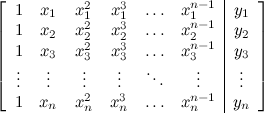
user posted image

and hence the interpolating polynomial can be found either by reducing this matrix to reduced row echelon form (Gauss–Jordan elimination), or by solving the linear system using Cramer’s Rule or user posted image.

P.S. MATRIX is not designed to be solved by hand, but very efficient in a numerical computing environment, which allows matrix manipulations, plotting of functions, and implementation of algorithms. Learn how to solve Linear Equations with MINVERSE and MMULT functions in Microsoft Excel.
TSCritical_Fallacy
post Dec 28 2013, 10:38 PM

∫nnộvisεr
Group Icon
VIP
3,713 posts

Joined: Nov 2011
From: Torino
Hi Flame Haze, RED-HAIR-SHANKS, maximR, crazywing26 and ystiang,

EXAMPLE :: Find a cubic polynomial whose graph passes through the points

user posted image

Solution :: Since there are four points, we will use an interpolating polynomial of degree n = 3. Denote this polynomial by

user posted image

and denote the x- and y-coordinates of the given points by

x1 = 1, x2 = 2, x3 = 3, x4 = 4 ... and ... y1 = 3, y2 = −2, y3 = −5, y4 = 0

Thus, the augmented matrix for the linear system in the unknowns a0, a1, a2, and a3 is

user posted image

I leave it for you to solve by hand (if you are interested), and here is the computation using MS Excel:

user posted image

from which it follows that a0 = 4, a1 = 3, a2 = −5, a3 = 1. Thus, the interpolating polynomial is

user posted image

The graph of this interpolating polynomial is shown below:

user posted image
Flame Haze
post Dec 28 2013, 10:40 PM

Enthusiast
*****
Senior Member
814 posts

Joined: Oct 2009


Sorry but I've forgotten every single thing about matrixes sweat.gif , A-level maths doesn't seem to deal with them, and I hope I won't be encountering them in Further Maths. Will take some time to catch up, busy spring cleaning the house for CNY icon_rolleyes.gif , and new semester is around the corner. cry.gif
TSCritical_Fallacy
post Dec 28 2013, 11:00 PM

∫nnộvisεr
Group Icon
VIP
3,713 posts

Joined: Nov 2011
From: Torino
QUOTE(Flame Haze @ Dec 28 2013, 10:40 PM)
Sorry but I've forgotten every single thing about matrixes sweat.gif  , A-level maths doesn't seem to deal with them, and I hope I won't be encountering them in Further Maths. Will take some time to catch up, busy spring cleaning the house for CNY  icon_rolleyes.gif , and new semester is around the corner.  cry.gif
House cleaning is important and you are an amazing character!

I suppose that you will encounter Matrices and Transformations in AS MODULE – Further Pure 1, and Matrix Algebra and Solution of Linear Equations in A2 MODULE - Further Pure 4. sweat.gif
danny88888
post Dec 28 2013, 11:24 PM

Casual
***
Junior Member
321 posts

Joined: Sep 2008


Attached Image Attached Image come someone explain this? What is the use for this?
TSCritical_Fallacy
post Dec 29 2013, 08:39 AM

∫nnộvisεr
Group Icon
VIP
3,713 posts

Joined: Nov 2011
From: Torino
Hi danny88888,

Some textbooks fail to explain the essential applications of Matrix Algebra. To find out the important application of the rank of a matrix, please read the confession of a Control & Instrument Engineer: smile.gif

To a Systems Designer/Engineer, whether they are Mechanical Systems & Electrical Systems, or Fluid Systems & Thermal Systems, the concepts of controllability and observability play an important role in the design of control systems in state space (Matrix form):

user posted image

where

x = n-state vector
u = r-control input vector
y = m-output vector
A = n × n state matrix
B = n × r control input matrix
C = m × n output matrix

A system is said to be controllable, if an input u to a system can be found that takes every state variable from a desired initial state user posted image to a desired final state user posted image; otherwise the system is said to be uncontrollable. In other words, an nth-order plant is completely controllable if the matrix

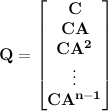
user posted image

is of rank n, where P is called the controllability matrix.

A system is said to be observable, if it is possible to determine the initial-state vector user posted image from the observation of the output y over a finite interval of time from t0; otherwise the system is said to be unobservable. Thus, an nth-order plant is completely observable if the matrix

user posted image

is of rank n, where Q is called the observability matrix.

Remark: The conditions of controllability and observability may govern the existence of a complete solution to the control system design problem. The solution to this problem may not exist if the system considered is not controllable. Although most physical systems are controllable and observable, corresponding mathematical models may not possess the property of controllability and observability.Then it is necessary to know the conditions under which a system is controllable and observable.
dividebyzero
post Dec 29 2013, 12:54 PM

New Member
*
Validating
37 posts

Joined: Oct 2010
Quick question once again:

user posted image

First part was cleared. The solution of the second part was blunt and depressing.

user posted image

What logic is this? Please, enlighten me.

In the meantime I'm off to study Abelian groups etc etc.
TSCritical_Fallacy
post Dec 29 2013, 05:40 PM

∫nnộvisεr
Group Icon
VIP
3,713 posts

Joined: Nov 2011
From: Torino
QUOTE(dividebyzero @ Dec 29 2013, 12:54 PM)
user posted image
ZERO,

This is purely algebraic manipulations. laugh.gif It is pretty obvious that

user posted image

Next, we divide both sides by y²:

user posted image

Then, we denote roots of the cubic function as

user posted image

Now we compare Eq.(1) with the properties of Sum and Product of Cubic Roots:

user posted image

From Eq.(3), we can detrmine

user posted image

With the results from (4) and (5), we can solve

user posted image

This post has been edited by Critical_Fallacy: Dec 29 2013, 05:46 PM
dividebyzero
post Dec 29 2013, 06:18 PM

New Member
*
Validating
37 posts

Joined: Oct 2010
QUOTE(Critical_Fallacy @ Dec 29 2013, 05:40 PM)
ZERO,

This is purely algebraic manipulations. laugh.gif It is pretty obvious that

user posted image

*
I understood every part of your explanation except this. Why would Sn be equivalent to the original roots? To my understanding, when the sum of two numbers is raised to any power, they give rise to intermediate terms like those in binomial theorem. Correct me if I'm wrong.
TSCritical_Fallacy
post Dec 29 2013, 06:42 PM

∫nnộvisεr
Group Icon
VIP
3,713 posts

Joined: Nov 2011
From: Torino
QUOTE(dividebyzero @ Dec 29 2013, 06:18 PM)
I understood every part of your explanation except this. Why would Sn be equivalent to the original roots? To my understanding, when the sum of two numbers is raised to any power, they give rise to intermediate terms like those in binomial theorem. Correct me if I'm wrong.
ZERO,

It was originated from here:

user posted image

Therefore, when we add up the three equations below:

user posted image

This post has been edited by Critical_Fallacy: Dec 29 2013, 06:51 PM
crazywing26
post Dec 29 2013, 07:00 PM

Getting Started
**
Junior Member
283 posts

Joined: Apr 2013


Critical_Fallacy, I do wonder how can you think in such brilliant ways of solving mathematical problems? In ways that usually people would not thought of yet effective. Is it with sufficient practise or critical thinking? Just asking only biggrin.gif

4 Pages  1 2 3 > » Top
 

Change to:
| Lo-Fi Version
0.2901sec    0.52    6 queries    GZIP Disabled
Time is now: 16th December 2025 - 09:56 PM