Welcome Guest ( Log In | Register )

Outline · [ Standard ] · Linear+

 Ask a Mathematical Physicist

views
     
ystiang
post Aug 6 2013, 09:23 PM

Getting Started
**
Junior Member
171 posts

Joined: May 2012
Mostly are out of syllabus, like Cauchy-Schwarz Inequality, AM-GM Inequality, but Number Theory(Modular Arithmetic, Diophantine Equation) and Euclidean Plane Geometry do cover on syllabus of STPM further maths...

9th Dec 2013: Updated questions and answers...

OMK 2013 Sulong

Section A

1. A large cube is divided into 99 cubes with integer lengths, 98 of them with side 1. Find the volume of the large cube.

2. Let M be the set of all nine-digit positive integers that contain each digit from 1 to 9 once. Find the highest common factor of all elements of M.

3. What is the remainder when 5^5555 is divided by 10000?

4. Given a trapezium with perpendicular diagonals and height 12. The length of one of its diagonals is 15. Find the area of the trapezium.

5. The digits of 2013 can be rearranged to form an arithmetic progression. Determine the number of four-digit positive integers with this property.
(Note: An arithmetic progression might have common difference 0.)

6. Determine the smallest prime factor of 8051.


Section B

1. Given a triangle ABC. The midpoints of AB, BC, CA are C1, A1, B1 respectively.
Construct another triangle DEF with side lengths equal to the lengths of AA1, BB1, CC1.
(a) Prove that the ratio of the area of triangle DEF to the area of triangle ABC is a constant, regardless of the choice of triangle ABC.
(b) Find the area of triangle DEF if AB = 13, BC = 14, CA = 15.


2. Prove that there exist integers a1, a2, a3, …, a2013, b, all greater than 1, such that
(a1!)(a2!)(a3!)…(a2013!) = b!


3. A sequence x1, x2, x3, … is defined as follows: x1 = 1, x2 = 143, and
xn+1 = 5(x1 + x2 + … + xn)/n for all n ≥ 2.
Prove that all terms of the sequence are integers.


Hints & Answers:
» Click to show Spoiler - click again to hide... «


This post has been edited by ystiang: Dec 9 2013, 05:53 PM
ystiang
post Aug 6 2013, 10:11 PM

Getting Started
**
Junior Member
171 posts

Joined: May 2012
QUOTE(5p3ak @ Aug 6 2013, 09:44 PM)
Thanks to maximR for showing me this thread.

I got question.

» Click to show Spoiler - click again to hide... «


Show means to prove right?  hmm.gif

This this correct? P(Z<500-510/s.d.)= 0.01
*
P(X < 500) = 0.01

Show basically means prove. Don't forget [shown].

Edited for: wrong info... sorry T_T

This post has been edited by ystiang: Nov 29 2013, 07:56 AM
ystiang
post Aug 6 2013, 10:39 PM

Getting Started
**
Junior Member
171 posts

Joined: May 2012
QUOTE(maximR @ Aug 6 2013, 10:31 PM)
Critical_Fallacy

I consulted the Bronze Medallist , and he told me that this solution is incorrect , and it'll be worth one point only . He attached a link to an accurate solution :

http://www.artofproblemsolving.com/Forum/v...ce9c11#p3152687

He added : The solution gives a construction of 2^k-1 terms but the problem statement requires exactly k terms

I never knew the questions in IMO would be this challenging !
*
Try to participate OMK if you intend to study form 6.
OMK considered as very hard, IMO I can't imagine my brain blank 4 hours...

For Malaysia, Top OMK performers are selected to attend the training camps, and the final IMO representatives are selected based on the students' performance in the camps and race. (I think only 6 in the final stage, and 3~4 of them are "bumiputera".

This post has been edited by ystiang: Aug 6 2013, 10:39 PM
ystiang
post Aug 6 2013, 11:56 PM

Getting Started
**
Junior Member
171 posts

Joined: May 2012
QUOTE(maximR @ Aug 6 2013, 10:48 PM)
I don't think I'll make the cut for IMO camps ( IPhO , probably . In the near future .  tongue.gif ) though . You know the Bronze Medallist I mentioned ? He's as old as me , but he has far more experience and he started very young , at about 7 .

How do you find STPM ? Enjoying it ?
*
You ask the same question to me several months ago... But I think my answer is different now.

Quiet enjoying... especially maths =)

My target: 3.5 or above.

Quit working this sem, and rapidly done all the PBS, focusing on study now.

The only 'tak syok' thing in this sem so far is my monthly test math paper, originally can get perfect score, but so much careless T_T


ystiang
post Aug 7 2013, 11:13 AM

Getting Started
**
Junior Member
171 posts

Joined: May 2012
QUOTE(5p3ak @ Aug 7 2013, 07:52 AM)
But when does the 4.3g come into play?  rclxub.gif
*
Since P(Z < z) = 0.01

Since the probability is less than 0.5, z must be negative.

P(Z < -z) = 1 - 0.01 = 0.99

From the normal distribution table, P(Z < 2.326) = 0.99

Thus, P(Z < -2.326) = 0.01

(500-510)/SD = -2.326
-10/SD = -2.326

SD = -10/-2.326 = 4.3g [shown]


This post has been edited by ystiang: Nov 29 2013, 07:55 AM
ystiang
post Aug 11 2013, 11:01 PM

Getting Started
**
Junior Member
171 posts

Joined: May 2012
QUOTE(Intermission @ Aug 11 2013, 02:06 PM)
As a unsuccessful wannabe math olympian who never had any formal training in mathematical olympiads, I participated in this year's OMK Sulong 2013. Here are a few of my crude attempts at solving those questions.  tongue.gif
The answers that I gave during the actual competition are:

1) 125. Looks quite obvious. So didn't give much thought to it.

3) 8125. Through last 4 digit analysis. the last 4 digits 0625 , 3125, 5625 and 8125 recur for every increment of 4 powers of 5. Since 5555= 4(1388) + 3, 8125 is the answer.

4) Is it 108? Wait, I think I made a mistake here. Not sure what I was thinking back then.user posted image[/URL][/IMG]

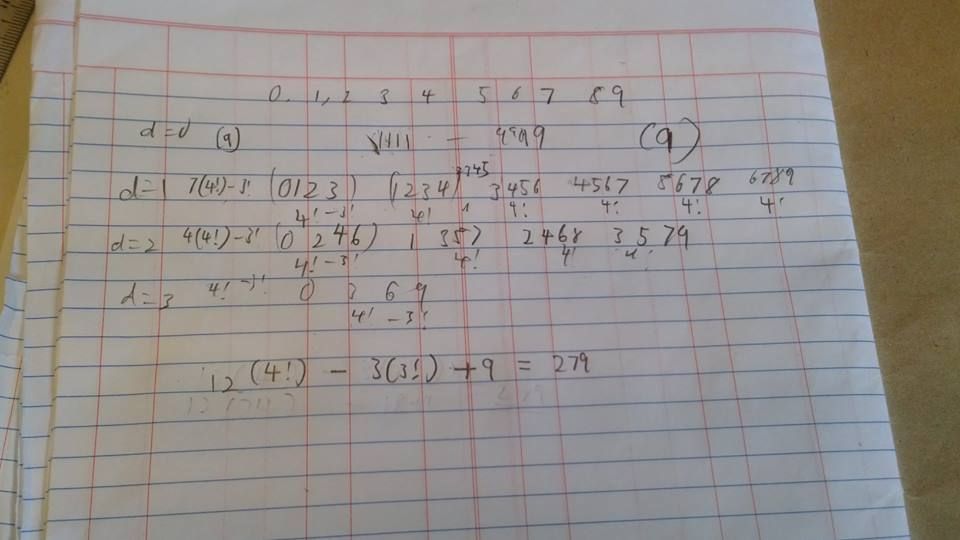
5) 279? Forgive me for my crude workings. 4! implies the number of permutation of the 4 digits. Minus 3! at combinations including the digit zero because one does not simply start a number with digit 0.
user posted image[/URL][/IMG]

6) 83. It took me forever to do it by trial and error but I got there.  tongue.gif

As for section B,

1) b) Heron's Formula!

3) I tried doing it by induction but I am not sure if I have done it correctly. The working is so long that I feel it is almost certainly wrong.
*
Bravo. Me too haven't had any formal training but surely you're more success than me.

For Section A, I think I only have one question correct, yup that prime factor.
Actually, 8051 = 8100 - 49 = (90^2) - (7^2) = (90-7)(90+7) = 83*97

Q3 should be easy though but I wrote 625 and the answer is 8125 TvT
Q1, Q4, Q5... just randomly put some answers...

Section B, I hate those prove, prove and prove...

ystiang
post Aug 14 2013, 01:12 AM

Getting Started
**
Junior Member
171 posts

Joined: May 2012
QUOTE(Intermission @ Aug 13 2013, 05:30 PM)
Are you planning to go for it again next year? It will be the last time we are allowed to participate in OMK.

*
I hope I can. I'm upper six this year, should be last year for me to participate =(
ystiang
post Aug 15 2013, 02:04 AM

Getting Started
**
Junior Member
171 posts

Joined: May 2012
QUOTE(manutd96 @ Aug 13 2013, 04:13 AM)
In a shooting competition, the probability that ali hits the target is 0.4. Find the minimum number of trials that ali needs to make such that the probability that he hits the target at least once is 0.8. << add maths question. How do I do it? Which method should I use? Is it part of binomial distribution?
*
P(X >= 1) = 1 - P(X < 1) = 1 - P(X = 0) = 0.8

Yup, binomial distribution.

» Click to show Spoiler - click again to hide... «


ystiang
post Nov 14 2013, 06:16 PM

Getting Started
**
Junior Member
171 posts

Joined: May 2012
QUOTE(ailing tan @ Nov 14 2013, 06:10 PM)
how to do this???? i need ur help!!!!!
*
|-2/(x+1)| < 1

-1 < -2/(x+1) < 1

0 < -2/(x+1) + 1 or -2/(x+1) - 1 < 0

(x-1)/(x+1) > 0 or -(x+3)/(x+1) < 0

By number line or sign table, you'll get

{x| x<-3 or x>1}


This post has been edited by ystiang: Nov 14 2013, 06:35 PM
ystiang
post Dec 4 2013, 06:43 AM

Getting Started
**
Junior Member
171 posts

Joined: May 2012
QUOTE(RED-HAIR-SHANKS @ Dec 4 2013, 04:48 AM)
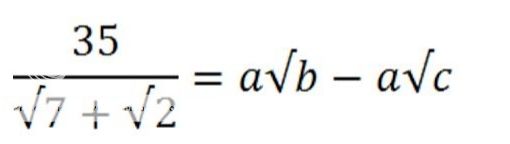
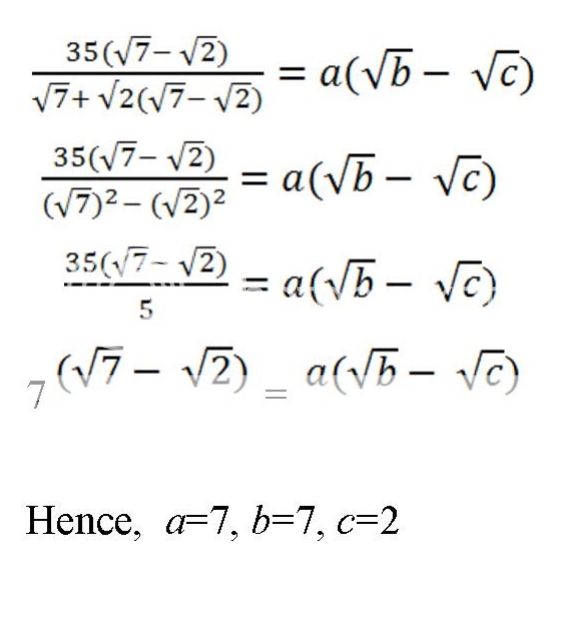
Thanks, by the way, can I humbly ask you to spend few minutes just to solve this question and might as well take a glance at my workings too? I spend around 2 hours to find the way to decipher it, quite some time, but I've finally managed to peel off my ''blind-eyes'' and find the values of a,b and c. Please do correct any of my steps in my workings if there's anything erroneous, and please do post any other workings that you know of. Thanks.

user posted image

» Click to show Spoiler - click again to hide... «

*
Your working don't have any error. Essentially you can verify your answer with calculator.
ystiang
post Dec 13 2013, 03:31 AM

Getting Started
**
Junior Member
171 posts

Joined: May 2012
QUOTE(Critical_Fallacy @ Dec 13 2013, 12:55 AM)
The following topics are lacking in STPM syllabus. To prepare for Calculus, you have to master them before going to college.

1. Functions (Trigonometric identities, Hyperbolic functions)
2. Complex numbers in exponential form
3. Differentiation of Hyperbolic functions
4. Taylor Series (General form of Maclaurin Series)
5. Partial differentiation
6. Integration by Reduction formula (useful for functions that can't be integrated directly)
7. Advanced integration applications (mechanics)
8. Polar coordinate systems
9. 2nd-order Differential equations
*
Trigonometric identities and Complex numbers in exponential form do cover in STPM Mathematics T syllabus.

Others are also in the STPM Further Mathematics syllabus which only a few canditates take for each year.

What they cut in the new syllabus for Maths T are law of sines, law of cosines, deductive geometry... Which are moved to Further Maths.


This post has been edited by ystiang: Dec 13 2013, 03:34 AM
ystiang
post Dec 15 2013, 10:16 PM

Getting Started
**
Junior Member
171 posts

Joined: May 2012
QUOTE(Critical_Fallacy @ Dec 13 2013, 11:24 AM)
Thanks for clarifying that! In fact, I learned the Law of Sines, and Law of Cosines in my classic SPM. laugh.gif

How are you doing on the mechanics? happy.gif
*
Oh ya, and Heron's formula too~

But the Plane Geometry in further maths is more likely logical reasoning, a lot of 'prove'.
And there are a few new theorems, Apollonius’, Ptolemy’s, Menelaus’ and Ceva’s theorem.

I'm terrible with this chapter... :/

Slowly in progress, so lazy to study in the holiday. sweat.gif
I'm done with kinematics in both one and two dimensions, now studying kinetics and dynamics.

This post has been edited by ystiang: Dec 15 2013, 10:23 PM
ystiang
post Dec 25 2013, 05:37 PM

Getting Started
**
Junior Member
171 posts

Joined: May 2012
QUOTE(v1n0d @ Dec 25 2013, 10:50 AM)
Alternating series are generally more fun to work with, because the terms sometimes cancel out, resulting in a very simple solution.

Since we're on the subject of series, do try this one:

For the geometric series user posted image, obtain the smallest value of user posted image if the difference between the sum of the first user posted image terms and the sum of the first user posted image terms is less than user posted image.

This is an STPM Mathematics T Paper 1 question from 2009.
*
A standard way to solve this type of problem in STPM, taking the logarithm at both sides:

» Click to show Spoiler - click again to hide... «


Hence, the least value of n is 5.

This post has been edited by ystiang: Dec 25 2013, 05:39 PM
ystiang
post Dec 31 2013, 05:53 PM

Getting Started
**
Junior Member
171 posts

Joined: May 2012
QUOTE(Critical_Fallacy @ Dec 31 2013, 05:28 PM)
Hi Flame Haze, RED-HAIR-SHANKS, maximR, crazywing26 and v1n0d,

Can you simplify this equation? sweat.gif

user posted image
*
Is it the answer:
» Click to show Spoiler - click again to hide... «


Brilliant & Interesting biggrin.gif
May I share it out later on my FB?


This post has been edited by ystiang: Dec 31 2013, 06:09 PM
ystiang
post Jan 16 2014, 05:18 PM

Getting Started
**
Junior Member
171 posts

Joined: May 2012
QUOTE(danny88888 @ Jan 15 2014, 11:08 PM)
Hi guys, just studied probability, have a tough time with conditional probability and independent events, is there anyone here who have a technique on how to master this topic?? Dont mind treating them a drink for your effort!
*
Conditional Probability
The probability that the event A occurs given that event B has occured is
P(A|B) = P(A ∩ B) / P(B)
(denominator is always the condition, notice the word given, if)


Independent events
Two events are said to be independent if the outcome of one cannot influence the outcome of the other in any way.
P(A ∩ B) = P(A) × P(B)
P(A|B) = P(A) or P(B|A) = P(B)

Example: STPM 2013 Mathematics (M) P2
It is known that of the customers buying laptops, 75% buy an antivirus software, 40% buy an additional memory card and 30% buy both.
a) Find the probability that a randomly selected customer does not buy any of those items.
b) Find the probability that a randomly selected customer buys an antivirus software given that an additional memory card is bought.
c) Determine whether the event "an additional memory card is bought" is independent of the event "an antivirus software is bought.

Information given:
QUOTE
Let A represents the customer that buy an antivirus software.
Let B represents the customer that buy an additional memory card.
P(A) = 0.75
P(B) = 0.4
P(A ∩ B) = 0.3


Solution:
» Click to show Spoiler - click again to hide... «


This post has been edited by ystiang: Jan 16 2014, 05:22 PM
ystiang
post Jan 24 2014, 07:49 PM

Getting Started
**
Junior Member
171 posts

Joined: May 2012
QUOTE(Critical_Fallacy @ Jan 24 2014, 02:54 PM)
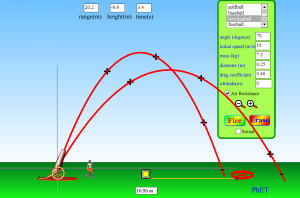
Has your Physics Teacher covered Projectile Motion? maximR, RED-HAIR-SHANKS, & ystiang are going to love this interactive simulation. happy.gif

Click to run the simulation!
user posted image
*
Will that human become disabled or even die with that shooting force? XDD

Btw, been not touching mechanics for a months...

Recently I'm studying discrete mathematics. (Very interesting =D)

Plenty of new theorem and corollary though.

This post has been edited by ystiang: Jan 24 2014, 08:37 PM
ystiang
post Jan 26 2014, 12:19 AM

Getting Started
**
Junior Member
171 posts

Joined: May 2012
QUOTE(delsoo @ Jan 26 2014, 12:08 AM)
Can you eexplain why dQ/Q0-Q equals to negative ln(Q0-Q) why not POSITIVE??    ps I haven't learn integration but I did know that d/dx of ln x= 1/x...
*
Notice that's ln(Q_0 - Q),

Since d/dx [ln (ax+b)] = a/(ax+b)
∫ a/(ax+b) dx = ln |ax+b| + c

In general,
∫ [f'(x) / f(x)] dx = ln |f(x)| + c

Hints/Ex.:
d/dx of (2 - x) = -1

This post has been edited by ystiang: Jan 26 2014, 12:26 AM
ystiang
post Jan 26 2014, 09:58 PM

Getting Started
**
Junior Member
171 posts

Joined: May 2012
QUOTE(danny88888 @ Jan 26 2014, 08:30 PM)
An internet firm considers three posibble mistakes in completing an order
A: The Wrong item is sent.
B: The item is lost in transit.
C: The item is damaged in transit.

Assuming the event A is independent of both B and C and that events B and C are mutually exclusive. The individual probabilities are P(A)=0.02, P(B)=0.01 and P©=0.04. Find the probability that at least one of the events, A,B or C occurs for a randomly chosen order.

This is how i do it, P(A)(P(B)+P©) = 0.02(0.01+0.04) = 1/1000 is it correct? Or can someone guide me to walkabout this question.
*
Event A is independent of both B and C,
P(A ∩ B) = P(A)P(B) = 0.0002
P(A ∩ C) = P(A)P© = 0.0008

Events B & C are mutually exclusive,
P(B ∩ C) = 0 or
P(B ∪ C) = P(B) + P© = 0.05

P(A or B or C) = P(A ∪ B ∪ C)
=P(A) + P(B) + P© - P(A ∩ B) - P(A ∩ C) - P(B ∩ C) = 0.02 + 0.01 + 0.04 - 0.0002 - 0.0008 - 0 = 0.069

You may use two-way table or Venn diagram to illustrate your problem.


ystiang
post Jan 27 2014, 05:27 PM

Getting Started
**
Junior Member
171 posts

Joined: May 2012
28th Jan 2014: Updated and corrected my wrong solutions...
Sorry for giving the wrong information! sweat.gif

QUOTE(MrCola @ Jan 27 2014, 01:51 PM)
F:x = x+1/x-1, if f^2(2)= 3f^-1(K), find the  value of k
Can anyone please help me to solve this question, im a little vit confused in inverse function.
*
f(x) = (x+1)/(x-1) , x ≠ 1

(f^2)(x) = [(x+1)/(x-1) + 1] / [(x+1)/(x-1) - 1] = x
(f^2)(2) = 2

Since (f^2)(x) = x, (f^-1)(x) = f(x)

You may verify it:
» Click to show Spoiler - click again to hide... «


(f^2)(2) = 3(f^-1)(k)
2 = 3[(k+1)/(k-1)]
By cross multiplying, you'll get k = -5.


QUOTE(maximR @ Jan 27 2014, 02:27 PM)
Mathematics questions

Q1.

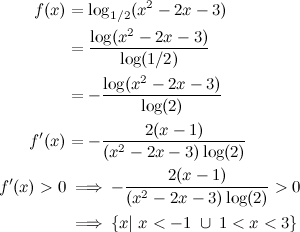
The interval on which the function f(x) = log1/2 (x^2 - 2x - 3) is monotone increasing is (  ) ?

Attempt :

» Click to show Spoiler - click again to hide... «


Q2.

If real numbers satisfy (x+5)^2 + (y-12)^2 = 14^2, then the minimum value of x^2 + y^2 is (  ) ?

Attempt :

» Click to show Spoiler - click again to hide... «

Thank you !  icon_rolleyes.gif
*
Q1
A monotone increasing function is always increasing, ie. f(x) is always increasing as x increase. ie. f(a) < f(b) for all a < b. The derivative of monotone increasing function is always positive.
» Click to show Spoiler - click again to hide... «


Q2
Notice that a circle equation.

BTW, Critical_Fallacy, can you teach me how to space out in mathURL LaTeX input?

Thanks for Critical_Fallacy for stating my mistakes~

This post has been edited by ystiang: Jan 28 2014, 08:03 PM
ystiang
post Jan 27 2014, 08:16 PM

Getting Started
**
Junior Member
171 posts

Joined: May 2012
QUOTE(ninty @ Jan 27 2014, 07:27 PM)
The idea is sound but I do not know how you came up with that answer.

» Click to show Spoiler - click again to hide... «


And I've drawn the graph explicitly just to check my calculations. I do not think f(x) = log_1/2 (x^2 - 2x - 3) is even defined on [-1,3].
*
Oops, I've drawn the wrong graph. doh.gif

sweat.gif

Just plot the graph with wolfram widgets,
http://www5a.wolframalpha.com/Calculate/MS...df=RangeControl

This post has been edited by ystiang: Jan 27 2014, 08:44 PM

2 Pages  1 2 >Top
 

Change to:
| Lo-Fi Version
0.0620sec    0.23    7 queries    GZIP Disabled
Time is now: 16th December 2025 - 06:57 AM