QUOTE(maximR @ Aug 14 2013, 03:28 PM)
Here's a question from an SPM Olympiad Fizik book :

QUOTE(kingkingyyk @ Aug 14 2013, 05:59 PM)
The
answer is B?

QUOTE(maximR @ Aug 14 2013, 06:02 PM)
According to the guy who provided the question, yes.
Under normal circumstances, your daily experience, common sense plus Newton’s 1st Law generally would tell you the “rational” answer seems to be
B. However, if B were the intended answer, why would the person who set the question bother to add the
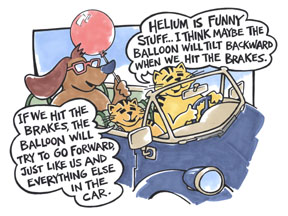
floating helium-filled balloon in the boxcar? Is it a tricky question?

There are 2 clues provided:
(1) If the helium-filled balloon wasn't tied to the floor of the boxcar,
it would float all the way up to the ceiling.
(2) In physics, Impulse of Force is used to refer to a
fast-acting force that is applied briefly: I = F*δt = m*δv.
QUOTE(kingkingyyk @ Aug 14 2013, 06:17 PM)
My reason:
When you are sitting in a moving bus, you are moving as well. When the bus stops, your inertia causes you to continue to move. Same to the question. The initial state of the objects is static. When you push the box, the inertia will cause the object to try to stay in the initial state, that is not moving. You might use Newton's Third Law to think about it.
QUOTE(kingkingyyk @ Aug 14 2013, 06:44 PM)
Physical Chemistry : Keywords, Calculations, Logical Thinking.
Lastly, logical thinking is not just using our “common sense.” After all, “common sense” tells us the earth is flat. But even when “common sense” is correct, it may tell us, for example, that gravity cannot be pulling a thing down and pushing up the other at the same time. Therefore,
critical thinking goes well beyond just using such basic principles.

Perhaps
Krevaki and
work_tgr can offer some clues as well.



 Aug 14 2013, 03:28 PM


 Quote
Quote


 0.0274sec
 0.72
0.72
 6 queries
 GZIP Disabled