Welcome Guest ( Log In | Register )

91 Pages « < 2 3 4 5 6 > » Bottom

Outline · [ Standard ] · Linear+

 Ask a Mathematical Physicist

views
     
maximR
post Aug 15 2013, 01:24 PM

Remember who you are
*******
Senior Member
3,864 posts

Joined: Dec 2009


» Click to show Spoiler - click again to hide... «


All right . Thank you ! I got only some of them covered through watching Walter Lewin's lectures , like proving the Work-Energy Theorem , P= h(rho)g , etc . I learned the general proof for derivatives too , but not the SPM way where you just add delta x and delta y to x and y respectively . I prefer the usual method , those that are available online .

TSCritical_Fallacy
post Aug 15 2013, 05:20 PM

∫nnộvisεr
Group Icon
VIP
3,713 posts

Joined: Nov 2011
From: Torino
QUOTE(kingkingyyk @ Aug 15 2013, 09:25 AM)
Helium gas balloon will move forward, pendulum will move behind? shocking.gif
QUOTE(Krevaki @ Aug 15 2013, 10:47 AM)
You're right! As the box moves to the right, the air gets compressed to the left, making the left side of the box denser than the right side. The helium balloon actually gets pushed to the right!
QUOTE(maximR @ Aug 15 2013, 01:20 PM)
But looking for explanations on the internet, there are some who use General Relativity to explain this. So is the explanation using air compression / buoyant force correct, or General Relativity, or both?
It takes the knowledge of Density of Steel, Density of Helium, Newton’s Law, Archimedes’ principle (Buoyancy), Impulse of Force, and a few assumptions to understand the tricky physics problem.

Statics ::

(1) The boxcar is at rest on a frictionless surface. Between the two objects inside the boxcar, a solid steel ball is much more dense than a helium-filled balloon. The steel pendulum and helium balloon are rigid bodies.

(2) Newton’s Law tells us the downward force of gravity pulls the steel pendulum and helium balloon, which results in their respective weights, W↓ = mg.

(3) Archimedes’ principle tells us the upward buoyant forces exerted on the steel pendulum and helium balloon “immersed fully” in the air, are equal to the respective weights of the air that the objects displace, F↑ = ρVg.

(4) For the heavier-than-air steel ball, because W↓ > F↑, the steel ball is pulled downward by the Net force.

(5) For the lighter-than-air helium balloon, because F↑ > W↓, the helium balloon is pushed upward by the Net force.

(6) Because the freedom of movements of the steel pendulum and helium balloon are constrained in the direction of the respective Net forces (vertical) axes, Newton’s Law tells us their respective normal Reaction forces are generated, so that they appear to be held in their places.

user posted imageuser posted image

Dynamics ::

(7) For the impulse of force, in which we assume the force exerted on boxcar acts for a very short time δt but is much greater than any other force present. Imagine flicking your finger to apply the impulse of force on the outer left side of the boxcar! The duration of the collision is very short and bring the boxcar to an abrupt STOP.

user posted image

(8) Now, because the steel pendulum and helium balloon are not constrained horizontally, any applied horizontal force will cause the objects to swing left and right.

(9) Since the boxcar comes to an abrupt STOP, when we reapply the Newton’s Laws and Archimedes’ principle from (1)−(5), the most probable positions of the steel pendulum and helium balloon caused by the impulse is depicted in Image C. What do you think? sweat.gif

user posted image
work_tgr
post Aug 15 2013, 10:53 PM

501 - Not Implemented
*******
Senior Member
4,583 posts

Joined: Oct 2006
From: ... suddenly 1 week


My first respond to this question is thinking about inertia and my answer goes to C.

Reedit : second thought, answer is B. tongue.gif

---

My explanation:

1. An opposite force, f occurs at the string to resist F. The direction of f is to the left.

2. Resultant force of L is pointing south west.

3. Resultant force of B is pointing north west.

This post has been edited by work_tgr: Aug 15 2013, 11:38 PM
VengenZ
post Aug 16 2013, 02:23 AM

La la la~
****
Senior Member
608 posts

Joined: Nov 2009
From: 127.0.0.1


Probably could use general relativity for that question. Einstein's famous thought experiment (physicist in a box):
user posted image
http://www.pitt.edu/~jdnorton/teaching/HPS...hway/index.html
(Principle in equivalence section)

Lets imagine the force exerted causes the box to accelerate with acceleration = g. Assuming that this experiment is not conducted in vacuum, we can say that the condition of the inside of the box will be exactly the same as if we were to rotate the box 90 degree anticlockwise.

Using this principle of equivalence, we know that in normal gravity condition (with air), the steel ball will move downward and the helium balloon will move upward. Now lets rotate this image back again 90 degree clockwise and we will get the answer.

The steel ball should move to the left and the helium to the right. So actually there is no answer? blink.gif

This post has been edited by VengenZ: Aug 16 2013, 02:32 AM
Krevaki
post Aug 16 2013, 11:52 AM

Regular
******
Senior Member
1,282 posts

Joined: Apr 2012
QUOTE(maximR @ Aug 15 2013, 01:20 PM)
I get it now .  nod.gif

But looking for explanations on the internet , there are some who use General Relativity to explain this . So is the explanation using air compression / buoyant force correct , or General Relativity , or both ?
*
Would you be so kind as to provide the reference link?

QUOTE(Critical_Fallacy @ Aug 15 2013, 05:20 PM)
It takes the knowledge of Density of Steel, Density of Helium, Newton’s Law, Archimedes’ principle (Buoyancy), Impulse of Force, and a few assumptions to understand the tricky physics problem.

Statics ::

(1) The boxcar is at rest on a frictionless surface. Between the two objects inside the boxcar, a solid steel ball is much more dense than a helium-filled balloon. The steel pendulum and helium balloon are rigid bodies.

(2) Newton’s Law tells us the downward force of gravity pulls the steel pendulum and helium balloon, which results in their respective weights, W↓ = mg.

(3) Archimedes’ principle tells us the upward buoyant forces exerted on the steel pendulum and helium balloon “immersed fully” in the air, are equal to the respective weights of the air that the objects displace, F↑ = ρVg.

(4) For the heavier-than-air steel ball, because W↓ > F↑, the steel ball is pulled downward by the Net force.

(5) For the lighter-than-air helium balloon, because F↑ > W↓, the helium balloon is pushed upward by the Net force.

(6) Because the freedom of movements of the steel pendulum and helium balloon are constrained in the direction of the respective Net forces (vertical) axes, Newton’s Law tells us their respective normal Reaction forces are generated, so that they appear to be held in their places.

user posted imageuser posted image

Dynamics ::

(7) For the impulse of force, in which we assume the force exerted on boxcar acts for a very short time δt but is much greater than any other force present. Imagine flicking your finger to apply the impulse of force on the outer left side of the boxcar! The duration of the collision is very short and bring the boxcar to an abrupt STOP.

user posted image

(8) Now, because the steel pendulum and helium balloon are not constrained horizontally, any applied horizontal force will cause the objects to swing left and right.

(9) Since the boxcar comes to an abrupt STOP, when we reapply the Newton’s Laws and Archimedes’ principle from (1)−(5), the most probable positions of the steel pendulum and helium balloon caused by the impulse is depicted in Image C. What do you think? sweat.gif

user posted image
*
But are we not looking for the moment when the box is "pushed"?
TSCritical_Fallacy
post Aug 21 2013, 04:05 AM

∫nnộvisεr
Group Icon
VIP
3,713 posts

Joined: Nov 2011
From: Torino
QUOTE(maximR @ Aug 15 2013, 01:20 PM)
But looking for explanations on the internet, there are some who use General Relativity to explain this. So is the explanation using air compression / buoyant force correct, or General Relativity, or both?
Have you discovered this link? icon_idea.gif

QUOTE(work_tgr @ Aug 15 2013, 10:53 PM)
Reedit : second thought, answer is B.  tongue.gif

1. An opposite force, f occurs at the string to resist F. The direction of f is to the left.
2. Resultant force of L is pointing south west.
3. Resultant force of B is pointing north west.
Possible, if it is an “open” boxcar. wink.gif

QUOTE(VengenZ @ Aug 16 2013, 02:23 AM)
Probably could use general relativity for that question. Einstein's famous thought experiment (physicist in a box):
In the physics of general relativity (non SPM), we can certainly describe the motion of the steel pendulum and helium balloon by the equivalence principle. icon_rolleyes.gif

QUOTE(Krevaki @ Aug 16 2013, 11:52 AM)
But are we not looking for the moment when the box is "pushed"?
True, but since the impulse acts for a very short time δt ~ 0 sec, the closest image that describes the positions (during δt) of the steel pendulum and helium balloon caused by the impulse that brings the boxcar to an abrupt STOP would probably be Image C. Just my 2 cents. sweat.gif

user posted image
TSCritical_Fallacy
post Aug 21 2013, 05:26 AM

∫nnộvisεr
Group Icon
VIP
3,713 posts

Joined: Nov 2011
From: Torino
QUOTE(young_97 @ Aug 20 2013, 09:32 PM)
this two question shocking.gif  unsure.gif
user posted image

Refer to Tensile testing and Stress–strain curve. icon_idea.gif

The formula to calculate the “apparentengineering stress, σ, is given by σ = F / Ao, assuming that the original cross-sectional area Ao is UNCHANGED (not reducing) through which the force is applied. In fact, as deformation continues, cross-sectional area decreases.

Similarly, the formula to calculate the engineering strain, ε, is given by ε = ΔL / Lo. Some questions give the elongation measurement L instead, and if that is the case, use ΔL = L − Lo.

user posted image

Refer to Properties of Water, Continuity equation, Bernoulli's principle and Venturi effect. icon_rolleyes.gif

Water is treated as an incompressible fluid because the changes in relative volume ΔV / V is negligible as the pressure increases.

In fluid mechanics, the continuity equation states that, in any steady state process, the rate of change of mass within the control volume is equal to the rate at which mass leaves the surface S of volume V.

user posted image

In other words, mass inflow = mass outflow. However, mass is also given by the product of ρV (density × volume). Because water is essentially incompressible, therefore the density ρ of water is treated as constant throughout the streamline from the hose to the head. For that reason, we can rewrite the continuity equation as follows:

Volumetric inflow rate, Q1 = Volumetric outflow rate, Q2[/B][/COLOR]

user posted image

Because Volumetric flow rate, Q is defined as Q = dV / dt,

and the volume of a mass, V is given by V = A*l (cross-sectional area × traversed length), therefore

A1 × (dl1 / dt) = A2 × (dl2 / dt)

Since dl / dt is defined as the velocity, υ, we can simplify the equation to

A1 × υ1 = A2 × υ2
young_97
post Aug 21 2013, 06:37 AM

Enthusiast
*****
Senior Member
828 posts

Joined: Dec 2010
QUOTE(Critical_Fallacy @ Aug 21 2013, 05:26 AM)
» Click to show Spoiler - click again to hide... «
I wonder where does we learn this hmm.gif
So deep rclxub.gif
TSCritical_Fallacy
post Aug 21 2013, 03:44 PM

∫nnộvisεr
Group Icon
VIP
3,713 posts

Joined: Nov 2011
From: Torino
QUOTE(manutd96 @ Aug 21 2013, 09:25 AM)
What is the ans for 3c and explanation please?
user posted image

If the gas is continuously supplied at a constant pressure, the new level of “A would probably look like this: icon_idea.gif

user posted image
manutd96
post Aug 21 2013, 04:02 PM

Getting Started
**
Junior Member
184 posts

Joined: Mar 2013


Ok thanks! Im impressed how well you edited the pic. I also want to know that,when an object fully immersed in water and its weight is then lets say, 5N , it will still be 5N when it is immersed further right as the vol of water displaced is still the same. Am I correct?
TSCritical_Fallacy
post Nov 13 2013, 09:11 PM

∫nnộvisεr
Group Icon
VIP
3,713 posts

Joined: Nov 2011
From: Torino
QUOTE(E Crew @ Nov 13 2013, 02:12 PM)
This is a question from my homework that I need help with.The question asked me to find the general solution for the given second differential equation.How am I suppose to solve this ? Anyone pros can help me out please ? icon_question.gif
user posted image
At first glance, you maybe tempted to solve ODE using Laplace Transforms. But it is not easy to find the Laplace Transform of 1/(1+t²). Since the ODE is a nonhomogeneous equation y'' + p(t)*y' + q(t)*y = g(t), your Lecturer probably has taught you about the Variation of Parameters formula.

user posted image

This post has been edited by Critical_Fallacy: Nov 15 2013, 01:58 PM
TSCritical_Fallacy
post Nov 13 2013, 09:44 PM

∫nnộvisεr
Group Icon
VIP
3,713 posts

Joined: Nov 2011
From: Torino
QUOTE(ailing tan @ Nov 13 2013, 09:18 PM)
can anyone explain why this is -500j not  positive 500J ???
user posted image
Because the gas undergoes expansion from L to J

W(L,J) = (0.005 − 0.003)m³ × (100)kPa = 200 J

and then the gas undergoes compression from J to L

W(J,L) = ½ × {(0.005 − 0.003)m³ × (600 + 100)kPa} = 700 J

Therefore, the net work of the system is:

W(L,J) − W(J,L) = 200 − 700 = -500 J

Ans (A)... icon_rolleyes.gif

This post has been edited by Critical_Fallacy: Nov 14 2013, 12:39 AM
TSCritical_Fallacy
post Nov 13 2013, 09:57 PM

∫nnộvisεr
Group Icon
VIP
3,713 posts

Joined: Nov 2011
From: Torino
QUOTE(ailing tan @ Nov 13 2013, 09:34 PM)
gaussian elimination is to make d g h = 0?
user posted image
Technically NO because you missed out the Matrix B. sweat.gif

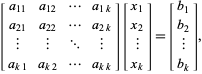
Given a system of linear equations in the form of Ax = B:

user posted image

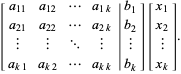
Transform the linear system into augmented matrix:

user posted image

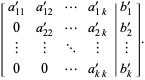
Then, perform Gaussian Elimination to put the augmented matrix into the upper triangular form:

user posted image
ailing tan
post Nov 14 2013, 05:28 PM

Getting Started
**
Junior Member
233 posts

Joined: Jul 2013
QUOTE(Critical_Fallacy @ Nov 13 2013, 09:44 PM)
Because the gas undergoes expansion from L to J

W(L,J) = (0.005 − 0.003)m³ × (100)kPa = 200 J

and then the gas undergoes compression from J to L

W(J,L) = ½ × {(0.005 − 0.003)m³ × (600 + 100)kPa} = 700 J

Therefore, the net work of the system is:

W(L,J) − W(J,L) = 200 − 700 = -500 J

Ans (A)... icon_rolleyes.gif
*

hi tanks for ur reply! i can understand finally!!
ailing tan
post Nov 14 2013, 06:10 PM

Getting Started
**
Junior Member
233 posts

Joined: Jul 2013
how to do this???? i need ur help!!!!!


Attached thumbnail(s)
Attached Image
ystiang
post Nov 14 2013, 06:16 PM

Getting Started
**
Junior Member
171 posts

Joined: May 2012
QUOTE(ailing tan @ Nov 14 2013, 06:10 PM)
how to do this???? i need ur help!!!!!
*
|-2/(x+1)| < 1

-1 < -2/(x+1) < 1

0 < -2/(x+1) + 1 or -2/(x+1) - 1 < 0

(x-1)/(x+1) > 0 or -(x+3)/(x+1) < 0

By number line or sign table, you'll get

{x| x<-3 or x>1}


This post has been edited by ystiang: Nov 14 2013, 06:35 PM
TSCritical_Fallacy
post Nov 14 2013, 08:02 PM

∫nnộvisεr
Group Icon
VIP
3,713 posts

Joined: Nov 2011
From: Torino
QUOTE(ailing tan @ Nov 14 2013, 06:10 PM)
how to do this???? i need ur help!!!!!
This belongs to the topic called Absolute-Value Inequalities.

To solve this problem, let's understand what is absolute value.

The absolute value of a real number R (denoted “|R|”) may be defined as the distance of R from zero.

For example, both –1 and 1 are one unit from zero, and therefore we have |–1| = |1| = 1.

The absolute value of R can be written as a function of the positive square root: |R| = √(R²).

Come back to the problem: |–2 / (x + 1)| < 1.

Let's define f(x) = –2 / (x + 1), and it follows that |f(x)| < 1.

By the above definition, we can intuitively imagine that f(x) = –1 and f(x) = 1.

To satisfy the condition of the inequality |f(x)| < 1, let's do four possible logic tests:

Test 1: f(x) < –1 :: Let f(x) = –1.1, and |f(x)| = |–1.1| = 1.1 < 1 ~ FALSE

Test 2: f(x) > –1 :: Let f(x) = –0.9, and |f(x)| = |–0.9| = 0.9 < 1 ~ TRUE

Test 3: f(x) < 1 :: Let f(x) = 0.9, and |f(x)| = |0.9| = 0.9 < 1 ~ TRUE

Test 4: f(x) > 1 :: Let f(x) = 1.1, and |f(x)| = |1.1| = 1.1 < 1 ~ FALSE

From the results, because Test 2 and 3 are TRUE, we can conclude that given the inequality |x| < a, the solution is always of the form –a < x < a.

Therefore, we have two inequalities: –1 < |f(x)| < 1.

Solve inequality #1: –1 < –2 / (x + 1) ... → ... we have x > 1.

Solve inequality #2: –2 / (x + 1) < 1 ... → ... we have x < –3.

Once you understand the concept, you can use the same simple approach as ystiang did.

Question: What if you were given the inequality |x| > a? sweat.gif
TSCritical_Fallacy
post Nov 15 2013, 12:59 PM

∫nnộvisεr
Group Icon
VIP
3,713 posts

Joined: Nov 2011
From: Torino
QUOTE(maximR @ Nov 15 2013, 11:45 AM)
If possible, post your questions in Critical_Fallacy's Ask a Mathematical Physicist Thread.  smile.gif
user posted image

Even though it is a complex number, you can solve this problem using basic algebraic manipulation skill that you have already learned in Form 2 Factorization & Form 3 Simultaneous equations. Let me show you:

Find √(16 − 30i).

Since (16 − 30i) is a complex number, your developed mathematical intuition should tell you that the expected answer must be also a complex number (a + bi). Therefore it can be written as

√(16 − 30i) = √[(a + bi)²]

Your task now is to find a and b. As simple as that, regardless of the square root sign.

16 − 30i = (a + bi)² = a² + 2abi + b²i².

Since i² = −1, you can rearrange the equation to

16 − 30i = (a² − b²) + (2ab)i.

Eq.(1): a² − b² = 16

Eq.(2): 2ab = −30 ... → ... b = −15/a

You can solve the simultaneous equations by expressing b in term of a and substitute it into Eq.(1):

a² − (−15/a)² = 16

Multiply both sides with a² and turn it into a standard quadratic equation:

(a²)² − 16a² − 225 = 0

(a² − 25) (a² + 9) = 0

By the definition of a complex number (a + bi) where a and b must be Real Numbers, it renders a² = −9 invalid and therefore

a² − 25 = 0 ... → ... a = 5

Back-substituting a = 5 into Eq.(2) to find b:

b = −15/5 = −3

With the values found for a & b, and for all complex z with Re(z) > 0, √(z²) = z, the answer for

√(16 − 30i) = 5 − 3i icon_rolleyes.gif

This post has been edited by Critical_Fallacy: Nov 15 2013, 01:59 PM
TSCritical_Fallacy
post Nov 17 2013, 01:05 AM

∫nnộvisεr
Group Icon
VIP
3,713 posts

Joined: Nov 2011
From: Torino
QUOTE(ailing tan @ Nov 16 2013, 05:20 PM)
I was given this question... can someone show how to get k=3??? my ans is not 3
user posted image

Given a system of linear equations with a set of variables x, y, z. Find k.

R1: 1x − 2y + 2z = 6
R2: 2x + 1y + 3z = 5
R3: 4x + 7y + 5z = k

Let's do some elementary row operations: You're lucky because element a11 is 1. See R1.

To eliminate coefficient of x (2) in R2, therefore 2 × R1: 2x − 4y + 4z = 12
R2 − 2R1:
R2': 5y − 1z = −7 ... eliminated x

To eliminate coefficient of x (4) in R3, therefore 4 × R1: 4x − 8y + 8z = 24
R3 − 4R1:
R3': 15y − 3z = k − 24 ... eliminated x

If you compare carefully R2' with R3', you'll notice that R2' & R3' are the same equation when scaled by a factor of 3, therefore 3 × R2': 15y − 3z = −21

Because it is stated that the equations are consistent, only then you can perform the next operation:
R3' − 3R2': 0 = k − 3

Solve for k and you have k = 3.

P.S. If you analyze the coefficient matrix, its determinant is 0, and thus the matrix is said to be singular, or it doesn't have a matrix inverse. If you plot the three equations in 3D, you'll discover that the linear system has infinitely many solutions because the equations are linearly dependent (see above R2' and R3'). If the system has a single unique solution, the three planes will intersect at a single point. icon_idea.gif

user posted image
ailing tan
post Nov 17 2013, 03:39 PM

Getting Started
**
Junior Member
233 posts

Joined: Jul 2013
why this is B why not A???


Attached thumbnail(s)
Attached Image

91 Pages « < 2 3 4 5 6 > » Top
 

Change to:
| Lo-Fi Version
0.0394sec    0.96    6 queries    GZIP Disabled
Time is now: 17th December 2025 - 11:30 AM