Welcome Guest ( Log In | Register )

392 Pages « < 348 349 350 351 352 > » Bottom

Outline · [ Standard ] · Linear+

 Insurance Talk V7!, Your one stop Insurance Discussion

views
     
MUM
post Mar 21 2025, 11:48 AM

10k Club
********
All Stars
14,959 posts

Joined: Mar 2015

QUOTE(togekiss @ Mar 21 2025, 09:58 AM)
this is true, but to collectively gather everyone to confront the insurance company, that will probably need social media or something. and someone needs to be the leader to bring the case to them.
*
If it is true or really enforce able by law....
........
.......
These repricing things had been there since many years ago, ...... had been brought up in the medias, ......had been brought up in the parliament, ...... BNM had also got involved, ...... recently there was even a 2 days public gatherings organised by PAC, .

Has Those "things" brought up to the attention ?

You judge yourself loh


contestchris
post Mar 21 2025, 12:12 PM

Look at all my stars!!
*******
Senior Member
5,579 posts

Joined: Aug 2011

QUOTE(Andr3w @ Mar 21 2025, 11:13 AM)
1) Yes I know. This is what I found and hopefully is correct. The increment premium after new plan upgrade will subject to again the commission structure deduction (up to 10 years) , with example 1st year they will minus 40% off my first year increment premium (not total premium). I just wonder anyone can tell me .... if example after upgrade new plan,  this 1st year premium,if  i not able to pay, will they go and minus the 40% from my 20k investment portion?

About why not standalone, I already explain previously.
*
No, they will not deduct the 40% of the "unallocated premiums" from your existing ILP account balances.

If you upgrade to a new medical rider on your existing investment-linked policy, you do not actually need to increase your basic regular premium (for which the increased portion will be re-subjected to lower allocation rates).

Also, there is a "hack" around this:

1. Just do single-premium topups annually (with 95% allocation rate)
2. Opt for regular top-up premiums (with 95% allocation rate)
hafizmamak85
post Mar 21 2025, 12:24 PM

Casual
***
Junior Member
463 posts

Joined: Nov 2009

QUOTE(contestchris @ Mar 21 2025, 12:12 PM)
No, they will not deduct the 40% of the "unallocated premiums" from your existing ILP account balances.

If you upgrade to a new medical rider on your existing investment-linked policy, you do not actually need to increase your basic regular premium (for which the increased portion will be re-subjected to lower allocation rates).

Also, there is a "hack" around this:

1. Just do single-premium topups annually (with 95% allocation rate)
2. Opt for regular top-up premiums (with 95% allocation rate)
*
There is no hack. ITOs know about this so they don't allow for top-ups to be made until you've fully paid up any outstanding annual premium amounts
SUStrumpkampung
post Mar 21 2025, 12:28 PM

Getting Started
**
Junior Member
59 posts

Joined: Jan 2017

QUOTE(hafizmamak85 @ Mar 18 2025, 08:49 PM)
You're being fleeced. Your new annual premiums are being quoted at a higher amount most likely due to lower projected fund investment return rates. Also, there may be other new policy charges (do check on this)
*
i have no time to go thru all the details and am not familiar with insurance terms

today they sent a reminder for the upgrade via email

i just noticed that the lifetime limit is now unlimited- no lifetime limit with 5 mil annual limit.

Maybe this is why the premium hiked rm6k extra to rm8k per year.

It is also stated that if i accept, no waiting period and medical underwriting. However if i choose to alter the terms, then there will be. Like forcing me to take it


Crazy... 6k extra per year worth it? or just cancel and risk it

koja6049
post Mar 21 2025, 12:56 PM

On my way
****
Junior Member
615 posts

Joined: Feb 2018
QUOTE(MUM @ Mar 21 2025, 11:48 AM)
If it is true or really enforce able by law....
........
.......
These repricing things had been there since many years ago, ...... had been brought up in the medias,  ......had been brought up in the parliament, ......  BNM had also got involved, ...... recently there was even a 2 days public gatherings organised by PAC, .

Has Those "things" brought up to the attention ?

You judge yourself loh
*
the only thing that was "brought to attention" is insurance shifting the blame to the medical industry, and govt seems want to act on it. But here lies the problem: you put pricing pressure on the doctors, the doctors can just leave the country and practice elsewhere. Our healthcare system will just deteriorate, this will not end well.
MUM
post Mar 21 2025, 01:01 PM

10k Club
********
All Stars
14,959 posts

Joined: Mar 2015

QUOTE(koja6049 @ Mar 21 2025, 12:56 PM)
the only thing that was "brought to attention" is insurance shifting the blame to the medical industry, and govt seems want to act on it. But here lies the problem: you put pricing pressure on the doctors, the doctors can just leave the country and practice elsewhere. Our healthcare system will just deteriorate, this will not end well.
*
Then it is not enforceable by law that the published premium rate during initial purchase had to be fulfilled to maturity

This post has been edited by MUM: Mar 21 2025, 01:02 PM
hafizmamak85
post Mar 21 2025, 01:06 PM

Casual
***
Junior Member
463 posts

Joined: Nov 2009

QUOTE(trumpkampung @ Mar 21 2025, 12:28 PM)
i have no time to go thru all the details and am not familiar with insurance terms

today they sent a reminder for the upgrade via email

i just noticed that the lifetime limit is now unlimited- no lifetime limit with 5 mil annual limit.

Maybe this is why the premium hiked rm6k extra  to rm8k per year.

It is also stated that if i accept, no waiting period and medical underwriting. However if i choose to alter the terms, then there will be. Like forcing me to take it
Crazy... 6k extra per year worth it? or just cancel and risk it
*
I don't think the 6k extra premium per annum is legal/lawful nor justifiable especially since the cost of insurance charges for your original medical rider is the same or higher compared to the cost of insurance charges for the upgraded medical rider. There must have been some underpricing/mispricing errors in the original IL policy (with the original medical rider) that they are now correcting in the premium pricing after accounting for the new upgrade. Completely unjustifiable.I believe both you and Andrew are in a same/similar boat. Fight for your rights. Sue them.

QUOTE(hafizmamak85 @ Mar 21 2025, 11:37 AM)
The part that really pisses me off and makes my blood boil  about your situation is that they are charging you allocation charges again for the additional premium levied when upgrading your plan. You've already made the case that the cost of insurance charges are the same or lesser for the medical coverage of your plan after upgrading. So why should the new premium amount quoted for your plan have any increment in the first place and why should you be expected to pay any further additional charges?????

This upgrade is basically an excuse to reprice your policy for sustainability, which maybe the ITO didn't account for sustainability properly in the policy's initial pricing. Why should you, the consumer, be expected to bear the burden for the ITO's mispricing and other errors???!
*
Always remember this: Also, if the ITOs didn't want to take on pricing risk, they should not have allowed for investment returns to be considered in pricing the IL policies nor should they have sold long term products. The moment the ITOs did that, they effectively implied a certain expectation in relation to the investment performance of the IL unit funds as well as the fixed nature of the cost of insurance and other long term charges in the product.

QUOTE(hafizmamak85 @ Mar 20 2025, 09:50 PM)
1 & 3) You have every right to insist on the insurers and takaful operators (ITOs) footing the bill as they have not kept up with your reasonable expectation in relation to the original annual premium amount.  The expectation implied in the pricing of the product was for the original annual premium to be sufficient to sustain the policy until the end of term.

If the ITOs weren't comfortable in taking on this risk, they should not have had the authority to set the minimum amount of sustainable annual premium for given insurance policy coverages nor would BNM be able to make it a requirement for the ITOs to price the IL contract such that it was expected to be sustainable until the end of term. There is legal force and value to this expectation. It is not zilch or zero. It has value. The question is , what is the value? And to me, the value implied is a no lapse guarantee if policyholders keep to their original annual premium payments and didn't make any withdrawals. Also, if the ITOs didn't want to take on pricing risk, they should not have allowed for investment returns to be considered in pricing the IL policies nor should they have sold long term products. The moment the ITOs did that, they effectively implied a certain expectation in relation to the investment performance of the IL unit funds as well as the fixed nature of the cost of insurance and other long term charges in the product.

Policyholders have an ironclad case. But whether our courts have competent, impartial judges and whether we have true professional actuaries who have very strong ethics is a separate matter. Our Malaysian actuaries are not competent especially when it comes to consumer rights and doing right by them and a lot of these issues are due to their lapses/incompetence.

But I still think consumers have the winning hand as this issue is beyond bonkers. I mean just look at the retained and ongoing earnings of life insurers. They are earning beyond RM 4 billion per annum and have over RM 20 billion in equity/retained earnings. There is no good reason to reprice the products/IL contracts. They are not facing going concern risks. The question is, do you as a consumer want to go through the hassle of fighting for your rights? I say you should, but it is ultimately up to you. Your call. If you keep letting them ride roughshod over you, they will keep increasing the premiums, but if some of you or a significant minority of you start complaining and taking action, this whole house of cards will fall. They will cry uncle.

How to hold them to account? By lodging complaints with BNM and the financial ombudsman and by launching a class action lawsuit. It's time for you guys to band together. Either band together and fight back or keep getting bullied. The choice is yours. None of you have to eat their spit.

Also, please do not buy into the media, BNM and the ITOs fluff excuse of medical inflation. It's just a ruse. They are doing this solely to guard the earning power of ITOs. The only ones standing in their way is you. The consumer. You have the ultimate power. Not them. Do not be afraid of them. None of these (medical inflation and other excuses) were unforeseeable. They did not account for even a measly 8% in annual medical inflation throughout the term of the contract although this has been the case for private healthcare expenditure in Malaysia since 2011. The ITOs have huge bloated expense and commission structures in place and excessive cost of insurance profit margins. And yet, they failed to account for  8% per annum medical inflation because they are confident the media is on their side and they can paint a one sided picture of hospitals being the cause although that isn't the reality of it.

I've already proved it to you. You can have a policy with death and disability coverage of RM 200k and a medical card with average payout of over RM 25k with claim frequency of over 12 claimants per 100 policyholders for only RM4200 per annum. So, please do not buy into their medical inflation excuse.

*
This post has been edited by hafizmamak85: Mar 21 2025, 01:11 PM
koja6049
post Mar 21 2025, 01:06 PM

On my way
****
Junior Member
615 posts

Joined: Feb 2018
QUOTE(MUM @ Mar 21 2025, 01:01 PM)
Then it is not enforceable by law that the published premium rate during initial purchase had to be fulfilled to maturity
*
I think the premium rate thing is already known, it is just hidden down in the t&c fine print when you sign the contract. The problem lies in many agents never bothered to explain because they just want fast money.

When I first signed insurance as a teenager, I also don't know much about this as the agent just shove the policy down my parents' throats. But after I went to Singapore for about 10 years and had to buy medishield, only then I learnt about repricing, premium increment with age, ILP etc.
MUM
post Mar 21 2025, 01:19 PM

10k Club
********
All Stars
14,959 posts

Joined: Mar 2015

QUOTE(koja6049 @ Mar 21 2025, 01:06 PM)
I think the premium rate thing is already known, it is just hidden down in the t&c fine print when you sign the contract. The problem lies in many agents never bothered to explain because they just want fast money.

When I first signed insurance as a teenager, I also don't know much about this as the agent just shove the policy down my parents' throats. But after I went to Singapore for about 10 years and had to buy medishield, only then I learnt about repricing, premium increment with age, ILP etc.
*
When I 1st bought insurance, ... not so many info available ( no internet), perhaps I was too young to really pay attention to the things said 30-40 yrs later, ..things about the insurance charges started in the policy table will be different according to age and that it will be subjected to changes.
The medical inflation rate at that time i believe was not high then......as I believes it started to jump alot after Covid.
Also due to the income n budget, there are only a limited types of insurance I can buy.

Later years, BNM came out with, "free look" requirements, which allowed the purchaser to read and understand before actually holding to it.
Now in the internet age, many info are available, so reading those info in the policy during the "look free period" easier


koja6049
post Mar 21 2025, 01:28 PM

On my way
****
Junior Member
615 posts

Joined: Feb 2018
QUOTE(MUM @ Mar 21 2025, 01:19 PM)
When I 1st bought insurance, ... not so many info available ( no internet), perhaps I was too young to really pay attention to the things said 30-40 yrs later, ..things about the insurance charges started in the policy table will be different according to age and that it will be subjected to changes.
The medical inflation rate at that time i believe was not high then......as I believes it started to jump alot after Covid.
Also due to the income n budget, there are only a limited types of insurance I can buy.

Later years, BNM came out with, "free look" requirements, which allowed the purchaser to read and understand before actually holding to it.
Now in the internet age, many info are available, so reading those info in the policy during the "look free period" easier
*
the problem still persist because not many people know what to look, where to look, or even understand what they're looking. The way insurance is sold in malaysia today is still smoke and mirrors, agents don't really explain well to their customers, and alot of info is still not available online.

A recent case when I visited a relative during this year's CNY, an aunt >60y/o, she complained that her premium has increased 50%. I told her to let me see her policy, it turns out her agent proposed to increase the premium on Wealthcover, not health, that is the main cause of the 50% increase. I tried explaining to her but she was not convinced, because she accepted what her agent has told her, and also it sort of tallied with the medical repricing thing currently in the news.
MUM
post Mar 21 2025, 01:37 PM

10k Club
********
All Stars
14,959 posts

Joined: Mar 2015

QUOTE(koja6049 @ Mar 21 2025, 01:28 PM)
the problem still persist because not many people know what to look, where to look, or even understand what they're looking. The way insurance is sold in malaysia today is still smoke and mirrors, agents don't really explain well to their customers, and alot of info is still not available online.

A recent case when I visited a relative during this year's CNY, an aunt >60y/o, she complained that her premium has increased 50%. I told her to let me see her policy, it turns out her agent proposed to increase the premium on Wealthcover, not health, that is the main cause of the 50% increase. I tried explaining to her but she was not convinced, because she accepted what her agent has told her, and also it sort of tallied with the medical repricing thing currently in the news.
*
Then hv to get a few agents from different agencies or companies to make the presentation and hv the full presentation session documented before buying.
There will be no end if want to blame the agent.
With the introduction of free look policy, the blame was shifted to buyer himself

This post has been edited by MUM: Mar 21 2025, 01:51 PM
hafizmamak85
post Mar 21 2025, 01:48 PM

Casual
***
Junior Member
463 posts

Joined: Nov 2009

QUOTE(koja6049 @ Mar 21 2025, 01:06 PM)
I think the premium rate thing is already known, it is just hidden down in the t&c fine print when you sign the contract. The problem lies in many agents never bothered to explain because they just want fast money.

When I first signed insurance as a teenager, I also don't know much about this as the agent just shove the policy down my parents' throats. But after I went to Singapore for about 10 years and had to buy medishield, only then I learnt about repricing, premium increment with age, ILP etc.
*
Premiums and cost of insurance charges are fixed. What is stated in the fine print can't be construed to the detriment of policyholders, which isn't currently the case. The clauses allowing for the repricing of premium and cost of insurance (COI) charges can only be exercised when the ITOs are facing going concern risks. Not to maintain their profit margins. Period.

For all the clauses that you point out on the ability of ITOs to reprice premiums/COI, I can also point you to disclosures and policy requirements boldly stating otherwise.

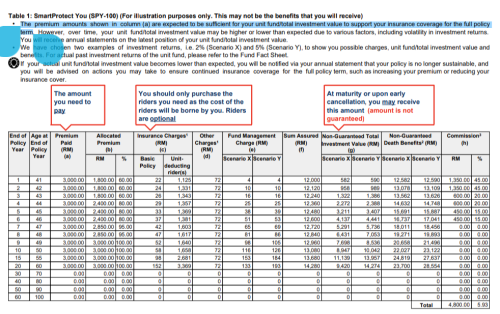
"The premium amount shown in column (a) are expected to be sufficient for your unit fund/total investment value to support your insurance coverage for the full policy term"

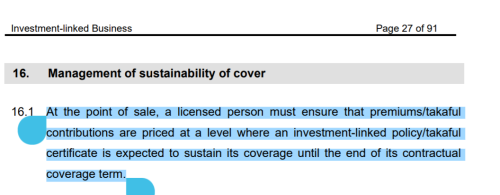
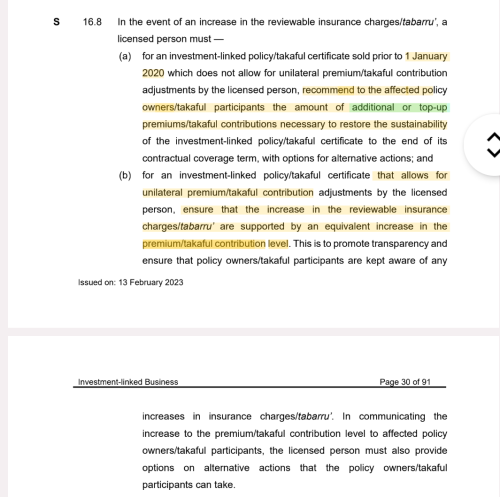
At the point of sale, a licensed person must ensure that premiums/takaful contributions are priced at a level where an investment-linked policy/takaful certificate is expected to sustain its coverage until the end of its contractual coverage term

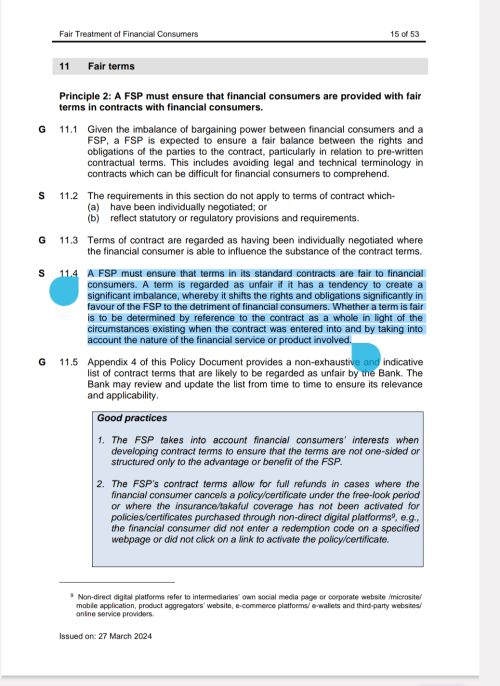
A FSP must ensure that terms in its standard contracts are fair to financial consumers. A term is regarded as unfair if it has a tendency to create a significant imbalance, whereby it shifts the rights and obligations significantly in favour of the FSP to the detriment of financial consumers. Whether a term is fair is to be determined by reference to the contract as a whole in light of the circumstances existing when the contract was entered into and by taking into account the nature of the financial service or product involved.

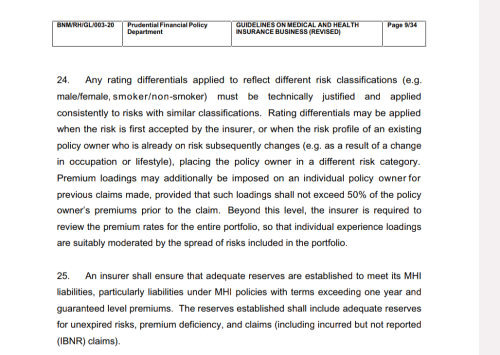
An insurer shall ensure that adequate reserves are established to meet its MHI liabilities, particularly liabilities under MHI policies with terms exceeding one year and guaranteed level premiums. The reserves established shall include adequate reserves for unexpired risks, premium deficiency, and claims (including incurred but not reported (IBNR) claims).

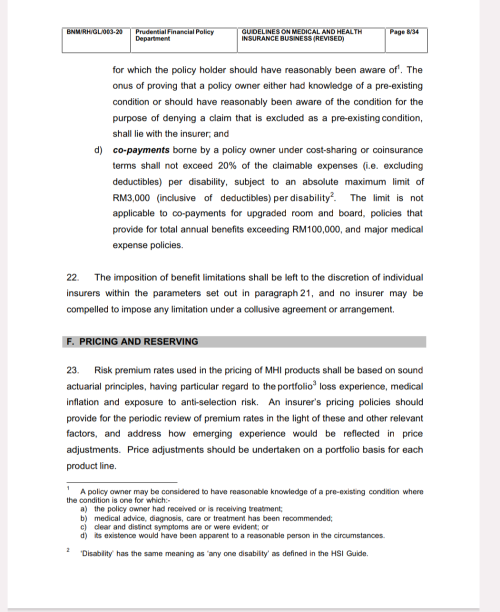
Risk premium rates used in the pricing of MHI products shall be based on sound actuarial principles, having particular regard to the portfolio3 loss experience, medical inflation and exposure to anti-selection risk. An insurer’s pricing policies should provide for the periodic review of premium rates in the light of these and other relevant factors, and address how emerging experience would be reflected in price adjustments. Price adjustments should be undertaken on a portfolio basis for each product line.

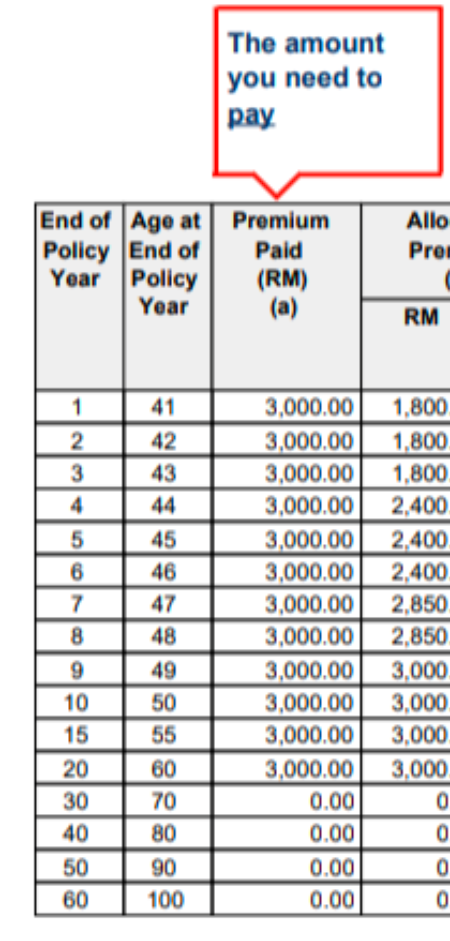
There are no premium step ups shown in the premium payment schedule per the illustration disclosure (see column (a)) nor are the premiums or cash values projected to account for different types of medical inflation scenarios (only various cash value outcomes for different types of investment return scenarios), implying fixed cost of insurance charges and premiums. Even with the different investment return scenarios, the ITOs still have committed to an expectation of sufficiency of annual premiums to sustain the policy until the end of term. The ITOs are also required to have sufficiently and appropriately accounted for medical inflation in the pricing of annual premiums and cost of insurance charges for long term products.

When there are contradictions between policy terms, disclosures and policy requirements, the contract terms and policies will be interpreted or construed in favour of policyholders, the weaker party in this bargain.

Will the Contra Proferentem Rule Remain Relevant for Insurance Contracts in Malaysia?

The contra proferentem rule is no stranger to the insurance industry in Malaysia. It is trite that pursuant to section 3(1) of the Civil Law Act 1956, the Malaysian courts could invoke the contra proferentem rule under the common law of England to interpret an ambiguity or uncertainty in an insurance contract.

When a term in an insurance contract lends itself to more than one possible construction/ interpretation, an ambiguity may be said to arise in the meaning of the term. In such event, the ambiguity is to be resolved against the insurers by applying the contra proferentum rule as they are the parties responsible for formulating the terms of the contract.

THE CURRENT MALAYSIAN POSITION

The contra proferentem rule has been applied by the Malaysian courts as part of the rules in interpreting insurance contracts as exemplified by the cases discussed belowThe contra proferentem rule has been applied by the Malaysian courts as part of the rules in interpreting insurance contracts as below.

In Malaysia National Insurance Sdn Bhd v Abdul Aziz bin Mohamed Daud [1979].......


user posted image

user posted image

user posted image

user posted image

user posted image

user posted image

This post has been edited by hafizmamak85: Mar 21 2025, 07:48 PM
adele123
post Mar 21 2025, 10:02 PM

Look at all my stars!!
*******
Senior Member
4,726 posts

Joined: Jul 2013


QUOTE(hafizmamak85 @ Mar 21 2025, 12:24 PM)
There is no hack. ITOs know about this so they don't allow for top-ups to be made until you've fully paid up any outstanding annual premium amounts
*
Not true.
hafizmamak85
post Mar 21 2025, 10:24 PM

Casual
***
Junior Member
463 posts

Joined: Nov 2009

QUOTE(adele123 @ Mar 21 2025, 10:02 PM)
Not true.
*
Wonderful. Can you please announce in this forum which ITOs allow for this?

If what you say is true, what is there to stop policyholders from just paying top ups (high allocations) and not paying regular annual premiums (subject to high allocation charges; lower allocations)???

This post has been edited by hafizmamak85: Mar 21 2025, 10:29 PM
contestchris
post Mar 22 2025, 12:03 AM

Look at all my stars!!
*******
Senior Member
5,579 posts

Joined: Aug 2011

QUOTE(hafizmamak85 @ Mar 21 2025, 10:24 PM)
Wonderful. Can you please announce in this forum which ITOs allow for this?

If what you say is true, what is there to stop policyholders from just paying top ups (high allocations) and not paying regular annual premiums (subject to high allocation charges; lower allocations)???
*
This is a loophole in the older ILPs, which the newer ILPs have fixed. My SmartProtect Essential 2 policy does not disallow this.
adele123
post Mar 22 2025, 12:40 AM

Look at all my stars!!
*******
Senior Member
4,726 posts

Joined: Jul 2013


QUOTE(hafizmamak85 @ Mar 21 2025, 10:24 PM)
Wonderful. Can you please announce in this forum which ITOs allow for this?

If what you say is true, what is there to stop policyholders from just paying top ups (high allocations) and not paying regular annual premiums (subject to high allocation charges; lower allocations)???
*
But... I didn't ask you the same question... I don't need to try so hard to prove myself to you.
hafizmamak85
post Mar 22 2025, 12:44 AM

Casual
***
Junior Member
463 posts

Joined: Nov 2009

QUOTE(contestchris @ Mar 22 2025, 12:03 AM)
This is a loophole in the older ILPs, which the newer ILPs have fixed. My SmartProtect Essential 2 policy does not disallow this.
*
SPE 2 does not allow policyholders to skip paying annual premiums and just pay top-ups. What they do allow is for policies that have fully paid up their allocation charges (within the first 6 to 10 years) and subsequently face sustainability issues (whether due to medical COI repricing or poor investment performance), to ameliorate those sustainability concerns via top-up payments. For policies within the first 6 to 10 years facing sustainability issues, they too would be allowed to use top-ups for the additional premiums needed to sustain the policy.

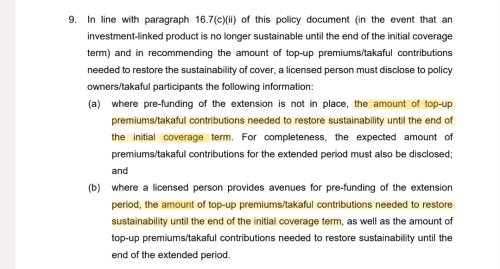
If those IL policies, whether prior to the first 10 years or subsequent to that, were to opt for enhancements in coverage, e.g. increase in policy death coverage from 100k to 1 mil, any additional annual premiums needed to sustain the policy would be subjected to allocation charges as if the policy were starting from year 1 again (only applicable to the additional annual premium amounts and not the original annual premium payments). Same thing if you were to change or add riders resulting in additional annual premiums needed to sustain the policy.

So when IL policyholders with old base policies opt to take on an upgrade (new medical rider with enhanced annual/lifetime limits), it seems to me they would be subjected to additional allocation charges as if they were starting from year 1. Please correct me if I am mistaken on this.

The really bonkers part is that new IL policies seem to have completely bypassed top-ups and gone the way of unilateral premium increments subjectable to allocation charges when cost of insurance charges are reviewed or increased.

user posted image

user posted image

This post has been edited by hafizmamak85: Mar 22 2025, 01:54 AM
hafizmamak85
post Mar 22 2025, 05:42 PM

Casual
***
Junior Member
463 posts

Joined: Nov 2009

QUOTE(hafizmamak85 @ Mar 21 2025, 11:37 AM)
The part that really pisses me off and makes my blood boil  about your situation is that they are charging you allocation charges again for the additional premium levied when upgrading your plan. You've already made the case that the cost of insurance charges are the same or lesser for the medical coverage of your plan after upgrading. So why should the new premium amount quoted for your plan have any increment in the first place and why should you be expected to pay any further additional charges?????

This upgrade is basically an excuse to reprice your policy for sustainability, which maybe the ITO didn't account for sustainability properly in the policy's initial pricing. Why should you, the consumer, be expected to bear the burden for the ITO's mispricing and other errors???!
*
To policyholders/consumers out there, always be wary about what you're being sold or have bought as part of an investment-linked insurance plan, but do not despair. There are a lot of contradictions, ambiguities, unclear language between and within the contract terms, sales disclosures and Malaysian laws/BNM policies.

BNM has not played its proper role in protecting your rights and interests and in fact, has acted in concert with the insurance industry in enacting policies or interpreting contract terms in favour of ITOs, to your detriment. And our Malaysian actuaries are, sorry to say, and even they would admit to it, 'koyak' when it comes to consumer rights.

In a sensible world, these contradictions and ambiguities will have to be resolved in your favour. So, it would be wise for you to consider initiating a class action lawsuit against the ITOs & BNM.

Whether you had recently upgraded your medical card as part of a guaranteed issuance offer and found yourself paying additional allocation and other charges or had your policy repriced due to sustainability issues (e.g. due to higher cost of insurance charges as part of medical repricing or sub-par unit fund investment performance), always be guided by the following:

- The consumer did not price investment-linked policies (including cost of insurance and other charges) or set the minimum amount of annual premium required for given insurance policy coverage. The ITOs bear sole responsibility and accountability in this matter.

- Built into the pricing of annual premiums, cost of insurance and other charges for long term investment-linked policies is the expectation of sufficiency of annual premiums to sustain the policy, including all its charges, until the end of the contract term. The ITOs bear full responsibility and accountability for this expectation and are expected to have appropriately accounted for their profits, expenses and any long term concerns regarding investment returns, medical inflation and other such matters in the policy's pricing.

- The value or legal force of this expectation, to be imputed into the terms of the contact or read as an implied term, is a no-lapse guarantee for as long as the annual premium payments (premium amount based on initial and not subsequent repricing) are maintained.

- Given the above, the ITOs only have the right to reprice premiums and other charges midway through the contract term when faced with going concern risks, not and never to maintain profit margins.

This post has been edited by hafizmamak85: Mar 22 2025, 06:44 PM

nexona88
post Mar 23 2025, 11:30 AM

The Royal Club Member
*********
All Stars
48,552 posts

Joined: Sep 2014
From: REality
https://www.freemalaysiatoday.com/category/...ease-in-claims/

Reason for premium increase because of 19% more medical insurance claims from previous years....
nelson969
post Mar 23 2025, 02:35 PM

Casual
***
Junior Member
323 posts

Joined: May 2020
diu lo, insurance become luxury after seeing my increment notice

392 Pages « < 348 349 350 351 352 > » Top
 

Change to:
| Lo-Fi Version
0.0198sec    0.53    6 queries    GZIP Disabled
Time is now: 19th December 2025 - 02:02 AM