Welcome Guest ( Log In | Register )

392 Pages « < 347 348 349 350 351 > » Bottom

Outline · [ Standard ] · Linear+

 Insurance Talk V7!, Your one stop Insurance Discussion

views
     
poweredbydiscuz
post Mar 20 2025, 01:48 PM

 
*******
Senior Member
3,839 posts

Joined: Oct 2011
QUOTE(Andr3w @ Mar 20 2025, 01:41 PM)
Seems like asking us pay higher premium, is to put more money into investment (if what the amount on the current COI table price is how much they will minus from yearly premium we pay).

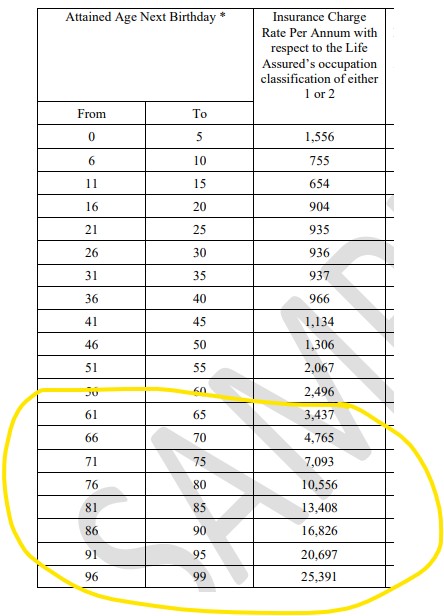
I have 20k++ in my investment portion. My next COI will be around 1.5k annually according to COI age bracket table. I want to stop paying premium and force my yearly COI to be deducted from my 20k++ investment until maybe it reach around less than 3k++ , then only i continue paying premium. My policy say it will not lapse until the investment become 0 when premium next due. So from I see, it seems can do such a thing with no complication? The purpose I want do this is to channel my premium money to better invest into things like ETF etc that give better return.

Any advise about complication or advise about my decision to stop paying premium on my ILP to force deduction from investment portion and then later on continue paying premium when investment almost dry up?
*
When you get older, your COI will become higher than your premium, and you won't have any fund from the investment portion to support it.
Andr3w
post Mar 20 2025, 01:52 PM

Getting Started
**
Junior Member
90 posts

Joined: Oct 2004
From: JB


QUOTE(poweredbydiscuz @ Mar 20 2025, 01:48 PM)
When you get older, your COI will become higher than your premium, and you won't have any fund from the investment portion to support it.
*
No problem. I know how much COI i need to pay when i get older from the table. Only till then I will pay the higher premium (which you say will increase due to that old age COI will be higher than current premium quoted) if the investment portion is close to 0 to prevent policy from lapse.... any issue? As mentioned, I want to stop paying premium for now is to channel the premium that i was suppose to pay for better investment returns(since i still have 20k++ in the investment portion)

This post has been edited by Andr3w: Mar 20 2025, 01:57 PM
poweredbydiscuz
post Mar 20 2025, 01:59 PM

 
*******
Senior Member
3,839 posts

Joined: Oct 2011
QUOTE(Andr3w @ Mar 20 2025, 01:52 PM)
No problem. I know how much COI i need to pay when i get older from the table. Only till then I will pay the higher premium (which you say will increase due to that old age COI will be higher than current premium quoted) if the investment portion is close to 0 to prevent policy from lapse.... any issue? As mentioned, I want to stop paying premium for now is to channel the premium that i was suppose to pay for better investment returns(since i still have 20k++ in the investment portion)
*
Well, the COI table is not fixed, it WILL increase almost every year from now on (especially the medical part). If you are confident you can pay the future premiums, then no issue.

EDIT: take note that it's not the old age increase COI that you need to worry about, it's the UNCERTAIN medical inflation, which will rack up your COI must faster than what's written in the table.

This post has been edited by poweredbydiscuz: Mar 20 2025, 02:02 PM
Andr3w
post Mar 20 2025, 02:03 PM

Getting Started
**
Junior Member
90 posts

Joined: Oct 2004
From: JB


QUOTE(poweredbydiscuz @ Mar 20 2025, 01:59 PM)
Well, the COI table is not fixed, it WILL increase almost every year from now on (especially the medical part). If you are confident you can pay the future premiums, then no issue.

EDIT: take note that it's not the old age increase COI that you need to worry about, it's the UNCERTAIN medical inflation, which will rack up your COI must faster than what's written in the table.
*
Thanks for reply

Currently the table shows like that. And also i know this table might change all the prices because all kind of reason like inflation etc , but this will happen throughout all insurance industry if that time comes (standalone or ILP irregardless) . Just that I am not sure insurance company will come out with all kind of funny reason to say i cannot stop paying my premium...

About your EDIT comment, how does this affect me if I continue to pay my premium now or not pay premium? Irregardless if COI increased by alot due to whatever reason, I still have to pay either by premium money (which they will increase alot) or via my investment portion. So this will still happen even if i continue to pay my premium now right? (which if i am affected by what you mentioned "UNCERTAIN medical inflation, which will rack up your COI must faster than what's written in the table" )

user posted image

This post has been edited by Andr3w: Mar 20 2025, 02:17 PM
hafizmamak85
post Mar 20 2025, 02:47 PM

Casual
***
Junior Member
463 posts

Joined: Nov 2009

QUOTE(Andr3w @ Mar 20 2025, 02:03 PM)
Thanks for reply

Currently the table shows like that. And also i know this table might change all the prices because all kind of reason like inflation etc , but this will happen throughout all insurance industry if that time comes (standalone or ILP irregardless) . Just that I am not sure insurance company will come out with all kind of funny reason to say i cannot stop paying my premium...

About your EDIT comment, how does this affect me if I continue to pay my premium now or not pay premium? Irregardless if COI increased by alot due to whatever reason, I still have to pay either by premium money (which they will increase alot) or via my investment portion. So this will still happen even if i continue to pay my premium now right? (which if i am affected by what you mentioned "UNCERTAIN medical inflation, which will rack up your COI must faster than what's written in the table" )

user posted image
*
If you don't stick to your premium payment schedule, there is the risk that you would not be able to later claim that the policy is not performing according to expectation when it is unable to meet all those high cost of insurance charges, esp. at the older ages but also before then, as a lot of these older policies and even some of the current ones, have high investment return rates assumed in the pricing (which allowed for the lower premiums). These high rates are not sustainable. You can then claim that it is the insurer or takaful operator who is responsible and should foot the bill. If you plan on investing your spare cash that should have gone to paying premiums in an ETF outside the insurer, then why bother having an investment-linked policy in the first place?

What insurers and takaful operators have sneakily done is to reduce the policy coverage term to ages 70 or 80, compared to the previous term of 100 years+, and thereafter operate the main policy and medical rider on a renewal basis up to ages 100 and above. The way the policies are currently priced, it is highly questionable even as to whether the policy can be sustained up until the end of even the shorter policy terms.

The original sins are the high investment return rate assumptions and the unsubstantiated and ridiculously priced high cost of insurance charges at older ages. This needs to change.

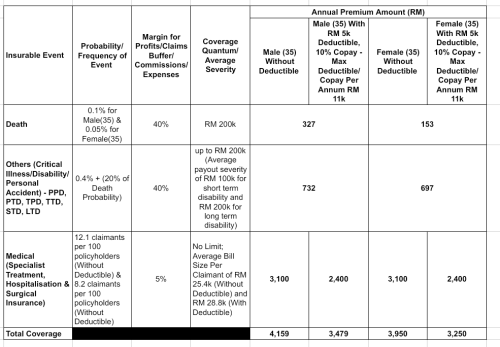
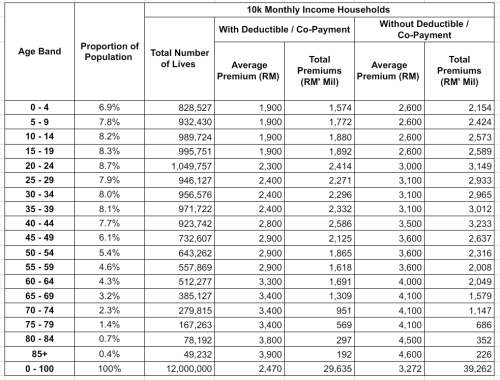
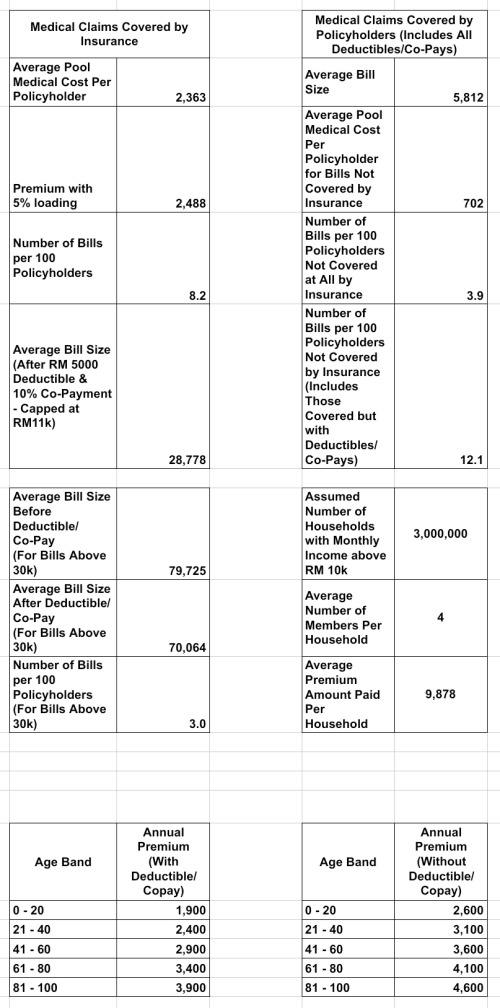
Medical Inflation is a poor excuse. A medical policy with 12.1 claimants per 100 policyholders and average claim amount of RM 25.4k and with a five percent margin for expenses only cost RM 3100 for a person aged 35. And you can still price the medical policy at less than 5k (RM 4600) for someone aged 100 and still sustain such high claim frequencies and average claim payments. Good enough to collect RM39 billion for 12 million lives. Are you telling me we can't solve a significant amount of our medical needs with over RM 3 billion per million lives??????

user posted image

user posted image

user posted image

This post has been edited by hafizmamak85: Apr 1 2025, 09:59 PM
hafizmamak85
post Mar 20 2025, 03:08 PM

Casual
***
Junior Member
463 posts

Joined: Nov 2009

QUOTE(hafizmamak85 @ Mar 18 2025, 09:19 PM)
Also, it's quite interesting that Jessica and Hsin Ying are not there anymore but Aznan and and Cindy have been promoted. Cindy was the Director of PFP (Prudential Financial Policy), the policy department which ultimately came out with all the beloved policies on the estate and investment-linked, and now she is the AG of supervision, the role held by Aznan prior to this. And what did Aznan or Cindy do to stop the abuse of the estate or restitute policyholders whose entitlements were misappropriated?

Are Aznan and Cindy going to help ensure Great Eastern, BNM and the Government of Malaysia restitute Great Eastern participating policyholders to the tune of RM 2.37 billion and more??? Also, what did they do to protect the rights and interests of investment-linked policyholders from unfair contract practices (repricing without proper justification) and deny & delay claims tactics??? The same should be asked of Fraziali Ismail, the current AG in charge of regulation.

A bunch of tupais, the lot of them.
*
Feel free to blame the above tupais for all the medical insurance/investment-linked policy troubles the rakyat are going through

QUOTE(hafizmamak85 @ Mar 18 2025, 09:55 PM)
One of the main reasons why people within older age groups (above 60) have to pay ridiculous amounts (above 8k per annum) in cost of insurance charges or premiums for medical coverage is that BNM did not make it a policy for at least partial community rating, where there would be a max cap in the difference between the highest and lowest priced policies within the pool. E.g. the highest priced policies within the pool should not be twice the price paid for the cheapest.

What can be gotten with an annual premium amount of between RM 3000 (RM 250 per month) and RM 4200 (RM 350 per month)? You'll be surprised and it would inform you that your insurers and takaful operators are fleecing you.

*
This post has been edited by hafizmamak85: Mar 20 2025, 03:29 PM
poweredbydiscuz
post Mar 20 2025, 03:25 PM

 
*******
Senior Member
3,839 posts

Joined: Oct 2011
QUOTE(Andr3w @ Mar 20 2025, 02:03 PM)
About your EDIT comment, how does this affect me if I continue to pay my premium now or not pay premium? Irregardless if COI increased by alot due to whatever reason, I still have to pay either by premium money (which they will increase alot) or via my investment portion. So this will still happen even if i continue to pay my premium now right? (which if i am affected by what you mentioned "UNCERTAIN medical inflation, which will rack up your COI must faster than what's written in the table" )
*
It's just to highlight that you need to prepare for much higher COI in the future.

When you pay the premium accordingly, you won't feel the sudden jump so much in the older age, as you already contribute into the fund since early days.

If you don't pay the premium and keep minimum in the fund, then you need to be prepared and discipline enough to set aside money and get ready for the sudden jump in older age. But this brings the question: why bother with ILP if you choose this option?

This post has been edited by poweredbydiscuz: Mar 20 2025, 03:27 PM
Andr3w
post Mar 20 2025, 03:30 PM

Getting Started
**
Junior Member
90 posts

Joined: Oct 2004
From: JB


QUOTE(hafizmamak85 @ Mar 20 2025, 02:47 PM)
If you don't stick to your premium payment schedule, there is the risk that you would not be able to later claim that the policy is not performing according to expectation when it is unable to meet all those high cost of insurance charges, esp. at the older ages but also before then, as a lot of these older policies and even some of the current ones, have high investment return rates assumed in the pricing (which allowed for the lower premiums). These high rates are not sustainable. You can then claim that it is the insurer or takaful operator who is responsible and should foot the bill. If you plan on investing your spare cash that should have gone to paying premiums in an ETF outside the insurer, then why bother having an investment-linked policy in the first place?

What insurers and takaful operators have sneakily done is to reduce the policy coverage term to ages 70 or 80, compared to the previous term of 100 years+, and thereafter operate the main policy and medical rider on a renewal basis up to ages 100 and above. The way the policies are currently priced, it is highly questionable even as to whether the policy can be sustained up until the end of even the shorter policy terms.

The original sins are the high investment return rate assumptions and the unsubstantiated and ridiculously priced high cost of insurance charges at older ages. This needs to change.

Medical Inflation is a poor excuse.A medical policy with 12.1 claimants per 100 policyholders and average claim amount of RM 25.4k and with a five percent margin for expenses only cost RM 3100 for a person ages 35.

user posted image

user posted image

user posted image
*
1) If you don't stick to your premium payment schedule, there is the risk that you would not be able to later claim that the policy
My comments : The bolded part is a risk that insurance will say to me? Just say it happens, can I say this affects everyone in the pool of my plan and not just me? Or is it me only because I never stick to premium schedule? ( I understand your points further down the sentence)

2) If you plan on investing your spare cash that should have gone to paying premiums in an ETF outside the insurer, then why bother having an investment-linked policy in the first place?
My comments : Just say i made a mistake by buying ILP. I cannot U-turn back whatever mistake that has been done. I do not want to change standalone because all kind of consideration (like waiting period, medical underwriting, even none of those , new plan later will say cannot claim after performing investigation down the road when claim time and give all kind of medical exclusion reason due to new plan date). I also cannot just give up since i need protection. Also only recently, i am more savvy with financial, hence thinking of ways to prevent more mistake that pours more money into this ILP investment portion, hence that is why i ask if stop paying premium is any danger or concern since i read policy will not lapse if stop paying premium but still will deduct investment portion.

3) Whatever happen, it should affect everyone (most of the time), we are at mercy of it. Like example recent bank negara announce insurance charge hike fiasco, everybody COI will increase 10% irregardless standalone or ILP and i don't believe insurance company can cheat because if I have previous COI charges before increase, I will know the increase COI of 10% is it real or not.

4) Thanks for your detail tables but i don't understand. Is it the last table, you mean COI for 41-60 with deductible should be around 2900?

This post has been edited by Andr3w: Mar 20 2025, 03:57 PM
Andr3w
post Mar 20 2025, 03:35 PM

Getting Started
**
Junior Member
90 posts

Joined: Oct 2004
From: JB


QUOTE(poweredbydiscuz @ Mar 20 2025, 03:25 PM)
It's just to highlight that you need to prepare for much higher COI in the future.

When you pay the premium accordingly, you won't feel the sudden jump so much in the older age, as you already contribute into the fund since early days.

If you don't pay the premium and keep minimum in the fund, then you need to be prepared and discipline enough to set aside money and get ready for the sudden jump in older age. But this brings the question: why bother with ILP if you choose this option?
*
I am old enough to see all kind of hikes (example recent bank negara allow all insurance company to hike price saying cannot sustain liao).. so I am prepared for anything ...just that it has to be across the board and lawful and not unfair treatment to certain group only.

I believe i can be discipline as I am with financial planning (which require more discipline)

As to why ILP i explain above to me reply to hafizmamak85
hafizmamak85
post Mar 20 2025, 04:13 PM

Casual
***
Junior Member
463 posts

Joined: Nov 2009

QUOTE(Andr3w @ Mar 20 2025, 03:30 PM)
1) If you don't stick to your premium payment schedule, there is the risk that you would not be able to later claim that the policy
My comments : The bolded part is a risk that insurance will say to me? Just say it happens, can I say this affects everyone in the pool and not just me? Or is it me only because I never stick to premium schedule? ( I understand your points further down the sentence)

2) If you plan on investing your spare cash that should have gone to paying premiums in an ETF outside the insurer, then why bother having an investment-linked policy in the first place?
My comments : Just say i made a mistake by buying ILP. I cannot U-turn back whatever mistake that has been done. I do not want to change standalone because all kind of consideration (like waiting period, medical underwriting, even none of those , new plan later will say cannot claim after performing investigation down the road when claim time and give all kind of medical exclusion reason due to new plan date). I also cannot just give up since i need protection. Also only recently, i am more savvy with financial, hence thinking of ways to prevent more mistake that pours more money into this ILP investment portion, hence that is why i ask if stop paying premium is any danger or concern since i read policy will not lapse if stop paying premium but still will deduct investment portion.

3) Whatever happen, it should affect everyone (most of the time), we are at mercy of it. Like example recent bank negara announce insurance charge hike fiasco, everybody COI will increase 10% irregardless standalone or ILP and i don't believe insurance company can cheat because if I have previous COI charges before increase, I will know the increase COI of 10% is it real or not.

4) Thanks for your detail tables but i don't understand. Is it the last table, you mean COI for 41-60 with deductible should be around 2900?
*
1) If everyone in the medical pool / investment-linked plan kept to their original premium payment schedule diligently and didn't withdraw anything from their cash values, and if it later turned out that their policies' cash values weren't sufficient to sustain the high cost of insurance charges at older ages, they would have a stronger case to claim that the policy had not performed according to expectation and that the insurer or takaful operator should foot the bill or any additional amounts needed to make the policy sustainable. You wouldn't have such a strong a case if you didn't keep to your original premium payment schedule.

2) It's something that you need to ask yourself. All your concerns
about waiting period, exclusion and other pre-existing condition clauses when opting for new plan, while significantly valid, can also be a risk (other than waiting period) with your current plan. Your current plan is also subject to all kinds of exclusions as well and the insurer can still deny or delay your claim.

What you need to ask yourself is if you still think it worth your while to hold your insurer accountable for any mispricing/underpricing errors in your current plan by maintaining your policy premiums and making them foot the bill for any issues that may crop up later on, e.g. policy cash values not being sufficient to cover cost of insurance charges.

3) Regardless of what BNM or the industry does, it is up to you as to whether you want to hold the insurer or takaful operator accountable. You can still keep to your original premium payment schedule and not pay the repriced premium amounts and later claim that the policy was not originally priced properly when it can't meet cost of insurance charges and therefore incumbent on the insurer or takaful operator to foot the bill for their errors.

4) For 41 - 60, with deductible would be RM 2900, without deductible would be 3100

This post has been edited by hafizmamak85: Mar 20 2025, 04:29 PM
hafizmamak85
post Mar 20 2025, 04:18 PM

Casual
***
Junior Member
463 posts

Joined: Nov 2009

QUOTE(Andr3w @ Mar 20 2025, 03:35 PM)
I am old enough to see all kind of hikes (example recent bank negara allow all insurance company to hike price saying cannot sustain liao).. so I am prepared for anything ...just that it has to be across the board and lawful and not unfair treatment to certain group only.

I believe i can be discipline as I am with financial planning (which require more discipline)

As to why ILP i explain  above to me reply to hafizmamak85
*
There is nothing lawful or legal about what BNM has allowed when it comes to medical insurance repricing. It is nothing but a crooked sham. No policy can be repriced midway through the contract term unless the insurer or takaful operator is facing a going concern risk. None of them are facing going concern risks. And, regardless of BNM's idiotic policies, no insurer or takaful operator has the right to reprice to maintain profit margins.

Just like how no one in their right mind would accept a hypothetical BNM policy that allows insurers to delay claim payments for up to two years, with or without justification, we should not accept these BNM policies for insurers or takaful operators to reprice investment-linked policies to maintain profit margins as lawful or legal.

This post has been edited by hafizmamak85: Mar 20 2025, 04:41 PM
Andr3w
post Mar 20 2025, 05:43 PM

Getting Started
**
Junior Member
90 posts

Joined: Oct 2004
From: JB


QUOTE(hafizmamak85 @ Mar 20 2025, 04:13 PM)
1) If everyone in the medical pool / investment-linked plan kept to their original premium payment schedule diligently and didn't withdraw anything from their cash values, and if it later turned out that their policies' cash values weren't sufficient to sustain the high cost of insurance charges at older ages, they would have a stronger case to claim that the policy had not performed according to expectation and that the insurer or takaful operator should foot the bill or any additional amounts needed to make the policy sustainable. You wouldn't have such a strong a case if you didn't keep to your original premium payment schedule.

2) It's something that you need to ask yourself. All your concerns
about waiting period, exclusion and other pre-existing condition clauses when opting for new plan, while significantly valid, can also be a risk (other than waiting period) with your current plan. Your current plan is also subject to all kinds of exclusions as well and the insurer can still deny or delay your claim.

What you need to ask yourself is if you still think it worth your while to hold your insurer accountable for any mispricing/underpricing errors in your current plan by maintaining your policy premiums and making them foot the bill for any issues that may crop up later on, e.g. policy cash values not being sufficient to cover cost of insurance charges.

3) Regardless of what BNM or the industry does, it is up to you as to whether you want to hold the insurer or takaful operator accountable. You can still keep to your original premium payment schedule and not pay the repriced premium amounts and later claim that the policy was not originally priced properly when it can't meet cost of insurance charges and therefore incumbent on the insurer or takaful operator to foot the bill for their errors.

4) For 41 - 60, with deductible would be RM 2900, without deductible would be 3100
*
1) I been diligently keeping to my original premium payment schedule since 2013 until today and never withdraw anything. Recently , i still got another letter saying i need to pay increase premium because no more sustainable anymore to the promised age. So how can i ask insurer to foot the bill because they still insist i pay the increased premium from this year on? (not to confuse situation as I got this letter the same time as the letter to level up me to a new plan campaign which i say in earlier thread). So is there really a strong case that i can make or is it just at the mercy that they say no choice by saying no more sustainable due to whole country COI increasing which is official in news and they already say can increase COI due to unforeseen circumstances if passed by BNM etc. This letter i also wondering if i defy and not agree, not sure what they can do to my policy (like what i am wondering if i don't pay premium)

2) If I stick to my current plan, there is no waiting period or medical exclusion concern risk as like when i start 2013 medical record status. Although still have risk but it is better than the risk of moving to new plan right?

3) How to hold them accountable? It is a norm COI table charges is not guaranteed and especially it is out on the news with BNM say approved, what else can do....About sustainability, they also can say due to unforeseen circumstances like medical inflation all out in the news, they cannot promise the sustainability promised anymore...

4) At what coverage may I ask? yearly 1 million or 5 million or ?
hafizmamak85
post Mar 20 2025, 09:50 PM

Casual
***
Junior Member
463 posts

Joined: Nov 2009

QUOTE(Andr3w @ Mar 20 2025, 05:43 PM)
1) I been diligently keeping to my original premium payment schedule since 2013 until today and never withdraw anything. Recently , i still got another letter saying i need to pay increase premium because no more sustainable anymore to the promised age. So how can i ask insurer to foot the bill because they still insist i pay the increased premium from this year on? (not to confuse situation as I got this letter the same time as the letter to level up me to a new plan campaign which i say in earlier thread). So is there really a strong case that i can make or is it just at the mercy that they say no choice by saying no more sustainable due to whole country COI increasing which is official in news and they already say can increase COI due to unforeseen circumstances if passed by BNM etc. This letter i also wondering if i defy and not agree, not sure what they can do to my policy (like what i am wondering if i don't pay premium)

2) If I stick to my current plan, there is no waiting period or medical exclusion concern risk as like when i start 2013 medical record status. Although still have risk but it is better than the risk of moving to new plan right?

3) How to hold them accountable? It is a norm COI table charges is not guaranteed and especially it is out on the news with BNM say approved, what else can do....About sustainability, they also can say due to unforeseen circumstances like medical inflation all out in the news, they cannot promise the sustainability promised anymore...

4) At what coverage may I ask? yearly 1 million or 5 million or ?
*
1 & 3) You have every right to insist on the insurers and takaful operators (ITOs) footing the bill as they have not kept up with your reasonable expectation in relation to the original annual premium amount. The expectation implied in the pricing of the product was for the original annual premium to be sufficient to sustain the policy until the end of term.

If the ITOs weren't comfortable in taking on this risk, they should not have had the authority to set the minimum amount of sustainable annual premium for given insurance policy coverages nor would BNM be able to make it a requirement for the ITOs to price the IL contract such that it was expected to be sustainable until the end of term. There is legal force and value to this expectation. It is not zilch or zero. It has value. The question is , what is the value? And to me, the value implied is a no lapse guarantee if policyholders keep to their original annual premium payments and didn't make any withdrawals. Also, if the ITOs didn't want to take on pricing risk, they should not have allowed for investment returns to be considered in pricing the IL policies nor should they have sold long term products. The moment the ITOs did that, they effectively implied a certain expectation in relation to the investment performance of the IL unit funds as well as the fixed nature of the cost of insurance and other long term charges in the product.

Policyholders have an ironclad case. But whether our courts have competent, impartial judges and whether we have true professional actuaries who have very strong ethics is a separate matter. Our Malaysian actuaries are not competent especially when it comes to consumer rights and doing right by them and a lot of these issues are due to their lapses/incompetence.

But I still think consumers have the winning hand as this issue is beyond bonkers. I mean just look at the retained and ongoing earnings of life insurers. They are earning beyond RM 4 billion per annum and have over RM 20 billion in equity/retained earnings. There is no good reason to reprice the products/IL contracts. They are not facing going concern risks. The question is, do you as a consumer want to go through the hassle of fighting for your rights? I say you should, but it is ultimately up to you. Your call. If you keep letting them ride roughshod over you, they will keep increasing the premiums, but if some of you or a significant minority of you start complaining and taking action, this whole house of cards will fall. They will cry uncle.

How to hold them to account? By lodging complaints with BNM and the financial ombudsman and by launching a class action lawsuit. It's time for you guys to band together. Either band together and fight back or keep getting bullied. The choice is yours. None of you have to eat their spit.

Also, please do not buy into the media, BNM and the ITOs fluff excuse of medical inflation. It's just a ruse. They are doing this solely to guard the earning power of ITOs. The only ones standing in their way is you. The consumer. You have the ultimate power. Not them. Do not be afraid of them. None of these (medical inflation and other excuses) were unforeseeable. They did not account for even a measly 8% in annual medical inflation throughout the term of the contract although this has been the case for private healthcare expenditure in Malaysia since 2011. The ITOs have huge bloated expense and commission structures in place and excessive cost of insurance profit margins. And yet, they failed to account for 8% per annum medical inflation because they are confident the media is on their side and they can paint a one sided picture of hospitals being the cause although that isn't the reality of it.

I've already proved it to you. You can have a policy with death and disability coverage of RM 200k and a medical card with average payout of over RM 25k with claim frequency of over 12 claimants per 100 policyholders for only RM4200 per annum. So, please do not buy into their medical inflation excuse.
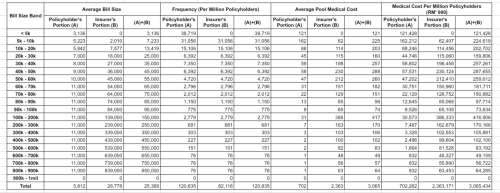
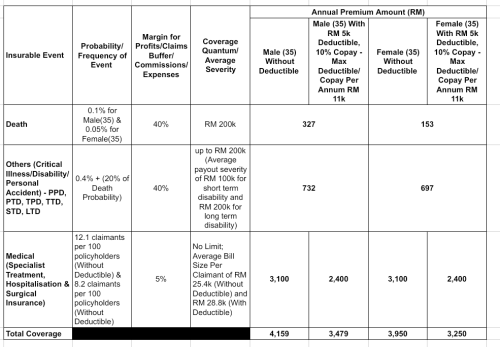
user posted image

user posted image

They are crying medical inflation with only an average claim size of less than half of what I quoted, RM 10k plus compared to my RM 25k plus, with a claim frequency of only 8 plus claimants per 100 policyholders, compared to my 12 plus claimants per 100 policyholders.
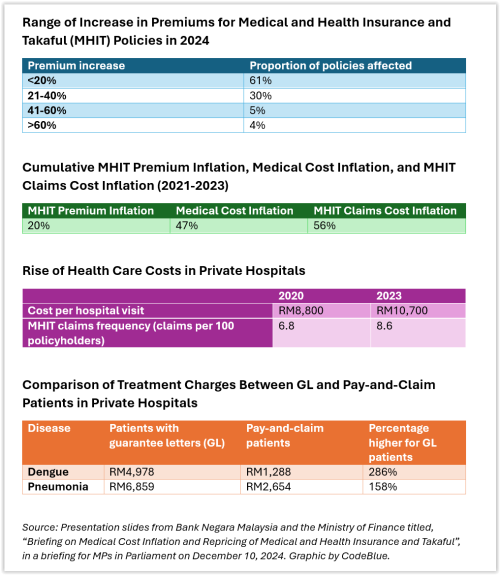
user posted image

2) This is something only you can answer. To me, your current plan's 50k coverage is worthless, useless and GE is milking you because they know you are in a tough spot. They know you're vulnerable, that you're paying for a useless overpriced product when they have another one in the stable, which they've offered to you for an upgrade (1 mil plus coverage), which has a lower cost of insurance charge, but comes with its own sly conditions. There may be changes to your policy's term. Maybe previously the medical card had low annual coverage but its coverage was up to age 100, but now, with the new enhanced coverage, only up to age 70 and renewal from there on. And they would have repriced it based on lower investment return rates assumed in pricing and cajoled you into taking the high deductible version to reduce premium payments. Even if you opt for the enhanced coverage, I still think you should fight for your rights to not have your policy repriced during the mid term of the contract and more importantly, to have a medical cover that is not on a renewal basis up until age 100+.

Yes, you don't have to go through the waiting period again. But what is it that you are ultimately forsaking? You have to get clear answers on this. The pain will come when you are age 70 and above and even more vulnerable then. Don't let them toy with you. Find out now.

4) The coverage I envisioned has no limit but the claims pattern shows up to be less than RM 1 million. Doesn't mean that it can't sustain RM 2 mil treatments. It's possible as long as the frequency is small.

This pricing (below) is doable. Of couse, someone is going to have to do the hard work of studying and projecting the "true" hospital admissions demand for all age groups for all types of health complications and severities, and it may turn out to be insufficient, but until then, this can be a guide to assess if medical insurance products are priced excessively, especially for older age groups. In the end, it will still turn out to be a wise policy to have partial community rating.
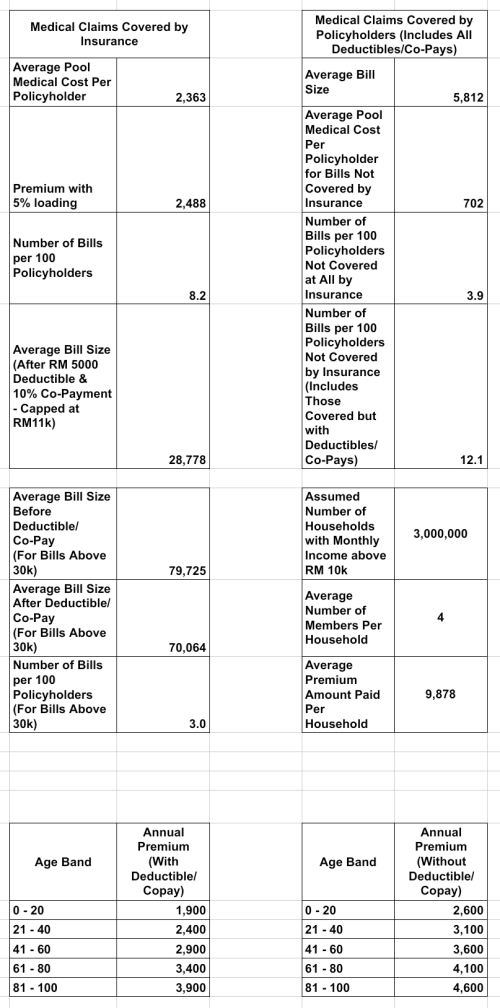
user posted image

This post has been edited by hafizmamak85: Mar 21 2025, 12:23 AM

adele123
post Mar 21 2025, 09:01 AM

Look at all my stars!!
*******
Senior Member
4,726 posts

Joined: Jul 2013


QUOTE(Andr3w @ Mar 20 2025, 11:43 AM)
» Click to show Spoiler - click again to hide... «

*
I tried to answer your original question 1st. If you have done the right comparison, where the COI of your current medical plan vs the COI of the new medical plan, if there is indeed no increase, then i think i highly suggest you to move over. Because in your previous post, you mention from your annual statement but actually in annual statement it contains COI of other non medical plans as well.

As for your original question on why there is such a huge premium increase, that i can only educated guess. When an insurance company ask you to move to a different plan, they typically need to NOT JUST take into account the current COI, but also the FUTURE COI. For example, if your current medical is until age 70, but lets say the new medical plan is until age 80, even if the COI is about the same, they PROBABLY have to take into account the COI for that additional 10 years.

Whether to upgrade your current medical plan to the new medical plan, i personally will do it. I think you said your plan is 200k annual limit? While 5mil is unnecessary but 200k is abit on the lower range but still very comfortable factoring inflation and etc... Then again if 200k is annual limit, and no lifetime limit, actually still ok (IMO). I mean, unless we all have stats on average cost of treatment easily lying around and do our medical inflation projection... then... we do our own estimate la.

QUOTE(Andr3w @ Mar 20 2025, 01:41 PM)
» Click to show Spoiler - click again to hide... «

*
Yes. In theory, if you have enough money in your policy, you can stop paying for awhile. It is the flexibility (pros and cons too) of owning ILP polic. Your plan is somewhat solid. You have realised what needs to be done with the necessary buffer.

I list down again the key thing you should do.

1) find out future charges
2) keep some buffer (the dwindling down to 3k)
3) you need to continuously monitor on a yearly basis on where your policy is now because 1 and 2 needs to be adjusted accordingly.

The complication is purely our human capacity and time. Such tracking is usually not for the average joe on the street. But if you are discipline, its ok too. And we all know in the long run ETF is the way to go. Insurance fund is like normal unit trust, under perform and high charges.

The increase in medical COI when done by the company is across the board ie it impacts everyone like you who bought the same medical plan from the same company.

I hope my input can help.
togekiss
post Mar 21 2025, 09:45 AM

Casual
***
Junior Member
429 posts

Joined: Jul 2022
QUOTE(hafizmamak85 @ Mar 20 2025, 02:47 PM)
If you don't stick to your premium payment schedule, there is the risk that you would not be able to later claim that the policy is not performing according to expectation when it is unable to meet all those high cost of insurance charges, esp. at the older ages but also before then, as a lot of these older policies and even some of the current ones, have high investment return rates assumed in the pricing (which allowed for the lower premiums). These high rates are not sustainable. You can then claim that it is the insurer or takaful operator who is responsible and should foot the bill. If you plan on investing your spare cash that should have gone to paying premiums in an ETF outside the insurer, then why bother having an investment-linked policy in the first place?

What insurers and takaful operators have sneakily done is to reduce the policy coverage term to ages 70 or 80, compared to the previous term of 100 years+, and thereafter operate the main policy and medical rider on a renewal basis up to ages 100 and above. The way the policies are currently priced, it is highly questionable even as to whether the policy can be sustained up until the end of even the shorter policy terms.

The original sins are the high investment return rate assumptions and the unsubstantiated and ridiculously priced high cost of insurance charges at older ages. This needs to change.

Medical Inflation is a poor excuse. A medical policy with 12.1 claimants per 100 policyholders and average claim amount of RM 25.4k and with a five percent margin for expenses only cost RM 3100 for a person ages 35. And you can still price the medical policy at less than 5k (RM 4600) for someone aged 100 and still sustain such high claim frequencies and average claim payments. Good enough to collect RM39 billion for 12 million lives. Are you telling me we can't solve a significant amount of our medical needs with over RM 3 billion per million lives??????

user posted image

user posted image

user posted image
*
i've always appreciated your insights. wished there were more like you to give us insights and education.
togekiss
post Mar 21 2025, 09:58 AM

Casual
***
Junior Member
429 posts

Joined: Jul 2022
QUOTE(hafizmamak85 @ Mar 20 2025, 04:13 PM)
1) If everyone in the medical pool / investment-linked plan kept to their original premium payment schedule diligently and didn't withdraw anything from their cash values, and if it later turned out that their policies' cash values weren't sufficient to sustain the high cost of insurance charges at older ages, they would have a stronger case to claim that the policy had not performed according to expectation and that the insurer or takaful operator should foot the bill or any additional amounts needed to make the policy sustainable. You wouldn't have such a strong a case if you didn't keep to your original premium payment schedule.


*
this is true, but to collectively gather everyone to confront the insurance company, that will probably need social media or something. and someone needs to be the leader to bring the case to them.
togekiss
post Mar 21 2025, 10:04 AM

Casual
***
Junior Member
429 posts

Joined: Jul 2022
QUOTE(hafizmamak85 @ Mar 20 2025, 04:18 PM)
There is nothing lawful or legal about what BNM has allowed when it comes to medical insurance repricing. It is nothing but a crooked sham. No policy can be repriced midway through the contract term unless the insurer or takaful operator is facing a going concern risk. None of them are facing going concern risks. And, regardless of BNM's idiotic policies, no insurer or takaful operator has the right to reprice to maintain profit margins.

Just like how no one in their right mind would accept a hypothetical BNM policy that allows insurers to delay claim payments for up to two years, with or without justification, we should not accept these BNM policies for insurers or takaful operators to reprice investment-linked policies to maintain profit margins as lawful or legal.
*
one of my prudential policy, i had to opt for a higher deductible in order to maintain the same premium. otherwise, it would be repriced as well.
contestchris
post Mar 21 2025, 11:01 AM

Look at all my stars!!
*******
Senior Member
5,581 posts

Joined: Aug 2011

QUOTE(Andr3w @ Mar 20 2025, 01:41 PM)
Seems like asking us pay higher premium, is to put more money into investment (if what the amount on the current COI table price is how much they will minus from yearly premium we pay).

I have 20k++ in my investment portion. My next COI will be around 1.5k annually according to COI age bracket table. I want to stop paying premium and force my yearly COI to be deducted from my 20k++ investment until maybe it reach around less than 3k++ , then only i continue paying premium. My policy say it will not lapse until the investment become 0 when premium next due. So from I see, it seems can do such a thing with no complication? The purpose I want do this is to channel my premium money to better invest into things like ETF etc that give better return.

Any advise about complication or advise about my decision to stop paying premium on my ILP to force deduction from investment portion and then later on continue paying premium when investment almost dry up?
*
Yes, there are some considerations.

1. Your basic regular premiums will likely have 100% allocation after a certain period of time. However, any single-premium adhoc top-ups or regular premium top-ups will have a maximum allocation rate of 95%.

2. You will not be able to claim tax relief progressively.

Your idea is sound but at that point why not just buy a standalone medical policy and pay the premiums annually?
Andr3w
post Mar 21 2025, 11:13 AM

Getting Started
**
Junior Member
90 posts

Joined: Oct 2004
From: JB


QUOTE(contestchris @ Mar 21 2025, 11:01 AM)
Yes, there are some considerations.

1. Your basic regular premiums will likely have 100% allocation after a certain period of time. However, any single-premium adhoc top-ups or regular premium top-ups will have a maximum allocation rate of 95%.

2. You will not be able to claim tax relief progressively.

Your idea is sound but at that point why not just buy a standalone medical policy and pay the premiums annually?
*
1) Yes I know. This is what I found and hopefully is correct. The increment premium after new plan upgrade will subject to again the commission structure deduction (up to 10 years) , with example 1st year they will minus 40% off my first year increment premium (not total premium). I just wonder anyone can tell me .... if example after upgrade new plan, this 1st year premium,if i not able to pay, will they go and minus the 40% from my 20k investment portion?

About why not standalone, I already explain previously.

This post has been edited by Andr3w: Mar 21 2025, 11:16 AM
hafizmamak85
post Mar 21 2025, 11:37 AM

Casual
***
Junior Member
463 posts

Joined: Nov 2009

QUOTE(Andr3w @ Mar 21 2025, 11:13 AM)
1) Yes I know. This is what I found and hopefully is correct. The increment premium after new plan upgrade will subject to again the commission structure deduction (up to 10 years) , with example 1st year they will minus 40% off my first year increment premium (not total premium). I just wonder anyone can tell me .... if example after upgrade new plan,  this 1st year premium,if  i not able to pay, will they go and minus the 40% from my 20k investment portion?

About why not standalone, I already explain previously.
*
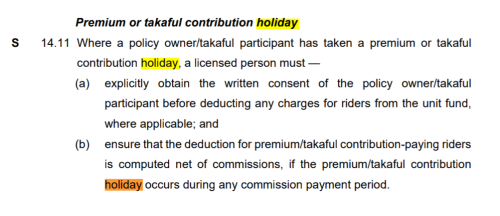
No, based on my understanding, they won't minus the new allocation charges (40% first year, 40% second year.....) from your unit fund (savings portion) if you don't keep to your premium payments, aka premium holiday, (based on BNM policy). They will wait for you to start making payments again before making deductions for allocation charges. However, they will still make deductions for cost of insurance charges. Also, BNM only says that ITOs can't make deductions for commissions during premium holiday. Nothing about deductions for management/operating expenses (which a part of the allocation charges covers) and cost of insurance charges other than getting your consent. And your "consent" I think is just a policy term in your main contract. I don't think ITOs actually call you up again and ask you to sign a new form again consenting to deductions when you are on premium holiday.

So, please do check again with the ITO on this

user posted image

The part that really pisses me off and makes my blood boil about your situation is that they are charging you allocation charges again for the additional premium levied when upgrading your plan. You've already made the case that the cost of insurance charges are the same or lesser for the medical coverage of your plan after upgrading. So why should the new premium amount quoted for your plan have any increment in the first place and why should you be expected to pay any further additional charges?????

This upgrade is basically an excuse to reprice your policy for sustainability, which maybe the ITO didn't account for sustainability properly in the policy's initial pricing. Why should you, the consumer, be expected to bear the burden for the ITO's mispricing and other errors???!

This post has been edited by hafizmamak85: Mar 21 2025, 12:06 PM

392 Pages « < 347 348 349 350 351 > » Top
 

Change to:
| Lo-Fi Version
0.2367sec    0.96    6 queries    GZIP Disabled
Time is now: 19th December 2025 - 08:45 PM