Welcome Guest ( Log In | Register )

427 Pages « < 380 381 382 383 384 > » Bottom

Outline · [ Standard ] · Linear+

 Interactive Brokers (IBKR), IBKR users, welcome!

views
     
Medufsaid
post Apr 17 2024, 05:48 PM

Look at all my stars!!
*******
Senior Member
3,490 posts

Joined: Jan 2003
QUOTE(incubustor @ Apr 17 2024, 03:00 PM)
managed to register.
*
QUOTE(Medufsaid @ Mar 26 2024, 09:22 PM)
do take note that if you want to open CIMB sg acct, you cannot use Wise anymore. can only do through these
  • deposit S$1k from CIMB MY (expensive)
  • deposit S$1k from other sg banks
so, unless u are ok with the expensive fees to transfer that S$1k, open a MBB (or OCBC) sg bank acct first. open CIMB sg when you want to transfer back to Malaysia
*


This post has been edited by Medufsaid: Apr 17 2024, 05:48 PM
SUSTOS
post Apr 17 2024, 08:27 PM

Look at all my stars!!
*******
Senior Member
8,667 posts

Joined: Aug 2019
From: Penang <-> Singapore


FT Alphaville: Equities

Does size matter any more?

FT Alphaville examines the ‘death of small-caps’ narrative

https://www.ft.com/content/abfbf19e-f963-4c...9e-7bef8896e8cd

QUOTE
The Russell 2000 small-caps index has now lagged behind the S&P 500 large-capitalisation index since its inception at the end of 1978, overturning a century of return data across multiple countries.

These are admittedly price returns, since no total return indices go back this far. But including dividends wouldn’t change the picture. Larger companies tend to be more generous with their dividends, so it would probably only worsen the small-cap underperformance. And it looks even more stark if you start in 1984, when the Russell 2000 was actually born (with data going back to the late 70s).

It’s tempting to dismiss this as merely the result of the powerful momentum currently enjoyed by the 10 biggest US stocks, which are thumping even the S&P 490. And notably, this isn’t happening internationally, where small>big largely still holds true.
SUSTOS
post Apr 17 2024, 10:15 PM

Look at all my stars!!
*******
Senior Member
8,667 posts

Joined: Aug 2019
From: Penang <-> Singapore


Before I forget... IBKR Q1 results:

https://gdcdyn.interactivebrokers.com/mkt/g...atestEarningsPR
SUSTOS
post Apr 22 2024, 03:25 PM

Look at all my stars!!
*******
Senior Member
8,667 posts

Joined: Aug 2019
From: Penang <-> Singapore


Milo about to become more expensive in Malaysia...

https://www.sinchew.com.my/news/20240422/nation/5552438
SUSTOS
post Apr 23 2024, 05:55 PM

Look at all my stars!!
*******
Senior Member
8,667 posts

Joined: Aug 2019
From: Penang <-> Singapore


Novartis results: https://www.novartis.com/news/novartis-fina...results-q1-2024

Roche reporting tomorrow.

Nestle reporting the day after tomorrow.

This post has been edited by TOS: Apr 23 2024, 05:57 PM
SUSTOS
post Apr 24 2024, 09:18 PM

Look at all my stars!!
*******
Senior Member
8,667 posts

Joined: Aug 2019
From: Penang <-> Singapore


Roche results: https://www.roche.com/investors


SUSTOS
post Apr 25 2024, 11:29 AM

Look at all my stars!!
*******
Senior Member
8,667 posts

Joined: Aug 2019
From: Penang <-> Singapore


Nestle reporting results later at 1 pm Malaysia/Singapore time: https://www.nestle.com/media/mediaeventscal...ree-month-sales

Unilever reporting results at 2 pm Malaysia/Singapore time: https://www.unilever.com/investors/results-...latest-results/

Time to see how many tins of Milo and packets of Nescafe you guys drank last quarter! laugh.gif

This post has been edited by TOS: Apr 25 2024, 05:37 PM
SUSTOS
post Apr 26 2024, 12:08 PM

Look at all my stars!!
*******
Senior Member
8,667 posts

Joined: Aug 2019
From: Penang <-> Singapore


QUOTE(TOS @ Apr 22 2024, 03:25 PM)
Milo about to become more expensive in Malaysia...

https://www.sinchew.com.my/news/20240422/nation/5552438
*
Check your latest Milo, Maggi and Nescafe prices here:

https://www.sinchew.com.my/news/20240426/nation/5563000
SUSTOS
post Apr 26 2024, 09:09 PM

Look at all my stars!!
*******
Senior Member
8,667 posts

Joined: Aug 2019
From: Penang <-> Singapore


In the luxury goods world, you want to stick to the ones that cater to the super luxurious customers, not the ones who wanna show off for one time to their friends...

2 brands to offer: Hermes is the popular one, but this FT article suggests another understated one: Brunello Cucinelli in Italy.

https://www.ft.com/content/d70a2ddc-6cfe-46...e8-feb2252795cc

Net debt is a whopping low 5 million EUR against annual FCF of some 135 million EUR per year. Found a rare gem eh lol drool.gif

https://investor.brunellocucinelli.com/en/s...r/presentations
SUSTOS
post Apr 27 2024, 10:39 PM

Look at all my stars!!
*******
Senior Member
8,667 posts

Joined: Aug 2019
From: Penang <-> Singapore


FT: The best books of the week

Non-Fiction

The Everything War — taking on Amazon’s march to monopoly
Dana Mattioli’s important book looks the winner-takes-all dynamic that built a competition-squashing behemoth

https://www.ft.com/content/48bd51aa-ea9a-4c...20-448ee5ce80f8
SUSTOS
post Apr 28 2024, 05:47 PM

Look at all my stars!!
*******
Senior Member
8,667 posts

Joined: Aug 2019
From: Penang <-> Singapore


FT Opinion: Markets

Relative measures can be absolutely wrong
Comparing one data point with another can be misleading, nonsensical or even dangerous.

by Stuart Kirk (APRIL 27 2024)

QUOTE
As a clever-clogs analyst a long time ago, I remember ripping a friend’s new business venture apart. Why would you touch such a horrible industry? The profit margins are barely in to double figures! But when revenues passed eight digits, his earnings were a million pounds per year. He realised before I did that money is absolute, whereas my financial models were full of percentages and ratios.

Relativism is not only a cultural problem. It is also rife in finance — as my friend demonstrated — as well as economics and politics. We are constantly bombarded with comparisons which make no sense at all.

Take the news that the UK plans to increase its defence budget to 2.5 per cent of gross domestic product by the end of the decade. What on earth does military spending have to do with the final value of goods and services produced in a country in one year? Even Nato believes its 2 per cent of GDP guideline “serves as an indicator of a country’s political will to contribute”. 

No it doesn’t — the denominator has nothing to do with politics. If anything should be calculated bottom-up on an absolute basis it’s national defence, assessing risk versus capability. In any rational world, how many 155mm artillery shells are needed should be independent of consumer confidence (the biggest driver of GDP). Armies should not starve if artificial intelligence fails to boost low productivity.

Carbon intensity metrics used to judge corporate greenness are another example of relative hogwash. Our atmosphere needs lower emissions, period — not having them increase less than revenues. Plus you can end up with a ridiculous situation in which companies are praised when sales outpace emissions solely because of inflation.

The hot topic of unemployment also suffers from wayward denominators. America has its jobless claims data, but the rest of the world rarely mentions the actual number of real human beings out of work. Mostly we talk about the unemployment rate, expressed as a percentage.

But these are a fiction — usually dividing an arbitrary definition of unemployment by a worse estimate of the number of people who are economically active. If someone feels worthless the day a survey hits their door mat, they may tick the “currently not actively seeking work” box. Hey presto, they aren’t included in the unemployment rate.

And therein lies the appeal of ratios and percentages, I suppose. They are one step removed from having to face unpalatable truths in either the numerator (how many tanks do we actually have compared with Russia) or the denominator (better optics on defence spending are merely due to a recession).

The inequality debate is another case in point. Those on the left prefer to throw around comparisons between the rich and poor. Meanwhile the right tends to focus on the numerator only, showing how much wealthier the poor are in absolute terms.

You may think markets are above spurious relativities. And to their credit (and, often, my shame) they frequently are. For example, no one cared that Amazon or Tesla had negative margins for years. Investors knew the revenue line was the only thing to watch.

Likewise, for decades markets have not been spooked much by soaring public debt ratios. Rich country public sector liabilities are now 100 per cent of GDP on average. This may yet prove disastrous. However, so far government bond owners have been right not to panic.

That said, investors still do things every bit as silly as comparing defence budgets to national incomes. We rank companies by their price-to-earnings ratios, say, despite the fact every company and sector measures their net profits differently.

Strategist reports are also devoured. These mostly consist of charts of variables which seem to move together (such as solar flare activity and year-on-year Nasdaq returns). Causation is claimed when the two numbers are merely correlated — if even that.

Perhaps our most common investment mistake is comparing today with the past. To be sure there are ratios that do revert to a mean — returns on equity for example. But extrapolating historical relationships is often ruinous, as many a failed hedge fund — Long-Term Capital Management springs to mind — will tell you.

Absolute numbers can mislead as well, of course. Sure, Alphabet’s market cap rose by a headline grabbing $200bn on Friday — but it’s a big company. Similarly, it was wrong during Covid to quote cases and deaths by country with no reference to population size.

We must all be more careful not to take relative or absolute facts as given. But the former are especially dangerous; inaccuracies can lurk in two numbers. And very often these shouldn’t even be compared at all.

stuart.kirk@ft.com   
Source: https://www.ft.com/content/7f0d8140-ee06-4a...5a-bc1cab5ec4cf


SUSTOS
post Apr 29 2024, 10:55 PM

Look at all my stars!!
*******
Senior Member
8,667 posts

Joined: Aug 2019
From: Penang <-> Singapore


Jane Streeters make a lot of money. A LOT

They are a big market maker, sucking lots of money from ETF holders via their AP role.

https://www.ft.com/content/54671865-4c7f-46...79-867ef68f0bde (use a paywall bypass plugin, lots of interesting numbers inside)
SUSTOS
post May 2 2024, 09:37 AM

Look at all my stars!!
*******
Senior Member
8,667 posts

Joined: Aug 2019
From: Penang <-> Singapore


The dangers of convertible bond: Kicking the can full of worms down the road.

https://www.ft.com/content/66e9743f-219b-4a...dd-2bc4822b9937 (use a paywall bypass).
imceobichi
post May 3 2024, 02:07 PM

Getting Started
**
Junior Member
115 posts

Joined: Aug 2020
Anybody tried IBKR withdrawal into cimb sg lately?

Why does the bank approval process for inward TT take so long lately?

Last time I remember it used to take at most 2-3 hours
SUSTOS
post May 3 2024, 02:55 PM

Look at all my stars!!
*******
Senior Member
8,667 posts

Joined: Aug 2019
From: Penang <-> Singapore


FT Undercover Economist | Life & Arts

The lesson of Loki? Trade less
Going back as far as the Norse gods, the market has tricked investors into making rash decisions

by Tim Harford (3 HOURS AGO)

QUOTE
The pages of the Financial Times are not usually a place for legends about ancient gods, but perhaps I can be indulged in sharing one with a lesson to teach us all.

More than a century ago, Odin, All-father, greatest of the Norse gods, went to his wayward fellow god Loki, and put him in charge of the stock market. Odin told Loki that he could do whatever he wanted, on condition that across each and every 30-year period, he ensured that the market would offer average annual returns between 7 and 11 per cent. If he flouted this rule, Odin would tie Loki under a serpent whose fangs would drip poison into Loki’s eyes from now until Ragnarök.

Loki is notoriously malevolent, and no doubt would love to take the wealth of retail investors and set it on fire, if he could. But when faced with such a — shall we say binding? — constraint, what damage could he really do?

He could do plenty, says Andrew Hallam, author of Balance and other books about personal finance. Hallam uses the image of Loki as the malicious master of the market to warn us all against squandering the bounties of equity markets.

All Loki would have to do is ensure the market zigged and zagged around unpredictably. Sometimes it would deliver apparently endless bull runs. At other times it would plunge without mercy. It might alternate mini-booms and mini-crashes; it might trade sideways; it might repeat old patterns, or it might do something that seemed quite new. At every moment, the aim would be to trick investors into doing something rash.

None of that would deliver Loki’s goals if we humans weren’t so easy to fool. But we are. You can see the damage in numbers published by the investment research company Morningstar; last year it found a shortfall in annual returns of 1.7 percentage points between what investors make and the performance delivered by the funds in which they invested.

There is nothing strange about investors making a different return from the funds in which they invest. Fund returns are calculated on the basis of a lump-sum buy-and-hold investment. But even the most sober and sensible retail investor is likely to make regular payments, month by month or year by year. As a result, their returns will be different, maybe better and maybe worse.

Somehow, it’s always worse. The gap of 1.7 percentage points a year is huge over the course of a 30-year investment horizon. A 7.2 per cent annual return will multiply your money eightfold over 30 years, but subtract the performance shortfall and you get 5.5 per cent a year, or less than a fivefold return in 30 years.

Why does this happen? The primary reason is that Loki’s mischievous gyrations tempt us to buy when the market is booming and to sell when it’s in a slump. Ilia Dichev, an economist at Emory University, found in a 2007 study that retail investors tended to pile into markets when stocks were doing well, and to sell up when they were languishing. (Without wishing to burden the long-suffering reader with technical details, it turns out that buying high and selling low is a bad investment strategy.)

One possible explanation for this behaviour is that investors are deeply influenced by what they’ve seen the stock market doing across their lives so far. The economists Ulrike Malmendier and Stefan Nagel have found that the lower the returns investors have personally witnessed, the less they are likely to put in the stock market. This means that bear markets scare investors away from their biggest buying opportunities.

Another study, by Brad Barber and Terrance Odean, looked at retail investors in the early 1990s, and found that they traded far too often. Active traders underperformed by more than 6 percentage points annually. Slumbering investors saw a much better performance. The sticker price of making a trade has plummeted since then, of course. Alas, the cost of making a badly timed trade is as high as ever.

Morningstar found that the gap between investment and investor returns is largest for more specialist investments such as sector equity funds or non-traditional equity funds. The gap is smaller for plain vanilla equity and smaller still for allocation funds, which hold a blend of stocks and bonds and automate away investor choices. That suggests that the investors who are trying to be clever are the most likely to fall short, while those who make the fewest possible decisions will lose out by the smallest amount.

I am always hearing that people should be more engaged with investing, and up to a point that is true. People who feel ignorant about how equity investing works and therefore stick their money in a bank account or under a mattress, are avoiding only modest risks and giving up huge potential returns.

But you can have too much of a good thing. Twitchily checking and rearranging your portfolio is a great way to get sucked into poorly timed trades. The irony is that the new generation of investment apps work the same way as almost any other app on your phone: they need your attention and have plenty of ways to get it.

Recent research by the Behavioural Insight Team, commissioned by regulators in Ontario, found that gamified apps — offering unpredictable rewards, leader boards and badges for activity — simply encouraged investors to trade more often. Perhaps Loki was involved in the app development process?

I’ve called this the Investor’s Tragedy. The more attention we pay to our investments, the more we trade, and the cleverer we try to be, the less we will have at the end of it all.
https://www.ft.com/content/77698939-0131-41...4d-a89570a8540e

Medufsaid
post May 3 2024, 03:09 PM

Look at all my stars!!
*******
Senior Member
3,490 posts

Joined: Jan 2003
QUOTE(imceobichi @ May 3 2024, 02:07 PM)
Last time I remember it used to take at most 2-3 hours
*
when was this? it always took 1 days to appear in CIMB sg. last week i withdraw and no unusual delays. funds came the next day.

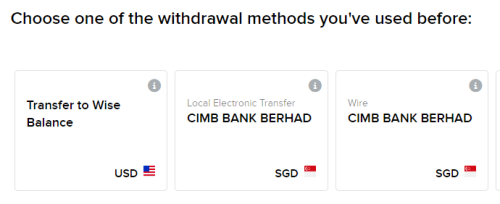
btw, do hook up Wire + Local electronic transfer. at least many alternative ways to withdraw out

user posted image
imceobichi
post May 3 2024, 05:46 PM

Getting Started
**
Junior Member
115 posts

Joined: Aug 2020
QUOTE(Medufsaid @ May 3 2024, 03:09 PM)
when was this? it always took 1 days to appear in CIMB sg. last week i withdraw and no unusual delays. funds came the next day.

btw, do hook up Wire + Local electronic transfer. at least many alternative ways to withdraw out

user posted image
*
Will link to wise
Avangelice
post May 6 2024, 10:19 AM

Look at all my stars!!
*******
Senior Member
5,272 posts

Joined: Jun 2008


Hi guys, what's the current cheapest way to fund usd into ikbr? Wise has gotten way expensive now

Edit

Never mind, it was answered from the previous page. Tq

This post has been edited by Avangelice: May 6 2024, 10:20 AM
Medufsaid
post May 6 2024, 01:14 PM

Look at all my stars!!
*******
Senior Member
3,490 posts

Joined: Jan 2003
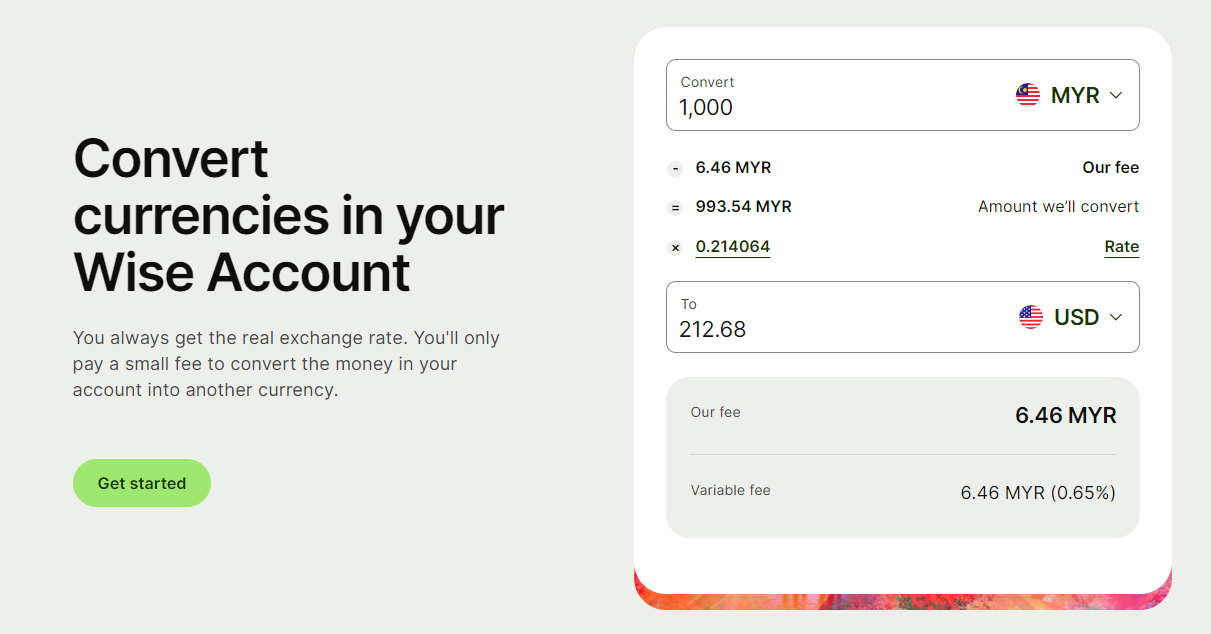
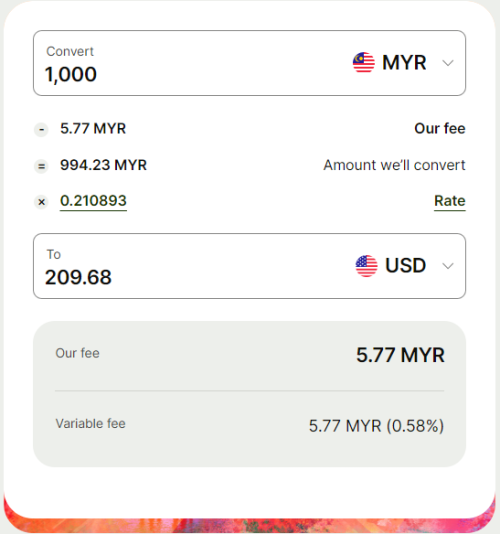
Avangelice wise is expensive, but credit where credit's due, it has gotten cheaper.
QUOTE(Medufsaid @ Jun 29 2023, 11:53 AM)
user posted image

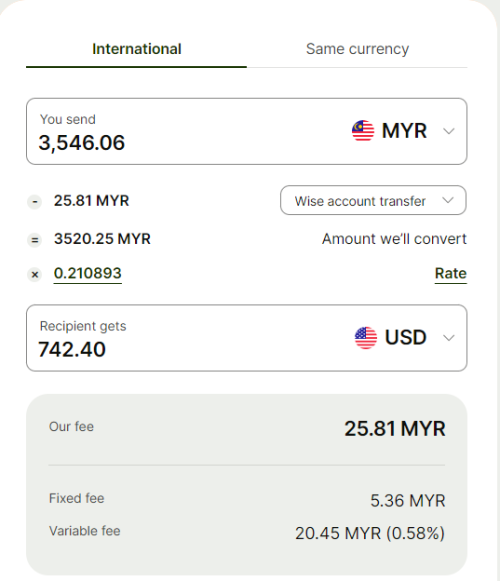
just make sure you convert into your USD balance, then send that out. don't send out MYR to IBRK as you'll have convenience (fixed) fees of RM5.36 added on https://wise.com/my/pricing/send-money?sour...etCcy=USD&tab=0

user posted image

This post has been edited by Medufsaid: May 6 2024, 01:16 PM
Avangelice
post May 6 2024, 01:22 PM

Look at all my stars!!
*******
Senior Member
5,272 posts

Joined: Jun 2008


QUOTE(Medufsaid @ May 6 2024, 01:14 PM)
Avangelice wise is expensive, but credit where credit's due, it has gotten cheaper.user posted image

just make sure you convert into your USD balance, then send that out. don't send out MYR to IBRK as you'll have convenience (fixed) fees of RM5.36 added on https://wise.com/my/pricing/send-money?sour...etCcy=USD&tab=0

user posted image
*
Thanks ill compare the process when I have the time.

1) cimb my > money match > cimb sg > ikbr sgd> ikbr usd (does this even make sense when I convert X 2?

2) wise myr > wise usd > ikbr

427 Pages « < 380 381 382 383 384 > » Top
 

Change to:
| Lo-Fi Version
0.0236sec    0.33    6 queries    GZIP Disabled
Time is now: 6th December 2025 - 05:21 PM