Welcome Guest ( Log In | Register )

Bump Topic Topic Closed RSS Feed
7 Pages < 1 2 3 4 5 > » Bottom

Outline · [ Standard ] · Linear+

 LYN Christian Fellowship V14 (Group)

views
     
prophetjul
post Feb 14 2019, 09:57 AM

10k Club
********
All Stars
12,268 posts

Joined: Oct 2010

QUOTE(yeeck @ Feb 13 2019, 02:28 PM)
It is the angel Gabriel (a messenger from God, thus it is God Himself messagewise), who calls her "full of grace".
*
There are only TWO passages in the NT which uses this phrase "full of grace".
NONE applied to Mary.
prophetjul
post Feb 14 2019, 12:59 PM

10k Club
********
All Stars
12,268 posts

Joined: Oct 2010

QUOTE(yeeck @ Feb 14 2019, 12:34 PM)
As if you know God's will and not the rest? Hehe
*
I do not know God's will but for His scriptures. Your traditions have many conflicts with His scriptures.
prophetjul
post Feb 14 2019, 01:02 PM

10k Club
********
All Stars
12,268 posts

Joined: Oct 2010

QUOTE(yeeck @ Feb 14 2019, 12:51 PM)
Wrong.

"And the Word became flesh and dwelt among us, and we beheld His glory, the glory as of the only begotten of the Father, full of grace and truth" (John 1:14). This one applies to Christ, the Word made Flesh.

"And Stephen, full of grace and fortitude, did great wonders and signs among the people." (Acts 6:8) This one applies to Stephen.

"And the angel being come in, said unto her: Hail, full of grace, the Lord is with thee: blessed art thou among women." (Luke 1:28). This one applies to Mary.

Do check the Greek words used, I think unknown warrior can explain, after which I will add in with the Catholic understanding from his explanation.
*
WRONG.

And the angel came in unto her, and said, Hail, thou that art highly favoured, the Lord is with thee: blessed art thou among women. Lk 1:28

The phrase "full of grace" in Greek is "plaras karitos," and it occurs in only two places in the New Testament; neither one is in reference to Mary.

"And the Word became flesh, and dwelt among us, and we beheld His glory, glory as of the only-begotten from the Father, full of grace and truth," (John 1:14).
"And Stephen, full of grace and power, was performing great wonders and signs among the people," (Acts 6:8).

Your verse is taken from the LATIN Vulgate, a very bad translation by Jerome.
prophetjul
post Feb 14 2019, 01:04 PM

10k Club
********
All Stars
12,268 posts

Joined: Oct 2010

QUOTE(yeeck @ Feb 14 2019, 12:35 PM)
They are when they intend to definitively teach the faithful. And you brought up the clear example of Peter that he was given the authority, but also as human he can fail/fall personally.
*
What's to definitively teach the faithful? He could teach wrong things but for the scriptures as their guide.
ALWAYS check with the scriptures.
prophetjul
post Feb 14 2019, 01:33 PM

10k Club
********
All Stars
12,268 posts

Joined: Oct 2010

QUOTE(pehkay @ Feb 14 2019, 01:21 PM)
Wah if like that Stephen will be sinless too smile.gif
*
icon_question.gif
prophetjul
post Feb 14 2019, 03:52 PM

10k Club
********
All Stars
12,268 posts

Joined: Oct 2010

QUOTE(yeeck @ Feb 14 2019, 03:01 PM)
For Luke 1:28, it's κεχαριτωμένη (kecharitomene).

For John 1:14, it's πλήρης χάριτος (pleres charitos), same as for Acts 6:8.

"Full of grace" is literally "pleres charitos," and that wording is used in reference to Jesus (John 1:14) and to St. Stephen (Acts 6:8). Obviously, its used with two different meanings in those two passages, but its meaning is clearly gleamed by its context. Technically, anyone who was recently baptized or received the sacrament of confession is pleres charitos.

In Luke 1:28, the word that the angel uses is kecharitomene. So its not literally "full of grace," but its root word is the Greek verb "to give grace" (charitoo). The word is the past perfect tense, meaning that the action of giving grace has already occurred. It was not something that was about to happen to her but something that has already been accomplished. The word was also used as a title. The angel did not say, "Hail Mary, you are kecharitomene" but rather, "Hail kecharitomene." Therefore the word is not simply an action but an identity.


Means your Latin Vulgate translation of "ave gratia plena" "Hail full of grace." is faulty.

The single Greek word kexaritomena and means highly favored, make accepted, make graceful, etc. It does not mean "full of grace" which is "plaras karitos" (plaras = full and karitos = Grace) in the Greek.


5923 χαριτόω (charitoō): vb.; Str 5487; TDNT 9.372—LN 88.66 show kindness graciously give, freely give (Eph 1:6); as a passive participle, subst., “one highly favored.”1
5487 χαριτόω [charitoo /khar·ee·to·o/] v. From 5485; TDNT 9:372; TDNTA 1298; GK 5923; Two occurrences; AV translates as “be highly favoured” once, and “make accepted” once. 1 to make graceful. 1a charming, lovely, agreeable. 2 to peruse with grace, compass with favour. 3 to honour with blessings.2

So you have rightly pointed out that the phrase "full of grace" is only found in two places in the NT. And both occasions did not apply to Mary. Thank You.


QUOTE

It is thus difficult to translate because it is a unique use of the word. It has been translated by various scholars as "full of grace", "graced one," "one who has been made graced," "highly graced," and "highly favored." In the last instance the translator is using the concept that to be graced by God is to find favor with God. It would appear that any translation should use the word "grace," because that is the root word.


So what do the other translations say about Luke 1:28? Let's find out.

The Nestle-Aland 26th edition, Greek New Testament Interlinear--"having gone into her he said rejoice one having been favored, the master is with you."
The NRSV English-Greek Reverse Interlinear New Testament--And he came to her and said, "Greetings, favored one! The Lord is with you."
American Standard Version--"And he came in unto her, and said, Hail, thou that art highly favored, the Lord is with thee."
English Standard Version--"And he came to her and said, Greetings, O favored one, the Lord is with you!
Today's English Version--'"The angel came to her and said, “Peace be with you! The Lord is with you and has greatly blessed you!”
King James Version--"And the angel came in unto her, and said, Hail, thou that art highly favoured, the Lord is with thee: blessed art thou among women."
New American Standard Bible--"And coming in, he said to her, Hail, favored one! The Lord is with you.
New International Version--"The angel went to her and said, Greetings, you who are highly favored! The Lord is with you.
New King James Version--"And having come in, the angel said to her, Rejoice, highly favored one, the Lord is with you; blessed are you among women!"
Revised Standard Version--"And he came to her and said, 'Hail, O favored one, the Lord is with you!'
New Revised Standard Version--And he came to her and said, “Greetings, favored one! The Lord is with you.”
The New Century Version--The angel came to her and said, “Greetings! The Lord has blessed you and is with you.”
New Living Translation--Gabriel appeared to her and said, “Greetings, favored woman! The Lord is with you!'”
The Cambridge Paragraph Bible--And the angel came in unto her, and said, Hail, 'thou that art 'highly favoured, 'the Lord is with thee: 'blessed art thou among women.'
The Holman Christian Standard Bible--"And the angel came to her and said, “Rejoice, favored woman! The Lord is with you."
International Standard Version--'"The angel'' came to her and said, “'Greetings, you who are highly favored! The Lord is with you!"

QUOTE

However, it might sound "clunky" to some—they might think "highly favored" is more title-sounding than "full of grace," and there is nothing inherently incorrect theologically about asserting that Mary was favored by God. The early Christians certainly believed in Mary's sinlessness, and they are  more trustworthy witnesses rather than the later comer Protestants who arrived more than 1500 years late to deny this belief.


Trying to justify your pagan understanding again? The apostles and prophets would have seriously protested if you did this.
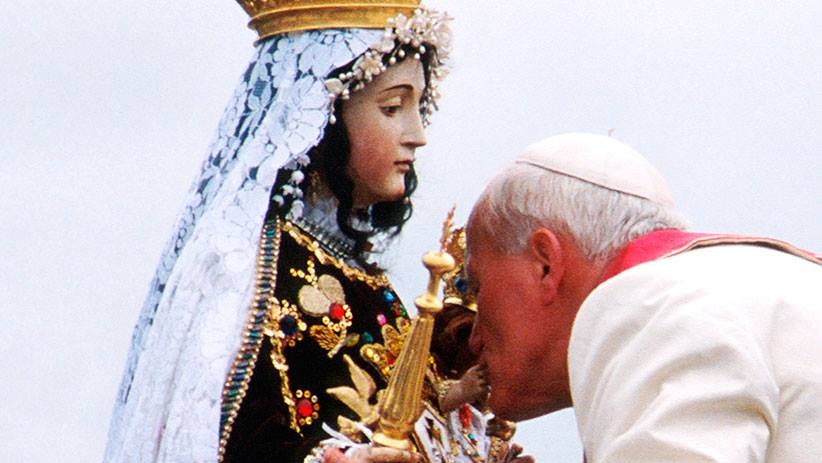
user posted image

Ex 20
4Thou shalt not make unto thee any graven image, or any likeness of any thing that is in heaven above, or that is in the earth beneath, or that is in the water under the earth:

5 Thou shalt not bow down thyself to them, nor serve them: for I the LORD thy God am a jealous God, visiting the iniquity of the fathers upon the children unto the third and fourth generation of them that hate me;

QUOTE
The constant faith of the Church attests to the belief in the special preparation of the holiness of the person of Mary to bear in her body the most holy person of the Son of God. Implicitly found in the Fathers of the Church in the parallelism between Eve and Mary (Irenaeus, Lyons, 140? - 202?); Found in the more general terms about Mary: "holy", "innocent", "most pure", "intact", "immaculate" (Irenaeus, Lyons, 140?-202?; Ephraem, Syria, 306-373; Ambrose, Milan, 373-397); Explicit language: Mary - free from original sin (Augustine, Hippo, 395-430 to Anselm, Normandy, 1033-1109).
*
Luke 11

27 And it came to pass, as he spake these things, a certain woman of the company lifted up her voice, and said unto him, Blessed is the womb that bare thee, and the paps which thou hast sucked.

28 But he said, Yea rather, blessed are they that hear the word of God, and keep it

prophetjul
post Feb 20 2019, 01:12 PM

10k Club
********
All Stars
12,268 posts

Joined: Oct 2010

QUOTE(yeeck @ Feb 15 2019, 11:08 AM)
This raises the question as to how to translate the word at issue (kecharitōmenē) in the first place.  The word is a form of the verb charitoō. This word should look familiar, even to non-Greek speakers. It’s where we get our word charisma, which refers to someone’s gift as a leader. In ancient Greek, the companion noun was charis, the stock New Testament word for grace. Although it’s sometimes translated as favor, it overwhelmingly is rendered in the King James Bible as grace. (Out of 156 instances, 132 read as grace, while just 7 are favor. Most of the rest appear to be translated as a form of thanks.)

We are right to suspect that charitoō then has something to do with grace as we understand it. And that’s exactly how it’s defined. Vine’s Expository Dictionary of New Testament Words defines the verb this way: “to endow with charis, primarily signified ‘to make graceful or gracious,’ … ‘to cause to find favor.’” Thayer’s Greek Lexicon puts it this way: “to pursue with grace, to compass with favor.” Another dictionary drops “favor” altogether and gives us this definition: “kecharitōmenē … means endowed with grace.”

However, these definitions do leave it open-ended as to whether grace or favor is the way to go. Although favor and grace have related meanings they remain distinct. In a theological context, grace is a free and unmerited gift of God. Grace is something given to someone. Usually we think of a favor as something done for someone else. So which way do we go in Luke 1? Unlike the noun, the verb is used only one other time in the New Testament, so we don’t have too many verses to guide us on how it’s used. (For the record, the other instance is Ephesians 1:6 and the most common translation is grace.)

Fortunately, the text does not leave us hanging. After Mary’s initial apprehension, the angel tells her, “Fear not, Mary, for thou hast found grace with God” (Luke 1:30). Grace here is the noun charis, which we’ve already established usually means grace and only rarely favor (in the New Testament at least). If Luke 1:28 was unclear, Luke 1:30 is our clarification. This should settle it. We’re talking about grace.


Now our question becomes: How much grace did Mary receive and when? The dogma of the Immaculate Conception holds that Mary was fully graced from the moment of conception, that through the grace of God, Mary’s life was one without sin. Is this supported by Luke 1:28?

For the answer, we now turn from the dictionary to the grammar book. As mentioned above kecharitōmenē is a form of the verb charitoō. Our focus will be on the tense. A verb tense at the most basic level refers to the time of action. “I wrote an article” is an example of the past tense. “I am writing” is present and “I will write” is future. Now in ancient Greek there were more than just these three simple tenses. There were other tenses that tell us something about the action done and its enduring impact. And that’s where things get exciting.

Kecharitōmenē is the “perfect” tense of charitoō. According to Herbert Weir Smyth’s A Greek Grammar for Colleges—still the bible for Greek grammar today—defines the perfect tense this way: “The perfect denotes a completed action the effects of which still continue in the present.” So Mary received grace in some complete way and remains completed in that grace. We’re coming awfully close to the Catholic dogma.

Or are we reading too much into this? Here’s the conclusion two scholars draw: “It is permissible, on Greek grammatical and linguistic grounds, to paraphrase kecharitōmenē as completely, perfectly, enduringly endowed with grace” (Blass and DeBrunner, Greek Grammar of the New Testament).

Indeed, to say that Mary was “completely, perfectly, enduringly endowed with grace” is not only a restatement of the dogma of the Immaculate Conception, it also points forward to the traditional teaching that Mary is a “Mediatrix of all graces” (yet to be dogmatically defined). If anything, “full of grace,” seems to understate what the Greek text is saying. But “filled completely, perfectly, and enduringly” is a mouthful, so it’s easy to see why the Vulgate went with the more poetic approximation “full of grace.” Don't forget, St Jerome was translating into Latin which was the lingua franca then.

By turns the dictionary, concordance, and grammar argue for the Catholic reading of Luke 1:28.

Three facts from the narrative seal the case. First, as St. Thomas Aquinas notes in his commentary on the Hail Mary, the angel’s reverent salutation of Mary is a complete reversal of roles from the Old Testament, in which men revered angels. Such reverence was due to angels because angels have a spiritual and incorruptible nature, are more familiar with God, and “partake most fully of the divine light.” In revering Mary, then, then Angel Gabriel is showing that she surpasses the angels in these three aspects. Only someone “full of grace” could merit such extraordinary reverence.

Second, in the Greek text, as Aquinas points out, Mary’s name is missing from Luke 1:28. The text literally reads as “Hail, full of grace.” Mary has become so “full of grace” that it has consumed her completely—it has become more who she is even than even her very name.

This omission makes the most sense if we translate the verb as grace and not as favor. A favor does not involve the interior man (or woman). It chiefly is concerned with their exterior circumstances. I can do a favor for you without changing who you are (for example, buy you a car, or get you a job). God’s grace changes who we are. Grace implies a spiritual state or interior condition (hence the phrase “state of grace”). One can imagine, then, that someone could be in such an intensive state of grace that it defines their whole personality.

Third, Mary’s reaction to the angel’s words is a giant clue as to their significance. Here is the text again (Douay-Rheims translation):

[28] And the angel being come in, said unto her: Hail, full of grace, the Lord is with thee: blessed art thou among women. [29] Who having heard, was troubled at his saying, and thought with herself what manner of salutation this should be. [30] And the angel said to her: Fear not, Mary, for thou hast found grace with God.

[31] Behold thou shalt conceive in thy womb, and shalt bring forth a son; and thou shalt call his name Jesus. [32] He shall be great, and shall be called the Son of the most High; and the Lord God shall give unto him the throne of David his father; and he shall reign in the house of Jacob for ever. [33] And of his kingdom there shall be no end. [34] And Mary said to the angel: How shall this be done, because I know not man? [35] And the angel answering, said to her: The Holy Ghost shall come upon thee, and the power of the most High shall overshadow thee. And therefore also the Holy which shall be born of thee shall be called the Son of God.

This is a lot to take in. Mary is “blessed among women.” Her son will be the “Son of the Most High” and a king after David. And she will do this while remaining a virgin. Instead, she will conceive by the “power of the most High.” Terror-inducing words for any mortal ears, not to mention an unmarried teenage virgin. Readers may recall that Mary was “troubled” by the words of the angel. Your quote of Luke 11 as if trying to make Scripture verses contradict each other is at least ill-advised. But Catholics do not see contradiction in Scripture.

But go back and read at what point she was “troubled.” Mary’s apprehension comes before the angel foretells the birth of Christ and His kingdom. It comes after just this one line: Hail, full of grace, the Lord is with thee: blessed art thou among women. One wonders, were this just an act of divine “favor” what would be so troubling to Mary? Favors are always welcomed, never feared. Divine grace, on the other hand, is powerful, awesome, even fearsome.

The doctrine of the Immaculate Conception can indeed be “troubling.” Our best response, however, is to follow the example of Mary and accept God’s words in faith.
*
Greek word:

Κεχαριτωμένη (source)

Transliteration:

Kecharitomene

Translation:

Literally,” You, who have been graced” (You that are highly favored, KJV)

English:

You (Second Person Singular)

Have (present tense)

Been (past participle of “to be”)

Graced (past participle of “to grace”).

Greek:

KE – perfect tense (prior event/occurrence/happening that is still existing/occurring or happening now)

CHARITO – a gift, something that is free or unmerited

MENE – a female receiver not giver.

The Latin translation “gratia plena” (full of grace, as found in Dhouay-Rheims) is not a literal translation from the Greek.

The Greek word κεχαριτωμένη in reference to Mary denotes her status as someone who "found favor or grace with God" (Luke 1:30).

The translation "full of grace" (from the Latin Vulgate's "gratia plena")is valid:

"It is permissible, on Greek grammatical and linguistic grounds, to paraphrase kecharitomene as completely, perfectly, enduringly endowed with grace." (Blass and DeBrunner, Greek Grammar of the New Testament)

'Highly favoured' (kecharitomene). Perfect passive participle of charitoo and means endowed with grace (charis), enriched with grace as in Ephesians 1:6 . . . The Vulgate gratiae plena [full of grace] "is right, if it means 'full of grace which thou hast received'; wrong, if it means 'full of grace which thou hast to bestow' " (A.T. Robertson, Word Pictures in the New Testament, p. 14)

In Catholic Bibles (containing the Deuterocanonicals),there is kecharitomene (a girl who is full of grace ~ Luke 1:28) and kecharitomeno (a boy who is full of grace ~ Sirach 18:17 LXX).

Are these two conceive immaculately too without sin?


There is no proper translation which suggests "FULL OF GRACE" as RCC is making it out to be.
And therefore an ungodly doctrine of "Immaculate conception"

Doing so is pagan worship of a creature. An Abomination to God.
prophetjul
post Feb 21 2019, 08:38 AM

10k Club
********
All Stars
12,268 posts

Joined: Oct 2010

QUOTE(yeeck @ Feb 20 2019, 03:21 PM)
Sirach 18:17 is usually translated as gracious man or justified man. Your error is thinking Luke 1:28 is a proof-text of the Immaculate Conception when it is merely a support, albeit an extremely strong one. But you will not see that word scream “Immaculate Conception!” The authority for the Immaculate Conception is the Church, and the authority of the Church is DEFINITELY given in Scripture. If you read Sirach 18 in context and in entirety, it points to the good works exhorted by the father to his son. On the other hand, Luke 1 points to the favour given to Mary, not on her own account, but by the grace/gift of God.

I've also explained the teaching of the Church that the just baptized are free from sin.

Every Christian once in heaven will be perfected by God’s grace. However, only of Mary, and of “her seed,” which is Jesus Christ, is it said that there will be enmity between them and Satan. Since Jesus is God and since holiness is an aspect of His Nature, he has that enmity by nature. Where as with Mary, she has it as a gift.

Genesis 3:14-15
“And the LORD God said unto the serpent … I will put enmity between thee and the woman, and between thy seed and her seed; it shall bruise thy head, and thou shalt bruise his heel.” KJV

Of which woman’s seed was He born ? The answer of course is Mary. Jesus even goes on to identify Mary as the “Woman” in John 2:4 , 19:26, and also see Revelation 12: 1, 5, while Protestants think that Jesus is insulting His own mother! Gosh!

If there had ever been a time when Mary was under Satan’s domination through personal or original sin, then there would not be a real enmity between her and Satan. Therefore, by virtue of the grace He gave her, God put Mary in opposition to Satan from the beginning and throughout her life. Notice that God the Father says that He will put the enmity between her and Satan. Only in God, and by His gift of grace, also in Mary, can it be said that there is enmity with Satan because only in them is their entire life opposed to Satan.

Therefore, since Mary had an enmity between her and Satan, and even though she was a descendant of Adam and would have contracted Original Sin, she was saved from the stain of it by the merits of Jesus Christ from the first moment of her life.
*
You were the one to bring along immaculate conception.

You may twist what ever the translations. The fact is the phrase was the same in Sirach. Are they full of grace too? Or do you find it to your inconvenience to translate as such?


Baptism in itself brings NOTHING. Having faith in the Lord Jesus and being born again brings LIFE.

Many RCCs I see goes through whatever traditions, yet their lives are void of Christ. They cheat and corrupt in their daily living.
Is that a sign of REPENTANCE? Nope.
TBF so do many non RCCs. goers.

Are they born again?

We ALL have holiness as imputed to us as a GIFT, not just Mary. Thrugh the faith in the righteousness of Jesus, His holiness is imputed to us as born again believers.
Holiness and righteousness go hand in hand.

2 Cor 5
21 For our sake he made him to be sin who knew no sin, so that in him we might become the righteousness of God.

That prophecy is about the messiah who will be born of a woman. That God has already has His deliverance plan in mind.
And God was referring to Eve, the mother of all mankind.

See how the RCC tries to accommodate their pagan doctrines?

What did Jesus say about the blessedness of a mother? Vs obeying God's word?

Maybe you glossed over........

Luke 11
27 And it came to pass, as he spake these things, a certain woman of the company lifted up her voice, and said unto him, Blessed is the womb that bare thee, and the paps which thou hast sucked.

28 But he said, Yea rather, blessed are they that hear the word of God, and keep it.

Which the RCC is consistently rebelling against. His word and instructions.

3Thou shalt have no other gods before me.
4Thou shalt not make unto thee any graven image, or any likeness [of any thing] that [is] in heaven above, or that [is] in the earth beneath, or that [is] in the water under the earth: 5Thou shalt not bow down thyself to them, nor serve them:

user posted image

user posted image

This post has been edited by prophetjul: Feb 21 2019, 08:55 AM
prophetjul
post Mar 6 2019, 12:44 PM

10k Club
********
All Stars
12,268 posts

Joined: Oct 2010

Mar 18 2019, 11:56 PM
This post has been deleted by Sophiera because: CF is not the place to argue about Catholicism

prophetjul
post Mar 18 2019, 08:51 AM

10k Club
********
All Stars
12,268 posts

Joined: Oct 2010

Mar 18 2019, 11:56 PM
This post has been deleted by Sophiera because: CF is not the place to argue about Catholicism

prophetjul
post Mar 19 2019, 08:33 AM

10k Club
********
All Stars
12,268 posts

Joined: Oct 2010

QUOTE(Sophiera @ Mar 19 2019, 12:11 AM)
Okay... there's quite a bit of mudslinging around huh?

I cleaned up to the last known calm moment on the thread, which is a simple prayer for the nation. I did not follow the blocks of arguments, nor do I want to read through every one of them.

Let's forget about those and focus on something more important. Please pray for NZ. They're going through horrible times now.

Amen
*
Why only NZ?

http://bpnews.net/52593/280-christians-kil...acks-in-nigeria

JOS, Nigeria (BP) -- Christian deaths are spiraling in Nigeria as militant Fulani herdsmen and Boko Haram terrorists escalate their attacks, according to reports from religious liberty watchdog groups active there.
As many as 280 people were killed in Christian communities in several attacks spanning February through mid-March in Nigeria's Middle Belt, according to varying reports from Christian Solidarity Worldwide (CSW), Morning Star News and International Christian Concern (ICC). Militants destroyed hundreds of homes and displaced residents.

In the latest attack, Fulani militants killed 10 Christians overnight March 16 in Kaduna state, Morning Star News reported today (March 18). The deaths follow the killing of 40 Christians in at least two attacks in Kaduna Feb. 10-26.

Meanwhile, a regional Nigerian court ruled that the national government failed to protect victims when militant Fulani killed 500 people, most of them Christian civilians, in several Middle Belt attacks in Benue State in 2016. The Court of Justice of the Economic Community of West African States (ECOWAS) on Feb. 26 sided with Christian plaintiffs and ordered the government to investigate the 2016 killings, saying the government shirked "its obligation to protect the human rights of the Agatu Community and prevent its violation."

The ECOWAS ordered the government to begin protecting the predominantly Christian communities by deploying adequate security personnel. But the ECOWAS stopped short of awarding plaintiffs $13.87 million requested in monetary damages. Plaintiffs included 11 Christian leaders and the Movement Against Fulani Occupation.

The latest attacks surround the Feb. 26 re-election of Nigerian President Muhammadu Buhari over challenger Atiku Abubakar, who has challenged the election results in court.

Buhari lost the vote in Middle Belt states that have substantial Christian communities, but won re-election by mustering a larger voter turnout in northern communities that are mostly Muslim, according to results from the Independent National Election Commission.

Latest attacks

Death tolls since February vary among reporting agencies, including attacks in Kaduna, Benue and Zamfara states.

-- In the largest tally, CSW reported 280 people died in February and March attacks, including 130 deaths in Kaduna, 120 in Zamfara and 30 in Benue states.

"Once again, we extend our deepest condolences to those who have lost loved ones in the violence in Kaduna, Benue and Zamfara states," CSW founder and chief executive Mervyn Thomas said today in releasing the tally. "It is clear that the culture of impunity that surrounds these attacks has emboldened perpetrators. We reiterate our call on state and the federal governments to address every source of violence in a swift, decisive and unbiased manner, ensuring that vulnerable communities are provided the protection they so desperately need."

-- ICC documented 205 killings in at least 60 attacks by Boko Haram and Fulani militants in February. Of those, Boko Haram killed 126, including 83 civilians, and Fulani militants killed 79, ICC said, but it's tally did not include March killings reported by other groups.

The Nigerian government has done little to protect Christians, ICC said.

"There have been no major attempts by the Nigerian government to hold the Fulani accountable or disarm them," ICC said March 4. "The re-election of President Buhari ensures that the government will remain dormant as the perpetrators continue to inflict suffering in Nigeria.

"The Middle Belt should remain a cause of great concern for all those interested in Nigeria's growth and stability," ICC said.

-- According to Morning Star's tally released today, at least 140 Christians have died in militant Fulani attacks in Kaduna since Feb. 10.

Open Doors ranked Nigeria 12th in its 2019 World Watch List of the 50 countries where it is most dangerous to live as a Christian. Of the 4,136 Christians killed in 2018, Nigeria accounted for 3,731, Open Doors said.

Nigeria ranked the third "most terrorized country" in the 2018 Global Terrorism Index for the fourth consecutive year.
prophetjul
post Mar 20 2019, 08:28 AM

10k Club
********
All Stars
12,268 posts

Joined: Oct 2010

QUOTE(Sophiera @ Mar 19 2019, 04:00 PM)
I did't know this until you posted it. Fresh news too, 11 hours ago.

I where can ask for prayers for something that I don't know? sad.gif NZ's event was widely reported.

Please pray
*
Christians are the biggest persecuted group.
They do not normally report these, especially in black Africa. We have to pray for them in Africa, China, middle east, etc. Lots of Martyrs.

Lord, have mercy!
prophetjul
post Mar 22 2019, 08:39 AM

10k Club
********
All Stars
12,268 posts

Joined: Oct 2010

https://www.christianitytoday.com/news/2019...re-chinese.html

The Chinese National People’s Congress, China’s legislature, convened at the beginning of the month in Beijing, and Premier Li Keqiang delivered his annual work report speech. According to the National Catholic Reporter, he reiterated the government’s commitment to “fully implement the [Communist] Party’s fundamental policy on religious affairs and uphold the sinicization of religion in China.”

The following week, Xu Xiaohong, chairman of the National Committee of the Three-Self Patriotic Movement, which oversees Protestant Christianity in China, spoke on his support for the policy and vowed to press on with its own five-year sinicization plan. Xu claimed that anti-China forces were using Christianity to subvert state power.

“[We] must recognize that Chinese churches are surnamed ‘China’, not ‘the West,’” he told delegates to the Chinese People’s Political Consultative Conference. “The actions by anti-China forces that attempt to affect our social stability or even subvert the regime of our country are doomed to fail.”
prophetjul
post Mar 26 2019, 01:41 PM

10k Club
********
All Stars
12,268 posts

Joined: Oct 2010

https://amos37.com/bill-johnsons-false-gospel/


prophetjul
post Jul 27 2019, 07:02 AM

10k Club
********
All Stars
12,268 posts

Joined: Oct 2010

QUOTE(Fat & Fluffy @ Jul 26 2019, 10:51 AM)
hi guys, any church in pj/kl that preaches similarly to new creation church in sg?
*
Why do you want to listen to heresy?
prophetjul
post Aug 7 2019, 09:53 AM

10k Club
********
All Stars
12,268 posts

Joined: Oct 2010

QUOTE(Fat & Fluffy @ Aug 6 2019, 10:33 PM)
not looking for a huge one, just wanna find one that preaches the same gospel
*
So you subscribe to a Hyper grace gospel?
prophetjul
post Aug 7 2019, 01:35 PM

10k Club
********
All Stars
12,268 posts

Joined: Oct 2010

QUOTE(Fat & Fluffy @ Aug 7 2019, 10:21 AM)
not too sure how u define it... but if u think ncc is one of them... then yea
*
Have a read here

https://standforthefaith.com/2017/09/12/bew...-joseph-prince/
prophetjul
post Aug 7 2019, 01:36 PM

10k Club
********
All Stars
12,268 posts

Joined: Oct 2010

QUOTE(thomasthai @ Aug 7 2019, 10:30 AM)
There are churches who are promoting their gospel as prosperity gospel?
*
Yes there are numerous churches doing this.

Especially the mega churches.
prophetjul
post Aug 8 2019, 09:16 AM

10k Club
********
All Stars
12,268 posts

Joined: Oct 2010

QUOTE(KLthinker91 @ Aug 7 2019, 04:23 PM)
depends which

from experience, SIB and DUMC are okay, and they're 2 of the biggest
*
SIB is seeker friendly church for the rich. The rich who are not asked to repent from their sins.
DUMC is milder.
Calvary and City Harvest are the worst. Kong Hee is the worst of the lot.

But most mega churches will have to preach tithing, which will necessarily lead to the prosperity gospel.
Otherwise they cannot maintain the lifestyle of the church, with all the investments into huge buildings.

prophetjul
post Aug 8 2019, 02:28 PM

10k Club
********
All Stars
12,268 posts

Joined: Oct 2010

QUOTE(KLthinker91 @ Aug 8 2019, 02:05 PM)
I'm curious

What kind of repentance are you asking for?

And are you against tithing?

BTW I'm just saying upfront, I dont like some things about these guys, but IMO SIB for one disposes of its money in missions very well. They have a decent strategy and they follow through... unlike some others I've seen with all sorts of crazy ideas.
*
Repentance...to turn away from sin. Yes?

Just this. SIB KL has lots of rich men. They do not preach against their old ways. In fact, they allow these rich persons to continue in their sins.

Thing is this. When its comes to Mosaic Law, the churches preach grace and sola gacia.
BUT, then they preach tithing! Tithing is part of the Torah. Either you follow the Law or you don't.
And more oft than not, they take verses out of their context to support their teaching on tithing, especially Malachi 3. laugh.gif


7 Pages < 1 2 3 4 5 > » Top
Topic ClosedOptions
 

Change to:
| Lo-Fi Version
0.1215sec    0.32    7 queries    GZIP Disabled
Time is now: 8th December 2025 - 07:16 PM