

Empirau. V dangerous to yr wallet.
 Name of MY edible fish & Fish eating concern, Fish name in Malaysia & mercury in fish Q&A
Name of MY edible fish & Fish eating concern, Fish name in Malaysia & mercury in fish Q&A
|
|
 Jan 17 2018, 02:23 PM Jan 17 2018, 02:23 PM
|
 
Senior Member
1,678 posts Joined: Mar 2016  
|
Empirau. V dangerous to yr wallet.
|
|
|
Jan 17 2018, 02:42 PM
Show posts by this member only | IPv6 | Post
#62
|

Junior Member
245 posts Joined: Oct 2004
|
QUOTE(Leo.Lee @ Jan 17 2018, 01:38 PM) I did but can't come up with a conclusion. That why i was posting here and see some different views and maybe some information that i have miss out. Who know maybe there are some expert here. I mean power of the Internet Networking, right? There is only argument in /k conclusion can make it your own If really want expert advice , then u need ro offer serious teh tarik session. |
|
|
Jan 17 2018, 04:23 PM
|

Newbie
5 posts Joined: Nov 2016
|
QUOTE(Leo.Lee @ Jan 17 2018, 12:24 PM) Yes, I believe in moderation too. Even overeating ginseng will do more harm than good. But in the case of mercury in fish which I am not familiar with, how much is too much and how much is too little? Thats a good question |
|
|
Jan 17 2018, 04:25 PM
|
|
Junior Member
372 posts Joined: Jun 2007
|
I'm pretty sure I did not eat much fish as a kid, and now as an adult I dont really like eating fish but here I am a successful adult with no issues.
TS believes in old wives tales much? |
|
|
Jan 17 2018, 05:18 PM
|

Junior Member
96 posts Joined: Feb 2017
|
QUOTE(Leo.Lee @ Jan 17 2018, 12:48 PM) Yes, but they do sell cod and salmon in the market and they're high in Omega 3. One of the thing that make me confuse is some say if scare mercury, you can eat tuna then some say don't eat tuna cause have mercury. Well, no offense ya. I am posting this question to get some debate from all of you guys. Just to see opinions from different views. I have do my own research before posting. It just that i got confuse in all those research. Salmon , cod , trout and bonitos are farmed. No such thing as caught in the wild anymore. Mercury conntent is minimal as they are running a very high end recirculation system which helps in the reduction of heavy metals. I know this cause I'm also in the industry of aqua farming. |
|
|
Jan 17 2018, 05:36 PM
|
|
Newbie
1 posts Joined: Jan 2016
|
QUOTE(Leo.Lee @ Jan 17 2018, 01:15 PM) Whoa... 0. As i mentioned earlier, I am no expert. I just have the same thought as you did and have been doing some research of my own. (I am not someone parents, I just did it for my own curiosity) and I am banana too. I got most of the information and photo from other sources and compile it into related topic. such a detailed information. where did you get it from? such a detailed information. where did you get it from?1. So, what you mean it is better NOT to substitute meat based Omega 3 with plant based? 2. Omega 3 sources, seal and whales? 3. I see. So, freshwater fish are actually safer than saltwater fish in term of mercury contents? 4. Yea. I did found a lot of list about mercury contents in fish and most of it from USA. Not much from Malaysia though. 5. lol. crayfish/crawfish? Apa itu? I did wonder whether those sea bass mentioned in USA list are the same as our Asian Sea Bass or not. 6. Those amount of serving are quite tricky. 170g? that would be around the size of my palm. I wonder how should i measure when we are eating in Chinese restaurant. lol.. I think one normal whole steamed fish should be consume by 4-5 person. that should be around 170g - 200 g, i think. 7. huh. I already have mercury in my body? Maybe i should bring my wife and family to do some check up. 8. yes, fish which is locally available in Malaysia. As in sold in Malaysia. Those normal fish that we will always talk about, buy in market or order in restaurant (normal class or high class restaurant) 1. Yes, don't substitute. But I didn't mean not to eat any plant based Omega 3. Marine plant like seaweed do have little amount of DHA & EPA. 2. Yes, seals and whales have Omega 3. That is how the Inuit / Eskimo people are able to live in cold region with lesser case of heart disease & brain related disease (dementia). Their traditional food are mainly meat with little to no plant based at all. Of course, their special genetic plays a role too. They only start to get heart disease & brain related disease (dementia) after being "modernized" (as in working in city and start to eat food like hamburger, bread & etc) . 3. So far the latest results based on current environment condition (pollution), yes, freshwater fish are safer than saltwater fish in terms of mercury contents. Which mean if there is suddenly a wildfire (either naturally like in Australia or man-made like in Indonesia) case occur or volcano eruption at Indonesia or normal stuff like some smoke spewing factory suddenly build nearby the river where you get your fish, I recommend avoid those fish. 4. Yea. I been searching quite a while few years ago and came out with no results. 5. Yes, crayfish/crawfish = freshwater lobster (In Malaysia, we usually just call it lobster). I was a Hospitality Management student. There is once during my internship where I introduce the freshwater lobster as just lobster to some ang moh, when it was served in front of them, they said there is no fucking way a lobster to be that small and that was a crayfish. Yes, Asian Sea Bass are not the same with bass that ang moh are familiar with. 6. I think that should be right. Around a palm sized portion should be around 150g - 200g. Yes, about needing 4-5 people to eat a normal steamed fish in chinese restaurant in order to match the recommended serving size. I saw that you mentioned that you're from Ipoh, Perak. Me too  So, back to the topic about needing 4-5 people. Unless, you eat in chinese restaurant that served super small fish. Like the one near Sam Poh Tong, Ipoh near Symphony Hotel Suite. I think the shop name is Rawang Fish restaurant where it is famous for the slogan "One guy, one fish" (in Cantonese) 7. Yes. Maybe you should do a blood check up for mercury level before you even concern about mercury in fish. As i mentioned before, fish are not the only living beings that is affected by mercury. The next thing you know, you might been eating beef or pork or chicken or maybe vegetable which is raised & grow near smoke spewing factory. 8. Okay coming right up.  This post has been edited by xxhenry89xx: Jan 17 2018, 05:38 PM |
|
|
Jan 17 2018, 05:37 PM
|

Junior Member
66 posts Joined: Jul 2016
|
QUOTE(upcars @ Jan 17 2018, 11:39 AM) Freshwater in Malaysia is patin, keli, temoleh, ikan hantu and few others. Chinese names are patin, tong sat, soon hock, Tak you lei. Other species edible is wan yue and wang bu liao . Empurau. walao ur knowldge on names of fish is ohsem Most is farmed except temoleh and wang bu liao which is still natural for now. Mercury comment is higher cause most farms do not wash their sangkar. Marine edible species too many to name. Snapper and grouper the most common . That alone also variety of species and mostly farmed. Jenahak, kerapu, bawal, siakap, ikan merah, semilang, etc etc are some of the more common ones. Red snapper, golden snapper, mutton snapper, mangrove Jack, tiger grouper, Goliath grouper, hybrid grouper, barramundi. Chinese is the pan family , Lou Fu pan , sekpan , loong Dan for grouper and Zhou family is hung Zhou, Kam Zhou , pak Zhou for snapper family. Siakap is common species. Most Marine fish are farmed as well. Hybrid grouper is a cross between tiger and Goliath and hence is what you are eating in most of the restaurants. But they still coin it as sek pan, even though it's already crossed hybrid between 2 species. Ok? Mercury content depends on which Waters and which farm and their water structure. give jiu 1 like +1 |
|
|
Jan 17 2018, 05:49 PM
|

Senior Member
1,165 posts Joined: Jul 2008 From: Kami's Palace
|
QUOTE(Leo.Lee @ Jan 17 2018, 01:38 PM) I did but can't come up with a conclusion. That why i was posting here and see some different views and maybe some information that i have miss out. Who know maybe there are some expert here. I mean power of the Internet Networking, right? /k is only full of trolls  |
|
|
Jan 17 2018, 06:28 PM
|
|
Newbie
1 posts Joined: Jan 2016
|
QUOTE(Leo.Lee @ Jan 17 2018, 11:27 AM) I have 2 young kids and my wife are pregnant with another one. My wife have been frequently advise to eat more fish especially those with high Omega 3 content as Omega 3 are good for brain development. It also have the same benefits for young child and also benefit adult in one way or another. For me, I think saltwater fish have "fishy" (flavors of the ocean) taste while freshwater fish have "muddy" (flavors of the lake/river) taste. When there is an exception, it usually mean those fish moved a lot and freely (big area for moving, move a lot usually are predator fish). Some fish I left out it Cantonese name, Hokkien name & etc.However, I realize that there is also the concern of mercury content in fish especially popular high Omega 3 content fish such as Tuna, Salmon and etc. To deal with that, I am thinking of eating plant based Omega 3 & local freshwater fish with lower Omega 3 content fish (not sure how low) but recently I heard that freshwater fish actually have higher mercury content that can affect brain development. I am confuse   . Do you guys have any info about this? . Do you guys have any info about this? Other than that, I also wanted to show my kids the photo of those fish before it is cooked & served on a plate as I noticed many youngster today don't even know what kind of fish that they're eating. (Including myself, I only know few but not really sure how to differentiate it). I don't want my kids to be like those kids in developed country like USA & etc that don't even realize the foods that they eat especially meat are living being that have head, feet, name and etc before being served as food. And being a Chinese and living in Malaysia, I also want to know and tell my kids the name of those fish in Chinese, Malay and etc. Hope you guys have some info about this. I hope some of you guys could named it? As such, I will separate type of local fish that I know of into freshwater & saltwater. Malaysia freshwater fish are not well known to outsiders/foreigners leading insufficient research about those fish. It is make worse by laymen's categorization (only categorize by rough physical appearances) which lead to misidentification of Malaysia freshwater fish (e.g. when you are told that you are eating a Patin Buah but actually it is a Patin Lawang or other similar looking species). However, it is laymen's categorization that bring forth common names (俗名), name that we know commonly/locally. Other kind of laymen's categorization/common names includes giving same name to similar looking fish which is from different species or different name for a same species of fish just because they look different between juvenile & adult. Furthermore, common names often vary across or even within regions. I will try include various common names for a same species of fish. P.S. I do not own any of the photo as below. EXTERNAL ANATOMY OF FISH 
Freshwater fish Giant Snakehead Also known as : Giant Mudfish / Red or Redline Snakehead Mandarin name : 多曼鱼 (Duō màn yú), 小盾鳢 (Xiǎo dùn lǐ) Cantonese name: 金筆 (Gam bat), 多曼魚 (Do man yu) Malay name : Ikan Toman Details: • It have different look and color throughout it life stage, the name Red or Redline Snakehead refer to when it was still a juvenile where it have red line pattern across its body.  Usually in Malaysia, they served Toman (most probably sliced or steaked) that look liked this but this Toman are considered as ""teenager" stage of Toman. 
This is what an adult Toman look like. Common Snakehead Also known as : Striped Snakehead / Snakehead Murrel / Chevron Snakehead Mandarin name : 线鳢 (Xiàn lǐ), 生鱼 (Shēng yú) Cantonese name: 生魚 (Saang Yu) Hokkien name : Lay Hu Malay name : Ikan Haruan  
You could see why it is called Striped Snakehead. Helicopter Catfish Also known as : Wallago Catfish Mandarin name : 鲶鱼 (Nian yu) Cantonese name: 鮎魚/鯰魚 (Nim Yu) Malay name : Ikan Tapah  Image above show the usual/normal Tapah with it scientific name, Wallago attu. 
This one is from different species, the Wallagonia leerii but Malaysian still refer this as Ikan Tapah (I heard some people differentiate this species as Tapah Tembaga, not sure) since it look quite similar. The image is from fishing documentary "River Monsters". I don't know how to differentiate between the two. Some said W. attu have pointier dorsal fin (the fin you will see above the water when a shark are coming toward you) than W. leerii. Some said W.leerii have darker upper body with clear stripe marking on its side body which given its English name, Striped Wallago Catfish . Malaysian Toothed Catfish Mandarin name : 白鲶 (Bái nián) Cantonese name : 發鯰 (Fatt nim), 發鯰魚 (Fatt nim yu), 馬蹄魚(Ma tai yu) Malay name : Ikan Gerahak, Ikan Gahak, Ikan Begahak Details: • It has similar body design with Tapah but with upturned snout, shorter barbels, lighter body colour which is silvery white and prominent tooth. • Its Cantonese name of 馬蹄魚(Ma tai yu) literally mean horse’s hoof fish because when the fish is put with its head down and its tail upward, it look like a horse leg. 
Asian Redtail Catfish Mandarin name : 白须公 (Bái xū gōng) Cantonese name: 白鬚公 (Baak Sou Gung / Pak Sou Gong) Malay name : Ikan Baung  
Striped Catfish Also known as : Iridescent shark / Sutchi Catfish / Siamese Shark Mandarin name : 巴丁(Bā dīng) Cantonese name: 巴丁魚 (Ba ding yu) Malay name : Ikan Patin, Patin Lawang Details: • The glow or iridescence exhibited in juveniles, as well as the shark-like appearance of this and other shark catfish earning it the name, Iridescent Shark. • The juveniles also have a stripe along the lateral line and a second stripe below the lateral line. Adults are generally darker coloured and often lack the striping, yet they still retain the glimmering glow. • This species of shark catfish are native to the rivers of Southeast Asia (originated from Thailand). It is not a shark. • This fish are preferred by locals (Malaysia) to be farmed because it can grow very quick, easy to be bred in captive, easy to formulate the feed, and has high immunity system and can adapt to surrounding easily compare to native shark catfish. • It is omnivorous but become increasingly herbivorous as they get older where they will lose their teeth. • This fish are commonly known in the market as Dory Fish, Cream Dory, Swai or Basa.  It is a type of catfish (shark catfish) not a shark. It is named so due to it front head resemble a shark. 
Juvenile striped catfish with it noticeable stripe. P.S. • Patin Kolam & Patin Sangkar usually refers to this species of fish. • While Patin Sungai refers to other species of shark catfish which is harder to be bred & farmed in captivity. Most of the Patin Sungai are wild caught and native in Malaysia rivers. Among those species includes: 1. Patin Buah 2. Patin Muncung 3. Patin Juara In order to harvest Patin Buah in captivity which is famous for it whitish sweet flesh compare to Patin Lawang's yellowish flesh, Malaysia has cross-bred Patin Lawang & Patin Buah to produce Patin Emas (Hybrid shark catfish) which is known in Mandarin as 巴丁鱼王 (Bā dīng yú wáng). Walking Catfish Mandarin name : 塘虱 (Táng shī) Cantonese name: 塘蝨 (Tong Sat) Hokkien name : Thor Sat Teochew name : Thow Sak Malay name : Ikan Keli 
It can do the same thing as snakehead does, breathing oxygen directly from the air and "walk" (snakelike movement) on land. Hence, the name. Mozambique Tilapia Mandarin name : 非洲鱼 (Fēizhōu yú) in Malaysia, 吳郭魚 (Wu Gu Yu) in Taiwan Cantonese name: 非洲魚 (Fei Zau Yu / Fei Chow Yu) in Malaysia, 福壽魚 (Fuk Sau Yu) in Hong Kong Hokkien name : Hui Chiu, Jit Pun Hur in Singapore (Literally ‘Japanese fish’, It is said that during WWII, the Japanese introduced tilapia to Singapore) Malay name : Ikan Tilapia  Sometime, the Malaysian Chinese call it Hek Fei Zau (Black Tilapia). 
This is the red tilapia. The Malaysian Chinese called it 紅非洲 (Hung Fei Zau) in Cantonese or more popular name, 金鳳魚 (Gam Fung Yu) in Cantonese which literally mean "Golden Phoenix Fish". The red tilapia are much more preferable among the Chinese due to its attractive red color. The first red one are result of inbreeding (mate with dad, mum or sibling). You know what happen when inbreeding, you get "K" child. So, when you're eating a red tilapia = eating "K" fish. Marble Goby Also known as : Gobies / Sleepers Gobies / Sand Goby Mandarin name : 笋壳鱼 (Sǔn ké yú), 顺壳鱼 (Shùn ké yú), 蓝哥鱼 (Lán gē yú), 林哥鱼 (Lín gē yú) Cantonese name: 筍殼 (Sun Hok / Soon Hock) Hokkien name : Soon Hock Malay name : Ketutu, Haruan Hantu, Bakut, Ubi, Ikan Malas Details: • This fish are active at night and would only move to catch foods in front of their mouth. Hence, earning it Malay name/nickname of Haruan Hantu & Ikan Malas. • This fish look like a bamboo shell when it is not moving in the water hence earning it Chinese name "Soon Hock" which literally mean bamboo shell. 

Malayan Mahseer Also known as : Greater Brook Carp / Malaysian Mahseer / Thai Mahseer Mandarin name : 忘不了 (Wàng bù liǎo), 似野结鱼 (Shì yě jié yú) Cantonese name: 忘不了 (Mong Bat Liu) Malay name : Empurau, Ikan Kelah, Kap Anak Air Besar Details: • The fish is reported to be the most expensive edible fish in Malaysia and has been known to fetch up to RM1, 800 to RM2, 000 per kilogram (I heard the price have drop. Most probably farmed and exceed supply). https://www.thestar.com.my/news/nation/2014...rm3000-empurau/ http://www.theborneopost.com/2015/03/17/em...-auction-in-hk/ • The fish was marketed by a Sarawakian named James Wong (王诩颖) a.k.a Malaysia River Fish Expert/King till it was introduced by a Taiwan/Hong Kong food show (not sure if it was a cooking show or something like our 8tv Ho Chak). • Noted that it is different from Peninsular Malaysia version of Ikan Kelah which usually called Kelah Merah. 
Hoven’s Carp Also known as : Mad Barb / Sultan Fish Mandarin name : 苏丹鱼 (Sū dān yú) Cantonese name: 蘇丹魚 (Sou Daan Yu) Malay name : Ikan Jelawat, Ikan Sultan Details: • The name Mad Barb refers to its behaviour when apparently intoxicated after consuming some types of poisonous fruit. This diet of poisonous fruits causes its flesh become occasionally toxic. • It is also called Sultan Fish because it used to be served only to the sultans and royals. • The section above its head is flat. It has silver coloured greenish back and belly with silvery white colour. • On its pectoral fins and its stomach contained red colour, curved side streaks and down. At the ends of the tail’s underside is red colour. 
Jullien’s Golden Carp Also known as : Seven-Striped Barb / Carpilla Ikan Temoleh Mandarin name : 国宝鲤 (Guó bǎo lǐ), 独目鲤 (Dú mù lǐ) Malay name : Ikan Temoleh, Temelian Details: • In Malaysia, this fish could only be found in Perak River and Pahang River but many would prefer the one from Pahang River. • It is one of two (2) critically endangered Malaysian freshwater fish. The second being Arowana. • While it is legally protected in Laos where it is forbidden to catch, trade or transport the species, the protection of this fish in Malaysia is still in grey area. • This fish have many noticeable characteristics such as longitudinal stripes above its lateral line and maxillary barbels (whisker like appendages near its mouth) to feel its surrounding. 
Giant Featherback Mandarin name : 关刀鱼 (Guān dāo yú) Cantonese name: 關刀魚 (Gwaan Dou Yu) Malay name : Ikan Belida Details: • This fish has long knife-like body and a long anal fin that gives these fish their name as featherback /knifefish. • It is normally silver white in color. • It has a lot of bone in its flesh which made it hard to eat as a fillet or as a whole. Usually, in order to eat this fish, people tend to minced it and made it into food like otak-otak, fish ball, fish cake and etc. 
Clown Featherback Also known as : Clown Knifefish / Spotted Featherback / Spotted Knifefish Mandarin name : 七星刀 (Qī xīng dāo) Cantonese name: 七星刀 (Cat Sing Dou) Malay name : Ikan Belida Bintik Details: • This fish has long knife-like body and a long anal fin that gives these fish their name as featherback /knifefish. • It has silvery gray color body with a row of large ocellated spots above the base of the anal fin for both juveniles and adult. • It has a lot of bone in its flesh which made it hard to eat as a fillet or as a whole. Usually, in order to eat this fish, people tend to minced it and made it into food like otak-otak, fish ball, fish cake and etc. 

Both giant & clown featherback have a lot of bones in their flesh. Asian Swamp Eel Also known as : Swamp Eel / Rice Eel / White Ricefield Eel Mandarin name : 黄鳝 (Huángshàn), 鳝鱼 (Shàn yú) Cantonese name: 黃鱔 (Wong Sin / Wong Siin), 鱔 (Sin / Siin), 鰻魚 (Maan Yu) Hokkien name : Mua Malay name : Belut Sawah, Belut Air Tawar 
Asian Sea Bass Also known as : Giant Sea Perch / Barramundi Mandarin name : 尖吻鲈 (Jiān wěn lú), 金目鲈 (Jīn mù lú), 盲槽 (Máng cáo), 石甲 (Shí jiǎ) Cantonese name: 金目鱸 (Gam Muk Lou), 盲鰽 (Maang Cou), 石甲 (Sek Gaap / Seck Kap) Hokkien name : Kim Bak Lor Malay name : Ikan Siakap, Siakap Putih, Kakap Putih Details: • Barramundi is a loanword from an Australian Aboriginal language of the Rockhampton area in Queensland meaning “large-scaled river fish”. • Despite it name of Asian Sea Bass, this fish are catadromous which mean the fish spends most of their life on fresh water and migrating to salt water in order to breed. However, there have been recorded reports of populations that spend their entire life cycle in salt water or in brackish water. • Easy identifiable by its golden-coloured opaque eye that looks like a cataract, hence the Chinese name 金目鲈 (Jin Mu Lu) literally mean ‘Golden-Eyed’ Bass. 
This post has been edited by xxhenry89xx: Aug 11 2018, 01:27 PM |
|
|
Jan 17 2018, 06:28 PM
|

Senior Member
740 posts Joined: May 2007 From: Land of Smiles.
|
QUOTE(gark @ Jan 17 2018, 01:38 PM) No need professor level.. just read the contents like a book. It’s almost impossible to determine which fish comes from where at the market/supermarket, you know.Here i summarize for you. 1. Mercury content is co-related to length and weight = ie. eat smaller fish 2. Fish near large cities have higher mercury concentration = ie. east fish from east coast or northern malaysia 3. Low mercury = Spanish mackerel, perch and sardines 4. Medium mercury = Indo-Pacific mackerel, promfet, longtail tuna, snapper, bream (redfish) 5. Highest mercury = tongkol, selar (Both sample from selangor fish market) 6. Lowest mercury level is fish sample from langkawi |
|
|
Jan 17 2018, 07:33 PM
|
|
Newbie
1 posts Joined: Jan 2016
|
QUOTE(Leo.Lee @ Jan 17 2018, 11:27 AM) I have 2 young kids and my wife are pregnant with another one. My wife have been frequently advise to eat more fish especially those with high Omega 3 content as Omega 3 are good for brain development. It also have the same benefits for young child and also benefit adult in one way or another. P.S. I do not own any of the photo as below.However, I realize that there is also the concern of mercury content in fish especially popular high Omega 3 content fish such as Tuna, Salmon and etc. To deal with that, I am thinking of eating plant based Omega 3 & local freshwater fish with lower Omega 3 content fish (not sure how low) but recently I heard that freshwater fish actually have higher mercury content that can affect brain development. I am confuse . Do you guys have any info about this? Other than that, I also wanted to show my kids the photo of those fish before it is cooked & served on a plate as I noticed many youngster today don't even know what kind of fish that they're eating. (Including myself, I only know few but not really sure how to differentiate it). I don't want my kids to be like those kids in developed country like USA & etc that don't even realize the foods that they eat especially meat are living being that have head, feet, name and etc before being served as food. And being a Chinese and living in Malaysia, I also want to know and tell my kids the name of those fish in Chinese, Malay and etc. Hope you guys have some info about this. Saltwater fish Unicorn Leatherjacket Also known as : Unicorn Filefish Mandarin name : 鹿仔鱼 (Lù zǐ yú), 鸡鱼 (Jī yú), 肉竹 (Ròu zhú) Cantonese name: 剝皮魚 (Mok Pei Yu), 牛鯭 (Ngau Mang), 大沙鯭 (Dai Sa Mang) Hokkien name : Keh Hu, Bak Teik Malay name : Ikan Barat-barat, Kerosok Padi, Ayam Laut Details: • This fish is sold/marketed as "Chicken Fish" in Malaysia. • This fish grow slowly and take more than 14 years to become sexually mature, making them vulnerable to fishing pressure. • Usually caught as a bycatch. https://www.tripadvisor.co.za/LocationPhoto...ersekutuan.html The links above show the photo of the fish sold at Jalan Alor. When I try to search about the fish, I found that the fish is called Unicorn Leatherjacket in English, Ikan Barat-barat in Malay and Keh Hu in Hokkien. And the image results based on using the information above are definitely showing the same fish. However, when I search using the terms "Chicken Fish", I found some fish image that definitely not Ikan Barat-barat/Unicorn Leatherjacket, instead it is another type of fish called Starry triggerfish and Ikan Jebong/Ayam Laut in Malay. Most of the search results are from Malay blog and as such, saying that Starry triggerfish is the "Chicken Fish". http://sharingthotsandluv.blogspot.my/2013...asam-manis.html One of the blog that write about Starry triggerfish/Ikan Jebong. My question is which is the real identity of "Chicken Fish" in Malaysia. Note that when i say in Malaysia because there is another Chicken fish from Vanuatu near Solomon Islands called poulet fish. Or is it both consider as the Chicken fish? Just like how the Chinese identify both freshwater catfish and marine/saltwater catfish as Tong Sat (Cantonese)? 
It is said to be taste like chicken. Hence, it is sold under the name of “Chicken Fish” in Malaysia. Redbelly Yellowtail Fusilier Mandarin name : 豆腐鱼 (Dòu fu yú), 黄尾鱼 (Huáng wěi yú) Cantonese name: Tau Fu Yu Hokkien name : Tau Hoo Malay name : Ikan Delah, Delah Pinang, Bagan, Sulit Details: • Well known for its use in making fish balls, because it gives the fish balls a nice bouncy texture. • The meat of the Yellowtail Fusilier is very sweet, so apart from using it to make fishballs, you can also pan-fry the whole fish. • On the other hand, the skin is very tough, so people don’t usually eat it. • You can easily identify Yellowtail Fusilier by its unique combination of yellow (tail), blue (middle section) and an obviously pink (belly) hues. 
Chinese Silver Pomfret Also known as : Butterfish Mandarin name : 斗鲳 (Dòu chāng), 斗底白鯧 (Dòu dǐ bái chāng), 斗底 (Dòu dǐ) Cantonese name: 斗底 (Dau Dai) Hokkien name : Dao Chior Malay name : Ikan Bawal Tambak, Duai Tambak Details: • This fish is the most expensive fish within the “鲳” (Chāng) fish category. • The fish is identified by its diamond shape with dull silver, pewter coloured body. 
Silver Pomfret Also known as : White Pomfret Mandarin name : 白鲳 (Bái chāng), 银鲳 (Yín chāng) Cantonese name: 白䱽 (Baak Cong / Pak Cong) Hokkien name : Pek Chior Malay name : Ikan Bawal Putih, Duai Putih Details: • The fish is identified by its silverish white, not pewter coloured body. 
Black Pomfret Mandarin name : 黑鲳 (Hēi chāng) Cantonese name: 黑鯧 (Haak Cong / Hak Chong) Hokkien name : Orh Chior Malay name : Ikan Bawal Hitam 
Snubnose Pompano Also known as : Snubnose Dart Mandarin name : 金鲳 (Jīn chāng) Cantonese name: 金鯧 (Gam Cong / Kam Cong) Hokkien name : Kim Chior Malay name : Bawal Mas, Nyior-nyior Details: • The fish is identified by its golden fins and tail. 
Yellowstripe Scad Also known as : Yellowstripe Trevally / Yellow-Banded Trevally / Smooth-Tailed Trevally Mandarin name : 金带细鲹 (Jīn dài xì shēn), 君令 (Jūn lìng) Hokkien name : Kun Ning Malay name : Ikan Kuning, Selar Kuning, Pelata Kuning Details: • This is the fish that Malaysian (mostly at coastal region, elsewhere they usually eat nasi lemak with fried chicken) and Singaporean eat with Nasi Lemak. • It is good for frying especially if it is coated with tumeric powder or paprika and a little salt. • It is also known as “the poor man’s fish” because of its affordability. • It is currently on World Wide Fund for Nature’s (WWF) red list of threatened ocean species. • Do not confuse this fish with another similar looking fish, Yellowtail Scad which is larger. This fish is around half the size smaller or more than Yellowtail Scad. • It can be easily identified by its distinctive and prominent lateral yellow strip running along the back from the head to its tail. It has small eyes, very thin scales and greyish tail. 

Nasi lemak with ikan kuning Yellowtail Scad Also known as : Northern Yellowtail Scad / One-finlet Scad / Omaka Mandarin name : 色腊 (Sè là) Cantonese name: Sik La Hokkien name : Sek La Malay name : Ikan Selar, Temenong Details: • It has yellow tail and an easily identifiable long dark strip of hard scales extending from the tail to 1/3 of body. • Do not confuse this fish with another similar looking fish, Yellowstripe Scad which is smaller. • This fish is often served at the peranakan restaurants grilled with sambal belacan chilli stuffed inside the fish. 

Ikan Selar-Yellowtail (top) vs. Ikan Kuning-Yellowstripe (bottom) Torpedo scad Also known as : Hardtail Scad / Finny Scad Mandarin name : 硬尾 (Yìng wěi) Cantonese name: 硬尾 (Ngang Mei) Hokkien name : Ngeh Bueh Malay name : Ikan Cencaru Details: • This fish has body color range from bluish-grey to greenish, changing to a silvery white on its sides and belly, with a large black spot on the upper rear edge of the gill cover, a series of prominent deep scutes along the side, long scythe-like pectoral fins, and a narrow caudal peduncle. 

Milkfish Also known as : Bangus Mandarin name : 虱目鱼 (Shī mù yú), 牛奶鱼 (Niú nǎi yú) Cantonese name: 虱目魚 (Sat Muk Yu) Hokkien name : Gu Ni Heur Malay name : Ikan Susu, Ikan Bandeng, Ikan Baulu Details: • It has streamlined body, huge eyes which is covered with a thick layer of transparent gelatinous tissue, a pointed snout with a small toothless terminal mouth and a large deeply-forked caudal fin. • The colour of its body is silvery blue-green above, silvery on sides and white below. • The young fry live at sea for two to three weeks and then migrate during the juvenile stage to mangrove swamps, estuaries, and sometimes lakes, and return to sea to mature sexually and reproduce. • This fish is considered as a bony fish hence the lower market value. • This fish is popular in Taiwan and Philippines where the local expertly debone the fish. 

Pale-edged Stingray Also known as : Sharpnose Stingray Mandarin name : 魟鱼 (Hōng yú), 魔鬼鱼 (Mó guǐ yú) Cantonese name: 鯆魚 (Pou Yu), 魔鬼魚 (Mo Gwai Yu) Hokkien name : Hung Heur Teochew name : Hung Hu Malay name : Ikan Pari Ketuka, Tuka Details: • This species is the most common stingray to be served in Malaysia as it is often a bycatch (caught unintentionally) in fisherman net which cause this species to be branded as Near Threatened. • It is used to be sold cheaply because there is no market value for it. It is considered as “fishy fish” as it has ammonia smell. • It is only began to be served as food in Malaysia after the Portuguese traders brought their cuisine in the form of Sambal Stingray (Ikan Bakar in Malay) using local ingredients to Malacca during Malacca Sultanate era and make popular by the Kristang (also known as the "Portuguese-Eurasians" or "Malacca Portuguese" or “Orang Serani” in Malay). • Trivia: Portuguese are the one who spread chilli to the rest of the world includes India (imagine curry without chilli) and Malaysia after Christopher Columbus who is an Italian under the Spanish found chilli at South America (Mexico). 
Indian Threadfin Mandarin name : 顺风午 (Shùn fēng wǔ), 午鱼 (Wǔ yú), 马友鱼 (Mǎ yǒu yú) Cantonese name: Mah Yau Yu Hokkien name : Ngor Her, Orh Ngor Malay name : Ikan Kurau, Senohong Details: • The fish is identified by it threadlike rays which are found under the pectoral fins (the front fins). The Indian threadfin has 5 threadfin. It has black and white pattern on its skin. • There is a premium grade Indian threadfin called the Balai Ngor. It is named so because they’re fished off Tanjung Balai in Indonesia (near to Singapore). It has a golden yellow hue on its skin in addition to the usual black and white.   5 threadfin under the pectoral fins Fourfinger Threadfin Also known as : Indian Salmon / Blue Threadfin / Rawas Fish Mandarin name : 午鱼 (Wǔ yú), 马友鱼 (Mǎ yǒu yú) Cantonese name: Mah Yau Yu Hokkien name : Peh Ngor, Ngor Her Malay name : Ikan Senangin, Senangin Rambu Empat Details: • This fish has 4 threadlike rays under the pectoral fins (the front fins). • The diameter of its eye is also greater than the distance between the eye and the snout. So compared to the Indian threadfin, the eyes are proportionally larger. • It also have lighter skin colour compared to Indian threadfin. Hence its name in Hokkien peh ngor (white ngor) as opposed to orh ngor (black ngor) referring to the Indian threadfin. 
Trivia: • Grouper are listed as fish which high in mercury. • This fish sometime named as Garouper which is a wrong spelling of its Portuguese name, Garoupa. Some said the word Garoupa was derived from Malay word, Kerapu. Some say it is the other way around. Nobody know for sure. I mean even the word "Mandarin" come from Portuguese mispronunciation of Malay word, "Menteri" when Portuguese traders are asking the Malay what to call those officer from China during Malacca Sultanate era. Spotted Coral Grouper Also known as : Bar Cheek Coral Trout Mandarin name : 石斑魚 (Shí bān yú), 七星斑 (Qī xīng bān), 太星斑 (Tai xīng bān) Cantonese name : 七星斑 (Cat Sing Baan / Chat Seng Paan) Hokkien name : Ang Gau, Chut Bee Gau Malay name : Kerapu Sunoh Pisang, Kerapu Bara Details: • A red, pale greyish or olive to dark brown grouper with small blue spots on the head, body and fins. Some spots on the head and anterior body are horizontally elongate forming dashes (oval shape). 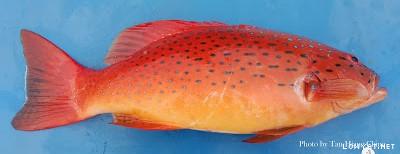 
 Blue spot (oval shape) that form dashes Leopard Coral Grouper Also known as : Leopard Coral Trout / Common Coral Trout Mandarin name : 石斑魚 (Shí bān yú), 东星斑 (Dōng xīng bān ), 西星斑 (Xi xīng bān) Cantonese name : 東星斑 (Dung Sing Baan), 西星斑 (Sai Sing Baan) Hokkien name : Ang Gau Malay name : Kerapu Sunoh Bara, Kerapu Bintang Details: • Most likely to refers as 東星斑 (Dung Sing Baan) as 西星斑 (Sai Sing Baan) refers to few other groupers. • A large olive green to reddish brown or orange-red grouper covered in regularly-spaced bright blue spots (except below), and a blue ring around the eye (may be broken up). • This fish can rapidly change their colour, and often assume a mottled pattern when hunting. This species is often mistaken for the Spotted Coral Grouper, which has some elongate spots or dashes on the head region.   Blue spot (round shape) on an orange-red Leopard Coral Grouper Orange-spotted Grouper Also known as : Goldspotted Rockcod / Estuary Cod Mandarin name : 石斑魚 (Shí bān yú), 红点石斑 (Hóng diǎn shí bān) Cantonese name : 青斑 (Ceng Baan) Hokkien name : Chia Gau Malay name : Ikan Kerapu Bintik Jingga, Kerapu Pinang, Kerapu Balong, Kerapu Rintek Details: • A pale brownish to greyish-brown grouper. • Best identified by their orange-brown to reddish-brown spots on their body and 4 to 5 “H-shaped” darker bars on its sides. 

H-shaped pattern Areolate Grouper Also known as : Areolate Rockcod / Greenspotted Rockcod Mandarin name : 石斑魚 (Shí bān yú), 西星斑 (Xi xīng bān) Cantonese name : 西星斑 (Sai Sing Baan / Sai Seng Paan) Hokkien name : Koay Gau Malay name : Kerapu Ekor Putih, Kerapu Bintik Bulat Details: • A pale grouper covered in close-set orange to brown spots (refers as areolate pattern - mean pattern like nipple) that become more numerous and relatively smaller as the fish grows, and a narrow white margin on the tail. 

Narrow white margin on the edge of the tail Duskytail Grouper Mandarin name : 石斑魚 (Shí bān yú), 红点油班 (Hóng diǎn yóu bān) Cantonese name : 芝麻斑 (Zi Maa Baan), 雙色尾紅斑 (Sheung Sik Mei Hung Paan) Hokkien name : Koay Gau Malay name : Kerapu Ekor Gelap Details: • This grouper often mistaken for the orange-spotted grouper because of the similar orange dots on the body of the fish. • The easiest way to identify this grouper is to look at its tail which only has the orange spots on the upper third while the lower two thirds is a dusky brown colour, hence its name. 

Lower two thirds of its tail in dusky brown colour Humpback Grouper Also known as : Mouse Grouper / Panther Grouper / Barramundi Cod / Polka Dot Cod or Grouper Mandarin name : 老鼠斑 (Lǎoshǔ bān), 驼背鲈 (Tuóbèi lú) Cantonese name : 老鼠斑 (Lou Syu Baan / Lou Shu Paan) Hokkien name : Ngiau Chee Gau, Zut Bi Gau Malay name : Kerapu Tikus, Kerapu Belida, Sunoh Details: • Its small head and humpback appearance resembles the Barramundi or Asian Sea Bass, earning it the name Barramundi Cod in Australia. • Its colour ranges from greenish white to pale greenish brown with large widely spaced round black spots all over the body, earning it the reputation of being occasionally called Polka Dot Cod/Grouper. • It is called Lou Shu Paan or Mouse Grouper because of its resemblance to the rodent. 
Giant Grouper Also known as : Brindlebass / Bumblebee Grouper / Brown Spotted Cod / Queensland grouper Mandarin name : 石斑魚 (Shí bān yú), 鞍帶石斑魚(Ān dài shí bān yú), 龙旦 (Lóng dàn) Cantonese name : 龍躉 (Lung Dan) Hokkien name : Gau Tun Malay name : Ikan Kertang, Kerapu Kertang, Kerapu Pertang Details: • Largest bony fish found in coral reefs and largest among the 石斑魚 (Shí bān yú) category. • DO NOT confuse with Goliath Grouper. They're not the same fish. • Adults are greyish-brown with a mottled pattern and darker fins, while small secretive juveniles are yellow with dark broad irregular bars and irregular dark spots on the fins. • The defining characteristic of the fish are the numerous small black dots which cover the fins, most predominantly on the pectoral fins, but also the dorsal and tail fins. 

Numerous small black dots which cover its fin Brown Marbled Grouper Also known as : Tiger Grouper / Black Rockcod / Carpet Cod / Flowery Rockcod Mandarin name : 石斑魚 (Shí bān yú), 老虎斑 (lǎo hǔ bān) Cantonese name : 老虎斑 (Lou Fu Baan / Lou Fu Paan) Malay name : Kerapu Harimau Details: • A large pale yellowish-brown grouper covered in small close-set brown spots, five vertical series of irregular dark brown blotches, and a distinctive small black saddle at the base of the tail. All the fins have small brown spots. 
Dragon Tiger Grouper Also known as : Hybrid Grouper / Sabah Grouper / Pearl Grouper Scientific name : Epinephelus Fuscoguttatus x Epinephelus Lanceolatus Mandarin name : 石斑魚 (Shí bān yú), 龙虎班 (Lóng hǔ bān) Cantonese name : 龍虎斑 (Lung Fu Baan / Long Fu Paan), 沙巴龍躉 (Sa Ba Lung Dan) Malay name : Kerapu Hibrid, Kerapu Kacukan Details: • A new type of grouper results from cross-breeding. • There are a lot of hybrid grouper in the current market but the first hybrid grouper is cross-bred via researches from Universiti Malaysia Sabah (UMS), Malaysia, in collaboration among researchers of the Borneo Marine Research Institute of UMS, the Fisheries Development Authority of Malaysia (LKIM) and Kinki University of Japan, represented by Prof. Dr Shigeharu Senoo of UMS. • This grouper was produced by fertilising the eggs of the tiger grouper (Brown Marbled Grouper or Lao Hu Ban in Mandarin) with the sperm of the giant grouper (Long Dan in Mandarin – literally mean Dragon Grouper) through the in-vitro fertilisation (IVF) technique; hence earning its name of Dragon Tiger Grouper derives from its Chinese name. 
Narrow-barred Spanish Mackerel Mandarin name : 马鲛鱼 (Mǎ jiāo yú), 康氏马鲛 (Kāng shì mǎ jiāo) Cantonese name : 鮫魚 (Gaau Yu / Kau Yue), 竹鮫 (Zuk Gaau / Chuk Gaau) Hokkien name : Tek Ka Malay name : Ikan Tenggiri Batang Details: • It has long body, lack of scales and thick rubbery skin. • It has dark bluish-grey to bluish-green top body, silvery grey sides and whitish belly with multiple dark grey vertical bars pattern on its body. • When selecting a Narrow-barred Spanish Mackerel, make sure that its flesh is slightly pinkish and not in whitish colour. The blood clots around the bone should be fresh red in colour. (refer the fish cross-section as below) 
The cross-section of the fish 
Spotted Spanish Mackerel Also known as : Indo-Pacific King Mackerel / Spotted Seerfish Mandarin name : 马鲛鱼 (Mǎ jiāo yú), 斑点马鲛 (Bān diǎn mǎ jiāo) Cantonese name : 線鮫 (Sin Gaau),泥鮫 (Nai Gaau) Hokkien name : Beh Ka Malay name : Ikan Tenggiri Papan, Ikan Tenggiri Bunga Details: • It has silvery white sides with several rows of round dark brownish spots scattered in about three irregular rows along the lateral line. 
Korean Seerfish Also known as : Korean Mackerel Mandarin name : 马鲛鱼 (Mǎ jiāo yú), 朝鲜马鲛 (Cháoxiǎn mǎ jiāo) Cantonese name : 扁鮫 (Bin Gaau) Hokkien name : Tua Pan Malay name : Ikan Tenggiri Korea Details: • Compare with the Narrow-Barred Spanish Mackerel & Spotted Spanish Mackerel, this fish have a more distinct hump above the eyes which make it look a bit “fiercer”. 
P.S. Tongkol, Aya and Tuna are referring to the same thing. It is just a matter of name from different region of Malaysia. Tongkol (also known as ikan kayu) mainly used by people of west Peninsular Malaysia while Aya used by people from east of Peninsular Malaysia. While Tuna are loanword from English. Mackerel Tuna Also known as : Eastern Little Tuna / Kawakawa Mandarin name : 巴鲣 (Bā jiān), 柴鱼 (Chái yú), 金鎗魚 (Jīnqiāngyú), 鲔鱼 (Wěi yú) Cantonese name : 杜仲 (Dou Zung, Tow Chung), 杜仲魚 (Dou Zung Yu) Hokkien name : Cha Hu Malay name : Ikan Tongkol Kurik, Aya Kurik, Kayu, Bakulan Details: • Dark blue-greenish dorsally, belly silvery-white. • Dark spots in area between pelvic and pectoral fins. • Many dark, broken, oblique stripes above lateral line, from below first dorsal fin to caudal peduncle. 
Dark spots in area between pelvic and pectoral fins. 
Frigate Tuna Also known as : Frigate Mackerel Mandarin name : 扁舵鲣 (Biǎn duò jiān), 平花鲣 (Píng huājiān) Cantonese name : 小杜仲 (Siu Dou Zung, Siu Tow Chung) Hokkien name : Cha Hu Malay name : Ikan Tongkol Selasih, Aya Selasih, Kayu, Bakulan Details: • A small dark blue tuna with silvery sides and belly, and 15 or more narrow, oblique to nearly horizontal dark wavy lines in a scaleless area above the lateral line. • Look quite similar to mackerel tuna but frigate tuna are only half the size of mackerel tuna and do not have dark spots in area between pelvic and pectoral fins. 
Longtail Tuna Mandarin name : 青甘金枪鱼 (Qīng gān jīnqiāngyú), 小黄鳍鲔 (Xiǎo huángqíwěi) Hokkien name : Cha Hu Malay name : Ikan Tongkol Hitam, Aya Hitam, Kayu, Bakulan Details: • Longtail tuna is a relatively small slender species with a very long slender tail. • This fish have metallic dark blue to black on the upper third of the body, and silver-white below, with colourless elongate oval spots in rows along the underside and belly. • Second dorsal and anal fins each followed by 7-10 finlets (pointy diamond shaped fin around tail area). • It has moderately long pectoral fins. 
Indian Mackerel Also known as : Mouth Mackerel / Long-jawed Mackerel Mandarin name : 甘望鱼 (Gān wàng yú), 羽鳃鲐 (Yǔ sāi tái) Cantonese name : 大口鮫 (Dai Hau Gau), 花鮫𩼰 (Fa Gau Ci),花鮫 (Fa Gau) Hokkien name : Kam Bong Hu Malay name : Ikan Kembung Borek, Ikan Temenung, Rumahan Details: • This fish have blue-green upper body with silvery sides and belly. • It has several dark stripes on upper body, uppermost stripes breaking up into spots on towards the rear of the body, and a prominent black spot on the body near the lower margin of the pectoral fin. • It has large mouth with it upper jawbone reaching beyond rear margin of eye and a visible long gill rakers when the fish open its mouth, hence the name Mouth Mackerel & Long-jawed Mackerel. • Its dorsal fin, pectoral fin and caudal (tail) fin are yellow in colour with black tips. 
Whitefin Wolf Herring Mandarin name : 西刀鱼 (Xī dāo yú) Cantonese name : Sai Tou Yue / Sai Dou Yue Hokkien name : Sai Toh Malay name : Ikan Parang Details: • This fish have a lot of bones with sweet flesh making it usually made into fish ball or home-made fish cake. • Its dorsal fin is entirely white or colourless, hence the name Whitefin. 
Whitefin Wolf Herring with white dorsal fin 
Whitefin Wolf Herring with colourless/transparent dorsal fin Blackfin Wolf Herring Also known as : Dorab Wolf Herring / Knife-fish / Leaping Silver-bar Mandarin name : 西刀鱼 (Xī dāo yú) Cantonese name : 西刀魚 (Sai Dou Yu) Hokkien name : Sai Toh Malay name : Ikan Parang Details: • This fish have a lot of bones with sweet flesh making it usually made into fish ball or home-made fish cake. • There are black markings on the upper part of its dorsal fin that set this fish apart from its closest relative, Whitefin Wolf Herring which lead to its name of Blackfin. 
Black marking on the upper part of the colourless/transparent dorsal fin Cobia Also known as : Black Bonito / Black Kingfish Mandarin name : 海鲡 (Hǎi lí), 军曹鱼 (Jūn cáo yú) Cantonese name : 懵仔 (Mung Zai), 懵仔魚 (Mung Zai Yu) Hokkien name : Hai Lay Malay name : Ikan Haruan Tasik Details: • This fish is distributed in most tropical and subtropical waters worldwide, but absent in the eastern Pacific ocean. • It is dark brown in color with creamy-white or yellowish belly and two silvery-white or bronze stripes from the head to base of tail. 

This post has been edited by xxhenry89xx: Jun 17 2019, 09:53 PM |
|
|
Jan 17 2018, 07:44 PM
|
|
Newbie
1 posts Joined: Jan 2016
|
QUOTE(pillage2001 @ Jan 17 2018, 01:23 PM) Guess nobody read your posts but damn good read. Agree to check on own body's mercury first before worrying about the bigger picture. Thank you for reading  patiently .... hahaha patiently .... hahaha |
|
|
Jan 17 2018, 08:00 PM
|
|
Junior Member
96 posts Joined: Feb 2017
|
Malaysia famous for kerapu. Is kerapu heaven. We compete against Taiwan, Indonesia, Thailand for the kerapu nation title. Other countries Western include Australia, USA, Italy and NZ.
|
|
|
Jan 17 2018, 08:03 PM
|

Junior Member
226 posts Joined: Aug 2009
|
QUOTE(tahfeikei @ Jan 17 2018, 11:36 AM) i guess one needs to eat a lot of fish to get mercury poisoning...BTW, don't drink water also cos i heard got a lot of female hormones in our water Wtf i loled |
|
|
Jan 18 2018, 11:18 AM
|

Newbie
0 posts Joined: Jan 2018
|
QUOTE(memekfalui @ Jan 17 2018, 02:42 PM) There is only argument in /k Well, argument/debate is what I am looking for. That is how different views come by. conclusion can make it your own If really want expert advice , then u need ro offer serious teh tarik session.  |
|
|
Jan 18 2018, 11:30 AM
|
|
Newbie
0 posts Joined: Jan 2018
|
QUOTE(tahfeikei @ Jan 17 2018, 11:36 AM) i guess one needs to eat a lot of fish to get mercury poisoning...BTW, don't drink water also cos i heard got a lot of female hormones in our water Yes, I have read about estrogen (female hormones) in water. It have cause the wild fish population to have more females by changing males into females. I dunno about the effect of this conditions on human but for fish, many of them have natural ability to change from male to female & vice versa so increase even a little bit of estrogen in water can make their ability to go haywire.The source of those estrogen (female hormones) are from human urine. I believe all of you should know that most of our drinking water are recycle from our pee water, shit water, wastewater & etc right? They got clean & recycle, usually send back to river & stream before sending back for human usage. Unfortunately, recycle water only clean shit, organic material, rubbish & kill bacteria but not chemical , in this case estrogen which come from urine of a human that was under medication like hormones pill, birth control pill & etc. |
|
|
Jan 18 2018, 12:15 PM
|
|
Newbie
1 posts Joined: Jan 2016
|
QUOTE(upcars @ Jan 17 2018, 05:18 PM) Salmon , cod , trout and bonitos are farmed. No such thing as caught in the wild anymore. Mercury conntent is minimal as they are running a very high end recirculation system which helps in the reduction of heavy metals. I know this cause I'm also in the industry of aqua farming. Yea, I know that most of the fish that we eat nowadays are farmed. Although I agree that wild caught fish taste better, I am actually one of those people that support fish farming. I just keep the hope that fish farming technique would improve in the future. |
|
|
Jan 18 2018, 12:56 PM
|
|
Junior Member
484 posts Joined: Jan 2010
|
QUOTE(xxhenry89xx @ Jan 17 2018, 06:28 PM) For me, I think saltwater fish have "fishy" (flavors of the ocean) taste while freshwater fish have "muddy" (flavors of the lake/river) taste. When there is an exception, it usually mean those fish moved a lot and freely (big area for moving, move a lot usually are predator fish). Some fish I left out it Cantonese name, Hokkien name & etc. Wa... I hope some of you guys could named it? As such, I will separate type of local fish that I know of into freshwater & saltwater. P.S. I do not own any of the photo as below. » Click to show Spoiler - click again to hide... «  hero I know the names, but always confuse the english with cantonese names |
|
|
Jan 18 2018, 02:51 PM
|
|
Newbie
0 posts Joined: Jan 2018
|
QUOTE(xxhenry89xx @ Jan 17 2018, 06:28 PM) For me, I think saltwater fish have "fishy" (flavors of the ocean) taste while freshwater fish have "muddy" (flavors of the lake/river) taste. When there is an exception, it usually mean those fish moved a lot and freely (big area for moving, move a lot usually are predator fish). Some fish I left out it Cantonese name, Hokkien name & etc. I hope some of you guys could named it? As such, I will separate type of local fish that I know of into freshwater & saltwater. P.S. I do not own any of the photo as below. Freshwater fish » Click to show Spoiler - click again to hide... « OMG !!!  Thank you so much.. This is what i wanted. Thank you so much.. This is what i wanted.1. So, Toman are called Do Man in Chinese. I just called them Sang Yu (Cantonese). And yes, the usual Toman that I saw is the "teenage stage" Toman which look a bit similar with Sang Yu. That why I just call them Sang Yu. 2. I don't think I ate or heard of Tapah Fish before. 3. About catfish, I always just called them catfish due to those "whisker". Now, I think I can differentiate it with Chinese name thanks to your info and photo. 4. Red tilapia is "K" fish? This is the most common fish that I ate. 5. Yes, I also heard that the price of Wang Bu Liao (Empurau) have dropped due to farming. Many people demand wild empurau that the wild fish population drop to the level of extinction just like our Arowana (note that being extinct refers to wild one). So, in a way farming this fish actually save the empurau just like how South America save their Araipama (I think it call Long Yu (Dragon Fish) in Chinese, I only saw this fish once at one of the 3 cave in Sam Poh Tong, the Nam Thean Tong) by farming them for food & leave wild one alone in the wild. 
Arapaima / Dragon Fish ? (I took the pic from google) 
Arapaima fillet 6. I haven't ate a swamp eel before. Unless you consider Unagi as one. 7. Barramundi and Asian Sea Bass  while I am not sure about sea bass, black bass in USA but I am sure that Barramundi are only refers by the Australian Ang Moh while Asian Sea Bass by Asian. while I am not sure about sea bass, black bass in USA but I am sure that Barramundi are only refers by the Australian Ang Moh while Asian Sea Bass by Asian.This post has been edited by Leo.Lee: Jan 18 2018, 03:09 PM |
|
|
Jan 18 2018, 02:54 PM
|
|
Senior Member
944 posts Joined: Jan 2007
|
QUOTE(Leo.Lee @ Jan 17 2018, 11:27 AM) I have 2 young kids and my wife are pregnant with another one. My wife have been frequently advise to eat more fish especially those with high Omega 3 content as Omega 3 are good for brain development. It also have the same benefits for young child and also benefit adult in one way or another. mercury contamination already reached the south pole.However, I realize that there is also the concern of mercury content in fish especially popular high Omega 3 content fish such as Tuna, Salmon and etc. To deal with that, I am thinking of eating plant based Omega 3 & local freshwater fish with lower Omega 3 content fish (not sure how low) but recently I heard that freshwater fish actually have higher mercury content that can affect brain development. I am confuse . Do you guys have any info about this? Other than that, I also wanted to show my kids the photo of those fish before it is cooked & served on a plate as I noticed many youngster today don't even know what kind of fish that they're eating. (Including myself, I only know few but not really sure how to differentiate it). I don't want my kids to be like those kids in developed country like USA & etc that don't even realize the foods that they eat especially meat are living being that have head, feet, name and etc before being served as food. And being a Chinese and living in Malaysia, I also want to know and tell my kids the name of those fish in Chinese, Malay and etc. Hope you guys have some info about this. it's in the air. source: national geographic. This post has been edited by shirohamada: Jan 18 2018, 02:55 PM |
| Bump Topic Add ReplyOptions New Topic |
| Change to: |  0.0451sec 0.0451sec
 1.24 1.24
 6 queries 6 queries
 GZIP Disabled GZIP Disabled
Time is now: 18th December 2025 - 09:39 PM |
 Quote
Quote