Welcome Guest ( Log In | Register )

119 Pages « < 35 36 37 38 39 > » Bottom

Outline · [ Standard ] · Linear+

 Venturing into Agriculture & Aquaculture, Co-Ordination & Implementation is KEY

views
     
TSParaOpticaL
post Jul 25 2011, 06:25 PM

Planter - Durian, Jackfruit, Papaya
*******
Senior Member
2,348 posts

Joined: Dec 2004
From: Ch3r@s


Hi MrFarmer,

thank you for your help. will PM you for the file.

Just found out from Joel that its called anthracnose leaf blight

i checked it out with the picture and it is quite similar with the one i researched online.

thanks Joel biggrin.gif


QUOTE(MrFarmer @ Jul 25 2011, 03:13 PM)
Hi ParaOptical,
I have with me "Buku Panduan-Simptom kekurangan nutrien bagi tanaman" by Jabatan Pertanian, reprint 2006. It's in the National language, Adobe file 8,681 KB. It says that make sure it's not disease or insects before diagnostic. PM me if you required the Buku Panduan. I find it complicated to understand.
*
rockdaman
post Jul 26 2011, 05:30 PM

Casual
***
Junior Member
357 posts

Joined: Nov 2004
From: Klang Valley


Something to share about fish farming:

http://www.time.com/time/health/article/0,...2081796,00.html

I believe fish farming is way to go.


Michael J.
post Jul 27 2011, 09:40 AM

On my way
****
Senior Member
596 posts

Joined: Jan 2006


rockdamn:

Good article. But would just like to highlight some things more relevant to Malaysia.

The organization I represent has been trying to attract FDIs into Malaysia aquaculture for years (aside from other biotech investments), and most companies engaged are hessitant. Apart from feed costs, the other key turn-off factor is the lack of cold-chain logistics. Unlike our neighbours in Thailand and Vietnam, Malaysia does not have a system of production, or even regulations that conforms to EU/US standards. For instance, the EU regulation requires that all harvested fish be gutted, UV treated, packaged, and frozen within 6 hours. How many producers in Malaysia actually practice that? Heck, we don't even have a national guideline for this either!

I had the opportunity to see for myself how the Vietnamese do aquaculture, and I can say, Malaysia is easily 10 years behind them, despite starting earlier than them, and have better access to technology and funds. Till today, we are still arguing about which species of fish to focus on, while neglecting the other more important issues. We are also so low on the productivity scale, we might as well go plant coconuts (often called the "lazy-man's crop" due to it little need for management). Let me just give some examples:

(i) In Vietnam, they can produce 1.35 million tons of basa/tra/sutchii on 6,000ha of land (ave: 225,000kg/ha); Malaysia's entire aquaculture production on 50,000ha land produced about 7.1 million tons last year (142,000kg/ha)

(ii) When WWF and some NGOs started claiming that Vietnamese aquaculture was not sustainable and unable to meet EU standards of food safety, the Vietnamese government and Aquaculture Producers Association immediately went to work to address the problem and change public perception. 90% of the farms were certified within 1 year, for both sustainability and EU food safety standard.

Of course, that does not mean Malaysia aquaculture is doomed. There are some examples of success, such as Trapia and some integrated patin farms up north and on the east coast. Then there's also Fish Protech in Sepang, an indoor aquaculture system farming jade perch.

I believe Malaysia can be a good destination for high-valued fish products. One such fish is in fact the jade perch. It is comparable to the sea perch (siakap) in versatility and toughness, and has good feed conversion ratio, despite being a purely fresh water fish. The only exception is that it has a very high retail price tag at present, about RM35 per kg. However, in order to make this work, the entire value chain has to be built, meaning an integrated approach has to employed. And this, sadly, has to come solely from the producers themselves. Yes, it will mean very high investments, but if done properly, the returns are equally good.

This post has been edited by Michael J.: Jul 27 2011, 09:44 AM
rockdaman
post Jul 27 2011, 10:27 AM

Casual
***
Junior Member
357 posts

Joined: Nov 2004
From: Klang Valley


QUOTE(Michael J. @ Jul 27 2011, 09:40 AM)
rockdamn:

Good article. But would just like to highlight some things more relevant to Malaysia.

The organization I represent has been trying to attract FDIs into Malaysia aquaculture for years (aside from other biotech investments), and most companies engaged are hessitant. Apart from feed costs, the other key turn-off factor is the lack of cold-chain logistics. Unlike our neighbours in Thailand and Vietnam, Malaysia does not have a system of production, or even regulations that conforms to EU/US standards. For instance, the EU regulation requires that all harvested fish be gutted, UV treated, packaged, and frozen within 6 hours. How many producers in Malaysia actually practice that? Heck, we don't even have a national guideline for this either!

I had the opportunity to see for myself how the Vietnamese do aquaculture, and I can say, Malaysia is easily 10 years behind them, despite starting earlier than them, and have better access to technology and funds. Till today, we are still arguing about which species of fish to focus on, while neglecting the other more important issues. We are also so low on the productivity scale, we might as well go plant coconuts (often called the "lazy-man's crop" due to it little need for management). Let me just give some examples:

(i) In Vietnam, they can produce 1.35 million tons of basa/tra/sutchii on 6,000ha of land (ave: 225,000kg/ha); Malaysia's entire aquaculture production on 50,000ha land produced about 7.1 million tons last year (142,000kg/ha)

(ii) When WWF and some NGOs started claiming that Vietnamese aquaculture was not sustainable and unable to meet EU standards of food safety, the Vietnamese government and Aquaculture Producers Association immediately went to work to address the problem and change public perception. 90% of the farms were certified within 1 year, for both sustainability and EU food safety standard.

Of course, that does not mean Malaysia aquaculture is doomed. There are some examples of success, such as Trapia and some integrated patin farms up north and on the east coast. Then there's also Fish Protech in Sepang, an indoor aquaculture system farming jade perch.

I believe Malaysia can be a good destination for high-valued fish products. One such fish is in fact the jade perch. It is comparable to the sea perch (siakap) in versatility and toughness, and has good feed conversion ratio, despite being a purely fresh water fish. The only exception is that it has a very high retail price tag at present, about RM35 per kg. However, in order to make this work, the entire value chain has to be built, meaning an integrated approach has to employed. And this, sadly, has to come solely from the producers themselves. Yes, it will mean very high investments, but if done properly, the returns are equally good.
*
Thank you for the highlight. I am currenty looking in aquaculture business and at this stage to start up small and profitable is difficult. I realised malaysia infrastuctures and regulations both are limited especially if you are not bumi.


Added on July 27, 2011, 10:29 am
QUOTE(ParaOpticaL @ Jul 25 2011, 06:25 PM)
Hi MrFarmer,

thank you for your help. will PM you for the file.

Just found out from Joel that its called anthracnose leaf blight

i checked it out with the picture and it is quite similar with the one i researched online.

thanks Joel biggrin.gif
*
Dear Para,

Do you mind to share what had ended up on your fish farm? I have read from the first page but didnt have any update after 3 months or any post i had missed out?


This post has been edited by rockdaman: Jul 27 2011, 10:29 AM
Michael J.
post Jul 27 2011, 10:55 AM

On my way
****
Senior Member
596 posts

Joined: Jan 2006


rockdamn:

Irregardless, the lack of infrastructure and regulations affect all who are in this industry.

I do have a suggestion, although it might be a little more "riskier" than usual. Try hobby-scale production. If you have the space, build a cement fish pond with the usual fittings. Or get one of those fibreglass tanks (about RM1,000 a piece I believe). Rear a couple dozen of your targeted fish, but ratio out as though you are on commercial production. Keep a cost-log book. And when it come to it, sell to your local restaurant, either at cost, or with a small profit. Don't quit your day job.

This was done by some of the more enterprising retirees in Sepang, where my family home is. One uncle in particular not only reared fish like red tilapia, siakap and jade perch in fibreglass tanks, but he also reared mud crabs and flower crabs, all which were sold to the local seafood restaurants or the many tourists who would come shopping for fresh seafood at Golden Palm Beach. His profit isn't a huge, but enough to make his retirement a comfortable one.
OMG!
post Jul 27 2011, 11:40 AM

Raymond
******
Senior Member
1,397 posts

Joined: Jan 2009
From: Peaceful Island


Okay, guys , i have seen the posts in this thread, and realise that there are indeed a few forummers who are experienced enough in the knowledge of plantation, farming and rearing, be it chicken, fruits, feeds or fishes. Among the few which i noted is Micheal J, Para Optical & Mr Farmer.

I am currently a university student who is interested to go for plantation, rearing or farming sectors upon completion of my study. I love to utilize my knowledge in sciences, particulary biology, chemistry, maths to practise in this field. In other words, we call this as a knowledge commercialisation in the industry to make it profitable and productive.

So, currently while in the midst of completing my final year degree, i would like to know more on the master programme which offers this kind of course, i realise there are not too popular and not too many offered in Malaysia, particulary on poultry nutrition. I have been worked in this poultry industry for my intern and i realised that i have developed a great interest in this area. I believe it is a rapidly growing industry in Msia seeing the fact the demand of chicken is highly elevated.

Thus, would any of you experienced seniors shed some light here? I know before furthering master, you need to step into the farm, and know very well the industry yourself, i have been to this industry for a few months and i realised that indeed i have lots to learn more. so i would like to know any good prospects of furthering master degree in poultry fields? The route to further and some constructive comments=)
any output is much appreciated!=)
Michael J.
post Jul 27 2011, 12:21 PM

On my way
****
Senior Member
596 posts

Joined: Jan 2006


OMG:

I don't want to comment too much on the quality of public university courses. And honestly, very few universities in Malaysia do offer something that is industry-specific.

I will however, comment on the poultry industry in Malaysia. I believe you should have known from your internship that the poultry industry in Malaysia is highly regulated. Producers cannot simply sell at any price they want (despite the price ceiling being relaxed), while costs are going up almost every week (feed, utilities etc.). Many producers are actually losing money selling fresh poultry, and the only reason they stay afloat is because of the other supporting aspects, eg. egg production, processed meat products (sausages, nuggets etc), fertilizer etc. These side businesses are very lucrative, and is the real reason for industrial poultry producers entering the business.

Hence, my comments is that if you want to get involved, get involved in the downstream part, i.e. the food processing aspect. For this, you may not need a Masters degree, but an ISO Auditor certification might come in pretty handy.

If you still insist on getting involved with upstream activities, then get involved with feed production and animal disease control. See how you can work on developing prebiotics or probiotics, and their related technologies; use of antibiotics will soon be banned in the EU/US, and likewise the sale of any animal product tainted with antibiotics. China might not follow, but you never know. Also, you might like to look into how to develop efficient feed meals, to reduce the Feed Conversion Ratio (FCR) in poultry. Right now, the best feed I know about has an FCR of 1.5:1, so anything around 1.2:1 would be highly impactful.

This post has been edited by Michael J.: Jul 27 2011, 12:25 PM
MrFarmer
post Jul 27 2011, 12:39 PM

Casual
***
Junior Member
478 posts

Joined: Mar 2011
From: Sabah


QUOTE(Michael J. @ Jul 27 2011, 10:55 AM)
rockdamn:

Irregardless, the lack of infrastructure and regulations affect all who are in this industry.

I do have a suggestion, although it might be a little more "riskier" than usual. Try hobby-scale production. If you have the space, build a cement fish pond with the usual fittings. Or get one of those fibreglass tanks (about RM1,000 a piece I believe). Rear a couple dozen of your targeted fish, but ratio out as though you are on commercial production. Keep a cost-log book. And when it come to it, sell to your local restaurant, either at cost, or with a small profit. Don't quit your day job.

This was done by some of the more enterprising retirees in Sepang, where my family home is. One uncle in particular not only reared fish like red tilapia, siakap and jade perch in fibreglass tanks, but he also reared mud crabs and flower crabs, all which were sold to the local seafood restaurants or the many tourists who would come shopping for fresh seafood at Golden Palm Beach. His profit isn't a huge, but enough to make his retirement a comfortable one.
*
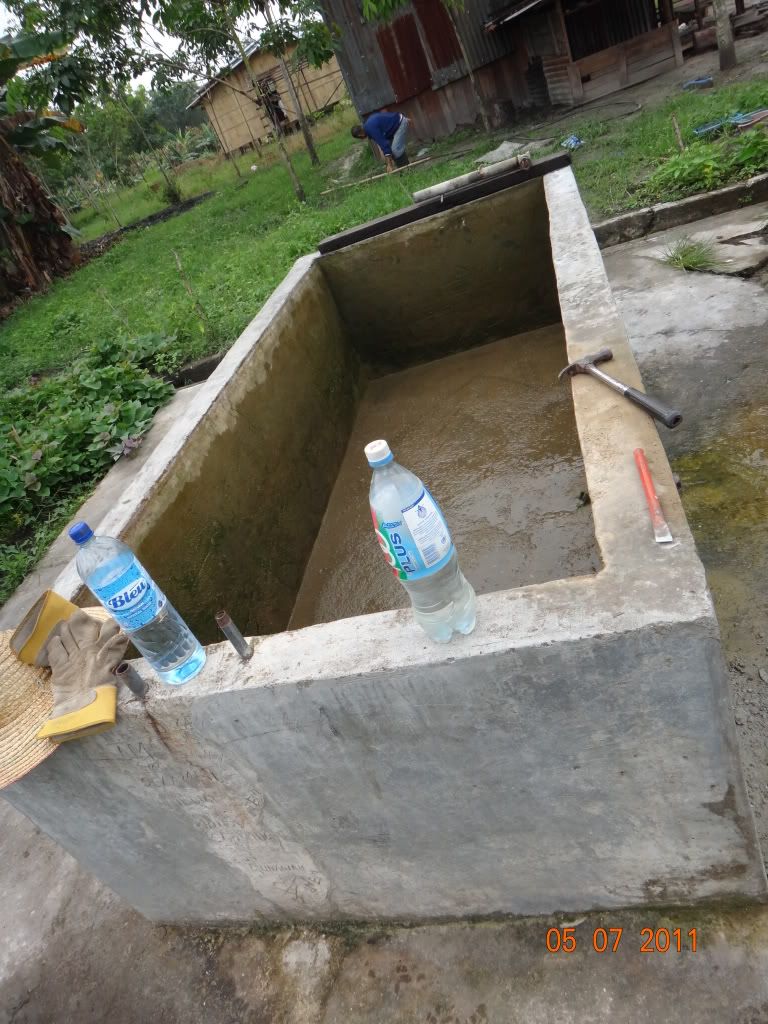
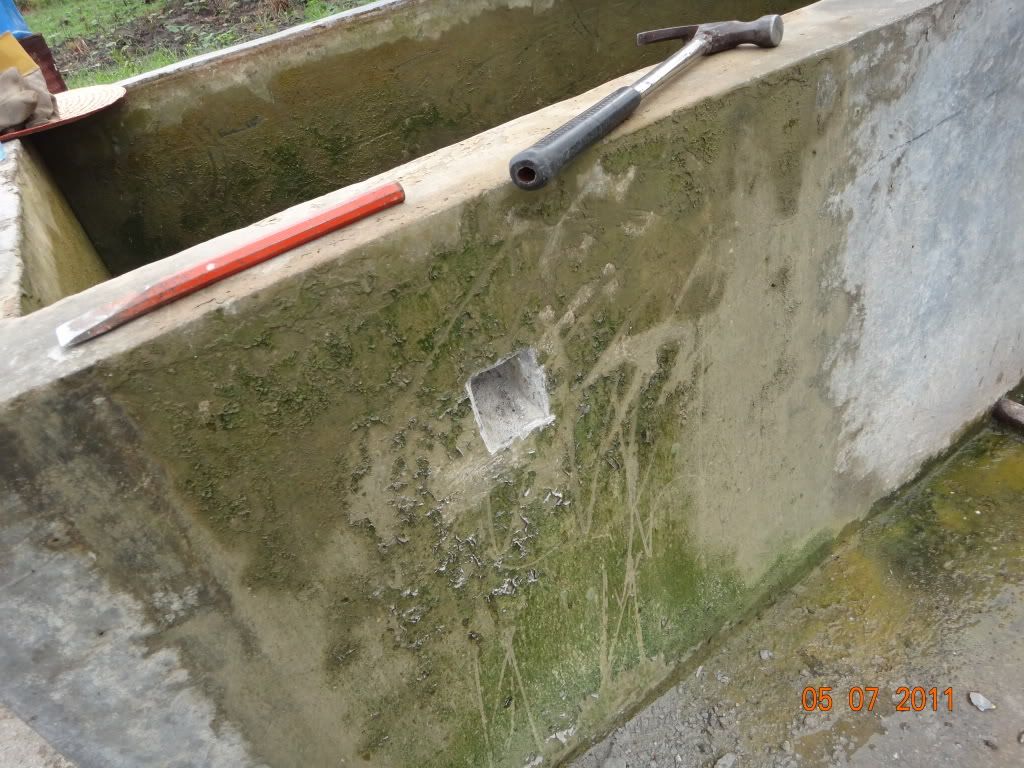
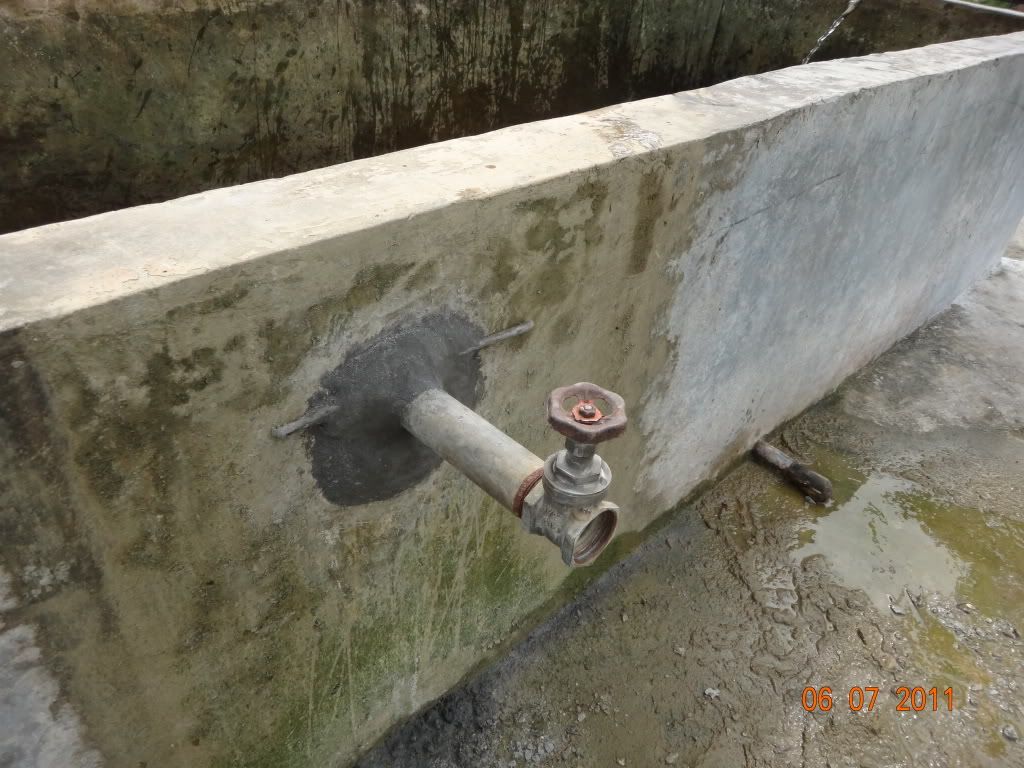
Hi Guys, what an opportunity. This should be fun. I was actually planning/ executing a "hobby-scale" experiment to check the feasibility of farming freshwater fishes. Open to all suggestions / help. My initial plan was to try out Tilapia as I've researched that the retail prices varies from $10.50 to $12.50 at my area. We have a disused bathing pool and we had converted it to a small pond.
user posted image
user posted image
user posted image
The pool is approximately 4 ft X 12 ft and depth is approximately 3 feet. Pool is felt by a dripping freshwater, piped in, gravity feed (not too strong, but i think is sufficient). We had installed an overflow pipe to discharge the access water. We have a water pump (petrol driven) and a small creek nearby should there be any water disruption (a frequent occurrence). The 'In' pipe is elevated to 3 feet above the water level to create a drop as to increase the oxygen level. There are no electricity supply at the moment. The water temperature is pretty warm / hot in the afternoon. Preparing to add a shade netting to lower the heat from the sun.

Farmer has little / no fish farming experience. These are the conditions at the moment. Kindly suggest
1) Improvement to be made to the pond ( already planning to build a shading net and a net preventing the fish from jumping out)
2) Type of fishes to start with (ease of farming, commercially viable, short maturing period)
3) Farming density (no air pump as no electricity at the moment)
4) Type of feeds (low cost)
We intend to market the final produce as live freshwater fishes locally.
So guys, please post your suggestion and share our knowledge. Maybe by running this experiment, it'll save others some time & funds and used as a starting point.
amirbashah
post Jul 27 2011, 12:41 PM

Getting Started
**
Junior Member
274 posts

Joined: Sep 2007
Hi guys,

I havent been here for a long time. I'm currently looking for new ideas for my future agriculture projects since my serai project failed and my gaharu project hasnt generate any income for me yet. I wont be doing it now due to financial constraint. Maybe a few years from now. In my opinion, planting vegetables such as bendi and chilli is a better option because both these veges can be harvested in a few months. What do you guys think?
MrFarmer
post Jul 27 2011, 12:43 PM

Casual
***
Junior Member
478 posts

Joined: Mar 2011
From: Sabah


OMG, sorry I can not offer much as I'm also very new into Farming. I was just adventurous enough to jump into this without without much proper thinking / planning. In Cantonese it's called Moung Cha Cha rclxub.gif
Michael J.
post Jul 27 2011, 01:27 PM

On my way
****
Senior Member
596 posts

Joined: Jan 2006


MrFarmer:

Sorry, I'm unable to view your photos on my network. But I can comment on the other aspects.

Your bathtub-pond is rather small, and shallow at that too. Without a proper filtration and aeration system, I'm afraid your biological load cannot be big. Couple that with the fact your water temperature tends to rise to the point human hands can feel warm, I'd say you're really gonna need a tough fish species. Shading might not solve the problem, as the surrounding soil will draw in the heat, and become like an insulator. But it could reduce the temperature flux.

Normally, the suggested load is about 40kg target weight per cubic meter, but without aeration and filtration, that'd be reduce to maybe about 4kg. Your tub is about 4 cubic meter, so maybe 4-6 fishes that can reach between 600g to 1kg. Air-breathing fish, such as gourami, climbing perch, and catfish are likely candidate. Tilapia are also good candidates, but a little more difficult, as water depth also influences their growth size. However you might be able to get weights of about 600g in your present setup.

As for feed, all the above are omnivores, so earthworms, chicken manure, standard fish pellets, etc would be fine. If you can breed mealworms, they'd be fine additions, and quite low cost too (if you breed them yourself).

From my experience, catfish species are the fastest growers with the least requirement for inputs. I recall some figures when I raised African catfish and basa in my old backyard pond, sloping at 4-6 feet deep, and 15 feet diameter (approx. 24kg harvest load). Do note, this pond also did not have aeration or filtration, and was directly exposed to sunlight. I placed 10 fingerlings of African catfish, and 10 patin fingerlings, both averaging 100g individual weights sometime in January a couple of years back. Fed them nothing more than ornamental fish pellets. By the week before Christmas, my family was harvesting African catfishes weighing in between 1.3 to 1.5kgs each, while the patin were a little smaller, at about 1.2 kgs each. Cost wise, we finished one large package of feed about every 2-3 weeks, or about RM16 per month, so the average price per fish would be about RM8.80, or about RM6.76 per kg liveweight. If I'm right, the current price of patin is about RM12-RM15 per kg, while African catfish is about RM13 per kg. More information can be found on AgriBazaar's facebook page:

http://www.facebook.com/pages/Agribazaar-2...213559122000211


Added on July 27, 2011, 1:40 pmamirbashah:

I'm so sorry to hear that your venture petered out. Don't worry, what does not kill us, will usually make us stronger.

Chili a little more difficult lar... Yields can be impressive and likewise the returns, but really need constant care. I tried on hobby scale before, but fruit fly infestation, anthracnose outbreak, mealybugs etc. really wreaked havoc on the commercial varieties. I mostly gave away the chilies, but the one good thing that resulted from this was that the breed I developed made it through unscathed. Not many seeds have been passed around, and I don't know if any of those I gave away are still being cultivated. Not sure if many people want to plant a 5 foot tall chili plant that bears white-colored chilies with a fragrance of apricots and peaches.

Bendi might fare better. I believe the latest hybrid okra released by MARDI is really good. Bought some seeds at the last National Seed Symposium. Didn't disappoint me.

This post has been edited by Michael J.: Jul 27 2011, 01:40 PM
amirbashah
post Jul 27 2011, 02:03 PM

Getting Started
**
Junior Member
274 posts

Joined: Sep 2007

Added on July 27, 2011, 1:40 pmamirbashah:

I'm so sorry to hear that your venture petered out. Don't worry, what does not kill us, will usually make us stronger.

Chili a little more difficult lar... Yields can be impressive and likewise the returns, but really need constant care. I tried on hobby scale before, but fruit fly infestation, anthracnose outbreak, mealybugs etc. really wreaked havoc on the commercial varieties. I mostly gave away the chilies, but the one good thing that resulted from this was that the breed I developed made it through unscathed. Not many seeds have been passed around, and I don't know if any of those I gave away are still being cultivated. Not sure if many people want to plant a 5 foot tall chili plant that bears white-colored chilies with a fragrance of apricots and peaches.

Bendi might fare better. I believe the latest hybrid okra released by MARDI is really good. Bought some seeds at the last National Seed Symposium. Didn't disappoint me.
*

[/quote]

I agree with you, it's not easy to plant chili. I've heard a lot of bad stories especially regarding the pest and virus associated with the plant. I did a lot of research on different crops (banana, sugar cane, bendi etc) but havent decide which one to choose. From my past experience, the most important thing is not to jump on the bandwagon when everyone starts doing something which is popular at that time. It happened to me with my serai venture. I got conned and the guy still owes me RM10k sad.gif

This post has been edited by amirbashah: Jul 27 2011, 02:06 PM
TSParaOpticaL
post Jul 27 2011, 02:58 PM

Planter - Durian, Jackfruit, Papaya
*******
Senior Member
2,348 posts

Joined: Dec 2004
From: Ch3r@s


for me, at my new site am planning the below

1) place to plant herbs that would be given out for free to help people

2) planting for banana

3) planting of nangka madu

4) fertigation

5) small fish pond

Michael J.
post Jul 27 2011, 03:29 PM

On my way
****
Senior Member
596 posts

Joined: Jan 2006


Para:

Speaking of which, I received some very nice pumpkins and squash from Green World Genetics today. They are varieties yet to be released to general public. Really huge fruits. Took some pictures, but can't upload.

Oh by the way, if anyone wanted to get seeds for pilot planting, or even commercial planting, you could talk to Dr. Manaf, the Senior Vice President of BiotechCorp. He's connected to GWG.

Email: manaf.radzi@biotechcorp.com.my
amirbashah
post Jul 27 2011, 03:33 PM

Getting Started
**
Junior Member
274 posts

Joined: Sep 2007
QUOTE(ParaOpticaL @ Jul 27 2011, 02:58 PM)
for me, at my new site am planning the below

1) place to plant herbs that would be given out for free to help people

2) planting for banana

3) planting of nangka madu

4) fertigation

5) small fish pond
*
You're such a good person trying to help other people. Speaking of nangka madu, I stumble upon a website where this guy is planting nangka madu and other crops. Here is the link. He's doing really well I guess.
MrFarmer
post Jul 27 2011, 07:00 PM

Casual
***
Junior Member
478 posts

Joined: Mar 2011
From: Sabah


QUOTE(amirbashah @ Jul 27 2011, 12:41 PM)
Hi guys,

I havent been here for a long time. I'm currently looking for new ideas for my future agriculture projects since my serai project failed and my gaharu project hasnt generate any income for me yet. I wont be doing it now due to financial constraint. Maybe a few years from now. In my opinion, planting vegetables such as bendi and chilli is a better option because both these veges can be harvested in a few months. What do you guys think?
*
HI amirbashah, can share why your Serai project failed? I dis plant some Serai a few months ago alone the perimeter of our farm, only as a supplementary corps. It shall be interesting for me to learn from you. Also the Gaharu, I've heard many people talking about it and the Indons even swear by it, cliaming to have medicinal value. I have in my possession a couple of plant-lets and have not decided on what to do with it.


Added on July 27, 2011, 7:04 pm[quote=Michael J.,Jul 27 2011, 01:27 PM]
MrFarmer:

Sorry, I'm unable to view your photos on my network. But I can comment on the other aspects.

Your bathtub-pond is rather small, and shallow at that too. Without a proper filtration and aeration system, I'm afraid your biological load cannot be big. Couple that with the fact your water temperature tends to rise to the point human hands can feel warm, I'd say you're really gonna need a tough fish species. Shading might not solve the problem, as the surrounding soil will draw in the heat, and become like an insulator. But it could reduce the temperature flux.

Normally, the suggested load is about 40kg target weight per cubic meter, but without aeration and filtration, that'd be reduce to maybe about 4kg. Your tub is about 4 cubic meter, so maybe 4-6 fishes that can reach between 600g to 1kg. Air-breathing fish, such as gourami, climbing perch, and catfish are likely candidate. Tilapia are also good candidates, but a little more difficult, as water depth also influences their growth size. However you might be able to get weights of about 600g in your present setup.

As for feed, all the above are omnivores, so earthworms, chicken manure, standard fish pellets, etc would be fine. If you can breed mealworms, they'd be fine additions, and quite low cost too (if you breed them yourself).

From my experience, catfish species are the fastest growers with the least requirement for inputs. I recall some figures when I raised African catfish and basa in my old backyard pond, sloping at 4-6 feet deep, and 15 feet diameter (approx. 24kg harvest load). Do note, this pond also did not have aeration or filtration, and was directly exposed to sunlight. I placed 10 fingerlings of African catfish, and 10 patin fingerlings, both averaging 100g individual weights sometime in January a couple of years back. Fed them nothing more than ornamental fish pellets. By the week before Christmas, my family was harvesting African catfishes weighing in between 1.3 to 1.5kgs each, while the patin were a little smaller, at about 1.2 kgs each. Cost wise, we finished one large package of feed about every 2-3 weeks, or about RM16 per month, so the average price per fish would be about RM8.80, or about RM6.76 per kg liveweight. If I'm right, the current price of patin is about RM12-RM15 per kg, while African catfish is about RM13 per kg. More information can be found on AgriBazaar's facebook page:

rclxub.gif I was targeting 30 to 50 fishes on my bath-tub pond blush.gif Looks like I need to sort out the high temperature of the water first. Then have to look into the aeration and filtration. Was thinking that with fresh water supply and dropping it from a height, it'll help to increase the dissolved Oxygen Level and ease the biological loading.

This post has been edited by MrFarmer: Jul 27 2011, 07:04 PM

OMG!
post Jul 28 2011, 09:04 AM

Raymond
******
Senior Member
1,397 posts

Joined: Jan 2009
From: Peaceful Island


QUOTE(Michael J. @ Jul 27 2011, 12:21 PM)
OMG:

I don't want to comment too much on the quality of public university courses. And honestly, very few universities in Malaysia do offer something that is industry-specific.

Hence, my comments is that if you want to get involved, get involved in the downstream part, i.e. the food processing aspect. For this, you may not need a Masters degree, but an ISO Auditor certification might come in pretty handy.

If you still insist on getting involved with upstream activities, then get involved with feed production and animal disease control. See how you can work on developing prebiotics or probiotics, and their related technologies; use of antibiotics will soon be banned in the EU/US, and likewise the sale of any animal product tainted with antibiotics. China might not follow, but you never know. Also, you might like to look into how to develop efficient feed meals, to reduce the Feed Conversion Ratio (FCR) in poultry. Right now, the best feed I know about has an FCR of 1.5:1, so anything around 1.2:1 would be highly impactful.
*
I can't agree more on the BOLD statement. But i realised that with the rapidly growing demand of poultry production & processing in our country, more and more efforts have been implemented and carried out by gov to meet this increasingly higher demand.

The whole industry i have been exposed to while on my intern, even the food processing aspects.I realized that GMP, HACCP, ISO 9001, are all important safety guidelines which food industry need to abide to. ISO Auditor Certification? do you mind to explain more? I think food industry company will sponsor the workers especially from QA/QC dept to undergo the training and obtain the certs right?

A few effort which i see is the current efforts by UPM researcher,from faculty of agriculture and animal sciences which recently come out with an idea of lactic acid fermented feed which could be used in animal feed.

We have know that the use of antibiotics in animal feed, causes development of resistance in a number of pathogenic
bacterial in the exposed animals. Furthermore, they have indirect adverse side effects with implications for human health. Thus a new alternative need to be penned down in order to produce a high quality and of minimal health effects due to the use of antibiotics in poultry diets.

Lactic acid fermented feeds are often suggested as alternatives to the use of antibiotic growth promoters.
It has made up a significant portion of poultry diet and nutrition. Fermented feed is characterized by high numbers of lactic acid bacteria, high number of yeast, a low pH and high concentration of lactic acid.

A good study by UPM here: http://www.pjbs.org/pjnonline/fin126.pdf
Michael J.
post Jul 28 2011, 09:15 AM

On my way
****
Senior Member
596 posts

Joined: Jan 2006


MrFarmer:

As with any agriculture business, aside from the direct management of the land and crop, the most important aspect is the marketing part. If you got crop, but no one to take the crop, or got person who take the crop but is lousy pay-master, I'm sure you can imagine the final outcome.

On the bath-tub pond thing, you are quite right. If you put in the proper setup, the biological load is around 40 fish. But again, you really need to consider the nature of the specie, and even the variant you choose. Tilapias are good fish, but make sure you choose the more domicile breed, as cichlids are by nature highly territorial fish. Catfish on the other hand are usually very tolerable of each other.

As for dissolved oxygen level, dripping water by itself does not do much to improve the condition. Water temperature, surface area, mineral content, and biological load (including microbes, algae, nitrates etc.) all influence this. That is why it is more profitable to do land-based aquaculture in cold-water regions (eg. Norway and China) rather than in the tropics, as the dissolved oxygen content in cold-water regions are very high, while the mineral contents tend to more balanced, and the biological load lower.


Added on July 28, 2011, 9:25 amOMG:

You are on the right track.

ISO Auditor Certification, as you mentioned, is often sponsored by the company that hires the QA/QC exec. However, that is very often the "cheaper" way to do things on the Company's part, as it costs less to hire a fresh grad as a QA, then send the person for training. However, if you are an independent Auditor for say KPMG or Moody International, then you are not bound to a single company. Also, you would be limited to just poultry sector, if say your certification is applicable for food sector in general.

Yes, I've come accross lactic acid fermentation feeds. But I'm sorry to say, UPM is a little too late in coming up with the study. There are already existing companies in Malaysia commercializing the product. Their technology was adapted from research work of Thai scientists and universities. Yet, it is always possible that UPM could improve on those technologies.

This post has been edited by Michael J.: Jul 28 2011, 09:25 AM
TSParaOpticaL
post Jul 28 2011, 09:57 AM

Planter - Durian, Jackfruit, Papaya
*******
Senior Member
2,348 posts

Joined: Dec 2004
From: Ch3r@s


To those who are interested to take some course in agriculture

http://www.umcced.edu.my/DIP/EDIP.html

Executive Diploma in Plantation Management by UMCCED

-----------------------------------------

Anyone has information on Training Course for Fertigation ??

MARDI has one but it is ALWAYS not enough participants

amirbashah
post Jul 28 2011, 04:18 PM

Getting Started
**
Junior Member
274 posts

Joined: Sep 2007
[quote=MrFarmer,Jul 27 2011, 07:00 PM]
HI amirbashah, can share why your Serai project failed? I dis plant some Serai a few months ago alone the perimeter of our farm, only as a supplementary corps. It shall be interesting for me to learn from you. Also the Gaharu, I've heard many people talking about it and the Indons even swear by it, cliaming to have medicinal value. I have in my possession a couple of plant-lets and have not decided on what to do with it.

I did intercropping with the gaharu trees. It was due to the soil condition of my land plus I got conned by the people supplying the serai. I didnt plough the soil before planting the serai. The soil was really hard and water can't get through. Moreover the supplier promised he would come to my land once a month to fertilize the serai and for weeding. Unfortunately he only went there once or twice in 6 months. That's my sad story.

Is the serai market doing good now? During the time I started the project, the serai was oversupplied causing the price to drop.

I've received a lot of mix reaction regarding gaharu. Some say they can fetch a lot of money but some sceptics dont believe it will happen. Currently I have around 2000-3000 trees on my land. Not sure how many trees survived. I havent visit my land for a few months now and now my land is 'semak' already. rclxub.gif


Added on July 28, 2011, 4:20 pm[quote=ParaOpticaL,Jul 28 2011, 09:57 AM]
To those who are interested to take some course in agriculture

http://www.umcced.edu.my/DIP/EDIP.html

Executive Diploma in Plantation Management by UMCCED

-----------------------------------------

Anyone has information on Training Course for Fertigation ??

MARDI has one but it is ALWAYS not enough participants
*

[/quote]

Seems like an interesting course. Can finish in a year. I'm doing my MBA now and most definitely wont be taking it right now.

This post has been edited by amirbashah: Jul 28 2011, 04:20 PM

119 Pages « < 35 36 37 38 39 > » Top
 

Change to:
| Lo-Fi Version
0.0196sec    1.03    6 queries    GZIP Disabled
Time is now: 19th December 2025 - 10:17 AM