Welcome Guest ( Log In | Register )

119 Pages « < 34 35 36 37 38 > » Bottom

Outline · [ Standard ] · Linear+

 Venturing into Agriculture & Aquaculture, Co-Ordination & Implementation is KEY

views
     
freerangechicks
post Jul 5 2011, 09:57 PM

New Member
*
Junior Member
8 posts

Joined: Jul 2011


Thanks for the valuable info. You guys are such a wonderful lot. I will probably try small scale first to see the outcome. Which should be my target choice? Ayam kampung or free range chicken?
Paraoptical, what I meant was when my chickens reach maturity who can I supply it to? Like Mrfarmer mention ayam aircon is contract to kfc. If say I'm the new guy in the market will I need to approach a middleman or I can supply direct. But since they are already taking from someone else is it difficult to convince them for me to supply them chickens?
Mrfarmer, that ayam kampung does not belong to anyone? Lol! Just slightly out of topic, does ayam hutan taste better than ayam kampung?
Michael J.
post Jul 6 2011, 08:43 AM

On my way
****
Senior Member
596 posts

Joined: Jan 2006


MrFarmer:
Yes, you are right about oil palms cultivated in a plantation setting taking up to 3.5 years before commercial harvesting. However in their wild/semi-wild condition, oil palms actually begin to develop fruit bunches a year after germinating from seed.

In a plantation setting, good agriculture practices would dictate that any inflorescence or new bunches formed on young palms should be ablated for the first 24 months, and harvesting can only begin on the 30th month. Some plantations are attempting to bring that earlier, so that first harvest begins on the 24th month instead. Ablation would ensure that the young palms would gain sufficient girth in order to support better productivity in later years.

For rubber trees, although this might be a more tedious process, how about trying to collect free-fall rubber seeds, germinate them, and do bud grafting using bud-wood from planted clones? LGM Sabah should have a list of rubber growers, and you could try asking them for the list. Meet growers who are scheduled to do their first round of pruning on 2-year old saplings, and collect the pruned bud-wood for your own grafting. Just a suggestion though; we do this often when propagating cocoa planting materials.
MrFarmer
post Jul 6 2011, 08:38 PM

Casual
***
Junior Member
478 posts

Joined: Mar 2011
From: Sabah


QUOTE(freerangechicks @ Jul 5 2011, 09:57 PM)
Thanks for the valuable info. You guys are such a wonderful lot. I will probably try small scale first to see the outcome. Which should be my target choice? Ayam kampung or free range chicken?
Paraoptical, what I meant was when my chickens reach maturity who can I supply it to? Like Mrfarmer mention ayam aircon is contract to kfc. If say I'm the new guy in the market will I need to approach a middleman or I can supply direct. But since they are already taking from someone else is it difficult to convince them for me to supply them chickens?
Mrfarmer, that ayam kampung does not belong to anyone? Lol! Just slightly out of topic, does ayam hutan taste better than ayam kampung?
*
Since it's small scale, you can try whatever you feel like it. Me, I'm doing Day Range Ayam Kampung (very small scale la).

There is another non-meat sector, chicken as pets. Wild Pheasant, Ayam Serramas & etc... Even ostrich..

Marketing, brand building, product differentiation. Depending what scale you're in. Middleman takes big quantity. Supply direct gives higher profit. There is a big difference in Farm Gate Price, Middleman Price, Retail Price. Of course everyone has to earn their keeps.

I'm not a Chicken Thief, the chicken belongs to my helper who has just resign and left. By the way, I did not manage to catch that chicken today, but I got the other one (there is two of them).

thumbup.gif Farming is fun, adventurous and gives you lots of exercise. It's a very healthy life style. Blue sky, white clouds, plenty of sunshine & fresh air.


Added on July 6, 2011, 8:51 pm
QUOTE(Michael J. @ Jul 6 2011, 08:43 AM)
MrFarmer:
Yes, you are right about oil palms cultivated in a plantation setting taking up to 3.5 years before commercial harvesting. However in their wild/semi-wild condition, oil palms actually begin to develop fruit bunches a year after germinating from seed.

In a plantation setting, good agriculture practices would dictate that any inflorescence or new bunches formed on young palms should be ablated for the first 24 months, and harvesting can only begin on the 30th month. Some plantations are attempting to bring that earlier, so that first harvest begins on the 24th month instead. Ablation would ensure that the young palms would gain sufficient girth in order to support better productivity in later years.

For rubber trees, although this might be a more tedious process, how about trying to collect free-fall rubber seeds, germinate them, and do bud grafting using bud-wood from planted clones? LGM Sabah should have a list of rubber growers, and you could try asking them for the list. Meet growers who are scheduled to do their first round of pruning on 2-year old saplings, and collect the pruned bud-wood for your own grafting. Just a suggestion though; we do this often when propagating cocoa planting materials.
*
Previously, LGM Sabah only give reference/ direct us to others LGM centers, but since it's state wise, maybe I'll check with them (main office) again. Have some contact on (small) suppliers, but I still can not/have not verify their clones.

Say Micheal, any easy way of verifying the clone at site?

Had not though on doing grafting as my requirement is small.

This post has been edited by MrFarmer: Jul 6 2011, 08:51 PM
leoleo584
post Jul 6 2011, 09:31 PM

Getting Started
**
Junior Member
98 posts

Joined: Feb 2009


Mr. Farmer is it you have your own land or rental land??i think the tough is to have a piece of land. Buy seem costly. What is your advice for new comers for this industry??
Michael J.
post Jul 7 2011, 09:00 AM

On my way
****
Senior Member
596 posts

Joined: Jan 2006


Mr Farmer:
The easiest way, is of course by proper book-keeping. This is a component of GAP, but usually only maintained by larger plantations.

Short of that, the next best thing (with accuracy) is via DNA profiling. Over in Peninsular, fresh leaf samples are usually sent to UPM for DNA verification. I do know UPM has a campus in Bintulu, but I'm not sure if they share the same DNA library or not. Charges range quite a bit; the facility at Bangi and Serdang usually charge something like RM30 to RM100 per sample, depending on certain conditions lar.

If cost is a problem, then the very last thing one could do is to engage an extension officer from LGM Sabah, best to get the breeder. The breeder would be able to identify the clones via physical attributes, and some of the qualitative aspects. You could do your own prelim evaluation, using the LGM clonal guidebook as a basis. For instance, some of the clones are prone to wind damage as they are top heavy (heavy branching), or some clones produce striated seeds etc. But whatever the case, at least get the breeder to verify and endorse those clones.

Just out of curiousity, what is your requirement? Grafting is costly and labor intensive, I admit. But it works for large and small quantities.
freerangechicks
post Jul 7 2011, 10:01 AM

New Member
*
Junior Member
8 posts

Joined: Jul 2011


MrFarmer, what you meant about day range means let the chickens roam in the day and back tot heir coup at night? Can I know where is your farm? Not to steal biggrin.gif but to visit if given the opportunity. Yup I like the freedom and away from the hustle and bustle of the city. So stressful.

This post has been edited by freerangechicks: Jul 7 2011, 10:02 AM
MrFarmer
post Jul 8 2011, 08:39 PM

Casual
***
Junior Member
478 posts

Joined: Mar 2011
From: Sabah


QUOTE(leoleo584 @ Jul 6 2011, 09:31 PM)
Mr. Farmer is it you have your own land or rental land??i think the tough is to have a piece of land. Buy seem costly. What is your advice for new comers for this industry??
*
Hi Leoleo584,
No I don't own any land. Even my house is an apartment smile.gif . I'm not qualify to give any advise as I'm also very new in farming, as it's only my 1st year. I can share with you my experience.
Personally I feel that if you just buy a piece of land and just go into farming, it's gonna take a very long time in return of investment. I have rented farm as well as on JV/Smart Partnership. There are lots of land owners who is leaving their land idle brows.gif


Added on July 8, 2011, 8:55 pm
QUOTE(Michael J. @ Jul 7 2011, 09:00 AM)
Mr Farmer:
The easiest way, is of course by proper book-keeping. This is a component of GAP, but usually only maintained by larger plantations.

Short of that, the next best thing (with accuracy) is via DNA profiling. Over in Peninsular, fresh leaf samples are usually sent to UPM for DNA verification. I do know UPM has a campus in Bintulu, but I'm not sure if they share the same DNA library or not. Charges range quite a bit; the facility at Bangi and Serdang usually charge something like RM30 to RM100 per sample, depending on certain conditions lar.

If cost is a problem, then the very last thing one could do is to engage an extension officer from LGM Sabah, best to get the breeder. The breeder would be able to identify the clones via physical attributes, and some of the qualitative aspects. You could do your own prelim evaluation, using the LGM clonal guidebook as a basis. For instance, some of the clones are prone to wind damage as they are top heavy (heavy branching), or some clones produce striated seeds etc. But whatever the case, at least get the breeder to verify and endorse those clones.

Just out of curiousity, what is your requirement? Grafting is costly and labor intensive, I admit. But it works for large and small quantities.
*
Thanks Micheal.
hmm.gif I guess I'll work on your second suggestion.
I don't have the budget, expertise, labor and time for producing my own clones. Also had never even gave it a though smile.gif Come to think of it, it does hold agood potential. I see lots of nursery doing for Palm Oil, but very little for rubber trees. The requirement for my next project is only about 1200 plant-lets for an area of 8 acres of hilly terrain. Time is also a factor as I planned to get it done up starting August and finishing by December. With the changing weather, I'm keeping my finger crossed as it close to impossible to clear / terrace the land during rainy season. Wish me luck.


Added on July 8, 2011, 9:14 pm
QUOTE(freerangechicks @ Jul 7 2011, 10:01 AM)
MrFarmer, what you meant about day range means let the chickens roam in the day and back tot heir coup at night? Can I know where is your farm? Not to steal  biggrin.gif  but to visit if given the opportunity. Yup I like the freedom and away from the hustle and bustle of the city. So stressful.
*
Hi Freerangechicks.
Yes, you're right.
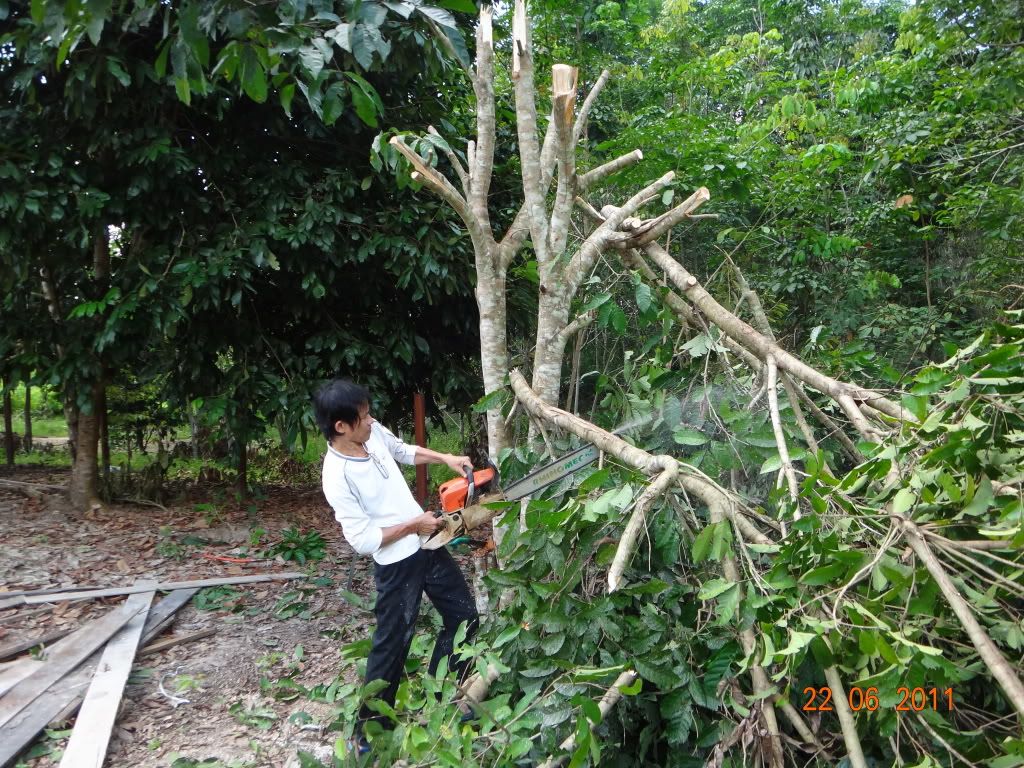
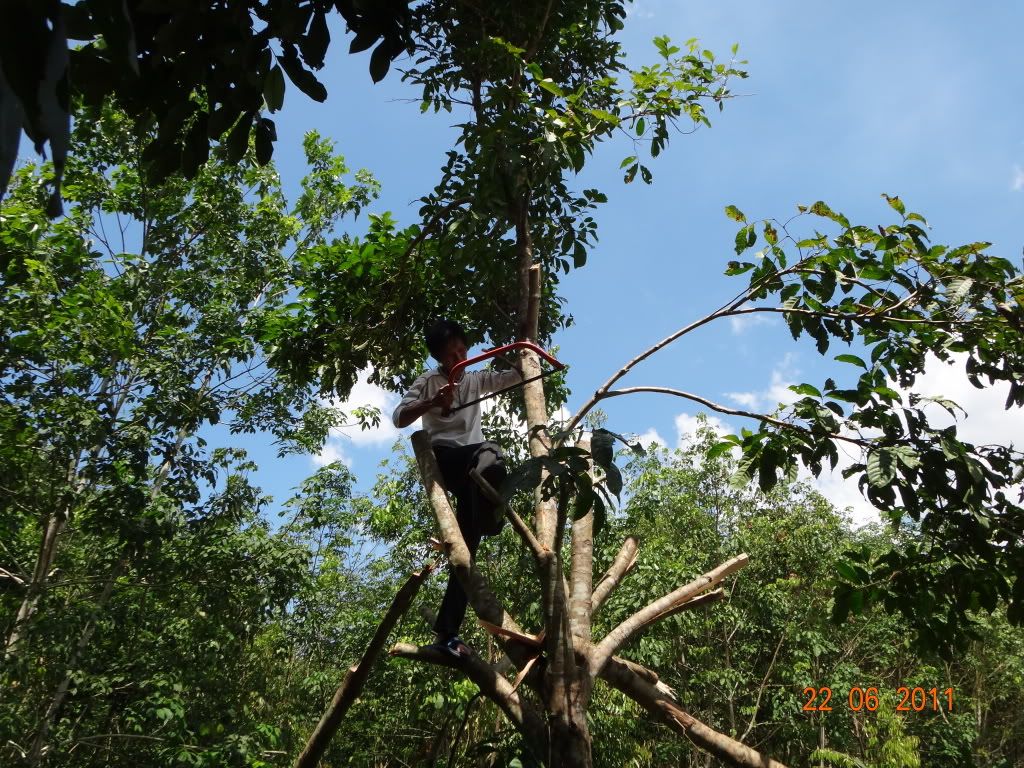
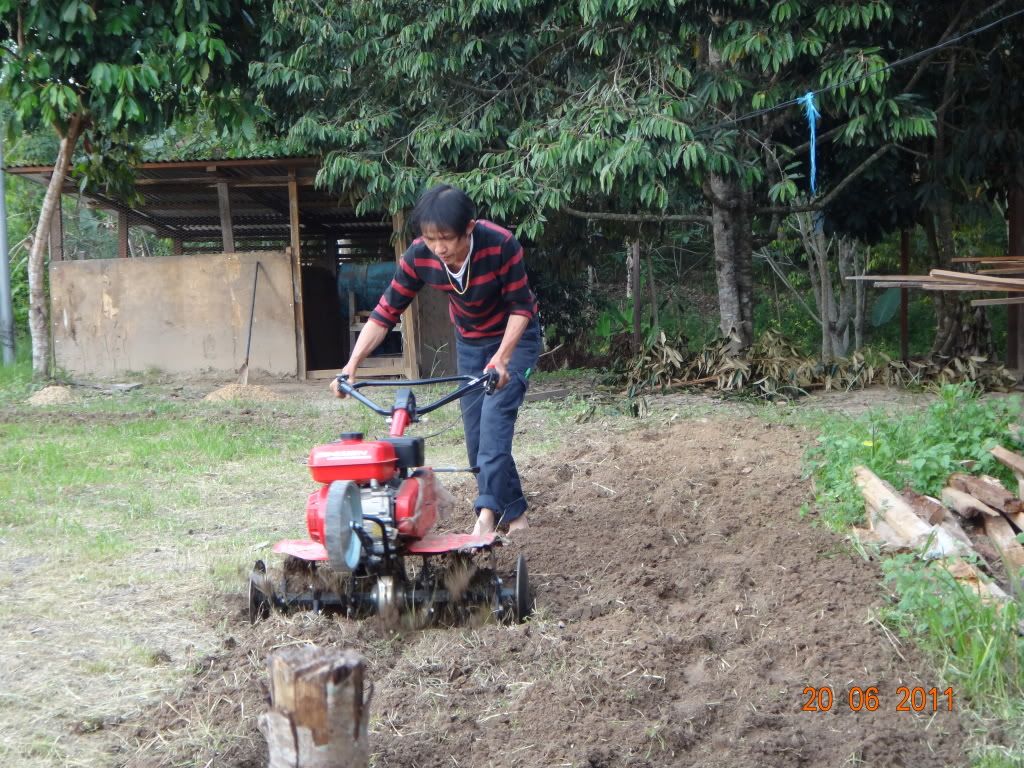
biggrin.gif It's in The Land Beneath The Wind, Sabah, near Keningau. You are welcome to visit, but only at your own risk biggrin.gif I just had 2 visitors (husband & wife) recently. Came to Sabah for a 6 day trip. He worked on the farm for 3 days. I worked as his driver / unlicensed tour guide for 3 days.
user posted image
user posted image
user posted image
He was re-living his childhood, His father was a farmer. He had so much fun using the some of the equipment such as grass cutter, chainsaw and evn the mini plougher.

This post has been edited by MrFarmer: Jul 8 2011, 09:14 PM

freerangechicks
post Jul 9 2011, 10:59 AM

New Member
*
Junior Member
8 posts

Joined: Jul 2011


MrFarmer,
Haha over in the east eh? I'm at Peninsular. Maybe only if I go there for a holiday. Seems like your visitor is having fun.

MrFarmer
post Jul 9 2011, 06:45 PM

Casual
***
Junior Member
478 posts

Joined: Mar 2011
From: Sabah


QUOTE(freerangechicks @ Jul 9 2011, 10:59 AM)
MrFarmer,
Haha over in the east eh? I'm at Peninsular. Maybe only if I go there for a holiday. Seems like your visitor is having fun.
*
hmm.gif you made it sound very far? Our globe is not that large after all. It's only 2 1/2 hour's flight from Sepang. My friend is from Klang. I reside in KL.

Sabah is a nice place to visit. Blessed with natural environment, plenty sea food. Lots of surrounding island, mountains and there is two
"lost valley" Danum Valley and Maliau Basin Lots of farming opportunities too.


TSParaOpticaL
post Jul 9 2011, 08:46 PM

Planter - Durian, Jackfruit, Papaya
*******
Senior Member
2,348 posts

Joined: Dec 2004
From: Ch3r@s


Mr Farmer,

which airline do you take to get to Keningau from KL ?

thanks


freerangechicks
post Jul 11 2011, 02:37 PM

New Member
*
Junior Member
8 posts

Joined: Jul 2011


LOL! Yes, it's indeed not so far in the sense of flight time but it will cost me a few working days. I will see when I'm free and hope to be able to visit there soon. Yes, seafood is great.
MrFarmer
post Jul 11 2011, 08:11 PM

Casual
***
Junior Member
478 posts

Joined: Mar 2011
From: Sabah


QUOTE(ParaOpticaL @ Jul 9 2011, 08:46 PM)
Mr Farmer,

which airline do you take to get to Keningau from KL ?

thanks
*
You can fly in from Sepang with either AirAsia or FireFly to Kota Kinabalu (~2.5hrs). After that by land transport to Keningau (~3 hrs).
SUSalaskanbunny
post Jul 11 2011, 11:08 PM

Foodie
*******
Senior Member
4,283 posts

Joined: Nov 2009
From: Vietnam

guys... lets say my company have got a palm plantation er... what side business can i do in the plantation er? wont kacau the plantation but use their land....

rear cattle and ayam ar?
Michael J.
post Jul 15 2011, 12:01 AM

On my way
****
Senior Member
596 posts

Joined: Jan 2006


It would intefere, more or less, with the plantation.

Assuming that the plantation allows you to use the land freely, you could do intercrop of banana, especially in immature areas. Just make sure you replace the nutrient input taken up by the banana plants, so the palms are not affected. Banana retail price per kg for Berangan is about RM2.80 in some places (Grade A), and RM2.50 for most (Grade B). Standard production is about 15kg combs per bunch (RM37.50), with intercropping densities of about 600 plants per ha in oil palm area (RM22,000/ha).

If you want something more mobile, try cattle ranching. Although I am very much against this, and many agriculturists share similar views, I do know that Kulim has been doing quite alright in this. Just to share generally, their cost of ranching (i.e. free-ranging, with supplementary feedings, disease management, slaughtering etc.) is about RM5 per kg carcass, or around RM1,500 per head. But bear in mind, this does not include the cost of buying the calves. If you can find an ok breeder, you might be able to get calves at about RM1,000 per head, and profit about RM500 per head. Retail price is about RM3,000 per 300kg carcass.

But again, and I believe I've mentioned this before, marketing and market access remains to be a serious problem, whatever produce it may be. Local beef have to reach areas with large meat demand, and low competition from cheap imported beef or kerbau meat, while banana have very short shelf life, maximum 7 days while green and kept chilled, and less than 5 days after forced ripening.
MrFarmer
post Jul 15 2011, 09:17 PM

Casual
***
Junior Member
478 posts

Joined: Mar 2011
From: Sabah


QUOTE(Michael J. @ Jul 15 2011, 12:01 AM)
It would intefere, more or less, with the plantation.

Assuming that the plantation allows you to use the land freely, you could do intercrop of banana, especially in immature areas. Just make sure you replace the nutrient input taken up by the banana plants, so the palms are not affected. Banana retail price per kg for Berangan is about RM2.80 in some places (Grade A), and RM2.50 for most (Grade B). Standard production is about 15kg combs per bunch (RM37.50), with intercropping densities of about 600 plants per ha in oil palm area (RM22,000/ha).

If you want something more mobile, try cattle ranching. Although I am very much against this, and many agriculturists share similar views, I do know that Kulim has been doing quite alright in this. Just to share generally, their cost of ranching (i.e. free-ranging, with supplementary feedings, disease management, slaughtering etc.) is about RM5 per kg carcass, or around RM1,500 per head. But bear in mind, this does not include the cost of buying the calves. If you can find an ok breeder, you might be able to get calves at about RM1,000 per head, and profit about RM500 per head. Retail price is about RM3,000 per 300kg carcass.

But again, and I believe I've mentioned this before, marketing and market access remains to be a serious problem, whatever produce it may be. Local beef have to reach areas with large meat demand, and low competition from cheap imported beef or kerbau meat, while banana have very short shelf life, maximum 7 days while green and kept chilled, and less than 5 days after forced ripening.
*
Hi Michael, was passing by a palm oil plantation the other day and saw a group of foreign labors clearing the Berangan (for good) and went up to chat with them. Asked them why are they clearing and throwing away the Berangan and was told that their boss instructed them to clear as the Berangan is "poisoning the roots of the palm". I just could not comprehend what them meant.

Talked to a University Pertanian lecturer during the MAHA 2010, he said it's a good idea to inter-crop bananas with rubber trees too and can most probably do it to 3 1/2 years. according to him, the fruits shall eventually be too small to market due to the lack of sun light.

Off topic, the tissue cultured Berangan that bought is growing at a very slow rate compared to the "local" shoots (Berangan, Emas and the type used for Goreng Pisang) that we dug up to propagate.

Also I'm wondering if it's a good idea to collect the above mentioned discarded "Poisonous" Berangan and plant it at my farm?
OMG!
post Jul 15 2011, 09:38 PM

Raymond
******
Senior Member
1,397 posts

Joined: Jan 2009
From: Peaceful Island


Basically if you are interested to have a farm and further down the road,you think it is a great opportunity to comercialised the chickens that you rear to for their eggs or to further processed into food, getting to supply to food chain, resturants or wet markets etc, i guess this is a great opportunity.

Today, i got the chance to have a visit to one of the integrated company for poultry breeding to further processing. let me share what i have gained from visiting the farm. The farm located at a very remoted area. I noticed at the entrance there are wheel drip column specially for lorry to dip the tyres and be sprayed with the disinfectant sprayer fixed around the wall before entering the farm.This is to avoid any contamination and ensure good sanitary. There are 5 workers and when I reached there, there are 2 indonesian workers in charge of the farm. They have their own wooden house to stay as they need to take care of the birds 24 days 7 weeks. The farm manager is a Chinese guy who rent the facilities and land for breeder group to grow broilers there. There are 7-8 brooders( a heated house for chick) for growing the birds, each brooder can have the capacity to accommodate up to 17000 birds.

The wood shaving are scattered on a floor layer for the small birds to move around. According to the vets, the use of wood shaving has its purposes. It protects the small birds (Grower) from falling down from the brooder. When the birds start to grow for a certain size, the layer of wood shaving will be rolled up because the birds are able to walk stably on the brooder. Besides serving the purpose of protection, the wood shaving also absorb moisture and provide heat to the birds. There are drinkers and feeder inside the coop which are to provide water and feed to the birds. Sometimes the drinkers might be unbalanced and contains not enough water, so the workers need to take note and correct the mistakes whenever possible. the vets said the feeder need to be full of feeds as birds sometimes can have a different eating habit, and thus the feed need to be filled fully to ensure the birds obtain enough nutrients for their growing pattern. Besides , the brooder also equipped with heater( using infrared ray ) to provide heat to the birds. it is usually switched on at night. When the birds grow to 1.5-1.7kg only will the birds be sent to be slaughtered and further processed in Food industries.

It will take half year for a hen to mature and 67th week old to continuously producing eggs . The capability for a hen to produce eggs range from 175-180 eggs per life span.
Integrated companies have the whole operation of producing chicken to further processing the meat based food . So basically there are Livestock, Breeder, Food Industries which all cater for the bussiness need of an integrated company.

To make it simple, there are basically divided into three categories:
a) Broiler- The tasks is to grow the broilers for further processed food purposes. The broilers are usually be given unlimited nutrients and allow for quicker grow.
b) Layer- This category has its sole purpose, that is to grow the broiler which meant for only laying eggs. Cocks and hens are not allowed to mate, thus hens will yield unfertilised eggs.
c) Breeder – to breed the birds , allowing the mating between cocks and hens. Fertilisation occurs and eggs hatched to produce chicks.


Welcome any feedbacks. I wish to learn more on this too=)

This post has been edited by OMG!: Jul 15 2011, 09:39 PM
Michael J.
post Jul 16 2011, 09:25 AM

On my way
****
Senior Member
596 posts

Joined: Jan 2006


MrFarmer:

The plantation should be in Sabah, if I'm not mistaken, right? I believe what the owners are referring to are nematodes. Banana corms are known to harbour root nematodes, a kind of small worm-like parasite that feeds on the roots of plants, and tends to act as a vector for various root-borne diseases. However, this usually happens when proper sanitation during planting of banana corms isn't practiced, i.e. disinfection of corm/suckers via nematicide immersion or hot water treatment. Also, although maybe to a lesser extent, fusarium oxysporium and phytophtora transmission via infected soil surrounding the banana corm could result in death of young palms.

The UPM lecturer is quite right. Sunlight is important for banana cultivation, but generally as long as 70% light penetration is available, the plants could still grow well and bear good fruits. As the canopy of the main crops begin to interlock to block out sunlight, understandably, productivity of banana would also drop. That's why in 10-year old coconut estates, intercropping with banana is a viable option, as the light penetration from the side is high enough for banana photosynthesis, whereas in oil palm, you'd probably need to wait till 20 years before gaining similar light penetrations. Other reasons lies with nutrient competition, and genetics. Maturing rubber/oil palm/cocoa trees will eventually take up more nutrients, and given their more extensive root system, would out-compete the banana's more localized root system for nutrients.

About the TC banana plantlet vs natural suckers, this is indeed interesting to note the difference in growth time. Although contentious, and could probably raise furore amongst TC labs, I have to comment that growing from suckers actually can result in faster growth. This is based on the experience, and experiments that were conducted while I was still with the plantation industry. However, one thing that growing bananas from suckers trail behind TC plantlets, is uniformity. This, along with freedom from diseases, is in fact really the main selling point of TC plantlets. When planting huge hectarages of bananas, the only way to reduce cost during harvesting, is for about 80% of the crop maturing and ripening at around the same time, which happens when the field is planted with TC banana plantlets. This way, you wouldn't need to have harvesters coming into the plantations frequently, and can harvest large quantities at the same time. Also, because of the larger scale of harvest, transportation costs will necessarily become lower as it is distributed over a greater unit number, while reducing frequency of transport.

DON'T TAKE THOSE DISCARDED SUCKERS. Please, be wary. Once the pathogens or pest get into your soil, that's the end of story for your farm. Very few crops are tolerant or resistant to those pathogens (fusarium, phytophtora, root nematodes), and the cost of cleaning up the mess is huge. A case in point is Panama disease that wiped out massive tracts (>90%) of banana plantings in Johore, caused by fusarium. Or the phytophtora shoot rot that kills 85% of oil palm in Latin America. Most of these cases are a result of transporting and planting disease ridden materials, including soil particles and dead plant materials, into healthy areas.

Do practice GAP. Note what our friend OMG highlighted about the chicken farm. There's some very good examples of GAP.
TSParaOpticaL
post Jul 20 2011, 08:45 PM

Planter - Durian, Jackfruit, Papaya
*******
Senior Member
2,348 posts

Joined: Dec 2004
From: Ch3r@s


hi people,

need your help in identifying the deficiency of my corn...thank you

user posted image


chinyen
post Jul 21 2011, 11:58 AM

Enthusiast
*****
Senior Member
754 posts

Joined: Jul 2009

Sole Distributor of World Eco Products? do you have gluten free flour ?
MrFarmer
post Jul 25 2011, 03:13 PM

Casual
***
Junior Member
478 posts

Joined: Mar 2011
From: Sabah


QUOTE(ParaOpticaL @ Jul 20 2011, 08:45 PM)
hi people,

need your help in identifying the deficiency of my corn...thank you
Hi ParaOptical,
I have with me "Buku Panduan-Simptom kekurangan nutrien bagi tanaman" by Jabatan Pertanian, reprint 2006. It's in the National language, Adobe file 8,681 KB. It says that make sure it's not disease or insects before diagnostic. PM me if you required the Buku Panduan. I find it complicated to understand.

119 Pages « < 34 35 36 37 38 > » Top
 

Change to:
| Lo-Fi Version
0.0252sec    1.48    6 queries    GZIP Disabled
Time is now: 19th December 2025 - 10:17 AM