

Good Morning everyone, does anyone know where I can get some worms such as African Nightcrawler, Tiger Worm or Red Worm in PJ area?
Venturing into Agriculture & Aquaculture, Co-Ordination & Implementation is KEY
Venturing into Agriculture & Aquaculture, Co-Ordination & Implementation is KEY
|
|
 Nov 10 2012, 10:16 AM Nov 10 2012, 10:16 AM
|
 
Junior Member
6 posts Joined: Nov 2012  
|
Good Morning everyone, does anyone know where I can get some worms such as African Nightcrawler, Tiger Worm or Red Worm in PJ area?
|
|
|
|
|
|
Nov 14 2012, 09:46 PM
|
|
Junior Member
36 posts Joined: Dec 2011
|
QUOTE(harvestopia @ Nov 10 2012, 11:16 AM) Good Morning everyone, does anyone know where I can get some worms such as African Nightcrawler, Tiger Worm or Red Worm in PJ area? I got a red worm supplier but he lives at Port Klang. Do u wan his contact number? |
|
|
Nov 14 2012, 10:47 PM
|
|
Junior Member
6 posts Joined: Nov 2012
|
Mind PM me the number. Thank you.
|
|
|
Nov 16 2012, 04:48 PM
|
|
Newbie
3 posts Joined: Nov 2012
|
Hi everybody! I am new here. My interest is in Soon Hock and have benefited reading the many tips members here have provided on the subject. Some questions I have hopefully some of u may know the answers of and they are:
1. Other than fr the wild malaysian soon hock farmers(say those in Johor) get their fingerlings from what reliable sources? 2. Is integrated soon hock/tilapia farming a reliable and significant source for fingerlings supply? 3. I was told there is an uncle in Kulai who is successful breeding and raising soon hock fingerlings in earthen ponds(the natural way) and is regular supplier of fingerlings to farms in Johor. Any body here can provide his address and contact number? |
|
|
Nov 17 2012, 08:41 PM
|

Senior Member
2,348 posts Joined: Dec 2004 From: Ch3r@s 
|
|
|
|
Nov 19 2012, 05:05 PM
|
|
Junior Member
85 posts Joined: Jan 2012
|
Hi Farmer,
Do you pre register for the MAHA? I have registered and received an email ask me to go there collect the badge. However, when I went there, they tell me do not have to take the badge, you will only have to walk in. Really waste my time. |
|
|
|
|
|
Nov 19 2012, 08:04 PM
|
|
Junior Member
114 posts Joined: Dec 2011
|
QUOTE(tskan @ Nov 16 2012, 04:48 PM) Hi everybody! I am new here. My interest is in Soon Hock and have benefited reading the many tips members here have provided on the subject. Some questions I have hopefully some of u may know the answers of and they are: For Soon Hock, I only know a way which is practically zero cost that can succeed, other ways I not too sure1. Other than fr the wild malaysian soon hock farmers(say those in Johor) get their fingerlings from what reliable sources? 2. Is integrated soon hock/tilapia farming a reliable and significant source for fingerlings supply? 3. I was told there is an uncle in Kulai who is successful breeding and raising soon hock fingerlings in earthen ponds(the natural way) and is regular supplier of fingerlings to farms in Johor. Any body here can provide his address and contact number? For Tilapia, only advise I can provide is to get yourself a mentor, copy his/her model to get a feel of it. There are many ways that can work. Any other questions, can ask me, I can help me a bit. I distribute Tilapia fish feed. |
|
|
Nov 19 2012, 09:33 PM
|
|
Newbie
3 posts Joined: Nov 2012
|
QUOTE(M_century @ Nov 19 2012, 08:04 PM) For Soon Hock, I only know a way which is practically zero cost that can succeed, other ways I not too sure Hi and thank u for yr response.For Tilapia, only advise I can provide is to get yourself a mentor, copy his/her model to get a feel of it. There are many ways that can work. Any other questions, can ask me, I can help me a bit. I distribute Tilapia fish feed. Am interested to know more about yr way with soon hock. Also I have tilapia wh I culture to feed my aros and soon hock. Will want to know more about yr tilapia feed. Give me range of this and prices. |
|
|
Nov 20 2012, 01:18 AM
|
|
Junior Member
114 posts Joined: Dec 2011
|
QUOTE(tskan @ Nov 19 2012, 09:33 PM) Hi and thank u for yr response. I don't culture soon hock. Only tilapia.Am interested to know more about yr way with soon hock. Also I have tilapia wh I culture to feed my aros and soon hock. Will want to know more about yr tilapia feed. Give me range of this and prices. From what I saw. They place a flat altar like above water, using pond not the floating type. Place all kinds of dead animals. Let it rot, then the corpse worm will fall into water for the waiting soon hock. Mainly because soon hock don't swim around much. From there I didn't enquire much but I've been told its profitable. If you plan to use tilapia feed for fingerling. Best to buy from nearest shop. Actually would save more from transport cost. Unless you into tilapia farming, then you could consider to understand my feed. |
|
|
Nov 20 2012, 05:45 AM
|

Junior Member
478 posts Joined: Mar 2011 From: Sabah
|
QUOTE(Kg Teratai @ Nov 19 2012, 05:05 PM) Hi Farmer, I did per-registered, but did not collect any badge. Last time I went, I just walk in, but need to fill up a form. Anyway, shall walk in again, as I don't have any business name card Do you pre register for the MAHA? I have registered and received an email ask me to go there collect the badge. However, when I went there, they tell me do not have to take the badge, you will only have to walk in. Really waste my time.  Added on November 20, 2012, 5:50 am QUOTE(M_century @ Nov 19 2012, 08:04 PM) For Soon Hock, I only know a way which is practically zero cost that can succeed, other ways I not too sure M_Century, agree with you on the mentor/student model, lust like in kung fu movies. Anyway, this works for all aspect of life. Be it in business, agriculture & etc. This shall take way lots of stress and trial & errors. Good luck to all of us.For Tilapia, only advise I can provide is to get yourself a mentor, copy his/her model to get a feel of it. There are many ways that can work. Any other questions, can ask me, I can help me a bit. I distribute Tilapia fish feed. This post has been edited by MrFarmer: Nov 20 2012, 05:50 AM |
|
|
Nov 20 2012, 08:03 AM
|
|
Newbie
3 posts Joined: Nov 2012
|
[quote=M_century,Nov 20 2012, 01:18 AM]
I don't culture soon hock. Only tilapia. From what I saw. They place a flat altar like above water, using pond not the floating type. Place all kinds of dead animals. Let it rot, then the corpse worm will fall into water for the waiting soon hock. Mainly because soon hock don't swim around much. From there I didn't enquire much but I've been told its profitable. If you plan to use tilapia feed for fingerling. Best to buy from nearest shop. Actually would save more from transport cost. Unless you into tilapia farming, then you could consider to understand my feed. [/quote) Haha! Very clever. Simple solution to difficult problem. Thank u! |
|
|
Nov 20 2012, 05:30 PM
|
|
Senior Member
2,348 posts Joined: Dec 2004 From: Ch3r@s
|
guys when are you going to MAHA 2012 ???
i am thinking monday or tuesday (less people) |
|
|
Nov 20 2012, 06:10 PM
|
|
Junior Member
478 posts Joined: Mar 2011 From: Sabah
|
QUOTE(ParaOpticaL @ Nov 20 2012, 05:30 PM) guys when are you going to MAHA 2012 ??? Me going on Friday.i am thinking monday or tuesday (less people) Flying back Thursday morning  |
|
|
|
|
|
Nov 22 2012, 04:26 PM
|
|
Senior Member
2,348 posts Joined: Dec 2004 From: Ch3r@s
|
wow this monsoon season created a lots of problem for the farmers & collectors here in N.Sembilan....
many reported that their fruits are half ripe only due to over-raining.... some buyers bought and complained the next day of the poor quality |
|
|
Nov 23 2012, 09:49 AM
|

Senior Member
596 posts Joined: Jan 2006
|
Para:
Yes, the heavy rainfall has been quite damaging. How's your durian production? I hope it is still ok.... I think varieties which are prone to half-ripening problems, like D24 and its siblings, will be quite affected. Speaking of durian, the experiment I did has come to a head. I've subjected the various open pollinated seedlings to a number of stressors, and have selected the few that showed best results. I am pleased to note that the D2 sib-pollinated seedlings performed outstandingly. Results: D2 - Tolerance to drought: 100% Survival (2/2); Phytophtora tolerance: 100% (2/2) D8 - Tolerance to drought: 0% Survival (0/8); Phytophtora tolerance: NA D28 - Tolerance to drought: 20% Survival (1/5); Phytophtora tolerance: NA D30 - Tolerance to drought: 0% Survival (0/6); Phytophtora tolerance: NA D88 - Tolerance to drought: 50% Survival (6/12); Phytophtora tolerance: 83% (10/12) D103 - Tolerance to drought: 33% Survival (4/12); Phytophtora tolerance: NA D144 - Tolerance to drought: 20% Survival (1/5); Phytophtora tolerance: NA D187 - - Tolerance to drought: 0% Survival (0/8); Phytophtora tolerance: NA Statistically speaking, D2 has the best drought tolerance and disease resistance amongst the tested seedlings. Nonetheless, it must be noted that only 2 seedlings were obtained (only 2 fully formed, viable seeds in one fruit), and hence there is some statistical bias. Interestingly, progeny which were supposedly derived from D2 bloodlines, such D144, suffered quite badly in the stress test. This is possibly due to selection for stronger expression of D24 genetics (i.e. better fruit yield, bigger fruits etc.). Most interestingly, seedlings with Thai bloodlines, i.e. D88 and D103 were highly drought tolerant. However, since most of the seedlings were open pollinated, the reduction in genetic purity would account for their statistically lower survival rates. The conclusion of this simple, albeit crude experiment, indicates that pure D2 clones would serve as ideal drought and disease tolerant rootstock for grafting purposes. D2-related bloodlines (i.e. non-selfed progeny) are not ideal in most cases, whereas Thai bloodlines (eg. D88 and D103) are highly suitable rootstock materials. Given the low fruit quality of some of the Thai bloodlines (eg. D103), such varieties would be most ideal as rootstock for grafting purposes. On a side note, I would also like to point out that I did flooding tests as well, i.e. I flooded the grow trays with standing water for a few weeks. All the seedlings did not suffer noticeable shock. I believe it has something to do with the soil composition I was using, and hence I have excluded the data from my observation. This post has been edited by Michael J.: Nov 23 2012, 09:54 AM |
|
|
Nov 23 2012, 11:12 AM
|
|
Junior Member
85 posts Joined: Jan 2012
|
Hi Farmer,
I may go to MAHA this afternoon. Not confirm yet. Hi MJ, I would like to know How to test the Phytophtora tolerance? I also found the D197 is quite easy infected by Phytophtora. The young tree I planted in the farm already show syptoms. I would also like to check with you. What is the nutrient need to supply to this tree? May be you can suggest which feterlizer to be applied. 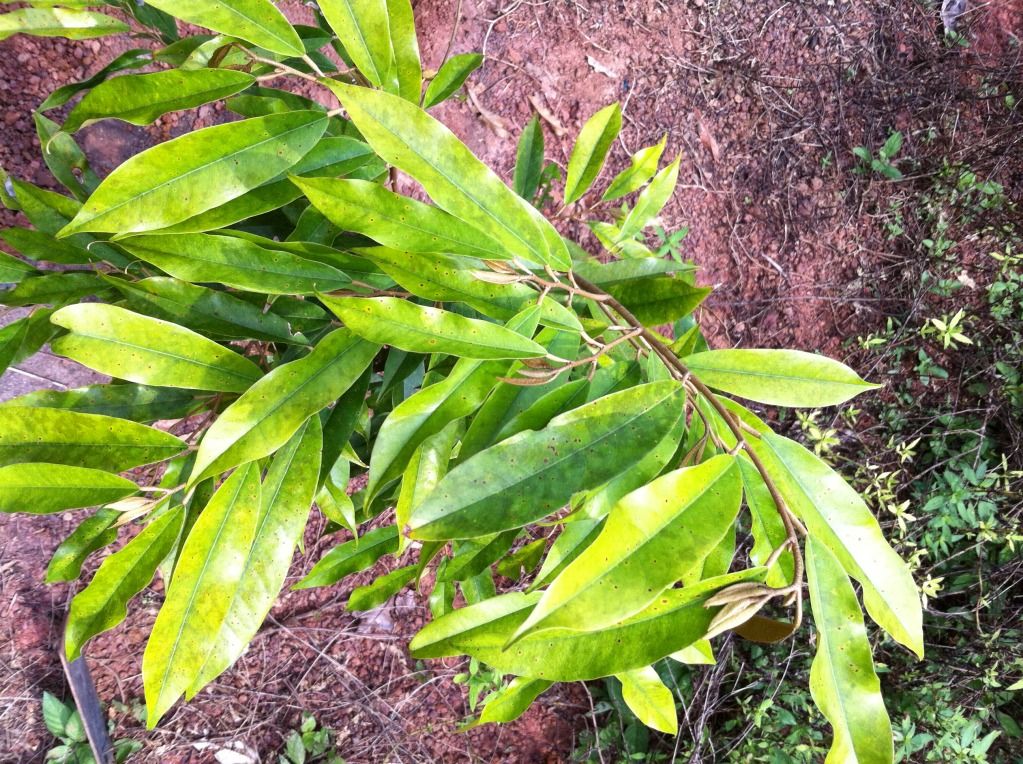 |
|
|
Nov 23 2012, 01:36 PM
|
|
Senior Member
596 posts Joined: Jan 2006
|
Kg Teratai:
Most of the later clones are susceptible to phytophtora, including premium ones like D197. That is why rootstock is very important. Seeing that most D197 are grafted plants, it could be a problem with the rootstock itself (as I understand it, many nurseries use D24 as rootstock, which is itself quite prone to the effects of phytophtora infection). A crude method of testing is to use soil from heavily affected areas to try germinating seeds. Those that die are susceptible, whereas those that survive are more tolerant. I do one additional step "shock" treatment step by reducing the soil moisture content (i.e. stressing the plant), and then suddenly increasing the water table to saturation (which favor phytophtora proliferation). If then plant is easily stressed by drought, the subsequent proliferation of phytophtora would more than likely cause infection and death. Thus, in this two stage process, it would be possible to "screen" tolerant plants. A more accurate way is to grow tissue samples of the selected plants in petri dishes (i.e. tissue culture), and then infect them with a solution of phytophtora enriched spores/mycelium, and incubate them. If the plant has the immunological provenance to stave off infection, it would show in survival rate. An additional step mycologist would take is to stain the samples with a dye to detect particular stress hormones, which would further indicate which plants are suffering from an infection. As I know, phytophtora is a very troublesome disease in durian orchards.... there's very little cure. The best offence is actually a strong defense. You could try trichoderma enriched organic fertilizers, it may help. But since the disease is already manifesting itself, I'm afraid there is no real cure. If it is a small tree, you could try applying metalaxyl into the soil; however this would give only short term solutions, and may damage the soil in the long run. Just a few questions though: How is the humidity and water drainage of your orchard? Is the soil porous, or clayish? Phytophtora are very agressive in areas with high humidity, compact, clayish soils, with excessive ground litter/plant biomass. If you want to know how to remedy a durian orchard, you can speak with Para; he's done a great job reviving a low production durian orchard. On a separate note, the following are a little presentation about the impacts of biotechnology: Growth from Fungi The Future of Drug Discovery Green Packaging This post has been edited by Michael J.: Nov 23 2012, 02:08 PM |
|
|
Nov 23 2012, 07:13 PM
|
|
Senior Member
2,348 posts Joined: Dec 2004 From: Ch3r@s
|
My durian production is no problem....probably due to me changing to the organic way for farming. but most of the farmers here are close to "dying" because of the free fall in price.
but from the information that i gathered, actually 90% of the clones are facing this problem and the durian collectors are choking because of this and also that caused the free fall of price. i am discussing with my sifu in order to deviate from this old practice and prevent from producing when everyone is producing. did you know that Musang King in Raub is at RM 3.50/kg QUOTE(Michael J. @ Nov 23 2012, 09:49 AM) Para: Well if you are hit by phyptopthora, you need to take immediate & strong action at times to solve it. there is no 2 ways about it BUT after its cured its best to start prevention for the future.Yes, the heavy rainfall has been quite damaging. How's your durian production? I hope it is still ok.... I think varieties which are prone to half-ripening problems, like D24 and its siblings, will be quite affected. I would say how to remedy but i strongly recommend 2 things :- 1) Use Organic Fertiliser 2) NEVER spray herbicide to kill the grass & weed. I would suggest grass cutting frequently so that cow grass will grow over the weeds. QUOTE(Michael J. @ Nov 23 2012, 01:36 PM) Kg Teratai: This post has been edited by ParaOpticaL: Nov 23 2012, 07:25 PMAs I know, phytophtora is a very troublesome disease in durian orchards.... there's very little cure. The best offence is actually a strong defense. You could try trichoderma enriched organic fertilizers, it may help. But since the disease is already manifesting itself, I'm afraid there is no real cure. If it is a small tree, you could try applying metalaxyl into the soil; however this would give only short term solutions, and may damage the soil in the long run. Just a few questions though: How is the humidity and water drainage of your orchard? Is the soil porous, or clayish? Phytophtora are very agressive in areas with high humidity, compact, clayish soils, with excessive ground litter/plant biomass. If you want to know how to remedy a durian orchard, you can speak with Para; he's done a great job reviving a low production durian orchard. On a separate note, the following are a little presentation about the impacts of biotechnology: |
|
|
Nov 23 2012, 09:58 PM
|
|
Junior Member
478 posts Joined: Mar 2011 From: Sabah
|
QUOTE(Kg Teratai @ Nov 23 2012, 11:12 AM) Hi Farmer, It was a bit of a disappointment. I went early morning, 10 am. Then it was raining. I only manage Hall A, B & C. This time I find that it is geared more towards the public. There were also lots of non-related exhibitors.I may go to MAHA this afternoon. Not confirm yet. Added on November 23, 2012, 10:00 pm QUOTE(ParaOpticaL @ Nov 23 2012, 07:13 PM) [color=blue]My durian production is no problem....probably due to me changing to the organic way for farming. but most of the farmers here are close to "dying" because of the free fall in price. Bought Raub Musang King @ MAHA 2012 (XL) for $9.00 / kg. Now so full but from the information that i gathered, actually 90% of the clones are facing this problem and the durian collectors are choking because of this and also that caused the free fall of price.  This post has been edited by MrFarmer: Nov 23 2012, 10:00 PM |
|
|
Nov 24 2012, 03:32 PM
|
|
Senior Member
2,348 posts Joined: Dec 2004 From: Ch3r@s
|
wow bro that's expensive.....now the exhibitors also smart....
QUOTE(MrFarmer @ Nov 23 2012, 09:58 PM) Added on November 23, 2012, 10:00 pm Bought Raub Musang King @ MAHA 2012 (XL) for $9.00 / kg. Now so full |
| Change to: |  0.0238sec 0.0238sec
 0.61 0.61
 6 queries 6 queries
 GZIP Disabled GZIP Disabled
Time is now: 18th December 2025 - 02:55 AM |
 Quote
Quote