Welcome Guest ( Log In | Register )

Outline · [ Standard ] · Linear+

 Venturing into Agriculture & Aquaculture, Co-Ordination & Implementation is KEY

views
     
fyseng
post Jul 30 2012, 03:49 PM

Getting Started
**
Junior Member
206 posts

Joined: Jan 2003


QUOTE(Kg Teratai @ Jul 30 2012, 03:41 PM)


Fyseng,

Wah. That is good skill that you have pick up. It has been many years, I am still not able to master the skill to identify the clone or type of durian tree. haiz.. must go back and ask si fu again.

I am not sure about sungai buloh, if you free, you can try Mardi Serdang. I have purchased few from them last month. There are few left after I purchased. Please contact them before you go. It is RM8 per tree.

Para,

I wonder if I can get D197 bud from you next time. It will be too far for me to get back to my kampung to get the bud. If I can get it from you, it will be nearer.
*
sad.gif Actually I don't really know how to identify the durian tree. Its the foreign worker at the nursery told me it is D101. I only know my mao san wang is D197 when I google it tongue.gif
Kg Teratai
post Jul 30 2012, 03:53 PM

Getting Started
**
Junior Member
85 posts

Joined: Jan 2012
Fyseng,

I see, Yes. Mao san wang is D197. There is a skill to identified the clone or type of durian tree by looking at the leaf. I saw people doing it previously.


Einjahr
post Jul 30 2012, 04:44 PM

Getting Started
**
Junior Member
121 posts

Joined: Dec 2010
hello guys, glad to find myself on this site.

What do you guys think about rabbit farming for meat ? Im toying with the idea of starting a small scale rabbit husbandry program at home, but before I jump into this. Can anyone recommend a good rabbit husbandry course ? Tried looking around online but I can only find ones that are dated 2010 back.
Michael J.
post Jul 30 2012, 04:58 PM

On my way
****
Senior Member
596 posts

Joined: Jan 2006


Whoosh...! Suddenly so many messages. Haa...

Para:
No problem, I probably mis-read some portions. Anyhow, still do be careful with metalaxyl and phytophtora; the fungus has been known to develop resistance to the chemical over time.

fyseng:
No problem.

Kg Teratai:
Do read this blog. You will notice that flowering season is about 3 months long, so it might be a case of late blooming. You could induce flowering if you choose to - http://durianinfo.blogspot.com/p/durian-se...production.html

(1) The Thai coconut is Pandan coconut, and it is a registered variety. We also know is "Aromatic Green Dwarf".
(2) You can get it from DOA in limited numbers. I would suggest you approach MARDI in Teluk Intan, or the nurseries near Bukit Kayu Hitam. MARDI would be most convenient since they propagate quite a lot, but they sometimes run out of stock. However the BKH seeds are higher quality (proven in field trial). Another company you could try (but difficult to convince them to sell to you) is United Plantations (UP) in Teluk Intan, Perak. One or two maybe they oblige lar. They are the largest coconut plantation in Malaysia, and largest hybrid coconut producer in the world. Another company you could try, but again not sure if they willing to sell to you, is YP Plantations in Pahang. They have a very large Pandan coconut plantation also, and most of the materials were bought from UP.

A word of caution though, please test the seedlings first before buying. If the nursery guy refuses to let you test, then don't buy; likely is fake. The way to test consist of two processes:
(i) Cut a bit of the green leaves, and use a lighter to burn the leaves. If it releases a pandan smell, then you are 30% sure it is Pandan coconut.
(ii) Break a bit of the tip of the young root, and mash it up on your fingers. Then smell it. If it has pandan smell, then confirm is Pandan coconut.

If (i) don't give you smell, but (ii) gives you smell, then there might be slight contamination in the seedling (i.e. might be a hybrid). If (ii) fail anyhow, then it means it's a fake. If (i) and (ii) both positive results, then you have a high-purity Pandan coconut seedling.

Also, pandan coconuts are never huge, not even large, and are always green when fresh. The nut should be about two-thirds the size of a volley ball or smaller; if it is larger, then confirm not pureline already. Also look at the collar (the neck of the germinated seedling); it should be a deep green with very little yellow color. If it is brownish green or orange/yellow-green, then it is some other variety. In any case, still do the testing.


Added on July 30, 2012, 5:13 pmEinjahr:

Rabbits don't really need much "coaching" for them to breed, and neither would you need to know much about it.... I mean, they are rabbits.... They will breed like, well, rabbits! Personally, I think the online resources are good enough. Otherwise, just buy a book on the subject, and you'd be good. Aside from that, it's gonna take a bit of trial and error, so start really really small (eg. a pair).

Rabbits used to be eaten quite often in the past here in Malaysia, but nowadays most people prefer the taste of chicken. Can't really blame people, as rabbit meat is very lean (little fat), and really low in tasty cholesterol. It is also quite gamey in taste (taste a little bit like goat), can become quite dry and coarse if not cooked the right way, and off-putting to people who look at rabbits as fluffy cute things instead of food. It would likely be a hard sell if you sold them whole and fresh. But you might have better success if you value added them, i.e. rabbit kebabs/satay, stewed rabbit meat, frozen rabbit burgers etc.

My mom and her family used to rear rabbits back in the Chinese new village, and during the Emergency, helped feed her entire family of 10 siblings throughout the period. They even had enough to share with the neighbours back then. I remember her substituting rabbit for pork in some of the usual Chinese dishes, and even making breaded fried rabbit hind-quarters instead of fried chicken. How she made it, I don't know, because my dad didn't like the thought of eating rabbits, and so she eventually stopped making it.

This post has been edited by Michael J.: Jul 30 2012, 05:17 PM

MrFarmer
post Jul 30 2012, 09:36 PM

Casual
***
Junior Member
478 posts

Joined: Mar 2011
From: Sabah


Wah so many post, was away just for a week. Taking friends on a tour of Sabah, including my farm of course biggrin.gif

Just to share, we can keep the scion/bud/shoot fresh by keeping them in a cooler box/ fridge or insulated Styrofoam box with ice.

Even seeds can be kept fresh by keeping them in the fridge. Those seeds (durians) that I kept, while in KL, I clean and washed them, then wrapped with newspaper, double heat sealed plastic bag (don't want the smell to come out, otherwise can't board the plane). Some of them had germinated.

Seedling price is so much higher here.
Pandan Coconut @ $15 each from Pertanian
D197 @ $28 independent Nursery
Lime (Limau kapas) @ $18 independent Nursery

Michael J.
post Jul 31 2012, 10:19 AM

On my way
****
Senior Member
596 posts

Joined: Jan 2006


Mr Farmer:

Whoa... That's quite a steep pricing.

About plant propagation, you are quite right that they can be kept fresh through temperature and humidity control. However, one has to bear in mind that any extension in storage will still negatively affect germination/success rate.

For the best results, it is still best to propagate recalcitrant seeds within 1-2 days, and grafts/budwood within 1-2 hours (max). In fact, if you could do the grafts within 5-10 minutes when the natural plant fluids and enzymes of the graft have not yet oxidize, that would be even better.

Anyway, a short update on my durian seeds. All of them are now about 1.5 feet tall. I had originally wanted to plant out another 60 seeds from various other "less desirable" varieties, but decided to only keep only a fraction for experimentation purposes. These have only just begun root extension, but should do quite well in time.

Separately, another interesting durian orchard in Penang. It looks really posh: http://www.durian.com.my/index.html
Kg Teratai
post Jul 31 2012, 02:14 PM

Getting Started
**
Junior Member
85 posts

Joined: Jan 2012
MrFarmer,

That is expensive in Sabah. I think you can grove and sell tree there.

MJ.

Thank you for the information. Will try to get the coconut from Mardi first.
chinyen
post Aug 2 2012, 03:15 PM

Enthusiast
*****
Senior Member
754 posts

Joined: Jul 2009
QUOTE(Michael J. @ Jul 30 2012, 04:58 PM)

Rabbits don't really need much "coaching" for them to breed, and neither would you need to know much about it.... I mean, they are rabbits.... They will breed like, well, rabbits! Personally, I think the online resources are good enough. Otherwise, just buy a book on the subject, and you'd be good. Aside from that, it's gonna take a bit of trial and error, so start really really small (eg. a pair).

Rabbits used to be eaten quite often in the past here in Malaysia, but nowadays most people prefer the taste of chicken. Can't really blame people, as rabbit meat is very lean (little fat), and really low in tasty cholesterol. It is also quite gamey in taste (taste a little bit like goat), can become quite dry and coarse if not cooked the right way, and off-putting to people who look at rabbits as fluffy cute things instead of food. It would likely be a hard sell if you sold them whole and fresh. But you might have better success if you value added them, i.e. rabbit kebabs/satay, stewed rabbit meat, frozen rabbit burgers etc.

My mom and her family used to rear rabbits back in the Chinese new village, and during the Emergency, helped feed her entire family of 10 siblings throughout the period. They even had enough to share with the neighbours back then. I remember her substituting rabbit for pork in some of the usual Chinese dishes, and even making breaded fried rabbit hind-quarters instead of fried chicken. How she made it, I don't know, because my dad didn't like the thought of eating rabbits, and so she eventually stopped making it.
*
eat rabbit.. :sweat

what is usually served is hare instead of rabbit in western countries, right? btw, wanna tumpang thread...hehe..is turkey difficult to rear and takes a long time to mature period?
Michael J.
post Aug 2 2012, 05:09 PM

On my way
****
Senior Member
596 posts

Joined: Jan 2006


chinyen:

It depends. If it is hunted and taken from the wild, they are usually hares; if they are bred for meat, those are rabbits. Hares have not been domesticated by man. So those found in restaurants are usually rabbits, not hare.

Turkey is similar as chicken or guinea fowl in rearing. They do need large areas to move about, and they love to graze. Breeding them, however, is quite a challenge for a smallholder, unless you've managed to get heritage strains, and not the industrial varieties. Heritage turkeys take about 28-30 weeks to reach maturity, while industrial varieties normally take about 14-18 weeks before slaughter.

MrFarmer
post Aug 7 2012, 02:17 PM

Casual
***
Junior Member
478 posts

Joined: Mar 2011
From: Sabah


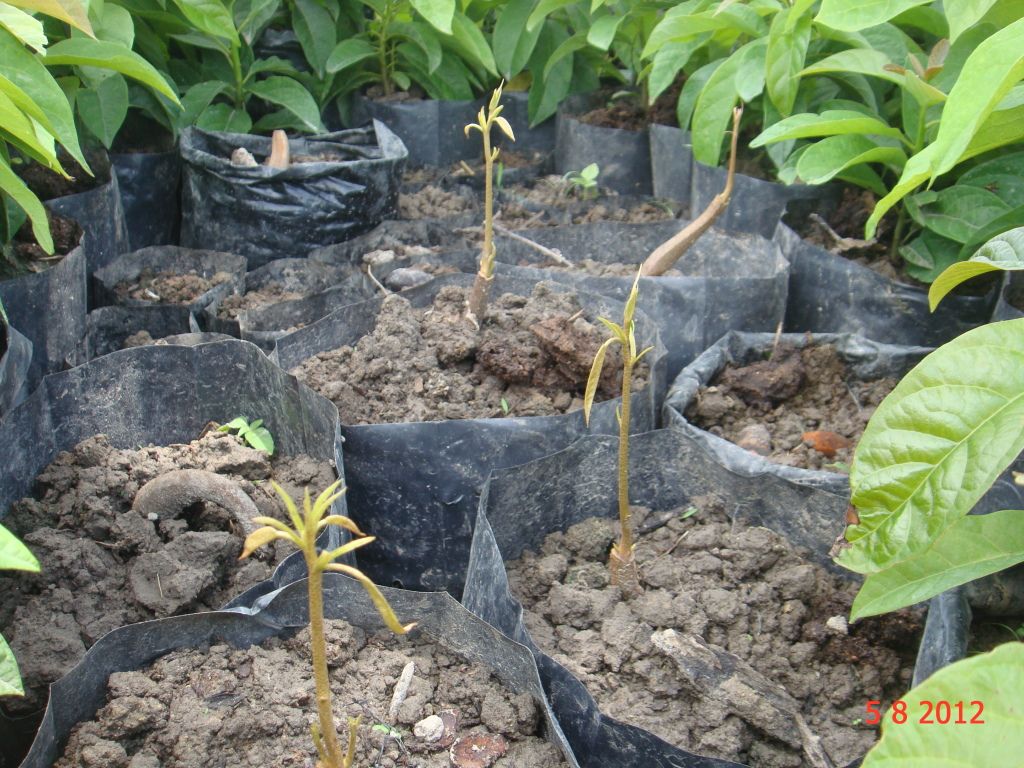
user posted image

Say what size of poly bag are you using for the Durian? I think my bags are too small initially as when the seed germinate and wants to flip up, it got stuck to the side. Transplanted some to bigger bags.
Michael J.
post Aug 7 2012, 04:47 PM

On my way
****
Senior Member
596 posts

Joined: Jan 2006


Mr Farmer:

You managed to germinate the Musang King? If so, congrats!

You don't really need a large polybag. I use one with a diameter of about 8.5cm only. You do need to be a little careful when planting the seeds initially though, as durian seeds germinate in a peculiar manner, i.e. it is rooting part will angle itself accutely irregardless how you plant it. The best way is to plant is flat of the soil surface, and let the roots find its own direction down. Or plant the germinating seed three-quarter-ways into the soil, with the root side just peeking out.

Now if after emerging from the soil, the seed gets caught by the side of the bag, don't worry. The seed is not as important as most people think; it only provides initial food for germinate and growth. The more important part in the growing shoot tip, which is "sandwiched" in the center of the seed. Normally, the shoot tip will extricate itself from the seed and be stand-alone quite soon. If not, you could help it along by washing away some of the soil so that the shoot is exposed to light; the shoot will autocorrect itself using light stimulation. This is the part you have to make sure it doesn't get jammed; if it does, it might die, and this could terminate growth of your durian seedling, provided you have clones/ materials that produce multiple shoots. I had one seedling whose cotyledon was so heavy it snaped the shoot off; fortunately it was a multi-shoot variant, so the side shoots grew to replace that main shoot.

Also note that durian seedlings, like some of its other cousins, cannot produce new growth below a certain notch (which is the point at which the seed/cotyledon is attached to the plant). If you accidentally cut/damage the plant below this point, it will never grow back. Anywhere above this notch, the plant could still regenerate new branches/growth points.


Added on August 7, 2012, 4:53 pmSorry, I should also clarify further:

Although you don't need a wide polybag, you will need a deep one. Durian seedling roots are very fast growing and deep, so anything less than 30cm deep is too shallow.

Alternatively, you could initiate germination in smaller polybags about 20cm deep and 8.5cm wide, then transplant them into large polybags (30cm wide by 45cm deep) for growth till 4th month stage. This kind of "two-stage nursery" method is good if you are targeting uniformity; you can select the seedlings which are about the same growth rate in the smaller polybag stage, and transplant them to the larger polybags. In theory, this would ensure that every batch of seedlings you produce will be more or less equal in growth and size.

This post has been edited by Michael J.: Aug 7 2012, 04:53 PM
MrFarmer
post Aug 8 2012, 12:08 PM

Casual
***
Junior Member
478 posts

Joined: Mar 2011
From: Sabah


QUOTE(Michael J. @ Aug 7 2012, 04:47 PM)
Mr Farmer:

You managed to germinate the Musang King? If so, congrats!

You don't really need a large polybag. I use one with a diameter of about 8.5cm only. You do need to be a little careful when planting the seeds initially though, as durian seeds germinate in a peculiar manner, i.e. it is rooting part will angle itself accutely irregardless how you plant it. The best way is to plant is flat of the soil surface, and let the roots find its own direction down. Or plant the germinating seed three-quarter-ways into the soil, with the root side just peeking out.

Now if after emerging from the soil, the seed gets caught by the side of the bag, don't worry. The seed is not as important as most people think; it only provides initial food for germinate and growth. The more important part in the growing shoot tip, which is "sandwiched" in the center of the seed. Normally, the shoot tip will extricate itself from the seed and be stand-alone quite soon. If not, you could help it along by washing away some of the soil so that the shoot is exposed to light; the shoot will autocorrect itself using light stimulation. This is the part you have to make sure it doesn't get jammed; if it does, it might die, and this could terminate growth of your durian seedling, provided you have clones/ materials that produce multiple shoots. I had one seedling whose cotyledon was so heavy it snaped the shoot off; fortunately it was a multi-shoot variant, so the side shoots grew to replace that main shoot.

Also note that durian seedlings, like some of its other cousins, cannot produce new growth below a certain notch (which is the point at which the seed/cotyledon is attached to the plant). If you accidentally cut/damage the plant below this point, it will never grow back. Anywhere above this notch, the plant could still regenerate new branches/growth points.


Added on August 7, 2012, 4:53 pmSorry, I should also clarify further:

Although you don't need a wide polybag, you will need a deep one. Durian seedling roots are very fast growing and deep, so anything less than 30cm deep is too shallow.

Alternatively, you could initiate germination in smaller polybags about 20cm deep and 8.5cm wide, then transplant them into large polybags (30cm wide by 45cm deep) for growth till 4th month stage. This kind of "two-stage nursery" method is good if you are targeting uniformity; you can select the seedlings which are about the same growth rate in the smaller polybag stage, and transplant them to the larger polybags. In theory, this would ensure that every batch of seedlings you produce will be more or less equal in growth and size.
*
Thank you. Yes managed to germinate just a few. I think 5 grew out of maybe 40 seeds (5 fruits). I used your suggestion of putting the seeds into a pail with water, line with old news papers. After a few days, it start to germinate. Surprisingly the first thing that grew out is the cotyledon (not the root). I transplanted all seeds (including the non germinated) into small poly bags, maybe 5 X 8 ". My mistake is that I though the cotyledon is the root, and planted it pointing downward. 2nd mistake is that I think I planted those seeds too deep, maybe 2~3" (was thinking that the roots shall hold better and deeper for easier handling when doing grafting. When I check back in a couple of days, the cotyledon was caught at the side of the poly bag, due to turning and the bag being too small diameter. Some died. Other seeds rotted due to air deprivation (I think, due to too deep).
Note my previous pic, on the left, there is a pic of the damaged cotyledon, which I guess may not survive. Am doing your suggestion of tow stage, transplanted some to bigger poly bags maybe 12X20". Hopefully it's large enough.
Guess I won't be grafting any durian yet as I don't have any scion source. Maybe just transplant it to the field in a couple of months (erh how long?).
optimus_shine
post Aug 8 2012, 01:29 PM

New Member
*
Junior Member
29 posts

Joined: Aug 2012
wanna ask how good is it to rear duck for salted egg?? my mom just started to rear it and say ts much easier to rear compare to chicken(easy die) and fish(slow grow up), I wanna invest in it but dunno much if its really profitable.

how much to rear to start can see any profit?
Michael J.
post Aug 9 2012, 10:20 AM

On my way
****
Senior Member
596 posts

Joined: Jan 2006


Mr Farmer:

Super! As I am still unable to view pictures from certain sources where I am (sigh), I will need to get back to you about the cotyledon germinating before root growth. Normally, some expansion of the seed coat will take place, and moderate expansion of the cotyledon is to be expected.

Seed rot will take place if the seeds are dead. Usually, undamaged and healthy seeds would be able to twart most diseases, except maybe phytophtora and fusarium rot lar. Two-three inches deep is too deep for most seeds.... a 1 inch depth is more than sufficient actually. Don't worry about sturdiness; durian tap roots are very agressive in the early stages.

As for field planting, this depends on your planning part. If you're going to do grafting, it would be best to wait till the seedlings are at least 4 months old, do the graft, and keep for another 4 months before planting out. For such instances, you will need a large polybag to keep the seedlings prior to field planting.


optimus_shine:

Hmm... this is a trickier question to answer.

(1) If you get the right breed and the right market, it can be phenomenally good. I've kept Muscovy (large white duck) and Khaki Campbells (small brown duck) before, and both have their pros and cons.

(2) Your mom is right. Most duck breeds have not been inbred very much, so they do not have deleterious (diseased) genes retained in them. Also, ducks are naturally resistant to most common poultry diseases, again due to better genetics compared to chickens. As for growth rate, that is contentious; good tilapia breeds which are properly fed can reach 800g weights in 3-4 months, while ducks take similar durations as well.

Some information on ducks:

Muscovies bear very large, white eggs which are really value for money; and they are quite good layers, but don't expect more than 150 eggs a year.

Khaki Campbells are the most consistent egg laying duck breed, averaging 300 eggs a year. The eggs are medium to small, bluish tinged, and have a rather fishy smell (when raw).

Both produce very good salted eggs, just that for commercial scale, the Khaki Campbells are the more sought after breed due to the quantity produced, and the fact that it's a small bird (so can keep more per area space). Price-wise, the Muscovy salted eggs can fetch up to RM1 each; the Khaki Campbell salted eggs average at RM0.30-0.40 each.

Read this link for some comparison between ducks and chickens:
http://kit94.tripod.com/eDvsC.html


Although I applaud your sense of entrepreneurship, I would like to caution against seeking for profits at the onset of your project. I mean, if you already have some hands-on experiences, then fine enough; but I'm guessing this is not the case.

For a good experience, try keeping 30 ducks in a 1000 square feet space, free range style. Do note that unlike chickens that need only about a few square feet space to remain happy layers, ducks won't lay eggs if they feel cooped up.

You will need to sex the ducks (through) venting so you get mostly females. Some people might contend this, but I find having 1 male to every 5 females help maintain the egg laying condition of the females.

To make sure you can find the eggs, prepare suitable nesting spots for the females before hand. Do remember that ducks like privacy when nesting, so each nest has to be significantly distant from the other. For Muscovies, I used a disused dog kennel kept about 1 foot above the soil, and a lined basket as a nest; for Khaki Campbells, they prefer nesting on the ground, so a shaded, slightly padded area would appeal to them.
TSParaOpticaL
post Aug 9 2012, 07:21 PM

Planter - Durian, Jackfruit, Papaya
*******
Senior Member
2,348 posts

Joined: Dec 2004
From: Ch3r@s


Hi People,

August Edition of the :-

Agriculture & Aquaculture Newsletter

is out

http://www.mediafire.com/?3zyvhsdwvklnmz4
optimus_shine
post Aug 12 2012, 04:27 AM

New Member
*
Junior Member
29 posts

Joined: Aug 2012
QUOTE(Michael J. @ Aug 9 2012, 10:20 AM)
optimus_shine:

Hmm... this is a trickier question to answer.

(1) If you get the right breed and the right market, it can be phenomenally good. I've kept Muscovy (large white duck) and Khaki Campbells (small brown duck) before, and both have their pros and cons.

(2) Your mom is right. Most duck breeds have not been inbred very much, so they do not have deleterious (diseased) genes retained in them. Also, ducks are naturally resistant to most common poultry diseases, again due to better genetics compared to chickens. As for growth rate, that is contentious; good tilapia breeds which are properly fed can reach 800g weights in 3-4 months, while ducks take similar durations as well.

Some information on ducks:

Muscovies bear very large, white eggs which are really value for money; and they are quite good layers, but don't expect more than 150 eggs a year.

Khaki Campbells are the most consistent egg laying duck breed, averaging 300 eggs a year. The eggs are medium to small, bluish tinged, and have a rather fishy smell (when raw).

Both produce very good salted eggs, just that for commercial scale, the Khaki Campbells are the more sought after breed due to the quantity produced, and the fact that it's a small bird (so can keep more per area space). Price-wise, the Muscovy salted eggs can fetch up to RM1 each; the Khaki Campbell salted eggs average at RM0.30-0.40 each.

Read this link for some comparison between ducks and chickens:
http://kit94.tripod.com/eDvsC.html
Although I applaud your sense of entrepreneurship, I would like to caution against seeking for profits at the onset of your project. I mean, if you already have some hands-on experiences, then fine enough; but I'm guessing this is not the case.

For a good experience, try keeping 30 ducks in a 1000 square feet space, free range style. Do note that unlike chickens that need only about a few square feet space to remain happy layers, ducks won't lay eggs if they feel cooped up.

You will need to sex the ducks (through) venting so you get mostly females. Some people might contend this, but I find having 1 male to every 5 females help maintain the egg laying condition of the females.

To make sure you can find the eggs, prepare suitable nesting spots for the females before hand. Do remember that ducks like privacy when nesting, so each nest has to be significantly distant from the other. For Muscovies, I used a disused dog kennel kept about 1 foot above the soil, and a lined basket as a nest; for Khaki Campbells, they prefer nesting on the ground, so a shaded, slightly padded area would appeal to them.
*
wow thanks for the thorough and detail reply, very informative! notworthy.gif

my mom will be the one who do the rearing as she stays in the farm, this is her first time rearing duck tho, I will post some pictures of the farm soon, does weather change their breeding/laying behavior as the location of the farm is slightly on higher altitude, its warm during the day but quite cold during the night.

i dont know what breed is the duck but she said is itik thailand sweat.gif

my mom has no knowledge in all this, is there a must know or do in rearing duck? atleast for basic.

thank you very much again!! thumbup.gif thumbup.gif


Added on August 12, 2012, 6:01 pmby the way, I found an extremely useful books to study on rearing ducks and its free thumbup.gif

http://journeytoforever.org/farm_library/AD33.pdf


Added on August 12, 2012, 6:01 pmjust ask my mom and it tursn out its khaki campbell breed nod.gif

This post has been edited by optimus_shine: Aug 12 2012, 06:01 PM
Michael J.
post Aug 13 2012, 09:27 AM

On my way
****
Senior Member
596 posts

Joined: Jan 2006


optimus_shine:

You've basically answered your own questions. Good effort!

Yes, Journey to Forever has a good collection of books, and well worth reading. I believe that you should find what you need to know in that book.

But I will add on a little: You really need to know your breed of ducks. Different breeds will have different behaviours and needs. For example, Indian Runners (Indonesian duck) don't nest and love to run around in open spaces, so you will need to literally search for their eggs since they will lay eggs anywhere on the ground. Muscovy ducklings tend to be cannabalistic, so you need to separate the smaller ducklings from the larger ones, and always ensure they are feed enough food. Hybrid ducks, like the Mulard are less flighty, calmers, and faster growers (thus heavy eaters) than most other duck breeds.

All ducks, however, require access to clean water for swimming and bathing to remain healthy. This is particularly true for breeds like the Pekin; breeds like Indian Runners prefer to graze in open spaces.

Anyway, the crux of the matter is that you need to know your ducks, their behaviours, likes/don't likes etc. This all would help in managing them, and most importantly prventing diseases and other avoidable problems. As cliche as it may sound, prevention is still better than cure.


Added on August 13, 2012, 9:45 amIf you're located up north, this might be interesting for you:

http://www.mudah.my/Anak+itik+telur-17099367.htm

This post has been edited by Michael J.: Aug 13 2012, 09:45 AM
insearching
post Aug 16 2012, 08:56 PM

New Member
*
Junior Member
39 posts

Joined: Dec 2011


Hello Sifu,

Mind I ask is there any crop that provide good returns within 1 - 2 years? like 1 kg of that particular crop which enable me to sell it for around few thousand ringgit?


MrFarmer
post Aug 17 2012, 12:39 AM

Casual
***
Junior Member
478 posts

Joined: Mar 2011
From: Sabah


QUOTE(insearching @ Aug 16 2012, 08:56 PM)
Hello Sifu,

Mind I ask is there any crop that provide good returns within 1 - 2 years? like 1 kg of that particular crop which enable me to sell it for around few thousand ringgit?
*
Oh Yes, of course there is. You may want to try opium biggrin.gif
optimus_shine
post Aug 17 2012, 02:46 AM

New Member
*
Junior Member
29 posts

Joined: Aug 2012
QUOTE(MrFarmer @ Aug 17 2012, 12:39 AM)
Oh Yes, of course there is. You may want to try opium  biggrin.gif
*
lol!

try saffron, its the most expensive herbs in the world! tongue.gif

119 Pages « < 65 66 67 68 > » Top
 

Change to:
| Lo-Fi Version
0.0232sec    0.65    6 queries    GZIP Disabled
Time is now: 20th December 2025 - 06:49 AM