

 Military Thread V19
  Jan 18 2016, 11:00 AM


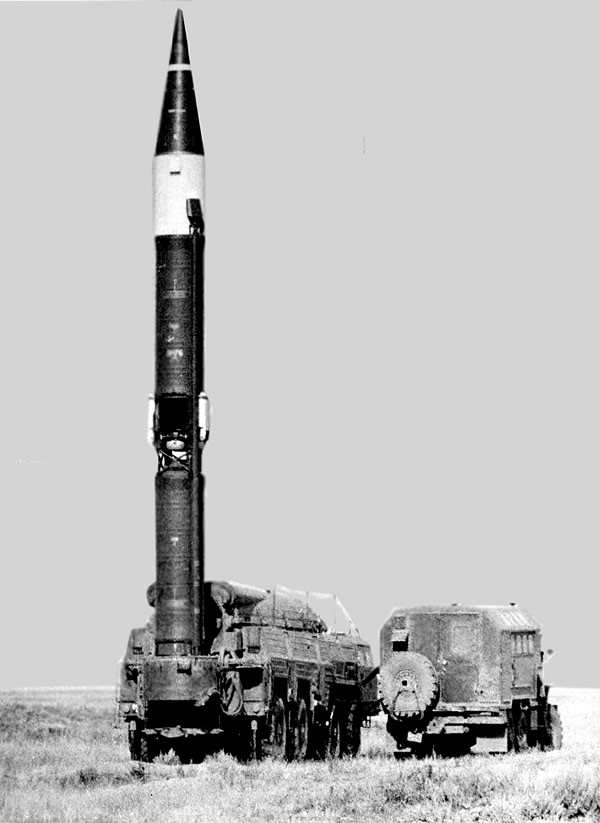
A TR-1 SRBM being prepared for launch
The TR-1 Temp is a mobile theatre ballistic missile developed and deployed by the Soviet Union during the Cold War. It was assigned the NATO reporting name SS-12 Scaleboard and carried the industrial designation 9M76. The missile system entered service in the mid-1960s.
The TR-1 was designed as a mobile weapon to give theatre commanders instant nuclear strike capability. The weapon used the same mobile launcher (the 8x8 MAZ-543 'Uragan') as the R-17 (SS-1 Scud-B) missile but the missile itself had an environmental protective cover that split down the middle and was only opened when the missile was ready to fire.
The missile itself is very much improved from the Scud. While the missile still uses liquid fuel and took as much as 90 minutes to fuel and prepare for launch, the missile itself is set in two stages instead of just one. A second booster activates around 30 seconds after launch. This greatly increased the altitude where the missile will reach before initiating its terminal phase, this extended the range of the missile to up to 1,000 kilometers.
The inertial navigation system uses three gyroscopes, making it much more accurate and with a smaller circular error probability (CEP) of as small as 300 meters compared to the earlier SS-1 Scud-B which can have a CEP of as much as 2,000 to 3,000 meters. Unlike the Scud missiles, the SS-12 was only ever designed to carry a single 500kt nuclear warhead. No other type of warhead were ever produced for the missile.
While the missile was advanced for its day, not many were ever produced. It is thought that the Soviets never had more than 300 SS-12 missiles during its entire service period. Unlike the widely distributed Scud-B missile, no SS-12 missiles were ever exported to foreign countries. Most SS-12 missiles were deployed to forward areas in East Germany and Czechoslovakia for instant nuclear retaliation in the event of a NATO attack. From here, the missiles can reach targets as far west as France and southern England.
Interestingly, during the 1980s Iran-Iraq war, the Iraqis, which were having trouble targeting Iranian cities with their short-ranged Scud missiles tried to purchase from the Soviet Union several examples of the SS-12 missiles with a view for local production; but the Soviets refused to sell them to the Iraqis due to fears that the Iraqis will mount chemical weapons onto them.
All SS-12 missiles were scrapped in the late 1980s due to the Strategic Arms Limitation Treaty (SALT) agreements.
 Quote
Quote







 0.0756sec
 0.61
0.61
 6 queries
 GZIP Disabled