Visionary push for another corridor
http://www.thestar.com.my/business/busines...other-corridor/.. is the MVV yet another grandiose idea that will struggle to take off?
Not necessarily so.
According to its advisers, they are already in serious talks with big-name organisations from across the globe. Among them are said to be the United States’ Mayo Clinic, a world-renowned medical and research facility, and Flex, formerly known as Flextronics International Ltd, a major electronics manufacturer.
MVV will become the sixth economic corridor in the country, but with one notable difference – it will be private sector-led. With groundwork expected to begin on the industrial park parcel in the first quarter of next year, Boston Design Group president Lawrence A. Chan presented the master plan to the MVV steering committee for approval on May 4.
An architect and urban planner by training, Boston-based Chan was brought in to conceptualise phase one. He was previously involved in the planning of the legislative precinct of Putrajaya some two decades ago.
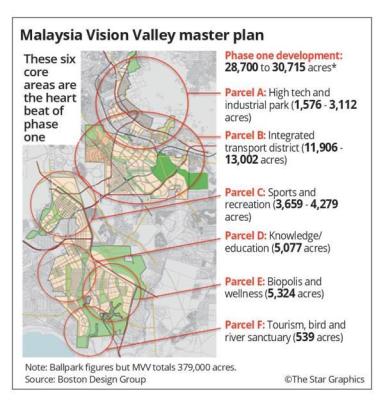
Seem that BSS located in Parcel B Integrated Transport District among 6 core areas of heart beat of phase one instead of Edu-Sports area stated earlier:hehe:
Chan says Boston Design Group was set up specially to make the first phase of MVV, about the size of Boston, a reality.
Phase one will have a total of six clusters, which will form the “heart beat” of MVV.
MVV will be an extension of Greater Kuala Lumpur and will have a population of two million.
Chan says there are various factors that will make MVV appealing to foreign investors.
It will be government-enabled but private sector-driven, which is unlike other economic corridors here.
Secondly, in order for it to be developed, the slate will not be wiped clean. That is, it will not begin with cutting down forests and slicing mountains.
“Instead, it will preserve and integrate the new with the old,” he says.
This factor will appeal to the global big names, whether they be in the industrial, healthcare, education or tourism sectors, he adds.
London’s attraction, he says, is a blend of the old and the new. The same approach was undertaken in other European cities.
“Harvard Square, where I used to have my office, took 350 years to be what it is today. Time and charm work together to bring about what we have there today,” notes Chan, who has also taught or served as a guest critic at institutions like the Harvard Graduate School of Design, Massachusetts Institute of Technnology and the Rhode Island School of Design.
Time and charm built these cities. It was this eclectic mix which gave them a place in time. As an urban planner, he will begin with what is at hand.
Already, much research and visits have been done at the kampung levels in terms of the people’s lifestyle, and on economic and environmental sustainability.
After having analysed the distribution of development aspiration of Negri Sembilan’s six “heart beat projects”, he recommends the six core areas to be sited in about 28,000 acres. These six nodes comprise high-tech industrial clusters, an integrated transport district, a knowledge-education parcel, a biopolis/wellness development, a sports and recreation parcel and a tourism-cum-nature development of more than 500 acres.
The high-speed rail (HSR) station at Labu will provide connectivity.
Expected to span 30 years, these six core areas will attract some RM290bil of investments and create 1.39 million new jobs.
This post has been edited by BSS30112015: May 13 2017, 01:39 PM 

 May 9 2017, 10:41 AM


 Quote
Quote





 0.0324sec
 0.35
0.35
 6 queries
 GZIP Disabled