Welcome Guest ( Log In | Register )

148 Pages « < 73 74 75 76 77 > » Bottom

Outline · [ Standard ] · Linear+

 Public Mutual Funds, version 0.0

views
     
frankzane
post Aug 15 2018, 01:34 PM

On my way
****
Junior Member
664 posts

Joined: Dec 2006


QUOTE(j.passing.by @ Aug 14 2018, 04:12 PM)
The returns in the main page tracked back all the previous transactions on the same fund, and totaled up all the values bought/switched-in and sold/switched-out. The returns is the difference between this total value and the current value.

The total value previously bought and sold is inclusive of any fees and service charges and taxes incurred.

(The same fund but under different account numbers, due to using multiple UTCs, will also be combined together.)

===========

I usually ignore the main page showing the value of the funds and only use it to counter check the total current value of the entire portfolio against my own Excel spreadsheet. My calculations treated the values differently.

PMO:
Total Bought: RM10,000
Total Sold: RM5000
Current value: RM5500
Total Returns of the fund = 10,000 - 5000 + 5500 = 500

My own calculations showing the current returns:
Total Units Bought: RM10,000 @ 0.2500 per unit = 40,000 units
Total Units Sold: 20,000 units
Remaining Units = 40,000 - 20,000 = 20,000
Current value: 0.2650 per unit
Total Returns of the fund = (0.2650 - 0.2500) x 20,000 = 300

Actually, the workings in the spreadsheet is a bit more complex than the simplified example shown above. The main page in my excel file would show the current active funds, their current returns and their CAGR (Compounded Annual Growth Rate).
*
Thank you very much! You explained it well.

So both calculations are correct, only that one referring to total returns (since the inception of the fund) whereas your calculation look at current returns. Am I right?

But there is no function in PMO to show all previous transactions, isnt there?

TSj.passing.by
post Aug 15 2018, 02:45 PM

Regular
******
Senior Member
1,639 posts

Joined: Nov 2010
QUOTE(frankzane @ Aug 15 2018, 01:34 PM)
Thank you very much! You explained it well.

So both calculations are correct, only that one referring to total returns (since the inception of the fund) whereas your calculation look at current returns. Am I right?

But there is no function in PMO to show all previous transactions, isnt there?
*
1) Yes, it is the total returns since the fund was started.

The difference is that when the fund is partially sold or switched out, in my excel calculations, I deduct not only the portion sold, but also any profit/loss associated with it.

Whereas PMO leaves the associated profit/loss in the fund.

I have to do that in my excel, otherwise I can't work out the annualised returns.

2) You can check back all the previous transactions... up to the past 3 years.

- Go to 'My Accounts'.
- Select the account you want to see, by clicking the account number on the left most column.
- It will show the Accounts page with several tabs... Account Details, Transactions, Distributions, Summary of Returns.
- Click the Transactions tab.
- Choose one of the transaction buttons on what to show... past month, 3 months, 1 year, etc.

This post has been edited by j.passing.by: Aug 15 2018, 02:58 PM
MakNok
post Aug 15 2018, 03:00 PM

Look at all my stars!!
*******
Senior Member
5,713 posts

Joined: Jan 2003
QUOTE(cyanlim @ Aug 2 2018, 10:15 AM)
Public mutual is not meant for short term investment, i yielded great profits in last year with investment in PRSEC and PFES about 8% to 8.5% ROI, but didn't sell out at that time , because i was just started to invest for 1 year.

Then this year because of the US-China Trade War now that both my funds are showing -ve in return meaning making a loss, but i will still continue invest because China's market won't be forever down and it will rise again is just the matter of time.

I would suggest to invest using EPF instead of cash, because of the sales charge % is different 3% EPF, and 5.5% for cash, therefore the breakeven point is lower if you invest using EPF. Unless you really have loads of cash till you don't know where else to invest.

My investment conditions:
1. Have sufficient cash flow in EPF or Cash.
2. Plan to invest long term 5 to 10 yrs or above.
3. Invest when price down, sell out when price high.
4. Try look into new fund which selling at lower NAV price per unit.
5. Overseas fund high risk but high return. 
6. Local fund can invest but need to wait and be patient.
*
No worth buying Mutual fund lo.
sales charge will kill you lo...
tell me...how long should i invest in mutual fund in order to be in profitable level?


EPF yearly dividend roughly average 5.5%.

Buying Mutual fund with sale charges at 3% mean that Mutual fund need to make extra fund dividend of 8.5% within the 1st year to breakeven.
if not, might as well let it hibernate inside your EPF account mah.

This post has been edited by MakNok: Aug 15 2018, 03:01 PM
TSj.passing.by
post Aug 15 2018, 03:30 PM

Regular
******
Senior Member
1,639 posts

Joined: Nov 2010
QUOTE(markedestiny @ Aug 7 2018, 02:22 PM)
yes, the only good thing for PM is now that we can rebalance the funds ourselves rather than depending on the agents
*
I started when internet was in still in its infancy. If the investor was living in a small town and has to travel far to a Public Bank or branch office, one way to get things done was leaving undated cheques and forms already filled in with a UTC/agent.

=========

BTW as mentioned in a previous post, gold members now have unlimited free switches when using PMO.

So far this year, in taking advantage of the new policy, I have changed the amount to switch to smaller amounts.

For example, if the plan was to make 1 or 2 switches per month previously, it can be changed to making a switch each week.

No need to think too much whether the timing is good or not to switch this week or next week. Just break the monthly switch to smaller amounts into weekly switches.

1) The minimal number of units acceptable in a switch is 1000.
2) After a fund is held more than 90 days, there is no lock-in penalty when switching out.
3) Gold members, unlimited free switches using PMO.


markedestiny
post Aug 15 2018, 03:42 PM

Enthusiast
*****
Junior Member
764 posts

Joined: May 2018
QUOTE(j.passing.by @ Aug 15 2018, 03:30 PM)
I started when internet was in still in its infancy. If the investor was living in a small town and has to travel far to a Public Bank or branch office, one way to get things done was leaving undated cheques and forms already filled in with a UTC/agent.

=========

BTW as mentioned in a previous post, gold members now have unlimited free switches when using PMO.

So far this year, in taking advantage of the new policy, I have changed the amount to switch to smaller amounts.

For example, if the plan was to make 1 or 2 switches per month previously, it can be changed to making a switch each week.

No need to think too much whether the timing is good or not to switch this week or next week. Just break the monthly switch to smaller amounts into weekly switches.

1) The minimal number of units acceptable in a switch is 1000.
2) After a fund is held more than 90 days, there is no lock-in penalty when switching out.
3) Gold members, unlimited free switches using PMO.
*
hmmm, what do u intend to achieve from making weekly switches into smaller amount?
TSj.passing.by
post Aug 15 2018, 03:53 PM

Regular
******
Senior Member
1,639 posts

Joined: Nov 2010
Is the Service Charge too excessive?

I think, a layman's opinion out of thin air, a fairer service charge would be 1.5% for equity funds. 0.5% or lesser for bond funds. And nil charges for money-market funds.

(Whether EPF or not, same charges.)

After all, this service charges are marketing cost and commission to the UTCs. Doing the marketing and transactions online has removed the involvement of any UTCs.

As for the operational cost of running the fund, there are the annual management fee and trustee fee.

If the industry cannot lower the service charge on their own, maybe it is time for the higher authority (is it BNM?) to initiate a review.


TSj.passing.by
post Aug 15 2018, 04:03 PM

Regular
******
Senior Member
1,639 posts

Joined: Nov 2010
QUOTE(markedestiny @ Aug 15 2018, 03:42 PM)
hmmm, what do u intend to achieve from making weekly switches into smaller amount?
*
No, it is making a monthly switch into smaller weekly switches. If making the weekly switches any smaller, it will be daily switches! smile.gif

What is achieved by making smaller switches? Maybe nothing at all. But if undecided to do the switch and time it this month or next month, or this week or next week.... the option is now open to 'not timing it' and do it this week/month and again next week/month, since the switching fee is removed out of the equation.

Note: In the long run, switching fees can slowly adds up...


markedestiny
post Aug 15 2018, 04:11 PM

Enthusiast
*****
Junior Member
764 posts

Joined: May 2018
I have made some switches to from equities either bond or money market funds for capital preservation due to market uncertainities
frankzane
post Aug 16 2018, 01:48 PM

On my way
****
Junior Member
664 posts

Joined: Dec 2006


QUOTE(j.passing.by @ Aug 15 2018, 02:45 PM)
1) Yes, it is the total returns since the fund was started.

The difference is that when the fund is partially sold or switched out, in my excel calculations, I deduct not only the portion sold, but also any profit/loss associated with it.

Whereas PMO leaves the associated profit/loss in the fund.

I have to do that in my excel, otherwise I can't work out the annualised returns.

2) You can check back all the previous transactions... up to the past 3 years.

- Go to 'My Accounts'.
- Select the account you want to see, by clicking the account number on the left most column.
- It will show the Accounts page with several tabs... Account Details, Transactions, Distributions, Summary of Returns.
- Click the Transactions tab.
- Choose one of the transaction buttons on what to show... past month, 3 months, 1 year, etc.
*
Thanks again.

I wondered how your excel looks like? hmm.gif
frankzane
post Aug 16 2018, 01:51 PM

On my way
****
Junior Member
664 posts

Joined: Dec 2006


QUOTE(j.passing.by @ Aug 15 2018, 03:53 PM)
Is the Service Charge too excessive?

I think, a layman's opinion out of thin air, a fairer service charge would be 1.5% for equity funds. 0.5% or lesser for bond funds. And nil charges for money-market funds.

(Whether EPF or not, same charges.)

After all, this service charges are marketing cost and commission to the UTCs. Doing the marketing and transactions online has removed the involvement of any UTCs.

As for the operational cost of running the fund, there are the annual management fee and trustee fee.

If the industry cannot lower the service charge on their own, maybe it is time for the higher authority (is it BNM?) to initiate a review.
*
I really think that PM should reduce their charges knowing that there are other UT platforms which charge much lower. I totally agree with your second point regarding online transactions which no longer incur any servicing cost!

Where can we post this suggestions ya? biggrin.gif
ehwee
post Aug 16 2018, 02:11 PM

Value Our Living Spaces!
*****
Junior Member
790 posts

Joined: Sep 2013
From: Selangor


I second to that, because of these high SC, I have redraw all my PM funds last year as my consultant seems dont care to advice and assist me on anything.

Not point pay SC to him

Waiting for PM to lower down it's SC rate from it's online platform then will consider enter PM again

This post has been edited by ehwee: Aug 16 2018, 02:13 PM
markedestiny
post Aug 16 2018, 04:15 PM

Enthusiast
*****
Junior Member
764 posts

Joined: May 2018
QUOTE(ehwee @ Aug 16 2018, 02:11 PM)
I second to that, because of these high SC, I have redraw all my PM funds last year as my consultant seems dont care to advice and assist me on anything.

Not point pay SC to him

Waiting for PM to lower down it's SC rate from it's online platform then will consider enter PM again
*
Similar with my agent, I have shown the comparison between the performance of my PM unit trusts portfolio with EPF's declared year-to-year dividends (compounded) and queried on the returns of my portfolio and there was no response when i tried to get the agent's opinion on how the portfolio could be rebalanced.

For me, I have not withdraw all yet but has rebalanced, switched funds my portfolio myself with the online platform. I also transferred out my PRS to another PRS provider where i dont have to pay for the sales fee for every time I deposit into the PRS.

If you do consider PM again in future, do a comparation with similar funds for performance even if the SC rate is reduced.
silverbolt143
post Aug 17 2018, 10:12 AM

Getting Started
**
Junior Member
283 posts

Joined: Aug 2005
From: KL - Subang - Damansara


Hi, im newbie here... just started withdrwing my EPF last March 2018 to invest in PB...also subscribe to PMO to monitor my fund and need some guidance....

My inception date as follows:
1) RM72,160 on 26/03/2018
2) add on RM53,939 on 16/08/2018

My question, is it normal to see my return in negative at this point of time? Overall is about -6.5% (minus 3% sales charges hence net -3.5% margin) upon inception..appreciate some advise....my current funds as per below:

user posted image


iamwilliamcwl
post Aug 17 2018, 11:41 AM

Getting Started
**
Junior Member
73 posts

Joined: May 2012
QUOTE(MakNok @ Aug 15 2018, 03:00 PM)
No worth buying Mutual fund lo.
sales charge will kill you lo...
tell me...how long should i invest in mutual fund in order to be in profitable level?
EPF yearly dividend roughly average 5.5%.

Buying Mutual fund with sale charges at 3% mean that Mutual fund need to make extra fund dividend of 8.5% within the 1st year to breakeven.
if not, might as well let it hibernate inside your EPF account mah.
*
I disagree, for short term yes it might not worth it but for long term you'll get more return than what you get keeping your money in the epf (if you are willing to take the risk la)

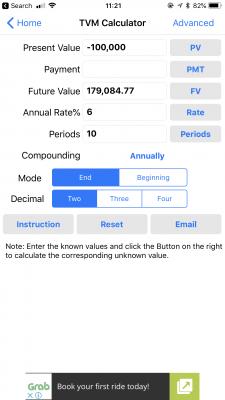
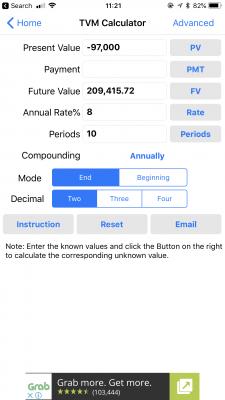
Let's assume you have 100k

epf give you average 6% return and unit trust give you average 8% return

if you have the 100k in epf for 10 years with 6% return, your future value would be 179,084.77

but if you have 100k minus 3% sales charge = 97k in unit trust for 10 years with 8% return, your future value would be 209,415.72

there is total 30,330.95 different,

in the end it's all about your time horizon and risk appetite

10 years (30,330.95 different)

Attached Image

Attached Image

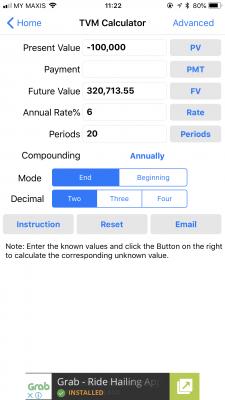
20 years (131,399.29 different)

Attached Image

Attached Image
MakNok
post Aug 17 2018, 11:52 AM

Look at all my stars!!
*******
Senior Member
5,713 posts

Joined: Jan 2003
QUOTE(iamwilliamcwl @ Aug 17 2018, 11:41 AM)
I disagree, for short term yes it might not worth it but for long term you'll get more return than what you get keeping your money in the epf (if you are willing to take the risk la)

Let's assume you have 100k

epf give you average 6% return and unit trust give you average 8% return

if you have the 100k in epf for 10 years with 6% return, your future value would be 179,084.77

but if you have 100k minus 3% sales charge = 97k in unit trust for 10 years with 8% return, your future value would be 209,415.72

there is total 30,330.95 different,

in the end it's all about your time horizon and risk appetite

10 years (30,330.95 different)

Attached Image

Attached Image

20 years (131,399.29 different)

Attached Image

Attached Image
*
tell me which fund give average return 8%...bullshit lah
which Public mutual fund...mine is high risk already lo...follow the market index...
i bought it both time when KLCI is at about 1720 point

Attached Image


today price

Attached Image

can analyse ?
sweat.gif

iamwilliamcwl
post Aug 17 2018, 12:01 PM

Getting Started
**
Junior Member
73 posts

Joined: May 2012
QUOTE(silverbolt143 @ Aug 17 2018, 10:12 AM)
Hi, im newbie here... just started withdrwing my EPF last March 2018 to invest in PB...also subscribe to PMO to monitor my fund and need some guidance....

My inception date as follows:
1) RM72,160 on 26/03/2018
2) add on RM53,939 on 16/08/2018

My question, is it normal to see my return in negative at this point of time? Overall is about -6.5% (minus 3% sales charges hence net -3.5% margin) upon inception..appreciate some advise....my current funds as per below:

user posted image
*
Yes it is normal, this 3 fund are investing in Malaysia (2 are local funds)
I believe one of the reason you are losing are because of the recent election & change of government, cause a lot of uncertainty made a lot foreign investor pull out from the market but worry not I believe our economic will be better with the new government rclxm9.gif
iamwilliamcwl
post Aug 17 2018, 12:04 PM

Getting Started
**
Junior Member
73 posts

Joined: May 2012
QUOTE(MakNok @ Aug 17 2018, 11:52 AM)
tell me which fund give average return 8%...bullshit lah
which Public mutual fund...mine is high risk already lo...follow the market index...
i bought it both time when KLCI is at about 1720 point

Attached Image
today price

Attached Image

can analyse ?
sweat.gif
*
how long have you invest?
MUM
post Aug 17 2018, 12:47 PM

10k Club
********
All Stars
14,885 posts

Joined: Mar 2015

QUOTE(iamwilliamcwl @ Aug 17 2018, 12:04 PM)
how long have you invest?
*
Mind sharing...which epf approved funds under pm can beat more than epf rate annually for the past 10 years or annualised 6.5% for the past 10 yrs?

MUM
post Aug 17 2018, 12:54 PM

10k Club
********
All Stars
14,885 posts

Joined: Mar 2015

QUOTE(silverbolt143 @ Aug 17 2018, 10:12 AM)
Hi, im newbie here... just started withdrwing my EPF last March 2018 to invest in PB...also subscribe to PMO to monitor my fund and need some guidance....

My inception date as follows:
1) RM72,160 on 26/03/2018
2) add on RM53,939 on 16/08/2018

My question, is it normal to see my return in negative at this point of time? Overall is about -6.5% (minus 3% sales charges hence net -3.5% margin) upon inception..appreciate some advise....my current funds as per below:

user posted image
*
Regarding your question......yes...it is normal during bad markets environment n also depends on the funds you selected.
Bear in mind that for every year the fund not making at least 6.5% pa....the fund would not beable to recover the accumulated opportunity cost lost of epf rate.
Btw...there are just a handful of epf approved funds that can beat the annualised epf rate consistently....thus select well
ehwee
post Aug 17 2018, 01:07 PM

Value Our Living Spaces!
*****
Junior Member
790 posts

Joined: Sep 2013
From: Selangor


So just wonder what are the example of PM funds that have a history profit records of 10 years with 8% return?

Anyone can share?

148 Pages « < 73 74 75 76 77 > » Top
 

Change to:
| Lo-Fi Version
0.0314sec    0.49    6 queries    GZIP Disabled
Time is now: 8th December 2025 - 03:21 PM