Welcome Guest ( Log In | Register )

Outline · [ Standard ] · Linear+

 Public Mutual Funds, version 0.0

views
     
markedestiny
post Aug 7 2018, 02:22 PM

Enthusiast
*****
Junior Member
764 posts

Joined: May 2018
QUOTE(j.passing.by @ Aug 6 2018, 02:42 PM)
Just a note on fund analysis and fund picking... the online service (Public Mutual Online) has been revamped beginning of this year.

The main homepage shows a pie chart breakdown on the type of funds, eg. money-market funds, equity funds, mixed asset funds, etc. And it has a section on resources... all the published articles and reports can be downloaded from here.

For Gold Members, there is an additional section on fund analysis... where its performance chart can select several funds for comparison.
*
yes, the only good thing for PM is now that we can rebalance the funds ourselves rather than depending on the agents
markedestiny
post Aug 7 2018, 02:30 PM

Enthusiast
*****
Junior Member
764 posts

Joined: May 2018
QUOTE(rinapua @ Aug 7 2018, 08:40 AM)
what fund is worth it to invest at this moment under public mutual?

I saw there is some cash deposit fund available now...is the income better if compare with normal saving and FD?

cash deposit fund, income fund and bond fund, is it the same?

how it works? thanks.  blush.gif
*
if you check back the previous comments from others, the return from PM is just doh.gif I kinda agreed after having leave most of the decision to buy and choice of funds to my agent. I have learned that you need to manage your own funds rather than depending on your agent.

If you use cash to invest, you get charge 5% fee up front, and if you used EPF, you get charge 3%. Even before you get the return, you already paid up 5% or 3% respectively.

If i have cash for investment, I would choose alternatives of investment, not PM dry.gif

markedestiny
post Aug 15 2018, 03:42 PM

Enthusiast
*****
Junior Member
764 posts

Joined: May 2018
QUOTE(j.passing.by @ Aug 15 2018, 03:30 PM)
I started when internet was in still in its infancy. If the investor was living in a small town and has to travel far to a Public Bank or branch office, one way to get things done was leaving undated cheques and forms already filled in with a UTC/agent.

=========

BTW as mentioned in a previous post, gold members now have unlimited free switches when using PMO.

So far this year, in taking advantage of the new policy, I have changed the amount to switch to smaller amounts.

For example, if the plan was to make 1 or 2 switches per month previously, it can be changed to making a switch each week.

No need to think too much whether the timing is good or not to switch this week or next week. Just break the monthly switch to smaller amounts into weekly switches.

1) The minimal number of units acceptable in a switch is 1000.
2) After a fund is held more than 90 days, there is no lock-in penalty when switching out.
3) Gold members, unlimited free switches using PMO.
*
hmmm, what do u intend to achieve from making weekly switches into smaller amount?
markedestiny
post Aug 15 2018, 04:11 PM

Enthusiast
*****
Junior Member
764 posts

Joined: May 2018
I have made some switches to from equities either bond or money market funds for capital preservation due to market uncertainities
markedestiny
post Aug 16 2018, 04:15 PM

Enthusiast
*****
Junior Member
764 posts

Joined: May 2018
QUOTE(ehwee @ Aug 16 2018, 02:11 PM)
I second to that, because of these high SC, I have redraw all my PM funds last year as my consultant seems dont care to advice and assist me on anything.

Not point pay SC to him

Waiting for PM to lower down it's SC rate from it's online platform then will consider enter PM again
*
Similar with my agent, I have shown the comparison between the performance of my PM unit trusts portfolio with EPF's declared year-to-year dividends (compounded) and queried on the returns of my portfolio and there was no response when i tried to get the agent's opinion on how the portfolio could be rebalanced.

For me, I have not withdraw all yet but has rebalanced, switched funds my portfolio myself with the online platform. I also transferred out my PRS to another PRS provider where i dont have to pay for the sales fee for every time I deposit into the PRS.

If you do consider PM again in future, do a comparation with similar funds for performance even if the SC rate is reduced.
markedestiny
post Aug 17 2018, 02:06 PM

Enthusiast
*****
Junior Member
764 posts

Joined: May 2018
QUOTE(silverbolt143 @ Aug 17 2018, 10:12 AM)
Hi, im newbie here... just started withdrwing my EPF last March 2018 to invest in PB...also subscribe to PMO to monitor my fund and need some guidance....

My inception date as follows:
1) RM72,160 on 26/03/2018
2) add on RM53,939 on 16/08/2018

My question, is it normal to see my return in negative at this point of time? Overall is about -6.5% (minus 3% sales charges hence net -3.5% margin) upon inception..appreciate some advise....my current funds as per below:

user posted image
*
In times where the market is volatile, it is best stay put with the monies on your epf. Now its too late as the funds have been invested and you just have to leave them alone. If you want, you can compare these against these amount of monies you have invested against EPF declared dividend next year to judge for yourself.

You can minimise your invested amount by 1)careful selection of funds coupled with 2)spreading the amount into smaller investment sums via DCA on quarterly basis perhaps rather than one big lump sum. By DCA, you could have average out the ups and downs of the market.

Two of your biggest funds happened to be high volatility in risk level i.e. Public Asia Ittikal and Public Asia Dividend, with foreign exposure of up to 98% shakehead.gif

On the other hand, Public Ittikal Sequel which has moderate volatility risk level with only up to 30% foreign exposure, which is more reasonable selection in times of market uncertanities is only less than RM20K. You could have increase the amount here rather than too much of the two funds above.


markedestiny
post Sep 19 2018, 08:13 PM

Enthusiast
*****
Junior Member
764 posts

Joined: May 2018
QUOTE(eligible @ Sep 19 2018, 04:29 PM)
One question, does PRS (Private Retirement Scheme) is a part of EPF investment?
*
No, it is not. For PRS, you have to pay cash. Check the PRS thread to find out better PRS funds.
markedestiny
post Oct 1 2018, 11:50 AM

Enthusiast
*****
Junior Member
764 posts

Joined: May 2018
QUOTE(MUM @ Sep 30 2018, 09:14 PM)
wow,....if 5 years ago, if only had selected PGSF, PCSF, some others, things would have been much better........

read post 1518, page 76 by J.passing.by....it did show interesting data on PM funds that had beaten EPF rate
*
He pointed these funds can perform if your timing is right. On retrospective, how many can of these new PM funds investors can time the market even experts can't
markedestiny
post Oct 1 2018, 11:53 AM

Enthusiast
*****
Junior Member
764 posts

Joined: May 2018
QUOTE(ChessRook @ Sep 30 2018, 10:26 PM)
I didn't realise you held that long. You need to compare every year to other similar funds (eg Psmallcap is doing better). If one's UT fund is consistently underperforming to its peers then one should consider switching after a period of say 3 years. I got this advice from watching one of those UT videos.

I won't repeat what MUM has written. There is a list of UT that is performing reasonably in the thread.
*
Within the pool of funds from PM, there is no peers to compare, unless you buy from other mutual funds platform which allows you to compare for the same sector or market segment... And if they could compare with better funds outside, they can see how poor most of the PM funds performance
markedestiny
post Oct 1 2018, 01:59 PM

Enthusiast
*****
Junior Member
764 posts

Joined: May 2018
QUOTE(MUM @ Oct 1 2018, 11:54 AM)
focused on only 1 fund that only focused on a sector of the economy of that individual country is a very high bets investing,,,,,diversify the port, monitor and make changes in tune with the individual needs and expectation that changes with the environment...

like maknok mentioned...."whoever recommend you that fund should be shot to death.."  biggrin.gif
*
biggrin.gif

I believe most of the PM investors trust their PM agents with their investment until too late ....

markedestiny
post Oct 8 2018, 01:34 PM

Enthusiast
*****
Junior Member
764 posts

Joined: May 2018
QUOTE(j.passing.by @ Oct 3 2018, 06:18 PM)
How to Beat EPF?

In the previous post, the 10-year annualized rate of EPF in the past 10 years from 2008 to 2017 was shown. It range from 4.50% to 6.90%, and a simple average of 6.02%.

While it was shown that some funds can have better returns than EPF, we should also note that EPF is the biggest mutual fund with 7-8 hundred billion in assets, and have huge revenue flowing in every month, was established more than 50 years ago, and have both in-house and external 3rd party investment teams running the show.

Needless to say, EPF can compete and outperform against many conservative mutual funds. To beat EPF, we will have to try a different field where EPF is not playing and not going head to head against it.

What fields to play? Aggressive small-cap funds, and non-local funds. And this is supported by the funds that beat EPF:

Public SmallCap Fund. 10-year total return: 136.96%
Public Islamic Opportunities Fund . 132.8%.
PB Asean Dividend Fund. 94.4%.

(If not mistaken, all the above 3 funds are oversubscribed and closed to fresh investments.)

Funds that were launched less than 10 years ago:
Public Far-East Alpha-30 Fund. 5-year total return: 101.5%
PB China Asean Equity Fund. 102.2%

When to play? EPF is in the market 24/7. To beat them, the ordinary investor has to stay in the game too.

Dropping in and out of the game (at random or following market noise or can’t handle the ‘paper loses’) means losing the game, unless of course the investor can perfectly time all his entries and exits.

So, what is the likeliest method to beat EPF? Long term buy-and-hold method. No short term timing – that is buys and sells frequently.

When to buy/invest? All the time. As and when you have spare money to invest.

What about those 10-year economic cycles? What about them?!!!

Buy all the time – whether the market is up or down – without timing… since your “long-term” is 20 to 30 years… even a 40 years buying cycle is possible if started at age 20.

What if you don’t have 10, 20 or 30 years to buy/invest continuously? Well, if you can’t beat them, you can join them.

Put the money into EPF. Or you can try your luck and put some into an equity fund too.

=========

If you are a short term player or planning to time the market, you may be interested to know that there are several funds with satisfactory YTD returns. Just to let you know what is possible... good luck!

PB Islamic Dynamic Allocation Fund
Public Islamic Global Equity Fund
Public Strategic Growth Fund

(Check their YTD returns since 29 Dec 2017.)
*
Have you check whether these funds which you have mentioned here are available for investment via EPF? Similar to your previous post where you have analyse and compare the performance of EPF vs some selected funds which you mentioned could beat EPF?

A quick check show otherwise...these funds are not available under EPF investment scheme. Perhaps you could just limit the analyse and comparisons to those available under the scheme instead.

This post has been edited by markedestiny: Oct 8 2018, 01:36 PM
markedestiny
post Oct 10 2018, 10:08 AM

Enthusiast
*****
Junior Member
764 posts

Joined: May 2018
QUOTE(j.passing.by @ Oct 10 2018, 06:44 AM)

===========
“What fields to play? Aggressive small-cap funds, and non-local funds. And this is supported by the funds that beat EPF:...”

The gist of the post was that mutual funds can give better returns than EPF. The funds mentioned were selected examples and nothing to do with funds within the EPF scheme.

As in a previous post, most of the funds approved in the EPF scheme were focus on the local stock market. It is only recently that more non-local funds were approved this year.

Anyway, any funds that were specifically mentioned are not recommendations. I am not qualified to make recommendations, just highlighting them as examples to lend support to the presentation.

It is more convenient for me to select and show their annualized returns as I received the monthly magazine from Public Mutual.

You may want to refer to Morningstar Malaysia where all the funds from every mutual fund companies are available for comparison.
*
Yes, I have made comparisons using Morningstar months ago and came to the following conclusions back then:

1) there are better mutual funds from other providers compared to PM's pool of available funds

2) highly rated funds from PM by Morningstar are usually or mostly, not available under PM's EPF approved funds

3) wrt to (2), for those PM funds not EPF approved, you can buy these with cash, but you would incurred high SC of 5% (or 5.5%?) for each cash deposit. Why bother when you can buy other better funds from other providers with low or no SC?

Since the comparison is made against beating EPF's compounded dividend (if you have not withdraw out), I agreed with EPF's report (google yourself), most of the investors did not get what they bargained for, when they invested out of their hard-earned EPF savings...
markedestiny
post Feb 26 2019, 10:14 AM

Enthusiast
*****
Junior Member
764 posts

Joined: May 2018
QUOTE(j.passing.by @ Feb 26 2019, 03:47 AM)
… continue from previous post on comparing Public Mutual funds returns against EPF.

Bond Funds
There are 17 bond funds… and 8 of them are with 10-years data.

1-year:  4.13% (Institutional Bond fund) to 6.47% (PB Aiman Sukuk fund)
3-year: 12.43% (Select Bond fund) to 18.17% (PB Aiman Sukuk fund)
5-year: 20.24% (Select Bond fund) to 27.27% (PB Aiman Sukuk fund)
10-year: 45.69% (Institutional Bond fund) to 82.18% (PB Islamic Bond fund)

PRS Funds
There are 6 core PRS funds and 3 non-core PRS funds. Only the core PRS funds were launched more than 5 years ago and with 5-years data.
1-year:  -10.93% (PRS Islamic Strategic Equity fund) to 2.34% (PRS Conservative fund)
3-year: -1.74% (PRS Growth fund) to 14.37% (PRS Strategic Equity fund)
5-year: -0.12% (PRS Growth fund) to 17.76% (PRS Conservative fund)

Summary: Needless to say, EPF outperformed both bond and PRS funds in the short and mid terms of 1, 3 and 5-years, and also in the longer 10-year.

========

Putting Everything Together.

The above were on Public Mutual funds. There are other funds from other fund houses. To check them and their returns, please refer to MorningStar Malaysia.

The point of using EPF as a benchmark to gauge UT funds’ performances is that EPF is among the biggest fund managers in the world with more than 800 billion ringgit in assets. Its investment is moderately conservative and all of us salary workers in the country are members of EPF.

In a retirement portfolio, EPF would play a central part and would occupy a major portion of the port. While EPF is not entirely risk free, it is pretty close to risk-free.

If risk-free is giving a return of about 6%, then investing and purchasing UT funds has to give a possible return several percentages above 6% to make it worthwhile to take on the added risk.

Another thing to take note is that there is a service charge in purchasing UT funds. If the service charge is 5.5%, to outperform EPF’s 10-year return of 82.22% (6.18% p.a.), the fund’s return has to be above 92.24% (6.75% p.a.)

========

EPF as part of retirement portfolio.

- Dividend is paid till age 100.
- Full withdrawal can be done any time after age 55.
- Contributions made after age 55 can be withdrawn at age 60.
- No limits on withdrawal in a month/year, on both the amount and frequency
- Nomination(s) can be easily and conveniently changed upon your request.
- Withdrawal transaction is quick and easy, transferred into your bank account within 3/4 working days.
- You can place a standing instruction to withdraw the yearly dividend automatically every year.
*
That's what most people have been saying, don't be itchy and withdraw your EPF for these funds especially PM. Their agents will always tell you it's a long term investment when you realised (most people dont realised or are financially savvy enough to pick up on these) that these funds don't give you any better returns than EPF. For those who have invested, you can do a scenario comparison for the monies you invested in these vs the same amount sitting in your EPF and you will be surprised.

Hopefully things will change in future when EPF planned to put in place an electronic platform for people to choose and select their own funds from various fund houses.
markedestiny
post Dec 8 2023, 04:04 PM

Enthusiast
*****
Junior Member
764 posts

Joined: May 2018
QUOTE(ronnie @ Dec 8 2023, 11:15 AM)
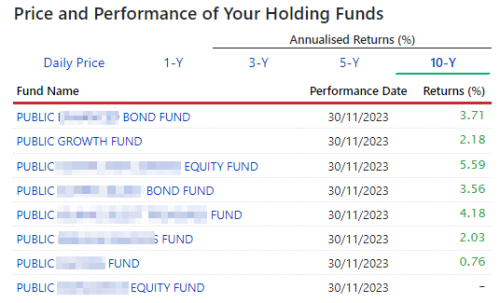
user posted image

Since the above Annualised numbers below EPF Dividend rate, should I just cash out and put in EPF
*
Compile the sums withdrawn throughout the years you took out from EPS to invest in PM against declared EPF divs and see...
markedestiny
post Dec 8 2023, 05:34 PM

Enthusiast
*****
Junior Member
764 posts

Joined: May 2018
QUOTE(ronnie @ Dec 8 2023, 04:45 PM)
i do not have the capital info as this UT was "inherited"

But in the last 7 years... it only had capital appreciation of 22% as of November 2023
*
Ok, can do a quick comparison, let's take the actual declared historical dividends from 2017 to 2022.

Let's say you withdrawn a sum of 10k at the end of 2016 to invest in PM. Running this sum compounded over 6 years from 2017 until 2022, you get a capital appreciation of 40.55%, Vs your 7 years 22%

EPF div data
2017 6.9%, 2018 6.15%, 2019 5.45%, 2020 5.2%, 2021 6.10%, and 2022 5.35%

This post has been edited by markedestiny: Dec 8 2023, 05:39 PM


Change to:
| Lo-Fi Version
0.1038sec    0.41    7 queries    GZIP Disabled
Time is now: 15th December 2025 - 02:58 AM