Welcome Guest ( Log In | Register )

Bump Topic Topic Closed RSS Feed
107 Pages « < 15 16 17 18 19 > » Bottom

Outline · [ Standard ] · Linear+

 [Home Appliances] Air-con, (Household)

views
     
MeToo
post Feb 13 2014, 03:06 PM

Look at all my stars!!
*******
Senior Member
9,333 posts

Joined: May 2009
QUOTE(PJusa @ Feb 13 2014, 12:51 PM)
i can confirm kimsim's statement. inverter will almost straight away produce savings of approx. 50% of electricity IF you dont underdimension the A/C (i.e. if the inverter doesnt run under full load), start/stop is not the main point btw.

» Click to show Spoiler - click again to hide... «
Do you mean if you do not use an aircon that is too small (HP wise) for the room size?

I'm using something like this.. wonder if its accurate for our Malaysia weather?

http://www.energystar.gov/?c=roomac.pr_properly_sized
SUSsupersound
post Feb 13 2014, 03:13 PM

10k Club
********
Senior Member
11,554 posts

Joined: Aug 2009
QUOTE(MeToo @ Feb 13 2014, 03:06 PM)
Do you mean if you do not use an aircon that is too small (HP wise) for the room size?

I'm using something like this.. wonder if its accurate for our Malaysia weather?

http://www.energystar.gov/?c=roomac.pr_properly_sized
*
Not that accurate, I always go for 0.5HP higher than what it stated.
Some always says with cabinet, bed or other things, it should reduce the surface area. It will be true if we stay in colder place.
But for a country that most of the time hot and high humidity, this won't work. Like my room, when ask the SA, they say 1HP already enough, but I insist of getting 1.5HP. End up now I only use it for 1-3 hours.
cherroy
post Feb 13 2014, 03:13 PM

20k VIP Club
Group Icon
Staff
25,802 posts

Joined: Jan 2003
From: Penang


QUOTE(PJusa @ Feb 13 2014, 02:41 PM)
even if you only use 1 hours, you can also break even. no reason not to buy. also the difference is not really 500 RM for 1 HB i believe. you would have to compare a certain model inverter/non-inverter price. not super cheap (high power wasting) a/c with a highly efficient branded inverter model wink.gif but even then you break even.
*
It is not about how many hours.

It all depended on electricity tariff.

If non-inverter running full load at 0.75Kw (1 HP), means with 1 hour usage it takes up 0.75KwH.

While if using alternatively with inverter, it saves 30% (a typical use( due to running at below full speed, means
0.525KwH

1Kwh depended on the tariff rate, if using the tariff rate at more than 500KwH (average residential power consumption with common air-conds use) one at 0.516

Means for every hour use, you save 0.155 cents.

So if inverter cost is Rm500 expensive than non-inverter, to recoup the cost.
Rm500/0.155 = 3225 hours of use.

if one day use 1 hour, it needs 3225 days of use to recoup the RM500 extra paid (set aside the noise/motor last longer issue), which means nearly need 9 years time, just for breakeven.
So if purely from money term consideration, inverter is not having any advantage.

If use 3 hours per day, means about 3 years
If use 8 hours per day means about 1 year.

So the math is quite simple, just work out accordingly.

One potential disadvantage of inverter, that based on my observation, compared to non-inverter is that there were cases (even in this forum) of PCB board that malfunction, which is need to control the variable running for DC motor of inverter, which non-inverter is not required this part. The board is not cheap, and warranty may only about 1 year. (I am not sure on this as each brand may different). So if spoil after warranty period, a potential costly part replacement may incurred, while non-inverter doesn't need to have this worry as we seldom hear of PCB board inside the blower unit spoilt, (may be not exposed to external rough environment, as well as it function quite basic as compared to inverter need to run at variable speed)

Also, as if the PCB board of inverter is placed with compressor DC motor, which means they are placed at outside, which exposed to external environment like heat, rain etc, which could potential reduce the life span of a PCB board.

This post has been edited by cherroy: Feb 13 2014, 03:14 PM

freestyler87
post Feb 13 2014, 03:19 PM

Casual
***
Junior Member
377 posts

Joined: Dec 2009
QUOTE(cherroy @ Feb 13 2014, 03:13 PM)
It is not about how many hours.

It all depended on electricity tariff.

If non-inverter running full load at 0.75Kw (1 HP), means with 1 hour usage it takes up 0.75KwH.

While if using alternatively with inverter, it saves 30% (a typical use( due to running at below full speed, means
0.525KwH

1Kwh depended on the tariff rate, if using the tariff rate at more than 500KwH (average residential power consumption with common air-conds use)  one at 0.516

Means for every hour use, you save 0.155 cents.

So if inverter cost is Rm500 expensive than non-inverter, to recoup the cost.
Rm500/0.155 = 3225 hours of use.

if one day use 1 hour, it needs 3225 days of use to recoup the RM500 extra paid (set aside the noise/motor last longer issue), which means nearly need 9 years time, just for breakeven.
So if purely from money term consideration, inverter is not having any advantage.

If use 3 hours per day, means about 3 years
If use 8 hours per day means about 1 year.

So the math is quite simple, just work out accordingly.

One potential disadvantage of inverter, that based on my observation, compared to non-inverter is that there were cases (even in this forum) of PCB board that malfunction, which is need to control the variable running for DC motor of inverter, which non-inverter is not required this part. The board is not cheap, and warranty may only about 1 year. (I am not sure on this as each brand may different). So if spoil after warranty period, a potential costly part replacement may incurred, while non-inverter doesn't need to have this worry as we seldom hear of PCB board inside the blower unit spoilt, (may be not exposed to external rough environment, as well as it function quite basic as compared to inverter need to run at variable speed)

Also, as if the PCB board of inverter is placed with compressor DC motor, which means they are placed at outside, which exposed to external environment like heat, rain etc, which could potential reduce the life span of a PCB board.
*
anyone have info about the PCB board, is that all brand York , Daikin , Mitsubishi and etc all PCB board located at the Compressor Unit (Outdoor Unit) ?

and this is another factor of im still considering to buy Inverter or not... T_T
cherroy
post Feb 13 2014, 03:21 PM

20k VIP Club
Group Icon
Staff
25,802 posts

Joined: Jan 2003
From: Penang


How much saving of inverter depended a lot of factor, there is no magical number, you use inverter, means you can automatically get 30% saving in electricity bill, 50%, or 10% whatever number.

Inverter just to replace the start-stop-start cycle of non-inverter, by using variable speed of its motor.

If one set the temp too low, like 18C, whereby inverter need to run full load most of the time aka full speed, the saving won't be much, or your room is not insulated good enough, plenty of heat loss factor around, aka inverter motor always need to run at higher speed to cool down the room, then the saving also won't be much.

That's why no manufacturers dare to use an accurate figure how much saving inverter can have compared to non-inverter, but just stated x% saving with typical use with *mark on it, as it depends on how the usage condition.
SUSsupersound
post Feb 13 2014, 03:24 PM

10k Club
********
Senior Member
11,554 posts

Joined: Aug 2009
QUOTE(freestyler87 @ Feb 13 2014, 03:19 PM)
anyone have info about the PCB board, is that all brand York , Daikin , Mitsubishi and etc all PCB board located at the Compressor Unit (Outdoor Unit) ?

and this is another factor of im still considering to buy Inverter or not... T_T
*
I always think it the simple way : more electronic parts, more cost of repair.
Cost of service also you need to think also. If your room are using more cotton cloth, the filter will blocked faster, which can shorten the duration of each service. Now I'm servicing my air cond once every 2 years but every 2 weeks I need to clean the filter.
SUSsupersound
post Feb 13 2014, 03:29 PM

10k Club
********
Senior Member
11,554 posts

Joined: Aug 2009
QUOTE(cherroy @ Feb 13 2014, 03:21 PM)
How much saving of inverter depended a lot of factor, there is no magical number, you use inverter, means you can automatically get 30% saving in electricity bill, 50%, or 10% whatever number.

Inverter just to replace the start-stop-start cycle of non-inverter, by using variable speed of its motor.

If one set the temp too low, like 18C, whereby inverter need to run full load most of the time aka full speed, the saving won't be much, or your room is not insulated good enough, plenty of heat loss factor around, aka inverter motor always need to run at higher speed to cool down the room, then the saving also won't be much.

That's why no manufacturers dare to use an accurate figure how much saving inverter can have compared to non-inverter, but just stated x% saving with typical use with *mark on it, as it depends on how the usage condition.
*
Maybe we should wait the inverter fanboy clarify on this.
Set at 18C won't do much help, only the piping will freeze.

SUSOptiplex330
post Feb 13 2014, 04:30 PM

10k Club
********
Senior Member
12,696 posts

Joined: Aug 2008
QUOTE(cherroy @ Feb 13 2014, 03:21 PM)
How much saving of inverter depended a lot of factor, there is no magical number, you use inverter, means you can automatically get 30% saving in electricity bill, 50%, or 10% whatever number.

Inverter just to replace the start-stop-start cycle of non-inverter, by using variable speed of its motor.

If one set the temp too low, like 18C, whereby inverter need to run full load most of the time aka full speed, the saving won't be much, or your room is not insulated good enough, plenty of heat loss factor around, aka inverter motor always need to run at higher speed to cool down the room, then the saving also won't be much.

That's why no manufacturers dare to use an accurate figure how much saving inverter can have compared to non-inverter, but just stated x% saving with typical use with *mark on it, as it depends on how the usage condition.
*
Yes, that's how inverter save money.

In fact, if inverter working at FULL LOAD all the time, it will use more electricity than non-inverter that is also working FULL LOAD because there is some power lost due to conversion from AC current to DC current. Inverter works on DC current.

Like you said, Inverter WILL ONLY SAVE money in situation whereby it has the opportunities to run PARTIAL LOAD.


SUSOptiplex330
post Feb 13 2014, 04:39 PM

10k Club
********
Senior Member
12,696 posts

Joined: Aug 2008
QUOTE(supersound @ Feb 13 2014, 03:29 PM)
Maybe we should wait the inverter fanboy clarify on this.
Set at 18C won't do much help, only the piping will freeze.
*
Assuming you have a adequately sized air cond in a room for the night. 8 hours running. 25C

FULL LOAD OR F
PARTIAL LOAD OR P

With non-inverter, during the entire night, a non-inverter will work like this: F-P-F-P-F-P-F-P-F-P-F-P-F-P-F-P-F-P-F-P-F
The continuous switching from F to P to F to P etc is similar to driving a car in city with plenty of Stop-Start-Stop-Start, using more fuel. The stopping and re-starting is that "thump" you hear in the night from the non-inverter air cond and which you will never hear from Inverter.


With Inverter, it will work this way: F-P-P-P-P-P-P-P-P-P-P-P-P-P-P-P-P-P.
After less than 1 hour, it is always running in Partial Load for the rest of the night. This is similar to a car that never have to fully stop, just run smoothly and continuously. This car DEFINITELY give far better mpg.


SUSkimsim
post Feb 13 2014, 05:16 PM

Let Me ❤️ You
*******
Senior Member
5,847 posts

Joined: Nov 2010
From: Malaysia 🇲🇾


QUOTE(supersound @ Feb 13 2014, 03:29 PM)
Maybe we should wait the inverter fanboy clarify on this.
Set at 18C won't do much help, only the piping will freeze.
*
18C of inverter set point...
Do you know how much from inverter working?

Inverter has offering from minimum BTU to Full load BTU and do to farcing inverter works with full load of BTU and higher power input watt.

But you're alright. From inverter can do in short duration to be reaching as faster to hit up your whole room envoplment and lower deg as your set point and after reached may works very slow as variable runs only.

Your temperature may keep remain the same until next morning wake up maybe will be feeze or full water marks of fogging at all.

If you wanna try and go a trip to Cameron highland and stay few night with rain season, I was guess you really enjoy the envoplment at all.

This post has been edited by kimsim: Feb 13 2014, 05:17 PM
SUSsupersound
post Feb 13 2014, 05:42 PM

10k Club
********
Senior Member
11,554 posts

Joined: Aug 2009
QUOTE(Optiplex330 @ Feb 13 2014, 04:39 PM)
Assuming you have a adequately sized air cond in a room for the night. 8 hours running. 25C

FULL LOAD OR F
PARTIAL LOAD OR P

With non-inverter, during the entire night, a non-inverter will work like this: F-P-F-P-F-P-F-P-F-P-F-P-F-P-F-P-F-P-F-P-F
The continuous switching from F to P to F to P etc is similar to driving a car in city with plenty of Stop-Start-Stop-Start, using more fuel. The stopping and re-starting is that "thump" you hear in the night from the non-inverter air cond and which you will never hear from Inverter.
With Inverter, it will work this way: F-P-P-P-P-P-P-P-P-P-P-P-P-P-P-P-P-P.
After less than 1 hour, it is always running in Partial Load for the rest of the night. This is similar to a car that never have to fully stop, just run smoothly and continuously. This car DEFINITELY give far better mpg.
*
But what is the interval of cut in cut out of the non inverter unit?
Set 26C more frequent, set 24 less frequent.
Again, if you know how the non air cond behaves, it will be more money saving than inverter type.
Also, non inverter don't have partial or full load story like you say, it only have full or off.
SUSOptiplex330
post Feb 13 2014, 05:45 PM

10k Club
********
Senior Member
12,696 posts

Joined: Aug 2008
QUOTE(supersound @ Feb 13 2014, 05:42 PM)
But what is the interval of cut in cut out of the non inverter unit?
Set 26C more frequent, set 24 less frequent.
Again, if you know how the non air cond behaves, it will be more money saving than inverter type.
Also, non inverter don't have partial or full load story like you say, it only have full or off.
*
Like I said, when BOTH running full load, non-Inverter uses less electricity.


QUOTE(Optiplex330 @ Feb 13 2014, 04:30 PM)
Yes, that's how inverter save money.

In fact, if inverter working at FULL LOAD all the time, it will use more electricity than non-inverter that is also working FULL LOAD because there is some power lost due to conversion from AC current to DC current. Inverter works on DC current.


Like you said, Inverter WILL ONLY SAVE money in situation whereby it has the opportunities to run PARTIAL LOAD.
*
This post has been edited by Optiplex330: Feb 13 2014, 05:53 PM
SUSkimsim
post Feb 13 2014, 06:24 PM

Let Me ❤️ You
*******
Senior Member
5,847 posts

Joined: Nov 2010
From: Malaysia 🇲🇾


QUOTE(Optiplex330 @ Feb 13 2014, 05:45 PM)
Like I said, when BOTH running full load, non-Inverter uses less electricity.
*
If both runing full load.

I would said inverter still more efficient than non-inverter.
Due to non inverter today still quite a numbers an runing R22 gas for working slower to cold down whole in place.

From inverter used R410a gas may high pressure to boots up more faster from 50% than R22 gas.

At the end still inverter unit for more power saving.

This post has been edited by kimsim: Feb 13 2014, 06:26 PM
SUSOptiplex330
post Feb 13 2014, 06:45 PM

10k Club
********
Senior Member
12,696 posts

Joined: Aug 2008
QUOTE(kimsim @ Feb 13 2014, 06:24 PM)
If both runing full load.

I would said inverter still more efficient than non-inverter.
Due to non inverter today still quite a numbers an runing R22 gas for working slower to cold down whole in place.

From inverter used R410a gas may high pressure to boots up more faster from 50% than R22 gas.

At the end still inverter unit for more power saving.
*
Inverter works on DC current.
So have to convert our Tenaga AC current to DC current before use. The lost due to conversion is between 5 to 10%


SUSkimsim
post Feb 13 2014, 06:53 PM

Let Me ❤️ You
*******
Senior Member
5,847 posts

Joined: Nov 2010
From: Malaysia 🇲🇾


QUOTE(Optiplex330 @ Feb 13 2014, 06:45 PM)
Inverter works on DC current.
So have to convert our Tenaga AC current to DC current before use. The lost due to conversion is between 5 to 10%
*
Lost a bit lah.

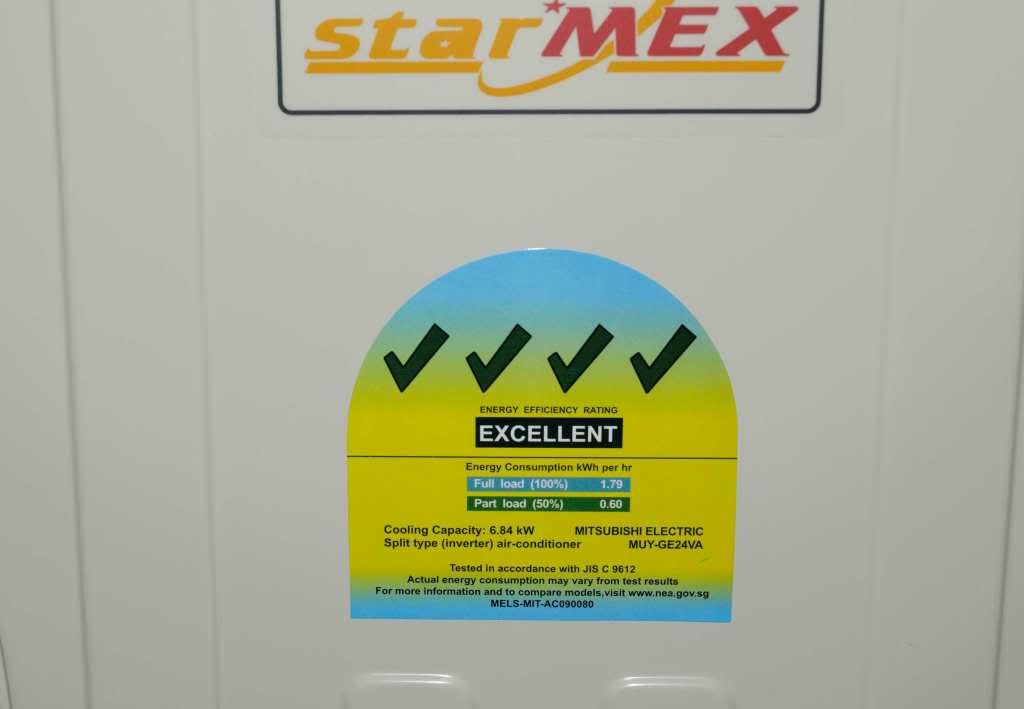
Share with part load of ME 2.5Hp inverter part load at 0.6kw only..better than get 1hp non inverter lol..

user posted image

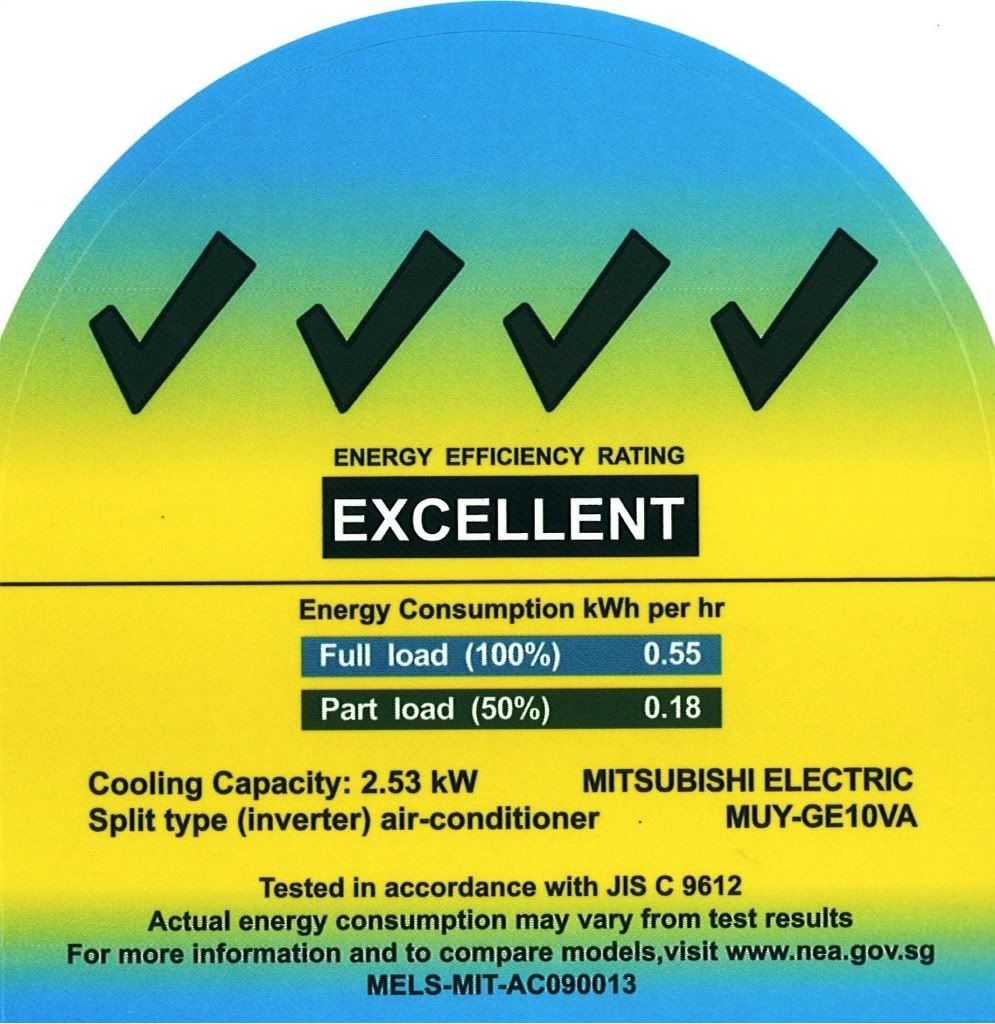
Also from 1hp inverter part load use at 0.18kw only
user posted image

But just notice latest ME inverter already change model to GJ, compare to Startmex vs Mr.Slim inverter really higher a bit on power input watt for 800w show in the specs.

This post has been edited by kimsim: Feb 13 2014, 06:59 PM
platinum_12
post Feb 13 2014, 10:03 PM

Enthusiast
*****
Senior Member
953 posts

Joined: Sep 2012
From: Selangor


QUOTE(Optiplex330 @ Feb 13 2014, 07:45 PM)
Inverter works on DC current.
So have to convert our Tenaga AC current to DC current before use. The lost due to conversion is between 5 to 10%
*
Ac compressors also slightly more efficient compared to dc compressors. So i would agree that at full speed, non inverters are more energy saving compared to inverters.

This post has been edited by platinum_12: Feb 13 2014, 10:05 PM
PJusa
post Feb 13 2014, 10:52 PM

Look at all my stars!!
*******
Senior Member
2,027 posts

Joined: Jan 2003
From: PJ
i dont know what's your issue. you dont believe facts that's fine. however i am not in charge of your electric bill and other appliances. it's an undisputable fact that an inverter will be more efficient if not horridly underdimensioned. as such you will safe money in the long run. underdimensioned of course also applies to ridiculous temp settings. i really dont understand what the agressive discussion is about.

i have personally replaced all a/c with inverters and with identical temp & mode settings (28° dry mode - translates to approx. 24-25° room temperature) on identical sets panasonic standard / panasonic inverter a/c i have reduced the power consumption for the entire house by pretty much exactly 50% under otherwise same conditions. this does not account for the not reduced usage on pc, tv, hood, lights, fridges etc. so it's safe to say that actual savings is more than 50%. multiply your savings by the tarif rate and there you go. inverter *always* pays for itself unless you cram a too small unit into a room so its working to hard which would make the user - frankly said - an idiot.

you may also wire me 1000 RM for the explanation. i'll let you know my account details. since we are talking physics there is no way around it anyway so case closed. of course you can make it not save money by overloading so i wont take your results as proof of the saving statement not beeing true wink.gif

This post has been edited by PJusa: Feb 13 2014, 11:00 PM
weikee
post Feb 13 2014, 11:08 PM

10k Club
********
All Stars
12,019 posts

Joined: Jan 2003
QUOTE(kimsim @ Feb 13 2014, 06:24 PM)
If both runing full load.

I would said inverter still more efficient than non-inverter.
Due to non inverter today still quite a numbers an runing R22 gas for working slower to cold down whole in place.

From inverter used R410a gas may high pressure to boots up more faster from 50% than R22 gas.

At the end still inverter unit for more power saving.
*
Cooling is measure in BTU if it can cool faster the BTU need to be higher. This is the standard measurement. What pressure the gas use does not matter.

I know from the specification of Panasonic, the 1HP inverter will cool faster because it have a mode called "Turbo" and this also increase the BTU, but that also increase the current.
freestyler87
post Feb 13 2014, 11:20 PM

Casual
***
Junior Member
377 posts

Joined: Dec 2009
QUOTE(PJusa @ Feb 13 2014, 10:52 PM)
i dont know what's your issue. you dont believe facts that's fine. however i am not in charge of your electric bill and other appliances. it's an undisputable fact that an inverter will be more efficient if not horridly underdimensioned. as such you will safe money in the long run. underdimensioned of course also applies to ridiculous temp settings. i really dont understand what the agressive discussion is about.

i have personally replaced all a/c with inverters and with identical temp & mode settings (28° dry mode - translates to approx. 24-25° room temperature) on identical sets panasonic standard / panasonic inverter a/c i have reduced the power consumption for the entire house by pretty much exactly 50% under otherwise same conditions. this does not account for the not reduced usage on pc, tv, hood, lights, fridges etc. so it's safe to say that actual savings is more than 50%. multiply your savings by the tarif rate and there you go. inverter *always* pays for itself unless you cram a too small unit into a room so its working to hard which would make the user - frankly said - an idiot.

you may also wire me 1000 RM for the explanation. i'll let you know my account details. since we are talking physics there is no way around it anyway so case closed. of course you can make it not save money by overloading so i wont take your results as proof of the saving statement not beeing true wink.gif
*
Thanks PJusa =)

last question of the day tomorrow i will go purchase my inverter lolz


my room is 12 feet x 12 feet x 11 feet ceiling height,
room facing north, 2 adults in the room... is that 1HP is good enough? i dont want asked shop they sure said 1.5hp better cause the can earn more...
im asking them for the calculation non of them can proof that...


platinum_12
post Feb 13 2014, 11:36 PM

Enthusiast
*****
Senior Member
953 posts

Joined: Sep 2012
From: Selangor


QUOTE(PJusa @ Feb 13 2014, 11:52 PM)
i dont know what's your issue. you dont believe facts that's fine. however i am not in charge of your electric bill and other appliances. it's an undisputable fact that an inverter will be more efficient if not horridly underdimensioned. as such you will safe money in the long run. underdimensioned of course also applies to ridiculous temp settings. i really dont understand what the agressive discussion is about.

i have personally replaced all a/c with inverters and with identical temp & mode settings (28° dry mode - translates to approx. 24-25° room temperature) on identical sets panasonic standard / panasonic inverter a/c i have reduced the power consumption for the entire house by pretty much exactly 50% under otherwise same conditions. this does not account for the not reduced usage on pc, tv, hood, lights, fridges etc. so it's safe to say that actual savings is more than 50%. multiply your savings by the tarif rate and there you go. inverter *always* pays for itself unless you cram a too small unit into a room so its working to hard which would make the user - frankly said - an idiot.

you may also wire me 1000 RM for the explanation. i'll let you know my account details. since we are talking physics there is no way around it anyway so case closed. of course you can make it not save money by overloading so i wont take your results as proof of the saving statement not beeing true wink.gif
*
It should be otherwise bro. Will i get any commission?


107 Pages « < 15 16 17 18 19 > » Top
Topic ClosedOptions
 

Change to:
| Lo-Fi Version
0.0305sec    0.64    6 queries    GZIP Disabled
Time is now: 1st December 2025 - 10:56 PM