QUOTE(mrjgx @ Mar 16 2013, 05:29 PM)
It takes a while to digest your points but I finally get it. To put it simpler here's the correct upgrade path for me. Get the normal red groupset first, then later on when I do the frame upgrade, get the one with the Quarq, sell off the old GXP crank. I agree with such recommendation, although I may lose a bit of money but that's the trade off as I am not going full blown for the complete ultimate bike.
At the moment I'm pretty much has narrowed down my power meter choices to Quarq. The power balance is to measure the effort for half of the pedal rotation, downstroke and upstroke, not for the left leg and right leg if I'm not wrong. Calibration can be done via iphone app too!
SRM is out of the question, too expensive and battery replacement is not DIY so I'll skip SRM any day. Polar look keo power meter is not ANT+, so I'll skip that either as I can't be using Garmin head unit (need to have polar's line up).
Powertap is a hub-based power meter, so changing wheelsets is not a practical way to use a hub based power meter.
Garmin vector is no where to be released, unknown dates and stuffs. The did acquire it from metrigear if i'm not mistaken, and there is from Stages (left crank arm power meter), which is pretty cheap.
All in all, Quarq seems the best option though and it is as reputable as SRM in the power meter industry. And I like to do a bit more of analyzing my training to a different level (I like to analyze things). It's time to compliment my HR training with a power meter.
At the moment I can't do much of the analysis post-ride be it outdoor or indoor as i'm using the sigma, but come to think of it, rather than getting a high end wheelsets, looks good on the bike but I still ride slow, I better off by getting a proper training tools for my engine. I'm going to spend my money on bike upgrades anyway, so better choose the path correctly. There are books to help in training and logging with powermeter, especially the one by Joe Friel (which I have and applied some of his HR training practices), but still I can't train with the suggested power trainings. Nearly getting dropped by an uncle who was once overweight seems to be the wake up call for me!

An investment on such tools I think will be very beneficial than a wheelset, i may not do racing but I do enjoy being fast on the road and see myself improves bit by bit. (whatever yank my chain as you may call it)
yup... GXP first would be the way to go... you don't want to end up with a headache of not being able to use a 30mm spindle down the road with your more expensive crank...
i don't see the pedal based system gaining reputation anytime soon for a couple of reasons... pedals are usually abused quite hard... used it to stand bikes on curbs, might scrape the ground a bit on hard cornering (crit pros lar), and worst of all... the part to most likely hit the deck first if you crash your bike... it might be good theoretically, but not in actual world applications...
regarding the powerbalance...it is a left right measurement function... the problem is, if you start lifting your right side on the left side downstroke... it affects the output measurements on the left side because the right lift will contribute to the downward motion of the left side and vice versa...
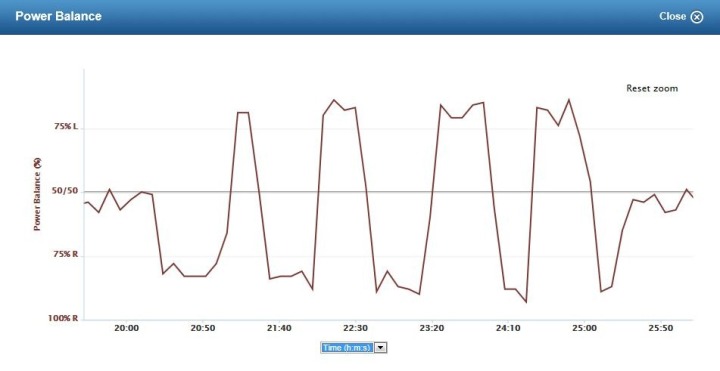
as for training with a power meter... i see that not even most pros will use the power meters day in day out... on days where they are just doing base miles... they just go along with normal computers...
some days, berty is fitted with an SRM


some days, not

they most likely use it to measure their full out efforts to see if they improve between a period of time in training or critical race days which is why they usually claim how much peak wattage they can hold for a period of time... GC guys are reportedly capable of holding up to 400watts and above for as long as 30 minutes and sprinters like cavendish reportedly puts out about 1300 watts on finishing line sprints...
something you might want to start getting used to before you dive into it...
http://home.trainingpeaks.com/racesalthough, it is not your training logs and you can't relate to it as you don't feel the efforts.. it might be a good chance to see if you can grapple with the amount of data that the power meters can throw at you...
usually the softwares can summarize for you peak power over a period of time in forms like this
Peak 5 minutes: 433w vs 462w
Peak 20 minutes: 388w vs 393w
Peak 4 hours: 259w vs 288w
which could help if you repeatedly do the same route or climb over a period of time to track your fitness improvement...
if i am not wrong, it should be also capable of giving you a training stress score called TSS that gives you some sort of like ranking for your workout that lets you look between power files even more easily without delving into the details..you can google it up to see what the TSS scores is all about as i part understand it is about how much stress you are puting your body into from the power files...
and as time goes by where your weight drops further and your power starts increasing... you start to see your power output for every kilo of your body starting to go up which is the standard normalized measurement for comparing power output between different riders..GC contenders are said to require at least upper end of 5w/KG to win the tour with Michele Ferrari claiming the magic number to be 6.7w/KG which is what armstrong targets to achieve in his peak periods before his arrival at tour starts ...
it's complicated as i say... you might want to head to 53x12.com or trainright.com to apply for their coaching after getting this...haha
p/s... some simple explanation i found on TSS, not sure if it is correctly explained
http://www.twowheelblogs.com/training-with...mple-definitionThis post has been edited by butthead: Mar 16 2013, 08:00 PM 

 Mar 15 2013, 03:24 PM


 Quote
Quote




 0.0485sec
 0.30
0.30
 6 queries
 GZIP Disabled