Welcome Guest ( Log In | Register )

Bump Topic Topic Closed RSS Feed

Outline · [ Standard ] · Linear+

 US stock discussion v4, Bulls-Bears HUAT AH!! Pigs get slaughter

views
     
TSsulifeisgreat
post Sep 9 2011, 11:46 PM, updated 15y ago

Regular
******
Senior Member
1,121 posts

Joined: Oct 2009
From: transiting asteroid


http://forum.lowyat.net/topic/1476526

EXCEEDED LIMIT OF 2500 POST, HINDSIGHT IS 20/20, DO MOVE FORWARD icon_rolleyes.gif
obama speeches r great! alwiz market goes down one laugh.gif
ok, guys & gals, the topic is now belong to u tongue.gif
all those who likes to ask FAQ questions such as brokers, commission & etc. pls refer to earlier version & those prior to it doh.gif
TSsulifeisgreat
post Sep 12 2011, 01:42 PM

Regular
******
Senior Member
1,121 posts

Joined: Oct 2009
From: transiting asteroid


1. determine what type of trader you are
http://www.tharptradertest.com/default.aspx?question=1

2. books for reading
http://forum.lowyat.net/index.php?showtopic=538473&hl=

3. seminars
http://forum.lowyat.net/index.php?showtopic=1670965&hl=

4. hedge fund
http://forum.lowyat.net/index.php?showtopic=1727398&hl=

5. index fund
http://forum.lowyat.net/index.php?showtopic=1266690&hl=

6. fair value
http://forum.lowyat.net/topic/1627421

7. warren buffet http://www.berkshirehathaway.com/
http://forum.lowyat.net/index.php?showtopic=1738276&hl=

I am curious, 99% lyn forumers worship warren buffet. But, then I ask did they follow sifu to invest in usa or berkshire itself. They run away and stick to bolehland. Bunch of hypocrites! When any of his lovers mention and idolizes him again or his books.

I just want to know. Have you all been able to put theory into practice and enjoy the moolah? Nothing to hide, they need to show their master is great and their own performance will speak for itself

I use technical analysis and my year 2011 klse performance +392% my target is +500%, miss by 108%. oh well, better than be IIVC
http://forum.lowyat.net/topic/1678458/+120 Post #137 last updated position +157%
http://forum.lowyat.net/topic/2039094/+1060?hl=bimb Post #1067 bimb +50%
http://forum.lowyat.net/topic/1764184/+1180 Post #1197 early yr2011 +185%

8. many moons ago debate on TA vs FA
http://forum.lowyat.net/index.php?showtopic=708693&hl=

9. portfolios of the giants
http://stockpickr.com/list/mostviewed/1/

10. I spent 1,XXX reading FA from Warren Buffet and my portfolio move as fast as a siput doh.gif after that, spent 1X,XXX to learn TA from my sifu William Wermine http://www.tradethetruth.com/ and my 1XX,XXX portfolio went bust laugh.gif I then sit back and contemplate what went wrong, reread up Bill books, notes, did trial and error subscribing to USA website and voila flex.gif The journey of a thousand miles began with a single step. Failure and tuition fees by the stock market itself is your best teacher http://pdfreebooks.org/0-tradeinstocks.htm Learning to detach my emotions and taking the time to understand and make the comparison between theory and practice from Jesse Livermore book did it for me icon_rolleyes.gif Remember to share the knowledge and do not charge anything brows.gif Pit your skills, live and real time against others, put it to the real world economic cycle test and rejoice as I crush my competitors cool2.gif
Kilgore in Apocalypse Now : I love the smell of napalm in the morning http://www.youtube.com/watch?v=sBksHaTQCbU You can do it too nod.gif

11. Steven Jobs was asked to give the 2005 commencement speech at Stanford.

In that address, delivered after Mr. Jobs was told he had cancer but before it was clear that it would ultimately claim his life, Mr. Jobs told his audience that “death is very likely the single best invention of life. It is life’s change agent.”

The benefit of death, he said, is you know not to waste life living someone else’s choices.

“Don’t let the noise of others’ opinions drown out your own inner voice. And most important, have the courage to follow your heart and intuition.”

http://finance.yahoo.com/news/With-Time-Ru...9&asset=&ccode=

12. Traders often pass through a series of 5 stages before becoming successful. In order, these are:

i. Unconscious Incompetence- Brand new traders enter at this stage, full of excitement and overconfidence that they will amass riches overnight. “How hard could it be? Price either goes up or down, right?” one may ask. The trader funds his account and starts quickly, taking lots of trades and unknowingly take on lots of risk. After a few initial successes, he is disappointed that price somehow turns on him every time he enters and he subsequently takes revenge by doubling up on new trades.

ii. Conscious Competence- After realizing how out of touch with the reality and danger of the market he was, the trader progresses to the next stage and sets out to educate himself by buying loads of systems, ebooks, and courses, searching for the “holy grail.” The trader seeks advice and entry signals from other traders in forums who brag about their earnings and wonders why it’s not him.

iii. The “Eureka” Moment- At this stage the trader finally realizes that it’s not necessarily the system that’s causing him to lose money, and that even a simple system that is based on how the market works and has a predictable edge can make money, so long as emotions are under control and the trader practices good money management. Once the trader realizes this, he/she can stop caring about what others are saying or trading and stick to one system. The trader executes trades with discipline every time an opportunity comes and doesn’t get disappointed by individual losses as it’s now a certainty that this type of trading will result in a profit over the long run. The light at the end of the tunnel is now visible.

iv. Conscious Competence- At the fourth stage the trader now makes trades whenever the system instructs him to, and the trader is fully accepting the risk involved. The trader furthermore cuts losses short and gets out with discipline when things get hairy in the market. Although it’s not quite second nature yet, he knows what it takes to be profitable and now manages to break-even.

v. Unconscious Competence- Finally the trader has achieved victory! He has become so used to trading that it’s become natural. The trader is now able to pick really big trades and hold on to big winners with confidence. Furthermore, he has mastered his emotions and is now profitable.

Source from internet
Attached Image

13. Jesse Livermore Gems

a) http://www.jesse-livermore.net/chapter1.php

Another lesson I learned early is that there is nothing new in Wall Street. There can't be because speculation is as old as the hills. Whatever happens in the stock market today has happened before and will happen again. I've never forgotten that. I suppose I really manage to remember when and how it happened. The fact that I remember that way is my way of capitalizing experience.

The fluctuations were from the first associated in my mind with upward or downward movements. Of course there is always a reason for fluctuations, but the tape does not concern itself with the why and wherefore. It doesn't go into explanations. I didn't ask the tape why when I was fourteen, and I don't ask it today, at forty. The reason for what a certain stock does today may not be known for two or three days, or weeks, or months. But what the dickens does that matter? Your business with the tape is now -- not tomorrow. The reason can wait. But you must act instantly or be left. Time and again I see this happen.

b) http://www.tischendorf.com/2009/06/29/over...ks-performance/

Resistance level

c) http://books.google.com.my/books?id=6eyy4P...epage&q&f=false

IIVC (Involuntary Investor Club Membership)

d) http://books.google.com.my/books?id=ldJiR5...epage&q&f=false

The market is operating in future time. It has usually factored in current events

e) http://books.google.com.my/books?id=fvt8DU...epage&q&f=false

The big money was not in the individual fluctuations but in the main movements that is, not in reading the tape but in sizing up the entire market and its trend...Old Turkey was dead right in doing and saying what he did. He had not only the courage of his convictions but the intelligent patience to sit tight.

f) http://www.tischendorf.com/2009/07/02/jess...-a-bull-market/

Got that? My sitting tight! It is no trick at all to be right on the market. You always find lots of early bulls in bull markets and early bears in bear markets. I’ve known many men who were right at exactly the right time, and began buying or selling stocks when prices were at the very
level which should show the greatest profit. And their experience invariably matched mine that is, they made no real money out of it. Men who can both be right and sit tight are uncommon. I found it one of the hardest things to learn. But it is only after a stock operator has firmly grasped this that he can make big money.

g) http://books.google.com.my/books?id=fvt8DU...epage&q&f=false

That is about all I had learned, to study general conditions, to take a position and stick to it. I can wait without a twinge of impatience. I can see a setback without being shaken, knowing that it is only temporary. I have been short one hundred thousand shares and I have seen a big rally coming. I have figured, and figured correctly, that such a rally as I felt was inevitable, and even wholesome, would make a difference of one million dollars in my paper profits.

And I nevertheless have stood pat and seen half my paper profit wiped out, without once considering the advisability of covering my shorts to put them out again on the rally, I knew that if I did, I might lose my position and with it the certainty of a big killing. It is the big swing that makes the big money for you. If I learned all this so slowly, it was because I learned by my mistakes, and some time always elapses between making a mistake and realizing it, and more time between realizing it and exactly determining it.

h) http://constellation1976.blogspot.com/2009...and-trends.html

Sucker

i) http://books.google.com.my/books?id=fvt8DU...epage&q&f=false

Syndicate

j) http://books.google.com.my/books?id=6eyy4P...epage&q&f=false

Not uncommon for stocks to suddenly spike up in a straight shot with heavy volume and then stop, roll at the top, exhausted

k) http://www.gold-eagle.com/gold_digest_03/h...on083003pv.html

Jesse Livermore timeless advise withstands the test of time

l) The Timeless Wisdom Of Jesse Livermore

Why is stock investing hard? Take a step back to think, and you realize that stock trading is the intersection of many realms of knowledge. Business. The economy. Finance. Innovation and technology. Government policy. The market. And don’t forget psychology. The more an investor knows about each of these fields, the more likely he or she will excel in the task of buying and selling stocks properly.

In the field of psychology alone, you have multiple topics to ponder. The psychology of the herd is important. So is the psychology of the self. Jesse Livermore, whose life spanned the 19th and 20th centuries, didn’t get a master’s degree in macro economics or a Ph.D. in cognitive behavior. But his experience, hard work, failures and successes across many bull and bear cycles make him one of the most respected stock and futures traders of all time.

Livermore grew up poor in Massachusetts. He found his calling after discovering he had a knack for numbers and for seeing price trends. Trading firms called “bucket shops” across the country kicked him out after he amassed profits despite stringent house rules in margin. He eventually became a powerful buyer and short-seller on Wall Street. Tragically, a self-inflicted bullet ended Livermore’s life on Nov. 28, 1940. But his book “How to Trade in tocks” remains a gem. As the following quotes from the first chapter “The Challenge of Speculation,” show, he defined genius in trading psychology.

Why not let Livermore’s wisdom help you?.“Profits take care of themselves, but losses never do. The speculator has to insure himself against considerable losses by taking the first small loss.” Your insurance policy: Sell a stock if it falls 8% from your purchase price. No questions, no exceptions. Nobody will care if you sold at a loss. The market surely won’t. “Successful speculation is anything but a mere guess. To be consistently successful, an investor or speculator must have rules to guide him.”

“Speculators in stock markets have lost money. But I believe it is a safe statement that the money lost by speculation alone is small compared with the gigantic sums lost by so-called investors who have let their investments ride. From my viewpoint, the investors are the big gamblers. They make a bet, stay with it, and if it goes wrong, they lose it all.”

Livermore offers a few examples. On April 28, 1902, New Haven & Hartford Railroad sold at $255 a share. On Jan. 2, 1940, it traded at $0.50. Chicago Northwestern went from $240 in January 1906 to “5/16, which is about $0.31 per share” on Jan. 2, 1940. Nearly 70 years later, some of America’s biggest banks took similar paths.

“A few thoughts should be kept uppermost in mind. One is: Never sell a stock, because it seems high priced. You may watch the stock go from 10 to 50 and decide it is selling at too high a level. That is the time to determine what is to prevent it from starting at 50 and going to 150 under favorable earning conditions and good corporate management.”

“One other point: It is foolhardy to make a second trade, if your first trade shows you a loss. Never average losses. Let that thought be written indelibly upon your mind.” “It may surprise many to know that in my method of trading, when I see by my records that an upward trend is in progress, I become a buyer as soon as a stock makes a new high on its movement, after having had a normal reaction. The same applies whenever I take the short side. Why? Because I am following the trend at the time. My records signal me to go ahead!” Jesse Livermore

14. “Don’t try to buy at the bottom and sell at the top. It can’t be done except by liars.” That said, Baruch said that through all of his time and research, he would develop a “feel” for when it was time to reduce positions. “I made my money by selling too soon.”

http://www.investmentpostcards.com/2008/06...bernard-baruch/

If a speculator is correct half of the time, he is hitting a good average. Even being right 3 or 4 times out of 10 should yield a person a fortune if he has the sense to cut his losses quickly on the ventures where he is wrong. Quotation of Bernard Baruch

http://www.icelebz.com/quotes/bernard_baruch/

15. Treasuries and Bonds ETF

http://forum.lowyat.net/topic/741185/+1060?hl=agz Post #1071

16. Nicolas Darvas was a renaissance man. Literate and athletic, he was good at a wide range of activities. He trained to be an economist at the University of Budapest. He earned a living at occupations as disparate as creating crossword puzzles and sports writing. He played championship pingpong. He toured Europe and the U.S. as one of the world’s highest paid ballroom dancers, book publisher Lyle Stuart noted in the preface of one of Darvas’ works.

Darvas’ most enduring feat was conquering Wall Street — in his spare time. Still dancing full-time, he parlayed a $3,000 bet on a speculative Canadian mining stock into a series of investments that culminated in a $2.25 million portfolio. That success earned him a profile in Time magazine. His 1960 book, “How I Made $2,000,000 in the Stock Market,” was a best-seller. It still pops up on reading lists for investors. Darvas’ book is notable for its skepticism about Wall Street’s conventional wisdom.

He wrote in a later book titled “Wall Street: The Other Las Vegas”: “Wall Street is nothing more than a huge gambling casino, bristling with dealers, croupiers and touts on one side and winners and suckers on the other. . . . I had been a winner and was determined to stay one.” He stayed one through his discovery of a strategy based on patterns formed by share prices. It was a strategythat involved no recommendations from analysts or brokers, no hot tips, no financial stories.

The crux of his strategy was price and volume data. Darvas (1920-77) developed what he called his box theory. As some stocks climb, their share prices stay within a range. Some break through the bottom of that range — or box — and are less likely to rally much soon. Others rise and set up a new, higher box. As soon as a stock climbed to start a higher box, Darvas liked to buy. Gradually he realized that institutional support from big money on Wall Street helped keep top-performing stocks from falling out of their boxes. What his strategy boiled down to was capitalizing on winning stocks’ price gains.

That approach would be familiar to investors who use and know the importance of charting stock patterns. Darvas arrived at his technique through a mix of circumstance and trial and error. Born in Hungary, he studied to be an economist at the University of Budapest. With the outbreak of World War II in 1939, he feared the Nazis and communists vying for control of his country. At age 23, with a forged visa and a little money, he fled to Turkey. Teaming with his half-sister Julia, they became one of the most popular professional dance duos in Europe
and, later, America. In 1951 he came to the U.S. He trained diligently for eight hours a day to hone his hoofer skills.

Darvas applied his dogged determination to learn about stocks. Soon he had read 200 books on investing. His first stock was offered to him in 1952 by two Toronto nightclub owners. The impresarios said they would pay him for a dancing engagement with 6,000 shares of Brilund, a Canadian mining firm. The stock then was worth 50 cents a share. Darvas didn’t take the Toronto gig. But to show goodwill, he bought their Brilund stock for $3,000. He forgot about it until months later.

He glanced at the stock’s price in the paper. “I shot upright in my chair,” he wrote in “How I Made.” “My50-cent Brilund stock was quoted at $1.90. I sold it at once and made a profit of close to $8,000.” He inspected charts. He noticed that as stocks moved up, they traded within a range. Leading stocks moved up again, trading in a higher range. He called each range the stock’s box. When a stock pulled back within a box, that was often a sign it would vault into a higher box. “Before a dancer leaps into the air he goes into a crouch to set himself for the spring,” Darvas wrote.

17. Singapore billionaire Peter Lim, dubbed the “Remisier King”
http://biz.thestar.com.my/news/story.asp?f...84&sec=business

Mr Lim is ranked Singapore's eighth richest man by Forbes Asia with a net worth of US$1.6 billion. Mr Lim, who made his fortune in the stock market. Lim became a stockbroker for mainly Indonesian clients. His successful returns earned him the nickname "Remisier King"
http://www.masteryourfinance.com/forum/php...2b2926b600d8b7f

Ironically, Mr Lim, who was one of Singapore's leading stockbrokers and is now a private investor, does not monitor the stock market every day

Another key reason for his success, he said, is patience.....does not subscribe to buying one day and selling the next to cash in.

His advice to young investors: 'You have to invest with a longer-term mindset. You buy a good stock, leave it there for 10 years. Come 10 years, this dollar can be many, many multiples. 'I think the trick is really to think long-term. 'You may not have a lot of money, but you have a lot of time.'

http://www.sgwayoflife.com/forum/viewtopic.php?p=5136

18. putting it all together http://www.williamoneil.com/
pricing http://books.google.com.my/books?id=SfQFy8...epage&q&f=false
background http://en.wikipedia.org/wiki/William_O%27Neil
great for traders http://www.investopedia.com/university/gre...p#axzz1c3T2cUep

QUOTE(Nasuada @ Sep 10 2011, 11:44 AM)
It will be meritorious to do some compilation as thread starter.

Nasuada.
Its US's jackpot if china really did FDI in US. Creating jobs and pumping some money into their horrendous economy. I wonder what's the law hindering the Chinese?

Nasuada.

*
This post has been edited by sulifeisgreat: Nov 11 2011, 01:23 PM
TSsulifeisgreat
post Sep 23 2011, 10:10 PM

Regular
******
Senior Member
1,121 posts

Joined: Oct 2009
From: transiting asteroid


Buy Long-Dated Treasuries? Goal is to fuel housing, other long-term buys, but policy fizzled in ’60s

A sharply divided Federal Reserve is expected to take modest steps Wednesday to bolster stagnant growth and hiring amid European debt woes.
The efforts likely won’t have a dramatic impact, analysts say. But inflation concerns may preclude stronger medicine, and in any case prior doses of shock and awe easing didn’t result in a self-sustaining, robust recovery.

The Fed will most likely sell or reinvest short-term bonds on its balance sheet and buy long-term debt to bring down interest rates for home loans and encourage other long-term investments, economists said. The tactic, dubbed Operation Twist, would give the central bank a way of trying to stimulate the economy without adding to its $2.8 trillion balance sheet. The Fed has expanded its balance sheet in two rounds of debt purchases, a process known as quantitative easing, which has kept rates low but also fueled inflation fears.

“It would be very difficult for them to contemplate a QE3 at this point,” said Keith Hembre, chief economist at First American Funds, “because the inflation backdrop is very different from when they instituted QE2,” a $600 billion bond-buying program, in November 2010. Fed chief Ben Bernanke has said that a third round of asset purchases would depend on further deterioration in the economic outlook and a renewed risk of deflation. But the economy, though weak, shows little sign of faltering and inflation has picked up.

An unusually large number of policymakers—three—dissented from the Fed’s pledge last month to keep rates near zero for two more years. They argued that Fed stimulus has done little more than boost commodity prices and could cause inflation to soar as the economyrecovers. The central bank’s task is complicated by its dual mandate to ensure maximum employment and price stability. With the jobless rate at 9.1%, some policymakers say the Fed must do more, especially because Congress seems dead set against further government stimulus.

“The Fed’s legally bound to do what they can to maximize employment consistent with price stability,” said Jerry Webman, chief economist at Oppenheimer-Funds. “They’ve got to do what’s required of them to encourage additional employment.” But many economists, including
some Fed policymakers, say that the central bank’s money printing has done little to increase jobs and wages. “Look at what all they’ve done
so far, and unemployment has been in a range of 8.8% to 10% over this period,” Hembre said.

Treasury rates already are near 60-year lows, while housing activity remains weak. Housing starts fell 5%in August, the Commerce Department said Tuesday. Twist’s Checkered Past. As for Operation Twist, tried during a recession in the early 1960s, “the general opinion was that it wasn’t effective,” said Richard DeKaser, an economist at the Parthenon Group. Webman added that Fed policies don’t necessarily encourage
people to take risks by hiring people. “This is not a monetary policy problem right now,” he said.

Nevertheless, with Congress opposed to more spending, economists say pressure is on the Fed to do something after the economy slowed to a crawl in the first half of the year and Europe’s debt crisis deepened. “Developments in Europe are going to weigh heavily on their deliberations,” DeKaser said. “Arguably that’s the biggest uncertainty hanging over the global economy at this time, and it’s clear that monetary policy will be mindful of those developments.” He added, “There’s tremendous diversity of views at the Fed, which makes coalescing around a single policy difficult.”


QUOTE(epalbee3 @ Sep 23 2011, 09:00 PM)
then y US does not want to do UE3 but extends the bond duration and lower the interest?
*
TSsulifeisgreat
post Sep 24 2011, 10:51 AM

Regular
******
Senior Member
1,121 posts

Joined: Oct 2009
From: transiting asteroid


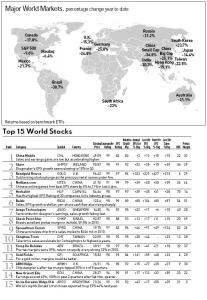
Big-Growth Markets Suffering Most In Rout

Emerging markets have long been the source of plenty of high growth stocks. As it turns out, the very same markets also can lead the world ont he way down. Asian stock indexes fell again Friday, although on the whole the pace of losses is easing.

Hong Kong’s Hang Seng index fell 1.4% and closed in the upper third of its range. Volume climbed compared to Thursday’s pace, which saw a gap-down 4.8% loss. The Singapore Straits Times index put in a similar performance.
It fell 2.5% Thursday, then gapped down Friday and ost 0.8%. But that index closed near the day’s high after paring a loss as bad as 2.3%. Australia’s All Ordinaries index, which fell 2.6%Thursday, lost 1.6% Friday.

But some of Asia’s major markets got no reprieve Friday. The Korean Composite Stock Price index dived 5.7% Friday, leaving a nasty gap in its wake and ending at the day’s worst price. Thursday’s loss came to 2.9%.
The Taiwan Stock Exchange Weighted index fell 3.1% Thursday and 3.5% Friday. The index’s chart shows two downside gaps in the past two days.

Paris and Frankfurt’s benchmark indexes managed small gains Friday after Thursday’s losses of 5.3% and 5%, respectively. Brazil’s Bovespa dived 4.8% Thursday, but on Friday managed to post a minuscule advance. Should investors be heartened by Friday’s mostly slower pace of losses? That would be a real stretch.

Every major bourse is in deep correction mode. Year-to-date losses are steeper abroad than in the U.S. The worst among the major markets this year are found in Paris and Frankfurt, the heart of the euro zone crisis. Those stock gauges have dived 26.1% and 25.3%, respectively, through Friday’s close.

The next-worst appear in Hong Kong (off 23.3%) and Mumbai (off 21.2%). Oddly, the Shanghai composite, a mostly locals-only market, has ceded just 13.4%. That is among the mildest losses seen among major foreign markets so far this year. TheShanghai’s decline is on a par with those seen in Singapore (off 15.4%), Tokyo (off 16.3%) and Sydney (off 16.6%).

So far, the U.S. indexes have logged losses that, compared to foreign results, are quite mild. With Friday’s close, the Nasdaq stands 6.4% below its New Year’s Eve close, while the S&P 500 has lost 9.6%. Bear in mind that these are stock indexes. Year-to-date losses among benchmark exchange traded funds are more severe. Some are staggering.

By that gauge, the worst is the Guggenheim China Small Cap HAO, which has crashed 36.8%. Well, Chinese small caps have had their own special problems this year. But China’s big-cap index has lost 25.1% this year. Korea is off 23.7%. And look at the major-market ETFs that have lost more than 30%: Brazil, Russia and India. Along with China, these are the core of the emerging-markets boom.

Attached Image
TSsulifeisgreat
post Sep 26 2011, 03:03 PM

Regular
******
Senior Member
1,121 posts

Joined: Oct 2009
From: transiting asteroid


y u invest in commodities? did u hav an exit plan before entering? hmm.gif
whoever told u invest in commodites, pls ask them wat to do now? nod.gif

QUOTE(zamans98 @ Sep 26 2011, 12:04 PM)
my GOLD and SILVER tanked heavily.

No mood to login and check.

AGQ alone is down by 115$ per share since i bought.
*
TSsulifeisgreat
post Sep 26 2011, 10:40 PM

Regular
******
Senior Member
1,121 posts

Joined: Oct 2009
From: transiting asteroid


ok, checked with jim rogers wink.gif

"5% correction in gold is meaningless. These things correct 10-15-20-30% every year. Nothing unusual about that. That is the way the markets work. "I have not sold any commodity. I own all my commodities. We are in a flexible bull market. We are far-far-far from a bubble so far."
http://www.businessinsider.com/jim-rogers-...olidates-2011-5

but zamans98, u did buy same time the jim rogers and around the same price hmm.gif if yes, then should have cushion to ride on

Dollar's Days Numbered; Buy Commodities: Jim Rogers | 14 Nov 2008 | 09:52 AM ET.The greenback faces serious devaluation as spiraling national debt and a worsening economic crisis undermine it, he said. He also speculated that a commodities bull run could last until 2020.
http://www.cnbc.com/id/27717135/Dollar_s_D...ties_Jim_Rogers

QUOTE(zamans98 @ Sep 26 2011, 03:14 PM)
everywhere everybody. EURO is sick. That's the core.
*
QUOTE(prophetjul @ Sep 26 2011, 03:23 PM)
Inflation..........ask Jim Rogers...........  biggrin.gif
*
TSsulifeisgreat
post Sep 26 2011, 10:56 PM

Regular
******
Senior Member
1,121 posts

Joined: Oct 2009
From: transiting asteroid


hehe.. we need to ask our in-house commodities sifu, prophetjul hmm.gif is he selling in yr 2020 too?

QUOTE(Myoswee @ Sep 26 2011, 10:54 PM)
That guy loaded with commodities

Bet he wouldn't say something bad on it i guess  laugh.gif
*
Equity market still in a tight range, all waiting for earnings season and co outlook whistling.gif

This post has been edited by sulifeisgreat: Sep 26 2011, 10:58 PM
TSsulifeisgreat
post Oct 1 2011, 02:02 AM

Regular
******
Senior Member
1,121 posts

Joined: Oct 2009
From: transiting asteroid


after so many years & still only a few shares selection in lyn usa forum? tat is y, I oso given up, updating in tis thread doh.gif
with the experience gathered, u guys/ gals should be doing fine, buying when up & shorting when it goes down
power it with options & voila, u got many zeros in ur bank ac, so y this thread so quiet rclxub.gif

let me help to btt tongue.gif
look for those shares which maintain their power during tis bear time, when bull cum, they got chance to roket wink.gif
here mostly FA specialist? u guys know how to read chart/ TA after so long? then can take a look below, some is goodie drool.gif

but knowing u all, here not so adventurous & not dare to play out of the box blink.gif
during bull time, all so hapi, never prepare umbrella for rainy days nor use puts, even when know how to use options hmm.gif
now bear time, hide in bunker? mus hav balls to face the market, follow the forumers in lyn bolehland, mus show, can do or die attitude flex.gif

Even Leaders Back Off; Some Nicely, Some Not

Consider the vast array of sectors represented in Your Weekly Review: software, hardware, medical, retailandfinance. They all have one thing in common: They all have backed off from their highs. The difference, of course, lies in how they retreated. Some showed heavy volume as they sliced
through key supports. Others are holding up well in what is, after all, a market correction.

Athenahealth ATHN, a maker of software targeting back-office operations at physicians’ practices, has dropped 15%from its Sept. 19 high.
The stock’s 10-week moving average has so far provided support, but last week’s 7% decline drew uncomfortably high volume. Cerner CERN, a rival of Athena health’s, is threatening to log a downside reversal this week. As it is, Cerner has seen an 8%gain whittled down to 1%. On the other hand, Cerner stands just 5% off its 52-week high.

Credit card giants MasterCard MA and Visa V also are testing their 10-week lines. Such tests, if they occur in soft trade, can be attractive buy points in a healthy market — but not in a correction. Discount retailer Dollar General DG is consolidating tightly, just 4% off its high. PriceSmart PSMT, the Caribbean and Central America’s largest warehouse-style retailer, reversed lower last week. Its retreat continues this week with a test of the 10-week line in slightly above-average volume. PriceSmart stands 17% below its 52-week high.

But Family Dollar Stores FDO, another discounter, is breaching its 50-and 200-day lines in fast trade. Sportswear maker Under Armour’s UA test of its 10-week line appears as part of a sloppy basing try. Many leaders — and even more ex leaders— are diving below their key supports. Among these you’ll find Green Mountain Coffee Roasters GMCR, which is falling after a failed breakout from a late-stage base. Aerospace issue TransDigm
Group’s TDG losses threaten to unravel its recent basing attempt.
TSsulifeisgreat
post Oct 1 2011, 08:47 AM

Regular
******
Senior Member
1,121 posts

Joined: Oct 2009
From: transiting asteroid


anyone willing to post daily & weekly charts of dog jones & s&p for the forumers overall viewing brows.gif

The Big Picture. Stocks Slammed, But Volume Is Mixed

Stock indexes stumbled Friday, closing out September with their fifth straight monthly loss.

The Nasdaq and NYSE composite each dropped 2.6%, while the S&P 500 sliced off 2.5%.

Volume was up on the NYSE and down on the Nasdaq as volatile trading continued.

Among leading stocks, virtually none rose in heavy volume, while the losers list was short, thanks at least in part to fewer stocks still considered leaders.

Friday's losses were broad. Declining issues led advancers by a roughly 7-to-2 ratio on both major exchanges. New lows led new highs on the Nasdaq by 169 to 3.

Meanwhile, the Economic Cycle Research Institute added to the gloom. The institute said the U.S. economy is tipping into a recession and "there's nothing that policymakers can do to head it off."

The last recession began in December 2007 and ended in June 2009, according to the National Bureau of Economic Research. ECRI noted in January 2008 that a downturn had begun and could turn into a recession. ECRI made its recession call in March 2008.

While such news had to discourage the bulls, predictions aren't necessarily useful to investors, even if they prove correct.

Here's why: Even in a recession, there are tradable rallies. That's why investors should stay focused on the price and volume action of the main indexes themselves.

The market will tell you when to get in and out of the market.

For example, the market flashed a follow-through day on March 20, 2008, which led to a 13% gain in the Nasdaq over two months.

During that period, breakouts and gains among top-rated stocks included natural gas play Southwestern Energy (SWN), up 39% in less than two months; oil and gas explorer Petrohawk Energy, up 183% in less than three months; oil-equipment stock Weatherford International (WFT), up 37% in three months; oil-equipment company Chart Industries (GTLS), up 58% in four months; and railroad operator CSX (CSX), up 32% in two months.

You don't want to miss those kinds of gains among top stocks.

So, if the market delivers a follow-through, it's not wise to sit on the sidelines simply because you are convinced a recession is under way.

The market follows the rules of the market, not the rules of economists, politicians or anybody else with an opinion.

For the week, the market was mixed. The Dow rose 1.3%, and the NYSE composite added 0.3%. But the Nasdaq dropped 2.7%, while the S&P 500 eased 0.4%. All closed near the week's lows.

Losses were sharp in other areas. The iPath Dow Jones UBS Copper ETN (JJC), an exchange traded fund that reflects the price of copper, slid 6% for the week. The Philadelphia semiconductor index shed 5.9%. And SPDR Gold Trust (GLD), an ETF that reflects the price of bullion, fell 1.1% — its fourth straight weekly loss after marking a high.


TSsulifeisgreat
post Oct 2 2011, 02:22 PM

Regular
******
Senior Member
1,121 posts

Joined: Oct 2009
From: transiting asteroid


btt time lyn usa forum guys/ gals cool2.gif wat makes the index moves? its component la! doh.gif
we look at dog jones components for roket riding, some of its chart shows gonna do swing trade, some shows wanna roket out brows.gif
My shopping cart icon_rolleyes.gif

swing trade
AA $9.5, BA $60.51, CAT $73.84, CVX $92.59, DD $39.97, DIS $30.16, JPM $30.12, MMM $71.79, PFE $17.68, TRV $48.73, UTX $70.36, XOM $72.63

buy high, sell higher provided it breakout icon_idea.gif
IBM wait $185
KO wait $75
MCD wait $90
VZ wait $40

» Click to show Spoiler - click again to hide... «
TSsulifeisgreat
post Oct 23 2011, 06:14 PM

Regular
******
Senior Member
1,121 posts

Joined: Oct 2009
From: transiting asteroid


One either earns the peanut or earns the monkey itself cool2.gif if cannot understand below excerpts, then nvm la laugh.gif
Buy low, sell high is a great theory. The trick is to know how to apply from threory into practice flex.gif

The big money was not in the individual fluctuations but in the main movements that is, not in reading the tape but in sizing up the entire market and its trend...Old Turkey was dead right in doing and saying what he did. He had not only the courage of his convictions but the intelligent patience to sit tight.
http://books.google.com.my/books?id=fvt8DU...epage&q&f=false

Got that? My sitting tight! It is no trick at all to be right on the market. You always find lots of early bulls in bull markets and early bears in bear markets. I’ve known many men who were right at exactly the right time, and began buying or selling stocks when prices were at the very
level which should show the greatest profit. And their experience invariably matched mine that is, they made no real money out of it. Men who can both be right and sit tight are uncommon. I found it one of the hardest things to learn. But it is only after a stock operator has firmly grasped this that he can make big money.
http://www.tischendorf.com/2009/07/02/jess...-a-bull-market/

» Click to show Spoiler - click again to hide... «
TSsulifeisgreat
post Oct 28 2011, 10:17 AM

Regular
******
Senior Member
1,121 posts

Joined: Oct 2009
From: transiting asteroid


AIYO!! doh.gif told u all liao mah, FUG THE BEAR until it moans to be a bull, but some stil takut & wan to hold cash shakehead.gif Requote "look at the bull bear ratio, 41% investment advisors is bearish, hav to goreng them kao kao, as they bring followers to holland" http://forum.lowyat.net/topic/1678458/+120 Post #140

if any major bears learnt a lesson from tis, then its goodie, no point fighting the trend, its best to just follow trend laugh.gif the time to short, is when the bull bear ratio terbalik. now await, those investment advisors to be bullish & they lead their followers to the slaughter house one more time ie. buy high & hold the bag
(IIVC members experience it a few mths ago, no need to explain in words, just check bank ac) tongue.gif

of coz there will be minor fluctuation here & there, there may be some minor pullback brows.gif but overall, chart showing up. take away your emotions, no need read the news, just look at the charts and volume. all you see is support & resistance rclxm9.gif

» Click to show Spoiler - click again to hide... «
TSsulifeisgreat
post Oct 28 2011, 12:10 PM

Regular
******
Senior Member
1,121 posts

Joined: Oct 2009
From: transiting asteroid


thumbup.gif it was great! the bear moan & moan since 1300, "I wanna be a bull", we went high together to 1480 wub.gif
indeed it was a great FUG. It was unprotected fugging all the way and took a medium risk playing call options
no balls to play high risk ie. futures laugh.gif

I m looking to gamble on some shorts/ puts option, taking a look over the weekend, due to the sudden dog jones spike
"not uncommon for stocks to suddenly spike up in a straight shot with heavy volume and then stop, roll at the top, exhausted..." only for traders and those using TA cool2.gif
http://books.google.com.my/books?id=6eyy4P...epage&q&f=false

QUOTE(simonc @ Oct 28 2011, 10:50 AM)
Been fugging the bear since u mentioned it back in 1300 biggrin.gif  thumbup.gif
*

AIYO! which bunker u were hiding in? u miss out on all the fun & 'money cannot buy' experience doh.gif
outlook remains superb since 26 sep 2011 cool2.gif but some of u wanna short further & cash out for global recession?
http://forum.lowyat.net/topic/2042861/+60 Post #61
http://forum.lowyat.net/topic/2042861/+120 Post #137
salute the IIVC members as they brave the onslaught and pick up valuable experience instead of hiding rclxms.gif

QUOTE(zamans98 @ Oct 28 2011, 10:20 AM)
Suddenly the OUTLOOK looks superb.. Nah, I will buy in when market start to goes down.
*
TSsulifeisgreat
post Oct 28 2011, 01:19 PM

Regular
******
Senior Member
1,121 posts

Joined: Oct 2009
From: transiting asteroid


Myoswee, u gonna do shorting now? target about to reach, as indices gonna encounter resistance level soon thumbup.gif

AIYO sky1809! I trading la! as I am trader using TA, what talk talk shakehead.gif
I give selection and links, to show no backhand cool2.gif
when u wanna join warren buffet & cum to usa market?
we wait u so long, until got janggut liao hmm.gif
u mus hav made lots of moolah from klse, so should be no problem upgrading to USA brows.gif
then u can short instead of hiding in bunker, come & join the fun tongue.gif

QUOTE(SKY 1809 @ Oct 28 2011, 12:14 PM)
People could look year long but still talking.

Talking is cheap and free.
*
TSsulifeisgreat
post Oct 28 2011, 02:28 PM

Regular
******
Senior Member
1,121 posts

Joined: Oct 2009
From: transiting asteroid


its a continous learning process, I hav to credit William Wermine for starting my journey rclxms.gif
if can understand Jesse Livermore strategies, this make sense http://www.williamoneil.com/ icon_rolleyes.gif
background http://en.wikipedia.org/wiki/William_O%27Neil
great for traders http://www.investopedia.com/university/gre...p#axzz1c3T2cUep

QUOTE(countdown @ Oct 28 2011, 02:03 PM)
i hv read couple of your replies and you did give many sounds advices backed by numbers, mind to share on where to start on proper chart analysis? a.k.a technical analysis? from scratch...really want a put some effort on this rather than just banking on sentiments. Any recommendation smile.gif?
*
as a forumer mention, we only see 1 investor in this forum. need to see what is his opinion, to settle below 5 issues

QUOTE(zamans98 @ Oct 28 2011, 02:11 PM)
Got, balls shaking with AAPL call options. One fine day when GREED overcame my emotion, the WINNING portfolio is now bleeding hard.
Now hide in the bunker.

Out of 5 LONG position prior to crash, only 1 recovered, AMD

Others like SLV, AGQ and GLD are quite near to entry price.

One dead stock is SPRINT (S)
*
sky1809, auto-cruise riding means auto cruise riding, exit and go to cash means exit and go to cash nod.gif
the market is always there. its just like standing by the beach, waiting for the waves to touch your feet
this is called trading, no need to run deep into sea water for more water or climb coconut tree for less water flex.gif
u can alwiz drop by 'property talk' section, no point putting all klse moolah profits all into reits
the returns, rental and refinancing capabilities of owning props, outweigh the benefits of overinvesting into reits biggrin.gif


This post has been edited by sulifeisgreat: Oct 28 2011, 02:38 PM
TSsulifeisgreat
post Nov 11 2011, 10:44 AM

Regular
******
Senior Member
1,121 posts

Joined: Oct 2009
From: transiting asteroid


WTF do u mean by hiding in bunker & this thread is in semi retirement stage?
we here r no farking daytraders, we r here for the long term to earn the monkey, not the peanuts brows.gif
I won't be here much, as sky1809 alwiz says, there is only 1 forumer in this thread laugh.gif

the dow has not even went below 10k doh.gif anyone bought during the low, got SO MUCH BUFFER tongue.gif wats the worry?
those who bought high & were killed during early part of the year, they now waiting for it to reach their buying price
BUT IT IS IMPOSSIBLE at the moment due to overhead resistance, TA gamblers should know better shakehead.gif

Singapore billionaire Peter Lim, dubbed the “Remisier King”
http://biz.thestar.com.my/news/story.asp?f...84&sec=business

Mr Lim is ranked Singapore's eighth richest man by Forbes Asia with a net worth of US$1.6 billion. Mr Lim, who made his fortune in the stock market. Lim became a stockbroker for mainly Indonesian clients. His successful returns earned him the nickname "Remisier King"
http://www.masteryourfinance.com/forum/php...2b2926b600d8b7f

Ironically, Mr Lim, who was one of Singapore's leading stockbrokers and is now a private investor, does not monitor the stock market every day

Another key reason for his success, he said, is patience.....does not subscribe to buying one day and selling the next to cash in.


His advice to young investors: 'You have to invest with a longer-term mindset. You buy a good stock, leave it there for 10 years. Come 10 years, this dollar can be many, many multiples. 'I think the trick is really to think long-term.
' You may not have a lot of money, but you have a lot of time.'

http://www.sgwayoflife.com/forum/viewtopic.php?p=5136

QUOTE(danmooncake @ Nov 11 2011, 08:25 AM)
I think those who were playing the Dow were making too much money or they got smacked down badly
and hiding in the bunker now. I'm betting the latter. 

The volatility shook off a lot of people who were in the market since August. Now, Europe trumps everything.

Dow recovers some but still hasn't safely cross above that 200MA line. So, basically any less than stellar news will definitely take us back to prior year price.

Nevertheless, I'm still here.

Let's roll.  biggrin.gif
*

Topic ClosedOptions
 

Change to:
| Lo-Fi Version
0.0646sec    0.46    7 queries    GZIP Disabled
Time is now: 4th December 2025 - 06:40 PM