

They say a picture is worth a thousand words, but what is not finish? Whats holding up?
DIY DIY amp club V2, Post your DIY amp here
DIY DIY amp club V2, Post your DIY amp here
|
|
 Oct 3 2010, 03:49 AM Oct 3 2010, 03:49 AM
|
 
Senior Member
8,186 posts Joined: May 2005 From: Beaumont, Baile Ath Cliath, EIRE.   
|
They say a picture is worth a thousand words, but what is not finish? Whats holding up?
|
|
|
|
|
|
Oct 3 2010, 07:23 AM
|

Senior Member
1,347 posts Joined: Jan 2003
|
QUOTE(jazzy939 @ Oct 3 2010, 03:49 AM) They say a picture is worth a thousand words, but what is not finish? Whats holding up? the casing stuff..the panel and everything   i hate doing it coz im not really a neat kinda a guy hahahh........ still thinking how to design the front panel and such.. |
|
|
Oct 3 2010, 03:06 PM
|

Senior Member
4,234 posts Joined: Nov 2004
|
sijosae's hybrid desu
 |
|
|
Oct 3 2010, 03:12 PM
|
|
Senior Member
1,347 posts Joined: Jan 2003
|
QUOTE(LittleGhost @ Oct 3 2010, 03:06 PM) sijosae's hybrid desu yeah yeah..i know u gonna say that hahahha...but its seriously good with regulator |
|
|
Oct 3 2010, 04:44 PM
|
|
Senior Member
4,234 posts Joined: Nov 2004
|
QUOTE(CV6149 @ Oct 3 2010, 03:12 PM) yeah yeah..i know u gonna say that hahahha... get the compact tube hybrid.but its seriously good with regulator |
|
|
Oct 12 2010, 05:21 AM
|
Senior Member
608 posts Joined: Aug 2008
|
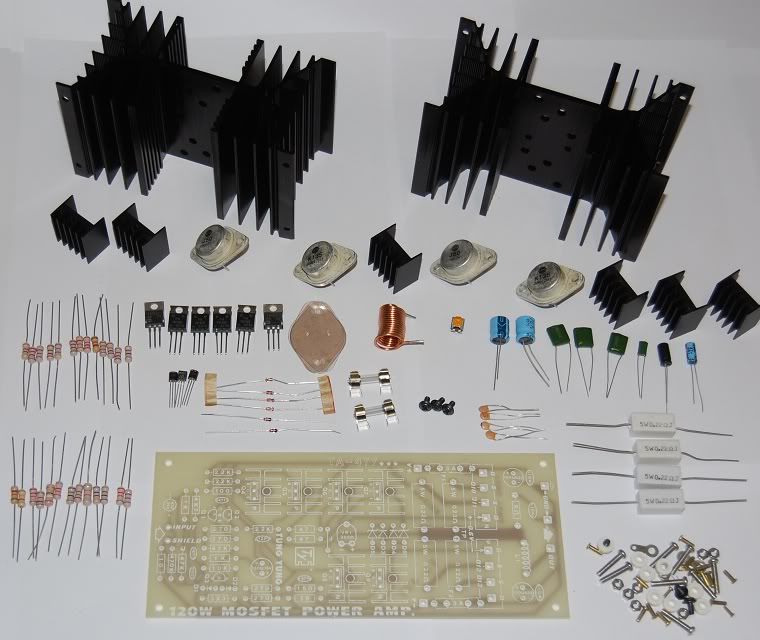
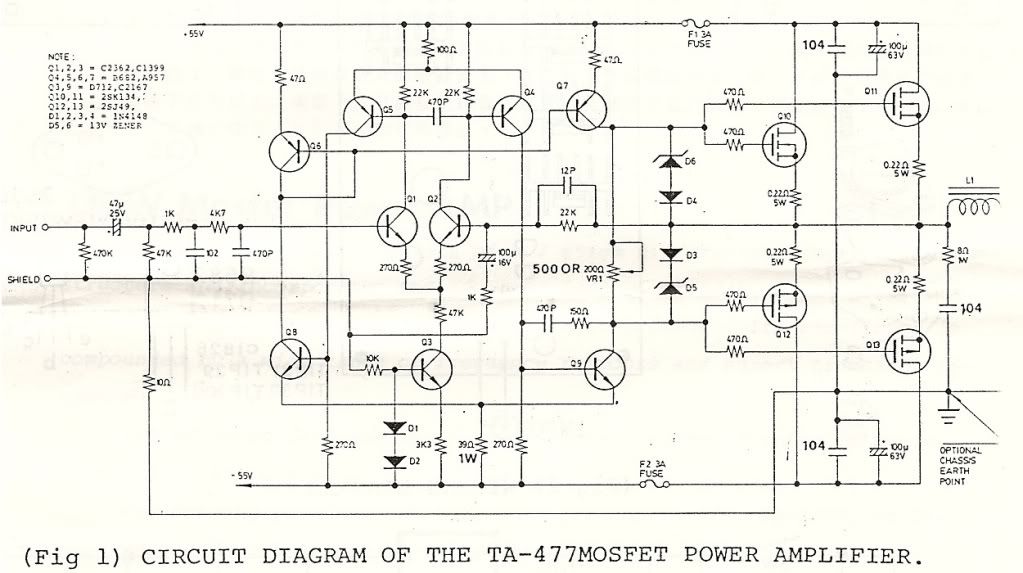
Just bought a MOSFET power amp kit. Going to assemble it in the next few days.
  This post has been edited by tanhks: Oct 12 2010, 11:05 AM |
|
|
|
|
|
Oct 12 2010, 07:15 AM
|
|
Senior Member
8,186 posts Joined: May 2005 From: Beaumont, Baile Ath Cliath, EIRE.
|
tanhks,
you beat me to it!  keep us posted with the progress and would appreciate a review..  |
|
|
Oct 15 2010, 05:37 AM
|

Senior Member
1,058 posts Joined: Apr 2006 From: Penang , Malaysia
|
how much you get for the kit?
how many watts are they? |
|
|
Oct 15 2010, 11:38 AM
|

Senior Member
600 posts Joined: Nov 2006 From: Bukit Mertajam,Penang State
|
QUOTE(tanhks @ Oct 12 2010, 05:21 AM) Just bought a MOSFET power amp kit. Going to assemble it in the next few days. Driving 2 pairs of MOSFETs w/o driver stage??  |
|
|
Oct 17 2010, 02:53 AM
|
|
Senior Member
608 posts Joined: Aug 2008
|
QUOTE(overclockalbert @ Oct 15 2010, 05:37 AM) how much you get for the kit? S$130 for one channel only (mono).how many watts are they? If success, am going to buy one more channel to make it stereo. Output is 120Watts. It requires a +55V -55V dual power supply This is a very big wattage amp compare to most branded audio amp. And this is a old kit actually, at least 15 year olds. The seller want to clear the stock and give me a discount (15 years ago was S$180). Nowaday most branded Mini HI FI use Integrated Circuit for everything including Power Amp. Only expensive audiophiles amplifier use discrete circuit (with individual transistor/FET/MOSFET). (this few days am very busy with other stuff....still haven't start assemble it yet) This post has been edited by tanhks: Oct 17 2010, 03:19 AM |
|
|
Oct 23 2010, 01:45 PM
|

Senior Member
623 posts Joined: Jan 2003 From: Kuala Lumpur 
|
Sorry if this is off topic, I would like to seek some advise from experience electronics/audio people.
 I am trying to make a simple DIY Oscilloscope using the soundcard line in as input source from the article below :- http://www.ledametrix.com/oscope/index.html From his wiring for the probe, what are the RISK of blowing up the soundcard / PC motherboard from over current / voltage ?? 
What is the max voltage / current can the Line In take and how to filter / protect them from over current/voltage ?? I am using it mainly to test/troubleshoot electronic circuits DC 12V or below with the following software :- http://www.sillanumsoft.org/prod01.htm or http://www.zeitnitz.de/Christian/scope_en Thank you |
|
|
Oct 23 2010, 03:02 PM
|
|
Senior Member
4,234 posts Joined: Nov 2004
|
To get the absolute specs, you need to refer to the datasheets of the ADC stage of the sound card.
the resistor setup is to current limit and provide okay-ish input impedance for the load. I think all is well if you prevent too much current leaking towards the input of the Soundcard. Need to do your maths here. Basically an ideal OSK when measuring voltage has very very high impedance (so that input current becomes moot). I don't know what you're fixing but, something that samples at 44.1KHz isnt going to capture oscillations occuring at 1MHz and above. EDIT: I see you're also into arduino. Any reasons for going with the Arduino route? I'm trying to design a high end attenuator + IR RX/TX control + LCD system for amplifiers but I don't know what chip to use. My only experience is C Language + 8051 based microcontrollers, so I think I'm fine with anything that works with C. This post has been edited by LittleGhost: Oct 23 2010, 03:05 PM |
|
|
Oct 23 2010, 11:39 PM
|
|
Senior Member
623 posts Joined: Jan 2003 From: Kuala Lumpur
|
QUOTE(LittleGhost @ Oct 23 2010, 03:02 PM) To get the absolute specs, you need to refer to the datasheets of the ADC stage of the sound card. Thanks for the reply.. the resistor setup is to current limit and provide okay-ish input impedance for the load. I think all is well if you prevent too much current leaking towards the input of the Soundcard. Need to do your maths here. Basically an ideal OSK when measuring voltage has very very high impedance (so that input current becomes moot). I don't know what you're fixing but, something that samples at 44.1KHz isnt going to capture oscillations occuring at 1MHz and above. EDIT: I see you're also into arduino. Any reasons for going with the Arduino route? I'm trying to design a high end attenuator + IR RX/TX control + LCD system for amplifiers but I don't know what chip to use. My only experience is C Language + 8051 based microcontrollers, so I think I'm fine with anything that works with C. I just want to use a PC Oscilloscope to do basic RF troubleshoot and learn more about the electrical signals... Got a pair of 315Mhz RF Transmitter and Receiver.. could not get it working with Arduino... and cannot "see" RF so need an DIY oscilloscope to "see" the RF. Will I be able to "see" anything since the soundcard is only at 44.1Khz ?? I use Arduino bcos of a few reasons :- 1. It is easy for beginners / noob like myself ( I'm a very new to electronics ) cos it was designed for artists/fashion designer 2. It is open source hardware ( parts is easily available here in Malaysia ), read my blog for details.. 3. Lots of vendors selling Arduino here in Malaysia 4. Lots of libraries and a very large communities worldwide ( http://www.arduino.cc/cgi-bin/yabb2/YaBB.pl?board=projects ) 5. The language is C like... make me feel at home.. (other MCU lang looks like assembly lang... yucks!!! ) 6. I hv figure out the LCD portion, the IR remote RX/TX should be easy, lots of articles online using Arduino What is a high end attenuator ?? I'm currently using a TA-2020 MKIII made by one of the forumer here, just using it, did not modify it or anything... just use it to drive my bookshelf speakers... You can read up a very good tutorial here :- http://www.ladyada.net/learn/arduino/ IR remote stuff here :- http://www.ladyada.net/learn/sensors/ir.html You can buy an Arduino locally in KL at : http://www.homebrew-tech.com/ |
|
|
|
|
|
Oct 24 2010, 01:46 AM
|
|
Senior Member
4,234 posts Joined: Nov 2004
|
Nyquist theorem states that you can only construct an original undistorted signal at a maximum of half the sampling frequency, so for 44.1KHz, you can only get 0-22KHz at most.
315MHz is VERY VERY high, it is not possible to be measured by means of normal oscilloscope. Even my Tektronik only goes up to 60MHz. |
|
|
Oct 25 2010, 10:14 PM
|

Junior Member
277 posts Joined: Jul 2009 From: Pearl of Orient
|
need little help here. I'm suspecting my AC lines creating interference to DC circuit, there is already a ferrite choke on AC wire but 'zzzzzzz' sound still coming out.
twisted pair or ferrite choke is more effective? space limited, not able to use both. actually twisted pair and ferrite choke is prevent interference or also prevent create interfere to others? |
|
|
Oct 25 2010, 10:18 PM
|
|
Senior Member
4,234 posts Joined: Nov 2004
|
not enough info, what are you building?
|
|
|
Oct 25 2010, 10:32 PM
|
|
Junior Member
277 posts Joined: Jul 2009 From: Pearl of Orient
|
-deleted-
This post has been edited by cent88: Oct 29 2010, 01:01 PM |
|
|
Nov 7 2010, 09:03 PM
|

Senior Member
936 posts Joined: Jun 2005
|
QUOTE(stan001 @ Oct 23 2010, 11:39 PM) Thanks for the reply.. Hi, just my opinion.I just want to use a PC Oscilloscope to do basic RF troubleshoot and learn more about the electrical signals... Got a pair of 315Mhz RF Transmitter and Receiver.. could not get it working with Arduino... and cannot "see" RF so need an DIY oscilloscope to "see" the RF. Will I be able to "see" anything since the soundcard is only at 44.1Khz ?? I use Arduino bcos of a few reasons :- 1. It is easy for beginners / noob like myself ( I'm a very new to electronics ) cos it was designed for artists/fashion designer 2. It is open source hardware ( parts is easily available here in Malaysia ), read my blog for details.. 3. Lots of vendors selling Arduino here in Malaysia 4. Lots of libraries and a very large communities worldwide ( http://www.arduino.cc/cgi-bin/yabb2/YaBB.pl?board=projects ) 5. The language is C like... make me feel at home.. (other MCU lang looks like assembly lang... yucks!!! ) 6. I hv figure out the LCD portion, the IR remote RX/TX should be easy, lots of articles online using Arduino What is a high end attenuator ?? I'm currently using a TA-2020 MKIII made by one of the forumer here, just using it, did not modify it or anything... just use it to drive my bookshelf speakers... You can read up a very good tutorial here :- http://www.ladyada.net/learn/arduino/ IR remote stuff here :- http://www.ladyada.net/learn/sensors/ir.html You can buy an Arduino locally in KL at : http://www.homebrew-tech.com/ Is it possible to give us the rx/tx pair model number? It is virtually impossible for those not in the industry to scope a signal higher than 200MHz as there are not that many scopes that can do so. Usually a mixed signal scope or RF scope can do so. I suggest that you only check the input and output pins of your rx/tx pair. send in a 1Khz square wave into the tx and see if the same happens on the rx side. if cannot see anything then there is some thing basic that is wrong. IC kaput kah or some setting wrong like enable not set. BTW Arduino or not, most MCU have C based compilers. If you want even easier try STAMP or some MCUs that have BASIC compilers. |
|
|
Nov 15 2010, 08:59 PM
|
|
Senior Member
608 posts Joined: Aug 2008
|
QUOTE(LittleGhost @ Oct 24 2010, 01:46 AM) Nyquist theorem states that you can only construct an original undistorted signal at a maximum of half the sampling frequency, so for 44.1KHz, you can only get 0-22KHz at most. There are 2nd hand oscilloscope for sale in Sim Lim Tower. It cost around S$200 to S$300 only.315MHz is VERY VERY high, it is not possible to be measured by means of normal oscilloscope. Even my Tektronik only goes up to 60MHz. But not sure are those 2nd hand oscilloscope able to measure up to 315Mhz. (315MHz is very very high, FM radio only 88MHz to 108MHz). |
|
|
Nov 15 2010, 09:05 PM
|
|
Senior Member
8,186 posts Joined: May 2005 From: Beaumont, Baile Ath Cliath, EIRE.
|
Yes, you are right and I was there awhile back.
Nope, definitely not over 200Mhz oscilloscope. More sub 100Mhz.. |
| Change to: |  0.0300sec 0.0300sec
 0.64 0.64
 6 queries 6 queries
 GZIP Disabled GZIP Disabled
Time is now: 21st December 2025 - 10:18 PM |
 Quote
Quote