QUOTE(joshhd @ Jul 17 2023, 02:05 AM)
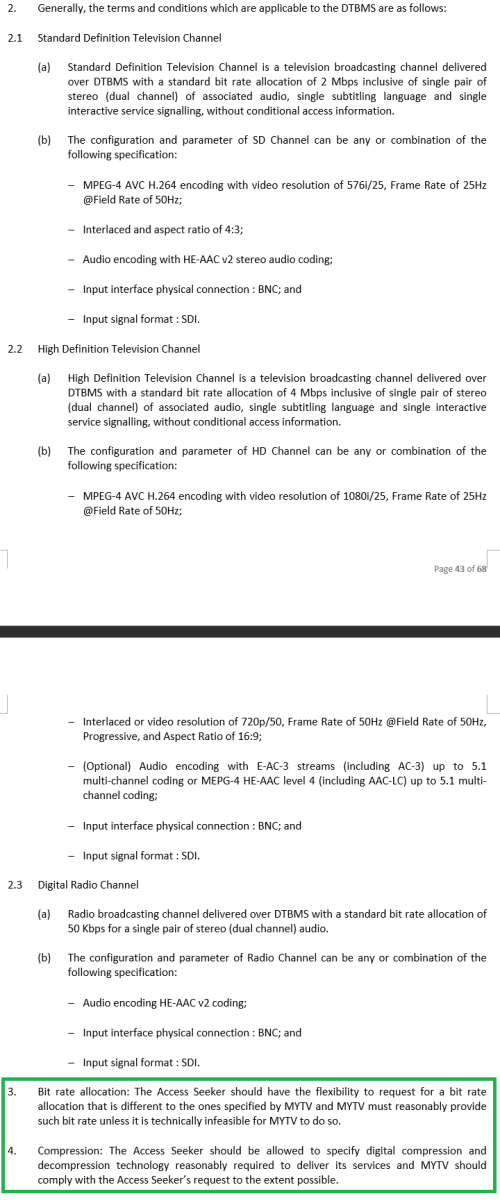
the 4Mbps/2Mbps that is recommended by MYTV is shared between everything (1 video, 1 stereo audio, 1 subtitles, 1 HBBTV service).
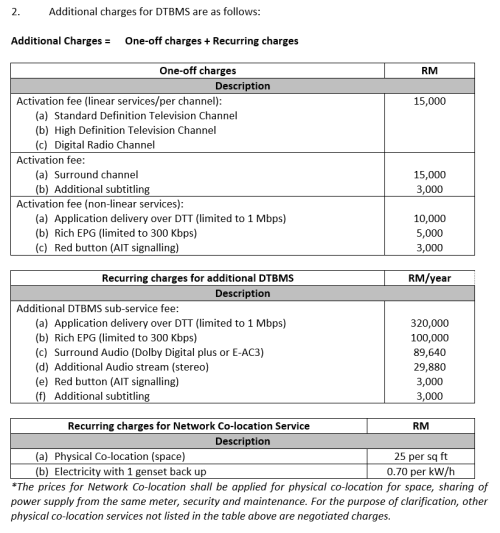
But surely increasing the audio bitrate from 32kbps to 48kbps (HE-AAC V2) dosen't cost that much in terms of video and bitrate - and would provide an overall better experience. 32kbps is really unsatisfactory for audio. It is unlike 32kbps to 128kbps where the 96kbps can give a slight improvement on video. Yeah, but I'm not sure if you add "Rich EPG" would it consume your allocated 4Mbps bandwidth, or it has a dedicated bandwidth of up to 300kbps (per channel, I assume). Why I think it should have a dedicated bandwidth, is because it costs RM100k per year per channel... Isn't it EPG supposed to be a basic feature (and included together as a package or something) on digital TV?

Anyway, the way I see it, it's like, feel free to allocate whatever you want within that 4Mbps, as long it is 1 video, 1 audio, 1 subtitle and 1 HbbTV. If there's no "special request in bitrate adjustments" from Access Seeker (broadcaster), then MYTV would stick to their default offering of ~3.97Mbps HD video and 0.032Mbps audio.
Imagine if insist to increase the audio quality (bitrate) within the 4Mbps allocation, then video quality (bitrate) would have to be sacrificed.
Let's say increase from 32kbps HE-AAC v2 to 96kbps HE-AAC (v1) as you mentioned earlier, that's an increase of 64kbps.
4000kbps - 96kbps audio = 3904kbps (3.9Mbps can be used for video). If you have EPG on that channel, then may need to reduce further somemore (not more than 300kbps). But, like I said, I'm not sure whether EPG has its dedicated allocation for it or not la...
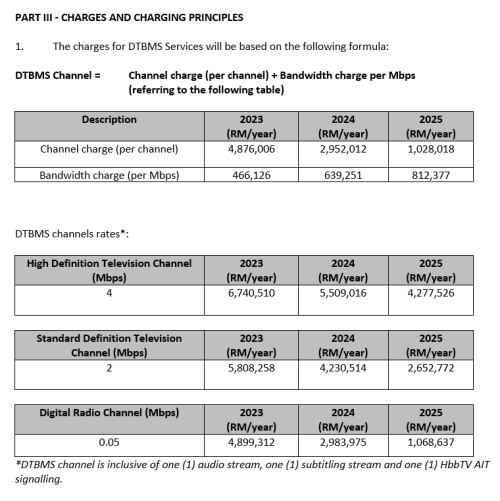
Otherwise, u can topup RM466,126 per 1Mbps (2023 rate).
Let's say topup 1Mbps on top of your default 4Mbps, then you'll get 5Mbps to use for video, 1 audio, 1 subtitle, 1 HbbTV. Imagine:
5000kbps - 96kbps audio = 4904kbps (4.9Mbps can be used for video).
Better than nothing lor.... If you ask me, I'll go for 6-8Mbps.

Or, I'm not sure if they would allow "flexible bitrate charge". For instance, every 1Mbps (1000kbps) costs RM466,126 (2023 rate), which is equivalent to RM466.12 per kbps.
Let's say increase from 32kbps HE-AAC v2 to 96kbps HE-AAC (v1) as you mentioned earlier, that's an increase of 64kbps, and you wanna pay that extra 64kbps charges only.
Therefore RM466.12 x 64 = pay extra RM29,831.68 for the year of 2023, per channel. And, it is not one-off ya. It is something that you'll need to pay extra every year, and the rates are different every year.
You try tell broadcasters (RTM or Media Prima) to pay more money to MYTV, see whether they're willing pay or not... Once they agreed to pay, then only I think MYTV will increase the bitrate. But, I'm pretty sure the majority of their mindset would be "Got many people complain meh? If not, why bother spend more money just to increase bitrate?".
Even if they use HEVC video codec, then they'll need to consider that there will be a large number of users where their receiver/TV that only supports H.264 and not the newer HEVC. And then, imagine how many millions of viewer's DVB-T2 set top boxes out there that doesn't support HEVC will become useless in Malaysia? Who's gonna pay to replace each and every viewer's H.264-only boxes? And imagine how much trouble that literally everyone needed to go through all those, simply because the broadcaster wants to pay lesser bandwidth fees to MYTV?
H.264 video codec could only do that much in that kind of bitrate. Like it or not, wider compatibility comes first, and H.264 is the way to go for few more decades to come.
What I said is taking 16kbps from the existing allocation of 4Mbps (they would be already paying for the bandwidth) and made it 48kbps (HE-AAC V2). 48kbps is really a compromise between quality and the limited bitrate they have without sacrificing the video quality. I wonder why they uses 48kbps (50kbps) for audio/radio channels but medicore 32kbps for TV channels.
Obviously - RTM has total access to MUX 2 and they are free to set their bitrate and they set it higher than the non RTM stations (48kbps TV /112kbps Radio).
Unfortunately, for audiophiles, online streaming/Unifi TV streams gives better audio quality. RTM uses 96kbps (which is double the bitrate of terrestrial broadcast).
Not sure for Media Prima (especially after they moved to their own system) but when they were using Dailymotion to host the streaming, it was 128kbps AAC-LC. It should be still higher than MYTV audio quality.
But if the general public dosen't notice the medicore audio, then why bother setting higher bitrates for TV audio?
To Qash:
And in terms of codec, MYTV can invest on improved H.264 codec to bring slightly improved quality with the limited bitrate. If MYTV is to migrate to H.265/HEVC - it will render many of the receiving devices (Digital TV/Set top boxes) useless. The country had just fully migrated to digital TV 4 years ago, and any switchover to a newer codec would not in the interest of the public. How to solve the E-waste generated by the switchover? (Which would be a lot of TVs and Set top boxes). It will also confuse the general public too because they have just gone into the process a few years ago. Broadcasters also fear to lost viewers too.
In fact, the base codec will stay at H.264 until there is another major switchover, possibly the switch off of DVB-T2. There are already concerns that the delivery of terrestrial platform (especially in Europe) might change, from the current DVB-T/DVB-T2 to 5G broadcast, shall the remaining UHF bandwidth allocated to TV stations is allocated to mobile operators.
The telcos there prefer the whole TV bandwidth to be allocated to them (and they have get/"stolen" both 800MHz and 700MHz bands) as they said low bands will bring faster broadband to rural areas (and it do) but broadcasters prefer it to be allocated for broadcast delivery - so that TV remains free to the public. The digital switchover allows the 800MHz band to be given for low band mobile coverage and in fact, the switchover to HEVC in some countries is partially as a result of 700MHz being allocated to mobile operators for low band 5G + demand from the public to have better visual quality.
There is even a newer codec call H.266 (VVC) that had come out recently, which broadcasters here are very likely to use to deliver UHD quality video in the future, shall there is any switchover.
This post has been edited by shaun_kok: Jul 17 2023, 05:09 AM 

 Jun 10 2023, 04:58 PM


 Quote
Quote







 0.1194sec
 0.56
0.56
 7 queries
 GZIP Disabled