Welcome Guest ( Log In | Register )

Bump Topic Topic Closed RSS Feed
151 Pages « < 23 24 25 26 27 > » Bottom

Outline · [ Standard ] · Linear+

 FundSuperMart v17 (FSM) MY : Online UT Platform, UT DIY : Babystep to Investing :D

views
     
iampokemon
post Jan 2 2017, 06:31 PM

Casual
***
Junior Member
391 posts

Joined: Jun 2010
QUOTE(AIYH @ Jan 2 2017, 06:19 PM)
One way to assess is to compare the fund with its peer within the same league, for example affin hwang select bond fund is a fixed income fund invest in diverse sectors within asia ex japan region, compared some funds in the same league

Also, if you have some financial knowledge, you can also read their fund fact sheet or annual report to see what they invest into, and with some financial news, along with the performance peer comparison, you can understand why such such fund is performing or declining as a lot of factors comes into play to determine a fund's worthy
(0) fund house is the party that managed the fund (i.e. Affin hwang select bond fund is managed by Affin hwang)
(1) Annual management charge is the charges charged by the fund house for mannaging the fund
(2) Trustee fee is the charges that charged for trustee institution to protect the fund money
(3) Switching Fee is the charges charged by fund house if you decide to switch between funds
(4) Annual expense ratio is the ratio that shows how much is the expense cost as compared to the fund value (overall value, not part of the individual charges)

(1) & (2) are according to the fund and was reflected in the daily NAV value, so regardless of the platform or agents (citibank, maybank, fsm, eUT etc....), these are the implicit charges in the fund you invest

(3) only incurred when you switch to different funds.

Platform fee is the charges charged by FSM for fixed income funds. (this is different to sales charge)

The difference between citibank or bank agents or fund house agents and FSM is that the bank agents charged at normal sales charge (usually) due to human processing need

Whereas FSM, the platform is online, you can deal your investment there, so the sales charge are usually low or 0% (for fixed income fund)

p/s: the expense part is also one of the criteria you can assess when choosing a fund (i.e. if several funds perform similarly, lower expense cost signify efficient investment fund) (at least thats what i think tongue.gif)
*
If 1 & 2 is already included in the NAV value. So does that mean if the projected annual return of 10.75% is already inclusive of this Annual Management Charge of 1.5 % or would I have to deduct 1.5% which makes the net projected earning percentage to 9.25%
contestchris
post Jan 2 2017, 06:35 PM

Look at all my stars!!
*******
Senior Member
5,559 posts

Joined: Aug 2011

QUOTE(wongmunkeong @ Jan 2 2017, 03:04 PM)
er.. sorry ar.. just to point out, thus U are clearer. may sound pointed/bad but please take it as creating clarity for U + other newbies that have weird ideas about UTs (and trying to logic/ calculate / compare things which are not worthwhile or calculatable):

1. Nope, based on the Qs U've been asking, even the last above, U dont know how UT works

UTs':
2. Fund's NAV =
a. (Fund's total value
b. / total units)
c. LESS daily pro-rated costs (mgt fees, this/that) LESS distributions

The main focus is (2a.) above
It is made up of Stocks' prices + Bonds's prices + cash & other stuff +interest/dividends/payouts from these held

Knowing (2a.) then, one would NOT compare UTs to stocks directly
Value of UT = a mini portfolio by itself, can hold stocks, bonds, FDs, Options, etc, a composite if U may call it that
Value of Stock = stock price * units

see the big difference?

<end of old fart's mumbling>
*
Uh...those are all basic knowledge. I do know it.

Anyway my apologies for complicating matters and asking about stocks here. Won't repeat that error as everyone seems to have lost their minds.
iampokemon
post Jan 2 2017, 06:38 PM

Casual
***
Junior Member
391 posts

Joined: Jun 2010
QUOTE(MUM @ Jan 2 2017, 06:27 PM)
if they did not charge you than it will be weird....
did Citibank send you any prospectus or fund factsheet?
those charges are stated in there.
*
They do gave me a brochure which states the charges for it, but if I remember correctly it is just 2% sales charge and the other charges is 0%. As I already lost the brochure since it was some time ago. I'll try to inquire it from the bank this week and find out more about it.
TSAIYH
post Jan 2 2017, 06:38 PM

Regular
******
Senior Member
1,166 posts

Joined: Jul 2016
QUOTE(iampokemon @ Jan 2 2017, 06:31 PM)
If 1 & 2 is already included in the NAV value. So does that mean if the projected annual return of 10.75% is already inclusive of this Annual Management Charge of 1.5 % or would I have to deduct 1.5% which makes the net projected earning percentage to 9.25%
*
If you mean by mutuak funds sold through bank agents or online platform, the published daily NAV values are net of those charges, meaning the performance are net off charges, what was displayed is the return you will get, no need of manual calculation.

However, i guess your question about projected annual return refer to insurance policy term as most of the time they use the projected term tongue.gif, that I am not so sure, you need to read their sales illustration fine print tongue.gif
TSAIYH
post Jan 2 2017, 06:41 PM

Regular
******
Senior Member
1,166 posts

Joined: Jul 2016
QUOTE(iampokemon @ Jan 2 2017, 06:38 PM)
They do gave me a brochure which states the charges for it, but if I remember correctly it is just 2% sales charge and the other charges is 0%. As I already lost the brochure since it was some time ago. I'll try to inquire it from the bank this week and find out more about it.
*
A responsible agent (at least I think) should provide you the published information about the fund to the investors to let them know their informed decision

For example, FSM page on Affin hwang select bond fund, at the bottom part, you will see the prospectus, fund fact sheet and annual report for investors to read and understand what they are investing and the charges inccured
SUSPLOUFFLE
post Jan 2 2017, 06:53 PM

Casual
***
Junior Member
442 posts

Joined: Oct 2012
public mutual fund really a scam?
!@#$%^
post Jan 2 2017, 06:56 PM

Safe Trader
********
All Stars
17,513 posts

Joined: Feb 2006
From: KL
QUOTE(PLOUFFLE @ Jan 2 2017, 06:53 PM)
public mutual fund really a scam?
*
says who?
iampokemon
post Jan 2 2017, 06:57 PM

Casual
***
Junior Member
391 posts

Joined: Jun 2010
QUOTE(AIYH @ Jan 2 2017, 06:38 PM)
If you mean by mutuak funds sold through bank agents or online platform, the published daily NAV values are net of those charges, meaning the performance are net off charges, what was displayed is the return you will get, no need of manual calculation.

However, i guess your question about projected annual return refer to insurance policy term as most of the time they use the projected term tongue.gif, that I am not so sure, you need to read their sales illustration fine print tongue.gif
*
I'm using the term projected because everything it is just an estimation based on previous annual results. But I don't think NAV values already lessen off the charges as I did make a check online before I purchase, which matches the current value of it.

But I'll find out more about it this week and see how it differs with FSM rclxub.gif
shankar_dass93
post Jan 2 2017, 06:59 PM

Look at all my stars!!
*******
Senior Member
2,955 posts

Joined: Sep 2009


QUOTE(PLOUFFLE @ Jan 2 2017, 06:53 PM)
public mutual fund really a scam?
*
Well you can't say they are scam but their service charges are definitely higher than FSM and the performance of PM's funds doesn't seem to catch my eyes.
TSAIYH
post Jan 2 2017, 07:11 PM

Regular
******
Senior Member
1,166 posts

Joined: Jul 2016
QUOTE(iampokemon @ Jan 2 2017, 06:57 PM)
I'm using the term projected because everything it is just an estimation based on previous annual results. But I don't think NAV values already lessen off the charges as I did make a check online before I purchase, which matches the current value of it.

But I'll find out more about it this week and see how it differs with FSM  rclxub.gif
*
Take some time to read the FSM FAQ:

09. CHARGES, CALCULATIONS, INCOME DISTRIBUTION

Q: WHAT KIND OF CHARGES DO I HAVE TO PAY?

A: There are 2 types of charges. One is the sales charge and the other is the annual expense of the fund.
The normal sales charge for most equity funds are around 7%. However, at Fundsupermart, the advantage is that most equity funds are sold at around 2% sales charge. The sales charge is applied at purchase.

The annual expense of the fund is what is charged to the fund. This includes the fund manager's annual management fee, and other administrative fees that are incurred in the running of the fund. You do not really need to fork out additional money to pay for the annual management charge to the fund manager. They will actually deduct it from the Net Asset Value of the fund daily, and the published price will take into account of the pro-rated annual management charge.
adele123
post Jan 2 2017, 07:11 PM

Look at all my stars!!
*******
Senior Member
4,726 posts

Joined: Jul 2013


QUOTE(iampokemon @ Jan 2 2017, 06:57 PM)
I'm using the term projected because everything it is just an estimation based on previous annual results. But I don't think NAV values already lessen off the charges as I did make a check online before I purchase, which matches the current value of it.

But I'll find out more about it this week and see how it differs with FSM  rclxub.gif
*
i think projection isn't the right word/concept. if the past return is 10%, it is 10%. and nobody projects it is going to be 10% next year.

and also i think you are confusing yourself. I don't know what your RM offers you but in a nutshell, it is this...

a) your RM is a sales person, hence will earn commission from that one-time sales charge

b) FSM is a corporate unit trust agent, hence will earn commission from the sales charge, which is one-time. the difference is FSM charges lower compared to most individual agents. although it seems that your RM doesn't charge you very high compared to others...

then again... you are referring to affin hwang select bond fund where actually most sales person don't charge that much for bond funds. i don't know much about this as i don't have experience buying from individual agents.

c) the annual management charge is something implicitly charged. what others say about NAV lessen off charges, again i think you misunderstood

d) NAV prices refers to the net asset value of the fund at a per unit price. This is the price you paid per unit. If your fund is RM1 per unit. Your sales charge is say 2% and you invested RM1000. So you will still get RM1 per unit but you have only 998 units. it doesn't mean NAV is RM0.98.


Avangelice
post Jan 2 2017, 07:12 PM

Look at all my stars!!
*******
Senior Member
5,272 posts

Joined: Jun 2008


QUOTE(PLOUFFLE @ Jan 2 2017, 06:53 PM)
public mutual fund really a scam?
*
scam is a very strong word.

I would say they do not put the clients at their best interests and only chase for commissions and sales. you do not want someone who wants your money badly just for his commision but find someone who really wants to help you at a fee of course base on their time and services like certified financial planners.

This post has been edited by Avangelice: Jan 2 2017, 07:13 PM
wongmunkeong
post Jan 2 2017, 08:10 PM

Barista FIRE
Group Icon
Elite
5,608 posts

Joined: May 2011
From: Here, There, Everywhere


QUOTE(contestchris @ Jan 2 2017, 06:35 PM)
Uh...those are all basic knowledge. I do know it.

Anyway my apologies for complicating matters and asking about stocks here. Won't repeat that error as everyone seems to have lost their minds.
*
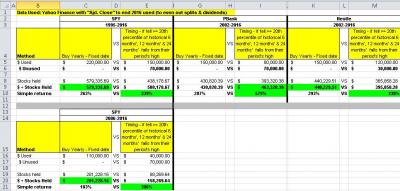
Urgh - my bad English, hard to "say what i mean" without data / tables + vocal tones laugh.gif

Anyhow, since U are a data cruncher - have a look at the below & feed data / play with the structure/Excel (ZIP file).
Don't take my opinion as gospel
Attached Image

Idea = A. buy blindly every year, same date (something like DCA)
VS
B. some sort of timing buy


1. Both using the same available funds.
for (B.) if unused for the year(s), accumulate for usage

2. Timing for (B.), used a simple - "Buy if the thing falls 80% or more based on historical falls":
a. Current Nav or Price LESS Highest in 6 months', 12 months' & 24 months'
b. Compare current 2a. to historical 2a. - if current <= historical's 20th percentile, then BUY with unused $ (timing ma)

3. For unused $, no interest was calculated/added

Tested the ETF for S&P500 + some local blue chip stocks.
I didn't test against UTs as the data for UTs are not as transparent - have to even out the historical NAV with distributions, splits, etc., else not comparable properly.

Data used was from Yahoo Finance & the price / nav used was the ADJ. CLOSE - which evens out the distributions, dividends, splits based on the last data point.

Opinion so far:
4. Don't bother timing if one invest $ which is not needed for 10 to 20 years AND one has a proper portfolio - ie. cash, FD, bonds + the UTs/ETFs/Stocks
Keep in mind - one may want to watch it 3-5 years when liquidation is needed.
COZ the total end value is more than "timing".

5. IF one is not working (ie no constant / reliable cash income from active work) OR has no proper portfolio planned / executed, the "timing" will make sense
COZ less capital at risk.

This post has been edited by wongmunkeong: Jan 2 2017, 08:14 PM


Attached File(s)
Attached File  Sim___Buy_blind_yearly_VS_trigger_20th_Percentile_of_Historical_Drop_v2.zip ( 7mb ) Number of downloads: 5
TakoC
post Jan 2 2017, 08:37 PM

Look at all my stars!!
*******
Senior Member
2,081 posts

Joined: Mar 2012
Waiting to see you guys update 2016 ROI numbers..
wodenus
post Jan 2 2017, 08:46 PM

Tree Octopus
********
All Stars
14,990 posts

Joined: Jan 2003
QUOTE(iampokemon @ Jan 2 2017, 06:10 PM)
Surprisingly, for citibank they doesn't charge an agent fee. It's only a one time fee of 2%. The same as my recent funds placement through Great Eastern.

I'm only looking at the technical indicator of the chart. Because it just look stagnant, which would suggest to a drop later on which I define it as bad.

The updates I get from my RM is a summarized version of a good or bad stock(straightforward). Either if it would be a good time to withdraw, placing more funds or perform a switching. Based on information they gotten from their bank and news they have read about. So far the indicators my former RM provided me is reliable.
*
Seriously? that is worth checking out.
wodenus
post Jan 2 2017, 08:49 PM

Tree Octopus
********
All Stars
14,990 posts

Joined: Jan 2003
QUOTE(iampokemon @ Jan 2 2017, 06:15 PM)
That's weird because Citibank didn't charge me for that, referring to the annual management charge. Although I did ask them about this before placing in it 1 year back.

And for Great Eastern I'm still waiting for the policy, as I'm also told the same as well that only a one-time fee of 2% will be charged for lifetime.

But a downside is that the bank will charge another 2% for switching funds, while FSM doesn't have that if it is managed by the same fund company.

Will research more about it.
*
OK are you sure we're still talking about mutual funds? or some sort of endowment policy? you don't get policies with mutual funds.
SUSyklooi
post Jan 2 2017, 08:50 PM

Look at all my stars!!
*******
Senior Member
8,188 posts

Joined: Apr 2013


QUOTE(TakoC @ Jan 2 2017, 08:37 PM)
Waiting to see you guys update 2016 ROI numbers..
*
Jan till end Dec....

pssssh...did not show you the fall from Early Jan tongue.gif


Attached thumbnail(s)
Attached Image
wodenus
post Jan 2 2017, 08:50 PM

Tree Octopus
********
All Stars
14,990 posts

Joined: Jan 2003
QUOTE(wongmunkeong @ Jan 2 2017, 08:10 PM)
Urgh - my bad English, hard to "say what i mean" without data / tables + vocal tones laugh.gif

Anyhow, since U are a data cruncher - have a look at the below & feed data / play with the structure/Excel (ZIP file).
Don't take my opinion as gospel
Attached Image

Idea = A. buy blindly every year, same date (something like DCA)
VS
B. some sort of timing buy


1. Both using the same available funds.
for (B.) if unused for the year(s), accumulate for usage

2. Timing for (B.), used a simple - "Buy if the thing falls 80% or more based on historical falls":
a. Current Nav or Price LESS Highest in 6 months', 12 months' & 24 months'
b. Compare current 2a. to historical 2a. - if current <= historical's 20th percentile, then BUY with unused $ (timing ma)

3. For unused $, no interest was calculated/added

Tested the ETF for S&P500 + some local blue chip stocks.
I didn't test against UTs as the data for UTs are not as transparent - have to even out the historical NAV with distributions, splits, etc., else not comparable properly.

Data used was from Yahoo Finance & the price / nav used was the ADJ. CLOSE - which evens out the distributions, dividends, splits based on the last data point.

Opinion so far:
4. Don't bother timing if one invest $ which is not needed for 10 to 20 years AND one has a proper portfolio - ie. cash, FD, bonds + the UTs/ETFs/Stocks
Keep in mind - one may want to watch it 3-5 years when liquidation is needed.
COZ the total end value is more than "timing".

5. IF one is not working (ie no constant / reliable cash income from active work) OR has no proper portfolio planned / executed, the "timing" will make sense
COZ less capital at risk.
*
Exactly.. if you only remember two things about mutual funds, it would be this :

(1) Diversify as much as you can

(2) Wait for as long as you can

That's it smile.gif


Kaka23
post Jan 2 2017, 09:01 PM

Look at all my stars!!
*******
Senior Member
8,259 posts

Joined: Sep 2009


QUOTE(yklooi @ Jan 2 2017, 08:50 PM)
Jan till end Dec....

pssssh...did not show you the fall from Early Jan  tongue.gif
*
Any big changes this year to be made on ur portfolio this Jan?
Avangelice
post Jan 2 2017, 09:04 PM

Look at all my stars!!
*******
Senior Member
5,272 posts

Joined: Jun 2008


QUOTE(wodenus @ Jan 2 2017, 08:49 PM)
OK are you sure we're still talking about mutual funds? or some sort of endowment policy? you don't get policies with mutual funds.
*
I think he signed up for an endowment fund and the RM explained it to him by using unit trust jargon which explains why he has a little understanding on how it works. same with my girlfriend at ocbc. the RM knows about TA Global and what fund to do and etc.

151 Pages « < 23 24 25 26 27 > » Top
Topic ClosedOptions
 

Change to:
| Lo-Fi Version
0.0189sec    0.76    6 queries    GZIP Disabled
Time is now: 14th December 2025 - 06:32 AM