
|
MrFarmer:
You are right to say the characteristics of the clone is based on the parent tree where the bud had been collected. However, the seed (i.e. rootstock) material also plays a very critical role in the success of the grafting/cloning process. If the rootstock isn't vigourous, chances are the budded graft would not take, and would have difficulty with surviving and growing. Growing directly from seeds have some advantages and disadvantages. For one, sowing seeds take a longer time to grow to planting stage. Two, you can never be sure of the quality of the material when planting seeds, even if it is taken from a field made up entire of clones. A simple reasoning to this is that different seeds, different genetic mix, so un-uniformed output. Bud grafting i.e. cloning means you are taking from the very best of proven trees, and mass producing them. This often means that your output will be uniform and consistent. The advatage of planting seeds is that you often can get massive amounts of materials at a time, and won't be dependent on the availability of budwood for grafting, or require the skill of trained grafters.
Haa.... Yea, I was just excited over my experiment results. No worries about it. The crux of the experiment is about developing a sustainable population of high performance breeds, that are fertile, able to continously reproduce over time, and face little genetic defects.
Bro, you cannot plant seeds taken from F1 hybrids and expect the same plants to form lar. For one, as you say, many hybrids do not produce viable offspring, i.e. they are sterile. For those that aren't sterile, the resulting offspring will not resemble the parents in terms of yield, vigour, flavor etc. How do I explain this.... It has to do with genetics and gene inheritance.
Ok, lets take two varieties of gourds, say Gourd A and Gourd B. They are remotely related to each other, with Gourd A having a genetic makeup of AA and Gourd B having a genetic makeup of BB. When Gourd A and Gourd B are cross pollinated to produce seeds, the offspring will have a genetic makeup that combine half of Gourd A and half of Gourd B, which is AB.
AA + BB => AB + AB
This offspring AB is known as the F1 Hybrid. It will have the best characteristics of both its parents, Gourd A and Gourd B, like strong vigour, big juicy fruits, sweet taste etc. This is known as hybrid vigour, or as breeders call it, heterosis.
However, heterosis is often a one hit wonder, meaning only the F1 Hybrid will have this kind of superior performance. If the F1 Hybrid was to breed with a sibling F1 Hybrid, what happens is regression, which is a reversion to the parent-type, or a degradation in hybrid vigour. What I mean is this:
AB +AB => 1xAA + 1xBB + 2xAB (physical regression)
Even though you might see there are some offspring that are genetically similar to the F1 Hybrid, the inbreeding with its sibling causes physical regression, i.e. a loss in hybrid vigour. This could be attributed to accumulation of defective genes due to the inbreeding. For growers, this often means a sharp reduction is yield, quality etc.
If the F1 Hybrid were to be cross pollinated with another, diffent variety or species, then hybrid vigour is likely prolonged. Eg., if Hybrid AB is crossed with Gourd C, what you might get is this:
AB + CC => 1xAC + 1xBc
However, the offspring will no longer be uniform, although performance wise they could be just as good.
Now, the examples I've given above are hybrids created from crossing between varieties that are closely related, so the seeds they produce can still germinate. In many cases, seed producers create non-compatible hybrids, i.e. they cross pollinate two different species or genus of plants to produce a hybrid. This hybrid is often sterile due to an imbalance in the genes inherited, i.e. cannot reproduce. An often quoted example is the hybrid between a horse and a donkey, called a mule. The mule is unable to breed because the genetic imbalance in its cells "suicides" the procreating cells, including embryonic cells. Likewise is the case in many plant hybrids; the seed may form, but the embryos die due to this genetic imbalance, and thus do not germinate.
Many seed producers actually favour hybrid seeds, because it literally forces growers to buy seeds from them. In this way, they can control the seed market and demand, and therefore make money. Personally, I'm not very supportive of this, but then again, without hybrids, it is simply impossible to feed 7 billion people, or 9 billion people in the next 18 year's time. Unless some cataclysm happens and wipes out 50% of the human population.
Yes, even with annuals, sometimes correcting an error when it appears may not give a quick enough result. Liquid fertilzers have a number of pros and cons. Pros are: (i) It is more readily absorbed by the palms (ii) It is often easier to apply (subjective) (iii) It is more targeted approach, as fertilizer absorbtion is most efficient through the leaves and roots. Cons include: (i) It is actually more costly when comparing active ingredient to volume (ii) It still leaches off just as easily as granular fertilizers (iii) Storage becomes a big problem.
Take note these are just a few points, but I think you get the gist. One could theoretically crush granular fertilizers and mix to water, but one also has to bear in mind that chemical fertilizers can scorch leaves, so the right volume to water ratio must be determined before doing so.
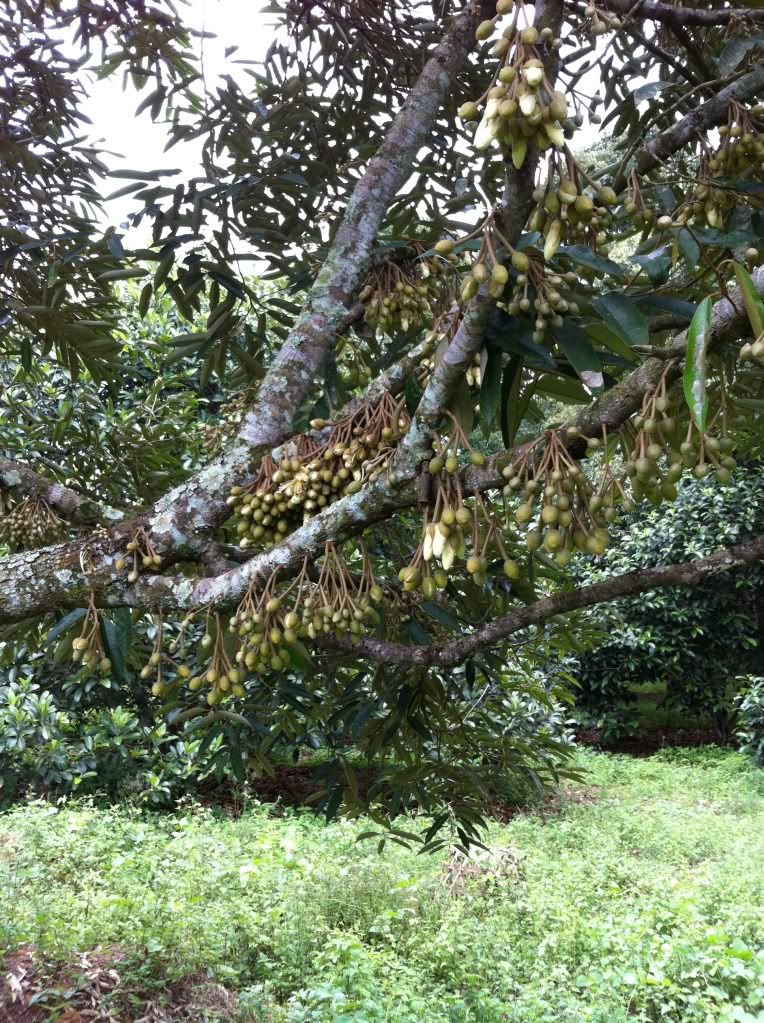
I'll leave the durian question to the right person to answer. From an agronomic point of view, you really don't want too many flowers/fruits on a tree. Having "just enough" is better than over production and stressing the tree, which could kill it in the long run. Also, although more flowers does equal more fruits, but more fruits equal smaller sized fruits, and smaller sized fruits equal lower grade, which in turn means less income per unit.
This post has been edited by Michael J.: Mar 14 2012, 11:10 AM
|



 Mar 13 2012, 12:06 PM


 Quote
Quote


 Shall check back with you when I reached a higher level.

 0.0325sec
 0.40
0.40
 6 queries
 GZIP Disabled