Welcome Guest ( Log In | Register )

Bump Topic Topic Closed RSS Feed
134 Pages « < 17 18 19 20 21 > » Bottom

Outline · [ Standard ] · Linear+

 LYN Catholic Fellowship V01 (Group), For Catholics (Roman or Eastern)

views
     
khool
post May 10 2015, 04:04 PM

Getting Started
**
Junior Member
225 posts

Joined: Mar 2008


Sixth Sunday of Easter

Gospel reading - Jn 15:9-17

Jesus said to his disciples:
“As the Father loves me, so I also love you.
Remain in my love.
If you keep my commandments, you will remain in my love,
just as I have kept my Father’s commandments
and remain in his love.

“I have told you this so that my joy may be in you
and your joy might be complete.
This is my commandment: love one another as I love you.
No one has greater love than this,
to lay down one’s life for one’s friends.
You are my friends if you do what I command you.
I no longer call you slaves,
because a slave does not know what his master is doing.
I have called you friends,
because I have told you everything I have heard from my Father.
It was not you who chose me, but I who chose you
and appointed you to go and bear fruit that will remain,
so that whatever you ask the Father in my name he may give you.
This I command you: love one another.”


This post has been edited by khool: May 10 2015, 04:04 PM
TSyeeck
post May 11 2015, 01:26 AM

Look at all my stars!!
*******
Senior Member
3,573 posts

Joined: Apr 2006


user posted image

"Greater love has no man than this, that a man lay down his life for his friends. You are my friends if you do what I command you" – John 15:13f
TSyeeck
post May 12 2015, 05:32 PM

Look at all my stars!!
*******
Senior Member
3,573 posts

Joined: Apr 2006


Sin

user posted image

700. This sin business worries me. Is it possible that mortal man can sin against Almighty God? I can see that he can sin against his fellow mortal men.

It is possible precisely because we are mortal men and He is Almighty God. What is sin? Sin is a crime, and crime is a breaking of the law. Now God created us, and He certainly has the right to lay down laws according to which we must conduct ourselves. If men will not obey those laws they sin against God just as those who refuse to obey the state are criminals in the eyes of state law. As a matter of fact, it would be impossible to sin against one's fellow men if one could not sin against God. Every sin supposes the violation of the rights of another. Rights and duties go together. If I have a duty it is because another has a right. But whence come the rights of my fellow men? What is their foundation? Since man did not make himself, he certainly did not make that which is less than himself, his rights. The very foundation of these rights is God the Creator, the Author of all morality. And every sin against your fellow man is a sin against the Author of the law—Almighty God. Without God you have rights with no assignable title and no real sanction,

701. Was the sin of our first parents the eating of an apple, or the committing of adultery?

It was not a sin of adultery. Disorder in their passions was subsequent to their first sin. Their higher faculties had perfect control over their lower faculties until they had rebelled against God. Only after that did things lower than themselves, even their own passions, rebel against them. There is far less reason why lesser things should obey man than for man to obey God. Nor were they expelled for eating an apple. Nowhere is an apple mentioned. They disobediently partook of the tree of knowledge of good and evil. The fruit of that tree could not communicate knowledge to them, but where before they had not known the evil of sin, they now had the sad knowledge of what it meant to be at variance with God. Their violation of God's prohibition was an implicit blasphemy, and a denial in practice of God's right to dictate their conduct.

702. How can God blame anyone for doing what he must do?

He cannot and does not. But for every free choice in the direction of evil man will have to render an account. Man is free, and no man must do moral evil.

703. Why did not God make their will power strong enough to resist the temptation?

He did. They need not have consented to it. God had to choose between giving man freedom of will or not. If man were not free, he would necessarily love and serve God. Man would have to love God. But God did not want a forced love from intelligent creatures. He wished to be freely chosen for His own sake. So He left man free. Yet if man is free, he is free not only to love God, but also to reject God. But God thought so much of man's freely given love that He preferred to risk not being chosen.

704. At least God could have given men a stronger will.

What do you mean by stronger will? Do you mean a will with a stronger propensity towards the good? But freedom means freedom from inclinations imposed by any outside agency. It means indifference and personal decision. Any intrinsic strengthening of man's will in one direction means diminishing his freedom in the opposite direction. God gave man the truth; He gave him grace; but always man remained his own master physically, although morally of course he was bound to obey God.

705. God knows all. He knew the pair must fall when He made them.

God does know all. He therefore knew that they would be free, and that there was no must fall about it. There was no necessity to fall, and they could have resisted the temptation. You may say, "But they did fall, and God must have known that they would fall." That is correct. But the fact that God knew this did not make them fall, nor place the responsibility upon God. If I find out by some means that you are going to sail for Europe next week, when you have sailed I do not tell everyone that I made you go. Knowledge as such does not cause events. Events are responsible for the knowledge one has of them.

706. Anyway God need not have made a serpent or devil to tempt them.

God did not make any devils. He made angels in quite a sinless condition, but also free, even as man. By misuse of their freedom of choice, some angels turned themselves into evil spirits. In his evil will Satan then tempted man. God permitted this, for man had to prove the reality of his devotedness to God. Anybody can serve God if he is never tempted. Man's real glory is to be tempted to abandon God, yet not to consent.

707. You say that man fell. Evolution says that man did not fall, but that he has experienced a steady rise from brutality.

History denies this steady rise. It is full of falls, and is, in fact, but a catalogue of ups and downs. Nations rise to a high state of civilization and decay. If evolution wants to maintain a steady uplift, history itself proves it wrong.

708. What do you mean by original sin?

Actual sin is a deliberate personal transgression of God's law. But original sin, which is inherited, does not mean that I have personally and maliciously transgressed. We must notice the difference between nature and grace. Nature is our being and all that our condition demands as rational animals. Grace means a gift or quality over and above all that our nature legitimately demands. Now nature is fitted to know God only by deduction from created things. Yet over and above this God's sheer goodness chose to give us what is in no way due to us, the supernatural destiny to see Him face to face in heaven, and the grace to attain this Vision. He promised this to Adam and, provided Adam were faithful, to all his children. And in this supernatural matter He regarded Adam as father of the human family. Adam failed. He and his children were deprived of this supernatural destiny and of the gift of sanctifying grace. This deprivation of grace is called original sin. It is called sin in so far as we lack that quality which renders us pleasing in God's sight as heirs to the Vision of Himself in heaven.

709. Does God create every soul now in a state of sin?

No. God's creative activity terminates in good only. But the soul cannot normally be infused into a child of Adam without its contracting the privation of the original gratuitous gifts it was destined to receive had Adam not fallen. I say normally because God did anticipate the merits of Christ in one case, preventing the soul of the Virgin Mary from contracting original sin. Do not imagine, however, that God creates a separated soul and then infuses it. By simultaneous action the soul is created and blended with the body, thus completing a nature in a state of sin. The stain of original sin, also, differs from the stain of personal sin, which is committed, not contracted. Original sin supposes a lack of grace, which would have been present, but it does not suppose a personal and malicious disposition.

710. What proof have you that original sin is inherited?

The very best—the word of the God who created us. In Ps. L., 7, we read David's testimony, "In sins did my mother conceive me." The original Hebrew has "in sin," not "in sins." He is speaking, not of his own personal sins, nor of any actual sin of his father or mother. He is speaking of original sin derived from Adam and the first fall, tracing back to the very first beginning of human life a sin handed on with human nature from parent to child. In Jn. IIL, 6, Christ demands that a man be born again of water and the Holy Ghost in Baptism. A birth means a life. Re-birth means the acquiring of some new principle of life not secured by our natural birth. And Baptism gives the principle of supernatural life without which we were born into this world, and the lack of which constitutes the very essence of original sin. St. Paul tells us clearly, "By one man sin entered into this world ... in whom all have sinned." Rom. V., 12. Experience confirms this revealed doctrine. Our very proneness to evil argues to a privation of original rectitude. As Chesterton has well remarked, men may deny original sin, but almost the only thing they know about original innocence is that they haven't got it.

711. To brand me with sin is as unjust as hanging me for a murder I did not commit.

Original sin does not brand you with the positive guilt of actual and personal malice. It is a privation of a grace and of a destiny to which no human being has a natural right. God offered that destiny to Adam and to all his children, regarding Adam as head of the human family. Were you a married man with a family, I could certainly agree to grant to you and to each of your children a substantial recompense, provided you fulfilled certain conditions specified by me. If you failed to comply with my conditions, I could certainly cancel that recompense. Nor could your children justly complain later that I had robbed them of anything due to them. Original sin is the deprivation of a right to a happiness which was never due to us. The privation of grace is essentially the privation of something gratuitous.

712. I can understand inheriting the effects of the first sin, hut why the sin itself? If my father is a thief, I share in his disgrace, but my soul is not stained by his sins.

Your father was not constituted the head of the whole human race, and is but the intermediate transmitter of an individual human nature. If we inherited original sin as something of positive personal malice, it would be unjust. But we do not. Death in a state of positive and serious personal malice merits hell. But if a child dies with no personal sin, but only original sin, whilst it can never attain to the very Vision of God, and thus suffers the privation of a gratuitous destiny, it will never endure the positive suffering of the lost in hell. It will be rendered happy according to its natural capacity.

713. Why inherit the first sin of Adam, and not his subsequent sins?

Only in the matter with which the first sin was connected was Adam constituted the supernatural head of the race. After his sin as head of supernaturally elevated human nature, he sinned as a private individual and independently of God's universal decree for the human race as such.

714. Why was I born without my consent, when I have to inherit original sin?

Before you existed your consent could hardly be requested. Also I would not need to be asked if someone offered to invest a few thousand dollars for me before I was able to be consulted. Yet the gift of life with a prospect of eternal happiness is more valuable than any earthly fortune. After all, if God permitted original sin, it was only because He knew that a greater good would eventuate in the Incarnation of His Son for us men and for our salvation. Christ has restored to every man the possibility of attaining the original supernatural destiny first offered us through Adam.

--Radio Replies

This post has been edited by yeeck: May 12 2015, 05:33 PM
TSyeeck
post May 13 2015, 03:48 PM

Look at all my stars!!
*******
Senior Member
3,573 posts

Joined: Apr 2006


user posted image
Statue of Our Lady of Fatima

The Blessed Virgin Mary, the Mother of God, appeared six times to three shepherd children ("The Three Seers") near the town of Fatima, Portugal between May 13 and October 13, 1917. Appearing to the children, the Blessed Virgin told them that She had been sent by God with a message for every man, woman and child living in our century. Coming at a time when civilization was torn asunder by war and bloody violence, She promised that Heaven would grant peace to all the world if Her requests for prayer, repration and consecration were heard and obeyed.

"If My requests are granted ... there will be peace"

user posted image

Our Lady of Fatima explained to the children that war is a punishment for sin and warned that God would further castigate the world for its disobedience to His Will by means of war, hunger and the persecution of the Church, the Holy Father and the Catholic Faithful. God's Mother prophesied that Russia would be God's chosen "instrument of chastisement," spreading the "errors" of atheism and materialism across the earth, fomenting wars, annihilating nations and persecuting the Faithful everywhere.

user posted image
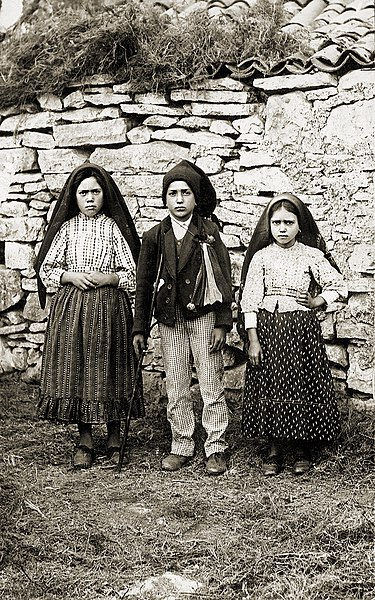
The 3 seers - Jacinta, Francisco, Lucia.

"If My requests are not granted, Russia will spread its errors throughout the world, raising up wars and persecutions against the Church. The good will be martryed, the Holy Father will suffer much and various nations will be annihilated."
In all Her appearances at Fatima, the Blessed Mother repeatedly emphasized the necessity of praying the Rosary daily, of wearing the Brown Scapular of Mount Carmel and of performing acts of reparation and sacrifice. To prevent the terrible chastisement at the hands of Russia and to convert "that poor nation", Our Lady requested the solemn public Consecration of Russia to Her Immaculate Heart by the Pope and all the Catholic bishops of the world. She also asked that the Faithful practice a new devotion of reparation on the first Saturday of five consecutive months ("The Five First Saturdays")

user posted image

The heart of Our Lady's Message to the world is contained in what has come to be called the "Secret" which She confided to the three child seers in July 1917. The Secret actually consists of three parts, the first two of which have been publicly revealed. The first part of the Secret was a horrifying Vision of hell "where the souls of poor sinners go" and contained an urgent plea from Our Lady for acts of prayer and sacrifice to save souls. The second part of the Secret specifically prophesied the outbreak of World War II and contained the Mother of God's solemn request for the Consecration of Russia as a condition for world peace. It also predicted the inevitable triumph of Her Immaculate Heart following Russia's consecration and the conversion "of that poor nation" to the Catholic Faith.

The Third Secret of Fatima

What is generally called the "Third Secret" is, in actuality, the third and final part of the full prophetic Secret which the Blessed Virgin gave to three child seers on July 13, 1917. The other two sections of the Secret (the vision of hell and the rise of Communist Russia) were publicly revealed with the publication of Sister Lucy’s Memoirs in the 1940s, the final part of the revelation remains in the possession of the Vatican and has not yet been disclosed to the world.

It was under the direct order of her bishop and, with the assistance of Our Lady, that Sister Lucy dos Santos wrote the third part of the Secret down on January 2, 1944. Speaking to Sister Lucy, the Queen of Heaven told her that it was God’s Will that she commit the Secret to paper and entrust it to her bishop and, through him, to Pope Pius XII. At that time, the Blessed Virgin also indicated that this part of the Secret was to be revealed to the Faithful no later than 1960.

Upon learning that her bishop was unwilling to open the envelope containing the Secret, Sister Lucy "made him promise," in the words of Canon Galamba, "that the Third Secret would be opened and read to the world upon her death or in 1960, whichever would happen first." If her bishop died first, it was agreed that the Secret would be confided to the Cardinal Patriarch of Lisbon. Despite this agreement, the Secret was, in fact, delivered to the Vatican where it has remained undisclosed to the public for over fifty years.

"Dangers threatening the faith and life of a Christian ... and therefore the world."
Since 1960 when, after reading the Secret, Pope John XXIII decided not to reveal the contents publicly, there has been growing speculation concerning what it contains. While in the past, speculation often identified the Secret with all sorts of cataclysms and disasters, more recent scholarship has indicated that it most likely concerns the widespread chaos, confusion and loss of faith that has gripped the Roman Catholic Church over the last three and a half decades.

In an interview conducted in November 1984, Cardinal Ratzinger (of the Holy Office) confirmed that, with the Pope’s permission, he had read the Secret and that it concerns, in his words, "a radical call to conversion, the absolute gravity of history, the dangers threatening the Faith and the life of a Christian, and therefore the world. And also the importance of the last times." The Cardinal went on to explain that "if it is not published ... it is to avoid confusing religious prophecy with sensationalism. But the things contained in the Third Secret correspond to what has been announced in Scripture and are confirmed by many other Marian apparitions."

user posted image
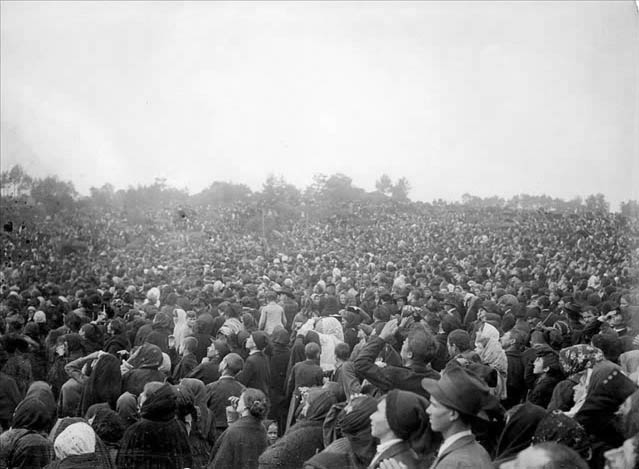
The estimated 70,000 people at the Miracle of the Sun

While the precise wording of the Secret remains unknown to the public, the labors of such famous Fatima scholars as Father Joachin Alonso (former official archivist of Fatima) and Frère Michel de la Sainte Trinité have nevertheless provided invaluable insights into its meaning and contents. The latter’s monumental 850-page work, The Third Secret is particularly noteworthy in this regard.

"The devil has succeeded in bringing in evil (to the Church) under the guise of good and the blind are beginning to lead others."
In his book, Frère Michel reports that, when questioned about the Secret, Sister Lucy said: "It’s in the Gospel and in the Apocalypse, read them!" He notes that she then particularly indicated Chapters VIII through XIII of the Apocalypse (Chapter XIII specifically concerns the rise of the Antichrist). In his study of the Third Secret, Frère Michel builds a powerful and compelling case that the Third Secret is a grave warning of apostasy within the Catholic Faith and a serious indictment of those in the Church hierarchy who have promoted dissent and outright heresy.

Although Sister Lucy is not permitted to reveal the final Secret of Our Lady until the Holy Father himself deems the moment opportune, nothing has prevented her from giving her opinion on the crisis in the Church as an individual person. In a series of letters written between 1969 and 1972, Sister Lucy reacted vigorously against modernists and others in the Church, in particular those who seek to minimize the importance of the Rosary. "This disorientation is diabolical," she wrote, and "it is sad that so many people let themselves be dominated by the diabolical wave sweeping over the world! And they are blinded to the point where they are incapable of seeing error! Their principal fault is that they have abandoned prayer." The saddest part of all, according to Sister Lucy, is that so many priests, religious and bishops are swept away in the confusion. "The devil has succeeded in bringing in evil (to the Church) under the guise of good and the blind are beginning to lead others, as the Lord tells us in His Gospel."

In the conclusion to his study of the Third Secret, Frère Michel sums up his findings as follows:

"Having reached the end of our inquiry, we are able to discern, with near certainty, the essential elements of Our Lady’s final secret: While ‘in Portugal, the dogma of the Faith will always be preserved,’ in many nations, perhaps in almost the entire world, the Faith will be lost. The pastors of the Church will fail gravely in the duties of their office. Through their fault, consecrated souls and the Faithful in great number will let themselves be seduced by pernicious errors spread everywhere. This will be the time of the decisive battle between the Blessed Virgin and the devil. A wave of diabolical disorientation will be hurled over the world. Satan will introduce himself even to the highest summit of the Church. He will blind the minds and harden the hearts of pastors. And God will deliver them to themselves as a chastisement for their refusal to obey the requests of the Immaculate Heart of Mary. This will be the great apostasy predicted for the ‘last times’; ‘the False Lamb’ and ‘False Prophet’ will betray the Church to the profit of ‘the Beast,’ according to the prophecy of the Apocalypse."

What you must do

It is up to each of us to listen, to read, to learn and to apply this Heavenly message in our own lives, particularly by praying the daily Rosary. To the extent we can, we must also do all we can to see to it that this final warning from Our Heavenly Mother is spread and that its significance is explained to everyone before it is too late. We must not be complacent in the promise of Her eventual triumph because it is still dependent on our co-operation with God’s grace and His plan outlined at Fatima. Our Lady will certainly triumph but we as individual Catholics might fall along the way.

This post has been edited by yeeck: May 13 2015, 03:52 PM
TSyeeck
post May 13 2015, 04:07 PM

Look at all my stars!!
*******
Senior Member
3,573 posts

Joined: Apr 2006


Modernism is Madness
May 12, 2015 by Fr. Dwight Longenecker


user posted image
Groovy Priests

You know the definition of insanity – when you repeat the same action over and over but expect different results.
A good example of this is left wing economics. Every experiment in socialism and communism has been a social, economic, human and political disaster of gigantic proportions. Nevertheless, left wingers continue to believe that what is needed is not to get rid of socialism forever, but to have MORE socialism.
Another example is universal sex education. The sex educators think that teen pregnancy, STDs and abortion will be reduced if only more young people were educated about contraceptive techniques, safe sex techniques and varied sexual practices. Of course when this happens there are more young people having sex so there are more STDs, teen pregnancies and abortions. The sex educators look at the results, scratch their heads and say, “I guess we need MORE sex education at a younger age.” So they start telling first graders about X rated stuff.
This is like putting orange juice in the tank of your car, and then when it doesn’t run you say, “Hey, I guess we didn’t put enough orange juice in the car!” So you open the back window and pour a couple of gallons in the back seat.
The same idiocy applies to modernism in the church.
The modernists said, “Let’s get rid of that supernatural stuff. Nobody can believe all that junk about Virgin Births, miracles, walking on the water and all that first century superstition. Let’s play all that down and tell everyone the church is about US and our family and our community. Let’s get rid of those dumb old hymns that had doctrine and long words in them. Doctrine is divisive and nobody knows what “consubstantial, co-eternal while unending ages run” really means nowadays. Then let’s tell people it doesn’t matter if they become priests and nuns. They can be holy just where they are. Oh yeah, let’s get everyone involved in peace and justice to make the world a better place because that’s really what its all about isn’t it–”what the world needs now is love sweet love….I want to teach the world to sin in perfect harmony…”
So the modernists eviscerated the church and cleansed it of the supernatural. They brought in banal hymns, even more banal sermons about being nice to one another, built flying pancake churches and brought in awful rock bands and polyester vestments and told everyone to just try a little bit harder to be nice folks.
And then the churches emptied. People felt if that was church they didn’t really need it, and they were right. They didn’t need that kind of church. If they wanted Protestant they should go Protestant because the Protestants do Protestant better than the Catholics ever will.
Then here’s the crunch. When the churches emptied and people voted with their feet the modernists said, “I guess we didn’t have enough modernism. To get people back we need MORE peace and justice stuff, MORE rock bands, MORE do-gooder sermons, MORE vapid homilies, in effect, MORE modernism.
And it will continue. They will never learn because that’s also one of the signs of true madness–the self delusion and insanity goes on forever without a cure.

Source: http://www.patheos.com/blogs/standingonmyh...nism-is-madness

This post has been edited by yeeck: May 13 2015, 04:09 PM
TSyeeck
post May 14 2015, 10:08 AM

Look at all my stars!!
*******
Senior Member
3,573 posts

Joined: Apr 2006


The liturgical spirit of the Ascension

user posted image

Some words about the Feast of the Ascension of Our Lord Jesus Christ into Heaven (Thursday May 14th, 2015 - 40 days after Easter) and associated liturgical and Catholic domestic practices.

Through the mystery of the Ascension we, who seemed unworthy of God’s earth, are taken up into Heaven. Our very nature, against which Cherubim guarded the gates of Paradise, is enthroned today high above all Cherubim."
Such are the words of St. John Chrysostom which plunge us directly into the mystery of Ascension Thursday. "Christ was lifted up to Heaven to make us sharers of His divinity."

Spirit of the Feast
Dr. Pius Parsch, in The Church’s Year of Grace, explains thus the meaning of Christ’s Ascension:

At the death of a beloved friend, we are filled with sorrow even though we know that his lot has been bettered. With this in mind we might expect the Church to commemorate her Savior’s ascension with at least some expression of sadness. Nothing can be further from the truth.

Today Christ triumphs, and is receiving the reward of his well earned merit. He patiently paid the price of our redemption, because He sought to free us from Satan’s power and effect our return home. This work, the object of His love and His life’s blood is now completed. He returns to heaven as a conqueror; Son stands before Father and tells of His mission completed.

We can characterize today’s feast as that of Christ’s heavenly enthronement, His coronation as King over heaven and earth."
This spirit is perfectly reflected in the hymn of Laud Salutis humanae Sator:

Hail, Thou who man’s Redeemer art,
Jesus, the joy of every heart,
Great Maker of the world’s wide frame
And purest love’s delight and flame!

Our guide, our way to heavenly rest,
Be Thou the aim of every breast;
Be Thou the soother of our tears,
Our sweet reward above the spheres. Amen"
Other names for this feast
The various words used by different regions exemplify the richness of this season. The Germans use the term Himmelfahrt (going up to Heaven). The Hungarians have a popular term "Thursday of the Communicants", because it was the traditional day of the annual Easter Communion. Most interesting is the Byzantine name, "Fulfilled Salvation", which St. Gregory of Nyssa explains thus: "The Ascension of Christ is the consummation and fulfillment of all other feasts and the happy conclusion of the earthly sojourn of Jesus Christ."

In Rome, the following Sunday is called "Sunday of the Rose", because then, the pope celebrates Mass at the church of Santa Maria Rotonda (the Pantheon, which predates the Christian era), and, in token of the Lord’s promise to send the Paraclete soon, a shower of roses is thrown from the central opening of the church.

Procession and folklore
From the beginning of its observance, this feast produced a liturgical procession which went outside the city, and usually to the top of a hill, in imitation of Christ’s leading the Apostles "out towards Bethany" (Lk 24:50). In Jerusalem, of course, it was the original path that Christ took to the summit of the Mount of Olives. In Rome, the pope was crowned by the cardinals in his chapel and in solemn procession conducted to the church of the Lateran. From there, after the Pontifical Mass, the procession went to a shrine outside the walls.

Ascension Plays became a generalized custom in Central and Western Europe. They enacted the Ascension by hoisting a statue of the Risen Christ aloft until it disappeared through an opening in the ceiling of the church. While the image, suspended on a rope, moved slowly upward, the people rose in the pews and stretched out their arms toward the figure of the Savior, acclaiming the Lord in prayer by singing a hymn such as "Ascendit Deus in altum, Alleluia" ("God rose on high").

Also, it was a widespread custom during the Middle Ages to eat a bird on Ascension Day, because Christ "flew" to Heaven. Pigeons, pheasants, partridges, and even crows, graced the dinner tables. In western Germany bakers gave their customers pieces of pastry made in the shapes of various birds. In England the feast was celebrated with games, dancing and horse races. In Central Europe, it is a traditional day of mountain climbing and picnics on hilltops and high places.
TSyeeck
post May 16 2015, 03:23 PM

Look at all my stars!!
*******
Senior Member
3,573 posts

Joined: Apr 2006


The Shroud: Not a Painting, Not a Scorch, Not a Photograph
March 27, 2015
“One of my favorite testimonials as to the authenticity of the Shroud,” says Barrie Schwortz, an expert on the Shroud of Turin, “actually came from my Jewish mother.”
Jim Graves

user posted image
People view the Shroud of Turin on display at the Cathedral of St. John the Baptist in Turin, Italy, in this April 26, 2010, file photo. (CNS photo/Paul Haring)

This June, Pope Francis will be making a pilgrimage to Turin, Italy, home of the famous Shroud of Turin, which many believe is the 2,000-year-old burial cloth of Jesus Christ. The pope’s June 21-22 visit will include time venerating the Shroud at the Cathedral of Saint John the Baptist. Francis will then visit the tomb of Bl. Pier Giorgio Frassati, buried in a nearby altar. The trip will also include a commemoration of St. John Bosco, founder of the Salesians and patron saint of youth who worked in Turin; this year marks the 200th anniversary of his birth. The papal visit will take advantage of April 19-June 24 exposition of the Shroud, which was last displayed in public in 2010.

The Shroud, which is a 14.5’ by 3.5’ linen cloth bearing the image of the front and back of a man who has been scourged and crucified, has been kept in Turin since 1578. Barrie Schwortz is one of the world’s leading experts on the Shroud. In 1978, Schwortz, a technical photographer, was invited to participate in the first ever in-depth scientific examination of the cloth, known as the Shroud of Turin Research Project (STRUP). A non-practicing Jew at the time, he reluctantly agreed to be part of STRUP, fully expecting the team to prove that the Shroud was a painted image from the Middle Ages. But after many years of study and reflection he came to believe in its authenticity.

Troubled by frequent inaccurate media reports on the subject, in 1996 Schwortz launched a website to share the true story of the Shroud and scientific research that had been performed on it. Two decades later he still makes Shroud presentations in the media and to a variety of groups, including seminarians in Rome.

Schwortz recently spoke with CWR.

CWR: What are some of the most compelling arguments that the Shroud is authentic?

user posted image
Barrie Schwortz (CNS photo/Paul Haring)

Barrie Schwortz: Thirty-seven years ago, when I went to Italy with STRUP to examine the Shroud, I assumed it was a fake, some sort of medieval painting. But after 10 minutes studying it, I knew it was not [a painting]. As a professional photographer, I was looking for brush strokes. But there was no paint and no brush strokes.

For 17 years I refused to accept that the Shroud was authentic. The last argument holding me back was related to the blood. The blood on the Shroud is reddish, but blood on a cloth, even after just a few hours, should turn brown or black. I had a conversation with Alan Adler, a blood chemist, on the phone and I shared my reservation. He got upset and asked, “Didn’t you read my paper?”

He had found a high content of bilirubin on the Shroud, which explains why the blood on the Shroud is red. When a man is beaten and has had no water, he can go into shock and the liver starts pumping out bilirubin. It makes the blood stay red forever. It was the last piece of the puzzle for me. I had nothing left to complain about. Sometimes I wonder why I hadn’t asked Alan Adler that question 17 years before, but I guess I wasn’t ready for the answer back then.

Although this was the final evidence that convinced me, it is no one particular piece of evidence that proves the Shroud is authentic. The entirety of evidence indicates that it is.

One of my favorite testimonials as to the authenticity of the Shroud actually came from my Jewish mother. She was originally from Poland, and had only a high school education. She heard one of my lectures, and afterwards we were driving home. She was quiet for a long time—you have to worry when a Jewish mother is quiet—so I asked her, “Mom, what did you think?” She said, “Barrie, of course it’s authentic. They wouldn’t have kept it for 2,000 years if it wasn’t.”

Now that was an excellent point. According to Jewish law, a blood-soaked shroud would have had to have been kept in the grave. To remove it, in fact, you would have been putting yourself at risk because you were violating the law.

The most plausible explanation to me for the Shroud, both because of the science and my own personal background as a Jew, is that it was the cloth that was used to wrap Jesus’ body.

CWR: What are some of the common falsehoods about the Shroud?

Schwortz: It would take hours to compose such a list. There seems to be a constant cacophony of nonsense being put out about the Shroud. One involves a medieval artist creating it by using three different photographic exposures and his own urine; I call that the “Shroud of Urine” theory. Now why would someone go to all that trouble when they simply could have painted an image?

The Shroud is a complex object, and a six-page article or 44-minute documentary—which must be entertaining—can’t do it justice. That’s why I created www.shroud.com so that people can review all the data and come to their own conclusion based on the facts.

CWR: What does the Shroud tell us about the physical sufferings of Christ?

Schwortz: It is literally a document of the Passion and the torture Jesus suffered. His face was severely beaten, and was particularly swollen around the eyes. I’m a fan of professional boxing; the facial image on the Shroud reminds me of a boxer who’s just lost a match.

The man has been severely scourged. Not only do we observe the wounds on the back, but the thongs wrapped around the body and hit the front as well. Forensically speaking, the image on the Shroud is more accurate than common depictions we see in art.

He has a spear wound on his side. His legs are not broken, as was typically the case with men who are crucified. His head and scalp are covered in wounds. Again, in art, we often see the Crown of Thorns depicted as a small circle resembling laurel leaves around Christ’s head. But that is not realistic. The soldiers actually took a thorn bush and smashed it down on his head.

We see the back of one hand, which indicates that the nails were driven not through the center of the palm, but an inch closer to the wrist. For a Roman soldier crucifying 20 or more people at a time, that makes sense. It’s the perfect place to drive a nail that will hold, and then you can move on to your next victim.

Regarding the feet, it’s impossible for us to judge if a single nail held both feet, or if nails were driven in each one. We have the actual remains of two crucifixion victims, and two nails were used in their feet.

CWR: Was he stretched out on the cross so that his arms were dislocated? And, had part of his beard been plucked out?

Schwortz: The forensic evidence tells us that he could have been stretched so that his arms were dislocated. And, we do observe a V-notch in his beard, indicating that it could have been plucked.

In the end, the forensic evidence indicates that the Gospel account is an accurate depiction of what happened during the Passion of Christ.

CWR: Some people have seen many other things in the Shroud, such as Roman coins covering Christ’s eyes.

Schwortz: Oh, yes. People see coins, flowers, and all kinds of other things that may or may not be there. Regarding the coins, on our STRUP team we had a NASA imaging scientist—a good Catholic, in fact—who indicated that the weave of the linen was too coarse to pick up the inscription of a coin. What we’re certain of is that we see an image of a man, and isn’t that what is important?

CWR: From your study of the Shroud, what kind of physical description of Christ can you offer us?

Schwortz: He was a well-built man; what we might describe as buff today. He had a strong upper body, a deep chest and good-sized shoulders. This makes sense, as he was a carpenter. At that time you’d have to go out and fell a tree, cut it up and carve it, all things which would require a lot of physical strength.

Regarding his height, it’s hard to tell. There is no defined edge of the image. It just fades out. The cloth, too, can be affected by humidity and stretched. That said, our best guess is 5’10” or 5’11”. So, he’d be a taller man for the time, but not so tall that the Gospel writers made note of it. In fact, we have the remains of Jewish men from the era that were over six feet.

CWR: Did he have a ponytail?

Schwortz: It certainly looks like it. Orthodox Jews of the period wore their hair long.

CWR: What can you tell us of the cloth itself?

Schwortz: It was a high-quality cloth that a man of high stature would have owned. It was probably made in Syria, and brought to Jerusalem on the back of a camel. Since it was imported, it would have been expensive. This is consistent with the Gospel account, which indicated that Joseph of Arimathea was a wealthy man. He probably owned it and had been planning to use it for himself.

Before my own Jewish father died he planned out his entire funeral. It’s reasonable to believe that Joseph of Arimathea did the same. When Christ died he gave him his own shroud, planning to buy another one for himself at some later date.

CWR: Your website just celebrated its 19th anniversary.

Schwortz: Yes. In 1995, I was talking to a friend, and he said, “You know that Shroud thing you’ve been studying? It was a painting by Leonardo da Vinci.” I asked him where he got that information. He said, “My wife and I were at the grocery store, and we saw it in a tabloid at the check-out.”

Now Leonardo da Vinci was a pretty good artist, but we have documentation about the Shroud dating back 100 years before he was born. No one is that good! I remember writing myself a note: “Consider building a website.” I did, and I’ve been overseeing and adding to it ever since.

I realized long ago what a great privilege it was to be in that room in Italy with STRUP in 1978. But with that privilege came a responsibility. As I tell my audiences, I wasn’t in that room for me, but for you. I don’t know why God picked me to be there, but what better witness than a skeptic? I had no emotional attachment to or interest in the subject at the time.

CWR: What was involved in your time with STRUP in 1978?

Schwortz: We arrived a week early with 80 crates of equipment, which was seized for five days by Italian customs. We had a limited time to implement a 67-page test plan, and as we had lost five days of preparation, we weren’t certain we could run all of our tests.

The Catholic Church itself had very little involvement. The Church, in fact, didn’t own the Shroud at the time. King Umberto, Duke of Savoy (the former ruling family of Italy), whose family had owned the Shroud for six centuries, gave permission for us to study it. The Church in Turin was merely the custodian of the artifact.

We initially asked for 96 hours to study it, but we were allowed to see it about 120 hours. We were there to collect data, not draw conclusions. We were there to answer one simple question: how was the image formed? In the three years following we produced papers that were submitted to peer-reviewed journals. In the end, we could only tell how it did not get there. It was not a painting, it was not a scorch, and it was not a photograph.

Our team was composed of experts of a variety of faiths, from Catholics to total skeptics. We had Mormons, Evangelical Christians, and Jews. Our religious belief was not a criterion for being on the team. In fact, as a Jew, I felt uncomfortable being on the team and I tried to quit twice. One of my friends on the STRUP team, Don Lynn, worked for JPL and was a good Catholic. When I told him I wanted to quit because I was Jewish, he asked, “Have you forgotten that Jesus was a Jew?”

I told him I didn’t know much about Jesus, but I did know he was a Jew. He asked, “Don’t you think he’d want one of the Chosen People on our team?” He told me to go to Turin and do the best job I could, and not worry about being a Jew.

CWR: Are there any other objects in the world that compare to the Shroud?

Schwortz: There is nothing like it.

CWR: What effect have you seen the Shroud have on people?

Schwortz: I’ve observed a broad range of responses. Some have no reaction, but for many others it revives their faltering faith. But, in the end, faith is not based on a piece of cloth, but is a gift of God stirred in the hearts of those who look upon it.

Source: http://www.catholicworldreport.com/Item/37...photograph.aspx
TSyeeck
post May 16 2015, 03:59 PM

Look at all my stars!!
*******
Senior Member
3,573 posts

Joined: Apr 2006


Looking UP: There are EYES in Heaven

Our Lord established a connection between heaven and earth, setting up vertical link... a sort of eye contact. When we make this contact with Him and keep it, we will not easily sin and ultimately we will save our souls! But if the link is cut, we will fail and fall into all sorts of sins and problems. This link is most easily destroyed and obscured by way of violation of the 6th and 9th Commandments, most especially through the eyes... Those who fall into impurity stop praying! And then they start doubting...and it all goes down hill from there. Consecration to Our Lady, the Helpmate of helpmates, prevents this from happening. For more please visit http://www.audiosancto.org & remember to say 3 Hail Marys for the priest


khool
post May 17 2015, 06:50 AM

Getting Started
**
Junior Member
225 posts

Joined: Mar 2008


Solemnity of the Ascension of the Lord; Seventh Sunday of Easter

Gospel Reading - Mk 16:15-20

Jesus said to his disciples:
“Go into the whole world
and proclaim the gospel to every creature.
Whoever believes and is baptized will be saved;
whoever does not believe will be condemned.
These signs will accompany those who believe:
in my name they will drive out demons,
they will speak new languages.
They will pick up serpents with their hands,
and if they drink any deadly thing, it will not harm them.
They will lay hands on the sick, and they will recover.”

So then the Lord Jesus, after he spoke to them,
was taken up into heaven
and took his seat at the right hand of God.
But they went forth and preached everywhere,
while the Lord worked with them
and confirmed the word through accompanying signs.
khool
post May 17 2015, 06:59 AM

Getting Started
**
Junior Member
225 posts

Joined: Mar 2008


Ascension Day explained with LEGO - For Children ... biggrin.gif:D:D:D


Courtesy: Father Roderick Vonhögen ... https://www.facebook.com/roderickvonhogen

This post has been edited by khool: May 18 2015, 12:12 PM
TSyeeck
post May 18 2015, 02:42 PM

Look at all my stars!!
*******
Senior Member
3,573 posts

Joined: Apr 2006


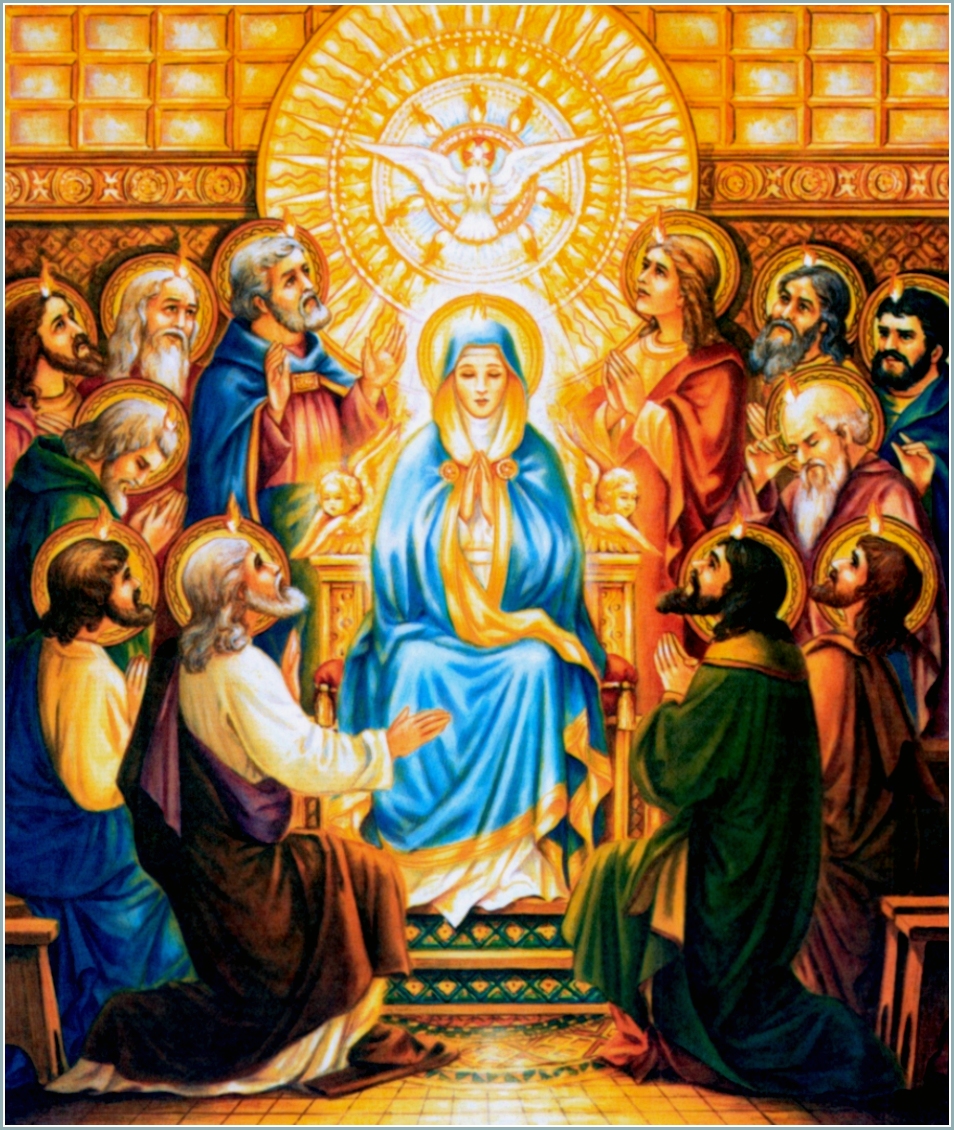
Sorry for posting this late as the novena is supposed to be started right after Ascension Thursday:
user posted image

Holy Spirit Novena
For the Feast of Pentecost


The novena in honor of the Holy Ghost is the oldest of all novenas since it was first made at the direction of Our Lord Himself when He sent His Apostles back to Jerusalem to await the coming of the Holy Ghost on the first Pentecost. Addressed to the Third Person of the Blessed Trinity, it is a powerful plea for the light and strength and love so sorely needed by every Catholic today. To encourage devotion to the Holy Spirit, the Church has granted the following indulgences:

"The faithful who devoutly assist at the public novena in honor of the Holy Spirit immediately preceding the Solemn Feast of Pentecost may gain a partial indulgence for themselves or as an offering for the intentions of the faithful departed.

Those who make a private novena in honor of the Holy Spirit, either before the Solemn Feast of Pentecost or at any other time in the year, may also gain a partial indulgence for themselves or as an offering for the intentions of the faithful departed."

Act of Oblation to the Holy Spirit
TO BE RECITED DAILY DURING THE NOVENA
ON MY KNEES before the great cloud of heavenly witnesses, I offer myself body and soul to Thee, eternal Spirit of God. I adore the brightness of Thy purity, the unerring keenness of Thy justice and the might of Thy love. Thou art the strength and light of my soul. In Thee I live and move and have my being. I desire never to grieve Thee by unfaithfulness to grace, and I pray with all my heart to be kept from the smallest sin against Thee. Make me faithful in every thought, and grant that I may always listen to Thy voice, watch for Thy light, and follow Thy gracious inspirations. I cling to Thee and give myself to Thee, and I ask Thee by Thy compassion to watch over me in my weakness. Holding the pierced feet of Jesus, looking at His five Wounds, trusting in His Precious Blood and adoring His opened side and stricken Heart, I implore Thee, adorable Spirit, Helper of my infirmity, so to keep me in Thy grace that I may never sin against Thee with the sin which Thou wilt not forgive. Grant to me the grace, O Holy Spirit, Spirit of the Father and of the Son, to say to Thee always and everywhere, "Speak, Lord, for Thy servant hears." Amen. (After a prayer by Cardinal Newman)

Prayer for the Seven Gifts of the Holy Ghost
TO BE RECITED DAILY DURING THE NOVENA
O LORD JESUS CHRIST, Who before ascending into Heaven didst promise to send the Holy Ghost to finish Thy work in the souls of Thine Apostles and Disciples, deign to grant the same Holy Spirit to me, that He may perfect in my soul the work of Thy grace and Thy love. Grant me the Spirit of Wisdom, that I may despise the perishable things of this world and aspire only after the things that are eternal; the Spirit of Understanding, to enlighten my mind with the light of Thy Divine truth; the Spirit of Counsel, that I may ever choose the surest way of pleasing God and gaining Heaven; the Spirit of Fortitude, that I may bear my cross with Thee and that I may overcome with courage all the obstacles that oppose my salvation; the Spirit of Knowledge, that I may know God and know myself and grow perfect in the science of the Saints; the Spirit of Piety, that I may find the service of God sweet and amiable; the Spirit of Fear, that I may be filled with a loving reverence towards God and may dread in any way to displease Him. Mark me, Dear Lord, with the sign of Thy true disciples, and animate me in all things with Thy Spirit. Amen.

FIRST DAY

O Holy Spirit! Lord of light!
From Thy clear celestial height,
Thy pure and beaming radiance give!

The Holy Ghost

Only one thing is important------eternal salvation. Only one thing, therefore, is to be feared------sin. Sin is the result of ignorance, weakness, and indifference. The Holy Ghost is the Spirit of Light, of Strength, and of Love. With His sevenfold gifts He enlightens the mind, strengthens the will, and inflames the heart with love of God. To ensure our salvation we ought to invoke the Divine Spirit daily, for "The Spirit helpeth our infirmity. We know not what we should pray for as we ought. But the Spirit Himself asketh for us."

Prayer

Almighty and eternal God, Who hast vouchsafed to regenerate us by water and the Holy Ghost, and hast given us forgiveness of all sins, vouchsafe to send forth from Heaven upon us Thy sevenfold Spirit, the Spirit of Wisdom and Understanding, the Spirit of Counsel and Fortitude, the Spirit of Knowledge and Piety, and fill us with the Spirit of Holy Fear. Amen.

Our Father and Hail Mary ONCE.
Glory be to the Father SEVEN TIMES.
Act of Oblation, Prayer for the Seven Gifts.

SECOND DAY
Come, Thou Father of the poor!
Come, with treasures which endure!
Come, Thou light of all that live!

The Gift of Fear

The gift of Fear fills us with a sovereign respect for God, and makes us dread nothing so much as to offend Him by sin. It is a fear that arises, not from the thought of Hell, but from sentiments of reverence and filial submission to our heavenly Father. It is the fear that is the beginning of wisdom, detaching us from worldly pleasures that could in any way separate us from God. "They that fear the Lord will prepare their hearts, and in His sight will sanctify their souls."

Prayer

Come, O blessed Spirit of Holy Fear, penetrate my inmost heart, that I may set Thee, my Lord and God, before my face forever; help me to shun all things that can offend Thee, and make me worthy to appear before the pure eyes of Thy Divine Majesty in Heaven, where Thou livest and reignest in the unity of the ever Blessed Trinity, God, world without end. Amen.

Our Father and Hail Mary ONCE.
Glory be to the Father SEVEN TIMES.
Act of Oblation, Prayer for the Seven Gifts.

THIRD DAY
Thou of all Consolers best,
Visiting the troubled breast,
Dost refreshing peace bestow.

The Gift of Piety

The gift of Piety begets in our hearts a filial affection for God as our most loving Father. It inspires us to love and respect for His sake persons and things consecrated to Him, as well as those who are vested with His authority, His Blessed Mother and the Saints, the Church and its visible Head, our parents and superiors, our country and its rulers. He who is filled with the gift of Piety finds the practice of his religion, not a burdensome duty, but a delightful service. Where there is love, there is no labor.

Prayer

Come, O Blessed Spirit of Piety, possess my heart. Enkindle therein such a love for God, that I may find satisfaction only in His service, and for His sake lovingly submit to all legitimate authority. Amen.


Our Father and Hail Mary ONCE.
Glory be to the Father SEVEN TIMES.
Act of Oblation, Prayer for the Seven Gifts.

FOURTH DAY
Thou in toil art Comfort sweet,
Pleasant coolness in the heat,
Solace in the midst of woe.

The Gift of Fortitude

By the gift of Fortitude the soul is strengthened against natural fear, and supported to the end in the performance of duty. Fortitude imparts to the will an impulse and energy which move it to undertake without hesitancy the most arduous tasks, to face dangers, to trample under foot human respect, and to endure without complaint the slow martyrdom of even lifelong tribulation. "He that shall persevere unto the end, he shall be saved."

Prayer

Come, O Blessed Spirit of Fortitude, uphold my soul in time of trouble and adversity, sustain my efforts after holiness, strengthen my weakness, give me courage against all the assaults of my enemies, that I may never be overcome and separated from Thee, my God and greatest Good. Amen.


Our Father and Hail Mary ONCE.
Glory be to the Father SEVEN TIMES.
Act of Oblation, Prayer for the Seven Gifts.


FIFTH DAY
Light immortal! Light Divine!
Visit Thou these hearts of Thine,
And our inmost being fill.

The Gift of Knowledge

The gift of Knowledge enables the soul to evaluate created things at their true worth-----in their relation to God. Knowledge unmasks the pretense of creatures, reveals their emptiness, and points out their only true purpose as instruments in the service of God. It shows us the loving care of God even in adversity, and directs us to glorify Him in every circumstance of life. Guided by its light, we put first things first, and prize the friendship of God beyond all else. "Knowledge is a fountain of life to him that possesseth it."

Prayer

Come, O Blessed Spirit of Knowledge, and grant that I may perceive the will of the Father; show me the nothingness of earthly things, that I may realize their vanity and use them only for Thy glory and my own salvation, looking ever beyond them to Thee, and Thy eternal rewards. Amen.


Our Father and Hail Mary ONCE.
Glory be to the Father SEVEN TIMES.
Act of Oblation, Prayer for the Seven Gifts.

SIXTH DAY

If Thou take Thy grace away,
Nothing pure in man will stay;
All his good is turned to ill.

The Gift of Understanding

Understanding, as a gift of the Holy Ghost, helps us to grasp the meaning of the truths of our holy religion. By faith we know them, but by Understanding we learn to appreciate and relish them, It enables us to penetrate the inner meaning of revealed truths and,through them to be quickened to newness of life. Our faith ceases to be sterile and inactive, but inspires a mode of life that bears eloquent testimony to the faith that is in us; we begin to "walk worthy of God in all things pleasing, and increasing in the knowledge of God."

Prayer

Come, O Spirit of Understanding, and enlighten our minds, that we may know and believe all the mysteries of salvation; and may merit at last to see the eternal light in Thy Light; and in the light of glory to have a clear vision of Thee and the Father and the Son, Amen.


Our Father and Hail Mary ONCE.
Glory be to the Father SEVEN TIMES.
Act of Oblation, Prayer for the Seven Gifts.

SEVENTH DAY
Heal our wounds, our strength renew;
On our dryness, pour Thy dew;
Wash the stains of guilt away.

The Gift of Counsel

The gift of Counsel endows the soul with supernatural prudence, enabling it to judge promptly and rightly what must be done, especially in difficult circumstances. Counsel applies the principles furnished by Knowledge and Understanding to the innumerable concrete cases that confront us in the course of our daily duty as parents, teachers, public servants, and Catholic citizens. Counsel is supernatural common sense, a priceless treasure in the quest of salvation. "Above all these things, pray to the Most High, that He may direct thy way in truth."

Prayer

Come, O Spirit of Counsel, help and guide me in all my ways, that I may always do Thy holy will. Incline my heart to that which is good; turn it away from all that is evil, and direct me by the straight path of Thy Commandments to that goal of eternal life for which I long. Amen.


Our Father and Hail Mary ONCE.
Glory be to the Father SEVEN TIMES.
Act of Oblation, Prayer for the Seven Gifts.

EIGHTH DAY
Bend the stubborn heart and will;
Melt the frozen, warm the chill;
Guide the steps that go astray.

The Gift of Wisdom

Embodying all the other gifts, as charity embraces all the other virtues, Wisdom is the most perfect of the gifts. Of wisdom it is written "all good things came to me with her, and innumerable riches through her hands." It is the gift of Wisdom that strengthens our faith, fortifies hope, perfects charity, and promotes the practice of virtue in the highest degree. Wisdom enlightens the mind to discern and relish things Divine, in the appreciation of which earthly joys lose their savor, whilst the Cross of Christ yields a Divine sweetness according to the words of the Saviour: "Take up thy cross and follow me, for mM yoke is sweet and My burden light."

Prayer

Come, O Spirit of Wisdom, and reveal to my soul the mysteries of heavenly things, their exceeding greatness, power and beauty. Teach me to love them above and beyond all the passing joys and satisfactions of earth. Help me to attain them and possess them for ever. Amen.


Our Father and Hail Mary ONCE.
Glory be to the Father SEVEN TIMES.
Act of Oblation, Prayer for the Seven Gifts.

NINTH DAY
Thou, on those who evermore
Thee confess and Thee adore,
In Thy sevenfold Gifts descend.

Give them comfort when they die;
Give them life with Thee on high;
Give them joys which never end. Amen.

The Fruits of the Holy Ghost

The gifts of the Holy Ghost perfect the supernatural virtues by enabling us to practice them with greater docility to Divine inspiration. As we grow in the knowledge and love of God under the direction of the Holy Ghost, our service becomes more sincere and generous, the practice of virtue more perfect. Such acts of virtue leave the heart filled with joy and consolation and are known as Fruits of the Holy Ghost. These Fruits in turn render the practice of virtue more attractive and become a powerful incentive for still greater efforts in the service of God, to serve Whom is to reign.

Prayer

Come, O Divine Spirit, fill my heart with Thy heavenly fruits, Thy charity, joy, peace, patience, benignity, goodness, faith, mildness, and temperance, that I may never weary in the service of God, but by continued faithful submission to Thy inspiration may merit to be united eternally with Thee in the love of the Father and the Son. Amen.

Our Father and Hail Mary ONCE.
Glory be to the Father SEVEN TIMES.
Act of Oblation, Prayer for the Seven Gifts.
TSyeeck
post May 21 2015, 02:45 PM

Look at all my stars!!
*******
Senior Member
3,573 posts

Joined: Apr 2006


Antinomianism

(anti, against, and nomos, law)

user posted image

The heretical doctrine that Christians are exempt from the obligations of moral law. The term first came into use at the Protestant Reformation, when it was employed by Martin Luther to designate the teachings of Johannes Agricola and his sectaries, who, pushing a mistaken and perverted interpretation of the Reformer's doctrine of justification by faith alone to a far-reaching but logical conclusion, asserted that, as good works do not promote salvation, so neither do evil works hinder it; and, as all Christians are necessarily sanctified by their very vocation and profession, so as justified Christians, they are incapable of losing their spiritual holiness, justification, and final salvation by any act of disobedience to, or even by any direct violation of the law of God. This theory — for it was not, and is not necessarily, anything more than a purely theoretical doctrine, and many professors of Antinomianism, as a matter of fact, led, and lead, lives quite as moral as those of their opponents — was not only a more or less natural outgrowth from the distinctively Protestant principle of justification by faith, but probably also the result of an erroneous view taken with regard to the relation between the Jewish and Christian dispensations and the Scriptures of the Old and New Testaments. Doubtless a confused understanding of the Mosaic ceremonial precepts and the fundamental moral law embodied in the Mosaic code was to no small extent operative in allowing the conception of true Christian liberty to grow beyond all reasonable bounds, and to take the form of a theoretical doctrine of unlimited licentiousness.
Although the term designating this error came into use only in the sixteenth century, the doctrine itself can be traced in the teaching of the earlier heresies. Certain of the Gnostic sect — possibly, for example, Marcion and his followers, in their antithesis of the Old and New Testament, or the Carpoeratians, in their doctrine of the indifference of good works and their contempt for all human laws — held Antinomian or quasi-Antinomian views. In any case, it is generally understood that Antinomianism was professed by more than one of the Gnostic schools. Several passages of the New Testament writings are quoted in support of the contention that even as early as Apostolic times it was found necessary to single out and combat this heresy in its theoretical or dogmatic as well as in its grosser and practical form. The indignant words of St. Paul in his Epistles to the Romans and to the Ephesians (Romans 3:8, 31; 6:1; Ephesians 5:6), as well as those of St. Peter, the Second Epistle (2 Peter 2:18, 19), seem to lend direct evidence in favour of this view. Forced into a somewhat doubtful prominence by the "slanderers" against whom the Apostle found it necessary to warn the faithful, persisting spasmodically in several of the Gnostic bodies, and possibly also colouring some of the tenets of the Albigenses, Antinomianism reappeared definitely, as a variant of the Protestant doctrine of faith, early in the history of the German Reformation. At this point it is of interest to note the sharp controversy that it provoked between the leader of the reforming movement in Germany and his disciple and fellow townsman, Johannes Agricola. Schitter, or Schneider, sometimes known as the Magister Islebius, was born at Eisleben in 1492, nine years after the birth of Luther. He studied and afterwards, taught, at Wittenberg, whence, in 1525, he went to Frankfort with the intention of teaching and establishing the Protestant religion there. But shortly afterwards, he returned to his native town, where he remained until 1536, teaching in the school of St. Andrew, and drawing considerable attention to himself as a preacher of the new religion by the courses of sermons that he delivered in the Nicolai Church. In 1536 he was recalled to Wittenberg and given a chair at the University. Then the Antinomian controversy, which had really begun some ten years previously, broke out afresh, with renewed vigour and bitterness. Agricola, who was undoubtedly anxious to defend and justify the novel doctrine of his leader upon the subject of grace and justification, and who wished to separate the new Protestant view more clearly and distinctly from the old Catholic doctrine of faith and good works, taught that only the unregenerate were under the obligation of the law, whereas regenerate Christians were entirely absolved and altogether free from any such obligation. Though it is highly probable that he made Agricola responsible for opinions which the latter never really held, Luther attacked him vigorously is six dissertations, showing that "the law gives man the consciousness of sin, and that the fear of the law is both wholesome and necessary for the preservation of morality and of divine, as well as human, institutions"; and on several occasions Agricola found himself obliged to retract or modify his Antinomian teaching. In 1540 Agricola, forced to this step by Luther, who had secured to this end the assistance of the Elector of Brandenburg, definitely recanted. But it was not long before the wearisome controversy was reopened by Poach of Erfurt (1556). This led ultimately to an authoritative and complete statement, on the part of the Lutheran, of the teaching upon the subject by the German Protestant leaders, in the fifth and sixth articles of the "Formula Concordiae". St. Alphonsus Liguori states that after Luther's death Agricola went to Berlin, commenced teaching his blasphemies again, and died there, at the age of seventy-four, without any sign of repentance; also, that Florinundus calls the Antinomians "Atheists who believe in neither God nor the devil." So much for the origin and growth of the Antinomian heresy in the Lutheran body. Among the high Calvinists also the doctrine was to be found in the teaching that the elect do not sin by the commission of actions that in themselves are contrary to the precepts of the moral law, which the Anabaptists of Munster had no scruple in putting these theories into actual practice.
From Germany Antinomianism soon travelled to England, where it was publicly taught, and in some cases even acted upon, by many of the sectaries during the Protectorate of Oliver Cromwell. The state of religion in England, as well as in the Colonies, immediately preceding and during this troublesome period of history was an extraordinary one, and when the independents obtained the upper hand there was no limit to the vagaries of the doctrines, imported or invented, that found so congenial a soil in which to take root and spread. Many of the religious controversies that then arose turned naturally upon the doctrines of faith, grace, and justification which occupied so prominent a place in contemporary thought, and in these controversies Antinomianism frequently figured. A large number of works, tracts, and sermons of this period are extant in which the fierce and intolerant doctrines of the sectaries are but thinly veiled under the copious quotation from the Scriptures that lend so peculiar an effect to their general style. In the earlier part of the seventeenth century, Dr. Tobias Crisp, Rector of Brinkwater (b. 1600), was accused, in the company of others, of holding and teaching similar views. His most notable work is "Christ Alone Exalted" (1643). His opinions were controverted with some ability by Dr. Daniel Williams, the founder of the Dissenters' Library. Indeed, to such an extent were extreme Antinomian doctrines held, and even practised, as early as the reign of Charles I, that, after Cudworth's sermon against the Antinomians (on John 2:3-4) was preached before the Commons of England (1647), the Parliament was obliged to pass severe enactments against them (1648). Anyone convicted on the oaths of two witnesses of maintaining that the moral law of the Ten Commandments was no rule for Christians, or that a believer need not repent or pray for pardon of sin, was bound publicly to retract, or, if he refused, be imprisoned until he found sureties that he would no more maintain the same. Shortly before this date, the heresy made its appearance in America, where, at Boston, the Antinomian opinions of Anne Hutchinson were formally condemned by the Newton Synod (1636).

Although from the seventeenth century onward Antinomianism does not appear to be an official doctrine of any of the more important Protestant sects, at least it has undoubtedly been held from time to time either by individual members of sections, and taught, both by implication and actually, by the religious leaders of several of these bodies. Certain forms of Calvinism may seem capable of bearing an Antinomian construction. Indeed it has been said that the heresy is in reality nothing more than "Calvinism run to the seed". Mosheim regarded the Antinomians as a rigid kind of Calvinists who, distorting the doctrines of absolute decrees, drew from it conclusions dangerous to religion and morals. Count Zinzendorf (1700-60), the founder of the Herrnhuters, or Moravians, was accused of Antinomianism by Bengal, as was William Huntingdon, who, however, took pains to disclaim the imputation.

But possibly the most noteworthy instance is that of the Plymouth Brethren, of whom some are quite frankly Antinomian in their doctrine of justification and sanctification. It is their constant assertion that the law is not the rule or standard of the life of the Christian. Here again, as in the case of Agricola, it is a theoretical and not a practical Antinomianism that in inculcated. Much of the teaching of the members of this sect recalls "the wildest, vagaries of the Antinomian heresy, which at the same time their earnest protests against such a construction being put upon their words, and the evident desire of their writers to enforce a high standard of practical holiness, forbid us to follow out some of their statements to what seems to be their logical conclusion." Indeed, the doctrine generally is held theoretically, where held at all, and has seldom been advocated to be put in practice and acted upon. Except, as has already been noted, in the case of the Anabaptists of Munster and of some of the more fanatical sections of the Commonwealth, as well as in a small number of other isolated and sporadic cases, it is highly doubtful if it has ever been directly put forward as an excuse for licentiousness; although, as can easily be seen, it offers the gravest possible incentive to, and even justification of, both private and public immorality in its worst and most insidious form.

As the doctrine of Antinomianism, or legal irresponsibility, is an extreme type of the heretical doctrine of justification by faith alone as taught by the Reformers, it is only natural to find it condemned by the Catholic Church in company with its fundamentally Protestant tenet. The sixth session of the Ecumenical Council of Trent was occupied with this subject and published its famous decree on Justification. The fifteenth chapter of this decree is directly concerned with Antinomian heresy, and condemns it in the following terms: "In opposition also to the cunning wits of certain men who, by good works and fair speeches, deceive the hearts of the innocent, it is to be maintained that the received grace of justification is lost not only by the infidelity, in which even faith itself if lost, but also by any other mortal sin soever, though faith be not lost; thereby defending the doctrine of the Divine law, which excludes from the King of God not only the unbelieving, but also the faithful who are fornicators, adulterers, effeminate, abusers of themselves with mankind, thieves, covetous, drunkards, revilers, extortioners, and all others who commit deadly sins; from which, with the help of Divine grace, they are able to refrain and on account of which they are separate from the grace of Christ" (Cap. xv, cf. also Cap. xii). Also, among the canons anathematizing the various erroneous doctrines advanced by the Reformers as to the meaning and nature of justification are to be found in the following:

Canon 19: "If anyone shall say that nothing besides faith is commanded in the Gospel; that other things are indifferent, neither commanded nor prohibited, but free; or that the Ten Commandments in no wise appertain to Christians; let him be anathema."
Canon 20: "If anyone shall say that a man who is justified and how perfect soever is not bound to the observance of the commandments of God and the Church, but only to believe; as if forsooth, the Gospel were a bare and absolute promise of eternal life, without the condition of observation of the commandments; let him be anathema."
Canon 21: "If anyone shall say that Christ Jesus was given of God unto men as a Redeemer in whom they should trust, and not also as a legislator whom they should obey; let him be an anathema."
Canon 27: "If anyone shall say that there is no deadly sin but that of infidelity; or that grace once received is not lost by any other sin, however grievous and enormous, save only by that infidelity; let him be anathema."

"If you love me, keep my commandments." - John 14:15
pkh
post May 21 2015, 03:30 PM

Casual
***
Junior Member
316 posts

Joined: Nov 2005
From: Saya Berjaya


Just one more week left before the re-shuffling. Too bad I'll be travelling instate and can't attend the farewells. Sigh ...
khool
post May 22 2015, 10:47 AM

Getting Started
**
Junior Member
225 posts

Joined: Mar 2008


QUOTE(pkh @ May 21 2015, 03:30 PM)
Just one more week left before the re-shuffling. Too bad I'll be travelling instate and can't attend the farewells. Sigh ...
*
Oh yes, June is almost upon us. I suppose we need to remember that we, as Catholics are called to be pilgrims in this world, not just in the physical sense but in the spiritual also?

TSyeeck
post May 22 2015, 01:57 PM

Look at all my stars!!
*******
Senior Member
3,573 posts

Joined: Apr 2006


History repeats itself

user posted image
Michelangelo's Doni Madonna

The artists of the Renaissance have left us some of the greatest masterpieces that human genius has ever created. The perfection reached by painters, sculptors and architects of that era is mindboggling. The two pictures on this page, one from Michelangelo, the other from Botticelli, are illustrations of the mastery of these Renaissance artists whose talents have never really been surpassed.

user posted image
Boticelli's Madonna of the Magnificat

Where does this blossoming of incomparable religious and cultural artefacts originate? It is the result of the brewing of knowledge that took place in the Universities and schools opened by the Catholic Church in the Middle Ages. Remember, until the Protestant revolution of 1517 launched by Martin Luther, Europe was a Catholic continent and all the centres of science were in the hands of the Church run by clerics or Catholic laymen. The Middle Ages were not the times of ignorance that biased modern history books want us to believe. It was a flourishing period of research and studies of the laws of nature and is at the
origin of the extraordinary technical progress that took place in the Renaissance and never stop ever since.

How is it that the Renaissance with its refined Christian civilisation was immediately followed by the rebellion of half of Europe against the Church in the wake of the revolt of the monk of Wittenberg? Why such a sudden collapse? During the 1400s ( the famous Italian Quattrocento), men impressed by the power of the human mind and amazed by their scientific discoveries became infatuated with themselves like the Narcissus of the Greek Mythology.

user posted image
Narcissus looking at his image in the water falls in love with himself: a representation of our modern world

They saw themselves so great that they started forgetting to whom they owed their gifts. God was gradually put aside. Artists of the Renaissance, without completely forgetting their faith for which they still produced exquisite works, focused on the exaltation of man rather than their Creator. So many paintings and sculptures, even in churches, cannot be looked at without feeling embarrassed at this ostentation of flesh. A glance at the wall of the Sistine Chapel, for instance, won’t help you to raise your soul to God, unfortunately.

When man reaches a certain perfection, his pride prevents him from remaining at a high level. He becomes tired of the best. Like Adam and Eve in the Garden, tired of having it too easy, he slips into a kind of nonchalance that leads him to become decadent. This is exactly what we observe nowadays. Christian principles have shaped our modern world and favoured a huge progress in every aspect of human activity - politics, economics, education, health, safety. It has made our life easier than it ever was. Yet, instead of being grateful to what Our Lord Jesus Christ and His Church have given to the world, modern men turn against them, blinded by their own achievements. Again the story of Narcissus.

Saint Augustine perfectly summarised what we are experiencing today in his book The City of God: “two cities have been formed by two loves: the earthly by the love of self, even to the contempt of God; the heavenly by the love of God, even to the contempt of self” [The City of God, Book XIV Chap. 28].

Father Fabrice Loschi
khool
post May 23 2015, 10:40 AM

Getting Started
**
Junior Member
225 posts

Joined: Mar 2008


Pentecost Sunday
Mass during the Day
Lectionary: 63

Gospel

Jn 20:19-23
On the evening of that first day of the week,
when the doors were locked, where the disciples were,
for fear of the Jews,
Jesus came and stood in their midst
and said to them, “Peace be with you.”
When he had said this, he showed them his hands and his side.
The disciples rejoiced when they saw the Lord.
Jesus said to them again, “Peace be with you.
As the Father has sent me, so I send you.”
And when he had said this, he breathed on them and said to them,
“Receive the Holy Spirit.
Whose sins you forgive are forgiven them,
and whose sins you retain are retained.”

Or

Jn 15:26-27; 16:12-15
Jesus said to his disciples:
“When the Advocate comes whom I will send you from the Father,
the Spirit of truth that proceeds from the Father,
he will testify to me.
And you also testify,
because you have been with me from the beginning.

“I have much more to tell you, but you cannot bear it now.
But when he comes, the Spirit of truth,
he will guide you to all truth.
He will not speak on his own,
but he will speak what he hears,
and will declare to you the things that are coming.
He will glorify me,
because he will take from what is mine and declare it to you.
Everything that the Father has is mine;
for this reason I told you that he will take from what is mine
and declare it to you.”

This post has been edited by khool: May 23 2015, 10:48 AM
khool
post May 23 2015, 10:41 AM

Getting Started
**
Junior Member
225 posts

Joined: Mar 2008


CATECHISM OF THE CATHOLIC CHURCH

PART THREE
LIFE IN CHRIST

SECTION ONE
MAN'S VOCATION LIFE IN THE SPIRIT

CHAPTER ONE
THE DIGNITY OF THE HUMAN PERSON

ARTICLE 8
SIN

I. MERCY AND SIN

1846 The Gospel is the revelation in Jesus Christ of God's mercy to sinners.113 The angel announced to Joseph: "You shall call his name Jesus, for he will save his people from their sins."114 The same is true of the Eucharist, the sacrament of redemption: "This is my blood of the covenant, which is poured out for many for the forgiveness of sins."115

1847 "God created us without us: but he did not will to save us without us."116 To receive his mercy, we must admit our faults. "If we say we have no sin, we deceive ourselves, and the truth is not in us. If we confess our sins, he is faithful and just, and will forgive our sins and cleanse us from all unrighteousness."117

1848 As St. Paul affirms, "Where sin increased, grace abounded all the more."118 But to do its work grace must uncover sin so as to convert our hearts and bestow on us "righteousness to eternal life through Jesus Christ our Lord."119 Like a physician who probes the wound before treating it, God, by his Word and by his Spirit, casts a living light on sin:

Conversion requires convincing of sin; it includes the interior judgment of conscience, and this, being a proof of the action of the Spirit of truth in man's inmost being, becomes at the same time the start of a new grant of grace and love: "Receive the Holy Spirit." Thus in this "convincing concerning sin" we discover a double gift: the gift of the truth of conscience and the gift of the certainty of redemption. The Spirit of truth is the Consoler.120

II. THE DEFINITION OF SIN

1849 Sin is an offense against reason, truth, and right conscience; it is failure in genuine love for God and neighbor caused by a perverse attachment to certain goods. It wounds the nature of man and injures human solidarity. It has been defined as "an utterance, a deed, or a desire contrary to the eternal law."121

1850 Sin is an offense against God: "Against you, you alone, have I sinned, and done that which is evil in your sight."122 Sin sets itself against God's love for us and turns our hearts away from it. Like the first sin, it is disobedience, a revolt against God through the will to become "like gods,"123 knowing and determining good and evil. Sin is thus "love of oneself even to contempt of God."124 In this proud self- exaltation, sin is diametrically opposed to the obedience of Jesus, which achieves our salvation.125

1851 It is precisely in the Passion, when the mercy of Christ is about to vanquish it, that sin most clearly manifests its violence and its many forms: unbelief, murderous hatred, shunning and mockery by the leaders and the people, Pilate's cowardice and the cruelty of the soldiers, Judas' betrayal - so bitter to Jesus, Peter's denial and the disciples' flight. However, at the very hour of darkness, the hour of the prince of this world,126 the sacrifice of Christ secretly becomes the source from which the forgiveness of our sins will pour forth inexhaustibly.

III. THE DIFFERENT KINDS OF SINS

1852 There are a great many kinds of sins. Scripture provides several lists of them. The Letter to the Galatians contrasts the works of the flesh with the fruit of the Spirit: "Now the works of the flesh are plain: fornication, impurity, licentiousness, idolatry, sorcery, enmity, strife, jealousy, anger, selfishness, dissension, factions, envy, drunkenness, carousing, and the like. I warn you, as I warned you before, that those who do such things shall not inherit the Kingdom of God."127

1853 Sins can be distinguished according to their objects, as can every human act; or according to the virtues they oppose, by excess or defect; or according to the commandments they violate. They can also be classed according to whether they concern God, neighbor, or oneself; they can be divided into spiritual and carnal sins, or again as sins in thought, word, deed, or omission. The root of sin is in the heart of man, in his free will, according to the teaching of the Lord: "For out of the heart come evil thoughts, murder, adultery, fornication, theft, false witness, slander. These are what defile a man."128 But in the heart also resides charity, the source of the good and pure works, which sin wounds.

IV. THE GRAVITY OF SIN: MORTAL AND VENIAL SIN

1854 Sins are rightly evaluated according to their gravity. The distinction between mortal and venial sin, already evident in Scripture,129 became part of the tradition of the Church. It is corroborated by human experience.

1855 Mortal sin destroys charity in the heart of man by a grave violation of God's law; it turns man away from God, who is his ultimate end and his beatitude, by preferring an inferior good to him.

Venial sin allows charity to subsist, even though it offends and wounds it.

1856 Mortal sin, by attacking the vital principle within us - that is, charity - necessitates a new initiative of God's mercy and a conversion of heart which is normally accomplished within the setting of the sacrament of reconciliation:

When the will sets itself upon something that is of its nature incompatible with the charity that orients man toward his ultimate end, then the sin is mortal by its very object . . . whether it contradicts the love of God, such as blasphemy or perjury, or the love of neighbor, such as homicide or adultery. . . . But when the sinner's will is set upon something that of its nature involves a disorder, but is not opposed to the love of God and neighbor, such as thoughtless chatter or immoderate laughter and the like, such sins are venial.130

1857 For a sin to be mortal, three conditions must together be met: "Mortal sin is sin whose object is grave matter and which is also committed with full knowledge and deliberate consent."131

1858 Grave matter is specified by the Ten Commandments, corresponding to the answer of Jesus to the rich young man: "Do not kill, Do not commit adultery, Do not steal, Do not bear false witness, Do not defraud, Honor your father and your mother."132 The gravity of sins is more or less great: murder is graver than theft. One must also take into account who is wronged: violence against parents is in itself graver than violence against a stranger.

1859 Mortal sin requires full knowledge and complete consent. It presupposes knowledge of the sinful character of the act, of its opposition to God's law. It also implies a consent sufficiently deliberate to be a personal choice. Feigned ignorance and hardness of heart133 do not diminish, but rather increase, the voluntary character of a sin.

1860 Unintentional ignorance can diminish or even remove the imputability of a grave offense. But no one is deemed to be ignorant of the principles of the moral law, which are written in the conscience of every man. The promptings of feelings and passions can also diminish the voluntary and free character of the offense, as can external pressures or pathological disorders. Sin committed through malice, by deliberate choice of evil, is the gravest.

1861 Mortal sin is a radical possibility of human freedom, as is love itself. It results in the loss of charity and the privation of sanctifying grace, that is, of the state of grace. If it is not redeemed by repentance and God's forgiveness, it causes exclusion from Christ's kingdom and the eternal death of hell, for our freedom has the power to make choices for ever, with no turning back. However, although we can judge that an act is in itself a grave offense, we must entrust judgment of persons to the justice and mercy of God.

1862 One commits venial sin when, in a less serious matter, he does not observe the standard prescribed by the moral law, or when he disobeys the moral law in a grave matter, but without full knowledge or without complete consent.

1863 Venial sin weakens charity; it manifests a disordered affection for created goods; it impedes the soul's progress in the exercise of the virtues and the practice of the moral good; it merits temporal punishment. Deliberate and unrepented venial sin disposes us little by little to commit mortal sin. However venial sin does not break the covenant with God. With God's grace it is humanly reparable. "Venial sin does not deprive the sinner of sanctifying grace, friendship with God, charity, and consequently eternal happiness."134

While he is in the flesh, man cannot help but have at least some light sins. But do not despise these sins which we call "light": if you take them for light when you weigh them, tremble when you count them. A number of light objects makes a great mass; a number of drops fills a river; a number of grains makes a heap. What then is our hope? Above all, confession.135

1864 "Therefore I tell you, every sin and blasphemy will be forgiven men, but the blasphemy against the Spirit will not be forgiven."136 There are no limits to the mercy of God, but anyone who deliberately refuses to accept his mercy by repenting, rejects the forgiveness of his sins and the salvation offered by the Holy Spirit.137 Such hardness of heart can lead to final impenitence and eternal loss.

V. THE PROLIFERATION OF SIN

1865 Sin creates a proclivity to sin; it engenders vice by repetition of the same acts. This results in perverse inclinations which cloud conscience and corrupt the concrete judgment of good and evil. Thus sin tends to reproduce itself and reinforce itself, but it cannot destroy the moral sense at its root.

1866 Vices can be classified according to the virtues they oppose, or also be linked to the capital sins which Christian experience has distinguished, following St. John Cassian and St. Gregory the Great. They are called "capital" because they engender other sins, other vices.138 They are pride, avarice, envy, wrath, lust, gluttony, and sloth or acedia.

1867 The catechetical tradition also recalls that there are "sins that cry to heaven": the blood of Abel,139 the sin of the Sodomites,140 the cry of the people oppressed in Egypt,141 the cry of the foreigner, the widow, and the orphan,142 injustice to the wage earner.143

1868 Sin is a personal act. Moreover, we have a responsibility for the sins committed by others when we cooperate in them:

- by participating directly and voluntarily in them;

- by ordering, advising, praising, or approving them;

- by not disclosing or not hindering them when we have an obligation to do so;

- by protecting evil-doers.

1869 Thus sin makes men accomplices of one another and causes concupiscence, violence, and injustice to reign among them. Sins give rise to social situations and institutions that are contrary to the divine goodness. "Structures of sin" are the expression and effect of personal sins. They lead their victims to do evil in their turn. In an analogous sense, they constitute a "social sin."144

IN BRIEF

1870 "God has consigned all men to disobedience, that he may have mercy upon all" (Rom 11:32).

1871 Sin is an utterance, a deed, or a desire contrary to the eternal law (St. Augustine, Faust 22:PL 42, 418). It is an offense against God. It rises up against God in a disobedience contrary to the obedience of Christ.

1872 Sin is an act contrary to reason. It wounds man's nature and injures human solidarity.

1873 The root of all sins lies in man's heart. The kinds and the gravity of sins are determined principally by their objects.

1874 To choose deliberately - that is, both knowing it and willing it - something gravely contrary to the divine law and to the ultimate end of man is to commit a mortal sin. This destroys in us the charity without which eternal beatitude is impossible. Unrepented, it brings eternal death.

1875 Venial sin constitutes a moral disorder that is reparable by charity, which it allows to subsist in us.

1876 The repetition of sins - even venial ones - engenders vices, among which are the capital sins.

Source: http://www.vatican.va/archive/ccc_css/arch...sm/p3s1c1a8.htm

This post has been edited by khool: May 23 2015, 10:47 AM
khool
post May 23 2015, 10:46 AM

Getting Started
**
Junior Member
225 posts

Joined: Mar 2008


PART THREE
LIFE IN CHRIST

SECTION TWO
THE TEN COMMANDMENTS

"Teacher, what must I do . . .?"

2052 "Teacher, what good deed must I do, to have eternal life?" To the young man who asked this question, Jesus answers first by invoking the necessity to recognize God as the "One there is who is good," as the supreme Good and the source of all good. Then Jesus tells him: "If you would enter life, keep the commandments." And he cites for his questioner the precepts that concern love of neighbor: "You shall not kill, You shall not commit adultery, You shall not steal, You shall not bear false witness, Honor your father and mother." Finally Jesus sums up these commandments positively: "You shall love your neighbor as yourself."1

2053 To this first reply Jesus adds a second: "If you would be perfect, go, sell what you possess and give to the poor, and you will have treasure in heaven; and come, follow me."2 This reply does not do away with the first: following Jesus Christ involves keeping the Commandments. The Law has not been abolished,3 but rather man is invited to rediscover it in the person of his Master who is its perfect fulfillment. In the three synoptic Gospels, Jesus' call to the rich young man to follow him, in the obedience of a disciple and in the observance of the Commandments, is joined to the call to poverty and chastity.4 The evangelical counsels are inseparable from the Commandments.

2054 Jesus acknowledged the Ten Commandments, but he also showed the power of the Spirit at work in their letter. He preached a "righteousness [which] exceeds that of the scribes and Pharisees"5 as well as that of the Gentiles.6 He unfolded all the demands of the Commandments. "You have heard that it was said to the men of old, 'You shall not kill.' . . . But I say to you that every one who is angry with his brother shall be liable to judgment."7

2055 When someone asks him, "Which commandment in the Law is the greatest?"8 Jesus replies: "You shall love the Lord your God with all your heart, and with all your soul, and with all your mind. This is the greatest and first commandment. And a second is like it: You shall love your neighbor as yourself. On these two commandments hang all the Law and the prophets."9 The Decalogue must be interpreted in light of this twofold yet single commandment of love, the fullness of the Law:

The commandments: "You shall not commit adultery, You shall not kill, You shall not steal, You shall not covet," and any other commandment, are summed up in this sentence: "You shall love your neighbor as yourself." Love does no wrong to a neighbor; therefore love is the fulfilling of the law.10

The Decalogue in Sacred Scripture

2056 The word "Decalogue" means literally "ten words."11 God revealed these "ten words" to his people on the holy mountain. They were written "with the finger of God,"12 unlike the other commandments written by Moses.13 They are pre-eminently the words of God. They are handed on to us in the books of Exodus14 and Deuteronomy.15 Beginning with the Old Testament, the sacred books refer to the "ten words,"16 but it is in the New Covenant in Jesus Christ that their full meaning will be revealed.

2057 The Decalogue must first be understood in the context of the Exodus, God's great liberating event at the center of the Old Covenant. Whether formulated as negative commandments, prohibitions, or as positive precepts such as: "Honor your father and mother," the "ten words" point out the conditions of a life freed from the slavery of sin. The Decalogue is a path of life:

If you love the LORD your God, by walking in his ways, and by keeping his commandments and his statutes and his ordinances, then you shall live and multiply.17

This liberating power of the Decalogue appears, for example, in the commandment about the sabbath rest, directed also to foreigners and slaves:

You shall remember that you were a servant in the land of Egypt, and the LORD your God brought you out thence with a mighty hand and an outstretched arm.18

2058 The "ten words" sum up and proclaim God's law: "These words the Lord spoke to all your assembly at the mountain out of the midst of the fire, the cloud, and the thick darkness, with a loud voice; and he added no more. And he wrote them upon two tables of stone, and gave them to me."19 For this reason these two tables are called "the Testimony." In fact, they contain the terms of the covenant concluded between God and his people. These "tables of the Testimony" were to be deposited in "the ark."20

2059 The "ten words" are pronounced by God in the midst of a theophany ("The LORD spoke with you face to face at the mountain, out of the midst of the fire."21). They belong to God's revelation of himself and his glory. The gift of the Commandments is the gift of God himself and his holy will. In making his will known, God reveals himself to his people.

2060 The gift of the commandments and of the Law is part of the covenant God sealed with his own. In Exodus, the revelation of the "ten words" is granted between the proposal of the covenant22 and its conclusion - after the people had committed themselves to "do" all that the Lord had said, and to "obey" it.23 The Decalogue is never handed on without first recalling the covenant ("The LORD our God made a covenant with us in Horeb.").24

2061 The Commandments take on their full meaning within the covenant. According to Scripture, man's moral life has all its meaning in and through the covenant. The first of the "ten words" recalls that God loved his people first:

Since there was a passing from the paradise of freedom to the slavery of this world, in punishment for sin, the first phrase of the Decalogue, the first word of God's commandments, bears on freedom "I am the LORD your God, who brought you out of the land of Egypt, out of the house of slavery."25

2062 The Commandments properly so-called come in the second place: they express the implications of belonging to God through the establishment of the covenant. Moral existence is a response to the Lord's loving initiative. It is the acknowledgement and homage given to God and a worship of thanksgiving. It is cooperation with the plan God pursues in history.

2063 The covenant and dialogue between God and man are also attested to by the fact that all the obligations are stated in the first person ("I am the Lord.") and addressed by God to another personal subject ("you"). In all God's commandments, the singular personal pronoun designates the recipient. God makes his will known to each person in particular, at the same time as he makes it known to the whole people:

The Lord prescribed love towards God and taught justice towards neighbor, so that man would be neither unjust, nor unworthy of God. Thus, through the Decalogue, God prepared man to become his friend and to live in harmony with his neighbor. . . . The words of the Decalogue remain likewise for us Christians. Far from being abolished, they have received amplification and development from the fact of the coming of the Lord in the flesh.26

The Decalogue in the Church's Tradition

2064 In fidelity to Scripture and in conformity with the example of Jesus, the tradition of the Church has acknowledged the primordial importance and significance of the Decalogue.

2065 Ever since St. Augustine, the Ten Commandments have occupied a predominant place in the catechesis of baptismal candidates and the faithful. In the fifteenth century, the custom arose of expressing the commandments of the Decalogue in rhymed formulae, easy to memorize and in positive form. They are still in use today. The catechisms of the Church have often expounded Christian morality by following the order of the Ten Commandments.

2066 The division and numbering of the Commandments have varied in the course of history. The present catechism follows the division of the Commandments established by St. Augustine, which has become traditional in the Catholic Church. It is also that of the Lutheran confessions. The Greek Fathers worked out a slightly different division, which is found in the Orthodox Churches and Reformed communities.

2067 The Ten Commandments state what is required in the love of God and love of neighbor. The first three concern love of God, and the other seven love of neighbor.

As charity comprises the two commandments to which the Lord related the whole Law and the prophets . . . so the Ten Commandments were themselves given on two tablets. Three were written on one tablet and seven on the other.27

2068 The Council of Trent teaches that the Ten Commandments are obligatory for Christians and that the justified man is still bound to keep them;28 the Second Vatican Council confirms: "The bishops, successors of the apostles, receive from the Lord . . . the mission of teaching all peoples, and of preaching the Gospel to every creature, so that all men may attain salvation through faith, Baptism and the observance of the Commandments."29

The unity of the Decalogue

2069 The Decalogue forms a coherent whole. Each "word" refers to each of the others and to all of them; they reciprocally condition one another. The two tables shed light on one another; they form an organic unity. To transgress one commandment is to infringe all the others.30 One cannot honor another person without blessing God his Creator. One cannot adore God without loving all men, his creatures. The Decalogue brings man's religious and social life into unity.

The Decalogue and the natural law

2070 The Ten Commandments belong to God's revelation. At the same time they teach us the true humanity of man. They bring to light the essential duties, and therefore, indirectly, the fundamental rights inherent in the nature of the human person. The Decalogue contains a privileged expression of the natural law:

From the beginning, God had implanted in the heart of man the precepts of the natural law. Then he was content to remind him of them. This was the Decalogue.31

2071 The commandments of the Decalogue, although accessible to reason alone, have been revealed. To attain a complete and certain understanding of the requirements of the natural law, sinful humanity needed this revelation:

A full explanation of the commandments of the Decalogue became necessary in the state of sin because the light of reason was obscured and the will had gone astray.32

We know God's commandments through the divine revelation proposed to us in the Church, and through the voice of moral conscience.

The obligation of the Decalogue

2072 Since they express man's fundamental duties towards God and towards his neighbor, the Ten Commandments reveal, in their primordial content, grave obligations. They are fundamentally immutable, and they oblige always and everywhere. No one can dispense from them. The Ten Commandments are engraved by God in the human heart.

2073 Obedience to the Commandments also implies obligations in matter which is, in itself, light. Thus abusive language is forbidden by the fifth commandment, but would be a grave offense only as a result of circumstances or the offender's intention.

"Apart from me you can do nothing"

2074 Jesus says: "I am the vine, you are the branches. He who abides in me, and I in him, he it is that bears much fruit, for apart from me you can do nothing."33 The fruit referred to in this saying is the holiness of a life made fruitful by union with Christ. When we believe in Jesus Christ, partake of his mysteries, and keep his commandments, the Savior himself comes to love, in us, his Father and his brethren, our Father and our brethren. His person becomes, through the Spirit, the living and interior rule of our activity. "This is my commandment, that you love one another as I have loved you."34

IN BRIEF

2075 "What good deed must I do, to have eternal life?" - "If you would enter into life, keep the commandments" (Mt 19:16-17).

2076 By his life and by his preaching Jesus attested to the permanent validity of the Decalogue.

2077 The gift of the Decalogue is bestowed from within the covenant concluded by God with his people. God's commandments take on their true meaning in and through this covenant.

2078 In fidelity to Scripture and in conformity with Jesus' example, the tradition of the Church has always acknowledged the primordial importance and significance of the Decalogue.

2079 The Decalogue forms an organic unity in which each "word" or "commandment" refers to all the others taken together. To transgress one commandment is to infringe the whole Law (cf. Jas 2:10-11).

2080 The Decalogue contains a privileged expression of the natural law. It is made known to us by divine revelation and by human reason.

2081 The Ten Commandments, in their fundamental content, state grave obligations. However, obedience to these precepts also implies obligations in matter which is, in itself, light.

2082 What God commands he makes possible by his grace.

Source: http://www.vatican.va/archive/ccc_css/arch...echism/p3s2.htm
TSyeeck
post May 23 2015, 10:25 PM

Look at all my stars!!
*******
Senior Member
3,573 posts

Joined: Apr 2006


Alleluia. Alleluia: Veni Sancte Spiritus, reple tuorum corda fidelium: et tui amoris in eis ignem accende.
Alleluia. Alleluia: Come, O Holy Spirit, fill the hearts of Thy faithful: and kindle in them the fire of Thy love.


Latin:
Veni, Sancte Spiritus,
Et emitte coelitus,
Lucis tuae radium.

Veni pater pauperum,
Veni dator munerum,
Veni lumen cordium.

Consolator optime.
Dulcis hospes animae,
Dulce refrigerium.

In labore requies,
In aestu temeries,
In fletu solatium.

O lux beatissima,
Reple cordis intima,
Tuorum fidelium.

Sine tuo numine,
Nihil est in homine,
Nihil est innoxium.

Lava quod est sordidum,
Riga quod est aridum,
Sana quod est saucium.

Flecte quod est rigidum,
Fove quod est frigidum,
Rege quod est devium.

Da tuis fidelibus,
In te confitentibus,
Sacrum septenarium.

Da virtutis meritum,
Da salutis exitum,
Da perenne gaudium.
Amen. Alleluia.

English:
Come, Thou Holy Spirit, come,
And from Thy celestial home
Shed a ray of light devine
Come, Thou Father of the poor,
Come, Thou source of all our store,
Come, within our bosoms shine.

Thou of Comforters the best,
Thou the soul's delightful guest,
Sweet refreshment here below.

In our labor rest most sweet,
Pleasant coolness in the heat,
Solace in the midst of woe.

O most blessed Light divine,
Shine within these hearts of Thine,
And our inmost being fill.

Where Thou art not, man hath nought
Nothing good in deed or thought,
Nothing free from taint of ill.

Heal our wounds, our strength renew,
On our dryness pour Thy dew,
Wash the stains of guilt away.

Bend the stubborn heart and will,
Melt the frozen, warm the chill,
Guide the steps that go astray.

On Thy faithful who adore,
And confess Thee evermore,
In Thy sevenfold gifts descend.

Give them virtue's sure reward,
Give them Thy salvation, Lord,
Give them joys that never end.
Amen. Alleluia.

This post has been edited by yeeck: May 23 2015, 10:29 PM
TSyeeck
post May 28 2015, 03:27 PM

Look at all my stars!!
*******
Senior Member
3,573 posts

Joined: Apr 2006


The Holy Trinity

user posted image

637. But there are many individual dogmas of the Church which my reason could never accept. Take, for example, your dogma of God.

Catholic dogma concerning the existence and nature of God is in perfect harmony with the conclusions of sane philosophy, which have already been discussed.

638. I am referring to the doctrine of the Trinity. You have no sufficient reason for believing in that contradictory doctrine.

No contradiction is involved in the doctrine of the Trinity. The reason why we believe it is because God says that it is true, using terms which express it as nearly as possible in human language. As God ought to know His own intimate nature, His describing it is the best of possible reasons for believing in it.

639. Has not the Christian doctrine of the Trinity a mythological origin?

No. Christ taught us this doctrine both implicitly and explicitly in giving us His revelation. And He definitely ordered His Apostles to baptize in the one Name of the Father, and of the Son, and of the Holy Ghost

640. But Indian philosophy taught this Trinitarian doctrine long before Christianity.

It did not. In the Vedic philosophy there are traces of a trinity, but not of the Trinity. The idea of Father, Son, and Holy Ghost is not to be found in it. That philosophy taught a pantheistic notion, all things being a kind of emanation from God to be reabsorbed into Him. It has no distinction such as ours between the Creator and the creature, and Brahma, Vishnu, and Siva bear no real resemblance whatever to the Christian doctrine of three divine and equal personalities sharing the one divine nature. The Indian notion no more resembles the Christian doctrine than does the hegelian Thesis, Antithesis, and Synthesis. You might just as well try to account for the notion of the Trinity from any notion of triplicity wherever it occurs.

641. The idea of the Trinity was derived from ancient Egyptian mythology. The Oracle of Serapis used to reply, "First God, Oxen the Word, and with them the Holy Spirit. All these are of the same nature and make but one whole, of which the power is eternal."

Your only reason for attempting to derive the doctrine from Egyptian mythology is that you do not wish to admit that it is from God. The Egyptians derived their religious notions from their own every-day life. They had a multiplicity of gods, a god for every locality, each associated with some animal as a symbol Later the idea grew that the gods resided in statues combining human figures with animal heads. Legend made the gods marry, sometimes two goddesses to one male god, thus forming a triad. Or again, the number three was derived from the family unit of father, mother, and child. The mother was the counterpart of the father, and that father lived again in his child. Religious idealization attributed these notions to a supreme god, and the Egyptians spoke of Osiris, Isis, and Horus, father, mother and child. But Isis and Horus were both inferior to Osiris, and all three mere myths. Nor does even the mythical notion imply a tri-unity or trinity in anything like the Christian sense of the word, nor any true divinity of infinite perfection.The Oracle of Serapis certainly never used the words you quote. The books of Trismegistus Hermes, or the Hermetic Books, which are the great source of Egyptian mythology are full of Neo-Platonic and post-Christian interpolations and additions, and are unreliable. The attributing of the expressions "Father, Son, and Holy Spirit" to the Oracle of Serapis is but a subterfuge of enemies of Christianity who wish to suggest that the doctrine was never revealed by God. Anyone Can attribute anything to anybody. It is a different matter if you ask for proof of authenticity. Men who will not believe in the doctrines of Christianity with evidence, will swallow oceans of oracles without evidence. Their eagerness not to be credulous when the historical Christ speaks is absurd in the light of their immense credulity when anybody merely mentions the magic words Oracle of Serapis. Their dislike of Christianity at once makes possible any anti-Christian assertion. But this is not rational.

642. Explain fully to us the Trinity, in the Christian sense of the word.

No man on earth can explain fully the Trinity. The finite mind cannot fully comprehend an infinite being. Even did God condescend to explain the doctrine fully to you, you would lack the capacity necessary in order to comprehend it. It is a revealed mystery to be accepted as true merely because God teaches it. However, we can explain the doctrine which Christians must believe. There are three divine Personalities in one divine Nature—the Father, the Son, and the Holy Ghost. These three Persons are equal in all things; equally God, equally eternal, powerful, etc. God is an infinitely perfect and purely spiritual Being, active in His knowledge and love. The knowledge God has of Himself is a living Personality called the Son. The idea of intellectual generation is not foreign to us, for we ourselves speak of our own thoughts as concepts and as the offspring of our intelligence. The mutual and reciprocal love between Father and Son is also a living personality—the Holy Spirit. There is no contradiction in this doctrine. We do not speak of one divine nature, yet three divine natures; nor of three divine persons, yet one divine person. We speak of one Divine Nature, yet of three Divine Persons, nature, and personality being quite different aspects of our consideration. It is as if, when dealing with the Persons, we viewed numerical distinction, as in the addition of 1 + 1 + 1 into 3, yet when dealing with the Nature in which all three Persona share, that fusion which results in unity by multiplication of the same three figures— 1X1X1 equals 1. Yet whilst the absence of contradiction is clear, the full significance of the triune nature of God is beyond the limited capacity of the human mind. We know the fact by revelation, and believe it implicitly because God has revealed it.

643. If Christ be the Son of God, there must have been a time when Be did not exist, for no son can be as old as his father.

Christ is the name given to the Second Person of the Holy Trinity in His assumed human nature. As the Christ, therefore, He was not eternal, but began in time. But before the Second Person appeared on earth in this human form, he existed as the Eternal Son of God, equal with the Father in all things. But in His divine nature, if He be a son, how can He be as old as His Father? I'm afraid it is impossible to express an eternal fact in terms of time. Time is successive duration. We speak of growing old as time goes by. But in eternity there is no succession of time, and there can be no such thing as age when we speak of God. Father, Son, and Holy Ghost always exist, not existed; and they exist not for a long time, but without time. What we call now is only the indivisible instant which is the last moment of the past and the first moment of the future simultaneously. Our time is based upon the coming and going of movement. But there is no such thing in God. Yet the Second Person of the Holy Trinity is truly a son. A son is a being or person who derives from his father the same human nature possessed by the father. In the one God, the Second Person shares through the First Person exactly the same Divine Nature. And from that point of view He is the Son. But He differs from earthly sons in that He does not receive a numerically distinct nature, nor does He exist subsequently to the Father. He eternally participates in the Divine Nature through the Father. The word son in human language is the nearest inadequate approximation we can find to express the truth by analogy. To say that it completely expressed the reality would be to fall into that anthropomorphism which you would be the first to ridicule. You cannot object to the treating of God as if He were merely a kind of glorified created human being, and then refuse to believe on the score that Catholic theology does not explain Him in terms which would reduce Him to the same level as ourselves,

644. What does the term Holy Ghost mean?

It means Holy Spirit. "Ghost" is Anglo-Saxon for spirit, "spiritus" in Latin meaning a breath. Thus the word spirit is associated with human breathing as a kind of intangible impulse. Christ used the term to bring home to us that the Third Person of the Holy Trinity is the impulse of love invisible and intangible between Father and Son. Since love tends to union, and union with and in God is holiness, the Third Person is termed the Holy Spirit.

645. You teach that the Holy Ghost proceeds from the Son, yet is responsible for the birth of that Son.

The eternal Son of God, in becoming man, took a human nature from the Virgin Mary. Thus was born a being who was both God and man. As God, this Second Person of the Holy Trinity always existed, and from Him in eternity the Holy Ghost always proceeds, as from the Father also. In this sense the Holy Ghost does not give being to the Son. But the human nature, which began in time, was due to the operation of the Holy Ghost, and was assumed by the Son. There is no inconsistency in this doctrine.

519. Let us turn to your abstract and intangible dogmas; and firstly the doctrine of the Trinity.

Though no human mind can fully comprehend the doctrine of the Trinity, yet the concept is not unintelligible. It certainly conveys a definite meaning to Christians. In revealing Himself to us God had to employ terms on our own level which could not but be inadequate to express His infinite perfection. But the terms used are not nevertheless without meaning. We know what a nature is, and we know what a person is. It may be, and in fact must be, that the Divine Nature, and the real character of Personality in God will be mysterious to us. But that does not mean that our ideas are wrong, or that they have nothing in them. It only means that if our ideas are right as far as they go, they do not go far enough to completely exhaust the reality.

520. To the lay mind it seems a hair-splitting of terms which cannot be of supreme importance.

I can but assure you that the matter is of supreme importance. For if the doctrine of the Trinity be false, that would be the end of the Christian religion.The very essence of the Christian religion is that the Eternal Son of God became man for our salvation. If there is no Trinity of Persons in God, there would be no Eternal Son to become man at all, and the whole of Christianity would be built on a mere flight of fancy. If I believed the doctrine of the Trinity to be false, or in the least uncertain, I would abandon Christianity altogether. That would be the only logical thing to do. So from the Christian point of view you can see that it is no question of hair-splitting, but a matter of supreme importance.

521. Wherein lies the significance?

The doctrine of the Trinity lifts the notion of God, and carries it beyond the most powerful created intelligence, as befits the dignity and majesty of God. By it, God takes life instead of being the great unknown X of the universe. One, He is not solitary. And the multiplicity of the universe is but the shadow of the diversity of God in Himself according to the Trinity of relationships. How conceive of God save as knowing and loving? And how conceive of thought and love in God save as God Himself, yet distinct as operations? How conceive of God as happy without society and reciprocal activity, before the universe; and after its creation, since the universe adds nothing to God Himself? The Trinity gives us a living rather than an abstract God, individualizing Thought and Love in Him, giving interior multiplicity with His eternal unity. If my thought became myself intimately and adequately, and my happiness in myself were essentially identified with myself, I would be a trinity whilst remaining myself. But what is not possible with me is a fact with God; and His living unity is the Trinity.

522. Isn't it merely ways of thinking of God, drawn from Plato?

The philosophy of Plato has contributed towards explanations of the subject, as it has contributed much towards many other departments of human thought. But the dogma of the Trinity in no way came from Plato, or from any other merely human source. The Trinity of Persons in God was taught as a fact by Christ to explain His own Person and work. He gave the dogma, and the dogma gave rise to philosophical explanations of it. Nor does the doctrine merely give ways of thinking of God. Aspects of our own thinking would not be Divine Persons. The dogma tells us of God's own intimate life within the Divine Nature.

523. Are the names Father, Son, and Holy Ghost, merely different titles of the one Being?

They are not merely three different titles of the one Being as if they were names only and in no sense realities. They are three relative personal aspects of one absolute and substantial Being. One and the same Absolute Being can have relative aspects distinct from one another. In God, of course, we meet with what should not be an unexpected mystery. The three relative aspects of the one Divine Nature are Personal. Our experience of finite and created man is of one nature and one person. But our knowledge of finite and created man cannot give us an adequate knowledge of the Infinite Creator unless we are prepared to work on a very crude and anthropomorphic basis. The fact that in the one Absolute God there are three relative Personalities, distinct in virtue of their relationship to each other, yet identically possessing the Divine Nature, is known to us by revelation alone. And we know the fact without being able to comprehend it fully, not because of any defect in God, but because of the defect in our finite selves.

524. Who first promulgated the doctrine that Christ is equal to the Father in power and glory?

That doctrine was first promulgated by Christ Himself, as recorded in the Gospels. Thus Christ said, "I and the Father are one." The doctrine was also clearly taught by St. Paul. Against various heretics in the early Church again and again the Bishops re-declared the truth both implicitly and explicitly. The General Councils of Nicea, and of Ephesus, as well as other Councils, excluded all ambiguity as to what Christ had revealed by their specific definitions and formulas.

user posted image

525. Can you find one Scripture text containing the word Trinity?

No. Nor is there any need to do so.

526. Can we suppose that the doctrine of the Trinity is taught in the Bible, yet no such word is there?

There is no question of supposition. The doctrine is clearly given by Christ in His words, "Baptize in the name of the Father and of the Son and of the Holy Ghost." Matt. XXVIII., 19.

527. The recurring genitive indicates a plurality of names, so that we should say, "In the name of the Father, and in the name of the Son, and in the name of the Holy Ghost." In that case the one name does not indicate one Divine Nature.

The one name of the Three Persons was certainly meant to indicate the unity of God despite triple Personality.

528. If you discount grammar in the interests of a particular exegesis words lose the power to prove anything.

Our exegesis involves no violation of grammar. And all danger of distortion is removed by the use of the usual safeguards of exegesis; namely, the analogy of faith, the interpretations of the Fathers, and the constant tradition of the Catholic Church. No argument based on grammatical form arises where the baptismal formula is concerned; nor can any such considerations rob the words of their trinitarian value.

529. When St. John says, "In the beginning was the word, and the word was with God, and the word was God," God was the subject of attribution where His word was concerned just as your hand is the instrument of your own conduct.

The Word of God was personal. My hand is not a person. The Word was with God, because the Second Person of the Trinity is distinct by personality from the Father and the Holy Ghost; yet the Word was God because possessing the same Divine Nature with them. To suggest that the Word of God is no more personal than my hand is quite opposed to the truth. St. John, who declares that the Word was with God, and was God, says also that the Word was made flesh and dwelt amongst us; that in "Him" was life; that "He" was in the world; that "He" dwelt amongst us; that we saw "His" glory, and of "His" fullness we receive grace. The Word was the Eternal Son of God, every bit as personal as the Father.

530. God the Father is explicitly stated.

It is also explicitly stated that the Word is "the only-begotten Son who is in the bosom of the Father." God may act in a fatherly way towards us men, but He is a true Father to the only-begotten Son, generated in the same Divine Nature, and equally the uncreated God with the Father and the Holy Spirit.

531. When Christ said, "My God, why hast Thou forsaken me?", whom did He address? Was He speaking to Himself?

He was addressing His heavenly Father, and in virtue of the sufferings of His created human nature.

532. What did the expression imply?

It did not imply any distinction between Himself and His Father so far as the Divine Nature was concerned. It implied that, in His human nature, He experienced that sense of dereliction by God which man deserved. If man abandons God he deserves to be abandoned by God. Jesus took the place of sinners, and suffered the sense of dereliction deserved by sinners.

533. I certainly do not understand the mystery of the Trinity.

Centuries ago St. Augustine replied to a similar complaint with the words, "If you do understand, then that is what God is not." He meant, of course, that no human being can fully comprehend God. We cannot exclude mystery when speaking of God, for if He came within the limits of our finite intelligence He would be finite and not God at all. At the same time, we can understand on our own level what the doctrine of the Trinity means. The idea of personality is not foreign to us, nor is the idea of a given nature. If the Trinity is a mystery it is because both the Nature and the Persons in God transcend all our notions of these things, our ideas giving but a faint and most inadequate reflection of the truth. It is also a mystery because our experience is limited to a single nature with a single personality. A single Divine Nature with a threefold Personality is not on the same plane as any of our ordinary experiences, and is known by revelation alone; and even then only insofar as human words can express the transcendent truth. But the terms are not meaningless, and we do find a profound significance in the doctrine.

user posted image

This post has been edited by yeeck: May 28 2015, 03:28 PM

134 Pages « < 17 18 19 20 21 > » Top
Topic ClosedOptions
 

Change to:
| Lo-Fi Version
0.0441sec    0.57    6 queries    GZIP Disabled
Time is now: 3rd December 2025 - 02:55 PM