Welcome Guest ( Log In | Register )

Bump Topic Topic Closed RSS Feed
134 Pages « < 18 19 20 21 22 > » Bottom

Outline · [ Standard ] · Linear+

 LYN Catholic Fellowship V01 (Group), For Catholics (Roman or Eastern)

views
     
TSyeeck
post May 30 2015, 12:55 AM

Look at all my stars!!
*******
Senior Member
3,573 posts

Joined: Apr 2006


Is 'Charlie Charlie' a harmless game? Exorcist says absolutely not

user posted image

Lima, Peru, May 27, 2015 / 04:14 pm (CNA/EWTN News).- A game that purports to invoke a Mexican demon – known as “Charlie, Charlie” and considered to be a simplified version of the Ouija board – has gone viral on social media among young people, prompting one exorcist to warn of its dangers.

The game, which has gained significant traction online in recent days, involves a pair of pencils or pens, a sheet of paper, and the invocation of a spirit named “Charlie.”

Scores of short video clips, posted mostly by teens, show players shrieking and running out of view when the pencil apparently moves on its own and points to a “yes” or a “no” after they say a phrase inviting the demon.

Spanish exorcist Jose Antonio Fortea told CNA that the so-called #CharlieCharlieChallenge involves the very real, occult practice of “calling on spirits.”

In an interview May 27, he warned that “some spirits who are at the root of that practice will harass some of those who play the game.” Even though the priest thinks that players “won't be possessed” necessarily, the spirit that has been invoked “will stay around for a while.”

Fr. Fortea also warned that playing the game “will result in other spirits beginning to enter into even more frequent communication.”

“And so then the person really can suffer much worse consequences from the demons,” he said.

Catholic experts have noted that occult activity and the resulting need for exorcisms has reached a critical level worldwide.

The International Association of Exorcists (AIE) met for their 12th annual conference in Rome last October. According to AIE spokesperson Dr. Valter Cascioli, an increasing number of bishops and cardinals asked to participate in the conference due to an increase in demonic activity.

“It's becoming a pastoral emergency,” Cascioli told CNA. “At the moment the number of disturbances of extraordinary demonic activity is on the rise.”

The rise in demonic activity can be attributed to a decreasing faith among individuals, coupled with an increase in curiosity and participation in occult activity such as Ouija boards and seances, Cascioli said.
TSyeeck
post May 30 2015, 04:00 PM

Look at all my stars!!
*******
Senior Member
3,573 posts

Joined: Apr 2006


Dear Priests: The Top 5 Heresies to Avoid This Trinity Sunday
by Brantly Millegan -

user posted image

Trinity Sunday is a special day each year when Christians are called to especially dwell on that great mystery of the Christian faith: the Trinity. There is only one God, but that one God has revealed himself to us as eternally existing as three distinct, co-equal, co-eternal persons, the Father, the Son, and the Holy Spirit.

The doctrine of the Trinity is arguably the most important doctrine of the Church, since it is regarding the very nature of God. It’s also one of the most confusing and misunderstood. So Trinity Sunday is a great time for priests to clear up misconceptions among their flock.

So please don’t add to the confusion by accidentally preaching heresy!

I have been disappointed more than once since joining the Catholic Church 5 years ago to hear Trinitarian heresies preached from the pulpit by well-meaning clergy on Trinity Sunday.

While there are many ways to go wrong with the Trinity, here are 5 common heresies to make sure you avoid.

Heresy #1) Denying the personhood of the Holy Spirit

I once heard a clergyman preach that the Trinity was “two whos and a what.” Actually, the Trinity is three whos: the Holy Spirit is a person just as much as the Father and Son. He is not a “force,” and he is not simply “God’s actions in the world.” He is a full and distinct person.

This is easy to forget since his name isn’t as personal as “Father” and “Son,” and he is often represented with non-personal things, such as the dove. All the more reason it’s important that priests don’t add to this confusion.

Heresy #2) Modalism

Modalism is an ancient trinitarian heresy which said that the three persons of the Trinity are just three modes or masks that God switches between. Sometimes God is in Father mode, sometimes he switches to Son mode, and other times he’s in Holy Spirit mode – but he’s only in one mode at a time.

This is usually preached accidentally when the teacher compares the Trinity to a person having multiple roles. A man may act as one person’s employee, the teacher says, another person’s husband, and another person’s father.

This certainly simplifies things, but it’s also wrong: the orthodox teaching is that all three persons of the Trinity exist eternally and concurrently. The persons are not just different jobs or forms God has.

Heresy #3) The God of the Old Testament is just the Father

The Son and the Holy Spirit are revealed most clearly in the New Testament, but that doesn’t mean that they weren’t around before that. The three persons of the Trinity, including the Son and the Holy Spirit, exist eternally and act together in perfect harmony.

That means that the God revealed in the Old Testament is the same God who was Incarnated in the person of Jesus. The God whose words and actions are recorded in the Old Testament is the same God who, after assuming a human nature, preached the Sermon on the Mount.

Heresy #4) Tritheism

Just as it’s important to emphasize the three persons, it’s also imperative to make it clear that Catholics only believe there is one God. Indeed, the first line of the Creed is, “We believe in one God…”

Be careful in your language. The three persons of the Trinity are divine, but they are not three Gods. Rather, they share the same divine substance (or, as the Creed says about the Father and Son, are “consubstantial”).

Three persons, one divine substance. That’s language approved by the Church.

Heresy #5) Dropping or altering gendered language

Divine revelation never refers to God as “Mother, Daughter, and Spirit.” And while it can be accurate, Scripture also doesn’t give us the formula “Creator, Redeemer, and Sanctifier.” Scripture gives God’s name as “Father, Son and Holy Spirit.”

Yes, the first person of the Trinity is named in Scripture (by Jesus no less!) as “Father.” Though motherly language is occasionally used to describe God, he is never given the name “Mother.” The Second person of the Trinity is called “Son,” and in assuming a human nature was a man.

Of course, God as God has no gender (though God as a human in Jesus does). But in addition to the fact that these terms were revealed by God himself to describe himself, this language has important theological meaning as well.

God is Father in his relationship to creation, since God created the world apart from himself (similar to how a human father is involved in the procreation of his children). The feminine principle, on the other hand, is receptive, and so is identified with creation (“Mother Earth”) and the Church (“Mother Church”).

There’s more that could be said here, but suffice it to say that God knew what he was doing when he described himself with male language. So let’s just stick with that.

So what should you preach?

One of the greatest articulations of the doctrine of the Trinity is the Athanasian Creed. Though named after the great 4th century defender of Trinitarian orthodoxy and hero of the faith St. Athanasius, most scholars today believe the creed was written a few centuries after his death. But regardless of who wrote it, it is a clear and thorough profession of the faith approved and used by the Church for more than a millenium.

Here it is:

Whosoever will be saved, before all things it is necessary that he hold the Catholic faith. Which faith except every one do keep whole and undefiled; without doubt he shall perish everlastingly.

And the Catholic faith is this: That we worship one God in Trinity, and Trinity in Unity; Neither confounding the Persons; nor dividing the Essence.

For there is one Person of the Father; another of the Son; and another of the Holy Ghost. But the Godhead of the Father, of the Son, and of the Holy Ghost, is all one; the Glory equal, the Majesty coeternal. Such as the Father is; such is the Son; and such is the Holy Ghost.

The Father uncreated; the Son uncreated; and the Holy Ghost uncreated. The Father unlimited; the Son unlimited; and the Holy Ghost unlimited. The Father eternal; the Son eternal; and the Holy Ghost eternal. And yet they are not three eternals; but one eternal. As also there are not three uncreated; nor three infinites, but one uncreated; and one infinite.

So likewise the Father is Almighty; the Son Almighty; and the Holy Ghost Almighty. And yet they are not three Almighties; but one Almighty. So the Father is God; the Son is God; and the Holy Ghost is God. And yet they are not three Gods; but one God.

So likewise the Father is Lord; the Son Lord; and the Holy Ghost Lord. And yet not three Lords; but one Lord. For like as we are compelled by the Christian verity; to acknowledge every Person by himself to be God and Lord; So are we forbidden by the Catholic religion; to say, There are three Gods, or three Lords.

The Father is made of none; neither created, nor begotten. The Son is of the Father alone; not made, nor created; but begotten. The Holy Ghost is of the Father and of the Son; neither made, nor created, nor begotten; but proceeding.

So there is one Father, not three Fathers; one Son, not three Sons; one Holy Ghost, not three Holy Ghosts. And in this Trinity none is before, or after another; none is greater, or less than another. But the whole three Persons are coeternal, and coequal.

So that in all things, as aforesaid; the Unity in Trinity, and the Trinity in Unity, is to be worshipped. He therefore that will be saved, let him thus think of the Trinity.

Furthermore it is necessary to everlasting salvation; that he also believe faithfully the Incarnation of our Lord Jesus Christ.

For the right Faith is, that we believe and confess; that our Lord Jesus Christ, the Son of God, is God and Man; God, of the Essence of the Father; begotten before the worlds; and Man, of the Essence of his Mother, born in the world. Perfect God; and perfect Man, of a reasonable soul and human flesh subsisting. Equal to the Father, as touching his Godhead; and inferior to the Father as touching his Manhood.

Who although he is God and Man; yet he is not two, but one Christ. One; not by conversion of the Godhead into flesh; but by assumption of the Manhood by God. One altogether; not by confusion of Essence; but by unity of Person. For as the reasonable soul and flesh is one man; so God and Man is one Christ;

Who suffered for our salvation; descended into hell; rose again the third day from the dead. He ascended into heaven, he sitteth on the right hand of the God the Father Almighty, from whence he will come to judge the living and the dead. At whose coming all men will rise again with their bodies; And shall give account for their own works. And they that have done good shall go into life everlasting; and they that have done evil, into everlasting fire.

This is the Catholic faith; which except a man believe truly and firmly, he cannot be saved.
TSyeeck
post Jun 1 2015, 12:31 AM

Look at all my stars!!
*******
Senior Member
3,573 posts

Joined: Apr 2006


" "In him we live and move and have our being", St Paul said at the Areopagus of Athens (Acts 17: 28). The strongest proof that we are made in the image of the Trinity is this: love alone makes us happy because we live in a relationship, and we live to love and to be loved. Borrowing an analogy from biology, we could say that imprinted upon his "genome", the human being bears a profound mark of the Trinity, of God as Love" – Pope Benedict XVI.
TSyeeck
post Jun 4 2015, 04:17 PM

Look at all my stars!!
*******
Senior Member
3,573 posts

Joined: Apr 2006


Corpus Christi this Sunday. Is your parish having Corpus Christi procession? Benediction of the Blessed Sacrament? Appreciate if you can post pictures from your parish celebration.
TSyeeck
post Jun 5 2015, 12:31 AM

Look at all my stars!!
*******
Senior Member
3,573 posts

Joined: Apr 2006


TSyeeck
post Jun 5 2015, 12:48 AM

Look at all my stars!!
*******
Senior Member
3,573 posts

Joined: Apr 2006


Sweet Sacrament divine,
hid in thine earthly home;
lo! round thy lowly shrine,
with suppliant hearts we come;
Jesus, to thee our voice we raise
In songs of love and heartfelt praise
sweet Sacrament divine.

Sweet Sacrament of peace,
dear home of every heart,
where restless yearnings cease,
and sorrows all depart.
there in thine ear, all trustfully,
we tell our tale of misery,
sweet Sacrament of peace.

Sweet Sacrament of rest,
ark from the ocean's roar,
within thy shelter blest
soon may we reach the shore;
save us, for still the tempest raves,
save, lest we sink beneath the waves:
sweet Sacrament of rest.

Sweet Sacrament divine,
earth's light and jubilee,
in thy far depths doth shine
the Godhead's majesty;
sweet light, so shine on us, we pray
that earthly joys may fade away:
sweet Sacrament divine.
khool
post Jun 5 2015, 02:38 PM

Getting Started
**
Junior Member
225 posts

Joined: Mar 2008


Source: http://www.patheos.com/blogs/publiccatholi...s-in-the-world/

The Catholic Patheosi are writing about why we chose to stay in the doomed Catholic Church.

I mean, it’s been in all the news lately that the Catholic Church is on the way out. We’re supposed to be over and done for, or at least going down for the count. Catholic teachings are irrelevant to the world today, or so we’re told.

So why would anyone stay in the Catholic Church? Is staying Catholic a twisted desire for irrelevance and being out of step with the world? Do we stay because we have nothing better to do with that hour each week?

Here, in three sentences, is why I stay.

1. Christ in the Eucharist called me to the Catholic Church.

2. Christ is in the Eucharist.

3. Christ has not told me to leave.

That’s it.

To the best of my ability, and according to the grace that I am given, I follow Jesus Christ and Him crucified. If you want to find Jesus Christ and Him crucified, go to a Catholic Church. He’s there, on all the altars of all the Catholic Churches in all the world.

The priest may ride with Jesse James, and the bishop may be as confused as the priest. The people in the seats around you may be all kinds of sinners. You may be all kinds of sinner yourself. But Jesus Christ the Lord is there — body, blood, soul and divinity — on that altar. And He’s there for you.

You can reach out and touch Him. You can partake of Him. You can be blessed, healed and loved by Him in a concrete, direct and completely reliable way, just by going to a Catholic Church and taking communion.

You hold out your hands and Christ is laid on your upright palm. You taste the wine and the blood of God Who died for you enters into you. You partake of His Passion, and you share in His triumph. He rose so that you may live forever. He died so that you can enter into God’s great ocean of mercy and forgiveness. He cleansed you with that blood you taste, saved you with the flesh hidden in bread on your palm.

I am not leaving the Catholic Church, because Christ in the Eucharist called me to the Church. I am not leaving the Catholic Church, because Christ is in the Eucharist and I partake of Him and His blessings in communion. I stay in the Catholic Church because my Lord and my God put me here and He has not told me to leave.

I chose Christ, and He is there on all the altars of all the Catholic Churches in all the world.
khool
post Jun 6 2015, 09:35 PM

Getting Started
**
Junior Member
225 posts

Joined: Mar 2008


The Solemnity of the Most Holy Body and Blood of Christ (Corpus Christi)
Lectionary: 168

Gospel (Mk 14:12-16, 22-26)

On the first day of the Feast of Unleavened Bread,
when they sacrificed the Passover lamb,
Jesus’ disciples said to him,
"Where do you want us to go
and prepare for you to eat the Passover?"
He sent two of his disciples and said to them,
"Go into the city and a man will meet you,
carrying a jar of water.
Follow him.
Wherever he enters, say to the master of the house,
'The Teacher says, "Where is my guest room
where I may eat the Passover with my disciples?"'
Then he will show you a large upper room furnished and ready.
Make the preparations for us there."
The disciples then went off, entered the city,
and found it just as he had told them;
and they prepared the Passover.
While they were eating,
he took bread, said the blessing,
broke it, gave it to them, and said,
"Take it; this is my body."
Then he took a cup, gave thanks, and gave it to them,
and they all drank from it.
He said to them,
"This is my blood of the covenant,
which will be shed for many.
Amen, I say to you,
I shall not drink again the fruit of the vine
until the day when I drink it new in the kingdom of God."
Then, after singing a hymn,
they went out to the Mount of Olives.
khool
post Jun 6 2015, 10:27 PM

Getting Started
**
Junior Member
225 posts

Joined: Mar 2008


Have a blessed Sunday fellow Catholics!!! biggrin.gif biggrin.gif biggrin.gif

user posted image
TSyeeck
post Jun 7 2015, 11:16 PM

Look at all my stars!!
*******
Senior Member
3,573 posts

Joined: Apr 2006


Corpus Christi at Jesus Caritas Church, Kepong:

user posted image

user posted image

user posted image

user posted image

user posted image

user posted image

user posted image

This post has been edited by yeeck: Jun 7 2015, 11:20 PM
TSyeeck
post Jun 7 2015, 11:17 PM

Look at all my stars!!
*******
Senior Member
3,573 posts

Joined: Apr 2006


From City Parish, Penang:

user posted image

user posted image

user posted image

user posted image

user posted image

This post has been edited by yeeck: Jun 7 2015, 11:17 PM
TSyeeck
post Jun 8 2015, 12:25 AM

Look at all my stars!!
*******
Senior Member
3,573 posts

Joined: Apr 2006


Does Christ Die Again at Mass?

One of the most unfortunate misunderstandings about the Catholic teaching on the Eucharist is that it consists of sacrificing Jesus Christ again - that at every Mass Christ is continually killed, continually suffering, continually dying, day in and day out. This misconception is partially due to the malice of certain detractors, and partially to an honest confusion over the relation of the Mass to the Sacrifice of the Cross. The Catholic Church does teach that the Eucharist is truly a sacrifice, and that it is truly our Lord Jesus Christ; therefore it is not too much of a stretch for those unfamiliar with Catholic teaching to wrongly assume that we believe our Lord is being killed at every Mass. While it is beyond the scope of this article to give a comprehensive treatment of the theology of the Eucharist, let us at least lay this bugbear to rest by showing that the Church does not and has never taught that Christ is sacrificed again in the Mass, as well as elucidate the true Catholic teaching on this particular point.

The Sacrifice of the Mass and Calvary

Catholic doctrine holds that Christ is truly present in the Sacrament of the Eucharist; in western tradition, His true presence begins from the time of the consecration and then endures so long as the sacramental species persist. Because it is Christ Himself who is present in the sacrament, the Mass does not simply consist of the worship, praise or offerings of the assembly, but rather of the very offering of Christ Himself to God the Father for the salvation of men. In the Mass, Christ Himself is present, and Christ Himself is offered. He offers Himself by virtue of His high priesthood; He is the offering by virtue of being the "Lamb of God, who takes away the sins of the world" (John 1:29). Thus, the Mass is truly an offering - the offering of Christ Himself.

But the only offering that Christ makes to God is of Himself, His whole being without reserve, which He offered for us on the cross. Christ, of course, died only one time upon the cross. This is a plain fact of history, as well as an affirmation of the Sacred Scriptures in multiple places:

"Christ also died once for our sins, the just for the unjust: that he might offer us to God, being put to death indeed in the flesh, but enlivened in the spirit" (1 Pet. 3:18).

"Knowing that Christ rising again from the dead, dies now no more, death shall no more have dominion over him. For in that he died to sin, he died once; but in that He lives, He lives unto God" (Rom. 6:9-10).

"So Christ, having been offered once to bear the sins of many, will appear a second time, not to deal with sin but to save those who are eagerly waiting for him" (Heb. 9:28).

It is a plain truth of the faith that Christ died His atoning death but once upon the cross.

It is this death upon the cross, this one event in history, that constitutes the formal act of Christ's sacrifice. In time, this act was carried out only once, as the above Scripture passages make clear. It is this sacrifice which makes our reconciliation with God possible. Though Jesus died only once, He is perpetually interceding for us before the throne of God, pleading His blood and the perfection of His offering to God on our behalf. "Christ Jesus, who died, yes, who was raised from the dead, who is at the right hand of God, who indeed intercedes for us" (Rom. 8:34).

This heavenly offering is the principle act of the Mass, where the one sacrifice of Christ is offered to God. This is a function of Christ's high priesthood. In the Epistle to the Hebrews, it is stated that because Christ is a perpetual high priest, He is ever offering Himself to God, and by virtue of this He is "able to save those who draw near" to Him. The author of Hebrews states:

"The former priests were many in number, because they were prevented by death from continuing in office; but he holds his priesthood permanently, because he continues for ever. Consequently he is able for all time to save those who draw near to God through him, since he always lives to make intercession for them" (Heb. 7:23-25).

Christ died on the cross only once; but because He ever lives, and because He is a perpetual high priest, He is always offering this sacrifice to God - and God is perpetually pleased by it because of the perfection of the offering, both in the priest and the victim. This is why, in the Resurrection, Christ still retains His wounds - these wounds are the signs of His sacrifice, which are forever presented to God. Thus, the offering of the cross and the offering of the Mass are both sacrificial, but the manner of the offering is different. The sacrifice of the cross was bloody, the perpetual offering of Christ to the Father in the Mass unbloody - nevertheless, both are sacrifices inasmuch as both flow from the one offering Christ makes of Himself to the Father.

We need to make an important distinction here: While the sacrifice of the Mass and the sacrifice of the cross are said to be the same sacrifice, this is meant in a very qualified sense. Well-meaning but poorly informed Catholics often get this point confused; knowing there is a link between the cross and the Mass, they errantly assume that the sacrifice of the cross is the sacrifice of the Mass in the historical sense, which in turn leads to all sorts of absurdities. For example, I keenly recall one woman many years ago explaining that at the Mass we actually "time travel" back to the cross, as if the offering of Christ in the Eucharist was His actual historical death. Her explanation of the Mass to her children was that they were traveling through time.

This misunderstanding was due to poor understanding of the relationship between the sacrifice of the cross and the sacrifice of the Mass. The two are the same sacrifice inasmuch as the priest is the same (Christ) and the victim is the same (Christ). Thus, the Mass and the Cross are the same sacrifice in the sense that someone who sees two showings of the same play in two successive nights has seem the same play, inasmuch as the cast and story remain the same. It does not mean, however, that in watching the play on night two one is somehow simultaneously witnessing the play from night one. Night one is night one, and night two is night two, even though they retain a very intimate connection.

Similarly, the Mass is grounded in the death of Christ on the cross - it is only because Christ died on the cross that He can eternally present that sacrifice to the Father - but the historical, bloody death of Christ on the cross is logically and theologically distinct from the unbloody presentation of that sacrifice. This is why the traditional formulations in the old catechisms teach that the Mass is the Sacrifice of the New Law in which Christ, through the ministry of the priest, offers Himself to God in an unbloody manner under the appearances of bread and wine. It is the manner of the offering which is distinct.

Is Christ offered at every Mass? Yes. Is this offering a true sacrifice? Yes. Is Christ slain at every Mass. No. He died once and dies no more.

Historical Development

The theology is admittedly intricate, especially for a Protestant or someone without any prior study of sacramental theology. It is sufficient to note that our above discussion should put to rest Protestant objections that we believe Christ is "killed" at every Mass. Still, in order to make the point more clearly, let us turn to history, especially the history of the Middle Ages and the Tridentine period, in order to make it clear that the Church has never taught that Christ dies at every Mass.

The idea that Christ is re-sacrificed in every Mass is said to be a perversion of the Gospel introduced during the Middle Ages, which to the opponents of the Church is the age of universal ignorance and superstition. To get a general idea of medieval thought on this issue, we can turn to Peter Lombard. Lombard (1100-1160) was the Bishop of Paris and most renowned theologian of the Middle Ages. Let us examine Peter Lombard's understanding of this question in his famous theological treatise, the Sentences. Remember that Peter Lombard was of such authority in the Middle Ages that all aspiring professors of theology were obliged to compose a commentary on Lombard's work in order to obtain their degree. Lombard can thus be taken as the authoritative exposition of medieval theology. In Book IV of the Sentences, he takes up the question of the nature of the Eucharistic sacrifice. Notice the emphasis on the continual offering of Christ, but with the distinction on the different modes or manners of offering:

The question is posed, whether what the priest does is properly called “sacrifice” or “offering” (immolatio), and whether Christ is offered (immoletur) daily, or was offered only once. The answer can be made briefly, that that which is offered and consecrated by the priest is called sacrifice and offering (oblatio), because it is the memory and representation of the true sacrifice and holy offering (immolatio) made on the altar of the Cross. And Christ died once on the Cross, and there was offered (immolatus) in Himself; but daily He is offered in the Sacrament, because in the Sacrament, there takes place the remembrance of what was done once...… what is done on the altar is and is called a sacrifice; and Christ was offered once, and is offered daily, but in one manner then, in another now. [1]

The Council of Trent, summoned to clarify the teaching of the Holy Catholic Church on the Mass against the errors of the 'Reformers', reaffirmed the distinctions noted by Peter Lombard. Note its citation of Hebrews 7:25, which we quoted above:

"And forasmuch as, in this divine sacrifice which is celebrated in the Mass, that same Christ is contained and immolated in an unbloody manner, who once offered Himself in a bloody manner on the altar of the cross; the holy Synod teaches, that this sacrifice is truly propitiatory and that by means thereof this is effected, that we obtain mercy, and find grace in seasonable aid, if we draw nigh unto God [cf. Heb. 7:25], contrite and penitent, with a sincere heart and upright faith, with fear and reverence. For the Lord, appeased by the oblation thereof, and granting the grace and gift of penitence, forgives even heinous crimes and sins. For the victim is one and the same, the same now offering by the ministry of priests, who then offered Himself on the cross, the manner alone of offering being different." [2]

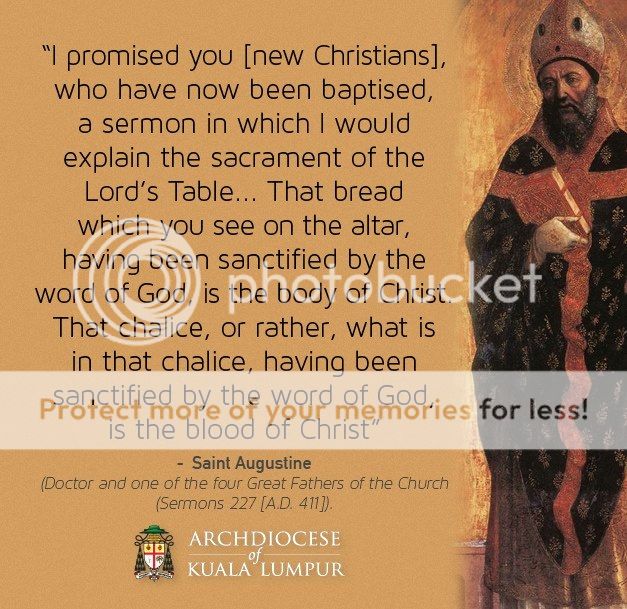
This same teaching and distinctions are found in the writings of the Church Fathers as well. St. Augustine of Hippo teaches that the Mass is a true and proper sacrifice, for the very reason that it has a "real resemblance" to the historical death of Christ upon the Cross:

"Was not Christ once for all offered up in His own person as a sacrifice? And yet, is He not likewise offered up in the sacrament as a sacrifice, not only in the special solemnities of Easter, but also daily among our congregations; so that the man who, being questioned, answers that He is offered as a sacrifice in that ordinance, declares what is strictly true? For if sacraments had not some points of real resemblance to the things of which they are the sacraments, they would not be sacraments at all" [3].

In noting the "real resemblance" of the sacraments to that which they signify, he is referring to what has been since called the 'sign value' or 'signification' of the sacrament. In the Eucharist, the wine signifies the pouring out of Christ's blood and the broken bread His broken body upon the cross. This signification via the proper elements actually makes present that reality which is signified; thus, the offering of the Mass with the proper matter and form actually makes present Christ and His one offering, which is why the Mass is truly a sacrifice. This is basic sacramental theology - the Mass is truly the sacrifice of Christ, not because it is identical with the historical sacrifice of the cross or because Christ is dying again, but because of the "real resemblance" between the two manners of offering which bring forth the sacramental realities. It is noteworthy that where Augustine writes “He is sacrificed”, he uses the present infinitive “immolari”, expressing a continual action - the ongoing, perpetual unbloody offering of Christ to the Father.

Conclusion

There is an intimate link between the sacrifice of the cross and that of the Mass. Both are offerings of Christ the high priest; in both cases, Christ is also the victim. Because of this "real resemblance", it is right and proper to call the Mass a sacrifice in the true and proper sense, understanding that it is nothing else than the sacrifice of Christ to God the Father for the sins of the world. The sacrifice is the same, though the manner in which it is presented is different - one bloody, the other unbloody; one happening once in history, the other perpetually - which means that, while Christ is continually offering Himself to the Father in the sacrifice of the Mass, He is not slain daily. He "dies no more", as St. Paul says in the Epistle to the Romans. In fact, if He were not alive forever more, He could not make this perpetual intercession at the right hand of the Father.

Ad majorem Dei gloriam.

NOTES

[1] Peter Lombard, Sentences, Lib. IV, Dist. 12
[2] Council of Trent, Session 22, Chapter 2
[3] St. Augustine of Hippo, Letter 98:9

Source: http://unamsanctamcatholicam.com/apologeti...in-at-mass.html

This post has been edited by yeeck: Jun 8 2015, 12:26 AM
TSyeeck
post Jun 9 2015, 05:28 PM

Look at all my stars!!
*******
Senior Member
3,573 posts

Joined: Apr 2006


How to Fight the Prosperity Gospel
Leticia Adams

user posted image

This morning I woke up and read an article about the Osteen Predicament. It was kind of weird because the issue of the prosperity gospel has been coming up a lot lately. I watched the video of Victoria Osteen’s sermon and wondered why anyone would believe that crap. It is so easy to see that her preaching that our happiness is the ultimate goal of following Christ is completely opposite of what Jesus Himself says in the Gospel. My problems with the Osteens and people like them such as TD Jakes, Joyce Meyer and so many mega church pastors are many; mostly the fact that they preach against Catholicism for one reason or another but mostly because they claim that all things Catholic are unbiblical. Well, there is nothing more unbiblical than the idea that if you follow Christ all your wishes will come true and you will never suffer again. Jesus said to pick up our CROSS and follow Him, that whoever wants to keep his life will lose it and that the world will hate us just as it hated Him. So where exactly in the Gospel did Jesus say His number one goal for dying on a cross was so that we would be “happy”? Umm, nowhere.

If anything, the idea that Jesus saying He came to give us life abundantly is a twisted way of seeing things through human eyes that see “abundance” in the form of material things. That isn’t what He meant, what He meant was that His death would open up the door of salvation so that we could be saved. That when we finish the race in this life that we will be with God for eternity in the next life in Heaven.

Heaven is another thing that people turn into some kind of “wishes come true” place. Heaven is not Disneyland. It is not a place where we are going to go and have all our favorite things because God’s a genie who is going to grant us our every wish. God will not grant us anything that is sinful, not good for us, or in any way stands between us and Him. Not on this earth and not in Heaven. If you love something more than God, then guess what? You are not going get that in Heaven, IF you make it there.

All of that is really easy for me to say matter-of-factly. This past Sunday when I heard my priest say that the prosperity gospel is the gospel of Satan, I wanted to stand up and cheer. I wanted to high-five him and I was so happy to smugly sit there and nod my head thinking about how right I’ve been all along to delete all things prosperity gospel from my Facebook newsfeed. And then he said “It’s easy for us to call out the prosperity gospel when others are preaching it, but how about when we are suffering? Do we ask God ‘why me?’”

That smacked the smug right out of my sails.

Most of the time, when I see some quote by the Osteens or any of the many other “happiness” pushers, I roll my eyes and then ask, “How do these people even suffer?” I mean, how can they suffer? When bad things happen to them, what do they do? How do they hold onto their faith when things fall apart? I usually ask that question with a lot of pride as if I suffer so graciously. Not.

Father’s question made me think about how I suffer. I do not suffer well. At the end of his homily he said that if we think we are suffering, then we need to look at the Christians in Iraq or the Holy Land and rethink that idea. On the one hand, suffering is suffering. If I am not a Christian in Iraq being hunted down to be killed, then that is because God knows that I would never, ever make it to Heaven on that path to sainthood, which basically means that He is well aware that I would reject Him and everything to do with Him if that were me. I’m a pansy. God not putting me there is Him saying, “you are not that strong.” True dat. My own suffering is still a cross that I have to embrace and carry, even if it’s washing the dishes and not fearing for my life (yet, that day could easily come this way). That’s just it though; I do not embrace my cross.

I drive a really ugly car. Instead of being thankful that the car gets me to point A to point B, I look around at everyone else’s car and wonder why I got stuck driving the humbling death trap. I act as if having to jump my car every time I need to go somewhere is the worst thing that could ever happen to me and that God must hate me to put me through this. Because He is supposed to grant my every wish, like get me a badass Dodge Challenger. It’s really easy for me to point out when someone is preaching the prosperity gospel, but it’s not so easy to look in the mirror and realize that I am living the prosperity gospel. If I don’t have all the things that I want in life, then it must mean God has forgotten me.

That could not be further from the truth. Does that mean that He wants me to suffer all the live long day? No. He created all things for our good. He wants us to enjoy life, but that isn’t the same as centering our life around being “happy”. Joy is not the same as happiness. Happiness is fleeting, but joy is always there even in the middle of a storm. Joy is what comes when we center our life around Jesus, Who is the source of life.

The last several months (maybe even a year or more) of my life have been full of crosses and I have gone to great lengths to try and avoid carrying them. I have whined, complained, sat down and pouted, begged God to take them away or just plain out yelled at Him for daring to give them to me in the first place. It wasn’t until I realized what a hypocrite that I am for always pointing at the splinter in the eyes of those who love the Osteens messages while living with the plank in my own, that I finally heard the words of Christ to pick up my cross and follow Him.

The first step in fighting the prosperity gospel is for me to recognize my own faults, to reject it in my own life and to resolve to change myself. When enough Christians do that, then that false gospel will die on its own. It doesn’t happen by fighting the preachers of it, it happens by fighting it in our own hearts and lives.

Source: http://www.catholicstand.com/fight-prosperity-gospel/

This post has been edited by yeeck: Jun 9 2015, 05:30 PM
khool
post Jun 11 2015, 02:20 PM

Getting Started
**
Junior Member
225 posts

Joined: Mar 2008


Nice article Bro Yeeck! This is helpful in combating the heresy that is the prosperity gospel! thumbs up! biggrin.gif
TSyeeck
post Jun 12 2015, 12:41 PM

Look at all my stars!!
*******
Senior Member
3,573 posts

Joined: Apr 2006


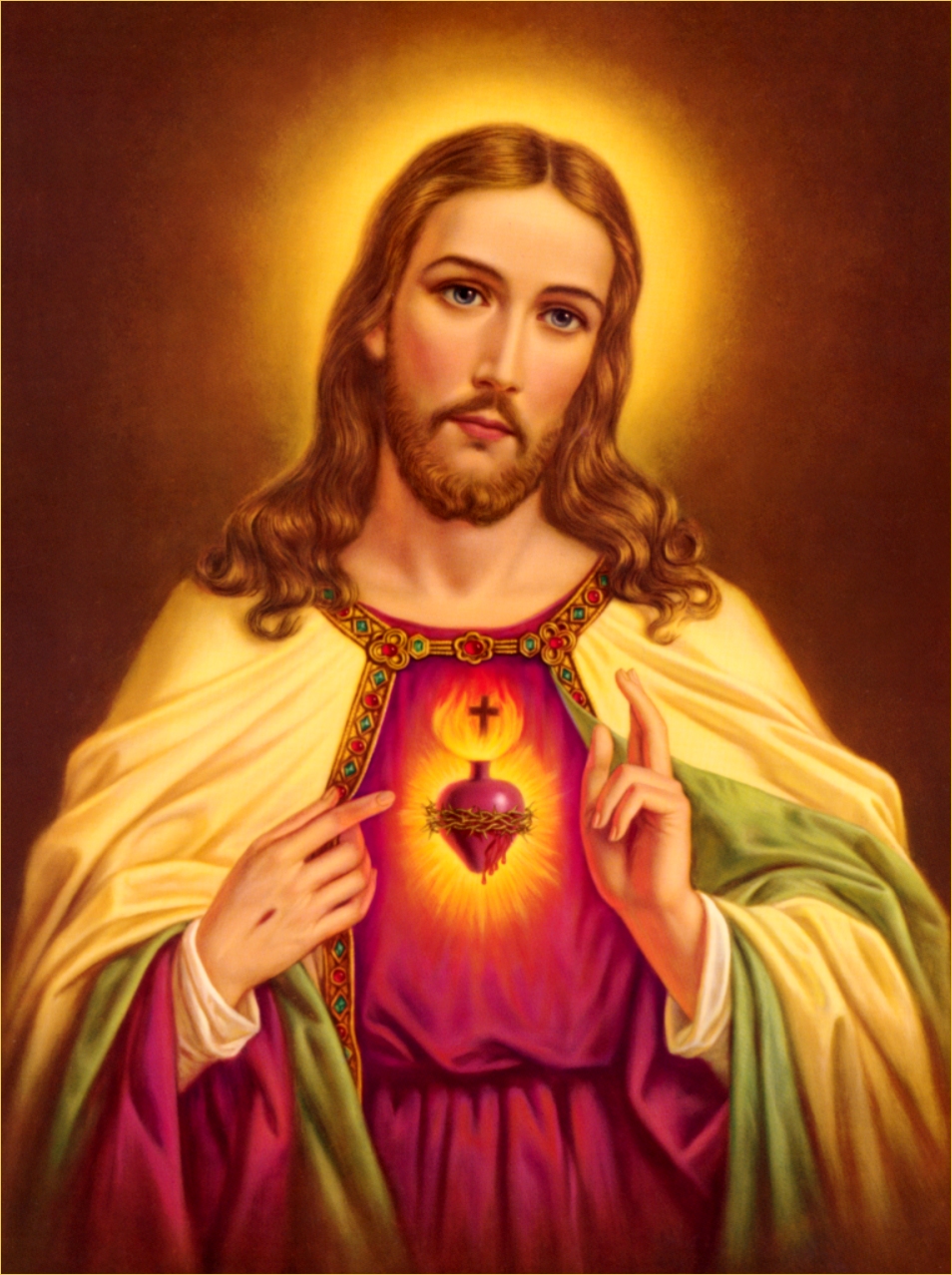
Happy Feast of the Sacred Heart of Jesus! Oh Jesus, meek and humble of heart, make our hearts like unto Thine!

user posted image

This post has been edited by yeeck: Jun 12 2015, 12:42 PM
TSyeeck
post Jun 12 2015, 01:30 PM

Look at all my stars!!
*******
Senior Member
3,573 posts

Joined: Apr 2006


Gentlemen: Let’s talk about your self esteem. Get rid of it. Self esteem is garbage. Both low self-esteem and high self-esteem are based on pride and disordered self-love. These are not Biblical or Christian concepts, but worldly ones. We need to die to ourselves, not to feed the beast of pride. Self esteem is pride. The modern cult of self esteem stems from a pop psychology that hates God. How’s this for self esteem: “Lord Jesus Christ, Son of God, have mercy on me, a sinner”?

We are defeated — we are absolutely defeated. Look around you at the grim landscape of society. Where are the Christian men? Men are emasculated. People don’t know what it is to be a man or a woman or a family. Men do not lead their families. We cannot stop abortion; we cannot stop divorce; we cannot stop feminism; we cannot stop pornography; we cannot stop our children leaving the faith or our families falling apart; we cannot stop the militant sodomites — imagine that! We cannot stop effeminates — spiritually mutilated half-men… those perverts who want to force you and your children and grandchildren to embrace and celebrate their filthy depravity that fills God’s nostrils with its stench and their own bodies with disease. We cannot stop it. We are defeated. But we are not really defeated — not if we unite ourselves to the Cross, because that Cross is the hook that has the bait that caught the Devil. We must die to ourselves on the Cross of Christ. Then we accept the truth about ourselves and allow God to put us through a crucifying and purgative humiliation. If you’re not afraid of this purgative humiliation, this harrowing, you will be victorious.

In the meantime, don’t lie and tell yourself and others how good you are.

You are inadequate. You should feel inadequate. You should “feel bad” about yourself. “But the foolish things of the world hath God chosen, that he may confound the wise; and the weak things of the world hath God chosen, that he may confound the strong. And the base things of the world, and the things that are contemptible, hath God chosen, and things that are not, that he might bring to nought things that are: That no flesh should glory in his sight.” (I Cor. 1:27-29) If God is going to use you, then you must be foolish, weak, base, and contemptible. You have to know that. You have to embrace it. You are inadequate. Do not be afraid of your inadequacy. Only if you acknowledge it will grace begin to operate in you. This is one reason that self knowledge is so important.

Do not be afraid for humiliation, either. We achieve humility by humiliations and God exalts the humble. Jesus’ Resurrection and Ascension at the Right Hand of God after His bitter Passion is the greatest example of exalted humility. After that, is Our Lady, whose Magnificat is a “humble boast,” if I might put it that way — which is summarized in the phrase “He hath put down the mighty from their thrones and hath exalted the humble.”

The spiritual writers remind us of the necessity of compunction of heart, contrition for sin, and humility. We must seriously cultivate those by acknowledging first our radical dependence on God for all our gifts of nature and of grace, and second, by acknowledging our sinfulness: our deserving of eternal damnation in hell by only one mortal sin (yet how many have we committed?), the countless venial sins that we’ve excused with lame excuses about relief from life’s difficulties, the bad example we’ve given others (including wives and children), our moral cowardice before a world that mocks Christ, and the fact that we don’t seem so swift as to “get it” when these things are pointed out to us. We go to confession, but then, like dogs returned to our vomit, we commit the same sins, we wallow in the same filth: Pornography. Infidelity by unchaste glances at other women. Ruining our own children’s innocence by letting the serpent of sexual impurity into our lives and therefore into our homes. Treating our wives like objects of lust on the one hand and fearing their displeasure on the other should we dare to assert our male patriarchal authority as head of the family. The failures pile up, and I’ve only touched a couple of commandments.

We need to crush our pride and disordered self-love, those things that keep us from getting down deep into what really makes us sick inside.

When you see the task that’s put before you in talks such as you’ve heard today, you might be tempted to say, “I can’t do it.” GOOD! You can’t. Say yes to the humiliation and yes to the inadequacy, and then God will begin to work in you. Saint Paul said “with Christ I am nailed to the cross. And I live, now not I; but Christ liveth in me” (Gal. 2: 19-20).

Gentlemen, ultimately, we must realize that we are not God. We must acknowledge our creatureliness. God is God and we are not. When Satan heard that bad news, he cried out “non serviam” — “I will not serve.” When Saint Michael heard it, he cried out “Who is like God?” Satan angrily screamed, like a troubled adolescent, “God is God and I am not!” Saint Michael joyfully sang “God is God and I am not … blessed be God! Who is like God? I will serve him.”

To do what we need to do will take courage, but there are two kinds of courage: One is based on pride and self-love, as in sports, military formation, in the tough-guy movies, and any other place where machismo reigns. This is narcissistic, bent in on itself. The other is true Christian courage, which is a virtue. It is rooted in truth, including the knowledge of our weakness, fatigue, uncertainty, and inadequacy. It is motivated by Christian Charity — love of God and love of neighbor. True courage is the stuff of martyrs, not of bullies.

But we can only achieve that if we render ourselves totally vulnerable — taking all the hits they give us — then we are invulnerable because you participate on the Victory of the Cross. The weight of sin will then crush itself. We must endure every humiliation, every loss, every trial for the love of God, and remember that Charity covers a multitude of sins.

When you feel bad about yourself, it is a moment of temptation. This bad feeling should be embraced for the love of God, like the publican, like the Syrophoenician woman, like the Good Thief, who said “we deserve this.” Don’t seek to bolster your self-esteem by some crutch — this is when people drink, indulge sexual appetite, or go for any drug. This is the time to go deep within ourselves and find God there, who never leaves us, and beg His grace and mercy.

Don’t be afraid to feel bad about yourself, because then you can die to yourself. Then we say with Saint John the Baptist: “I must decrease and He must increase.”

- Br. Andre Marie
TSyeeck
post Jun 15 2015, 01:42 AM

Look at all my stars!!
*******
Senior Member
3,573 posts

Joined: Apr 2006


St. Cyprian, St. Justina, Lust And Devils

This story of the conversion of St. Cyprian is very, very interesting. It also talkes about how the demons are tempting us and how to overcome them.

user posted image

‘IN THE REIGN of Decius (249-251) there lived in Antioch (of Pisidia) a certain philosopher and renowned sorcerer whose name was Cyprian, a native of Carthage. Springing from impious parents, in his very childhood he was dedicated by them to the service of the pagan god Apollo. At the age of seven he was given over to magicians for the study of sorcery and demonic wisdom. At the age of ten he was sent by his parents, as a preparation for a sorcerer’s career, to Mount Olympus, which the pagans called the dwelling of the gods. Here there were a numerous multitude of idols, in which demons dwelled.

On this mountain Cyprian studied all manner of diabolical arts: he mastered various demonic transformations, learned how to change the nature of the air, to bring up winds, produce thunder and rain, disturb the waves of the sea, cause damage to gardens, vineyards and fields, to send diseases and plagues upon people; and in general he learned a ruinous wisdom and diabolical activity filled with evil. In this place he saw a numberless legion of demons, with the prince of darkness at their head; some stood before him, others served him, still others cried out in praise of their prince, and some were sent into the world in order to corrupt people. Here he likewise saw in their false forms the pagan gods and goddesses, and also diverse phantoms and specters, the invocation of which he learned in a strict forty-day fast. He ate only after the setting of the sun, and not bread or anything else, but only acorns from oak trees.

When he was fifteen years old he began to receive lessons from seven great sorcerers; from them he learned many demonic secrets. Then he went to the city of Argos, where, having served the goddess Juno for a time, he learned many practices of deception from her priests. He lived also in Taurapolis (on the island of Icara) in the service of the goddess Diana; and from there he went to Sparta, where he learned how to call forth the dead from the graves and to force them to speak by means of various incantations and spells. At the age of twenty, Cyprian came to Egypt, and in the city of Memphis he learned yet greater charms and incantations. In his thirtieth year he went to the Chaldeans, and having learned astrology there, he finished his studies. After this he returned to Antioch, being perfect in all evil-doing. Thus he became a sorcerer, magician, and destroyer of souls, a great friend and faithful slave of the prince of hell, with whom he conversed face to face, being vouchsafed to receive from him great honor, as he himself testified.

“Believe me,” he said; “I have seen the prince of darkness himself, for I propitiated him by sacrifices. I greeted him and spoke with him and his ancients; he liked me, praised my understanding, and before everyone said: ‘Here is a new Jambres, always ready for obedience and worthy of communion with us!’ And he promised to make me a prince after my departure from the body, and for the course of earthly life to help me in everything. And he gave me a legion of demons to serve me. When I departed from him, he addressed me with these words: ‘Take courage, fervent Cyprian; arise and accompany me; let all the demonic ancients marvel at you.’ Consequently, all of his princes also were attentive to me, seeing the honor shown to me. The outward appearance of the prince of darkness was like a flower. His head was crowned by a crown (not an actual, but a phantom one) made of gold and brilliant stones, as a result of which the whole space around him was illuminated; and his clothing was astonishing. When he would turn to one or the other side, that whole place would tremble; a multitude of evil spirits of various degrees stood obediently at his throne. I gave myself over entirely into his service at that time, obeying his every command.” Thus did St. Cyprian relate of himself after his conversion.

From this it is evident what kind of man Cyprian was: as a friend of the demons, he performed all their works, causing evil to people and deceiving them. Living in Antioch, he turned many people away to every kind of lawless deed; he killed many with poisons and magic, and slaughtered young men and maidens as sacrifices for the demons. He instructed many in his ruinous sorcery: some he taught to fly in the air, others to sail in boats on the clouds, still others to walk on water. By all the pagans he was revered and glorified as a chief priest and most wise servant of their vile gods. Many turned to him in their needs, and he helped them by means of the demonic power with which he was filled: with some he cooperated in their adulteries, with others in anger, enmity, revenge, jealousy. Already he was entirely in the depths of hell and in the jaws of the devil; he was a son of gehenna, a partaker of the demonic inheritance and of their eternal perdition. But the Lord, who does not desire the death of a sinner, in His unutterable goodness and His mercy which is not conquered by the sins of men, deigned to seek out this lost man, to draw out of the abyss one who was mired in the filth of the depths of hell, and to save him in order to show to all men His mercy; for there is no sin which can conquer His love of mankind.

He saved Cyprian from perdition in the following way.

THERE LIVED AT THAT TIME in Antioch a certain maiden whose name was Justina. She came from pagan parents; her father was a priest of the idols, Aedesius by name, and her mother was called Cledonia. Once, sitting at the window of her house, this maiden, who had then already reached womanhood, by chance heard the words of salvation out of the mouth of a deacon who was passing by, whose name was Praylius. He spoke of our Lord Jesus Christ’s becoming man, that He had been born of the Most Pure Virgin and, having performed many miracles, had deigned to suffer for the sake of our salvation, had risen from the dead with glory, ascended into the heavens, and sits at the right hand of the Father and reigns eternally. This preaching of the deacon fell on good soil, into the heart of Justina, and began quickly to bring forth fruit, uprooting in her the thorns of unbelief. Justina wished to be instructed in the Faith by this deacon better and more completely, but she did not dare to seek him out, being restrained by a maiden’s modesty. However, she secretly went to the church of Christ, and often hearing the word of God, with the Holy Spirit acting in her heart, she came to believe in Christ.

Soon she convinced her mother of this also, and then brought to the faith her aged father as well. Seeing the understanding of his daughter and hearing her wise words, Aedesius reflected within himself thus: “The idols are made by the hands of men and have neither soul nor breath, and therefore how can they be gods?” While he was reflecting on this, once at night he saw during sleep, by Divine consent, a wondrous vision: he saw a great multitude of light-bearing Angels, and in their midst was the Saviour of the world, Christ, Who said to him: “Come to Me, and I will give you the Kingdom of Heaven.”

After rising in the morning, Aedesius went with his wife and daughter to the Christian Bishop, whose name was Optatus, begging him to instruct them in the Faith of Christ and to perform upon them holy Baptism. At the same time he informed him of the words of his daughter and of the angelic vision which he had seen himself. Hearing this, the Bishop rejoiced at their conversion, and having instructed them in the Faith of Christ, he baptized Aedesius, his wife Cledonia, and their daughter Justina; and then, having given them communion of the Holy Mysteries, he let them go in peace.

When Aedesius had become strengthened in the Faith of Christ, the Bishop, seeing his piety, made him a presbyter. After this, having lived virtuously and in the fear of God for a year and six months, Aedesius in holy faith came to the end of his life. As for Justina, she valiantly struggled in the keeping of the Lord’s commandments, and having come to love her Bridegroom Christ, she served Him with fervent prayers, in virginity and chastity, in fasting and great abstinence. But the enemy, the hater of the human race, seeing such a life, envied her virtues and began to do harm to her, causing various misfortunes and sorrows.

AT THAT TIME there lived in Antioch a certain youth named Aglaias, the son of wealthy and renowned parents. He lived luxuriously, giving himself entirely over to the vanity of this world. Once he saw Justina as she was going to church, and he was struck by her beauty. The devil instilled shameful intentions into his heart. Being inflamed with lust, Aglaias by all means strove to gain the good disposition and love of Justina and by means of deception to bring the pure lamb of Christ to the defilement which he planned. He observed all the paths by which the maiden would walk, and, meeting her, would speak to her cunning words, praising her beauty and glorifying her; showing his love for her, he strove to draw her into fornication by a cunningly-woven net of deceptions. The maiden, however, turned away from him and fled from him, despising him and not desiring even to hear his deceptive and cunning speeches. But the youth did not grow cool in his desire of her beauty, and he sent to her the request that she should agree to become his wife.

She, however, replied to him: “My Bridegroom is Christ; Him I serve, and for His sake I preserve my purity. He preserves both my soul and my body from every defilement.”

Hearing such a reply from the chaste maiden, Aglaias, being instigated by the devil, became yet more inflamed with passion. Not being able to deceive her, he intended to seize her by force. Having gathered to his aid some foolish youths like himself, he waylaid the maiden in the path along which she usually walked to church for prayer; there he met her and, seizing her, began dragging her by force to his house. But she began loudly to scream, beat him in the face, and spat on him. The neighbors, hearing her wails, ran out of their houses and took the immaculate lamb, St. Justina, from the hands of the impious youth as from the jaws of a wolf. The disorderly youths scattered, and Aglaias returned with shame to his house. Not knowing what more to do, he decided, with the increase of impure lust in him, upon a new evil deed: he went to the great sorcerer and magician Cyprian, the priest of the idols, and having informed him of his sorrow, begged his help, promising to give him much gold and silver. Having heard out Aglaias, Cyprian comforted him, promising to fulfill his desire. “I will so manage,” he said, “that the maiden herself will seek your love and will feel passion for you even stronger than that which you have for her.”

Having thus consoled the youth, Cyprian let him go, full of hope. Then, taking the books of his secret art, he invoked one of the impious spirits who, he was sure, could soon inflame the heart of Justina with passion for this youth. The demon willingly promised to fulfill this and proudly said: “This deed is not difficult for me, because many times I have shaken cities, crumbled walls, destroyed houses, caused the shedding of blood and patricide, instilled hatred and great anger between brothers and spouses, and have brought to sin many who have given a vow of virginity. In monks who have settled in mountains and were accustomed to strict fasting and have never even thought about the flesh, I have instilled adulterous lust and instructed them to serve fleshly passions; people who have repented and turned away from sin, I have converted back to evil deeds; many chaste people I have thrown into fornication. Will I really be unable to incline this maiden to the love of Aglaias? Indeed, why do I speak? I will swiftly show my powers in very deed. Take this powder” (here he gave him a vessel full of something) “and give it to this youth; let him sprinkle the house of Justina with it, and you will see that what I have said will come to pass.”

Having said this, the demon vanished. Cyprian called Aglaias and sent him to sprinkle the house of Justina secretly with the contents of the demon’s vessel. When this had been done, the demon of fornication entered the house with the flaming arrows of fleshly lust in order to wound the heart of the maiden with fornication, and to ignite her flesh with impure lust.

user posted image

Justina had the custom every night to offer up prayers to the Lord. And behold, when, according to custom, she arose at the third hour of the night and was praying to God, she suddenly felt an agitation in her body, a storm of bodily lust and the flame of the fire of gehenna. In such agitation and inward battle she remained for quite a long time; the youth Aglaias came to her mind, and shameful thoughts arose in her. The maiden marveled and was ashamed of herself, feeling that her blood was boiling as in a kettle; now she thought about that which she had always despised as vile. But in her good sense Justina understood that this battle had arisen in her from the devil; immediately she turned to the weapon of the sign of the cross, hastened to God with fervent prayer, and from the depths of her heart cried out to Christ her Bridegroom: “O Lord, my God, Jesus Christ! Behold how many enemies have risen up against me and have prepared a net in order to catch me and take away my soul. But I have remembered Thy name in the night and have rejoiced, and now when they are close about me I hasten to Thee and have hope that my enemy will not triumph over me. For thou knowest, O Lord my God, that I, Thy slave, have preserved for Thee the purity of my body and have entrusted my soul to Thee. Preserve Thy sheep, O good Shepherd; do not give it over to be eaten by the beast who seeks to devour me; grant me victory over the evil desire of my flesh.”

Having prayed long and fervently, the holy virgin put the enemy to shame. Being conquered by her prayer, he fled from her with shame, and again there came a calm in Justina’s body and heart; the flame of desire was quenched, the battle ceased, the boiling blood was stilled. Justina glorified God and sang a song of victory.

The demon, on the other hand, returned to Cyprian with the sad news that he had accomplished nothing. Cyprian asked him why he had not been able to conquer the maiden. The demon, even against his will, revealed the truth: “I could not conquer her because I saw on her a certain sign of which I was afraid.”

Then Cyprian called a yet more malicious demon and sent film to tempt Justina. He went and did much more than the first one, falling upon the maiden with great rage. But she armed herself with fervent prayer and laid upon herself yet a more powerful labor: she clothed herself in a hair shirt and mortified her flesh with abstinence and fasting, eating only bread and water. Having thus tamed the passions of her flesh, Justina conquered the devil and banished him with shame. And he, like the first one, returned to Cyprian without accomplishing anything.

Then Cyprian called one of the princes of the demons, informed him about the weakness of the demons he had sent, who could not conquer a single maiden, and asked help from him. This prince of demons severely reproached the other demons for their lack of skill in this matter and for their inability to arouse passion in the heart of the maiden. Having given hope to Cyprian and promised to seduce the maiden by other means, he took on the appearance of a woman and went to Justina. And he began to converse piously with her, as if desiring to follow the example of her virtuous life and her chastity. Conversing in this way, he asked the maiden what kind of reward there might be for such a strict life and for the preservation of purity.

Justina replied that the reward for those who live in chastity is great and beyond words, and that it is very remarkable that people do not in the least concern themselves for such a great treasure as angelic purity. Then the devil, revealing his shamelessness, began with cunning words to tempt her, saying: “But then how could the world exist? How would people be born? After all, if Eve had preserved her purity, how would the human race have increased? In truth marriage is a good thing, being established by God Himself; the Sacred Scripture also praises it, saying: Let marriage be had in honor among all, and the bed undefiled (Heb. 13:4). And many saints of God also did they not enter into marriage, which God gave them as a consolation, so that they might rejoice in their children and praise God?”

Hearing these words, Justina recognized the cunning deceiver, the devil, and, more skillful than Eve, conquered him. Without continuing this conversation, she immediately fled to the defense of the Cross of the Lord and placed its honorable sign on her forehead; and her heart she turned to Christ her Bridegroom. And the devil immediately vanished with yet greater shame than the first two demons.

In great disturbance, the proud prince of the demons returned to Cyprian, who, finding out that he had not managed to do anything, said to him: “Can it be that even you, a prince powerful and more skillful than others in such matters, could not conquer the maiden? Who then among you can do anything with this unconquerable maiden’s heart? Tell me by what weapon she battles with you, and how she makes powerless your mighty power?”

Being conquered by the power of God, the devil unwillingly acknowledged: “We cannot behold the sign of the Cross, but flee from it, because it scorches us like fire and banishes us far away.”

Cyprian became angry at the devil because he had put him to shame, and reproaching the demon, he said: “Such is your power that even a weak virgin conquers you!”

Then the devil, desiring to console Cyprian, attempted yet another undertaking: he took on the form of Justina and went to Aglaias with the hope that, having taken him for the real Justina, the youth might satisfy his desire, and thus neither would the weakness of the demons be revealed, nor would Cyprian be put to shame. And behold, when the demon went to Aglaias in the form of Justina, the youth leaped up in unspeakable joy, ran to the false maiden, embraced her and began kissing her, saying: “How good it is that you have come to me, fair Justina!”

But no sooner had the youth pronounced the word “Justina” than the demon immediately disappeared, being unable to bear even the name of Justina. The youth became greatly afraid and, running to Cyprian, told him what had happened. Then Cyprian by his sorcery gave him the form of a bird and, having enabled him to fly in the air, he sent him to the house of Justina, advising him to fly into her room through the window. Being carried by a demon in the air, Aglaias flew on the roof. At this time Justina happened to look through the window of her room. Seeing her, the demon left Aglaias and fled. At the same time, the phantom appearance of Aglaias also vanished, and the youth, falling down, was all but dashed to pieces. He grasped the edge of the roof with his hands and, holding on to it, hung there; and if he had not been let down to the ground by the prayer of St. Justina, the impious one would have fallen down and been killed.

Thus, having achieved nothing, the youth returned to Cyprian and told him of his woe. Seeing himself put to shame, Cyprian was greatly grieved and thought himself of going to Justina, trusting in the power of his sorcery. He turned himself into a woman and into a bird, but he did mpt manage to reach as far as the door of the house of Justina before his false appearances disappeared, and he returned with sorrow.

AFTER THIS CYPRIAN began to gain revenge for his shame, and by his sorcery he brought diverse misfortunes on the house of Justina and on the houses of all her relatives, neighbors and friends, as once the devil had done to righteous Job (Job 1:15-19, 2:7). He killed their animals, he struck down their slaves with plagues, and in this way he brought them to extreme grief. Finally, he struck with illness Justina herself, so that she lay in bed and her mother wept over her. Justina, however, comforted her mother with the words of the Prophet David: I shall not die, but live, and I shall tell of the works of the Lord (Psalm 117:17).

Not only on Justina and her relatives, but also on the whole city, by God’s allowance, did Cyprian bring misfortune as a result of his untamable rage and his great shame. Plagues appeared in the animals and various diseases among men; and the rumor spread, through the activity of the demons, that the great sorcerer Cyprian was punishing the city for Justina’s opposition to him. Then the most honorable citizens went to Justina and with anger tried to persuade her not to grieve Cyprian any longer, and to become the wife of Aglaias, in order to escape yet greater misfortunes for the whole city because of her. But she calmed them by saying that soon all the misfortunes which had been brought about with the help of Cyprian’s demons would cease. And so it happened. When St. Justina prayed fervently to God, immediately all the demonic attacks ceased; all were healed from the plagues and recovered from their diseases. When such a change occurred, the people glorified Christ and mocked Cyprian and his sorcerer’s cunning, so that from shame he could not show himself among men and he avoided meeting even friends.

Having become convinced that nothing could conquer the power of the sign of the cross and the name of Christ, Cyprian came to his senses and said to the devil: “O destroyer and deceiver of all, source of every impurity and defilement! Now I have discovered your infirmity. For if you fear even the shadow of the cross and tremble at the name of Christ, then what will you do when Christ Himself comes to you? If you cannot conquer those who sign themselves with the sign of the cross, then whom will you tear away from the hands of Christ? Now I have understood what a non-entity you are; you are not even able to take revenge! Listening to you, 1, wretched one, have been deceived, and I believed your tricks. Depart from me, accursed one, depart! For I must entreat the Christians that they might have mercy on me. I must appeal to pious people, that they might deliver me from perdition and be concerned over my salvation. Depart, depart from me, lawless one, enemy of truth, adversary and hater of every good thing!”

Having heard this, the devil threw himself on Cyprian in order to kill him; attacking him, he began to beat and strangle him. Finding no defense anywhere, and not knowing how to help himself and be delivered from the fierce hands of the demon, Cyprian, already scarcely alive, remembered the sign of the cross, by the power of which Justina had opposed all the demons’ power, and he cried out: “O God of Justina, help me!”

Then, raising his hand, he made the sign of the cross, and the devil immediately leaped away from him like an arrow shot from a bow. Gaining courage, Cyprian became bolder, and calling on the name of Christ, he signed himself with the sign of the cross and stubbornly opposed the demon, cursing and reproaching him. As for the devil, standing far away from him and not daring to draw near to him out of fear of the sign of the cross and the name of Christ, he threatened Cyprian in every manner, saying: “Christ will not deliver you out of my hands!” Then, after long and fierce attacks on Cyprian, the demon roared like a lion and went away.

THEN CYPRIAN took all his books of magic and went to the Christian Bishop Anthimus. Falling to the feet of the Bishop, he entreated him to have mercy on him and to give him holy Baptism. Knowing that Cyprian was a great sorcerer, feared by all, the Bishop thought that he had come to him with some kind of trick, and therefore he refused him, saying: “You do much evil among the pagans; leave the Christians in peace, lest you speedily perish.” Then Cyprian with tears confessed everything to the Bishop and gave him his books to be burned. Seeing his humility, the Bishop instructed him and taught him the holy faith, and then commanded him to prepare for Baptism; and his books he burned before all the believing citizens.

Leaving the Bishop with a contrite heart, Cyprian wept over his sins, sprinkled ashes on his head, and sincerely repented, calling out to the true God for the cleansing of his iniquities. Coming the next day to church, he heard the word of God with joyful emotion, standing among the believers. And when the deacon commanded the catechumens to go out, declaring: “Ye catechumens depart,” and certain ones were already going out, Cyprian did not wish to go out, saying to the deacon: “I am a slave of Christ; do not chase me out of here.” But the deacon said to him: “Since you have not yet been given holy Baptism, you must go out of the church.”

To this Cyprian replied: “As Christ my God I liveth, Who has delivered me from the devil, Who has preserved the maiden Justina pure, and has had mercy on me—you will not chase me out of the church until I become a complete Christian.”

The deacon related this to the Bishop, and the Bishop, seeing the fervor of Cyprian and his devotion to the faith of Christ, called him up and immediately baptized him in the name of the Father and the Son and the Holy Spirit.

Finding out about this, St. Justina gave thanks to God, distributed much alms to the poor, and made an offering in church. And Cyprian, on the eighth day after his Baptism, was made a reader by the Bishop; on the twentieth day he was made subdeacon, and on the thirtieth day a deacon; and in a year he was ordained priest. Cyprian completely changed his life; with every day he increased his struggles, and constantly weeping over his previous evil deeds, he perfected himself and ascended from virtue to virtue. Soon he was made Bishop, and in this rank he led such a holy life that he equaled many great saints. At the same time he zealously took care of the flock of Christ which had been entrusted to him. St. Justina the maiden he made a deaconess, and then entrusted to her a convent, making her abbess over other Christian maidens. By his conduct and instruction he converted many pagans and acquired them for the Church of Christ. Thus, idol worship began to die out in that land, and the glory of Christ increased.

Seeing the strict life of St. Cyprian, his concern for the faith of Christ and for the salvation of human souls, the devil ground his teeth against him And inspired the pagans to slander him before the governor of the eastern region, saying that he had put the gods to shame, had converted many people away from them, and was glorifying Christ, Who was hostile to their gods. And so, many impious ones came to the governor Eutolmius, who was then governing those regions, and made slanders against Cyprian and Justina, accusing them ,of being hostile to their gods and to the emperor and to all authorities, saying that they were disturbing the people, deceiving them, and leading them in their footsteps, disposing them to worship the crucified Christ. At the same time they asked the governor to give Cyprian and Justina over to death for this. Having heard their request, Eutolmius commanded that Cyprian and Justina be seized and placed in prison. Then, setting out for Damascus, he took them with him in order to make judgment upon them.

And when they had brought the prisoners of Christ, Cyprian and Justina, to him, he asked Cyprian: “Why have you changed your earlier glorious way of life, when you were a renowned servant of the gods and brought many people to them?”

St. Cyprian related to the governor how he had found out the infirmity and the deception of the demons and come to understand the power of Christ, which the demons feared and before which they trembled, disappearing from before the sign of the precious cross; and likewise he explained the reason for his conversion to Christ, for Whom he declared his readiness to die. The torturer did not accept the words of Cyprian in his heart, but being unable to reply to them, he commanded that the Saint be hung up and his body scraped, and that St. Justina be beaten on the mouth and eyes. For the whole time of the long torments they ceaselessly confessed Christ and endured everything with thanksgiving. Then the torturer imprisoned them and strove by kind exhortation to return them to idol worship. When he was unable to convince them, he commanded that they be thrown into a cauldron; but the boiling cauldron did not cause them any harm, and they glorified God as if they were in some cool place. Seeing this, one priest of the idols, by name Athanasius, said: “In the name of the god Aesculapius, I also will throw myself into this fire and put to shame those sorcerers.” But hardly had the fire touched him than he immediately died.

Seeing this, the torturer became frightened, and not desiring to judge them further, he sent the martyrs to the governor Claudius in Nicomedia, describing all that had happened to them. This governor condemned them to be beheaded with the sword. When they were brought to the place of execution, Cyprian asked a little time for prayer, so that Justina might be executed first; he feared that Justina would become frightened at the sight of his death. But she joyfully bent her head under the sword and departed unto her Bridegroom Christ. Seeing the innocent death of these martyrs, a certain Theoctistus, who was present there, greatly pitied them and, being inflamed in his heart towards God, he fell down to St. Cyprian and, kissing him, declared himself a Christian. Together with Cyprian he also was immediately condemned to be beheaded.

user posted image

Thus they gave over their souls into the hands of God; their bodies, however, lay for six days unburied. Certain of the strangers who were there secretly took them and brought them to Rome, where they gave them to a certain virtuous and holy woman whose name was Rufina, a relative of Claudius Caesar. She buried with honor the bodies of the holy martyrs of Christ: Cyprian, Justina, and Theoctistus. At their graves many healings occurred for those who came to them with faith. (Their martyrdoms occurred toward the end of the third century—according to some, in about the year 268, but according to others, in 304.) ‘ ‘Lives of Saints’, Moscow 1904

khool
post Jun 15 2015, 12:48 PM

Getting Started
**
Junior Member
225 posts

Joined: Mar 2008


"Then Cyprian with tears confessed everything to the Bishop and gave him his books to be burned." ... means Cyprian made a confession to the Bishop, and also performed penance, in the way of giving up his pagan worship yes?

Bro Yeeck, may I know the source for this article? I think this is very useful! Thanks in advance! biggrin.gif
TSyeeck
post Jun 15 2015, 01:59 PM

Look at all my stars!!
*******
Senior Member
3,573 posts

Joined: Apr 2006


QUOTE(khool @ Jun 15 2015, 12:48 PM)
"Then Cyprian with tears confessed everything to the Bishop and gave him his books to be burned." ... means Cyprian made a confession to the Bishop, and also performed penance, in the way of giving up his pagan worship yes?

Bro Yeeck, may I know the source for this article? I think this is very useful! Thanks in advance! biggrin.gif
*
Translated from the Russian Lives of Saints, Moscow, 1904.
TSyeeck
post Jun 15 2015, 02:36 PM

Look at all my stars!!
*******
Senior Member
3,573 posts

Joined: Apr 2006


Recently I was present at the last rites of a young cancer patient at the General Hospital. Anointing of the eyes, ears, nose, mouth, hands, feet, followed by Apostolic Blessing which carries a plenary indulgence, and reception of Holy Viaticum (communion for the sick/dying). Felt emotional. cry.gif but glad that he was resigned to the Will of God and ready to go.

This post has been edited by yeeck: Jun 15 2015, 06:26 PM

134 Pages « < 18 19 20 21 22 > » Top
Topic ClosedOptions
 

Change to:
| Lo-Fi Version
0.0445sec    0.20    6 queries    GZIP Disabled
Time is now: 3rd December 2025 - 05:32 AM