Welcome Guest ( Log In | Register )

Bump Topic Topic Closed RSS Feed
39 Pages « < 13 14 15 16 17 > » Bottom

Outline · [ Standard ] · Linear+

 LYN Catholic Fellowship V01 (Group), For Catholics (Roman or Eastern)

views
     
khool
post Feb 5 2016, 08:04 AM

Getting Started
**
Junior Member
225 posts

Joined: Mar 2008


QUOTE(yeeck @ Feb 4 2016, 12:28 AM)

*
From EWTN?
God bless him, and Father Mike ... notworthy.gif biggrin.gif

Actually, is it any wonder that Catholicism is thriving in the East European countries? Persecution always makes one think of and go back to God even more, and that in itself is a great miracle ... biggrin.gif

This post has been edited by khool: Feb 5 2016, 08:04 AM
khool
post Feb 5 2016, 08:52 AM

Getting Started
**
Junior Member
225 posts

Joined: Mar 2008


Some tips when going for confession before end of Lent and Easter ... biggrin.gif


FYI, Season of Lent begins this 10th February, Ash Wednesday!
God Bless, and Happy CNY!

khool
post Feb 5 2016, 09:04 AM

Getting Started
**
Junior Member
225 posts

Joined: Mar 2008


Mass at Santa Marta- There is no humility without humiliation

There can be neither humility nor holiness without taking the path of humiliation. Francis spoke of this truth as he recalled the story of David during Mass at Santa Marta on Monday morning, 1 February.

“In the first reading the story of King David continues”, the Pope began, referring to the day’s passage from the Second Book of Samuel (15:13-14, 30; 16:5-13). The story, he explained, “began when Samuel went to the house of [David’s] father, and David was anointed king”, even though he was still a boy. Then “he grew up, he had his problems, but he was always a man respectful of the king who did not like him”. In fact the king “knew that he would be his successor”. And “in the end David managed to unite the kingdom of Israel: everyone together with him”. However, “he was feeling insecure and his zeal for the house of the Lord began to weaken”.

Precisely “at that moment — we heard the other day — David was one step away from becoming corrupt”, Francis continued. Thus “the holy King David, a sinner but a saint, became corrupt”. But then “the Prophet Nathan, sent by God” helped him “understand what a bad thing he had done, an evil thing: because a corrupt person doesn’t realize it. It takes a special grace to change the heart of a corrupt person”. Thus, “David, who still had a noble heart”, recognized his sin, “he recognized his fault”. What did Nathan say to him? These were his words: “The Lord has forgiven your sin, but the corruption you have sown will grow. You killed an innocent man to hide adultery. The sword shall never depart from your house”. Thus, the Pope explained, “God forgives sin, David converts but the wounds of corruption are difficult to heal. We see this in so many parts of the world”.

This is the point in David’s story, Francis affirmed, that “we arrive at in today’s passage: David’s son battles against his father. He wants power: his son is already corrupt”. But “what does David do? With the nobility that he had won back after his sin — and also the penance he had done to save the son who had died, the child of adultery — he rejoins his own: ‘Let us flee the city lest Absalom — his son — should overtake us, then visit disaster upon us and put the city to the sword’, as was customary in those times”.

The Pontiff recalled that “God castigates David harshly: ‘The sword shall never depart from your house’”. But, Francis continued, “he defends the house and flees, he leaves”. Is he perhaps “a coward? No, he is a father”. And “he allows the ark to return”, he does not “use God to defend himself”. In other words, David “leaves in order to save his people: this is the path of holiness that David began to follow, after the moment in which he became corrupt”.

The passage, the Pope continued, presents David weeping as he climbs the steep Mount of Olives. “His head was covered”, a sign of mourning, and he was walking barefoot. He was doing penance. “And all those who were with him also had their heads covered and they were weeping as they went: weeping and penance”. Scripture also tells us that “some, who did not like him, began to follow and curse him”. Among them was Shimei, who called him “murderer”, reminding him of “the crime he had committed against Uriah the Hittite in order to cover his adultery”. Abishai, one of the people closest to David, “wanted to defend him” and wanted to take off Shimei’s head in order to silence him. But David goes “a step further: ‘If he is cursing it is because the Lord has said to him, ‘Curse David!’”. He then “says to his servants: ‘My own son, who came forth form my loins, is seeking my life”. He is referring to his son Absalom. This is why he turns again to his servants saying: “Let this Benjaminite curse, for the Lord has told him to”.

The question, Francis explained, is that “David is able to see the signs: it is the moment of his humiliation, it is the moment in which he is paying for his fault”. Therefore, he says: “Perhaps the Lord will look upon my affliction and make it up to me with benefits for the curses he is uttering this day”. Basically, “he entrusts himself to the Lord’s hands: this is David’s path, from the moment of corruption to this entrustment to the hands of the Lord. This is holiness. This is humility”.

The Pope continued. “I think”, he said, “that each one of us, should someone say something bad about us”, would react by saying “No, I didn’t do it, this isn’t true, no!”. In fact, we “immediately try to say that it isn’t true”. Or else “we do as Shimei did: we say something even worse in response”. But humility, Francis stated, “can reach a heart only through humiliation: there is no humility without humiliation”. And, he said, “if you are not able to bear some humiliation in your life, you are not humble. That’s how it is: I would say it’s that mathematical, it’s that simple!”.

For this reason, the Pope continued, “the only path to humility is humiliation”. Therefore, “David’s goal, which is holiness, is reached through humiliation”. Also, “the goal of holiness that God gives to his children, gives to the Church, comes through the humiliation of his Son who lets himself be cursed, who lets himself be borne on the Cross, unjustly”. Francis clarified that “this Son of God who humbles himself, is the path of holiness: David, with his attitude, prophesies the humiliation of Jesus”.

Before ending his homily Francis asked of “the Lord, for each of us, for all the Church, the grace of humility, but also the grace of understanding that it is impossible to be humble without humiliation”.

Source: http://www.news.va/en/news/mass-at-santa-m...ility-without-h

khool
post Feb 5 2016, 10:18 AM

Getting Started
**
Junior Member
225 posts

Joined: Mar 2008


A video on prison inmates making Eucharistic hosts as part of their penitence ... biggrin.gif


Source: http://www.catholicnewsagency.com/news/the...ic-hosts-10166/

This post has been edited by khool: Feb 5 2016, 10:21 AM
khool
post Feb 6 2016, 09:30 AM

Getting Started
**
Junior Member
225 posts

Joined: Mar 2008


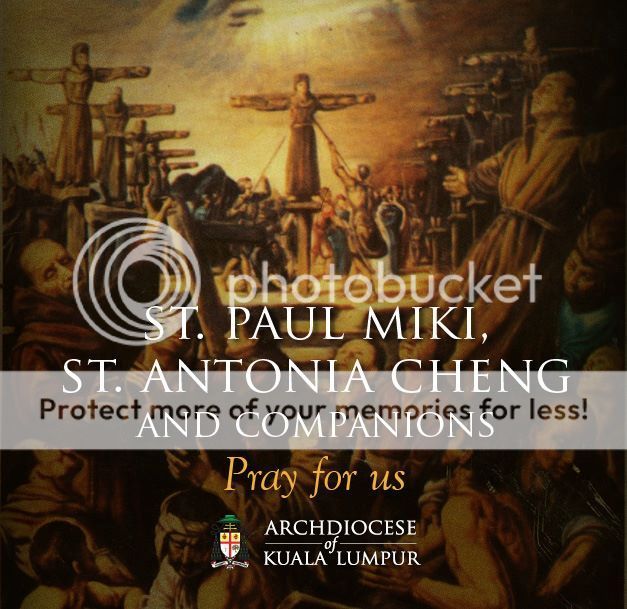
St. Paul Miki, SJ (1564?-1597)
By Bert Ghezzi
From Voices of the Saints

Christianity spread like wildfire in sixteenth-century Japan. By the 1580s, less than forty years after Francis Xavier introduced the faith, the church counted two hundred thousand converts. The growth had proceeded despite the opposition of Buddhist priests and many petty rulers. However, in 1587, Emperor Hideyoshi ordered the banishment of all Catholics, forcing the Jesuit missionaries to operate from hiding. But outright persecution did not break out until late 1596, when Hideyoshi rounded up twenty-six Jesuits, Franciscans, and laypeople and prepared to martyr them.

Among the victims was St. Paul Miki, a Jesuit novice who had just completed eleven years of training. Paul’s noble family was converted when he was a child and at age five he was baptized. Educated by Jesuits, the gifted youth joined their novitiate at age twenty-two. He had studied intensively the teachings of the Buddhists so as to be able to debate their priests. He welcomed his chance at martyrdom, but may have wished just a little that it would be delayed long enough for him to be ordained a priest.

user posted image

Hideyoshi had the left ears of the twenty-six martyrs severed as a sign of disrespect and paraded them through Kyoto. Dressed in his simple black cassock, Paul stood out among them. Most onlookers realized that this noble young man could have worn the samurai’s costume with two swords on his belt. The whole display had the unexpected effect of evoking compassion from the crowd, some of whom later became converts.

The martyrs were then taken to Nagasaki. They were tied to crosses with their necks held in place by iron rings. Beside each was an executioner with his spear ready to strike. An eyewitness gave this account:

QUOTE
When the crosses were set up it was a wonderful thing to see the constancy of all of them. Our brother Paul Miki, seeing himself raised to the most honorable position that he had ever occupied, openly proclaimed that he was a Japanese and a member of the Society of Jesus. And that he was being put to death for having preached the gospel. He gave thanks to God for such a precious favor.

He then added these words: “Having arrived at this moment of my existence, I believe that no one of you thinks I want to hide the truth. That is why I declare to you that there is no other way of salvation than the one followed by Christians. Since this way teaches me to forgive my enemies and all who have offended me, I willingly forgive the king and all those who have desired my death. And I pray that they will obtain the desire of Christian baptism.”

At this point, he turned his eyes toward his companions and began to encourage them in their final struggle. The faces of them all shone with great gladness. Another Christian shouted to him that he would soon be in paradise. “Like my Master,” murmured Paul, “I shall die upon the cross. Like him, a lance will pierce my heart so that my blood and my love can flow out upon the land and sanctify it to his name.”

As they awaited death the entire group sang the canticle of Zachary (see Luke 1:67-79). The executioners stood by respectfully until they had intoned the last verse. Then at a given signal they thrust their spears into the victims’ sides. On that day, February 5, 1597, the church of Japan welcomed its first martyrs.

Excerpt from Voices of the Saints by Bert Ghezzi.

Source: http://www.ignatianspirituality.com/ignati...st-paul-miki-sj


This post has been edited by khool: Feb 6 2016, 09:32 AM
khool
post Feb 7 2016, 08:27 AM

Getting Started
**
Junior Member
225 posts

Joined: Mar 2008


“The Name of God Is Mercy” EXPLAINED in 6 Points.

Marigina Bruno
2015 | Catholic Media | Pope Francis
02/02/2016

Even those who don’t know much about Pope Francis could likely tell you that he is passionate about revealing God’s mercy to all people. This has become more evident with the release of his first book since becoming Pope in 2013. “The Name of God is Mercy” was released mid-January with hopes of helping people better understand the Extraordinary Jubilee Year of Mercy that began December 8th 2015 and will conclude November 20th 2016.

The book has been written in an easy to read interview style with Vatican reporter Andrea Tornielli. Pope Francis shares memories from his youth as well as stories from his earlier days as a priest that invite us to see why the message of God’s mercy is so close to his heart and crucial to his mission as Pope.

“It is a place for urgent care, not a place to see a specialist. I hope that the Jubilee [The Holy Year of Mercy] will serve to reveal the Church’s deeply maternal and merciful side, a Church that goes forth toward those who are “wounded,” who are in need of an attentive ear, understanding, forgiveness, and love.” – Pope Francis in “The Name of God is Mercy”

Source: http://catholic-link.org/2016/02/02/pope-f...ercy-explained/


This post has been edited by khool: Feb 7 2016, 08:33 AM
khool
post Feb 9 2016, 04:18 PM

Getting Started
**
Junior Member
225 posts

Joined: Mar 2008


The Threads of Bleeding Flesh and the Thief

user posted image

WEITEN-RAXENDORF, AUSTRIA (1411)

The Eucharistic Miracles of the World. In the parish church of Weiten, a thief broke into the sacristy and got hold of a
consecrated Host that he slipped into one of his gloves. According to reports from the village of Weiten, the theft occurred in 1411. The thief then mounted his horseintending to make for the nearby village of Spitz. Instead of taking the main road, he chose a side road that passes through the valley of Mühldorf and is known as “Am Schuß.” When he arrived at the spot (that today is marked by a chapel in honor of the miracle) his horse halted and would not move, no matter how much the man beat him. Some laborers working in the surrounding fields came to help. But there was no way to make the horse move; it stood still as a statue. Then without warning, the animal leaped to a gallop, and the Sacred Host hidden in the rider's glove dropped to the ground without anyone noticing.

A few days later, a Mrs. Scheck from Mannersdorf passed by the spot and saw the Host encircled in a strong light. In great wonder, she picked up the Holy Eucharist and noticed that the consecrated Host was broken in two Parts but remained joined together by threads of Bleeding Flesh. Greatly moved and at her own expense, in thanksgiving, she built a small chapel on the spot. As news of the miracle spread, many pilgrims came to the place. Later, it was necessary to build a bigger church to honor the precious reliquary in order to contain the great crowds that came every year on pilgrimage.


To view more pictures on this and the PDF source of this particular Eucharistic Miracle, click:
http://www.therealpresence.org/eucharst/mi..._pdf/Weiten.pdf
God bless your home!

To know more about Eucharistic Miracles visit:
Real Presence Eucharistic Education and Adoration Association
http://www.therealpresence.org/eucharst/mir/emw_coggi.htm

Help enrich others' faith and knowledge about the Eucharistic Miracles of the World by sharing photos in our album:
https://www.facebook.com/media/set/?set=a.3...06700227&type=3
— with Mhelisse Abion, Amelia Dimla, Jaymee EN Jazmine and Tess Hernandez.

Source: https://www.facebook.com/IAmACatholicByHear...?type=3&theater

khool
post Feb 9 2016, 04:23 PM

Getting Started
**
Junior Member
225 posts

Joined: Mar 2008


Its of the heart

Today's Gospel prepares us for Lent. And we are tempted to do many things for God, just to make him happy. But ha..ha, be careful, pleasing God is one thing, He hates: for many want to please God and end up doiing the wrong things.But do His will and be like Him, be merciful like Him and that is true religion.

9.2.16 Tuesday
Mark 7:1-13

The Pharisees and some of the scribes who had come from Jerusalem gathered round Jesus, and they noticed that some of his disciples were eating with unclean hands, that is, without washing them. For the Pharisees, and the Jews in general, follow the tradition of the elders and never eat without washing their arms as far as the elbow; and on returning from the market place they never eat without first sprinkling themselves. There are also many other observances which have been handed down to them concerning the washing of cups and pots and bronze dishes. So these Pharisees and scribes asked him, ‘Why do your disciples not respect the tradition of the elders but eat their food with unclean hands?’ He answered, ‘It was of you hypocrites that Isaiah so rightly prophesied in this passage of scripture:

This people honours me only with lip-service, while their hearts are far from me. The worship they offer me is worthless, the doctrines they teach are only human regulations. You put aside the commandment of God to cling to human traditions.’ And he said to them, ‘How ingeniously you get round the commandment of God in order to preserve your own tradition! For Moses said: Do your duty to your father and your mother, and, Anyone who curses father or mother must be put to death. But you say, “If a man says to his father or mother: Anything I have that I might have used to help you is Corban (that is, dedicated to God), then he is forbidden from that moment to do anything for his father or mother.” In this way you make God’s word null and void for the sake of your tradition which you have handed down. And you do many other things like this.’

Source: https://www.facebook.com/phillips.muthu/pos...562020113963789

This post has been edited by khool: Feb 9 2016, 04:26 PM
khool
post Feb 10 2016, 05:43 AM

Getting Started
**
Junior Member
225 posts

Joined: Mar 2008


Happy Fasting!!! biggrin.gif

user posted image

khool
post Feb 10 2016, 08:04 AM

Getting Started
**
Junior Member
225 posts

Joined: Mar 2008


user posted image

user posted image


This post has been edited by khool: Feb 10 2016, 08:13 AM
khool
post Feb 10 2016, 08:08 AM

Getting Started
**
Junior Member
225 posts

Joined: Mar 2008


Thank you Father Roderick! biggrin.gif


khool
post Feb 10 2016, 08:15 AM

Getting Started
**
Junior Member
225 posts

Joined: Mar 2008


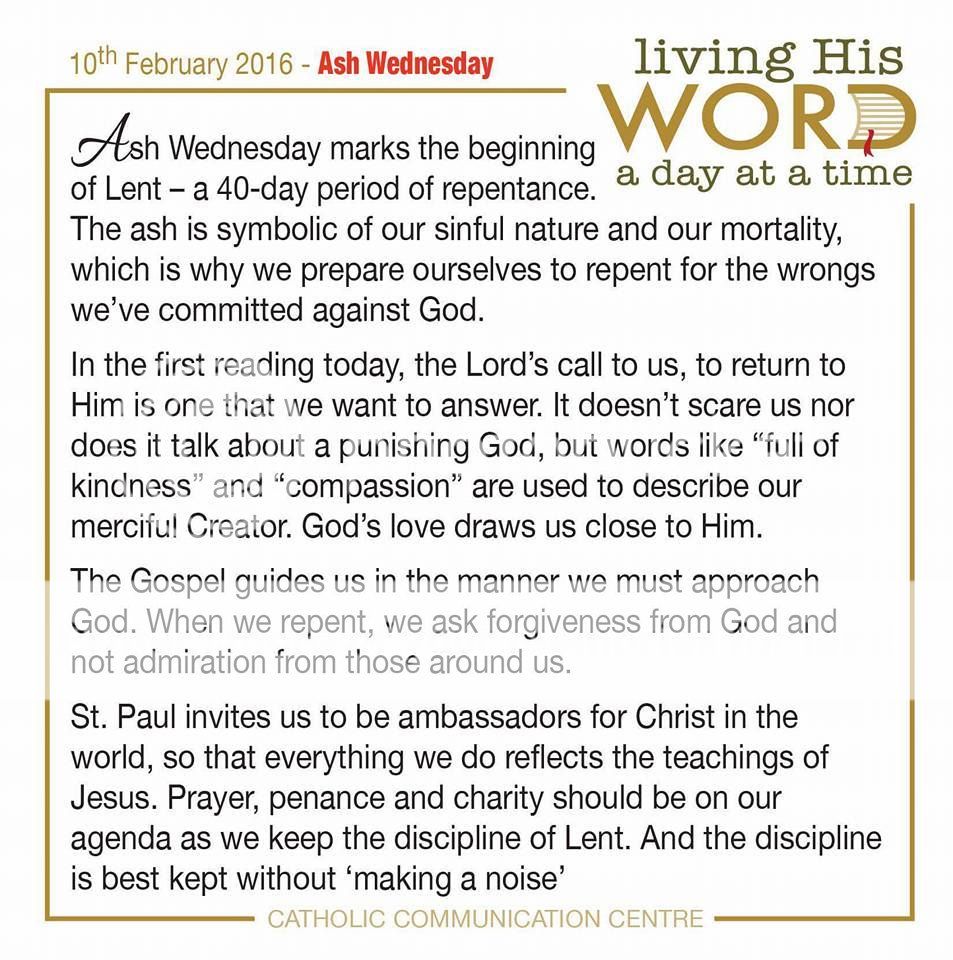
""Ash Wednesday"", February 10, 2016

Holy Gospel according to:
"Matthew 6:1-6, 16-18"

Jesus said to his disciples:
“Take care not to perform righteous deeds in order that people may see them; otherwise, you will have no recompense from your heavenly Father. When you give alms, do not blow a trumpet before you, as the hypocrites do in the synagogues and in the streets to win the praise of others. Amen, I say to you, they have received their reward. But when you give alms, do not let your left hand know what your right is doing, so that your almsgiving may be secret. And your Father who sees in secret will repay you.
“When you pray, do not be like the hypocrites, who love to stand and pray in the synagogues and on street corners so that others may see them. Amen, I say to you, they have received their reward. But when you pray, go to your inner room, close the door, and pray to your Father in secret. And your Father who sees in secret will repay you.
“When you fast, do not look gloomy like the hypocrites. They neglect their appearance, so that they may appear to others to be fasting. Amen, I say to you, they have received their reward. But when you fast, anoint your head and wash your face, so that you may not appear to be fasting, except to your Father who is hidden. And your Father who sees what is hidden will repay you.”

“God showered his blessings & miracles, always on you & your beautiful family; Amen †”

khool
post Feb 11 2016, 02:41 PM

Getting Started
**
Junior Member
225 posts

Joined: Mar 2008


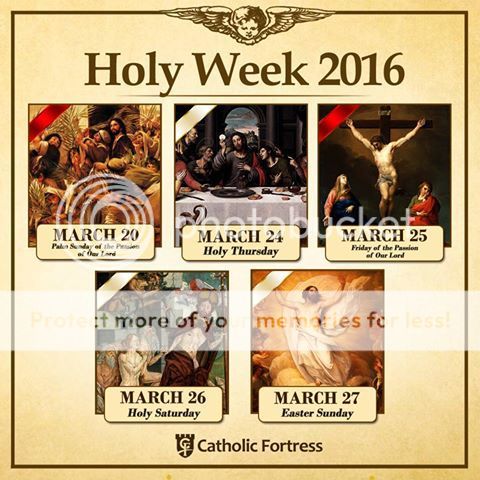
Mark your calender's ... biggrin.gif

user posted image

khool
post Feb 13 2016, 08:37 AM

Getting Started
**
Junior Member
225 posts

Joined: Mar 2008


(Some) Good advice from St. John Chrysostom on fasting ... biggrin.gif

user posted image

khool
post Feb 14 2016, 02:56 PM

Getting Started
**
Junior Member
225 posts

Joined: Mar 2008


Today is the feast of St. Valentine. Saint Valentine, officially known as Saint Valentine of Rome, is a third-century Roman saint widely celebrated on February 14 and commonly associated with "courtly love."

user posted image

Although not much of St. Valentine's life is reliably known, and whether or not the stories involve two different saints by the same name is also not officially decided, it is highly agreed that St. Valentine was martyred and then buried on the Via Flaminia to the north of Rome.

In 1969, the Roman Catholic Church removed St. Valentine from the General Roman Calendar, because so little is known about him. However, the church still recognizes him as a saint, listing him in the February 14 spot of Roman Martyrolgy.

The legends attributed to the mysterious saint are as inconsistent as the actual identification of the man.

One common story about St. Valentine is that in one point of his life, as the former Bishop of Terni, Narnia and Amelia, he was on house arrest with Judge Asterius. While discussing religion and faith with the Judge, Valentine pledged the validity of Jesus. The judge immediately put Valentine and his faith to the test.

St. Valentine was presented with the judge's blind daughter and told to restore her sight. If he succeeded, the judge vowed to do anything for Valentine. Placing his hands onto her eyes, Valentine restored the child's vision.

Judge Asterius was humbled and obeyed Valentine's requests. Asterius broke all the idols around his house, fasted for three days and became baptized, along with his family and entire 44 member household. The now faithful judge then freed all of his Christian inmates.

St. Valentine was later arrested again for continuing to try to convert people to Christianity. He was sent to Rome under the emperor Claudius Gothicus (Claudius II). According to the popular hagiographical identity, and what is believed to be the first representation of St. Valentine, the Nuremberg Chronicle, St. Valentine was a Roman priest martyred during Claudius' reign. The story tells that St. Valentine was imprisoned for marrying Christian couples and aiding Christians being persecuted by Claudius in Rome. Both acts were considered serious crimes. A relationship between the saint and emperor began to grow, until Valentine attempted to convince Claudius of Christianity. Claudius became raged and sentenced Valentine to death, commanding him to renounce his faith or be beaten with clubs and beheaded.

St. Valentine refused to renounce his faith and Christianity and was executed outside the Flaminian Gate on February 14, 269. However, other tales of St. Valentine's life claim he was executed either in the year 269, 270, 273 or 280. Other depictions of St. Valentine's arrests tell that he secretly married couples so husbands wouldn't have to go to war. Another variation of the legend of St. Valentine says he refused to sacrifice to pagan gods, was imprisoned and while imprisoned he healed the jailer's blind daughter. On the day of his execution, he left the girl a note signed, "Your Valentine."

Pope Julius I is said to have built a church near Ponte Mole in his memory, which for a long time gave name to the gate now called Porta del Popolo, formerly, Porta Valetini.

The romantic nature of Valentine's Day may have derived during the Middle Ages, when it was believed that birds paired couples in mid-February. According to English 18th-century antiquarians Alban Butler and Francis Douce, Valentine's Day was most likely created to overpower the pagan holiday, Lupercalia.

Although the exact origin of the holiday is not widely agreed upon, it is widely recognized as a day for love, devotion and romance.

Whoever he was, Valentine did really exist, because archaeologists have unearthed a Roman catacomb and an ancient church dedicated to St. Valentine. In 496 AD Pope Gelasius marked February 14th as a celebration in honor of his martyrdom.

Relics of St. Valentine can be found all over the world. A flower-crowned skull of St. Valentine can be found in the Basilica of Santa Maria in Cosmedin, Rome. In 1836, other relics were exhumed from the catacombs of Saint Hippolytus on the Via Tiburtina and were identified as Valentine's. These were transported for a special Mass dedicated to those young and in love.

Fr. John Spratt received a gift from Pope Gregory XVI in 1836 contianing a "small vessel tinged" with St. Valentine's blood. This gift now stands placed in Whitefriar Street Church in Dublin, Ireland.

Other alleged relics were found in Prague in the Church of St Peter and Paul at Vysehrad; in the parish church of St. Mary's Assumption in Chelmno Poland; at the reliquary of Roquemaure in France; in the Stephansdom in Vienna; in Balzan in Malta and also in Blessed John Duns Scotus' church in the Gorbals area of Glasgow, Scotland.

St. Valentine is the Patron Saint of affianced couples, bee keepers, engaged couples, epilepsy, fainting, greetings, happy marriages, love, lovers, plague, travellers, and young people. He is represented in pictures with birds and roses and his feast day is celebrated on February 14.

Source: Catholic Online

khool
post Feb 14 2016, 02:57 PM

Getting Started
**
Junior Member
225 posts

Joined: Mar 2008


Amen!

user posted image

khool
post Feb 14 2016, 03:03 PM

Getting Started
**
Junior Member
225 posts

Joined: Mar 2008


Gospel Reading: First Sunday of Lent, February 14: Luke 4:1-13

user posted image

Filled with the Holy Spirit, Jesus returned from the Jordan and was led by the Spirit into the desert for forty days, to be tempted by the devil. He ate nothing during those days, and when they were over he was hungry. The devil said to him, “If you are the Son of God, command this stone to become bread.” Jesus answered him, “It is written,

One does not live on bread alone.”

Then he took him up and showed him all the kingdoms of the world in a single instant. The devil said to him, “I shall give to you all this power and glory; for it has been handed over to me, and I may give it to whomever I wish. All this will be yours, if you worship me.” Jesus said to him in reply, “It is written:

You shall worship the Lord, your God, and him alone shall you serve.”

Then he led him to Jerusalem, made him stand on the parapet of the temple, and said to him, “If you are the Son of God, throw yourself down from here, for it is written:

He will command his angels concerning you, to guard you, and: With their hands they will support you, lest you dash your foot against a stone.”

Jesus said to him in reply, “It also says,

You shall not put the Lord, your God, to the test.”

When the devil had finished every temptation, he departed from him for a time.

khool
post Feb 14 2016, 04:02 PM

Getting Started
**
Junior Member
225 posts

Joined: Mar 2008


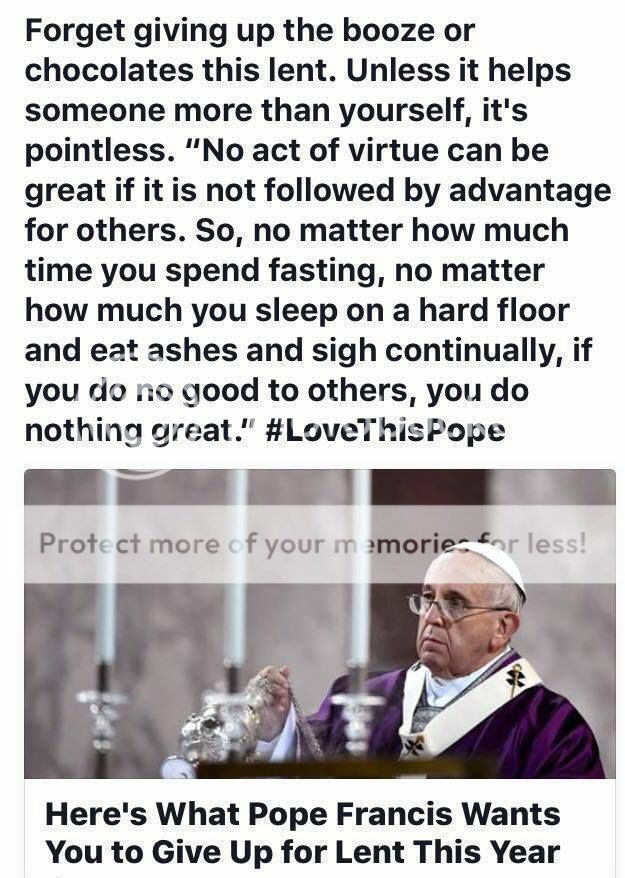
Pope Francis, on sacrifice ...

user posted image

khool
post Feb 18 2016, 07:54 AM

Getting Started
**
Junior Member
225 posts

Joined: Mar 2008


God gave us religion because He knows what is required for holiness much better than we do.

The cup of benediction that we bless is it not Participation in the blood of Christ?
Is this a ritual being offered in a religion ordained by God dedicated to the doctrine and the breaking of the bread and the prayers living according to One Lord One Faith One Baptism in which Paul calls us to obedience to the faith in charity In a church that as a sign of unity God told Peter to Feed His sheep?

The false age of enlightenment and paganism which became New Age philosophies have influenced humanity more than you will ever know.

I AM NOT RELIGIOUS!

Then through Satan's influence, you are not truly Christian.

Hebrews 12:14
Make every effort to live in peace with everyone and to be holy; without holiness no one will see the Lord.

khool
post Feb 18 2016, 02:47 PM

Getting Started
**
Junior Member
225 posts

Joined: Mar 2008


QUOTE(yeeck @ Feb 18 2016, 12:14 PM)
All those satanic lyrics glorifying Lucifer, sex and drugs and point blank blasphemy about all things sacred in the Catholic Church. Proof to the separated brethren that the Catholic Church IS the enemy of the devil.
*
As it has ever been the case, the Church was, is and forever will be a thorn in the side of old 'Loo ... biggrin.gif


39 Pages « < 13 14 15 16 17 > » Top
Topic ClosedOptions
 

Change to:
| Lo-Fi Version
0.1499sec    0.57    7 queries    GZIP Disabled
Time is now: 14th December 2025 - 01:27 AM