Welcome Guest ( Log In | Register )

Bump Topic Topic Closed RSS Feed

Outline · [ Standard ] · Linear+

 LYN Catholic Fellowship V01 (Group), For Catholics (Roman or Eastern)

views
     
khool
post May 12 2017, 09:16 AM

Getting Started
**
Junior Member
225 posts

Joined: Mar 2008


Friday of the Fourth Week of Easter
Lectionary: 283


user posted image

Reading 1 (Acts 13:26-33)

When Paul came to Antioch in Pisidia, he said in the synagogue:
"My brothers, children of the family of Abraham,
and those others among you who are God-fearing,
to us this word of salvation has been sent.
The inhabitants of Jerusalem and their leaders failed to recognize him,
and by condemning him they fulfilled the oracles of the prophets
that are read sabbath after sabbath.
For even though they found no grounds for a death sentence,
they asked Pilate to have him put to death,
and when they had accomplished all that was written about him,
they took him down from the tree and placed him in a tomb.
But God raised him from the dead,
and for many days he appeared to those
who had come up with him from Galilee to Jerusalem.
These are now his witnesses before the people.
We ourselves are proclaiming this good news to you
that what God promised our fathers
he has brought to fulfillment for us, their children, by raising up Jesus,
as it is written in the second psalm,
You are my Son; this day I have begotten you."

Responsorial Psalm (Ps 2:6-7, 8-9, 10-11ab)

R. You are my Son; this day I have begotten you.
or:
R. Alleluia.


"I myself have set up my king
on Zion, my holy mountain."
I will proclaim the decree of the LORD:
The LORD said to me, "You are my Son;
this day I have begotten you."
R. You are my Son; this day I have begotten you.
or:
R. Alleluia.


"Ask of me and I will give you
the nations for an inheritance
and the ends of the earth for your possession.
You shall rule them with an iron rod;
you shall shatter them like an earthen dish."
R. You are my Son; this day I have begotten you.
or:
R. Alleluia.


And now, O kings, give heed;
take warning, you rulers of the earth.
Serve the LORD with fear, and rejoice before him;
with trembling rejoice.
R. You are my Son; this day I have begotten you.
or:
R. Alleluia.


Alleluia (Jn 14:6)

R. Alleluia, alleluia.
I am the way and the truth and the life, says the Lord;
no one comes to the Father except through me.
R. Alleluia, alleluia.

Gospel (Jn 14:1-6)

Jesus said to his disciples:
"Do not let your hearts be troubled.
You have faith in God; have faith also in me.
In my Father's house there are many dwelling places.
If there were not,
would I have told you that I am going to prepare a place for you?
And if I go and prepare a place for you,
I will come back again and take you to myself,
so that where I am you also may be.
Where I am going you know the way."
Thomas said to him,
"Master, we do not know where you are going;
how can we know the way?"
Jesus said to him, "I am the way and the truth and the life.
No one comes to the Father except through me."
user posted image

REFLECTION

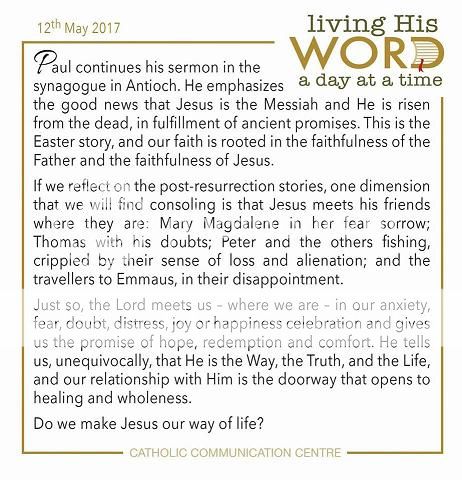
Many Dwelling Places. At the Last Supper, Jesus intimates to His disciples His coming “departure.” It is the “taking away of the Bridegroom,” and the disciples are certainly sad. But Jesus consoles them that His death actually is but a passage to the Father’s house where He will prepare dwelling places (Greek monai) for them. The word is related to menein which means to stay, remain, or abide with. So John refers here to the place (state or situation) where the disciples can abide with the Father and with Jesus.

“Dwelling places” is a type of Jewish imagery that refers to the destination of the holy and the just. In the New Testament, it is equivalent to “Paradise” or “bosom of Abraham,” that is, eternal habitation or heaven.

Heaven is our eternal destination. It is there that Jesus awaits us, even as He is with us always. Believers, therefore, are to fix their sight on this eternal goal. Here on earth, we do not have a lasting home; instead, we seek the One that is to come (cf Heb 13:14).

“Imagine there’s no heaven …” goes a famous line from John Lennon of The Beatles. Is this really a solution to life’s vicissitudes and contradictions?

Some parents feel that their child is not coming at the best time. They should ask the Lord to heal and strengthen them to accept their child fully and wholeheartedly. It is important for that child to feel wanted. He or she is not an accessory or a solution to some personal need (AL 170).

SOURCE: “365 Days with the Lord 2017,” ST. PAULS Philippines, 7708 St. Paul Rd., SAV, Makati City (Phils.) http://www.ssp.ph/

khool
post May 12 2017, 09:25 AM

Getting Started
**
Junior Member
225 posts

Joined: Mar 2008


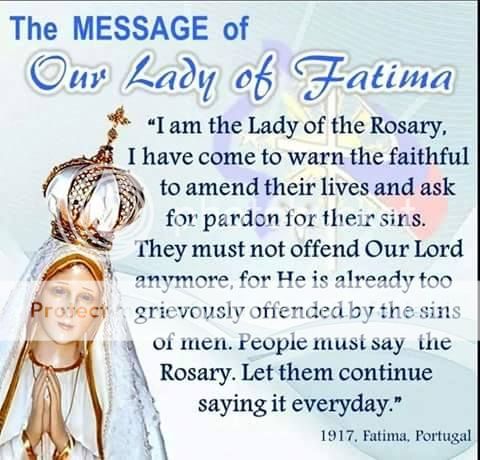
What was Sr. Lucia's advice after Fatima visions? Pray. Everyday.

user posted image

Fatima, Portugal, May 11, 2017 / 05:02 am (CNA/EWTN News).- The niece of Fatima visionary Sr. Lucia dos Santos said her aunt was a normal person like everyone else, but shared some personal advice that her saintly relative used to give: to pray at least something every day.

“She always asked me to pray the rosary every day, because there were many who did not pray,” Maria dos Anjos, niece of Fatima visionary Lucia dos Santos, told CNA in an interview.

“This was what Our Lady asked: that we pray the rosary every day. Because there were many who didn't pray and because of this many souls went to hell because there was no one to pray for them,” she said.

Anjos, who only saw her aunt when they went to visit her in the convent, said the advice Lucia always gave her was to pray daily, and “that I not forget.”

She recalled that in a few of the conversations she had with her aunt, she confessed to not finishing the rosary because she was tired, having worked hard in the fields all day.

In response, Lucia didn’t reproach, but instead told her to “always start it, and if you don’t finish, Our Lady will finish it.”

Anjos, 97, is the daughter of one of Lucia’s older sisters. She grew up in the house directly across the street from where Lucia and her family used to live, and continues to live there with one of her sons today. Every evening she can be seen sitting on the front porch area with a rosary in hand.

While now there are paved streets and cars driving past the houses and tourist shops set up near Lucia’s house, which is now preserved as a museum and is open to the public for visits, Anjos said that when she was growing up, “there wasn’t anything here...just a mountain and some sheep and donkeys.”

Although she was only one year old at the time Lucia entered the convent, Anjos said her family would go to visit whenever they could.

Lucia, she said, “was a sister like the others. There was no difference. She was just like the other sisters who were in the convent,” and was always “joyful” – both as a child and as a religious sister.

Recalling memories that her mother had shared of her and Lucia’s childhood, Anjos said Lucia was a normal child like everyone else, and never lacked playmates.

“Many children came to play with her because their parents went to the wine estates and left their children here, because there was always someone at the house of Lucia’s mother who looked after the kids,” Anjos said.

Her grandmother and mother to Lucia, Maria Rosa Farreira, was catechist, and would also teach the children who came to the house while their parents were away.

Faith was always a big part of their family, even before the apparitions, Anjos said, explaining that “we always prayed the rosary, we went to Mass every Sunday, we did what we saw that could be done.”

After the apparitions of Mary, “we continued, doing more, and remembering that Our Lady asked us to pray more and to make more sacrifices,” she said, jesting that “we do our homework well.”

She recalled being able to attend Mass with Pope John Paul II during one of his three visits to Fatima, saying she was able to receive communion from him alongside her aunt, Sister Lucia.

“When communion came, I received communion from his hands, from the hands of the Holy Father. I liked it a lot,” she said, adding “you always like good things, do you not?”

Though she wasn’t able to speak with John Paul, Anjos said she was still “very happy,” and is equally content to welcome Pope Francis during his May 12-13 visit for the centenary of the Fatima apparitions.

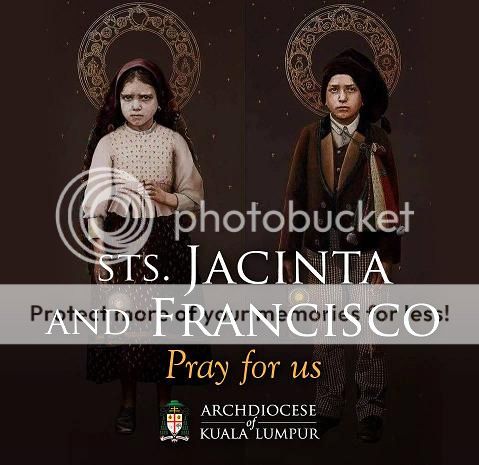
During the visit, Francis will also canonized the two other Fatima visionaries – Francisco and Jacinta Marto – who were Lucia’s younger cousins, but died shortly after the apparitions took place.

“I am very glad they will be canonized,” she said, explaining that in her and her family’s mind, the siblings were already saints. Though it will now become official, she said she believes devotion to them will be “the same,” since people had already viewed them as holy.

While she’s sad she won’t be able to attend this Mass personally, Anjos said she’ll be watching it on TV, which she said is enough to make her happy.

Noting an uptick in visits to the shrine, Anjos said that many people, her family included would pray the rosary and visit the shrine after the apparitions, but “it seems that we have more devotion.”

“I think that faith has increased here and in the whole world,” she said. “At least I think it has, because many people come here, and that’s why we have to (pray) more and more. I think it did a lot of good for people to have Our Lady appear here.”

Source: http://www.catholicnewsagency.com/news/wha...everyday-17504/

khool
post May 12 2017, 09:26 AM

Getting Started
**
Junior Member
225 posts

Joined: Mar 2008


user posted image

khool
post May 15 2017, 09:12 AM

Getting Started
**
Junior Member
225 posts

Joined: Mar 2008


Monday of the Fifth Week of Easter
Lectionary: 285


user posted image

Reading 1 (Acts 14:5-18)

There was an attempt in Iconium
by both the Gentiles and the Jews,
together with their leaders,
to attack and stone Paul and Barnabas.
They realized it,
and fled to the Lycaonian cities of Lystra and Derbe
and to the surrounding countryside,
where they continued to proclaim the Good News.

At Lystra there was a crippled man, lame from birth,
who had never walked.
He listened to Paul speaking, who looked intently at him,
saw that he had the faith to be healed,
and called out in a loud voice, "Stand up straight on your feet."
He jumped up and began to walk about.
When the crowds saw what Paul had done,
they cried out in Lycaonian,
"The gods have come down to us in human form."
They called Barnabas "Zeus" and Paul "Hermes,"
because he was the chief speaker.
And the priest of Zeus, whose temple was at the entrance to the city,
brought oxen and garlands to the gates,
for he together with the people intended to offer sacrifice.

The Apostles Barnabas and Paul tore their garments
when they heard this and rushed out into the crowd, shouting,
"Men, why are you doing this?
We are of the same nature as you, human beings.
We proclaim to you good news
that you should turn from these idols to the living God,
who made heaven and earth and sea and all that is in them.
In past generations he allowed all Gentiles to go their own ways;
yet, in bestowing his goodness,
he did not leave himself without witness,
for he gave you rains from heaven and fruitful seasons,
and filled you with nourishment and gladness for your hearts."
Even with these words, they scarcely restrained the crowds
from offering sacrifice to them.

Responsorial Psalm (Ps 115:1-2, 3-4, 15-16)

R. Not to us, O Lord, but to your name give the glory.
(Non nobis domine ... domine, tua da gloriam!)
or:
R. Alleluia.


Not to us, O LORD, not to us
but to your name give glory
because of your mercy, because of your truth.
Why should the pagans say,
"Where is their God?"
R. Not to us, O Lord, but to your name give the glory.
(Non nobis domine ... domine, tua da gloriam!)
or:
R. Alleluia.


Our God is in heaven;
whatever he wills, he does.
Their idols are silver and gold,
the handiwork of men.
R. Not to us, O Lord, but to your name give the glory.
(Non nobis domine ... domine, tua da gloriam!)
or:
R. Alleluia.


May you be blessed by the LORD,
who made heaven and earth.
Heaven is the heaven of the LORD,
but the earth he has given to the children of men.
R. Not to us, O Lord, but to your name give the glory.
(Non nobis domine ... domine, tua da gloriam!)
or:
R. Alleluia.


Alleluia (Jn 14:26)

R. Alleluia, alleluia.
The Holy Spirit will teach you everything
and remind you of all I told you.
R. Alleluia, alleluia.

Gospel (Jn 14:21-26)

Jesus said to his disciples:
"Whoever has my commandments and observes them
is the one who loves me.
Whoever loves me will be loved by my Father,
and I will love him and reveal myself to him."
Judas, not the Iscariot, said to him,
"Master, then what happened that you will reveal yourself to us
and not to the world?"
Jesus answered and said to him,
"Whoever loves me will keep my word,
and my Father will love him,
and we will come to him and make our dwelling with him.
Whoever does not love me does not keep my words;
yet the word you hear is not mine
but that of the Father who sent me.

"I have told you this while I am with you.
The Advocate, the Holy Spirit
whom the Father will send in my name—
he will teach you everything
and remind you of all that I told you."

[IMGhttp://i790.photobucket.com/albums/yy184/khool/18491602_10207008118640824_7702520656460061707_o_zpssajyk8di.jpg[/IMG]

REFLECTION

Whoever loves me will keep my word. Discipleship is a union of intimate love with Jesus, but love is not to be interpreted merely as emotion. Love is also a matter of human decision and action. One who truly loves Jesus proves it by keeping His commandments or, better, the “new commandment” of love. And this is to love one another as Jesus loves His disciples (cf Jn. 13:34).

Unlike love that usually means a one-to-one relationship, the love of Jesus takes the form of a triad: Jesus-I-brother/sister. To love Jesus is not to be thoroughly focused on Him only, but to welcome the brother and sister in that relationship. It is not “you and me against the world,” an exclusive love, but rather an inclusive one that welcomes others. John writes: “If anyone says, ‘I love God,’ but hates his brother, he is a liar; for whoever does not love a brother whom he has seen cannot love God whom he has not seen” (1 Jn. 4:20).

It is certainly easier to love Jesus because He is all good and loving than a fellow human being with all his or her weaknesses, shortcomings, and sins. But this is how we prove to the Lord that we really love Him.

“[Lord,] lead me in the path of Your commandments, for that is my delight” (Ps. 119:35).

SOURCE: “365 Days with the Lord 2017,” ST. PAULS Philippines, 7708 St. Paul Rd., SAV, Makati City (Phils.) http://www.ssp.ph/

khool
post May 15 2017, 09:29 AM

Getting Started
**
Junior Member
225 posts

Joined: Mar 2008


user posted image
khool
post May 16 2017, 08:47 AM

Getting Started
**
Junior Member
225 posts

Joined: Mar 2008


Tuesday of Fifth Week of Easter
Lectionary: 286


Reading 1 (Acts 14:19-28)

In those days, some Jews from Antioch and Iconium
arrived and won over the crowds.
They stoned Paul and dragged him out of the city,
supposing that he was dead.
But when the disciples gathered around him,
he got up and entered the city.
On the following day he left with Barnabas for Derbe.

After they had proclaimed the good news to that city
and made a considerable number of disciples,
they returned to Lystra and to Iconium and to Antioch.
They strengthened the spirits of the disciples
and exhorted them to persevere in the faith, saying,
"It is necessary for us to undergo many hardships
to enter the Kingdom of God."
They appointed presbyters for them in each Church and,
with prayer and fasting, commended them to the Lord
in whom they had put their faith.
Then they traveled through Pisidia and reached Pamphylia.
After proclaiming the word at Perga they went down to Attalia.
From there they sailed to Antioch,
where they had been commended to the grace of God
for the work they had now accomplished.
And when they arrived, they called the Church together
and reported what God had done with them
and how he had opened the door of faith to the Gentiles.
Then they spent no little time with the disciples.

Responsorial Psalm (Ps 145:10-11, 12-13ab, 21)

R. Your friends make known, O Lord, the glorious splendor of your kingdom.
or:
R. Alleluia.


Let all your works give you thanks, O LORD,
and let your faithful ones bless you.
Let them discourse of the glory of your kingdom
and speak of your might.
R. Your friends make known, O Lord, the glorious splendor of your kingdom.
or:
R. Alleluia.


Making known to men your might
and the glorious splendor of your kingdom.
Your kingdom is a kingdom for all ages,
and your dominion endures through all generations.
R. Your friends make known, O Lord, the glorious splendor of your kingdom.
or:
R. Alleluia.


May my mouth speak the praise of the LORD,
and may all flesh bless his holy name forever and ever.
R. Your friends make known, O Lord, the glorious splendor of your kingdom.
or:
R. Alleluia.


Alleluia (Lk 24:46, 26)

R. Alleluia, alleluia.
Christ had to suffer and to rise from the dead,
and so enter into his glory.
R. Alleluia, alleluia.

Gospel (Jn 14:27-31a)

Jesus said to his disciples:
"Peace I leave with you; my peace I give to you.
Not as the world gives do I give it to you.
Do not let your hearts be troubled or afraid.
You heard me tell you,
'I am going away and I will come back to you.'
If you loved me,
you would rejoice that I am going to the Father;
for the Father is greater than I.
And now I have told you this before it happens,
so that when it happens you may believe.
I will no longer speak much with you,
for the ruler of the world is coming.
He has no power over me,
but the world must know that I love the Father
and that I do just as the Father has commanded me."

user posted image

REFLECTION

Peace… not as the world gives. In Jesus’ time, the world celebrated the “peace of Augustus” that marked the end of civil strifes in Rome and its provinces when Octavian (later proclaimed Augustus Caesar) defeated all his rivals. It was peace “the world gives,” one sustained by treaties and armies and made at the cost of subjugation. Jesus’ gift of peace is of another kind. It comes with Jesus’ subjugation of sin, death, and the devil, paid at the price of his own life.

In the setting of his farewell at the Last Supper, Jesus is not giving a peace of good-bye. He is anticipating the peace that he will win with his death and glorification. This peace comes with the giving of the Holy Spirit. On the evening of the first day of the week (the day of his resurrection), Jesus appears to the disciples and says, “Peace be with you” and breathes on them the Holy Spirit (cf Jn 20:21-22). The Holy Spirit will inspire and console them, even in the midst of anguish and pain.

Christians will live in this peace in their tranquil conviction that no one and nothing can separate them from the love of Christ: neither anguish, nor distress, nor persecution—not even death (cf Rom 8:35-39).

“Lord, make us instruments of your peace!”

SOURCE: “365 Days with the Lord 2017,” ST. PAULS Philippines, 7708 St. Paul Rd., SAV, Makati City (Phils.) http://www.ssp.ph/

khool
post May 17 2017, 10:12 AM

Getting Started
**
Junior Member
225 posts

Joined: Mar 2008


Wednesday of the Fifth Week of Easter
Lectionary: 287


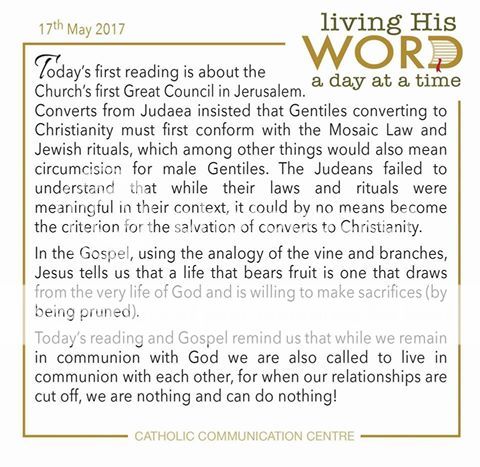
Reading 1 (Acts 15:1-6)

Some who had come down from Judea were instructing the brothers,
"Unless you are circumcised according to the Mosaic practice,
you cannot be saved."
Because there arose no little dissension and debate
by Paul and Barnabas with them,
it was decided that Paul, Barnabas, and some of the others
should go up to Jerusalem to the Apostles and presbyters
about this question.
They were sent on their journey by the Church,
and passed through Phoenicia and Samaria
telling of the conversion of the Gentiles,
and brought great joy to all the brethren.
When they arrived in Jerusalem,
they were welcomed by the Church,
as well as by the Apostles and the presbyters,
and they reported what God had done with them.
But some from the party of the Pharisees who had become believers
stood up and said, "It is necessary to circumcise them
and direct them to observe the Mosaic law."

The Apostles and the presbyters met together to see about this matter.

Responsorial Psalm (Ps 122:1-2, 3-4ab, 4cd-5)

R. Let us go rejoicing to the house of the Lord.
or:
R. Alleluia.


I rejoiced because they said to me,
"We will go up to the house of the LORD."
And now we have set foot
within your gates, O Jerusalem.
R. Let us go rejoicing to the house of the Lord.
or:
R. Alleluia.


Jerusalem, built as a city
with compact unity.
To it the tribes go up,
the tribes of the LORD.
R. Let us go rejoicing to the house of the Lord.
or:
R. Alleluia.


According to the decree for Israel,
to give thanks to the name of the LORD.
In it are set up judgment seats,
seats for the house of David.
R. Let us go rejoicing to the house of the Lord.
or:
R. Alleluia.


Alleluia (Jn 15:4a, 5b)

R. Alleluia, alleluia.
Remain in me, as I remain in you, says the Lord;
whoever remains in me will bear much fruit.
R. Alleluia, alleluia.

Gospel (Jn 15:1-8)

Jesus said to his disciples:
"I am the true vine, and my Father is the vine grower.
He takes away every branch in me that does not bear fruit,
and everyone that does he prunes so that it bears more fruit.
You are already pruned because of the word that I spoke to you.
Remain in me, as I remain in you.
Just as a branch cannot bear fruit on its own
unless it remains on the vine,
so neither can you unless you remain in me.
I am the vine, you are the branches.
Whoever remains in me and I in him will bear much fruit,
because without me you can do nothing.
Anyone who does not remain in me
will be thrown out like a branch and wither;
people will gather them and throw them into a fire
and they will be burned.
If you remain in me and my words remain in you,
ask for whatever you want and it will be done for you.
By this is my Father glorified,
that you bear much fruit and become my disciples."

user posted image

REFLECTION

Remain in me, as I remain in you. In the Old Testament, Israel is compared to a choice vine, taken from Egypt and planted in a vineyard especially prepared by the Lord (cf Ps 80:9). Alas, instead of producing sweet grapes for the Lord, Israel yielded sour fruits. This is the metaphor of unfaithfulness and violence that characterized the people of Israel and Judah. The people were not clinging to the Lord who was their vine grower.

In Gospel, the metaphor of the grapevine serves to explain Jesus’ relationship with his own disciples. The vine is Jesus, and the branches are the disciples. To remain or abide in Jesus is to be attached to him in such a way that life would be impossible without him, just as a branch has no life and soon withers if it is detached from the vine. A person not connected with Jesus may continue to exist, but the person lives a shadow life that has no real meaning and does not benefit anyone in a permanent way.

While the metaphor points to a close interpersonal bond with Jesus, however, it does not mean that one cuts off one’s relationship with others and thinks only of one’s private relationship with the Lord. For remaining with Jesus means living his love that is radically unselfish and so reaches out to others. Abiding with Jesus “bears fruit” as he does—he gives his life that others may live.

What kind of “fruits” does your present life produce?

SOURCE: “365 Days with the Lord 2017,” ST. PAULS Philippines, 7708 St. Paul Rd., SAV, Makati City (Phils.) http://www.ssp.ph/

khool
post May 17 2017, 04:32 PM

Getting Started
**
Junior Member
225 posts

Joined: Mar 2008


user posted image

khool
post May 18 2017, 08:43 AM

Getting Started
**
Junior Member
225 posts

Joined: Mar 2008


Thursday of the Fifth Week of Easter
Lectionary: 288


user posted image

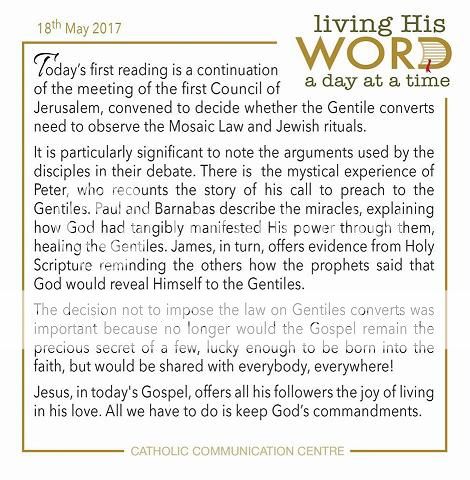
Reading 1 (Acts 15:7-21)

After much debate had taken place,
Peter got up and said to the Apostles and the presbyters,
"My brothers, you are well aware that from early days
God made his choice among you that through my mouth
the Gentiles would hear the word of the Gospel and believe.
And God, who knows the heart,
bore witness by granting them the Holy Spirit
just as he did us.
He made no distinction between us and them,
for by faith he purified their hearts.
Why, then, are you now putting God to the test
by placing on the shoulders of the disciples
a yoke that neither our ancestors nor we have been able to bear?
On the contrary, we believe that we are saved
through the grace of the Lord Jesus, in the same way as they."
The whole assembly fell silent,
and they listened
while Paul and Barnabas described the signs and wonders
God had worked among the Gentiles through them.

After they had fallen silent, James responded,
"My brothers, listen to me.
Symeon has described how God first concerned himself
with acquiring from among the Gentiles a people for his name.
The words of the prophets agree with this, as is written:

After this I shall return
and rebuild the fallen hut of David;
from its ruins I shall rebuild it
and raise it up again,
so that the rest of humanity may seek out the Lord,
even all the Gentiles on whom my name is invoked.
Thus says the Lord who accomplishes these things,
known from of old.

It is my judgment, therefore,
that we ought to stop troubling the Gentiles who turn to God,
but tell them by letter to avoid pollution from idols,
unlawful marriage, the meat of strangled animals, and blood.
For Moses, for generations now,
has had those who proclaim him in every town,
as he has been read in the synagogues every sabbath."

Responsorial Psalm (Ps 96:1-2a, 2b-3, 10)

R. Proclaim God's marvelous deeds to all the nations.
or:
R. Alleluia.


Sing to the LORD a new song;
sing to the LORD, all you lands.
Sing to the LORD; bless his name.
R. Proclaim God's marvelous deeds to all the nations.
or:
R. Alleluia.


Announce his salvation, day after day.
Tell his glory among the nations;
among all peoples, his wondrous deeds.
R. Proclaim God's marvelous deeds to all the nations.
or:
R. Alleluia.


Say among the nations: The LORD is king.
He has made the world firm, not to be moved;
he governs the peoples with equity.
R. Proclaim God's marvelous deeds to all the nations.
or:
R. Alleluia.


Alleluia (Jn 10:27)

R. Alleluia, alleluia.
My sheep hear by voice, says the Lord;
I know them, and they follow me.
R. Alleluia, alleluia.

Gospel (Jn 15:9-11)

Jesus said to his disciples:
"As the Father loves me, so I also love you.
Remain in my love.
If you keep my commandments, you will remain in my love,
just as I have kept my Father's commandments
and remain in his love.

"I have told you this so that
my joy might be in you and
your joy might be complete."

user posted image

REFLECTION

Remain in my love. The origin of love is always God, for God is love. This love is manifested in the divine Trinity where each of the divine Persons is attuned to each other in love. The Father loves the Son, and the Son as the Logos/Word is pros ton Theon (Jn 1:1)—often translated as “with God” but more accurately “attuned to God.”

Divine love now embraces creation, human beings in particular. After Jesus’ dialogue with Nicodemus, John declares “For God so loved the world that he gave his only Son” (Jn 3:16). The Son loves all men and women just as the Father loves them. Jesus loves them to the very end—till death. He offers his very life for his disciples.

Love, if it is to be love, should be reciprocal. The love of Jesus calls for a response: a love manifested in the observance of his commandments. And his commandments can be summarized by love: “I give you a new commandment: love one another. As I have loved you, so you also should love one another. This is how all will know that you are my disciples, if you have love for one another” (Jn 13:34-35).

True love bears fruit in joy—authentic joy that comes from the conviction that one is loved. This joy will weather the vicissitudes of life and the highs and lows of emotions.

Do you allow yourself to be “surprised by joy”? Where does this joy spring from?

SOURCE: “365 Days with the Lord 2017,” ST. PAULS Philippines, 7708 St. Paul Rd., SAV, Makati City (Phils.) http://www.ssp.ph/

khool
post May 19 2017, 09:34 AM

Getting Started
**
Junior Member
225 posts

Joined: Mar 2008


Friday of the Fifth Week of Easter
Lectionary: 289


user posted image

Reading 1 (Acts 15:22-31)

The Apostles and presbyters, in agreement with the whole Church,
decided to choose representatives
and to send them to Antioch with Paul and Barnabas.
The ones chosen were Judas, who was called Barsabbas,
and Silas, leaders among the brothers.
This is the letter delivered by them:
"The Apostles and the presbyters, your brothers,
to the brothers in Antioch, Syria, and Cilicia
of Gentile origin: greetings.
Since we have heard that some of our number
who went out without any mandate from us
have upset you with their teachings
and disturbed your peace of mind,
we have with one accord decided to choose representatives
and to send them to you along with our beloved Barnabas and Paul,
who have dedicated their lives to the name of our Lord Jesus Christ.
So we are sending Judas and Silas
who will also convey this same message by word of mouth:
'It is the decision of the Holy Spirit and of us
not to place on you any burden beyond these necessities,
namely, to abstain from meat sacrificed to idols,
from blood, from meats of strangled animals,
and from unlawful marriage.
If you keep free of these,
you will be doing what is right. Farewell.'"

And so they were sent on their journey.
Upon their arrival in Antioch
they called the assembly together and delivered the letter.
When the people read it, they were delighted with the exhortation.

Responsorial Psalm (Ps 57:8-9, 10 and 12)

R. I will give you thanks among the peoples, O Lord.
or:
R. Alleluia.


My heart is steadfast, O God; my heart is steadfast;
I will sing and chant praise.
Awake, O my soul; awake, lyre and harp!
I will wake the dawn.
R. I will give you thanks among the peoples, O Lord.
or:
R. Alleluia.


I will give thanks to you among the peoples, O LORD,
I will chant your praise among the nations.
For your mercy towers to the heavens,
and your faithfulness to the skies.
Be exalted above the heavens, O God;
above all the earth be your glory!
R. I will give you thanks among the peoples, O Lord.
or:
R. Alleluia.


Alleluia (Jn 15:15b)

R. Alleluia, alleluia.
I call you my friends, says the Lord,
for I have made known to you all that the Father has told me.
R. Alleluia, alleluia.

Gospel (Jn 15:12-17)

Jesus said to his disciples:
"This is my commandment: love one another as I love you.
No one has greater love than this,
to lay down one's life for one's friends.
You are my friends if you do what I command you.
I no longer call you slaves,
because a slave does not know what his master is doing.
I have called you friends,
because I have told you everything I have heard from my Father.
It was not you who chose me, but I who chose you
and appointed you to go and bear fruit that will remain,
so that whatever you ask the Father in my name he may give you.
This I command you: love one another."

user posted image

REFLECTION

As I love you. In the Synoptic gospels, Jesus’ core command is expressed in the “first and greatest” of the commandments: “You shall love the Lord your God with all your heart, with all your soul, with all your mind, and with all your strength… You shall love your neighbor as yourself” (Mk 12:30-31). In John, the commandment is expressed as love for one another. This sounds rather exclusive, different from the Synoptic version. But what is emphasized here is the font and measure of love: The love of Jesus. And the love of Jesus is but a reflection of God’s love.

While it seems confined to the community of disciples, the commandment of love in John becomes a force for apostolic dynamism: People will recognize those who belong to Christ by their love for one another (cf Jn 13:35). Moreover, the degree of love is expanded from self-love to God’s love for us, which is much deeper than our self-love. Nobody really hates himself, but there are times when people give up on themselves and on their lives. But God is greater than our hearts! God’s love or Jesus’ love as measure of our love opens a broader panorama in the living of that love.

How deep is your love? What is the measure of that love?

How far will you go to manifest that love?

SOURCE: “365 Days with the Lord 2017,” ST. PAULS Philippines, 7708 St. Paul Rd., SAV, Makati City (Phils.) http://www.ssp.ph/

khool
post May 19 2017, 09:35 AM

Getting Started
**
Junior Member
225 posts

Joined: Mar 2008


user posted image

khool
post May 19 2017, 09:42 AM

Getting Started
**
Junior Member
225 posts

Joined: Mar 2008


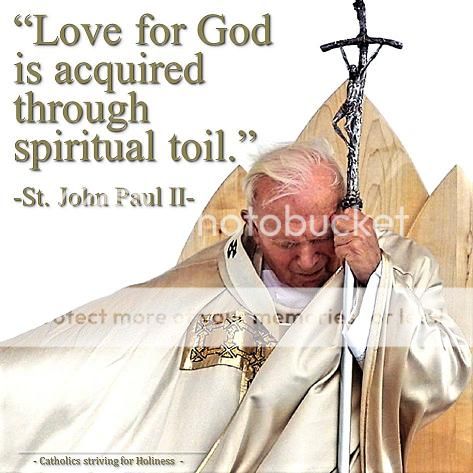
GROWTH IN SPIRITUAL LIFE. “Love for God is acquired through spiritual toil (St. John Paul II).”

user posted image

Dear brethren in Christ, I have come across these passages from “In Conversation with God, vol 3., n. 22.2” by Francis Fernandez Carvajal which I recommend to you to meditate upon as they explain the reasons why scant progress is made in one’s spiritual life and their corresponding opposite to advance in one’s love for God and others.

QUOTE
There are various reasons that cause us to make scant progress in the interior life, and even to lose ground and give way to discouragement. However, these reasons can be reduced to just a few: carelessness, negligence in little things connected with service to God and friendship with him; drawing back from the sacrifices He asks of us (cf R. Garrigou-Lagrange, The Three Ages of the Interior Life).

• All we have to offer to God each day are little acts of faith and love. Petitions. Acts of thanksgiving during Holy Mass. Visits to the Blessed Sacrament and being aware that we are going to meet Jesus Christ himself who is waiting for us... Our customary prayers throughout the day. Overcoming our shortcomings at work, answering people pleasantly, asking for things politely...

• Many little things done with love and for love comprise our treasure for this or that day, which we will carry with us into eternity. Our interior life is normally nourished by little things carried out with love and attention.

• To claim anything else would be to mistake our way, to find nothing or very little to offer to God. It is good for us to remember, Monsignor (Jose Maria) Escrivá points out, the story of that character imagined by a French author, who set out to hunt lions in the corridors of his home, and naturally did not find any. Our life is quite ordinary; trying to serve God in big things would be like trying to hunt lions in the corridor. Just like the huntsman in the story, we would end up empty-handed (J. Escrivá, Letter, 24 March 1930), with nothing to offer. We have the ordinary everyday things.

• Just as drops of water added to one another give life to the thirsty earth, so do our little deeds: a glance at an image of Our Lady, a word of encouragement for a friend, a reverent genuflection before the tabernacle, rejecting a distraction during our prayer, overcoming our laziness.

• All create good habits, virtues which enable the life of our soul to flourish. If we are faithful to these little acts, if we frequently renew our desire to please God, when something bigger arises for us to offer him such as an illness which is hard to bear or some failure at work, then, too, we will be able to gather fruit from what God has wanted or permitted. Then the words of Christ will be fulfilled: He who is faithful in very little is faithful also in much (cf Luke 16:10).

Another thing that causes us to regress in the life of the soul is refusing to accept the sacrifices that God asks of us (R. Garrigou-Lagrange, loc cit). Such sacrifices provide an opportunity for us to go against our own selfishness - always a sign of love. They show our determination to seek Christ throughout the day instead of seeking ourselves.

• Love for God is acquired through spiritual toil (John Paul II, Homily, 3 February 1980), through the effort and interest that is born, with the help of grace, in the depths of our soul. There can be no love, either human or divine, without this willing sacrifice.

• Love grows within us, and develops in the midst of our setbacks and the resistance each of us puts up to that love on the inside, and also grows and develops in the face of resistance from ‘the outside’, that is, despite the many external forces that are foreign and even hostile to it (ibidem). As Our Lord has promised us that the help of his grace will never fail us, it all depends on our correspondence with it, on our determination, on our willing to start time and again without getting discouraged. The more faithful we are to grace, the more help He gives us, the easier we will find it to follow the way. We will also find that more is being demanded of us: an even greater finesse in our soul. Love always calls for more love.
Source: https://www.facebook.com/Catholicsstrivingf...4916063/?type=3

khool
post May 22 2017, 03:04 PM

Getting Started
**
Junior Member
225 posts

Joined: Mar 2008


user posted image

khool
post May 22 2017, 03:06 PM

Getting Started
**
Junior Member
225 posts

Joined: Mar 2008


user posted image

"Look down upon me, good and gentle Jesus, While before Thy face I humbly kneel And with burning soul, pray and beseech Thee, To fix deep in my heart, Lively sentiments of faith, hope and charity, True contrition for my sins And a firm purpose of amendment. While I contemplate with great love and tender pity, Thy five most precious wounds, Pondering over them within me, And calling to mind the words that David, Thy prophet, said of Thee , my Jesus, "They have pierced My hands and feet, They have numbered all my bones."

khool
post May 22 2017, 05:11 PM

Getting Started
**
Junior Member
225 posts

Joined: Mar 2008


Love is our law: God is our portion; here by faith, in heaven by sight

The Christian law is a law of love. It is all comprised in the love of God. We are bound to love Him for Himself, ourselves in Him, and our neighbours for Him. God is the one principle, from Whom everything flows, and towards Whom everything must tend. He is the centre in Whom all things find their unity. Love, says St. Augustine, is the only worship God exacts, and which alone is pleasing to Him. Faith alone does not honour God-the devils believe and tremble. [127] Hope without love is not enough, because it stops short at God's promises without going on to Himself.

Charity alone reaches Him, is united to Him, and rests in Him as in the supreme Good. What avails the practice of exterior works, if they are not animated and quickened by the heart? Men only pay attention to outward demonstrations, and they judge the heart by them, for they cannot see any deeper. But God looks upon the heart. [128] According to the state of the heart, He appraises all else.

user posted image

Love is the only thing that makes Our Lord's yoke easy and His burden light. [129] Fear causes us to feel the whole weight of the law; hope lightens it but in part; love alone removes the whole burden of it. According to St. Augustine, the lover feels nothing burdensome to him, or if it be a burden, he loves it. The lover counts what he does as nothing, fears lest he does not enough, and longs ever to do more. Love knows no bounds, and is always able to grow stronger, above all if its object be infinitely lovable. To love such an object is at once a motive and a means to love it more. The more it is loved, the better is it known; and the better it is known, the more one longs to love it. In this way, knowledge and love serve to increase one another indefinitely.

The soul enjoys the true liberty of the children of God, [130] only in so far as it loves. 'Love' says St. Augustine, 'and do what you will'. You would not wish to do anything contrary to love, nor therefore to a law which is itself wholly founded on love. In the same way, St. Paul says that the law is not made for the just. [131] Why does the just man need an external law; he finds all the precepts written in his heart? And not only does he find there the law, but the perfection of the law. Love would not have him stop short at what God commands: it urges him to pass on to those things which please Him, to what He counsels without expressly commanding. Love is his rule, his whole desire, his whole strength. That is why he is perfectly free, for freedom consists in doing what we will, and in willing what we do.

Such love is all the purer, as the heart becomes detached from its own interests and tends towards the object loved, without looking back on itself. This degree of purity is the state to which God is continually striving to raise the soul that has given itself to Him. All the favours which He has bestowed on it, the trials through which He has caused it to pass, the sacrifices He exacts of it, all combine to purify its love, and to separate all alloy from it. Thus may the interior way be defined, not as a state of pure love, but as a constant tending towards it.

It may be said that the tending towards pure love is also the aim of the ordinary Christian, and I agree: but with a distinction. If, in the normal way, retaining our liberty, we mingle our own activity with the workings of grace, this will hinder those workings from producing their full effect. In the passive way, however, having given to God all right over our own will, God acts upon us more powerfully; nothing hinders or restrains His work, and therefore it achieves its full effect. It is difficult, not to say impossible, for this difference to be understood by those who are not in the passive way, however perfect they may be otherwise. But it is none the less real, and it would be presumptuous to doubt the word of those saints who have spoken on the matter from their own experience.

However, we are not to take fright at the mention of pure love, as though it were contrary to Christian hope. Those who have so written as to give this impression either expressed themselves badly or were misunderstood. In this life, charity does not, and never can, exclude hope. So long as we do not possess the thing we love, we must desire to do so. And not only desire it, but hope for it, in virtue of God's promises. And we count it a duty to hope for it, by reason of the express command which He lays upon all His children.

The love of God is not such as to exclude hope, no matter to what degree it has arrived, but is the actual possession of God or the assurance of possessing Him. The actual possession only takes place in heaven, the assurance in Purgatory. Here on earth, where the enjoyment of God is neither perfect nor assured, and where, apart from a special revelation, one cannot even be sure of one's salvation or that one is in a state of grace, [132] how is it possible for charity to banish hope from the Christian heart? To do so would be to enter on a state of despair absolutely incompatible with love.

In this life, charity always implies the other two theological virtues; and, far from destroying them, perfects them in perfecting itself. Anything that could destroy faith and hope in us would all the more destroy charity. It is absurd, then, to think that the trials that are sent to purify our love can in any way lessen the virtue of hope. It is equally absurd to imagine that there can be such a thing as a state, or even an act, of pure love, which would involve a renouncement of hope. Even if hope may not be the motive for the love, nevertheless it exists at the bottom of the heart. In the words of St. Paul: there remain faith, hope and charity. [133] This is the case even with the greatest saints, so long as they are still pilgrims in via. It is only at the end of their pilgrimage that faith ceases, because one no longer believes, but sees clearly. Similarly hope comes to an end, because one either possesses or is assured of possessing. So charity reigns alone, since in heaven there is scope only for charity. Such is St. Paul's teaching; a doctrine, incidentally, based on the very essence and definition of the three theological virtues.

The fact that God urges certain souls to sacrifices in their most severe trials, proves nothing to the contrary of what I have been saying. God's intention is not to purify love at the expense of hope (for that would be acting contrary to Himself), but, while purifying love to purify hope at the same time, and so lead the soul to place God's glory and will above all selfinterest. This does not require the soul to renounce its happiness, but to subordinate it, as it must be subordinated, to God's good pleasure, which must always be its motive.

It might perhaps have been better not to have touched on these matters, which are extremely delicate and very difficult to explain, or even to understand with perfect precision. It is not necessary that souls should know about these things in advance, because those whom God calls to such a great sacrifice are few and far between; and when they are in this state, their perplexity and darkness are such that they could not make use of their previous knowledge, even if they wanted to. As for the directors of such souls, God never fails, provided they consult Him in prayer, to give them the necessary light to guide their penitents, and the best books would be useless to them, if they did not seek that light in their own union with God. But as this subject, which is the highest of all relating to the interior life, caused much public comment at the end of the seventeenth century, and in consequence of a just condemnation many persons became prejudiced against a subject understood by very few, I have thought fit to explain the matter briefly, in order to correct certain false impressions, and to dispel prejudice.

The great and inestimable advantage of love is that it leads to the eternal possession of God: this is the privilege of love alone. Faith and hope cannot open the gate to heaven, unless charity be joined to them. [134] Even during this life, love enables us to possess God to a certain degree, for loving Him is the beginning of possession. We may love any other object without possessing it, or possess it without loving it. But God, Who is the supreme Good, has this peculiar to Himself alone: His love cannot be separated from the possession of Him, nor the possession of Him from His love.

Of course such possession is imperfect on earth, because it is enjoyed beneath the veil of faith. The heart delights in God, and is filled with Him and contemns everything else. If it have yet any desire left, it can only be for a fuller and more assured enjoyment of that love. Yes: when the love of God reaches a certain point, it stills all the agitations of the human heart, even in this life. It brings a peace, which cannot be troubled, so long as the love subsists which gave it birth.

But who are those in whom love rises to such a height as to give them, even in this land of exile, a foretaste of the happiness of their heavenly home? They are souls who may justly be termed children of God, because they are led by His Spirit. [135] As sons, they already share in their Father's inheritance. Others partake of His gifts and graces; these enter already into an anticipated possession of Himself. Having given themselves to God, God gives Himself wholly to them. He unites them with Himself, communicating to them something of that changelessness of peace and rest which He Himself enjoys.

And the proof of this is that no earthly happenings of any kind cause them either joy or sorrow. They accept all things with an even mind, and though some slight agitation may take place on the surface of their souls, the depths of the soul are undisturbed. I have only to appeal to the experience of the saints. Were there ever souls more calm and still? One has only to look at their serenity in the midst of the most painful tortures. Was it the effect of their own reflections or efforts at self-control, made at such moments? Indeed no: they owed it to their possession of God, Who so filled their hearts that there was no room left for any other feeling or thought of self.

127. James ii. 19
128. I Kings xvi. 7
129. Cf. Matt. xi. 30
130. Cf. Rom. viii. 21
131. I Tim. i. 9
132. Cf. Eccles. ix. 1
133. I Cor. xiii. 13
134. Cf. I Cor. xiii. 2
135. Cf. Rom. viii. 14

Spiritual Maxims,
by John Nicholas Grou, S.J.
(1731-1803)

Source: http://www.catholictreasury.info/books/spi...axims/index.php


39 Pages « < 37 38 39Top
Topic ClosedOptions
 

Change to:
| Lo-Fi Version
0.1301sec    0.74    7 queries    GZIP Disabled
Time is now: 2nd December 2025 - 12:21 AM