

LYN Catholic Fellowship V01 (Group), For Catholics (Roman or Eastern)
LYN Catholic Fellowship V01 (Group), For Catholics (Roman or Eastern)
|
|
 Mar 16 2016, 06:57 AM Mar 16 2016, 06:57 AM
Return to original view | Post
#321
|
 
Junior Member
225 posts Joined: Mar 2008  
|
|
|
|
|
|
|
Mar 25 2016, 09:11 AM
Return to original view | Post
#322
|
|
Junior Member
225 posts Joined: Mar 2008
|
     |
|
|
Mar 25 2016, 09:17 AM
Return to original view | Post
#323
|
|
Junior Member
225 posts Joined: Mar 2008
|
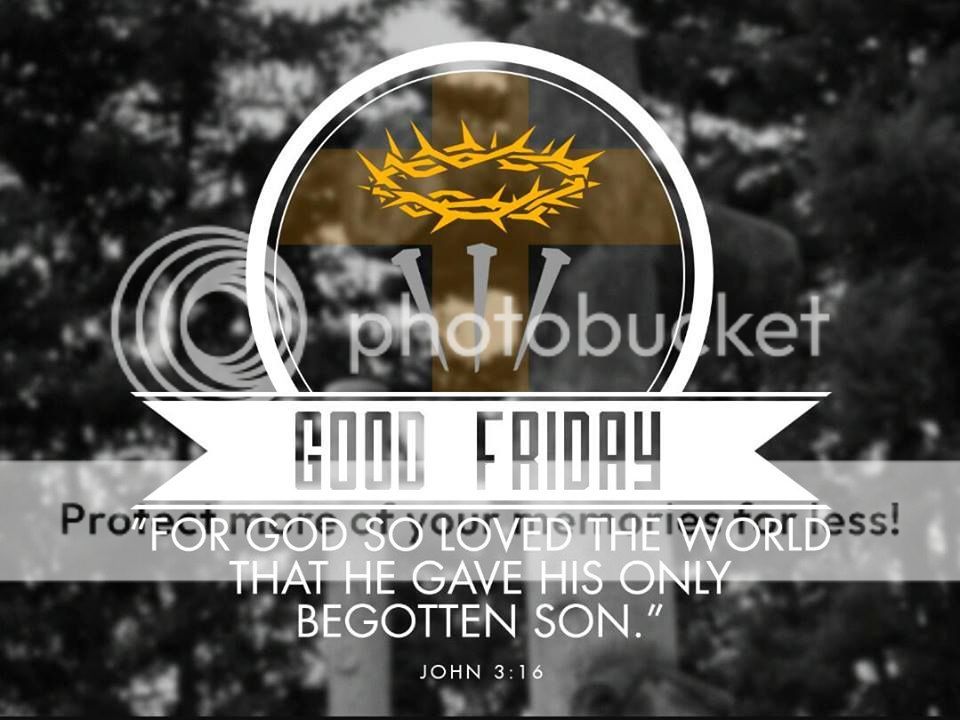
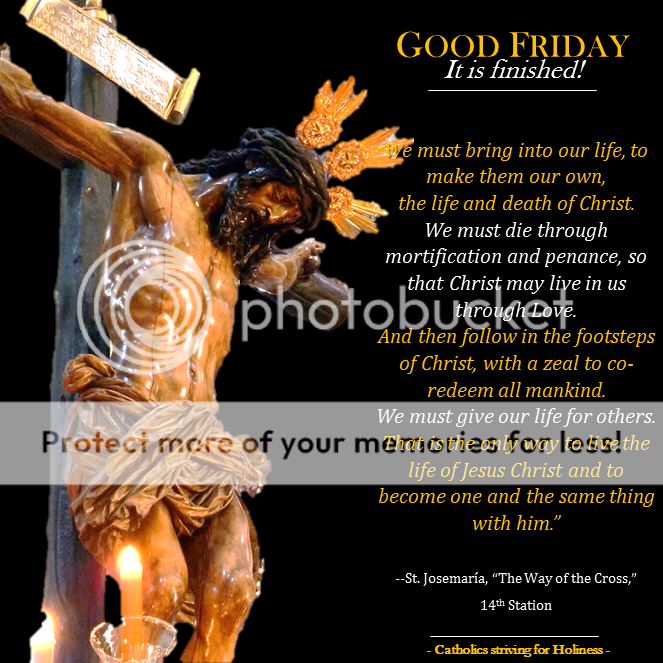
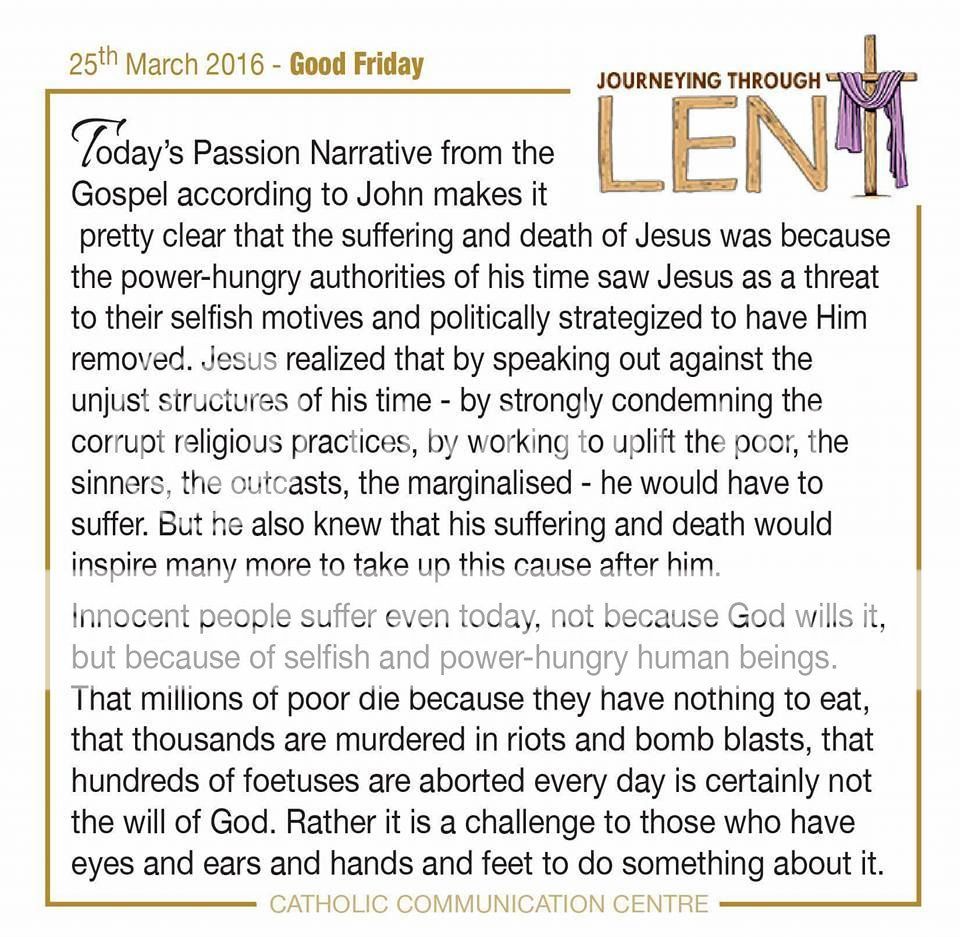
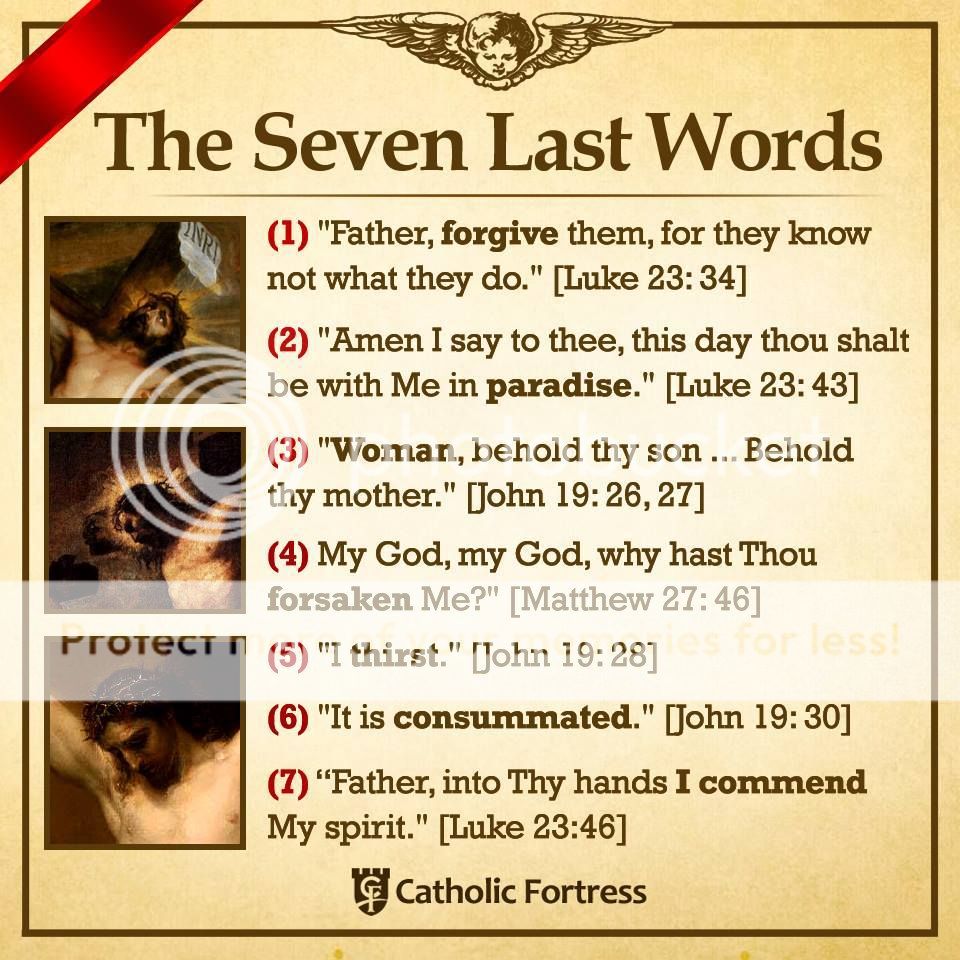 Have a Blessed Good Friday and see you all in Church for Stations of the Cross! Amen!  |
|
|
Mar 27 2016, 07:28 AM
Return to original view | Post
#324
|
|
Junior Member
225 posts Joined: Mar 2008
|
Let yourselves be moved by hope, Pope says at Easter Vigil
By Elise Harris Vatican City, Mar 26, 2016 / 03:38 pm (CNA/EWTN News) During the Easter Vigil, Pope Francis told attendees not to be overcome by sadness in the face of life’s difficulties, but to be open to hope, which is not the absence of problems, but is a gift from God when we allow him to enter our lives. “We, like Peter and the women, cannot discover life by being sad, bereft of hope,” the Pope said March 26. He urged the faithful not to “stay imprisoned within ourselves, but let us break open our sealed tombs to the Lord so that he may enter and grant us life. Let us give him the stones of our rancor and the boulders of our past, those heavy burdens of our weaknesses and falls.” As we anticipate Jesus’ Resurrection from the dead, the first stone which must be moved aside is “the lack of hope which imprisons us within ourselves,” he said. The Pope then prayed that the Lord would free us from the trap of being “Christians without hope, who live as if the Lord were not risen, as if our problems were the center of our lives.” Pope Francis spoke to the thousands present inside St. Peter’s Basilica for the Easter Vigil, which is celebrated the night before Easter in anticipation of Jesus’ rising from the dead. The vigil began in the atrium of the basilica with the traditional blessing of the fire and the preparation of the Easter candle. The Pope then led a procession with the lit candle to the main altar, where he continued with the rest of the Mass. In the course of the celebration, Francis administered the Sacraments of Christian Initiation – Baptism, Confirmation and the Eucharist – to 12 newcomers in the Catholic Church, hailing from Italy, Albania, Cameroon, Korea, India and China. Those being baptized included Yong Joon Lee, the Korean ambassador to Italy, and his wife Hee Kim. In his homily, the Pope noted how the women in the Gospel, after going to anoint Jesus' body, had run to the disciples and told them about how they had found the tomb empty. Peter and the others did not initially believe the women, yet Peter ran to the tomb anyway, he said. “There was doubt in Peter’s heart, together with many other worries: sadness at the death of the beloved Master and disillusionment for having denied him three times during his Passion,” he said. But still, something in Peter’s behavior had changed. Instead of staying sedentary and remaining at home with the others, Peter rose, refusing to succumb to the somber atmosphere in the days following Jesus’ death or to be overcome by his doubts. Peter, the Pope said, “was not consumed by remorse, fear or the continuous gossip that leads nowhere.” “He was looking for Jesus, not himself. He preferred the path of encounter and trust. And so, he got up, just as he was, and ran towards the tomb from where he would return amazed.” This, Francis observed, “marked the beginning of Peter’s resurrection, the resurrection of his heart.” Without giving in to sadness or darkness, Peter “made room for hope: he allowed the light of God to enter into his heart, without smothering it.” Like Peter, the women also had the same experience of awe when they went to Jesus' tomb with oil and met the angel, who told them that the Lord had risen, Francis said, adding that like them, we can't allow ourselves to be overcome by a lack of hope. Pope Francis stressed that there will always be problems “both within and without,” which won’t go away. What’s important, he said, is to place them in the light of the Risen Lord, “and in a certain sense, to evangelize them.” The resurrection of the Lord is “the foundation of our hope,” he said, clarifying that this hope is neither “mere optimism, nor a psychological attitude or desire to be courageous.” Rather, he said, Christian hope “is a gift that God gives us if we come out of ourselves and open our hearts to him.” Hope will never disappoint us because we have been given the Holy Spirit, the Pope said, noting that the Spirit doesn’t seek to make things look appealing or “remove evil with a magic wand.” The Holy Spirit, he said, “pours into us the vitality of life, which is not the absence of problems, but the certainty of being loved and always forgiven by Christ, who for us has conquered sin, death and fear.” Pope Francis emphasized that each person, after having met Jesus, is then sent out by him to proclaim the Easter message, and “to awaken and resurrect hope in hearts burdened by sadness, in those who struggle to find meaning in life.” However, he cautioned that we shouldn’t proclaim ourselves, but must rather be “joyful servants of hope” who announce the Risen Lord through our lives and the ways in which we love. “Otherwise we will be only an international organization full of followers and good rules, yet incapable of offering the hope for which the world longs,” he said. Francis concluded his homily by telling attendees that their hope can be strengthened by following the angel’s advice to the women in the Gospel: “Remember what [Jesus] told you.” He urged them to always remember Jesus’ words and deeds, “otherwise we will lose hope.” He urged everyone to “open our hearts to hope and go forth,” praying that the constant memory of Jesus’ works and words would be “the bright star which directs our steps in the ways of faith toward the Easter that will have no end.” Source: http://www.catholicnewsagency.com/news/let...er-vigil-18684/ |
|
|
Mar 28 2016, 01:57 PM
Return to original view | Post
#325
|
|
Junior Member
225 posts Joined: Mar 2008
|
With only $200,12 nuns and little television experience, Mother Angelica began broadcasting a religious talk show from a TV studio put together in the monastery garage in suburban Birmingham in 1981. That show grew into Eternal Word Television Network, which has long had the blessing of the Vatican.
Despite its humble beginnings, EWTN Global Catholic Network calls itself the world's largest religious media network. It has 11 TV networks that broadcast Catholic programming to more than 258 million households in more than 145 counties and territories. Mother Angelica was fearless because she had God on her side. She saw what He needed her to do, and she did it! She transformed the world of Catholic broadcasting and brought the Gospel to far corners of our world. That witness of faith was unmistakable to anyone who met and worked with her, and generations of Catholics have and will continue to be formed by her vision and her ‘Yes’ to God’s will. 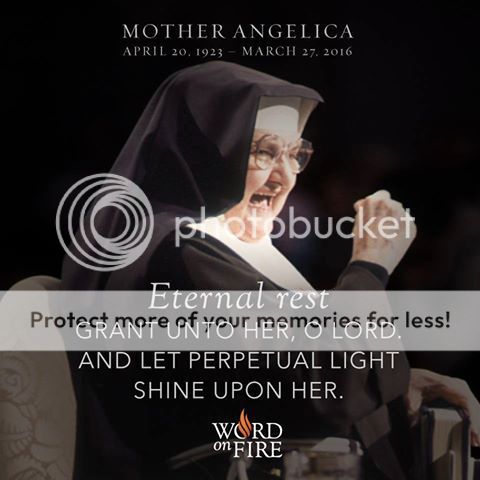 |
|
|
Mar 28 2016, 02:03 PM
Return to original view | Post
#326
|
|
Junior Member
225 posts Joined: Mar 2008
|
Amen, blessed Easter!
|
|
|
|
|
|
Mar 31 2016, 03:31 PM
Return to original view | Post
#327
|
|
Junior Member
225 posts Joined: Mar 2008
|
QUOTE(yeeck @ Mar 31 2016, 12:23 PM) A rarely quoted part of Scripture in these modern times: something like ...I charge thee, before God and Jesus Christ, who shall judge the living and the dead, by his coming, and his kingdom: [2] Preach the word: be instant in season, out of season: reprove, entreat, rebuke in all patience and doctrine. [3] For there shall be a time, when they will not endure sound doctrine; but, according to their own desires, they will heap to themselves teachers, having itching ears: [4] And will indeed turn away their hearing from the truth, but will be turned unto fables. [5] But be thou vigilant, labour in all things, do the work of an evangelist, fulfill thy ministry. Be sober. --Second Epistle Of Saint Paul To Timothy Chapter 4.  a. no need to take communion b. no need to go for confession c. no need to celebrate Easter (for that matter, dispense with Christmas also then!) d. no need to have priests e. no need for last rites f. no need to pray rosary / structured prayer g. no need to pray for the dead h. no need to ask Saints to pray with us g. no need to even go to Church (?!?!?!!!) awww heck, why even bother with baptism then? just a couple amens, alleluias and God-Bless-you's is more than enough eh? Carry on with completely no worries at all ... sounds good? ...  This post has been edited by khool: Mar 31 2016, 03:31 PM |
|
|
Mar 31 2016, 04:39 PM
Return to original view | Post
#328
|
|
Junior Member
225 posts Joined: Mar 2008
|
QUOTE(yeeck @ Mar 31 2016, 04:23 PM) That's like telling Jesus...."Dear Lord, I don't want to deny myself, do penance, and carry the cross." And what did Jesus said about the broad and narrow ways? Matthew 7:13-14 (NRSVCE)The Narrow Gate 13 “Enter through the narrow gate; for the gate is wide and the road is easy[a] that leads to destruction, and there are many who take it. 14 For the gate is narrow and the road is hard that leads to life, and there are few who find it. |
|
|
Mar 31 2016, 04:46 PM
Return to original view | Post
#329
|
|
Junior Member
225 posts Joined: Mar 2008
|
The full chapter, so no cherry picking (which I abhor / detest)
Matthew 7 (NRSVCE) Judging Others 1 “Do not judge, so that you may not be judged. 2 For with the judgment you make you will be judged, and the measure you give will be the measure you get. 3 Why do you see the speck in your neighbor’s[a] eye, but do not notice the log in your own eye? 4 Or how can you say to your neighbor,[b] ‘Let me take the speck out of your eye,’ while the log is in your own eye? 5 You hypocrite, first take the log out of your own eye, and then you will see clearly to take the speck out of your neighbor’s[c] eye. Profaning the Holy 6 “Do not give what is holy to dogs; and do not throw your pearls before swine, or they will trample them under foot and turn and maul you. Ask, Search, Knock 7 “Ask, and it will be given you; search, and you will find; knock, and the door will be opened for you. 8 For everyone who asks receives, and everyone who searches finds, and for everyone who knocks, the door will be opened. 9 Is there anyone among you who, if your child asks for bread, will give a stone? 10 Or if the child asks for a fish, will give a snake? 11 If you then, who are evil, know how to give good gifts to your children, how much more will your Father in heaven give good things to those who ask him! The Golden Rule 12 “In everything do to others as you would have them do to you; for this is the law and the prophets. The Narrow Gate 13 “Enter through the narrow gate; for the gate is wide and the road is easy[d] that leads to destruction, and there are many who take it. 14 For the gate is narrow and the road is hard that leads to life, and there are few who find it. A Tree and Its Fruit 15 “Beware of false prophets, who come to you in sheep’s clothing but inwardly are ravenous wolves. 16 You will know them by their fruits. Are grapes gathered from thorns, or figs from thistles? 17 In the same way, every good tree bears good fruit, but the bad tree bears bad fruit. 18 A good tree cannot bear bad fruit, nor can a bad tree bear good fruit. 19 Every tree that does not bear good fruit is cut down and thrown into the fire. 20 Thus you will know them by their fruits. Concerning Self-Deception 21 “Not everyone who says to me, ‘Lord, Lord,’ will enter the kingdom of heaven, but only the one who does the will of my Father in heaven. 22 On that day many will say to me, ‘Lord, Lord, did we not prophesy in your name, and cast out demons in your name, and do many deeds of power in your name?’ 23 Then I will declare to them, ‘I never knew you; go away from me, you evildoers.’ Hearers and Doers 24 “Everyone then who hears these words of mine and acts on them will be like a wise man who built his house on rock. 25 The rain fell, the floods came, and the winds blew and beat on that house, but it did not fall, because it had been founded on rock. 26 And everyone who hears these words of mine and does not act on them will be like a foolish man who built his house on sand. 27 The rain fell, and the floods came, and the winds blew and beat against that house, and it fell—and great was its fall!” 28 Now when Jesus had finished saying these things, the crowds were astounded at his teaching, 29 for he taught them as one having authority, and not as their scribes. God bless! |
|
|
Mar 31 2016, 07:07 PM
Return to original view | Post
#330
|
|
Junior Member
225 posts Joined: Mar 2008
|
 |
|
|
Mar 31 2016, 11:05 PM
Return to original view | Post
#331
|
|
Junior Member
225 posts Joined: Mar 2008
|
The pillar and foundation of truth has to be committed to one doctrine for all time. The disciples of the apostles taught, defended, and died in the Catholic Faith. Justin in 150 AD writing to the emperor of Rome, explained how Satan created paganism to keep humanity from Catholic truth.
The foundation built on rock starts by believing these four words of God. "THIS IS MY BODY" Those who didn't, the disciples of the apostles called heretics. What brings you closer to the Eucharist is of God, what pushes you away cannot be. Ignatius of Antioch "I have no taste for corruptible food nor for the pleasures of this life. I desire the bread of God, which is the flesh of Jesus Christ, who was of the seed of David; and for drink I desire his blood, which is love incorruptible" (Letter to the Romans 7:3 [A.D. 110]). "Take note of those who hold heterodox opinions on the grace of Jesus Christ which has come to us, and see how contrary their opinions are to the mind of God. . . . They abstain from the Eucharist and from prayer because they do not confess that the Eucharist is the flesh of our Savior Jesus Christ, flesh which suffered for our sins and which that Father, in his goodness, raised up again. They who deny the gift of God are perishing in their disputes" (Letter to the Smyrnaeans 6:2–7:1 [A.D. 110]). Justin Martyr "We call this food Eucharist, and no one else is permitted to partake of it, except one who believes our teaching to be true and who has been washed in the washing which is for the remission of sins and for regeneration [i.e., has received baptism] and is thereby living as Christ enjoined. For not as common bread nor common drink do we receive these; but since Jesus Christ our Savior was made incarnate by the word of God and had both flesh and blood for our salvation, so too, as we have been taught, the food which has been made into the Eucharist by the Eucharistic prayer set down by him, and by the change of which our blood and flesh is nurtured, is both the flesh and the blood of that incarnated Jesus" (First Apology 66 [A.D. 151]). 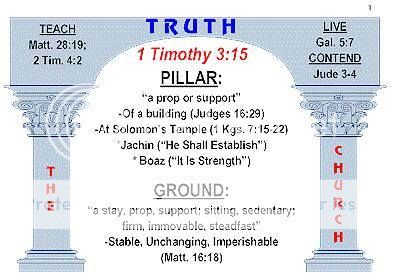 This post has been edited by khool: Mar 31 2016, 11:09 PM |
|
|
Apr 2 2016, 09:49 AM
Return to original view | Post
#332
|
|
Junior Member
225 posts Joined: Mar 2008
|
QUOTE(De_Luffy @ Apr 2 2016, 12:50 AM) A quick Question, Jesus ascension to heaven should be around 40 days right? But I see many churches shorten it to just 1 month? It is 40 days, for the Catholic Church. It is also a holy day of obligation (for Catholics in Malaysia), meaning all Catholics are required to attend Mass and Holy Communion for that day. Ascension Day for 2016 falls on May 5, btw. Cannot speak for other churches. |
|
|
Apr 2 2016, 09:57 AM
Return to original view | Post
#333
|
|
Junior Member
225 posts Joined: Mar 2008
|
This post has been edited by khool: Apr 2 2016, 09:57 AM |
|
|
|
|
|
Apr 2 2016, 02:41 PM
Return to original view | Post
#334
|
|
Junior Member
225 posts Joined: Mar 2008
|
A quick guide ...
|
|
|
Apr 3 2016, 07:43 AM
Return to original view | Post
#335
|
|
Junior Member
225 posts Joined: Mar 2008
|
 |
|
|
Apr 3 2016, 04:26 PM
Return to original view | Post
#336
|
|
Junior Member
225 posts Joined: Mar 2008
|
“Let us take things as we find them: let us not attempt to distort them into what they are not... We cannot make facts. All our wishing cannot change them. We must use them.”
CARDINAL JOHN HENRY NEWMAN In the old covenant God gave the law to hearts of stone to lead to grace. ( I no longer call you servants but friends, the benignity of God leadeth thee to penance, out of faith, hope, and charity the greatest of these is charity, the gentiles do what the law requires without ever knowing the law, their conscience bares witness, I have not come to abolish the law but to fulfill the law) charity fulfilled the law. In the New Covenant God gave us grace to fulfill the law of love. OSAS ? Ephesians 2:10 ESV For we are his workmanship, created in Christ Jesus for good works, which God prepared beforehand, that we should walk in them. James 2:14-17 ESV What good is it, my brothers, if someone says he has faith but does not have works? Can that faith save him? If a brother or sister is poorly clothed and lacking in daily food, and one of you says to them, “Go in peace, be warmed and filled,” without giving them the things needed for the body, what good is that? So also faith by itself, if it does not have works, is dead. Matthew 5:16 ESV In the same way, let your light shine before others, so that they may see your good works and give glory to your Father who is in heaven. Ephesians 2:8-9 ESV For by grace you have been saved through faith. And this is not your own doing; it is the gift of God, not a result of works, ( Mosaic law, circumcision sacrificing bulls and goats. ..) so that no one may boast. James 2:26 ESV For as the body apart from the spirit is dead, so also faith apart from works is dead. Hebrews 13:16 ESV Do not neglect to do good and to share what you have, for such sacrifices are pleasing to God. James 2:18 ESV But someone will say, “You have faith and I have works.” Show me your faith apart from your works, and I will show you my faith by my works. 2 Timothy 3:17 ESV That the man of God may be competent, equipped for every good work. Romans 2:6-10 ESV He will render to each one according to his works: to those who by patience in well-doing seek for glory and honor and immortality, he will give eternal life; but for those who are self-seeking and do not obey the truth, but obey unrighteousness, there will be wrath and fury. There will be tribulation and distress for every human being who does evil, the Jew first and also the Greek, but glory and honor and peace for everyone who does good, the Jew first and also the Greek. Colossians 3:23-24 ESV Whatever you do, work heartily, as for the Lord and not for men, knowing that from the Lord you will receive the inheritance as your reward. You are serving the Lord Christ. Matthew 7:21-23 ESV “Not everyone who says to me, ‘Lord, Lord,’ will enter the kingdom of heaven, but the one who does the will of my Father who is in heaven. On that day many will say to me, ‘Lord, Lord, did we not prophesy in your name, and cast out demons in your name, and do many mighty works in your name?’ And then will I declare to them, ‘I never knew you; depart from me, you workers of lawlessness.’ James 4:17 ESV So whoever knows the right thing to do and fails to do it, for him it is sin. Titus 1:16 ESV They profess to know God, but they deny him by their works. They are detestable, disobedient, unfit for any good work. 1 Corinthians 16:14 ESV Let all that you do be done in love. Titus 2:14 ESV Who gave himself for us to redeem us from all lawlessness and to purify for himself a people for his own possession who are zealous for good works. Proverbs 3:27-28 ESV Do not withhold good from those to whom it is due, when it is in your power to do it. Do not say to your neighbor, “Go, and come again, tomorrow I will give it”—when you have it with you. James 1:27 ESV Religion that is pure and undefiled before God, the Father, is this: to visit orphans and widows in their affliction, and to keep oneself unstained from the world. Hebrews 10:24 ESV And let us consider how to stir up one another to love and good works, Galatians 6:9 ESV And let us not grow weary of doing good, for in due season we will reap, if we do not give up. 2 Corinthians 5:10 ESV For we must all appear before the judgment seat of Christ, so that each one may receive what is due for what he has done in the body, whether good or evil. Hebrews 6:10 ESV For God is not unjust so as to overlook your work and the love that you have shown for his name in serving the saints, as you still do. John 14:15 ESV “If you love me, you will keep my commandments. John 3:19-21 ESV And this is the judgment: the light has come into the world, and people loved the darkness rather than the light because their works were evil. For everyone who does wicked things hates the light and does not come to the light, lest his works should be exposed. But whoever does what is true comes to the light, so that it may be clearly seen that his works have been carried out in God.” James 2:8 ESV If you really fulfill the royal law according to the Scripture, “You shall love your neighbor as yourself,” you are doing well. Galatians 5:14 ESV For the whole law is fulfilled in one word: “You shall love your neighbor as yourself.” Psalm 37:3-4 ESV Trust in the Lord, and do good; dwell in the land and befriend faithfulness. Delight yourself in the Lord, and he will give you the desires of your heart. Galatians 5:16 ESV But I say, walk by the Spirit, and you will not gratify the desires of the flesh. Hebrews 10:26-31 ESV For if we go on sinning deliberately after receiving the knowledge of the truth, there no longer remains a sacrifice for sins, but a fearful expectation of judgment, and a fury of fire that will consume the adversaries. Anyone who has set aside the law of Moses dies without mercy on the evidence of two or three witnesses. How much worse punishment, do you think, will be deserved by the one who has spurned the Son of God, and has profaned the blood of the covenant by which he was sanctified, and has outraged the Spirit of grace? For we know him who said, “Vengeance is mine; I will repay.” And again, “The Lord will judge his people.” Matthew 5:48 ESV You therefore must be perfect, as your heavenly Father is perfect. Proverbs 3:27 ESV Do not withhold good from those to whom it is due, when it is in your power to do it. Psalm 37:3 ESV Trust in the Lord, and do good; dwell in the land and befriend faithfulness. Titus 3:1 ESV Remind them to be submissive to rulers and authorities, to be obedient, to be ready for every good work, 2 Thessalonians 3:13 ESV As for you, brothers, do not grow weary in doing good. Romans 14:12 ESV So then each of us will give an account of himself to God. 1 Corinthians 15:58 ESV Therefore, my beloved brothers, be steadfast, immovable, always abounding in the work of the Lord, knowing that in the Lord your labor is not in vain. Luke 9:23 ESV And he said to all, “If anyone would come after me, let him deny himself and take up his cross daily and follow me. Mark 12:31 ESV The second is this: ‘You shall love your neighbor as yourself.’ There is no other commandment greater than these.” Ecclesiastes I perceived that there is nothing better for them than to be joyful and to do good as long as they live; 2 Peter 3:18 ESV But grow in the grace and knowledge of our Lord and Savior Jesus Christ. To him be the glory both now and to the day of eternity. Amen. 1 Peter 3:13-17 ESV Now who is there to harm you if you are zealous for what is good? But even if you should suffer for righteousness' sake, you will be blessed. Have no fear of them, nor be troubled, but in your hearts honor Christ the Lord as holy, always being prepared to make a defense to anyone who asks you for a reason for the hope that is in you; yet do it with gentleness and respect, having a good conscience, so that, when you are slandered, those who revile your good behavior in Christ may be put to shame. For it is better to suffer for doing good, if that should be God's will, than for doing evil. Titus 3:8 ESV The saying is trustworthy, and I want you to insist on these things, so that those who have believed in God may be careful to devote themselves to good works. These things are excellent and profitable for people. Romans 12:1 ESV I appeal to you therefore, brothers, by the mercies of God, to present your bodies as a living sacrifice, holy and acceptable to God, which is your spiritual worship. Acts 10:2 ESV A devout man who feared God with all his household, gave alms generously to the people, and prayed continually to God. Isaiah 1:17 ESV Learn to do good; seek justice, correct oppression; bring justice to the fatherless, plead the widow's cause. 1 Timothy 2:1-15 ESV First of all, then, I urge that supplications, prayers, intercessions, and thanksgivings be made for all people, for kings and all who are in high positions, that we may lead a peaceful and quiet life, godly and dignified in every way. This is good, and it is pleasing in the sight of God our Savior, who desires all people to be saved and to come to the knowledge of the truth. For there is one God, and there is one mediator between God and men, the man Christ Jesus, Psalm 37:27 ESV Turn away from evil and do good; so shall you dwell forever. Psalm 37:27-29 ESV Turn away from evil and do good; so shall you dwell forever. For the Lord loves justice; he will not forsake his saints. They are preserved forever, but the children of the wicked shall be cut off. The righteous shall inherit the land and dwell upon it forever. Thank you, Luke Haskell !!! |
|
|
Apr 3 2016, 04:39 PM
Return to original view | Post
#337
|
|
Junior Member
225 posts Joined: Mar 2008
|
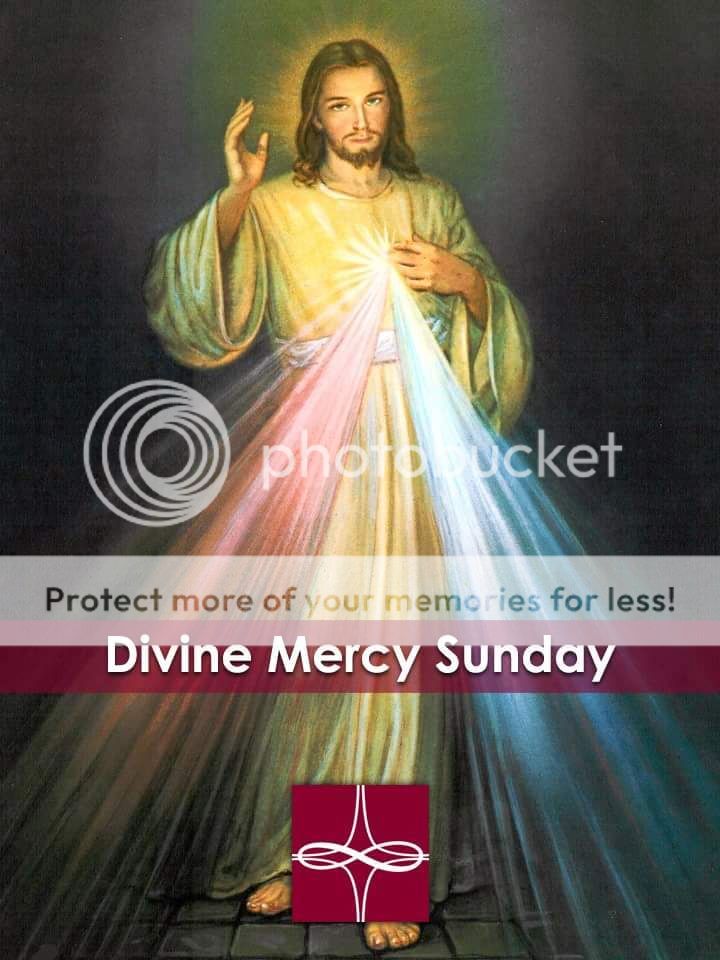
Today we celebrate Divine Mercy Sunday. Jesus, I trust in you!
 |
|
|
Apr 5 2016, 10:49 AM
Return to original view | Post
#338
|
|
Junior Member
225 posts Joined: Mar 2008
|
QUOTE(yeeck @ Apr 5 2016, 12:39 AM) Yes indeed. After all, in Catholic belief, Mother Mary IS the new Eve a.k.a. Eva-to-Ave ... Ave Maria!!! This post has been edited by khool: Apr 5 2016, 10:50 AM |
|
|
Apr 6 2016, 08:01 AM
Return to original view | Post
#339
|
|
Junior Member
225 posts Joined: Mar 2008
|
 |
|
|
Apr 9 2016, 01:27 PM
Return to original view | Post
#340
|
|
Junior Member
225 posts Joined: Mar 2008
|
Pope Francis’s much-anticipated document on the family has now been released.
Here are 12 things to know and share. 1. What are the basic facts about the document? It is called Amoris Laetitia (Latin, “the joy of love”), and it is what is known as a “post-synodal apostolic exhortation.” An apostolic exhortation is a pastoral document in which the pope exhorts the Church. Although it contains doctrine, its primary focus is pastoral care. (Apostolic exhortations are different from encyclicals, which do focus on doctrine.) When a pope issues an apostolic exhortation in response to a meeting of the synod of bishops (a gathering of bishops from around the world), it is called a post-synodal (“after the synod”) apostolic exhortation. Amoris Laetitia was written in response to two meetings of the synod of bishops—one held in 2014 and one in 2015, both of which were devoted to the subject of the family. 2. What subjects does the document cover? It is 255 pages long, so it covers a wide array of topics connected with the family. In his summary of its contents, Pope Francis explains: I will begin with an opening chapter inspired by the Scriptures, to set a proper tone. I will then examine the actual situation of families, in order to keep firmly grounded in reality. I will go on to recall some essential aspects of the Church’s teaching on marriage and the family, thus paving the way for two central chapters dedicated to love. I will then highlight some pastoral approaches that can guide us in building sound and fruitful homes in accordance with God’s plan, with a full chapter devoted to the raising of children. Finally, I will offer an invitation to mercy and the pastoral discernment of those situations that fall short of what the Lord demands of us, and conclude with a brief discussion of family spirituality (AL 6). At the two synods of bishops, two subjects of discussion were the pastoral care of those who are divorced and civilly remarried and of people with a homosexual orientation. Although these are not the focus of Amoris Laetitiae—they represent only a small part of what it has to say—they are the subjects many people will be most interested to know about, so they are what we will cover here. 3. What does the document say about homosexuality? It says very little. It notes that same-sex unions “may not simply be equated with marriage” (AL 52). It also says: During the Synod, we discussed the situation of families whose members include persons who experience same-sex attraction, a situation not easy either for parents or for children. We would like before all else to reaffirm that every person, regardless of sexual orientation, ought to be respected in his or her dignity and treated with consideration, while ‘every sign of unjust discrimination’ is to be carefully avoided, particularly any form of aggression and violence. Such families should be given respectful pastoral guidance, so that those who manifest a homosexual orientation can receive the assistance they need to understand and fully carry out God’s will in their lives. In discussing the dignity and mission of the family, the Synod Fathers observed that, “as for proposals to place unions between homosexual persons on the same level as marriage, there are absolutely no grounds for considering homosexual unions to be in any way similar or even remotely analogous to God’s plan for marriage and family.” It is unacceptable “that local Churches should be subjected to pressure in this matter and that international bodies should make financial aid to poor countries dependent on the introduction of laws to establish ‘marriage’ between persons of the same sex” (AL 250-251). And that’s it. Contrary to the hopes of some, the document did not attempt to reframe the Church’s teaching on same-sex activity or same-sex unions. 4. What does the document say regarding Cardinal Walter Kasper’s proposal to give Holy Communion to some who are divorced and civilly remarried after a “penitential period”? Nothing. This proposal is not brought up. 5. Does the document propose a specific, concrete solution to the problem of divorced and civilly remarried? No. After reviewing a variety of defective marital situations in which people may find themselves, the document states: If we consider the immense variety of concrete situations such as those I have mentioned, it is understandable that neither the Synod nor this exhortation could be expected to provide a new set of general rules, canonical in nature and applicable to all cases (AL 300). Instead, the document articulates a set of principles to be applied to the pastoral care of such individuals. 6. What are these principles? The chapter discussing them is lengthy, so we can’t cover them fully, but they include: Not watering down the Church’s teaching on marriage Helping people grow toward realizing the Church’s teaching on marriage in their own lives Recognizing that people in defective situations are not all in the same situation Helping integrate such people into the life of the Church, based on what is possible in their individual cases 7. What does the document say about not watering down the Church’s teaching on marriage? In articulating the Church’s basic teaching, it states: Christian marriage, as a reflection of the union between Christ and his Church, is fully realized in the union between a man and a woman who give themselves to each other in a free, faithful and exclusive love, who belong to each other until death and are open to the transmission of life, and are consecrated by the sacrament, which grants them the grace to become a domestic church and a leaven of new life for society (AL 292). Later, it states: In order to avoid all misunderstanding, I would point out that in no way must the Church desist from proposing the full ideal of marriage, God’s plan in all its grandeur. . . . A lukewarm attitude, any kind of relativism, or an undue reticence in proposing that ideal, would be a lack of fidelity to the Gospel and also of love on the part of the Church for young people themselves. To show understanding in the face of exceptional situations never implies dimming the light of the fuller ideal, or proposing less than what Jesus offers to the human being (AL 307). 8. What does the document say about helping people grow toward realizing the Church’s teaching on marriage in their own lives? It says: The Fathers [of the synods] also considered the specific situation of a merely civil marriage or, with due distinction, even simple cohabitation, noting that “when such unions attain a particular stability, legally recognized, are characterized by deep affection and responsibility for their offspring, and demonstrate an ability to overcome trials, they can provide occasions for pastoral care with a view to the eventual celebration of the sacrament of marriage” (AL 293, emphasis added). It also says: Along these lines, Saint John Paul II proposed the so-called “law of gradualness” in the knowledge that the human being “knows, loves and accomplishes moral good by different stages of growth” (Familiaris Consortio 34). This is not a “gradualness of law” but rather a gradualness in the prudential exercise of free acts on the part of subjects who are not in a position to understand, appreciate, or fully carry out the objective demands of the law. For the law is itself a gift of God which points out the way, a gift for everyone without exception; it can be followed with the help of grace, even though each human being “advances gradually with the progressive integration of the gifts of God and the demands of God’s definitive and absolute love in his or her entire personal and social life” (ibid., 9). 9. What does the document say about people in defective situations not all being in the same situation? It says: The divorced who have entered a new union, for example, can find themselves in a variety of situations, which should not be pigeonholed or fit into overly rigid classifications leaving no room for a suitable personal and pastoral discernment. One thing is a second union consolidated over time, with new children, proven fidelity, generous self giving, Christian commitment, a consciousness of its irregularity and of the great difficulty of going back without feeling in conscience that one would fall into new sins. The Church acknowledges situations “where, for serious reasons, such as the children’s upbringing, a man and woman cannot satisfy the obligation to separate” (John Paul II, Familiaris Consortio 84). There are also the cases of those who made every effort to save their first marriage and were unjustly abandoned, or of “those who have entered into a second union for the sake of the children’s upbringing, and are sometimes subjectively certain in conscience that their previous and irreparably broken marriage had never been valid” (ibid.). Another thing is a new union arising from a recent divorce, with all the suffering and confusion which this entails for children and entire families, or the case of someone who has consistently failed in his obligations to the family. It must remain clear that this is not the ideal which the Gospel proposes for marriage and the family (AL 298). 10. What does the document say about helping integrate such people into the life of the Church, based on what is possible in their individual cases? It says: I am in agreement with the many Synod Fathers who observed that “the baptized who are divorced and civilly remarried need to be more fully integrated into Christian communities in the variety of ways possible, while avoiding any occasion of scandal. . . . “Their participation can be expressed in different ecclesial services, which necessarily requires discerning which of the various forms of exclusion currently practiced in the liturgical, pastoral, educational and institutional framework, can be surmounted. “Such persons need to feel not as excommunicated members of the Church, but instead as living members, able to live and grow in the Church and experience her as a mother who welcomes them always, who takes care of them with affection and encourages them along the path of life and the Gospel. “This integration is also needed in the care and Christian upbringing of their children, who ought to be considered most important” (AL 299). It also says: Naturally, if someone flouts an objective sin as if it were part of the Christian ideal, or wants to impose something other than what the Church teaches, he or she can in no way presume to teach or preach to others; this is a case of something which separates from the community (cf. Matt.18:17). Such a person needs to listen once more to the gospel message and its call to conversion. Yet even for that person there can be some way of taking part in the life of community, whether in social service, prayer meetings or another way that his or her own initiative, together with the discernment of the parish priest, may suggest (AL 297). And it says: Conversation with the priest, in the internal forum, contributes to the formation of a correct judgment on what hinders the possibility of a fuller participation in the life of the Church and on what steps can foster it and make it grow. Given that gradualness is not in the law itself (cf. Familiaris Consortio, 34), this discernment can never prescind from the gospel demands of truth and charity, as proposed by the Church. For this discernment to happen, the following conditions must necessarily be present: humility, discretion and love for the Church and her teaching, in a sincere search for God’s will and a desire to make a more perfect response to it. These attitudes are essential for avoiding the grave danger of misunderstandings, such as the notion that any priest can quickly grant “exceptions,” or that some people can obtain sacramental privileges in exchange for favors (AL 300). 11. Does the document foresee any possibility for sacramentally absolving and giving Communion to people who are civilly remarried if they are not living as brother and sister? It does. In the main text of the document, it begins by noting certain principles to be taken into account, stating: For an adequate understanding of the possibility and need of special discernment in certain “irregular” situations, one thing must always be taken into account, lest anyone think that the demands of the gospel are in any way being compromised. The Church possesses a solid body of reflection concerning mitigating factors and situations. Hence it can no longer simply be said that all those in any “irregular” situation are living in a state of mortal sin and are deprived of sanctifying grace. More is involved here than mere ignorance of the rule. A subject may know full well the rule, yet have great difficulty in understanding “its inherent values,” or be in a concrete situation which does not allow him or her to act differently and decide otherwise without further sin. . . . The Catechism of the Catholic Church clearly mentions these factors: “imputability and responsibility for an action can be diminished or even nullified by ignorance, inadvertence, duress, fear, habit, inordinate attachments, and other psychological or social factors” (CCC 1735). In another paragraph, the Catechism refers once again to circumstances which mitigate moral responsibility, and mentions at length “affective immaturity, force of acquired habit, conditions of anxiety or other psychological or social factors that lessen or even extenuate moral culpability” (CCC 2352). For this reason, a negative judgment about an objective situation does not imply a judgment about the imputability or culpability of the person involved. (AL 301-302). The document thus envisions the case of a person who may be living in an objectively sinful situation but who is not mortally culpable because of a variety of factors of a cognitive or psychological nature. Nothing in this is new. The Church has long recognized that people living in objectively grave sin may not be in a state of mortal sin. Consequently, the document goes on to state: Because of forms of conditioning and mitigating factors, it is possible that in an objective situation of sin—which may not be subjectively culpable, or fully such—a person can be living in God’s grace, can love and can also grow in the life of grace and charity, while receiving the Church’s help to this end (AL 305). At this point the text contains a footnote that states: In certain cases, this [i.e., the Church’s help toward him growing in grace and charity] can include the help of the sacraments. Hence, “I want to remind priests that the confessional must not be a torture chamber, but rather an encounter with the Lord’s mercy” (Apostolic Exhortation Evangelii Gaudium [24 November 2013], 44: AAS 105 [2013], 1038). I would also point out that the Eucharist “is not a prize for the perfect, but a powerful medicine and nourishment for the weak” (ibid., 47: 1039) (AL footnote 351). The document thus envisions administering sacramental absolution and Holy Communion to those living in objectively sinful situations who are not mortally culpable for their actions due to various cognitive or psychological conditions. Since they are not mortally culpable, they could be validly absolved in confession and, being in the state of grace, they could in principle receive Communion. 12. Does the document say how common such situations are? No. However, the fact it only makes this application of the principles in a footnote suggests that such situations are not common and that they are not to be presumed. The same is indicated by the large number of cautions contained in the text regarding such things as: The obligation to proclaim God’s full vision of marriage, not watering it down with “a lukewarm attitude, any kind of relativism, or an undue reticence in proposing that ideal” (AL 307). That people in such situations should either become sacramentally married (AL 293) or separate (AL 298) or live as brother and sister (cf. AL footnote 329). People who flout Church teaching on marriage need to listen to the gospel message and convert (AL 297). That misunderstandings like a “priest can quickly grant ‘exceptions’” must be avoided (AL 300). That cognitive or psychological conditions must exist which keep a person’s objective grave sin from becoming mortal (AL 301-302, 307). The need to avoid scandal (AL 299). And, in case one needs the source ... http://www.catholic.com/blog/jimmy-akin/po...-know-and-share |
|
Topic ClosedOptions
|
| Change to: |  0.3053sec 0.3053sec
 0.27 0.27
 7 queries 7 queries
 GZIP Disabled GZIP Disabled
Time is now: 14th December 2025 - 08:03 PM |
 Quote
Quote