

LYN Catholic Fellowship V01 (Group), For Catholics (Roman or Eastern)
LYN Catholic Fellowship V01 (Group), For Catholics (Roman or Eastern)
|
|
 Mar 19 2016, 10:29 PM Mar 19 2016, 10:29 PM
|
 
Senior Member
3,574 posts Joined: Apr 2006  
|
Happy feast of St Joseph!
|
|
|
|
|
|
Mar 23 2016, 01:29 PM
|
|
Senior Member
3,574 posts Joined: Apr 2006
|
 |
|
|
Mar 24 2016, 12:11 AM
|
|
Senior Member
3,574 posts Joined: Apr 2006
|
"Benedict XVI grasped the nature of the new age of terrorism. Why did nobody listen?"
http://www.catholicherald.co.uk/commentand...-nobody-listen/ |
|
|
Mar 24 2016, 06:55 AM
|

Senior Member
726 posts Joined: Sep 2014
|
Partly due to Europe freedom of movement, ie, The Schengen Treaty.
Did you know Europe lack joint database for terrorists? Everyone could predicted it would happen but nobody tackle the issues. Europeans should learn counter-terrorism from Israel. |
|
|
Mar 24 2016, 12:10 PM
|

Senior Member
737 posts Joined: Jul 2010 From: Klang
|
QUOTE(tinarhian @ Mar 24 2016, 06:55 AM) Partly due to Europe freedom of movement, ie, The Schengen Treaty. Lol tinar so free past midnight, get some sleep pleaseDid you know Europe lack joint database for terrorists? Everyone could predicted it would happen but nobody tackle the issues. Europeans should learn counter-terrorism from Israel.  |
|
|
Mar 25 2016, 01:34 AM
|
|
Senior Member
3,574 posts Joined: Apr 2006
|
Good Friday and Annunciation…Together?
 This year, Great and Holy Friday falls on March 25, the Feast of the Annunciation. The Byzantine Church doesn’t move the celebration of the feast, which might seem strange! However, I'd like to propose that it actually makes a lot of sense. In these two events we see the awesome condescension of God, and we can look at both of them through the role of Mary, the Mother of God. First, at the Annunciation, God condescended to become man through Mary. Mary said “yes” in behalf of humanity, receiving in her body--as in a chalice--the gift of divinity, so that it could be poured out into the world in a way that we could receive it. St. Ephrem beautifully expresses this mystery in one of his Hymns on the Nativity (#11): A wonder is Your mother: The Lord entered her and became a servant; He entered able to speak and He became silent in her; He entered her thundering and His voice grew silent; He entered Shepherd of all; a lamb He became in her; He emerged bleating. The womb of Your mother overthrew the orders: The Establisher of all entered a Rich One; He emerged poor. He entered her a Lofty One; He emerged humble. He entered her a Radiant One, and He put on a despised hue and emerged. He entered, a mighty warrior, and put on fear inside her womb. He entered, Nourisher of all, and He acquired hunger. He entered, the One who gives drink to all, and He acquired thirst. Stripped and laid bare, He emerged from [her womb], the One who clothes all. Secondly, at the Crucifixion, the Lord made another great act of condescension: the acceptance of physical death. And again, Mary was there saying “yes,” this time in behalf of the Church, receiving the gift of eternal life that was pouring forth from Jesus on the cross, as He changed death into life. The Festal Theotokion in Tone 4 clearly illustrates the connection between these two events of the Annunciation and the Crucifixion, as well as Mary's role: The mystery hidden from all ages and unknown to the angels has been made known to those on earth through you, O Theotokos. God has taken flesh in a union without confusion, and willingly accepted the Cross for us; whereby He raised the first-formed Adam and saved our souls from death. These two condescensions of God--these two parts of the mystery of the Incarnation--changed everything, and they happened at the beginning and end of Jesus’ earthly life. So even though we think of one as a joyful event and the other as a sorrowful, it doesn’t seem strange to me to commemorate them together. There is also a tradition from early in the Church to do just that! This tradition said that Jesus died on March 25: “He suffered in the thirty-third year, March 25th, Friday, the eighteenth year of Tiberius Caesar, while Rufus and Roubellion were Consuls" (Commentary on Daniel by St. Hippolytus, 170-240 A.D.). And as the perfect man, it was believed that He had been conceived and died on the same day, therefore making March 25 the date of the Annunciation. (Later, the date of His Nativity, December 25, was based on this calculation.) Fun facts aside, this Great and Holy Friday is a beautiful opportunity for us to reflect deeply on the mystery of the self-emptying of Christ through the Incarnation, with the Mother of God as our teacher and model. We can allow her to teach us how we can be a chalice like she was—receiving the love of God and pouring it out to others by loving them, making it accessible to them and helping them to thirst for more. This year we lose our Annunciation mitigation of the fast for fish and oil, we get a major headache trying to decipher the liturgical typikon, and we feel the awkwardness of celebrating the Divine Liturgy on Great and Holy Friday…but theologically it seems very beautiful and meaningful to me to celebrate these two earth-shattering events of the Incarnation on the same day. Disagree if you want!...It won’t happen again until the year 2157 anyway! –Mother Cecilia |
|
|
|
|
|
Mar 25 2016, 01:43 AM
|
|
Senior Member
3,574 posts Joined: Apr 2006
|
Weeping Women
 The pew I occupy on a daily basis is very close to the eighth station of the Cross: “the women of Jerusalem weep over Jesus.” This proximity occasions my reflecting on it more than on the other stations. It has become, in a manner of speaking, my station, so let me presume to tell you about it as we approach the Sacred Triduum. The episode is related only in Saint Luke’s Gospel: “And there followed him a great multitude of people, and of women, who bewailed and lamented him. But Jesus turning to them, said: Daughters of Jerusalem, weep not over me; but weep for yourselves, and for your children. For behold, the days shall come, wherein they will say: Blessed are the barren, and the wombs that have not borne, and the paps that have not given suck. Then shall they begin to say to the mountains: Fall upon us; and to the hills: Cover us. For if in the green wood they do these things, what shall be done in the dry?” (Luke 23:27-31) In this mystery, Our Lord says things that are profoundly counterintuitive for a man faced with crying women. At first blush, we might think that Jesus would want to console these women, whose weeping was, after all, for Him. We might expect Him to say that all will be well, since His Father’s will is being accomplished, and God’s wrath is being appeased. We might expect Him to assuage their sorrow and encourage them to have confidence in the eventual triumph of good that will happen with the Resurrection. The salvation of the world is, after all, being accomplished! But He does nothing of the sort. Instead, He tells them not to weep for Him, but to weep for themselves and their children. Why? Because the days will come when the terrible prophesy of Osee (10:8) will be realized among them. In that passage, Osee (Hosea) is looking ahead to the punishments on the Northern Kingdom for their idolatry. God’s just punishments will make the children of Israel cry out: “and they shall say to the mountains: Cover us; and to the hills: Fall upon us!” (Osee 10:8) This prophesy was fulfilled in the eighth century B.C., when the Assyrians took the northern tribes captive. Here, Jesus is applying the words to what remains of the Southern Kingdom, based in Jerusalem, and He is clearly speaking of the destruction of Jerusalem by Titus’ invading Roman army in the year 70 A.D. So, instead of accepting their sympathy or giving them consolation, Our Lord tells these weeping women of bad things yet to happen, not only to them, but also to their children. He concludes with a rhetorical question: “For if in the green wood they do these things, what shall be done in the dry?” Destructive forces, such as fire, that will not spare a green tree will surely not spare a dry one. Jesus, who is sometimes seen as the green tree, is here struck by the force of divine justice in His Passion. Yet how much greater will be the calamity when the inhabitants of Jerusalem have filled up the measure of their fathers (cf. Matt. 23:32) — that is, when they have contracted such a severe debt of divine retribution for their crimes and impenitence? If the inhabitants of Jerusalem can be so wicked as to resort to killing an innocent man during this Messianic time of blessings and grace, how much worse will things be when God’s wrath is turned on the Holy City, that “dry wood” now perfectly seasoned by its own sins to be burned? Those acquainted with the terrors of the Destruction of Jerusalem — including Jewish civil war compounding the violence of a Roman siege, including also hunger and thirst, driving some even to the crime of cannibalism — will understand just how bad that dry wood will be. And those terrors included also literal fire. Josephus testifies that, although Titus wanted to spare the Temple, “God had, for certain, long ago doomed it to the fire;… and the flames were kindled by the Jews themselves, when that fatal day came” (Jos., De Bello Jud. , vi. 4.). In his Harmonized Exposition of the Four Gospels (Vol. 4, pg. 453), Father A.E. Breen aptly observes, “It is strange indeed that in many of our churches this station of the cross is described as the point where ‘Jesus consoles the daughters of Jerusalem.’ It is just the opposite of a consolation: it is a woe more terrible than any found in Jeremiah, the prophet of the wrath of God.” Why this terrible warning to a group of women who are lamenting His suffering? Does this not seem cruel, as if to make those who seek to compassionate Him suffer more? Before I reply to that question directly, let me comment on the form of address Jesus uses for these women. He calls them “daughters of Jerusalem,” a title that is found in such dramatically different Old-Testament texts as the Canticle of Canticles and the Lamentations of Jeremias. In the Canticle, the daughters of Jerusalem are witnesses of the love affair between the Bride (the Church) and the Bridegroom (Christ); in the Lamentations, the daughter (singular) represents the Holy City itself, ravaged by the Babylonians, who bring her children into captivity: “To what shall I compare thee? or to what shall I liken thee, O daughter of Jerusalem? to what shall I equal thee, that I may comfort thee, O virgin daughter of Sion? for great as the sea is thy destruction: who shall heal thee?” (Lam. 2:13). Curiously, these “Daughters of Jerusalem” that Our Lord spoke to are both the witnesses of Christ’s espousals to His Church and those whose children are threatened with yet another destruction of Jerusalem, worse than that of the Babylonians. If these women are believers, they form part of the mystical Bride of Christ, the Church. Further, according to the Ignatius Catholic Study Bible, “In addressing this to the faithful ‘Daughers of Jerusalem’ (Lk 23:28), he may be identifying them with the righteous ‘daughters’ of the city who will escape the catastrophe by the mercy of God and become a source of consolation for others (Ezek 14:22).” This is what I see at work here. Jesus is actually telling these Christian daughters of Jerusalem the harsh truth, but He is at the same time directing their weeping to another purpose. Weeping is not a bad thing, even though it is often caused by misery. In Judges chapter twenty-one we find an instance of prayerful weeping being answered, when the tribe of Benjamin is spared from destruction. In Joel 2:16-20, the prayerful weeping of the priests leads to Israel being delivered from its enemies. And here is King David: “Depart from me, all ye workers of iniquity: for the Lord hath heard the voice of my weeping. The Lord hath heard my supplication: the Lord hath received my prayer” (Psalm 6:9-10). During the protracted siege of Jerusalem — possibly during the interval between Vespasian’s and Titus’ management of the horrible campaign — the Christian faithful followed the signs that Jesus mentioned in Luke 19 and in His lengthy and vivid discourse in Matthew 24. Vespasian had cast a trench about Jerusalem, and compassed it round (Luke 19:43), but then he was recalled to Rome to become Emperor. Titus came later to lead the campaign. According to Dom Guéranger, the Christians, having seen the prophesies fulfilled, escaped during this interval. The Church historian Eusebius of Caesarea informs us of what happened: “But the people of the church in Jerusalem had been commanded by a revelation, vouchsafed to approved men there before the war, to leave the city and to dwell in a certain town of Perea called Pella. And when those that believed in Christ had come there from Jerusalem, then, as if the royal city of the Jews and the whole land of Judea were entirely destitute of holy men, the judgment of God at length overtook those who had committed such outrages against Christ and his apostles, and totally destroyed that generation of impious men.” (Eusebius, History of the Church 3, 5; alternative translation found here). The little infants and toddlers often portrayed in the eighth station of the Cross would be almost forty years old — a Biblical generation — at the time of these terrible events. We may well imagine that among those gathered in Pella during and after Jerusalem’s horrible destruction were these thirty-somethings whose mothers had prayed and wept for themselves and for their children, having been admonished to do so at the eighth station of the Cross — my station. In the Immaculate Heart of Mary, Brother André Marie, M.I.C.M. |
|
|
Mar 25 2016, 09:11 AM
|

Junior Member
225 posts Joined: Mar 2008
|
   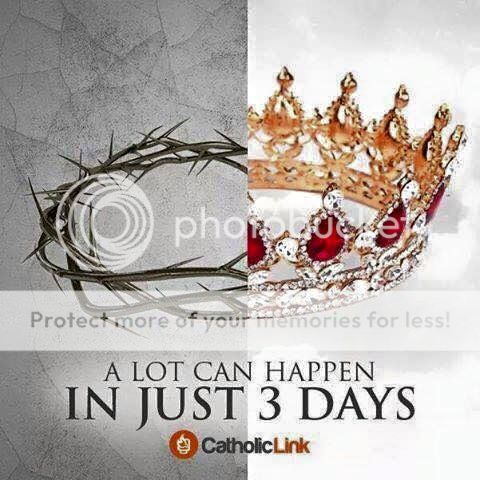 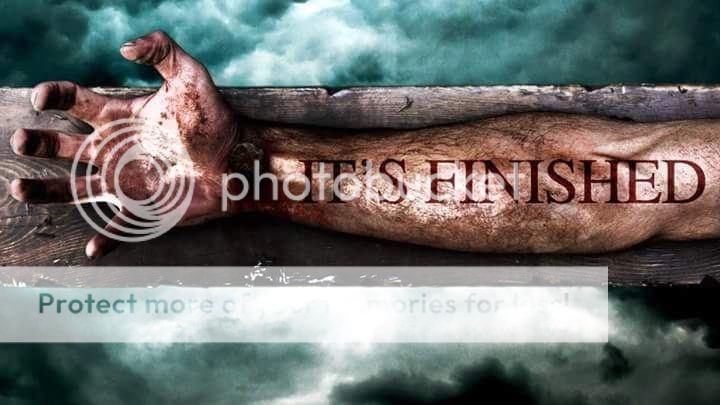 |
|
|
Mar 25 2016, 09:17 AM
|
|
Junior Member
225 posts Joined: Mar 2008
|
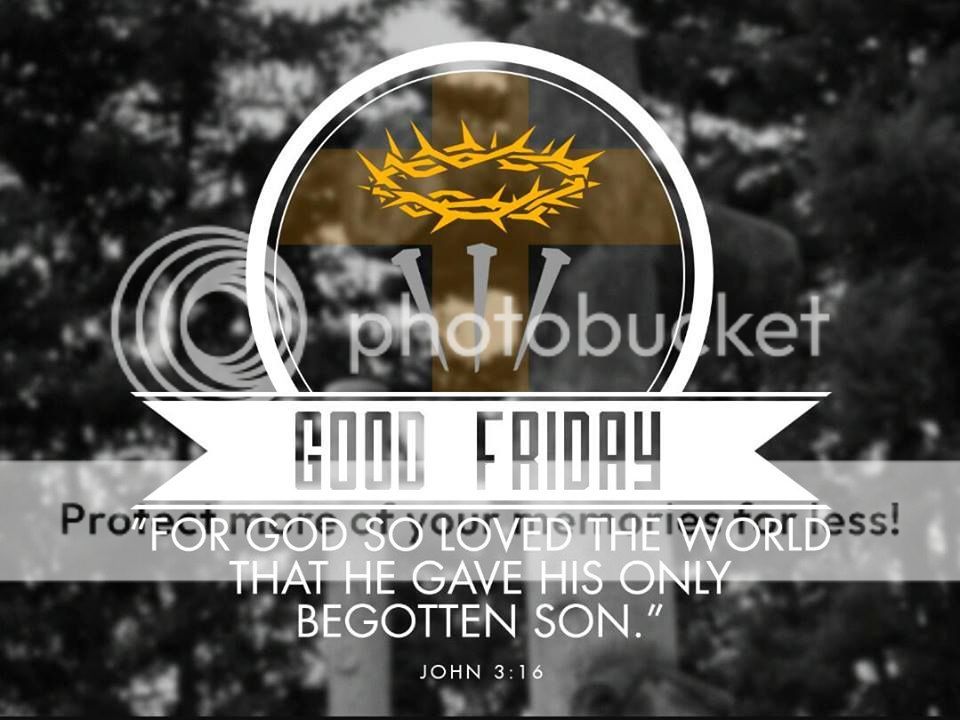
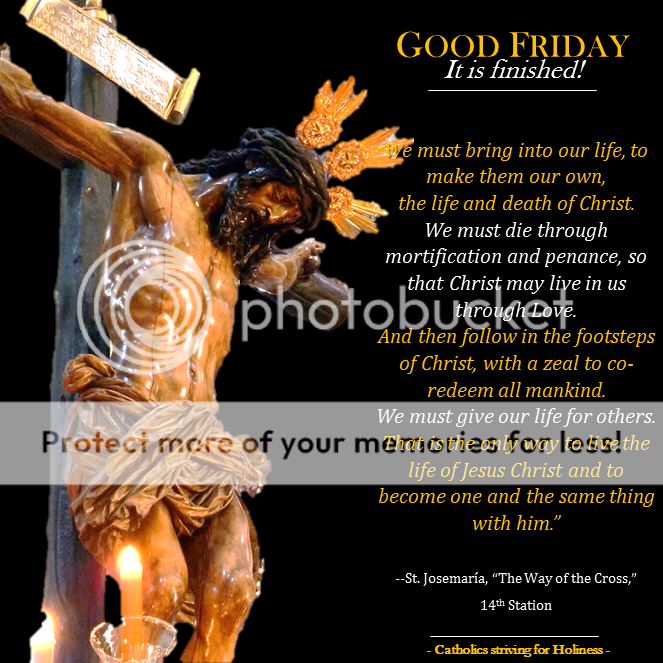
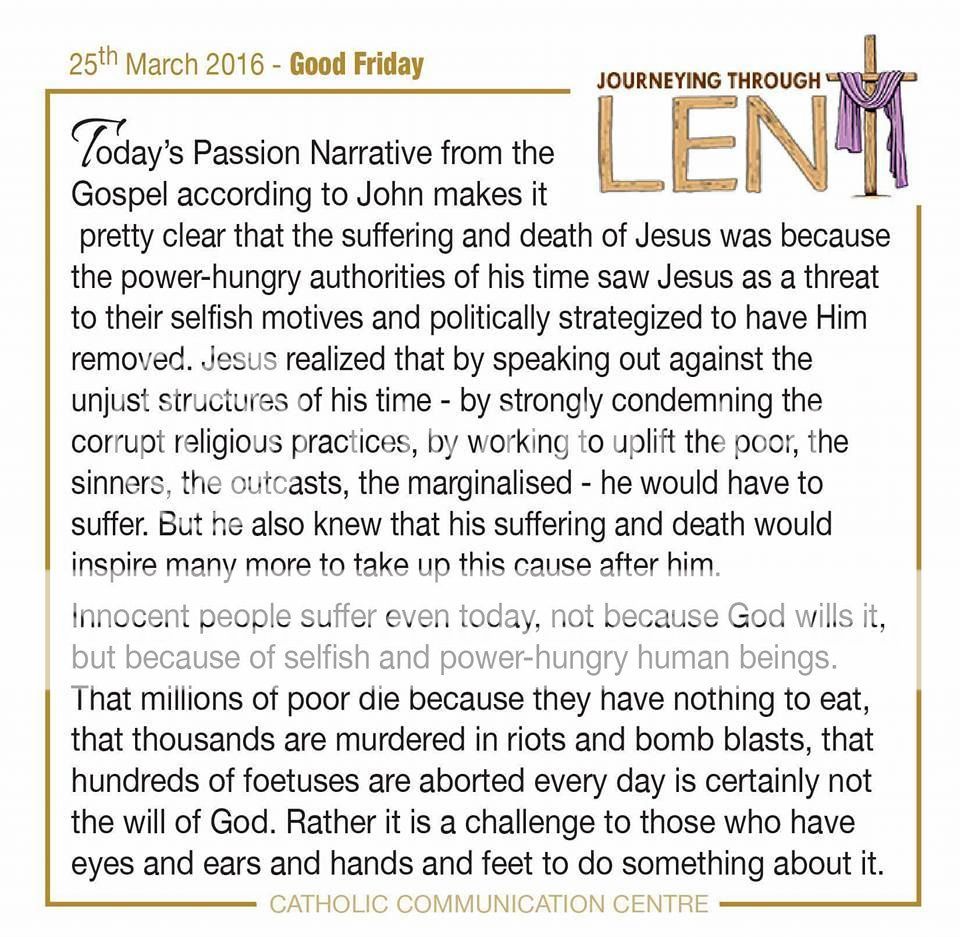
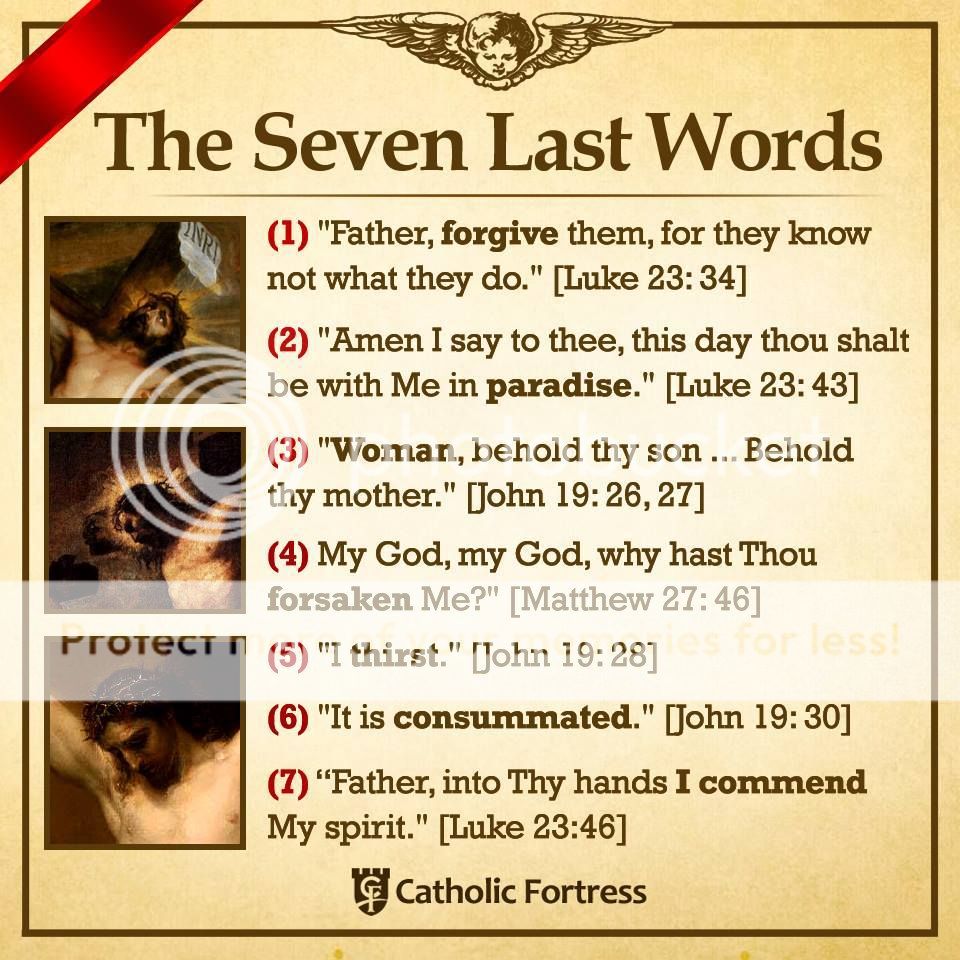 Have a Blessed Good Friday and see you all in Church for Stations of the Cross! Amen!  |
|
|
Mar 26 2016, 02:16 PM
|
|
Senior Member
3,574 posts Joined: Apr 2006
|
|
|
|
Mar 26 2016, 06:00 PM
|
|
Senior Member
737 posts Joined: Jul 2010 From: Klang
|
QUOTE(yeeck @ Mar 26 2016, 02:16 PM) I have a great respect for this former pope, he resigned as pope because of scandals he can no longer hide and he decided to retire into a more peaceful life  |
|
|
Mar 27 2016, 07:28 AM
|
|
Junior Member
225 posts Joined: Mar 2008
|
Let yourselves be moved by hope, Pope says at Easter Vigil
By Elise Harris Vatican City, Mar 26, 2016 / 03:38 pm (CNA/EWTN News) During the Easter Vigil, Pope Francis told attendees not to be overcome by sadness in the face of life’s difficulties, but to be open to hope, which is not the absence of problems, but is a gift from God when we allow him to enter our lives. “We, like Peter and the women, cannot discover life by being sad, bereft of hope,” the Pope said March 26. He urged the faithful not to “stay imprisoned within ourselves, but let us break open our sealed tombs to the Lord so that he may enter and grant us life. Let us give him the stones of our rancor and the boulders of our past, those heavy burdens of our weaknesses and falls.” As we anticipate Jesus’ Resurrection from the dead, the first stone which must be moved aside is “the lack of hope which imprisons us within ourselves,” he said. The Pope then prayed that the Lord would free us from the trap of being “Christians without hope, who live as if the Lord were not risen, as if our problems were the center of our lives.” Pope Francis spoke to the thousands present inside St. Peter’s Basilica for the Easter Vigil, which is celebrated the night before Easter in anticipation of Jesus’ rising from the dead. The vigil began in the atrium of the basilica with the traditional blessing of the fire and the preparation of the Easter candle. The Pope then led a procession with the lit candle to the main altar, where he continued with the rest of the Mass. In the course of the celebration, Francis administered the Sacraments of Christian Initiation – Baptism, Confirmation and the Eucharist – to 12 newcomers in the Catholic Church, hailing from Italy, Albania, Cameroon, Korea, India and China. Those being baptized included Yong Joon Lee, the Korean ambassador to Italy, and his wife Hee Kim. In his homily, the Pope noted how the women in the Gospel, after going to anoint Jesus' body, had run to the disciples and told them about how they had found the tomb empty. Peter and the others did not initially believe the women, yet Peter ran to the tomb anyway, he said. “There was doubt in Peter’s heart, together with many other worries: sadness at the death of the beloved Master and disillusionment for having denied him three times during his Passion,” he said. But still, something in Peter’s behavior had changed. Instead of staying sedentary and remaining at home with the others, Peter rose, refusing to succumb to the somber atmosphere in the days following Jesus’ death or to be overcome by his doubts. Peter, the Pope said, “was not consumed by remorse, fear or the continuous gossip that leads nowhere.” “He was looking for Jesus, not himself. He preferred the path of encounter and trust. And so, he got up, just as he was, and ran towards the tomb from where he would return amazed.” This, Francis observed, “marked the beginning of Peter’s resurrection, the resurrection of his heart.” Without giving in to sadness or darkness, Peter “made room for hope: he allowed the light of God to enter into his heart, without smothering it.” Like Peter, the women also had the same experience of awe when they went to Jesus' tomb with oil and met the angel, who told them that the Lord had risen, Francis said, adding that like them, we can't allow ourselves to be overcome by a lack of hope. Pope Francis stressed that there will always be problems “both within and without,” which won’t go away. What’s important, he said, is to place them in the light of the Risen Lord, “and in a certain sense, to evangelize them.” The resurrection of the Lord is “the foundation of our hope,” he said, clarifying that this hope is neither “mere optimism, nor a psychological attitude or desire to be courageous.” Rather, he said, Christian hope “is a gift that God gives us if we come out of ourselves and open our hearts to him.” Hope will never disappoint us because we have been given the Holy Spirit, the Pope said, noting that the Spirit doesn’t seek to make things look appealing or “remove evil with a magic wand.” The Holy Spirit, he said, “pours into us the vitality of life, which is not the absence of problems, but the certainty of being loved and always forgiven by Christ, who for us has conquered sin, death and fear.” Pope Francis emphasized that each person, after having met Jesus, is then sent out by him to proclaim the Easter message, and “to awaken and resurrect hope in hearts burdened by sadness, in those who struggle to find meaning in life.” However, he cautioned that we shouldn’t proclaim ourselves, but must rather be “joyful servants of hope” who announce the Risen Lord through our lives and the ways in which we love. “Otherwise we will be only an international organization full of followers and good rules, yet incapable of offering the hope for which the world longs,” he said. Francis concluded his homily by telling attendees that their hope can be strengthened by following the angel’s advice to the women in the Gospel: “Remember what [Jesus] told you.” He urged them to always remember Jesus’ words and deeds, “otherwise we will lose hope.” He urged everyone to “open our hearts to hope and go forth,” praying that the constant memory of Jesus’ works and words would be “the bright star which directs our steps in the ways of faith toward the Easter that will have no end.” Source: http://www.catholicnewsagency.com/news/let...er-vigil-18684/ |
|
|
Mar 27 2016, 10:55 PM
|
|
Senior Member
3,574 posts Joined: Apr 2006
|
Blessed Pascha to all brothers and sisters in Christ!
 |
|
|
|
|
|
Mar 27 2016, 11:09 PM
|
|
Senior Member
3,574 posts Joined: Apr 2006
|
Hail thee, festival day! Blessed day to be hallowed forever; Day when our Lord was raised, Breaking the kingdom of death. Lo, the fair beauty of the earth, From the death of the winter arising! Every good gift of the year Now with its master returns. Rise from the grave now, O Lord, The author of life and creation. Treading the pathway of death, New life You give to us all. |
|
|
Mar 28 2016, 01:57 PM
|
|
Junior Member
225 posts Joined: Mar 2008
|
With only $200,12 nuns and little television experience, Mother Angelica began broadcasting a religious talk show from a TV studio put together in the monastery garage in suburban Birmingham in 1981. That show grew into Eternal Word Television Network, which has long had the blessing of the Vatican.
Despite its humble beginnings, EWTN Global Catholic Network calls itself the world's largest religious media network. It has 11 TV networks that broadcast Catholic programming to more than 258 million households in more than 145 counties and territories. Mother Angelica was fearless because she had God on her side. She saw what He needed her to do, and she did it! She transformed the world of Catholic broadcasting and brought the Gospel to far corners of our world. That witness of faith was unmistakable to anyone who met and worked with her, and generations of Catholics have and will continue to be formed by her vision and her ‘Yes’ to God’s will. 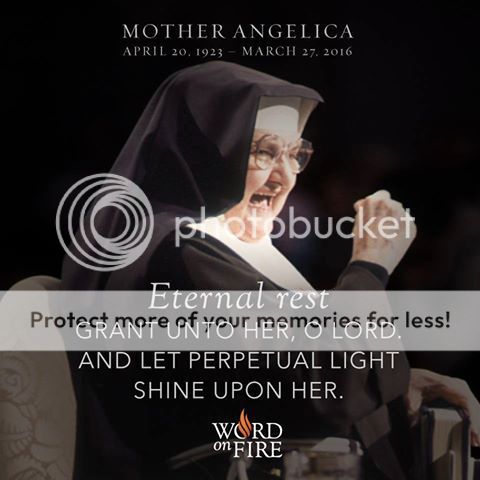 |
|
|
Mar 28 2016, 02:03 PM
|
|
Junior Member
225 posts Joined: Mar 2008
|
Amen, blessed Easter!
|
|
|
Mar 28 2016, 09:24 PM
|
|
Senior Member
3,574 posts Joined: Apr 2006
|
Sunday, 27 March 2016
BREAKING: Fr. Thomas Uzhunnalil was crucified by ISIS on Good Friday ~ Cardinal Schönborn confirmed the priest's martyrdom during the Easter Vigil Austrian media is reporting that Cardinal Schönborn of Vienna confirmed last night, during the Easter Vigil at Stephansdom that the Salesian priest, Fr. Thomas Uzhunnalil was crucified by ISIS on Good Friday. Polonia Christiana is also carrying the news, based on the Austrian reports. Fr. Tom is now in Paradise with Our Blessed Lord and His Mother. May his murderers repent and come to believe in the Gospel. "Father, forgive them, for they know not what they do" (Luke, 23:34) 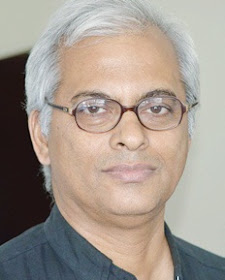 St. Thomas Uzhunnalil, pray for us. Prayer of St. Francis Xavier for the Conversion of the Infidels Eternal God, Creator of all things, remember that Thou alone didst create the souls of infidels, framing them to Thine own image and likeness; behold, O Lord, how, to Thy dishonor, hell is daily replenished with them. Remember, O Lord, Thine only Son, Jesus Christ, Who suffered for them, most bountifully shedding His precious blood. Suffer not, O Lord, Thy Son and our Lord to be any longer despised by infidels. But, rather, being appeased by the entreaties and prayers of the elect, the saints, and of the Church, the most blessed spouse of Thy Son; be mindful of Thy mercy, yet forgetful of their idolatry and infidelity. Cause all to know Him Whom Thou didst send, Jesus Christ Thy Son, our Lord, Who is our health, life, and resurrection, through Whom we are freed and saved, to Whom be all glory forever. Amen. |
|
|
Mar 28 2016, 10:39 PM
|
|
Senior Member
3,574 posts Joined: Apr 2006
|
By Father Martin B. Hellriegel, a German-American pastor in Saint Louis. Written in 1941 as a response to refute the Third Reich, and to reiterate Who actually reigns as King forever and ever. Text: Verse 1-To Jesus Christ, our Sov'reign King, Who is the world's salvation, All praise and homage do we bring, And thanks and adoration. Refrain: Christ Jesus Victor, Christ Jesus Ruler! Christ Jesus, Lord and Redeemer! Verse 2- Thy reign extend, O King benign, To ev’ry land and nation, For in Thy kingdom, Lord divine, Alone we find salvation. (Refrain) [Verse 3- To Thee and to Thy Church, great King, We pledge our hearts’ oblation, Until before Thy throne we sing, In endless jubilation. Refrain] |
|
|
Mar 30 2016, 11:45 AM
|
|
Senior Member
3,574 posts Joined: Apr 2006
|
Is Confession in Scripture?
Tim Staples  The Lord declares in Isaiah 43:25: I, I am He who blots out your transgressions for my own sake, and I will not remember your sins. Psalm 103:2-3 adds: Bless the Lord, O my soul, and forget not all his benefits, who forgives all your iniquity, who heals all your diseases… Many will use these verses against the idea of confession to a priest. God forgiving sins, they will claim, precludes the possibility of there being a priest who forgives sins. Further, Hebrews 3:1 and 7:22-27 tell us Jesus is, “the… high priest of our confession” and that there are not “many priests,” but one in the New Testament—Jesus Christ. Moreover, if Jesus is the “one mediator between God and men” (I Tim. 2:5), how can Catholics reasonably claim priests act in the role of mediator in the Sacrament of Confession? BEGINNING WITH THE OLD The Catholic Church acknowledges what Scripture unequivocally declares: it is God who forgives our sins. But that is not the end of the story. Leviticus 19:20-22 is equally unequivocal: If a man lies carnally with a woman… they shall not be put to death… But he shall bring a guilt offering for himself to the Lord… And the priest shall make atonement for him with the ram of the guilt offering before the Lord for his sin which he has committed; and the sin which he has committed shall be forgiven him. Apparently, a priest being used as God’s instrument of forgiveness did not somehow take away from the fact that it was God who did the forgiving. God was the first cause of the forgiveness; the priest was the secondary, or instrumental cause. Thus, God being the forgiver of sins in Isaiah 43:25 and Psalm 103:3 in no way eliminates the possibility of there being a ministerial priesthood established by God to communicate his forgiveness. OUT WITH THE OLD Many Protestants will concede the point of priests acting as mediators of forgiveness in the Old Testament. “However,” they will claim, “The people of God had priests in the Old Testament. Jesus is our only priest in the New Testament.” The question is: could it be that “our great God and Savior Jesus Christ” (Titus 2:13) did something similar to that which he did, as God, in the Old Testament? Could he have established a priesthood to mediate his forgiveness in the New Testament? IN WITH THE NEW Just as God empowered his priests to be instruments of forgiveness in the Old Testament, the God/man Jesus Christ delegated authority to his New Testament ministers to act as mediators of reconciliation as well. Jesus made this remarkably clear in John 20:21-23: Jesus said to them again, “Peace be with you. As the Father has sent me, even so I send you.” And when he had said this, he breathed on them, and said to them, “Receive the Holy Spirit. If you forgive the sins of any, they are forgiven; if you retain the sins of any, they are retained.” Having been raised from the dead, our Lord was here commissioning his apostles to carry on with his work just before he was to ascend to heaven. “As the Father has sent me, even so I send you.” What did the Father send Jesus to do? All Christians agree he sent Christ to be the one true mediator between God and men. As such, Christ was to infallibly proclaim the Gospel (cf. Luke 4:16-21), reign supreme as King of kings and Lord of lords (cf. Rev. 19:16); and especially, he was to redeem the world through the forgiveness of sins (cf. I Peter 2:21-25, Mark 2:5-10). The New Testament makes very clear that Christ sent the apostles and their successors to carry on this same mission. To proclaim the gospel with the authority of Christ (cf. Matthew 28:18-20), to govern the Church in His stead (cf. Luke 22:29-30), and to sanctify her through the sacraments, especially the Eucharist (cf. John 6:54, I Cor. 11:24-29) and for our purpose here, Confession. John 20:22-23 is nothing more than Jesus emphasizing one essential aspect of the priestly ministry of the apostles: To Forgive men’s sins in the person of Christ— “Whose sins you forgive, they are forgiven, whose sins you retain are retained.” Moreover, auricular confession is strongly implied here. The only way the apostles could either forgive or retain sins is by first hearing those sins confessed, and then making a judgment whether or not the penitent should be absolved. TO FORGIVE OR TO PROCLAIM? Many Protestants and various quasi-Christian sects claim John 20:23 must be viewed as Christ simply repeating “the great commission” of Matthew 28:19 and Luke 24:47 using different words that mean the same thing: Go therefore and make disciples of all nations, baptizing them in the name of the Father and of the Son and of the Holy Spirit. … and that repentance and forgiveness of sins should be preached in his name to all nations… Commenting on John 20:23 in his book, Romanism—The Relentless Roman Catholic Assault on the Gospel of Jesus Christ! (White Horse Publications, Huntsville Alabama, 1995), p. 100, Protestant Apologist Robert Zins writes: It is apparent that the commission to evangelize is tightly woven into the commission to proclaim forgiveness of sin through faith in Jesus Christ. Mr. Zin's claim is that John 20:23 is not saying the apostles would forgive sins; rather, that they would merely proclaim the forgiveness of sins. The only problem with this theory is it runs head-on into the text of John 20. “If you forgive the sins of any… if you retain the sins of any.” The text cannot say it any clearer: this is more than a mere proclamation of the forgiveness of sins—this “commission” of the Lord communicates the power to actually forgive the sins themselves. FREQUENT CONFESSION The next question for many upon seeing the plain words of St. John is, “Why don’t we hear any more about Confession to a priest in the rest of the New Testament?” The fact is: we don’t need to. How many times does God have to tell us something before we’ll believe it? He only gave us the proper form for baptism once (Matt. 28:19), and yet all Christians accept this teaching. But be that as it may, there are multiple texts that deal with Confession and the forgiveness of sins through the New Covenant minister. I will cite just a few of them: II Cor. 2:10: And to whom you have pardoned anything, I also. For, what I have pardoned, if I have pardoned anything, for your sakes have I done it in the person of Christ (DRV). Many may respond to this text by quoting modern Bible translations, e.g., the RSVCE: What I have forgiven, if I have forgiven anything, has been for your sake in the presence of Christ (emphasis added). St. Paul, it is argued, is simply forgiving someone in the way any layperson can forgive someone for wrongs committed against him. The Greek word—prosopon—can be translated either way. And I should note here that good Catholics will argue this point as well. This is an understandable and valid objection. However, I do not concur with it for four reasons: 1. Not only the Douay-Rheims, but the King James Version of the Bible—which no one would accuse of being a Catholic translation—translates prosopon as “person.” 2. The early Christians, who spoke and wrote in Koine Greek, at the Councils of Ephesus (AD 431) and Chalcedon (AD 451), used prosopon to refer to the “person” of Jesus Christ. 3. Even if one translates the text as St. Paul pardoning “in the presence of Christ,” the context still seems to indicate that he forgave the sins of others. And notice: St. Paul specifically said he was not forgiving anyone for offenses committed against him (see II Cor. 2:5). Any Christian can and must do this. He said he did the forgiving “for [the Corinthian’s] sakes” and “in the person (or presence) of Christ.” The context seems to indicate he is forgiving sins that do not involve him personally. 4. Just three chapters later, St. Paul gives us the reason why he could forgive the sins of others: “All this is from God, who through Christ reconciled us to himself and gave us the ministry of reconciliation” (II Cor. 5:18). Some will argue that "the ministry of reconciliation" of verse 18 is identical to "the message of reconciliation" in verse 19. In other words, St. Paul is simply referring to a declarative power here. I don't agree. I argue St. Paul uses distinct terms precisely because he is referring to more than just “the message of reconciliation,” but the same ministry of reconciliation that was Christ’s. Christ did more than just preach a message; he also forgave sins. James 5:14-17: Is any one among you sick? Let him call for the elders of the church, and let them pray over him, anointing him with oil in the name of the Lord; and the prayer of faith will save the sick man, and the Lord will raise him up; and if he has committed sins, he will be forgiven. Therefore confess your sins to one another, and pray for one another, that you may be healed. The prayer of a righteous man has great power in its effects. Elijah was a man of like nature with ourselves and he prayed fervently that it might not rain… and… it did not rain… When it comes to one “suffering;” St. James says, “Let him pray.” “Is any cheerful? Let him sing praise.” But when it comes to sickness and personal sins, he tells his readers they must go to the “elders”—not just anyone—in order to receive this “anointing” and the forgiveness of sins. Some will object and point out that verse 16 says to confess our sins “to one another” and pray “for one another.” Is not James just encouraging us to confess our sins to a close friend so we can help one another to overcome our faults? The context seems to disagree with this interpretation for two main reasons: 1. St. James had just told us to go to the presbyter in verse 14 for healing and the forgiveness of sins. Then, verse 16 begins with the word therefore—a conjunction that would seem to connect verse 16 back to verses 14 and 15. The context seems to point to the “elder” as the one to whom we confess our sins. 2. Ephesians 5:21 employs this same phrase. “Be subject to one another out of reverence for Christ.” But the context limits the meaning of “to one another” specifically to a man and wife—not just anyone. Similarly, the context of James 5 would seem to limit the confession of faults “to one another” to the specific relationship between “anyone” and the “elder” or “priest” (Gr.—presbuteros). ONE PRIEST OR MANY? A major obstacle to Confession for many Protestants (me included when I was Protestant) is that it presupposes a priesthood. As I said above, Jesus is referred to in Scripture as “the apostle and high priest of our confession.” The former priests were many in number, as Hebrews 7:23 says, now we have one priest—Jesus Christ. The question is: how does the idea of priests and confession fit in here? Is there one priest or are there many? I Peter 2:5-9 gives us some insight: … and like living stones be yourselves built into a spiritual house, to be a holy priesthood, to offer spiritual sacrifices acceptable to God through Jesus Christ… But you are a chosen race, a royal priesthood, a holy nation, God’s own people… If Jesus is the one and only priest in the New Testament in a strict sense, then we have a contradiction in Sacred Scripture. This, of course, is absurd. I Peter plainly teaches all believers to be members of a holy priesthood. Priest/believers do not take away from Christ’s unique priesthood, rather, as members of his body they establish it on earth. FULL AND ACTIVE PARTICIPATIO If one understands the very Catholic and very biblical notion of participatio, these problematic texts and others become relatively easy to understand. Yes, Jesus Christ is the “one mediator between God and men” just as I Tim. 2:5 says. The Bible is clear. Yet, Christians are also called to be mediators in Christ. When we intercede for one another or share the Gospel with someone, we act as mediators of God’s love and grace in the one true mediator, Christ Jesus, via the gift of participatio in Christ, the sole mediator between God and men (see I Timothy 2:1-7, I Timothy 4:16, Romans 10:9-14). All Christians, in some sense, can say with St. Paul, “…it is no longer I who live, but Christ who lives in me…” (Gal. 2:20) PRIESTS AMONG PRIESTS If all Christians are priests, then why do Catholics claim a ministerial priesthood essentially distinct from the universal priesthood? The answer is: God willed to call out a special priesthood among the universal priesthood to minister to his people. This concept is literally as old as Moses. When St. Peter taught us about the universal priesthood of all believers, he specifically referred to Exodus 19:6 where God alluded to ancient Israel as “a kingdom of priests and a holy nation.” St. Peter reminds us that there was a universal priesthood among the Old Testament people of God just as in the New Testament. But this did not preclude the existence of a ministerial priesthood within that universal priesthood (see Exodus 19:22, Exodus 28, and Numbers 3:1-12). In an analogous way, we have a universal “Royal Priesthood” in the New Testament, but we also have an ordained clergy who have priestly authority given to them by Christ to carry out his ministry of reconciliation as we have seen. TRULY AWESOME AUTHORITY A final couple of texts we will consider are Matt. 16:19 and 18:18. Specifically, we’ll examine the words of Christ to Peter and the apostles: “Whatever you bind on earth shall be bound in heaven, and whatever you loose on earth shall be loosed in heaven.” As CCC 553 says, Christ here communicated not only authority “to pronounce doctrinal judgments, and to make disciplinary decisions in the Church,” but also “the authority to absolve sins” to the apostles. These words are unsettling, even disturbing, to many. And understandably so. How could God give such authority to men? And yet he does. Jesus Christ, who alone has the power to open and shut heaven to men, clearly communicated this authority to the apostles and their successors. This is what the forgiveness of sins is all about: to reconcile men and women with their heavenly Father. CCC 1445 puts it succinctly: The words bind and loose mean: whomever you exclude from your communion, will be excluded from communion with God; whomever you receive anew into your communion, God will welcome back into his. Reconciliation with the Church is inseparable from reconciliation with God. |
|
|
Mar 30 2016, 05:53 PM
|
|
Senior Member
3,574 posts Joined: Apr 2006
|
A Catholic Responds – Five Common Protestant Objections to the Sacrament of Confession
DEACON MICHAEL BICKERSTAFF In discussing the Catholic faith with non-Catholics, the doctrine concerning confessing one’s sins to a priest often arises. Indeed, in my experience, the Sacrament of Reconciliation ranks right up there with Marian Dogmas among the Church’s teachings that prompt the most questions from those inquiring about the Catholic Faith. The following objections to the doctrine are those about which I am most often asked to respond. Objection #1 – Only God can forgive sin. Catholics teach that a priest can forgive sin, but a priest is only a man. Isn’t it true that only God can forgive sin? I don’t mean in a way that any of us can forgive one another, but in the way that God forgives and saves us. Reply to Objection #1: It is true that only God can forgive sin (on His own authority). But, God has chosen to delegate that authority. When a priest with faculties to absolve sin says the words of absolution during Confession, he forgives the penitent’s sins by the power and authority of Christ conferred to that priest through Holy Orders. The priest thus acts in the person of Christ (in persona Christi). Christ delegated this authority to his priests much in the same way that any higher authority delegates its authority to its ambassadors and others who represent the higher authority. Objection #2 – The bible does not teach that a man can forgive sin. What you said seems to me to be a man-made explanation, not God’s teaching. Show me where you find this in the bible. Reply to Objection #2: That men are delegated the authority from God to forgive sin on his behalf is clearly a part of Divine Revelation. Two passages show this ambassadorial relationship. “And there people brought to him a paralytic lying on a stretcher. When Jesus saw their faith, he said to the paralytic, ‘Courage, child, your sins are forgiven.’ At that, some of the scribes said to themselves, ‘This man is blaspheming.’ Jesus knew what they were thinking, and said, ‘Why do you harbor evil thoughts? Which is easier, to say, ‘Your sins are forgiven,’ or to say, ‘Rise and walk’? But that you may know that the Son of Man has authority on earth to forgive sins’ – he then said to the paralytic, ‘Rise, pick up your stretcher, and go home.’ He rose and went home. When the crowds saw this they were struck with awe and glorified God who had given such authority to human beings.” (Matthew 9:2-8, emphasis added) “So whoever is in Christ is a new creation: the old things have passed away; behold, new things have come. And all this is from God, who has reconciled us to himself through Christ and given us the ministry of reconciliation, namely, God was reconciling the world to himself in Christ, not counting their trespasses against them and entrusting to us the message of reconciliation. So we are ambassadors for Christ, as if God were appealing through us. We implore you on behalf of Christ, be reconciled to God.” (2 Corinthians 5:17-20, emphasis added) There are two means by which sin is forgiven through the agency of man according to the bible. a) Through Baptism Before a person is baptized, he is guilty of Original Sin and, if baptism occurs after the age of reason, of personal sin. When a person is baptized, all personal sin, Original Sin and the punishments due to sin are wiped clean. The baptized believer is thus born again and receives the grace of justification. Protestant terminology says that this person is justified and saved. Catholic terminology says that this person’s soul is in the state of Sanctifying Grace. Not all Protestants believe that baptism is necessary to be justified and saved. But the following passages demonstrate the truth of the Catholic teaching. Christ commanded his apostles to baptize. “The eleven disciples went to Galilee, to the mountain to which Jesus had ordered them. When they saw him, they worshiped, but they doubted. Then Jesus approached and said to them, ‘All power in heaven and on earth has been given to me. Go, therefore, and make disciples of all nations, baptizing them in the name of the Father, and of the Son, and of the Holy Spirit, teaching them to observe all that I have commanded you. And behold, I am with you always, until the end of the age.’” (Matthew 28:16-20) Baptism is a condition of salvation. “He said to them, ‘Go into the whole world and proclaim the gospel to every creature. Whoever believes and is baptized will be saved; whoever does not believe will be condemned.’” (Mark 16:15-16, emphasis added) Peter preached that repentance and baptism is for the forgiveness of sin. “Peter (said) to them, ‘Repent and be baptized, every one of you, in the name of Jesus Christ for the forgiveness of your sins; and you will receive the gift of the Holy Spirit.’” (Acts 2:38, emphasis added) Peter teaches that baptism saves the believer. “For Christ also suffered for sins once, the righteous for the sake of the unrighteous, that he might lead you to God. Put to death in the flesh, he was brought to life in the spirit. In it he also went to preach to the spirits in prison, who formerly did not obey, when God’s patience waited in the days of Noah, during the building of the ark, in which a few, that is, eight persons, were saved through water. Baptism, which corresponds to this, now saves you, not as a removal of dirt from the body but as an appeal to God for a clear conscience, through the resurrection of Jesus Christ…” (1 Peter 3:20-21, emphasis added) Ananias instructs Paul that baptism will wash away his sin. “A certain Ananias, a devout observer of the law, and highly spoken of by all the Jews who lived there, came to me and stood there and said, ‘Saul, my brother, regain your sight.’ And at that very moment I regained my sight and saw him. Then he said, ‘The God of our ancestors designated you to know his will, to see the Righteous One, and to hear the sound of his voice; for you will be his witness before all to what you have seen and heard. Now, why delay? Get up and have yourself baptized and your sins washed away, calling upon his name.’” (Acts 22:12-16, emphasis added) b) Through Confession of Sin to God’s minister (a priest) Baptism does not remove a person’s inclination to sin (called concupiscence by Catholics). Therefore, it is likely that a baptized believer will personally sin after baptism. Some of those sins might be so grave that they result in the loss of Sanctifying Grace. God does not pretend that this does not happen. Instead, in his mercy, God has provided an ordinary means for such a sinner to appeal to him for forgiveness and a restoration of grace, similar to when he was first saved through Baptism. Jesus gave his Apostles the authority and power to forgive sin as documented in John 20. Some Protestants will argue that this pertains to preaching the Gospel and that forgiveness results from the faith of the believer alone. The argument goes, “The gospel is preached, those who accept it are forgiven their sins, those who don’t have their sins retained.” Of course this is not at all what the text says: “On the evening of that first day of the week, when the doors were locked, where the disciples were, for fear of the Jews, Jesus came and stood in their midst and said to them, ‘Peace be with you.’ When he had said this, he showed them his hands and his side. The disciples rejoiced when they saw the Lord. Jesus said to them again, ‘Peace be with you. As the Father has sent me, so I send you.’ And when he had said this, he breathed on them and said to them, ‘Receive the holy Spirit. Whose sins you forgive are forgiven them, and whose sins you retain are retained.’” (John 20:19-23, emphasis added) Paul speaks of the ministry of reconciliation and the ambassadorial relationship he exercises. “So whoever is in Christ is a new creation: the old things have passed away; behold, new things have come. And all this is from God, who has reconciled us to himself through Christ and given us the ministry of reconciliation, namely, God was reconciling the world to himself in Christ, not counting their trespasses against them and entrusting to us the message of reconciliation. So we are ambassadors for Christ, as if God were appealing through us. We implore you on behalf of Christ, be reconciled to God.” (2 Corinthians 5:17-20, emphasis added) How is the believer reconciled to God? The passages above clearly show the involvement of God’s ministers in the process of reconciliation. More is required than faith or belief alone. James makes this point in his epistle: So also faith of itself, if it does not have works, is dead. Indeed someone might say, “You have faith and I have works.” Demonstrate your faith to me without works, and I will demonstrate my faith to you from my works. You believe that God is one. You do well. Even the demons believe that and tremble. (James 2:17-19, emphasis added) Objection #3 – But I don’t need a priest, I can go directly to God and ask forgiveness. I have a personal relationship with the Lord. I often go to him in prayer, asking him to forgive my sins. Why would I need a priest to get in the way? Reply to Objection #3: Anyone, of course, can go directly to God and pray for forgiveness. Indeed we should do so as soon as we are aware of having sinned. But the Church teaches and the scriptures support that God desires people to confess to him through his priests. The Jewish leaders persisted in accusing Jesus of forgiving sins. And Jesus admitted that he did. The above passage from Matthew 9 demonstrates that Jesus did so in his human nature, having authority from God. In the above passage from John 20, Jesus states specifically that he was passing on this ministry and authority, given him by the Father, to his apostles. People of his day denied that Jesus had this power. It is no wonder that some in our day deny that his priests have this power. Whether or not one understands the why… the what and how are clear. God desires it, so we should do it. Objection #4 – If you are saved, nothing more is required. When a person is saved, he cannot lose his salvation. All of your arguments presume that one can lose salvation. Reply to Objection #4: This reveals a misunderstanding of how we are saved. First, the sacraments are not works of men, but of God who works through his sacraments. It is no more a work for a person to present himself for baptism or to confess his sins to a priest than it is for a person to answer an altar call in a protestant service or to pray the Protestant’s “Sinner’s Prayer”. Second, a person must do more than believe to be saved, he must do something… cooperate with God’s grace in some way… be baptized… seek forgiveness from God in the way that God desires… (see above passages). God’s loving call to us demands our response. Our baptism and our sacramental confessions are simply necessary components of that response as are our acts of faith, hope and love. Third, salvation can indeed be lost. When we accept God’s invitation through belief and baptism, we are justified (receive Sanctifying Grace) and have begun the process of salvation through an ongoing conversion. It is possible to reject this freely offered gift of salvation from God through future sin. If we lose this grace, we once again accept his call through sacramental confession. The notion of “once save, always saved” is not only not found in scripture, we are warned against believing in such a thing. “Now I am reminding you, brothers, of the gospel I preached to you, which you indeed received and in which you also stand. Through it you are also being saved, if you hold fast to the word I preached to you, unless you believed in vain.” (1 Corinthians 15:1-2, emphasis added) “All this I do for the sake of the gospel, so that I too may have a share in it. Do you not know that the runners in the stadium all run in the race, but only one wins the prize? Run so as to win. Every athlete exercises discipline in every way. They do it to win a perishable crown, but we an imperishable one. Thus I do not run aimlessly; I do not fight as if I were shadowboxing. No, I drive my body and train it, for fear that, after having preached to others, I myself should be disqualified.” (1 Corinthians 9:23-27, emphasis added) “Therefore, whoever thinks he is standing secure should take care not to fall. No trial has come to you but what is human. God is faithful and will not let you be tried beyond your strength; but with the trial he will also provide a way out, so that you may be able to bear it.” (1 Corinthians 10:12-13, emphasis added) “Now I am speaking to you Gentiles. Inasmuch then as I am the apostle to the Gentiles, I glory in my ministry in order to make my race jealous and thus save some of them. For if their rejection is the reconciliation of the world, what will their acceptance be but life from the dead? If the firstfruits are holy, so is the whole batch of dough; and if the root is holy, so are the branches. But if some of the branches were broken off, and you, a wild olive shoot, were grafted in their place and have come to share in the rich root of the olive tree, do not boast against the branches. If you do boast, consider that you do not support the root; the root supports you. Indeed you will say, ‘Branches were broken off so that I might be grafted in.’ That is so. They were broken off because of unbelief, but you are there because of faith. So do not become haughty, but stand in awe. For if God did not spare the natural branches, (perhaps) he will not spare you either. See, then, the kindness and severity of God: severity toward those who fell, but God’s kindness to you, provided you remain in his kindness; otherwise you too will be cut off.” (Romans 11:13-22, emphasis added) Objection #5 – Evidence shows that Catholic Sacraments do not work. Confession is nothing more than a permission slip to keep on sinning. People keep on sinning after going to Confession, so it doesn’t work. Same with the Sacrament of the Sick – people are anointed but die anyway. Doesn’t this prove that your sacraments are not effective? Reply to Objection #5: In regards to the Sacrament of the Sick, the Church does not teach that it is a guaranteed remedy for bodily illness. While it may be God’s will to heal bodily illness through the sacrament on some occasions, it is also a sacrament that heals our spiritual sickness and prepares us for death. It is clearly illustrated in scripture. “Is anyone among you sick? He should summon the presbyters of the church, and they should pray over him and anoint (him) with oil in the name of the Lord, and the prayer of faith will save the sick person, and the Lord will raise him up. If he has committed any sins, he will be forgiven.” (James 5:14-15) In regards to the sacrament of Confession, it is taught that the grace of the sacrament helps the person to avoid future sin; it is not taught that the sacrament is a guarantee against all future sin. The Sacrament of Confessions is no more a permission slip to keep on sinning than is what Protestants mean by “accepting Jesus and one’s personal Lord and Savior”. Into the deep… - See more at: http://www.integratedcatholiclife.org/2012...h.1nO3Z6lo.dpuf |
|
Topic ClosedOptions
|
| Change to: |  0.0481sec 0.0481sec
 0.52 0.52
 6 queries 6 queries
 GZIP Disabled GZIP Disabled
Time is now: 3rd December 2025 - 10:44 PM |
 Quote
Quote